GLF
General Level Framework
A Framework for Pharmacist Development
in General Pharmacy Practice
GLF Second Edition
October 2007
About CoDEG
The Competency Development and Evaluation Group (CoDEG) is a collaborative network of developers and researchers, practitioners, specialist and academic pharmacists.
Further information and implementation resources and guidance are available from
www.codeg.org
CoDEG is supported by the following organisations:
East & South East England Specialist Pharmacy Services
East of England, London, South Central & South East Coast Clinical PharmacySchool of Pharmacy and Biomolecular Sciences,
University of Brighton
Organisational Endorsement
The following Pharmacy organisations have endorsed the framework:
The Guild of Healthcare Pharmacists
Pharmaceutical Services Negotiating Committee
Centre for Postgraduate Pharmacy Education
Support from other Pharmacy Organisations:
The Royal Pharmaceutical Society welcomes the contribution that the GLF could make to supporting continuing professional development within the profession. The GLF has been added, for selection by pharmacists, to the Society’s Plan and Record CPD website (www.uptodate.org)
The NPA see this framework as a valuable aid to CPD, helping pharmacists develop beyond the acceptable standards of competence a pharmacist will demonstrate at registration to make a wider contribution in their role in healthcare.
Preface to the General Level Competency Framework
The CoDEG General Level Framework (GLF) supports post-registration
development for pharmacists delivering general pharmacy services. The framework can be used by pharmacists working in hospital, community pharmacy and primary care.
A controlled trial of the first edition GLF has demonstrated that its use accelerates and sustains pharmacists’ development (Antoniou et al. Pharmacy Education 2005: 5: 201-7).
The second edition GLF (Mills et al. Pharmaceutical Journal 2005; 275: 48-52) has been successfully evaluated in primary care and community pharmacy. This version is suitable for use in hospital, primary care and community pharmacy.
The GLF has been adopted by the College of Pharmacy Practice and its Faculty of Prescribing and Medicines Management for full membership. Further information about this is available at www.collpharm.org.uk
The GLF and the KSF
A guidance document describing how the GLF links with the KSF outline for a Band 6 pharmacist has been produced and is available from the CoDEG website.
The guide was developed in partnership with Cambridge University Hospitals NHS Foundation Trust, with support from the Guild of Healthcare Pharmacists
The GLF and RPSGB Plan and Record
Previously, pharmacists using the GLF have been able to add the GLF behaviours to the Plan and Record website manually using guidance from CoDEG. The GLF behaviours have now been added to the Plan and Record website as part of an overall revision of the site. This development facilitates the use of the GLF with the Society’s CPD requirements.
Correspondence and enquiries, please e-mail: [email protected]
Foreword to the Second Edition: What’s changed?
OverviewThe main drivers for revising the successful first edition (October 2003) of the General Level Framework (GLF) were the need to:
• Incorporate developments in NHS and Pharmacy Policy and Practice since the development of the first edition.
• Take account of other relevant competencies and competency frameworks published since 2000
• Generalise the content and terminology for use in hospital, primary care and community pharmacy
The result of this revision and the ensuing successful evaluation in primary care and community pharmacy has resulted in the 2nd Edition that is available for use across all three areas of pharmacy practice.
Summary of main changes
Users familiar with the first edition will immediately notice two key changes:
1. The generalisation of the terminology in the handbook and framework (grids). The grids have been adapted to allow for four assessment phases to monitor performance as used initially by pharmacists at the Chelsea and Westminster hospital.
2. The addition of a Management and Organisational Cluster. This cluster incorporates:
• Clinical Governance: Risk Management, Standard Operating Procedures
• Service Provision: Quality and Improvement
• Budgets and Reimbursement: Financial flows; Prescribing expenditure; formularies etc.
• Organisations: Local and national linked (e.g. UKCPA, NPA)
• Training and staff management: Personal Development Plans
• Procurement: Stock management and cost effectiveness
Minor changes have been made to the remaining clusters. The Delivery of Patient Care cluster has a change in the order that the competencies appear. This was to align the shift in focus of practice from the prescription to the patient.
Other Resources
The CoDEG website (www.codeg.org) has several resources to support the use of the GLF. These include how to use the GLF for CPD and guidance on how it links with the KSF.
Contents
About CoDEG and Organisational Endorsements ……….. 2
Preface ………... 4
Forward to the Second Edition: “What’s Changed?”……… 5
Introduction ……….... 6
Competencies and their uses ……….. 7
Introducing the Framework ………. 11
Assessment rating ………. 12
Guidance notes on assessment ……….. 12
Competency Framework and Descriptors Delivery of Patient Care ………... 11
Personal ………. 34
Problem Solving ……… 49
Management and Organisation……….59
Appendices ………. 89
1 – Assessment Tools: Mini-PAT; Mini-CEX and CBD………. 90
2 – Medicines related Consultation Framework (MrCF)………96
About CoDEG
The Competency Development and Evaluation Group (CoDEG) is a collaborative network of developers and researchers, practitioners and specialist and academic pharmacists.
Further information and implementation resources and guidance are available from
www.codeg.org
CoDEG is supported by the following organisations:
East & South East England Specialist Pharmacy Services
East of England, London, South Central & South East Coast Clinical PharmacySchool of Pharmacy and Biomolecular Sciences,
University of Brighton
Organisational Endorsement
The following Pharmacy organisations have endorsed the framework:
The Guild of Healthcare Pharmacists
Pharmaceutical Services Negotiating Committee
Centre for Postgraduate Pharmacy Education
Support from other Pharmacy Organisations
:
The Royal Pharmaceutical Society welcomes the contribution that the GLF could make to supporting continuing professional development within the profession. The GLF has been added, for selection by pharmacists, to the Society’s Plan and Record CPD website(www.uptodate.org)
The NPA see this framework as a valuable aid to CPD, helping pharmacists develop beyond the acceptable standards of competence a pharmacist will demonstrate at registration to make a wider contribution in their role in healthcare.
Preface to the General Level Competency Framework
The CoDEG General Level Framework (GLF) supports post-registration development for pharmacists delivering general pharmacy services. The framework can be used by pharmacists working in hospital, community pharmacy and primary care.
A controlled trial of the first edition GLF has demonstrated that its use accelerates and sustains pharmacists’ development (Antoniou et al. Pharmacy Education 2005: 5: 201-7). The second edition GLF (Mills et al. Pharmaceutical Journal 2005; 275: 48-52) has been successfully evaluated in primary care and community pharmacy. This version is suitable for use in hospital, primary care and community pharmacy.
The GLF has been adopted by the College of Pharmacy Practice and its Faculty of Prescribing and Medicines Management for full membership. Further information about this is available at www.collpharm.org.uk
The GLF and the KSF
A guidance document describing how the GLF links with the KSF outline for a Band 6 pharmacist has been produced and is available from the CoDEG web-site.
The guide was developed in partnership with Cambridge University Hospitals NHS Foundation Trust, with support from the Guild of Healthcare Pharmacists
The GLF and RPSGB Plan and Record
Previously, pharmacists using the GLF have been able to add the GLF behaviours to the Plan and Record web-site manually using guidance from CoDEG. During 2007, the GLF behaviours will be added to the Plan and Record Website as part of an overall revision of the site. This development will facilitate the use of the GLF with the Society’s CPD requirements.
Correspondence and enquiries, please e-mail: [email protected] An electronic version is available to download from www.codeg.org
Publications
An article by Dr Mills et al describes the development of the General Level Framework for primary care and community pharmacy:
Mills et al (2005) Pharmaceutical Journal, 275: 48-52
The following articles describe early pilots and evaluations of the General Level Framework:
Antoniou et al. Pharmacy Education 2005; 3/4: 201-7 Webb et al. Int J Pharm Pract 2003: 11(suppl): R91 Goldsmith et al. Pharmacy Education 2003; 2: 127-134 McRobbie et al. Pharmacy Education 2001; 2: 67-76
An article by Alison Eggleton describes how the GLF can be used with the NHS Knowledge and Skills Framework for Band 6 hospital pharmacists:
Foreword to the Second Edition: What’s changed?
OverviewThe main drivers for revising the successful 1st edition (October 2003) of the General Level Framework (GLF) were the need to:
• Incorporate developments in NHS and Pharmacy Policy and Practice since the development of the first edition;
• Take account of other relevant competencies and competency frameworks published since 2000;
• Generalise the content and terminology for use in hospital, primary care and community pharmacy.
The result of this revision and the ensuing successful evaluation in primary care and community pharmacy has resulted in the 2nd Edition that is available for use across all three areas of pharmacy practice.
Summary of main changes
Users familiar with the 1st edition will immediately notice two key changes:
1. The generalisation of the terminology in the handbook and framework (grids). The grids have been adapted to allow for four assessment phases to monitor performance as used initially by pharmacists at the Chelsea and Westminster hospital.
2. The addition of a Management and Organisational Cluster. This cluster incorporates:
• Clinical Governance: Risk Management, Standard Operating Procedures • Service Provision: Quality and Improvement
• Budgets and Reimbursement (financial flows; prescribing expenditure; formularies, etc).
• Organisations: Local and national linked (e.g. UKCPA, NPA) • Training and staff management: Personal Development Plans • Procurement: Stock management and cost effectiveness
Minor changes have been made to the remaining clusters. The Delivery of Patient Care cluster has a change in the order that the competencies appear. This was to align the shift in focus of practice from the prescription to the patient.
Other Resources
The CoDEG website (www.codeg.org) has several resources to support the use of the GLF. These include how to use the GLF for CPD and guidance on how it links with the KSF.
Introduction
The purpose of this document is to provide guidance on a competency framework that supports the development of pharmacists as safe, effective general level practitioners. In hospital general level usually relates to the services delivered by a Band 6 pharmacist. In primary care this framework is aimed at pharmacists working either full time, part time or on a sessional basis for PCTs, or GP practices providing audit support and/or medication review services, and pharmacists working full or part time in a registered pharmacy premises in the community. PCT pharmacist working at a strategic level may find it useful to consider the Advanced and Consultant Level Competency Framework (ACLF) as this may be more suitable.
The framework will:
Facilitate continuing professional development;
Help individuals and their tutors define gaps in knowledge and skills, and identify training and development needs;
Provide documentary support for appraisals and service delivery.
As well as individual pharmacists, the framework can be used by education and training providers, employers and commissioners.
A portfolio based on this framework can be used to demonstrate a pharmacist’s ability to work at a general level. This provides a platform for further development to higher level practice. For NHS employed pharmacists this may be the ACLF and for community pharmacists this may be the Pharmacist with a Special Interest (PhwSI) framework.
Competencies and their uses
What is a competency framework?
Competence is the ability to carry out a job or task. A competency is a quality or characteristic of a person related to effective or superior performance. It is made up of many things such as motives, traits and skills. A behavioural competency describes typical behaviour observed when effective performers apply motives, traits or skill to job relevant tasks.
Different organisations define competency in different ways. The NHS identifies three main models of competence.
Outcome (standards) model: essentially expectations of an individual undertaking a particular area of work or work role. This model has its origins in national occupational standards, which form the basis of vocational qualifications (S/NVQs). A task-based competency is often referred to as a competence, and its assessment is criterion referenced.
Educational model: focuses on what an individual needs to know or be able to do by the end of a period of learning, usually in the form of stated learning outcomes. Assessment is usually norm-referenced or grade-related.
Personal model: deals with the underlying characteristics of an individual that result in effective performance. These qualities often relate to knowledge, skills, motives and personal traits. Most commonly applied to management, the model relies on behavioural indicators and is useful in self-assessment and individual development.
The NHS Knowledge and Skills Framework and Development Review Guidance (NHS Exec, 2003)
This general level competency framework has been developed using a hybrid approach. While behavioural competencies help individuals (and their managers) look at how they do their job, the outcome model identifies whether someone is effective in a particular area of work.
A competency frameworkis a collection of competencies that are thought to be central to effective performance.
What can competency frameworks be used for?
Competency frameworks can be used to support a range of different things. Typically, they are used to help with:
Training and development Recruitment
Performance review
What can this framework be used for?
We envisage that this framework will be used to help with training and development activities (see below). However, as the pharmacist develops, the framework also has the potential to be used as an aid to recruitment and as a tool to help in appraisal and to demonstrate performance.
Who can use this framework? The framework can be used by: The individual practitioner
¾ To facilitate continuing professional development
¾ To help individuals identify gaps in knowledge and skills and identify training and development needs
¾ To demonstrate requirements for service delivery Employers
¾ As an aid to appraisals and setting personal development plans
¾ To provide opportunities for individual employers in a geographical area to work collaboratively to deliver training for their staff
¾ To provide support for the recruitment and induction process Commissioners
¾ To set standards and monitor service delivery
¾ To provide a framework for accreditation of pharmacists for service delivery
¾ To identify and remedy poor performance Education and training providers
¾ To provide training linked to service provision
¾ To provide the link between training and practice
Links to other frameworks
Competency Frameworks used to develop this framework
The development of this framework included full mapping against general level elements of key pharmacy competency lists and frameworks. The frameworks/lists mapped were:
• Previous editions of the General Level Framework 2003 and 2004; • RPSGB 2003. Plan and Record. Continuing Professional Development.
Appendix 4: Key areas of competence for all pharmacists. RPSGB London.; • National Prescribing Centre and NHS Executive, 2003. Competencies for
pharmacists working in primary care;
• RPSGB. Competencies of the future pharmacy workforce. Phase 1 report. April 2003. RPSGB, London
• A Competency Framework for Community Health Pharmacy Services June 2003 • A Competency Framework for Medicines Information: UKMI Services Sept 2001. As the MI training workbook used in many hospital trusts, a detailed mapping of this GLF and the MI competences is available on (www.codeg.org);
• National Prescribing Centre, 2003. Maintaining competence in prescribing – an outline framework to help pharmacist supplementary prescribing;
• College of Mental Health Pharmacists, 2001. Outline competencies for mental health pharmacists.
Links to the Competency Framework for the Assessment of Pharmacists providing the Medicines Use Review (MUR) and Prescription Intervention Service
The General Level Framework was used as a basis for the development of the MUR framework. A mapping document demonstrating how the two frameworks link can be found on the CoDEG website (www.codeg.org).
The GLF and the NHS Knowledge and Skills Framework
The GLF maps fully onto the KSF Profile for Band 6 pharmacists recommended by the Guild of Healthcare Pharmacists (GHP). Guidance of the mapping for this version of the GLF and prior GF versions is available on the CoDEG web-site (www.codeg.org). The GLF can be used as evidence for the KSF as detailed in the DH KSF document11: The KSF states that:
“Qualifications and other competences, for example, may be used as evidence towards the achievement of the dimensions and levels if this is agreed and applicable but they cannot replace the NHS KSF”
Hence pharmacists and managers alike can be reassured that by using the GLF and meeting the agreed standards for the competences will meet the requirements of the KSF for Band 6 pharmacists.
Pharmacy Practice Framework
The Practice framework being developed by the RPSGB will define what members of the pharmacy team do and what they therefore need to know, what skills they must acquire and how they need to behave. The Practice framework will involve the definition of:
• Key roles pharmacist and members of the pharmacy team perform
• Broad functions that enable pharmacists and members of the team to fulfil each role • Daily activities that contribute to each function
• Specifications of the knowledge, skills and attitudes pharmacists and pharmacy team members need
The general level competency framework will be a tool that will support pharmacists delivering core services in fulfilling the requirements of the pharmacy practice
Introducing the Framework
The structure of the framework
This framework is made up of the following components:
The main areas of competency (competency cluster), which are:
o Delivery of patient care
o Problem solving
o Personal
o Management and Organisation
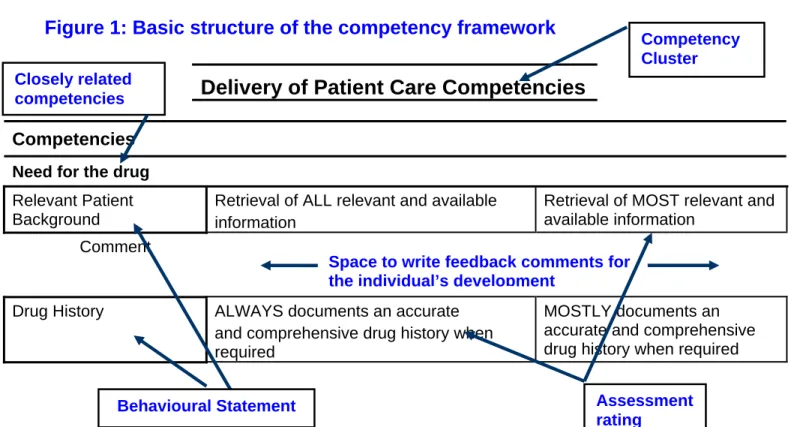
Each of these clusters contains closely related competencies. Using the Delivery of
patient care competency cluster as an example, the competencies in this area pertain
to:
o Patient consultation
o Need for the drug
o Selection of drug
o Drug specific issues
o Provision of drug product
o Medicines information and patient education
o Monitoring drug therapy
o Evaluation of outcomes Each of these competencies has:
o A number of statements, known as behavioural statements that define how that competency would be recognised.
o An assessment rating ranging from always, usually, sometimes or never. The basic structure is illustrated in Figure 1.
Figure 1: Basic structure of the competency framework
Delivery of Patient Care Competencies
Competencies Need for the drug
Relevant Patient Background
Retrieval of ALL relevant and available information
Retrieval of MOST relevant and available information
Comment
Drug History ALWAYS documents an accurate and comprehensive drug history when required
MOSTLY documents an accurate and comprehensive drug history when required
Competency Cluster
Assessment rating
Behavioural Statement
Space to write feedback comments for the individual’s development
Closely related competencies
Assessment Rating
The assessment rating is on a four-point scale of Never, Sometimes, Usually and Always.
Feedback from the evaluation in secondary care suggested the definitions below for the assessment ratings. Assessment should be referenced to the desired performance level that would be expected at a general level. This may vary between areas, trusts or organisations.
Rating Definitions Percentage
expression
Always Demonstrates the expected standard practice with
very rare lapses
85-100 %
Mostly Implies standard practice with occasional lapses 51-84 %
Sometimes Much more haphazard than “mostly” 21-50 %
Never Very rarely meets the standard expected. No
logical thought process appears to apply
0-20 %
Guidance notes on assessment
There are various acceptable methods of assessment using the framework. This includes assessment by another individual and self assessment. In the secondary care evaluation where there are several pharmacists both senior and junior, professional development was facilitated by structured assessment alongside annual appraisal. This included day to day observations; accompanied visits; using other staff to assess; and unusual clinical situations.
Day to day observations
In the secondary care evaluation this method of assessment was used in sites where junior pharmacists are supervised day-to-day by a more experienced member of staff; for example, ward based teams or a senior pharmacy manager. In community pharmacy this option might be useful in pharmacies with more than one pharmacist.
Accompanied visits
This option could be used if the assessor or facilitator do not have the opportunity to observe the pharmacist’s daily practice and hence need to make arrangements to accompany the pharmacist in their work. Assessment can be based on a number of briefer accompanied visits or during a period at work.
Two different types of accompanied visits were used successfully in the secondary care evaluation.
1. Assessment with learning
An interactive accompanied visit, which included an assessment component and a training component. In this situation, the assessor asked questions for clarification and to identify learning points.
2. Assessment only
This has been described as shadowing. Here the interaction between the assessor and practitioner was more limited (unless there was an issue of patient care to resolve). Feedback was reserved until the assessment was completed.
Using other staff to assess
The use of staff, other than the assessor, to assess competencies was found useful in the secondary care trial. This included other pharmacists, technicians, nurses, medical staff or other relevant personnel. The opinion of other staff may be particularly helpful in relation to problem solving and personal competencies. However, assessment should not be based solely on the reports of staff other than the designated assessors. The assessment should at least include some direct observation.
Unusual clinical situations
There were occasions during the assessments in secondary care when there were no patients to demonstrate a particular competency. In these circumstances, the assessor constructed a hypothetical scenario. For example for drug/patient interactions they might ask how the patient management would change if the patient was pregnant. The assessment is then based on their response.
Assessment in Primary Care
In primary care pharmacists generally work in professional isolation and thus direct assessment is less appropriate. In the primary care evaluation the pharmacists
completed a self assessment and identified their individual learning needs from this. A portfolio of evidence was used to demonstrate performance against the competencies. They received two visits during the evaluation from a facilitator who helped them in this process.
The sources of evidence collected to support self assessment form part of the pharmacists CPD. These can include:
• Plan and record documentation from the RPSGB’s CPD folder; • Case scenarios;
• Intervention records;
• Anonymised pharmaceutical care records;
• Any written documentation or procedures used in their practice; • Records relating to any continuing education undertaken;
• Documentation required by commissioners, employers or education and training providers.
Using the rating scale
The following is an example of how to assess an individual against the four-point scale.
Following an accompanied visit, it was seen that the individual sometimes identifies a drug-drug interaction, prioritises them appropriately and takes appropriate action when they discover it.
This would be assessed by:
Sometimes identify drug interaction Always prioritises appropriately Always appropriate action.
This highlights that they follow through appropriately but need further development on identifying the interactions.
Assessment Tools
The main assessment tool using this framework is the development of a portfolio of evidence linked to the behaviours.
As a result of ongoing implementation of the framework various other assessment tools have been developed (see Appendix 1). These are based on the tools used by junior doctors during their foundation training but are applicable for pharmacists in all sectors. They include:
• Self mini-PAT (Peer Assessment Tool) for general level pharmacists • Mini-CEX (Clinical Evaluation Exercise) for general level pharmacists • Case Based Discussions for general level pharmacists
The Medication Related Consultation Framework (MRCF) has been developed to support pharmacists in developing consultation skills1. The summary tool is available in Appendix 2.
All of the tools mentioned above are available on the CoDEG website (www.codeg.org).
Setting a performance standard
In the secondary care evaluation the individual hospital trusts set the desired performance levels that the general level pharmacist could be compared to. Wider implementation has led to groups of hospitals setting area/regional levels to encourage consistency. This has been possible because the service delivered by Band 6
pharmacists tends to be very similar between different hospital trusts.
1
Abdel Tawab, R.; Davies, J.G.; Horne, R. & James, D.H. Evaluating pharmaceutical consultations: a validation of the “Medication-related Consultation Framework (MRCF)”. The International Journal of Pharmacy Practice, Supplement 2005, 13: R27.
Although some competencies will have an obvious minimum performance level such as legal requirements, the diversity of roles of pharmacists in primary care (many
pharmacists have PCT/GP practice-based roles as well as community pharmacy roles) means it is not possible to set fixed levels for all the behaviours in the GLF. However, as a result of the primary care evaluation a consensus of performance levels for the Delivery of Patient Care and Management and Organisation clusters was achieved. In order to support users of this framework to consider desired performance levels, the levels used in the primary care evaluation were subsequently reviewed to ensure their suitability for secondary care. These are available on the CoDEG website
(www.codeg.org).
Using the Competency Framework to support CPD
The Framework can be used to support CPD (including linking the use of the GLF with RPSGB Plan and Record). It is recommended that a portfolio of evidence is used to demonstrate competence against the behaviours in the framework that are relevant to an individual pharmacist’s role. The section before each cluster in this handbook describes the interpretation of the competency and related behavioural statements. These will assist in completing the steps below. The steps were successfully used to support users of the GLF who took part in the primary care evaluation and have been adapted to ensure relevance for both sectors.
STEP 1 Set the Scene
Familiarise yourself with the relevant competencies and behavioural statements (including their general interpretation) in the GLF
Review the recording of CPD using the RPSGB Plan and Record process
STEP 2 Determine the a)desired and b)current level of performance
For each of the behavioural statements in Step 1 consider the following questions:
a What do I understand by this behavioural statement? How does this behaviour relate to my job?
What is the desired performance level reasonable for my area of practice? For some behaviours this may be defined by Regulatory, Professional or Organisational standards.
(If you are not sure about this for specific behaviours, you may wish to discuss this with colleagues, mentors or your manager as appropriate). b What method(s) might I use to determine where my current performance
lies?
Who might I involve in this process?
What evidence can I collect and document to support my current performance?
Am I achieving the desired performance level?
statements. Don’t worry if you don’t complete all the behavioural statements at once. It is far better to think through a few behaviours through in detail than glossing over many.
STEP 3 Identify your learning and development needs:
1. Consider the behavioural statements where your current performance is
to the right of (therefore below) the desired performance level.
2. These determine your learning and development needs for these competency areas.
3. To start with, choose a behaviour that You would be most comfortable with, and
will be straightforward to determine your learning and development need within your working environment
Each behaviour could result in a separate entry for your CPD or alternatively you may find that one learning objective covers more than one behaviour/competency.
You can add competencies to the RPSGB list if necessary
Record each learning need in the Reflection section of Plan and Record.
STEP 4 Planning and action: Filling the Gap
1. Once you have determined the learning and development need plan how you might meet that need. This forms your action plan.
Write SMART objectives: Specific, Measurable, Achievable, Realistic,
Timely.
Determine an appropriate learning method that is realistic within the likely resource constraints in your workplace and your preferred learning style.
You may find it easier to split them into short (1-4 months), medium (4-8 months) or long term entries ((4-8-12 months). This will help you build your CPD record over a year (or time period that suits your CPD) and allow entries to coincide with planned events such as formal appraisals or CPD submission deadlines.
2. Complete the action you have decided on for each learning need.
Complete the Planning and Action sections of Plan and Record for each learning need.
STEP 5 Evaluate and Demonstrate
1. Complete the Evaluation section of Plan and Record for each CPD entry. 2. You will need to provide written evidence to demonstrate your
achievement of, or movement towards, the desired performance level for the relevant competency/behavioural statements in your CPD plan. Examples of evidence include:
Case studies (i.e. prescription interventions, advice to patients or other heath professionals) that relate to specific competencies and behavioural statements. Use the record of evidence form to record these;
Protocols, procedures, and other examples of systems you have put in place as a result of a learning action;
Audits and surveys completed;
Formal Postgraduate training assessments;
Evidence required by commissioners or employers (e.g. evidence required by PCTs for delivering the Community Pharmacy Contract);
are insufficient as evidence alone as they do not describe the application of the knowledge/skills gained
For each source of evidence, you will find it easier to state the competency and behavioural statements the example relates to. One source of evidence can cover more than one behaviour across more than one competency area. If this is the case you will need to be able to explain this to your facilitator.
There is no set style or length required for the evidence for your record. Simple summaries that provide a focus for further discussion with your facilitator are fine.
Adapted with kind permission from © London Pharmacy Education & Training Using the Competency Framework to support Continuing Professional Development
Delivery of Patient Care Competencies
Patient Consultation
This competency incorporates the structure and processes needed to provide a patient with advice. This advice may be part of a request for the treatment of symptoms, whether coming from an in-patient or an out-patient in hospital or in the community. The personal skills needed for effective communication in this process are described in the personal competencies cluster. The Society has produced guidance on the process of responding to symptoms2. This approach is relevant irrespective of the sector of practice. There must be a system in place to support quality and consistency whilst allowing the user to bring in their own knowledge and experience. An appropriate system could also aid data collection and audit.
The delivery of a patient consultation is linked to the communication skills and behaviours in the Personal Cluster of this framework. Consultations should embrace the concept of concordance. The National Prescribing Centre have produced a framework to support achieving shared decision-making with patients about their medicines3.
The pharmacist should demonstrate a structured, patient-centered process of consultation with patients and carers.
Assessment of the patient consultation competency could be facilitated using the Medicines Consultation Framework. Appendix 2 includes a summary assessment tool. The full tool is available on the CoDEG website (www.codeg.org).
Patient Assessment The pharmacist should:
Recognise and interpret the condition. This includes exploring the following:
The identity of the patient;
The nature and duration of the symptoms;
2
Guidance on Counter Prescribing. Pharm J 2000; 265: 359
3
Other symptoms that may be associated with the condition (where appropriate observe other signs, visible or otherwise;
Concurrent or recent medication to exclude adverse drug reactions.
The following should always be referred:
Symptoms that are potentially serious;
Persistent symptoms;
Patients at increased risk;
Take particular care when dealing with:
Babies;
Infants and children;
Pregnant women;
Breast feeding mothers;
Older people;
The pharmacist should:
Determine the goal of treatment which might be one of the following:
Curing a disease or disorder;
Reducing or eliminating a symptom;
Arresting or slowing disease progression;
Preventing a disease;
A combination of any of the above;
Recommend a treatment, taking into account the patient’s own health beliefs and preferences. The action taken might be one of the following:
Give self-care advice and/or reassurance without recommending a medicine or other treatment;
Recommend a medicine or treatment;
Refer to someone else;
Provide advice. The following information should be provided where appropriate:
Information on why a particular course of action is being suggested and how to achieve the intended outcomes;
Information on the condition as assessed during the consultation and any changes that need to be monitored;
Information on the medicine or treatment recommended and how to use it;
Advice on when it would be appropriate to seek further advice from either the pharmacist or someone else if the condition does not improve;
A combination of any of the above.
Consultation or referral
The general level pharmacist should be aware of their own limitations and always consult a colleague if necessary or refer the patient appropriately. During a specific episode of care the decision to continue with the consultation or to refer may occur at anytime. For example at the outset as the health need is inappropriate for pharmacist management, or at the end once identified medicines problems have been prioritised and referral is the appropriate action. Referral could be to another health professional or to a more senior colleague. Referral may also involve signposting patients to other services or organisations.
The referral and consultation process should form part of continuing professional development and it is expected that during the course of an individuals work, repeated exposure to similar pharmaceutical problems will result in development of the general level pharmacist’s experience and competence.
Recording Consultations
In order to allow monitoring of the treatment that has been recommended and allow audit of care, a record of the consultation should be made in appropriate cases in the patient’s records. Many community pharmacy IT systems now allow pharmacists to record these electronically.
Patient Consent
As pharmacists develop new roles and provide additional services they will require a greater understanding of the issues surrounding consent. This has an increasing focus
for NHS services4. There are already key areas of practice where consent is obtained e.g. sharing of patient information, recording of patient information in patient medication records (PMR). Additional services such as screening or monitoring for chronic diseases, medication review, and prescribing and patient group directions (PGD) usage all require patient consent.
Need for the drug
Relevant patient background
In providing pharmaceutical care for a patient it is essential that background information about the patient’s health and social status is identified. Without this information it is difficult to establish the existence of, or potential for, medication related problems. Review of prescriptions without this information risks flawed judgements on the appropriateness of therapy for that individual. The detail required will vary depending on the circumstances. Sources of patient information include medical, nursing and electronic records, as well as directly from the patient or carer themselves.
Details required may include:
Age – the very young and the very old are most at risk of medication related problems. A patient’s age will indicate their likely ability to metabolise and excrete medicines and therefore have implications for appropriate selection of drug dosage.
Gender – may impact on the choice of therapy for certain conditions.
Ethnic background/religion – pharmaceutical implications of this information include racial pre-dispositions to intolerance or ineffectiveness of drug classes. For example ACE-inhibitors in Afro-Caribbean individuals, or, the unsuitability of drug formulations such as blood products in Jehovah’s Witness patients or porcine derived products for Jewish patients.
Social background – this may impact on their ability to manage their medicines and may influence their pharmaceutical care needs. For example what are their home circumstances? Do they live in their own home or in residential accommodation? Do they have a visiting district nurse or carer?
4
Presenting condition - need to establish what symptoms the patient described and the signs identified by the doctor on examination. Could they be attributed to the side-effects of prescribed or purchased medicines?
Working diagnosis - of the medical team treating the patient. How would you expect this condition to be managed? What drug therapy would be considered appropriate and evidenced based? This will give you an indication as to the classes of medications you expect to see on the prescription (this could be in the form of a drug chart in hospital or a prescription in the community).
Previous medical history - establishing concurrent medical conditions will help you to ensure that management of the acute newly diagnosed problem does not compromise a prior condition, and guide the selection of appropriate therapy by identifying potential contraindications.
Relevant laboratory or other physical findings of the medical examination? (If available) - focus on findings that will affect drug therapy, including:
o Renal function
o Liver function
o Full blood count
o Blood pressure
o Cardiac rhythm
Consider not only the impact that these findings could have on the ongoing management of drug therapy, e.g. need for dose adjustments, but also whether these results could have been caused by an unwanted drug effect.
Establishing this background information will allow you to make more accurate assessment of the appropriateness of recommendations.
Obtaining relevant information will depend on your sector of practice. Routine review of medical notes (if available) may be inappropriate and unnecessary for the retrieval of basic information, and the most concise information source should be used. Possible sources of information include:
Patients – patients are often able to provide information, particularly in relation to medicine taking, although some skill is required in terms of managing the
consultation to avoid becoming sidetracked. However, there are times when they are the only accurate source for the information you require.
Medical notes – will provide the most detailed description of the patient’s care to date, although they are often lengthy and repetitive and should therefore be used to confirm findings rather than as a first source of reference. Increasingly medical notes will be available electronically and routinely accessible by pharmacists. Previous hospital admissions and subsequent discharge summaries are often useful to clarify medication histories.
Pharmacy based information – e.g. Patient Medication Records (PMR). In community pharmacy an up to date PMR is the most accessible and relevant source of information about the patient’s medication history.
Nursing ‘Kardex’ – In a hospital setting, this is usually an excellent basic summary of the patient’s admission details and should be used as the first source of information. It is concise and accessible and will provide all of the key features identified above, with the possible exception of laboratory findings, although abnormal results are often commented upon. In primary care, if pharmacists provide domiciliary visits, then nursing care plans are normally found in the patient’s home if they are being treated by community nurses.
Nurses (including practice and district nurses) – are the frontline care providers for the patients in hospital and increasingly in primary care. Hence, developing a good working relationship with the nurses is a valuable exercise. In hospital a daily handover from the nursing team can prove to be an excellent source on information about the patient’s current condition.
Allied health care professionals - e.g. physiotherapists, social services care workers or occupational therapists maybe involved in the patient’s medicines management e.g. assessing compliance and recommending compliance aids. Laboratory results systems
If laboratory results are readily available, the general level pharmacist should ensure that they have personal access and have been trained in retrieving correct patient information from the database.
Finally, remember that all patient information that comes to your attention is CONFIDENTIAL and should not be discussed with anyone not involved in that patient’s care.
Drug history
Taking a complete drug history may not always form part of the service the pharmacist is delivering. However, pharmacists need to be aware of the patient’s medications. This process is included in the patient assessment behaviour in the patient consultation competency above.
It is important to distinguish between a complete drug history and reconciliation of medicines. Medicines reconciliation is defined by the Institute of Healthcare
Improvement as ‘the process of identifying the most accurate list of a patient’s current medicines – including name, dosage, frequency and route – and comparing it to the current list in use, recognising any discrepancies and documenting any changes, thus resulting in a complete list of medicines, accurately communicated.’
Complete Drug History: a clinical process that includes identification of drug allergies or serious ADRs; information gathering from the patient; and documentation of information. It forms part of medication review and admission into hospital.
Taking accurate and complete drug histories has been shown to have a beneficial effect on patient care5,6. Pharmacists have demonstrated that they can accurately and reliably take drug histories7. The benefit to the patient is that errors of omission or transcription are identified and corrected early, reducing the risk of harm and improving care2.
5Beers MH, Munekata M, Storrie M. The accuracy of medication histories in the hospital medical records of elderly person. J Am Geriatr Soc. 1990;38:1183-7.
6
Nester TM, Hale LS. Effectiveness of a pharmacist-acquired medication history in promoting patient safety. Am J Health-Syst Pharm 2002;59(22):2221-5.
7
Gurwich EL. Comparison of medication histories acquired by pharmacists and physicians. Am J Hosp Pharm. 1983;40:1541-2.
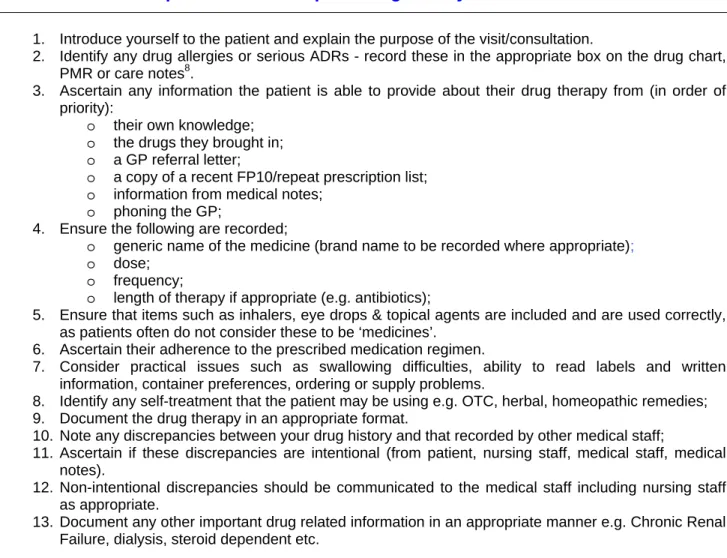
Queries regarding drug therapy should be clarified with the prescriber, or referred to a more senior pharmacist. Table 1 describes the core components of a drug history, although individual organisations may have additional components they wish to routinely include (refer to local guidelines).
Table 1. Core components of a complete drug history
1. Introduce yourself to the patient and explain the purpose of the visit/consultation.
2. Identify any drug allergies or serious ADRs - record these in the appropriate box on the drug chart, PMR or care notes8.
3. Ascertain any information the patient is able to provide about their drug therapy from (in order of priority):
o their own knowledge;
o the drugs they brought in;
o a GP referral letter;
o a copy of a recent FP10/repeat prescription list;
o information from medical notes;
o phoning the GP;
4. Ensure the following are recorded;
o generic name of the medicine (brand name to be recorded where appropriate);
o dose;
o frequency;
o length of therapy if appropriate (e.g. antibiotics);
5. Ensure that items such as inhalers, eye drops & topical agents are included and are used correctly, as patients often do not consider these to be ‘medicines’.
6. Ascertain their adherence to the prescribed medication regimen.
7. Consider practical issues such as swallowing difficulties, ability to read labels and written information, container preferences, ordering or supply problems.
8. Identify any self-treatment that the patient may be using e.g. OTC, herbal, homeopathic remedies; 9. Document the drug therapy in an appropriate format.
10. Note any discrepancies between your drug history and that recorded by other medical staff;
11. Ascertain if these discrepancies are intentional (from patient, nursing staff, medical staff, medical notes).
12. Non-intentional discrepancies should be communicated to the medical staff including nursing staff as appropriate.
13. Document any other important drug related information in an appropriate manner e.g. Chronic Renal Failure, dialysis, steroid dependent etc.
Selection of Drug
This relates to the principles of evidence-based medicine, clinical and cost-effectiveness in the selection of the most appropriate drug, dose and formulation for an individual patient. General level pharmacists are not expected to know the full breadth of clinical evidence for all conditions, but should familiarise themselves with and be able to demonstrate appreciation of key literature relevant to their current field of practice. For example for respiratory conditions they should know the BTS/SIGN guidelines on the management of asthma, COPD etc. Pharmacists should also be
aware of local trust formularies. Postgraduate education and continuing professional development should be guided by learning needs identified in practice.
Drug-drug interactions
General level pharmacists are expected to:
Identify common, well-documented, actual drug interactions.
Be able to recognise those drugs with increased risk of potential interactions such as
drugs with narrow therapeutic indices
drugs metabolised by the CYP450 system
drugs which are inducers or inhibitors of the CYP450 system
Assess the actual or potential interaction for clinical significance, management options and refer appropriately.
Drug-patient interactions
This refers to individual, patient specific reactions and contra-indications/cautions to medicines in certain patient groups such as children and pregnancy. A general level pharmacist should:
Understand the potential for unwanted effects of medicines e.g. allergies and other adverse drug reactions (ADR’s).
Ensure that any allergy or ADR is identified and documented;
Review the prescription to ensure that no culprit medicines have been prescribed; Take appropriate action to ensure that no harm comes to the patient.
Drug-disease interactions
This refers to the contra-indications/cautions that should be applied to the use of individual drugs in a range of pathophysiological conditions. A general level pharmacist should be able to:
Understand the mode of action and pharmacokinetics of medicines;
Understand how these mechanisms may be altered by the disease e.g. renal impairment;
Understand how these mechanisms may be altered by genetic determinants e.g. beta blockers in patients of Afro-Caribbean origins;
Drug specific issues
The pharmacist should ensure that the medicine as prescribed can be administered safely and effectively to the individual patient. The pharmacist should:
Assess the prescription to ensure that the dose is appropriate. This includes adjustments for route and formulation prescribed. For example IV versus PO metronidazole, IM versus PO anti-psychotics, liquid versus solid dosage forms. Consider whether the prescribed route is available (is the patient nil by mouth?
Are they able to take medicines orally?) and appropriate for that patient (e.g. unnecessary prescription of IV medication when the patient can swallow, or a solid dosage form when the patient has dysphagia);
Consider whether the medicine is available in a suitable form for administration via the prescribed route?
Consider whether the nurses or care staff require any specific information in order to administer the medicine safely. For example appropriateness of crushing tablets, dilution requirements for parenteral medication, rate of administration, iv compatibilities including syringe drivers;
Consider whether aids are required to ensure safe and effective administration e.g. volumatics for inhalers;
Complete documentation to ensure the safe and effective administration of the medicine.
Particular attention should be paid to the monitoring of parenteral therapy, which carries the additional risk of extravasation, infection and administration errors.
Provision of drug product
The pharmacist is responsible for the efficient supply of medicines to patients. When supplying a medicine for an individual patient the pharmacist should:
Ensure the prescription is clear, unambiguous and legal in the country it is being dispensed in. Pharmacists may need to take into account the different rules in England, Scotland and Wales (e.g. drug tariff and exemptions);
Consider the availability of the drug within the hospital or community (i.e. formulary, drug tariff and local shared care policy);
Consider whether the prescribed indication is within the medicine’s license (unlicensed drugs procedure);
Follow local guidelines to obtain unlicensed and non-formulary medicines and ensure that appropriate documentation is completed;
Communicate clearly with the relevant people to ensure the efficient and safe supply of medicines;
Ensure continuity of supply for in-patient use, discharge and in the community; Document supply issues clearly on the drug chart or prescription and ensure that
all instructions are clear. In secondary care endorsement of drug chart should follow local trust guidelines;
Ensure medicines are labelled accurately e.g. with clear dosage instructions. Consider products with similar names or packaging, patients with similar names, and dispensing for many family members at the same time;
Ensure medicines are labelled appropriately for the patient e.g. the visually impaired, non English speakers.
Patient information and education
It is expected that the pharmacist will provide medicine and health information and advice, both to patients, carers and medical staff. This may be in response to information requested by an individual, but the pharmacist should also seek actively, opportunities to provide this aspect of the pharmacy service.
Public Health
Pharmacists should actively explore the patient’s need for lifestyle advice such as diet, smoking and exercise. The contribution that pharmacists can make to public health are detailed in ‘Choosing Health Through Pharmacy’ (Department of Health 2005). This includes brief opportunistic advice. A wide range of resources to support pharmacists’ involvement in public health are available at http://www.pharmacymeetspublichealth.org/. An awareness of local services and initiatives and the referral process in primary care or discharge planning is essential.
Health Needs
The pharmacist must take into account the patient’s cultural, language and social background when assessing their health need. This will influence their health beliefs and may affect the style of communication adopted.
Need for information is identified
It is important that the pharmacist is aware of differing individual needs for information and facilitates its provision in an appropriate format. Pharmacists should be cautious about providing information to patients in a ‘blanket’ format. This may not be appropriate for patients who have been on a medicine long term and require specific information relevant to their situation – this will not be established unless the pharmacist allows the patient an opportunity early in the consultation to ask their own questions.
Medicines Information
The pharmacist should ensure the accuracy of the medicine information they provide, utilise appropriate resources and consult with appropriate colleagues if unsure. The information should then be delivered in a manner appropriate to the recipient. Jargon should be avoided when speaking to patients, but caution is required not to cause confusion by trying to over simplify information – some warfarin patients will have no more idea about the state of their blood if it is described as ‘too thin’ or ‘too thick’ or the implications for their health, than if given a list of the clotting factors that warfarin inhibits.
Provision of written information
Where necessary the pharmacist may provide written medicine information.
A product information leaflet must be provided with dispensed medicines. This is now a legal requirement and all manufacturers produce them.
Health information leaflets are produced by many national organisations such as Diabetes UK and the British Heart Foundation. Pharmacists should be aware of and provide these valuable resources.
Patients may need specific information such as a medicines reminder chart. The individual preparing the information should ensure that the print is legible, of an appropriately sized font, and that the information is accurate. Written
information should be signed and dated to facilitate the response to any subsequent queries.
Monitoring drug therapy
Once a drug has been appropriately selected for a patient, supplied and administered, ongoing use of the drug should be assessed, both for the desired therapeutic effect and the appearance of adverse reactions. Therapeutic drug monitoring (TDM) is an essential duty for hospital pharmacists. Pharmacists in primary care will increasingly have access to this information electronically and will need to be aware of its importance, how to interpret it and take appropriate action.
Identification and prioritisation of medicines management problems
The pharmacist should be able to identify patients for whom ongoing monitoring of therapy is required. They should be able to identify monitoring parameters for effectiveness of treatment and potential adverse effects of drug therapy and establish and maintain a plan for reviewing the therapeutic objective/end point of treatment. This may be necessary due to characteristics of the medicine or particular patient needs.
Drug characteristics
1. The pharmacist should Identify patients prescribed drugs with narrow therapeutic indices and be familiar with the monitoring parameters for these drugs. These include:
Warfarin (there are recent NPSA recommendations on the management of patients on warfarin. Further information is available at www.npsa.nhs.uk;
Digoxin; Phenytoin; Carbamazepine; Vancomycin; Gentamicin; Theophylline; Lithium ; Unfractionated heparin.
2. For drugs amenable to TDM and where the information is available, calculate predicted levels if no patient serum concentrations are available;
3. Identify monitoring parameters for ongoing disease management such as BP and cholesterol;
4. Evaluate the patient against these parameters; 5. Recommend appropriate monitoring to medical staff; 6. Discuss with a colleague if necessary;
7. Discuss changes to medication with medical staff if required.
Patient characteristics
The pharmacist should be able to recognise those patients who will require ongoing pharmaceutical input because of their clinical condition. For example, concomitant:
Renal impairment; Hepatic impairment; or, An unstable clinical condition.
The pharmacist should be able to prioritise the medicines management problems of both individual patients and the group of patients for whom they are responsible.
Use of guidelines
A general level pharmacist should be able to demonstrate an awareness of guidelines available for the clinical field in which they are practicing. Pharmacists should also know the practical implications of these guidelines. Guidelines may be local policies or national guidelines from established groups (e.g. British Thoracic Society guidelines for respiratory diseases, National Service Frameworks, NICE guidance, Trust nil by mouth policy or peri-operative sliding scales guidelines on surgical wards).
The pharmacist should be able to utilise guidelines and be aware of both the advantages and disadvantages of their use, and show regard for individual patient need when using guidelines.
Resolution of medicines management problems
Having identified and prioritised medicines management problems, the pharmacist should ensure that an appropriate action to this problem is identified and implemented. If resolution requires the input of a number of staff, the action required and the urgency of that action must be accurately communicated to the relevant personnel. At all times, the pharmacist must ensure that no harm comes to the patient.
Record of Contributions
In order to allow monitoring of the treatment that has been recommended and allow audit of care, a record of the consultation should be made in appropriate cases in the patient’s records. These can be manual or electronic.
Where relevant, the general level pharmacist should document information to support their contribution to patient care and ensure information is available to other members of staff.
Evaluation of outcomes
Reflection and evaluation of practice is essential if an individual pharmacist is going to undertake effective work based learning. Contributions to care should be recorded and followed up where possible to establish the outcomes of individual actions. It may not be appropriate or possible for a general level pharmacist to follow the care of an individual patient every time, but effective communication with colleagues will often establish outcomes.
There are different mechanisms for assuring evaluation of contributions:
− Actual feedback from patient, carer, or health professional on a specific issue/service
− Reflecting on service delivery or patient encounter and as a result identifying a service improvement need or a learning need from it.
The pharmacist should be able to demonstrate that they reflect on their contributions and learn from the outcomes.
A Competency Framework for Pharmacy Practitioners: London, Eastern and South East General level Specialist Pharmacy Services
Delivery of Patient Care
Competencies Rating
a = Initial self assessment b = Four month facilitation c = Eight month facilitation d = Twelve month self assessment
© LM/DF/ DMcR/JGD/DW/JQ/SA Primary Care Evaluation Draft July 2004 36
Patient Consultation
a b a b a b a b
Patient Assessment
ALWAYS uses appropriate questioning to obtain relevant information from the patient
c d
USUALLY uses
appropriate questioning to obtain all relevant information from the patient
c d
SOMETIMES uses appropriate questioning to obtain all relevant information from the patient
c d
Does NOT use appropriate questioning to obtain all relevant information from the patient c d Comment a b a b a b a b Consultation or referral Pharmaceutical or health problems are ALWAYS
appropriately referred c d
Pharmaceutical or health problems are USUALLY
appropriately referred c d
Pharmaceutical or health problems are SOMETIMES
appropriately referred c d
Does NOT appropriately refer pharmaceutical or health problems c d Comment a b a b a b a b Recording Consultations ALWAYS documents consultation where appropriate in the patient’s
records c d
USUALLY documents consultation where appropriate in the patient’s
records c d
SOMETIMES documents consultation where appropriate in the patient’s
records c d
Does NOT document consultation where appropriate in the patient’s
records c d
Comment
a b a b a b a b
Patient consent
ALWAYS satisfactorily obtains patient consent if
appropriate c d
USUALLY satisfactorily obtains patient consent if
appropriate c d
SOMETIMES satisfactorily obtains patient consent if
appropriate c d
NEVER satisfactorily
obtains patient consent c d
A Competency Framework for Pharmacy Practitioners: London, Eastern and South East General level Specialist Pharmacy Services
Delivery of Patient Care
Competencies Rating
a = Initial self assessment b = Four month facilitation c = Eight month facilitation d = Twelve month self assessment
© LM/DF/ DMcR/JGD/DW/JQ/SA Primary Care Evaluation Draft July 2004 37
Need for the drug
a b a b a b a b
Relevant Patient Background
Retrieval of ALL relevant
and available information c d
Retrieval of MOST relevant
and available information c d
Retrieval of SOME relevant
and available information c d
Does NOT retrieve relevant or available information c d Comment a b a b a b a b Drug History ALWAYS documents an accurate and comprehensive drug
history when required c d
MOSTLY documents an accurate and
comprehensive drug
history when required c d
SOMETIMES documents an accurate and comprehensive drug
history when required c d
Does NOT document a
drug history for any patient c d
Comment
Selection of drug
a b a b a b a b
Drug-drug interactions
are ALWAYS identified c d
Drug-drug interactions
are USUALLY identified c d
Drug-drug interactions are SOMETIMES
identified c d
Does NOT identify any
drug-drug interactions c d a b a b a b a b Drug-drug interactions are ALWAYS appropriately prioritised c d Drug-drug interactions are USUALLY appropriately prioritised c d Drug-drug interactions are SOMETIMES appropriately prioritised c d
Does NOT prioritise any
drug-drug interactions c d
a b a b a b a b
Drug – drug interactions
Appropriate action is ALWAYS taken c d Appropriate action is USUALLY taken c d Appropriate action is SOMETIMES taken c d
Does NOT take any
appropriate action c d
A Competency Framework for Pharmacy Practitioners: London, Eastern and South East General level Specialist Pharmacy Services
Delivery of Patient Care
Competencies Rating
a = Initial self assessment b = Four month facilitation c = Eight month facilitation d = Twelve month self assessment
© LM/DF/ DMcR/JGD/DW/JQ/SA Primary Care Evaluation Draft July 2004 38
Selection of Drug a b a b a b a b Drug-patient interactions are ALWAYS identified c d Drug-patient interactions
are USUALLY identified c d
Drug-patient interactions are SOMETIMES
identified c d
Does NOT identify any
drug-patient interactions c d a b a b a b a b Drug-patient interactions are ALWAYS appropriately prioritised c d Drug-patient interactions are USUALLY appropriately prioritised c d Drug-patient interactions are SOMETIMES appropriately prioritised c d
Does NOT prioritise any
drug-patient interactions c d a b a b a b a b Drug – patient interactions Appropriate action is ALWAYS taken c d Appropriate action is USUALLY taken c d Appropriate action is SOMETIMES taken c d
Does NOT take any
appropriate action c<