NASA/TM-2016-219358
Machine Learning Technologies and Their
Applications for Science and Engineering
Domains Workshop
– Summary Report
Manjula Ambur
Langley Research Center, Hampton, Virginia
Katherine G. Schwartz
Georgia Institute of Technology, Atlanta, Georgia
Dimitri N. Mavris
Georgia Institute of Technology, Atlanta, Georgia
December 2016
NASA STI Program . . . in Profile
Since its founding, NASA has been dedicated to the advancement of aeronautics and space science. The NASA scientific and technical information (STI) program plays a key part in helping NASA maintain this important role.
The NASA STI program operates under the auspices of the Agency Chief Information Officer. It collects, organizes, provides for archiving, and disseminates NASA’s STI. The NASA STI program provides access to the NTRS Registered and its public interface, the NASA Technical Reports Server, thus providing one of the largest collections of aeronautical and space science STI in the world. Results are published in both non-NASA channels and by NASA in the NASA STI Report Series, which includes the following report types:
• TECHNICAL PUBLICATION. Reports of completed research or a major significant phase of research that present the results of NASA
Programs and include extensive data or theoretical analysis. Includes compilations of significant scientific and technical data and information deemed to be of continuing reference value. NASA counter-part of peer-reviewed formal professional papers but has less stringent limitations on manuscript length and extent of graphic presentations.
• TECHNICAL MEMORANDUM. Scientific and technical findings that are preliminary or of specialized interest, e.g., quick release reports, working
papers, and bibliographies that contain minimal annotation. Does not contain extensive analysis.
• CONTRACTOR REPORT. Scientific and technical findings by NASA-sponsored contractors and grantees.
• CONFERENCE PUBLICATION.
Collected papers from scientific and technical conferences, symposia, seminars, or other meetings sponsored or co-sponsored by NASA.
• SPECIAL PUBLICATION. Scientific,
technical, or historical information from NASA programs, projects, and missions, often
concerned with subjects having substantial public interest.
• TECHNICAL TRANSLATION. English-language translations of foreign scientific and technical material pertinent to NASA’s mission.
Specialized services also include organizing and publishing research results, distributing specialized research announcements and feeds, providing information desk and personal search support, and enabling data exchange services. For more information about the NASA STI program, see the following:
• Access the NASA STI program home page at http://www.sti.nasa.gov
• E-mail your question to [email protected]
• Phone the NASA STI Information Desk at 757-864-9658
• Write to:
NASA STI Information Desk Mail Stop 148
NASA Langley Research Center Hampton, VA 23681-2199
NASA/TM-2016-219358
Machine Learning Technologies and Their
Applications for Science and Engineering
Domains Workshop
– Summary Report
Manjula Ambur
Langley Research Center, Hampton, Virginia
Katherine G. Schwartz
Georgia Institute of Technology, Atlanta, Georgia
Dimitri N. Mavris
Georgia Institute of Technology, Atlanta, Georgia
National Aeronautics and Space Administration Langley Research Center Hampton, VA 23681
Available from:
NASA STI Program / Mail Stop 148 NASA Langley Research Center
Hampton, VA 23681-2199
Acknowledgments
The authors gratefully acknowledge the fifteen presenters/experts from Universities and Industry for their time and effort in enthusiastically participating in the workshop and the ensuing discussions. Our thanks to the BDAMI team members Jeremy Yagle, Robert Milletich, Ted Sidehamer, Stephen Casey, Evana Gizzi, Macarena Ortiz, Daniel Sammons, and Zachary Ernst for their help in organizing the workshop and their thoughtful inputs to the next steps section for this effort. The development and application of machine learning techniques by the BDAMI team would not have been possible without the strong collaboration and continued support from the subject matter experts from the mission organizations; we sincerely thank the following for their valued contributions - Danette Allen; Damodar Ambur; Dale Arney; Trey Arthur; Erik Axdahl; Randy Bailey; Kris Bedka; Eric Burke; Jeff Cerro; Kyle Ellis; Christie Funk; Dana Hammond; Angela Harrivel; Jeff Herath; Jon Holbrook; Patty Howell; Lisa Le Vie; Constantine Lukashin; Louis Nguyen; Jeremy Pinier; Alan Pope; Brandi Quam; Laura Rogers; Cheryl Rose; Jamshid Samareh; Mark Sanetrik; Rob Scott; Lisa Scott-Carnell; Steve Scotti; Patrick Shea; Walt Silva; Mia Sicohi; Chad Stephens; Scott Striepe; Patrick Taylor; Marty Waszak; Bill Winfree; Kristopher Wise. We have special appreciation for the following subject matter experts for their valuable time and full engagement in the workshop discussions and providing insightful inputs in their specific domains for next steps section – Chris Rumsey, Lisa Le Vie, Patrick Taylor, Bill Kimmel and Alan Pope. Bianca Clark from the National Institute for Aerospace was instrumental in communicating, setting up and managing the website, and the logistics to bring the speakers from different parts of the country and we thankfully acknowledge her efforts. The authors and the BDAMI team thank the Reid Center team, especially Andrea McGruder for their help with arrangements at the Pearl Young and Reid Center for this three-day workshop. Last but not the least, we are indebted to Marty Waszak for his encouragement and Convergent Aeronautics Solutions/CAS Project funding support to conduct this workshop.
The use of trademarks or names of manufacturers in this report is for accurate reporting and does not constitute an official endorsement, either expressed or implied, of such products or manufacturers by the National Aeronautics and Space Administration.
Contents
Executive Summary………..……….1
Overview of NASA Langley Comprehensive Digital Transformation (CDT) Initiative ... 3
NASA Langley
Big Data and Machine Intelligence Capabilities and Workshop Goal………6
Summaries of Workshop Presentations and Discussions ... 10
Key Workshop Themes ... 27
Next Steps – Expert’s inputs: The role of machine learning and big data in NASA’s future ... 30
Executive Summary
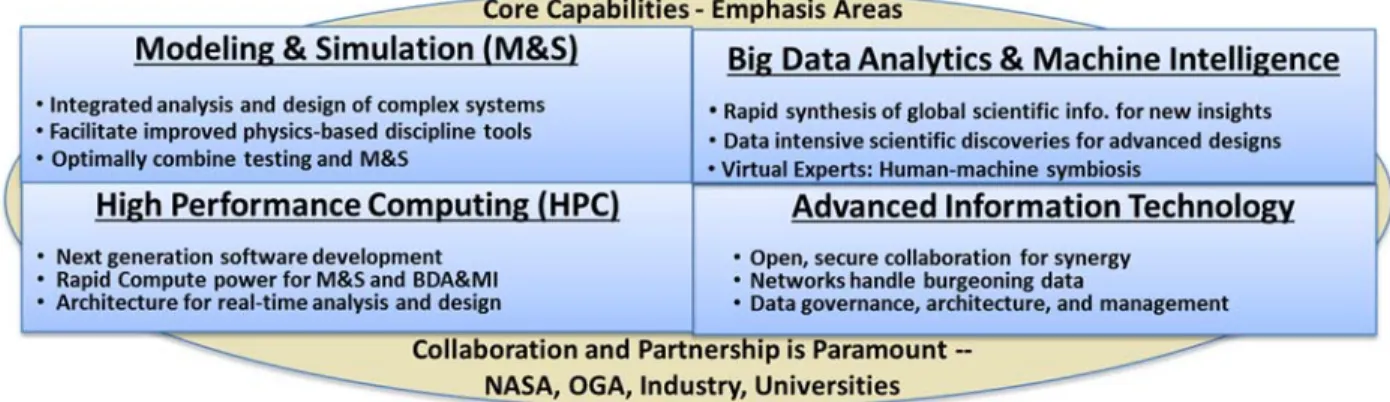
The fields of machine learning and big data analytics have made significant advances over the past several years and have been demonstrating potential to transform how the traditional disciplines of science and engineering are conducted. The new, advanced methods combined with rapidly evolving computational capabilities, has created an environment where cross-fertilization of methods and unique collaborations can achieve previously unattainable outcomes. NASA Langley Research Center has recognized these changes in the technical and scientific communities and created the Comprehensive Digital Transformation (CDT) initiative that focuses on the development and synergistic integration of four main pillars: advanced modeling and simulation, machine learning and big data analytics, high performance computing, and advanced IT infrastructure.
The CDT Machine Learning and Big Data Analytics team planned a workshop held at NASA Langley in August 2016 to bring together leading experts the field of machine learning and NASA scientists and engineers. The primary goal for this workshop was to assess the state-of-the-art in this field, introduce these leading experts to the aerospace and science subject matter experts, and develop opportunities for collaboration. The workshop was held over a three day-period with lectures from 15 leading experts followed by significant interactive discussions. The invited lecturers and their lecture topics were:
• Dr. Sebastian Pokutta, Georgia Institute of Technology
Machine Learning in Engineering: Applications and Trends • Dr. Ella Atkins, University of Michigan
New Data Sources to Revolutionize UAS Situational Awareness and Minimize Risk • Dr. Chris Codella, IBM, Watson Group
Cognitive Computing and IBM Watson in Research, Operations, and Medicine • Dr. Tsengdar Lee, NASA Science Mission Directorate
NASA Earth Science Knowledge Network • Dr. Barnabas Poczos, Carnegie Mellon University
Applied Machine Learning for Design Optimization in Cosmology, Neuroscience and Drug Discovery
• Dr. Lyle Long, Pennsylvania State University
Toward Human-Level (and Beyond) Artificial Intelligence • Dr. Una-May O’Reilly, MIT
Machine Learning: Data Driven Artificial Intelligence • Dr. Matthias Scheutz, Tufts University
Intelligent Agents: One-Shot Learning through Task-Based Natural Language Dialogues • Dr. Dimitri Mavris, Georgia Institute of Technology
Application of Machine Learning for Aircraft Design • Dr. Karthik Duraisamy, University of Michigan
Data-driven Turbulence Modeling: Current Advances and Future Challenges • Dr. Heng Xiao, Virginia Polytechnic Institute and State University
A Physics-Informed Machine Learning Framework for RANS-Based Predictive Turbulence Modeling
Materials Informatics: Mining and Learning from Data for Accelerated Design and Discovery
• Dr. Jaime Carbonell, Carnegie Mellon University
Machine Learning and Data Analytics for Aircraft Design and Operation: CMU and Boeing Partnership
• Dr. Vipin Kumar, University of Minnesota
Big Data in Climate: Opportunities and Challenges for Machine Learning and Data Mining • Dr. Raju Vatsavai, North Carolina State University
Global Earth Observations Based Machine Learning Framework for Monitoring Critical Natural and Man-Made Infrastructures
This report provides an overview of each of the 15 invited lectures, as well as a summary of the key discussion topics that arose during both formal and informal discussion sessions. Each participant in the workshop, whether they were an invited lecturer or an attendee in the audience, were encouraged to seek out collaboration opportunities and identify areas of synergy in the field. Four key workshop themes were identified after the closure of the workshop, and insight into these themes is provided in this report after the discussion after the workshop discussion summaries. The four identified key themes are: classification with imperfect data, usage of natural language commands, applications in science and engineering, and the concept of the ‘virtual assistant’.
Upon the conclusion of the workshop, several attendees in different research fields provided their feedback on how they are already utilizing machine learning algorithms to advance their research, new methods they learned about during the workshop, and collaboration opportunities they identified during the workshop. Input was received from specialists in the field of computational fluid dynamics, aerospace system design, human machine interaction, climate science, and aircraft training and safety. Furthermore, the NASA CDT Machine Learning/ Big Data Analytics team provided their insights from the workshop with respect to key takeaways and potential follow-up opportunities.
Overview of NASA Langley’s Comprehensive Digital Transformation (CDT) Initiative
NASA and the nation have unique challenges in aeronautics, space exploration, and science. Even now, it takes approximately 10 years from conceptualization to developing and deploying an evolutionary aircraft, a launch system, or an instrument for gathering earth science data. This severely impacts system affordability and our nation’s global competitive position. NASA Langley Research Center (LaRC) initiated Comprehensive Digital Transformation (CDT), which is intended to serve as a catalyst to create an integrated, digital tools and technologies capability to enable transformational changes in conducting relevant and innovative research, systems analysis, and design. This is achieved by augmenting NASA’s efforts by leveraging and synergistically combining non-NASA funded, state-of-the-art advancements in modeling and simulation, high performance computing (HPC), big data analytics and machine intelligence, and IT infrastructure – the four core capability areas. Applying these capabilities both individually and through convergence of these compute- and data- intensive capabilities will lead to innovative concepts, reduced design cycle time, improved affordability, and increased confidence in the designs.
CDT is a capability development and demonstration initiative strongly aligned with NASA strategy and program goals. This effort requires extensive collaborations between NASA, other government agencies, academia, and the private sector to leverage knowledge, tools and methods to realize this integrated capability for addressing NASA’s aeronautics, space exploration, and science mission challenges. As a catalyst, CDT is envisioned to take on five overarching functions.
1. Leverage advancements from external to NASA organizations in all digital tools and technologies. 2. Utilize seed investments internal and external to NASA to develop and demonstrate individual and
integrated capabilities.
3. Leverage current NASA program work and funds to demonstrate value/benefits to the mission. 4. Advocate to NASA mission directorates and influence capability advancements in alignment with
current program goals and anticipated future needs.
5. Facilitate capability demonstrations that lead to and enable transformational solutions to NASA mission challenges.
LaRC’s approach encompasses development and demonstration of the four core capabilities individually and together with a synergistic integration of them to conduct discipline, multidiscipline and system-level demonstrations. Individual core capabilities have identified 3 focus areas each that need to be developed and strengthened providing benefit to missions and demonstrating the potential. System level demonstrations are being worked concurrently in a spiral development model, to lead up to transformational demonstrations that are aligned with the agency-level, mission directorate goals.
In this approach, this first tier is a development of a CDT capability baseline, both at individual capability areas and system integration levels. This requires an assessment of the current state of the tools, methods and compute infrastructure to identify gaps in executing an end-to-end analysis and design of current generation aerospace systems (e.g., Blended Wing Body as a fixed wing aircraft example). Existing discipline and multidiscipline tools utilizing available code integration methods will be integrated with open-architectures to demonstrate integrated analysis and design capability on current aircraft, space systems, and science instruments. It also requires evaluation of and securing leveraging opportunities to fill these gaps from within and outside of NASA, as well as identification of necessary NASA investments in critical missing areas in order to develop this capability. Identification and implementation of tools for combining analysis codes at the discipline, multidiscipline, and systems levels is also necessary. This integrated capability, with benefits of compute- and data-intensive capabilities from the four core areas, must be demonstrated where possible on benchmark candidate aircraft, spacecraft, and science instruments to elicit improvements achievable (e.g., design reliability, reduced testing needs, reduced design cycle time,…) through integration of analysis and design tools, machine intelligence, and HPC in advanced IT architectures. This short-term demonstration of benefits through the CDT approach is expected to position us for better advocacy and moving the Center to work in a collaborative culture between research, engineering, and systems analysis and design.
The second tier of this activity is advanced capability development and demonstration. The outcomes from this effort are aimed to enable transformational changes in the state of systems level analysis and design by opening the design space for aerospace systems beyond those that are currently possible with dramatic reductions in the design cycle time. Meeting this goal requires identification of
gaps in tools and methods between the above baseline and the needed state within each discipline, systems level, and end-to-end integration tools with variable fidelity to capture the physics, define critical tests needed to validate the tools, quantify the uncertainties at the discipline and multidisciplinary levels and propagate them to the systems level to improve confidence in research results and systems design. Addressing these gaps must then be prioritized to determine where the most investment and advocacy must be focused, both within NASA and externally, to advance the capability for a future state. These efforts will be undertaken in conjunction with NASA and non-NASA efforts.
Big Data and Machine Intelligence Capabilities and Workshop Goals
Big Data Analytics and Machine Intelligence Capability (BDAMI) Goals and Projects
The Big data Analytics and Machine Intelligence capability team developed a vision and roadmap in 2014. The goal is to enable LaRC to discover “unknowns” and deliver previously
unimaginable capabilities by applying transformational technologies as force multipliers for scientific and engineering discoveries and systems innovation and optimization. The vision is to have a “Virtual Expert” or “Virtual Research and Design Partner” enabling NASA employees to achieve greater scientific discoveries and rapid system design optimization.
Figure 3: Big Data Analytics and Machine Intelligence Capability Vision. The key capabilities of this Virtual Partner are:
• Able to quickly digest the latest research innovations and leverage insights.
• Deep analysis of world-wide multimedia scientific information and data enabling discovery of trends, unobvious relationships, and possible paths with evidence.
• Ability to ask engineering design-related questions and get reliable answers.
• Fusion and real-time analysis of data utilizing HPC to optimize modeling and simulation, ground, and flight testing.
• Accelerated ideation & design to increase research productivity. The six strategic goals set are to:
1. Keep up with big data, deep analytics and machine intelligence technologies and capabilities, and advance LaRC knowledge and utilization and application of them.
Big Data Analytics & Machine Intelligence Capability
Vision:
2. Build a robust data intensive scientific discovery analytics capability and cognitive computing analytics to enable better science and engineering; Work collaboratively with subject matter experts.
3. Build a modular, robust and flexible big data and machine intelligence architecture and infrastructure to enable use by multiple disciplines/groups for heterogeneous data. 4. Ensure understanding, expertise and use of machine intelligence and artificial intelligence
remains a long-term focus.
5. Proactively pursue, utilize and leverage partnerships and collaborations with other NASA Centers, universities, federal research organizations, and Information Technology industry. 6. Ensure buy-in at the grassroots level, resource availability with linkage to programs and
investment prioritization for building and enhancing a big data, deep analytics and machine intelligence capability.
Over the last two plus years the BDAMI team has embarked on working a few selected projects/pilots to develop foundational expertise in applying big data analytics and machine learning technologies to Langley’s aerospace domain data and information, working toward building a broader capability. This required investigation and experimentation, and working very collaboratively with the discipline subject matter experts (SMEs). Two of the major capability focus areas that are being worked are Data Intensive Scientific Discovery (DISD) and Deep Content Analytics (DCA). Both areas are equally important, and will eventually need to come together in the “Virtual Expert” vision, with data fusion and analyses of scientific and engineering data, scholarly literature, web, and multimedia. There are no readily available solutions for applying machine learning and big data techniques to the information and physics-based data sets in our aerospace domains. These challenges can only be researched, investigated, and developed into solutions through the ongoing collaboration of Big Data Team experts and SMEs, and by leveraging expertise and algorithms from universities, industry, and other NASA Centers. The team in collaboration with subject matter experts has been working on many pilots/projects and made progress in developing expertise and experience, and developing algorithms and solutions. A summary of each area is provided below.
Data Intensive Scientific Discovery (DISD): DISD’s goal is to develop a machine learning and data mining capability for data analytics enabling our SMEs to save time, and to derive new insights and discoveries from experimental and computational data sets that would not otherwise be possible. The key pilots being worked are - 1) Rapid Anomaly Detection for the Non-Destructive Evaluation of Composite Materials: The goal is to develop algorithms that assist SMEs to rapidly detect different failure modes for better design of material compositions and structures; 2) Predict Flutter from Aeroelasticity Data: The goal is to develop algorithms that SMEs will use to accurately predict flutter precursors and flutter onset, in order to help optimize testing and to enhance vehicle design configurations; 3) Pilot Cognitive-State Assessment: The goal is to predict aircraft pilots’ cognitive state using physiological data from flight simulations while performing tasks during various alertness states to help improve pilot training and safety; 4) Enhanced Launch Vehicle Designs: The goal is to develop a framework in which to apply machine learning algorithms for improved design of space launch vehicles using data from modeling and simulation codes/programs; 5) Atmospheric and Earth Science Data Analysis: The goal is to apply machine learning algorithms for rapid and enhanced data fusion and analyses, leading to better climate modeling, new insights and better science.
Deep knowledge/Content Analytics (DCA): The goal is to provide the technical community with easy-to-use analytics technologies that will allow them to quickly access and grasp internal and global knowledge without spending hours/months in reading, keep up with trends, identify experts, get answers with evidence, identify optimal paths for research, and derive actionable nuggets. Two key capabilities being in place are: Knowledge Assistants: The goal is to provide a seamless, easy-to-use capability for researchers/engineers to create ‘Knowledge Assistants’ for their specific domain content with deep analysis for insights, trends, and experts, using the Watson Content Analytics capability we built over the last three years. The key projects/corpus analyzed and being used by experts are – Uncertainty quantification; Aerospace vehicle design; Space radiation research/HRP; Human machine teaming; Model based Engineering. Additional activities include: Watson cognitive technologies Proof of Concepts/POC: Goal is the application of cognitive computing technologies to aerospace domains to understand and evaluate the use for our mission areas. Aerospace Innovation Advisor POC goal is to accelerate the pace of innovation and discovery, enabling researchers to identify optimal research paths. Topic being considered is Hybrid Electric propulsion; Watson Pilot Advisor POC goal is to help Pilots with decision making by providing a set of recommended actions for a given problem situation using the corpus of flight manuals, reports and data from flight deck.
Collaborations and Partnerships: The BDAMI team has established strong partnerships with Georgia Institute of Technology, MIT Computer Science and Artificial Intelligence Lab/CSAIL, Old Dominion University, NASA Ames Research Center Machine learning group, and IBM Watson Group. These partnerships are helping the team to leverage, learn and expand their expertise to develop innovative solutions for aerospace data and information challenges using data analytics and machine learning technologies.
For detailed information about BDAMI vision and progress, please refer to “Comprehensive Digital Transformation – “Big Data Analytics and Machine Intelligence Capability Strategy, Roadmap and Progress - NASA TM -2016-219361”.e
Workshop Goals
The Machine Learning Technologies and Their Applications for Scientific and Engineering Domains workshop was hosted by the Big Data and Machine Intelligence group. It was held at NASA Langley Research Center August 16-18, 2016. The workshop aimed to bring together experts in the field of machine learning with experts from other scientific fields that could benefit from machine learning techniques. The goal of the workshop was to cultivate collaborative research opportunities to both further the development of machine learning techniques and advance other domains through leveraging opportunities.
The workshop provided presentations from 15 different experts and was attended by 300 participants over the course of three days. Each expert was invited to discuss their research topics for 45 minutes, and then were allotted dedicated break-out time for further, informal discussion. The following sections provide summaries of the workshop presentations as well as summaries of the informal
discussion sessions. It is important to note that not all speakers were able to appear in person for their presentations; therefore, they were unable to conduct informal discussion sessions. The speakers that provided their talks through teleconference were Dr. Sebastian Pokutta, Dr. Barnabas Poczos, and Dr. Una-May O’Reilly.
The full agenda for the workshop as well as the full proceedings can be found at the following website: http://www.nianet.org/nasalarcmachinelearning2016/
Summaries of Workshop Presentations
Dr. Sebastian Pokutta
Presentation Summary
Dr. Pokutta, an Associate Professor in the Industrial and Systems Engineering department at the Georgia Institute of Technology, discussed the current state-of-the art in the field of Machine Learning and how he and his colleagues at Georgia Tech are working together to advance the field. Dr. Pokutta is involved in an inter-disciplinary machine learning research group at Georgia Tech (GT) that is comprised of approximately 80 faculty from across the campus. The GT machine Learning Center was founded to bring together engineers, data scientists, and statisticians for the purpose of developing new methods, encouraging the cross-fertilization of existing methods, and applying techniques to unique use cases.
Dr. Pokutta defined machine learning, in simple terms, as gaining insight from data using computers. It was stated that advances in computing, algorithms, and sensor technology have led to an accelerated development and progression of the machine learning field. The process of implementing machine learning ideals is iterative and can be summarized through three main steps: measure, learn, and optimize. For data analysis and learning, Dr. Pokutta stated that the availability of large amounts of data is no longer the problem, but entities need to ensure they are collecting the right data because that is what inhibits the effectiveness of data analytics techniques. For decision making and optimization concerns, black box solvers have been proven to be very efficient for real world problems, such as dispatching and scheduling in heavy industries.
The current trends and game changers in the field were stated to be the concept of cyber-physical systems, in-situ machine learning, and deep learning. Cyber-physical systems can be defined as those where the machine, sensors, and computing power are tightly integrated to provide the intended outcome, such as an autonomous vehicle. In-situ machine learning regards systems where high performance computing resources are placed near the sensors that are collecting the data, which enables the learning and processing to be performed in-situ. This enables very high performance with low energy and price points. Deep learning is the result of the convergence of larger datasets and faster computing capabilities. It is a field that was impossible to pursue five years ago, but now enables analysis like high-accuracy, real-time image recognition.
Dr. Pokutta concluded his lecture with two success stories. The first was predictive and prescriptive maintenance, where predictive implies the system is monitored and imminent failures are predicted. Prescriptive implies the inclusion of spare parts logistics and workforce scheduling for planning purposes. The use of machine learning to improve maintenance planning minimizes operational costs of assets and improves asset availability. It was mentioned that neural networks have been leveraged to categorize failure modes. The second success story described was real-time manufacturing optimization for problems where the design space is large and optimal parameter settings are desired. Dr. Pokutta described how surrogate models are being used to model the floating catalyst synthesis process for carbon nanotubes. The neural networks are then used to predict the effect of varying a parameter and determine the optimal settings for the parameters.
Dr. Ella Atkins
Presentation Summary
Dr. Ella Atkins from the University of Michigan discussed how advances in the machine learning and data analytics fields are aiding unmanned aircraft systems (UAS) situational awareness and risk mitigation. With machine learning techniques, sensor and database information can be processed quickly and used to change UAS situational awareness. The capabilities of UAS to process and store the data they collect ranges from inert packages where no data is collected or stored to storing data on-board and analyzing it in real-time to influence the mission. The current capabilities in the field are optimizing a mission when given a baseline flight plan, Guidance Navigation and Control system, vehicle dynamics, envelope constraints, energy dynamics, and constraints. Furthermore, Dr. Atkins stated that machine learning techniques can be used to capture and avoid different pilot or operator behaviors.
The first specific use case Dr. Atkins discussed was utilizing autonomy for safety through electronic geofencing. Electronic geofencing refers to invisible geographical boundaries in the airspace that UAS can be subjected during operation. There are different types of geofences, such as keep-in where UAS are restricted from leaving the boundaries and keep-out where UAS are restricted from entering an area defined by the boundary. The formulation and utilization of electronic geofences requires information on property lines, expected air and ground traffic, airspace rules, etc. However, even when they are put in place many questions still exist because standards have not been set and units have not been safety-certified. These questions include: How do you stop the UAS if it violates the geofence? When control is returned to the operator if it is taken away?
The second use case Dr. Atkins discussed was emergency landing planning for aircraft. Dr. Atkins explained that different data sources, such as roadways and traffic patterns, can be synthesized to prioritize potential landing sites for aircraft in distress. Cell phone data can also be used to characterize how heavily populated a roadway might be, but issues arise due to the dynamic nature of the data and inaccuracies.
Discussion Summary
Discussions with Dr. Atkins centered on policy for autonomous air vehicles and the distance they are allowed to operate within. With regards to autonomy in general, it was stated that in general people in the community are convinced that that pilots are well-trained and dependable; therefore, they are more open to autonomous cars than autonomous aircraft. Next, the topic of the operating distance was discussed. Dr. Atkins stated she is opposed to placing a 500-foot cap on autonomous aircraft. First, there are property ownership issues. Some feel that people that own a plot of land should control the airspace above it, up until a certain altitude. However, small UAS now make backyards navigable airspace and it, therefore, is the property of U.S. government. Secondly, 500 feet is too low to recover the UAS and its mission when something goes awry.
Some proposed solutions were discussed, such as increased segregation of the airspace and ownership agreements for rental or leasing of airspace over private property. The current state of UAS policy is a waiver process that can take up to six months. Congress asked the FAA to create a set of regulations for line-of-sight missions, which they did. However, there is still much more policy work to be done with regards to beyond-line-of-sight missions. Discussions concluded with the topic of the Automatic Dependent Surveillance Broadcast technology, ADS-B, which help UAS with communication and
avoidance. ADS-B does not provide a form of conflict resolution, and its applicability going forward was questioned due to scalability concerns for high-density UAS scenarios.
Dr. Chris Codella
Presentation Summary
Dr. Chris Codella from IBM discussed cognitive computing and the advances made regarding IBM Watson over the past decade. Cognitive computing machines learn their behaviors through education and use forms of expression that are more natural for human interaction. In 2011, Watson was introduced to much of the public through a game of Jeopardy where it demonstrated an ability to handle more subtle context and cleverness beyond the challenges of understanding natural human language.
Dr. Codella explained that Watson parses and sorts text, generalizes and forms statistical aggregation of phrases, and then creates probabilistic hypotheses. Watson weighs evidence to synthesize answers and over time the accuracy and relevance of the answers are adjusted due to the evolution of the model from the training material Watson ingests. It was stated that the vision for Watson is to be used as an expert assistant that can bring a plethora of answers to an interpreted query, each with confidence levels.
Dr. Codella also provided insight into the different types of keyword searches. Keyword searches can be utilized to return documents containing the provided keywords where the judgment of the documents is based on importance. However, when using popular search engines like Google you can run into the issue of providing too many keywords, which limits the results you receive. Expert question and answer, on the other hand, utilizes natural language questions to produce possible answers and evidence. Expert Q&A can be rule-based or probabilistic-based, like Watson, which is better for complex combinatorial problems.
Cognitive computing can be applied in a variety of use cases, such as in aircraft and airlines operations to streamline decision making by providing several decision options. Dr. Codella acknowledged that in just a few years the basics of cognitive computing has been realized, and the next step is to work with structured or symbolic data.
Discussion Summary
Workshop participants from NASA’s Armstrong Flight Research Center were interested in the subject/verb/object method Watson utilizes to interpret the meaning of a human language statement or command and were curious if there were other rules that Watson uses to extract information out of language. Dr. Codella stated this was only one way Watson extracts facts from language, and that several methods are used and the results are indexed for future searches and follow-up questions. The idea of symbolic reasoning was also mentioned, and it was stated that IBM is in the process of investigating it. Several researchers were also interested in the ability of Watson provide the virtual assistance to read and synthesize research papers. Dr. Codella stated that they are continuing along the process to develop these capabilities and are leveraging the increase in computing power. He also stated they are not currently looking into using Watson and Watson-like technology to debug computer code, but that it would be a useful application.
Dr. Codella was asked about Watson’s ability to handle information communications, such as email messages or social media, and stated that there are ongoing experiments but the capability depends
on the type of language. Emails are more easily handled because they tend to follow normal spoken language structures; however, social media language like Twitter requires more training because a unique vernacular is used. With regard to lack of data, Watson provides the ability to provide ‘best guesses’ to answer questions when insufficient data is present to definitively answer the question. Watson does this by default because it provides a ranking of answers with confidence levels for each. Dr. Codella recalled that it is important to remember there should always be a human in the loop for decision support, and that people make decisions in different manners when there is a lack of data. Watson provides what it considers to be the most relevant information to be considered, and the person in change will make a conclusion based on their own list of questions.
During the breakout session workshop attendees were interested in hearing more about how Watson handles misinformation and how it can be used for image processing. Dr. Codella stated that users must provide curated data to Watson, and possibly provide data flags regarding its usefulness. It was also stated that image processing is possible if a standard for comparison is provided. Examples that were discussed include identification of cancerous cells in medical scans, failure identification in a composite material, and the study of craters on the moon.
Dr. Tsengdar Lee
Presentation Summary
Dr. Tsengdar Lee, from NASA, discussed the advances in big data with respect to the earth science community. Dr. Lee stated that research he was presenting was based off of IBM Watson’s ability to point to answers and data when provided a natural language question. In the earth science field, NASA has an unlimited amount of data from the past 40 years and is continuously collecting new data. However, the ability to utilize this data to gain knowledge and insight hinges on the ability to promoting the data, categorizing it, and useful data processing software. If these challenges can be overcome, it is desired to produce specific information about a topic or question similar to a google card, which provides information like keywords, instruments, datasets, variables, etc.
Dr. Lee discussed the desire to be able to create a database that can be easily queried, with the goal of providing a one-stop gateway that is able to proactively recommend personalized datasets, tools, algorithms, and experience. A two-step process was discussed that could lead to this capability, the creation of a science knowledge network construction and data processing workflow recommendations. The science knowledge network can employ either a fixed or open lexicon of entries: schema-based or schema-free. Schema-based inputs are fixed vocabulary whereas schema-free inputs are unstructured data, such as papers. Vocabulary and expertise is learned through ingestion of this input material. Therefore, the data must be labeled properly in order for the machine to assess and understand it on multiple levels.
The data can be modeled as social entities and social network analysis techniques can be applied to study software recommendations. Papers can be fed into the network, parsed based upon a set structure. The information from the paper can then be used to recommend other papers, identify research trends, identify usage of datasets, etc. Dr. Lee stated that they have experienced some difficulties with the use of natural language and the ability to capture information from some aspects of research papers, like figure and table captions. The next steps of this research are to continue the definition of the algorithm and work on training the system. Realization of these capabilities can be a concern due to worker displacement from the value of information that can be inferred from seemingly innocuous data.
Discussion Summary
Dr. Lee was questioned about the ability to utilize his work to identify small, less-known datasets that researchers could utilize. He stated that these datasets can be discovered without his machine through commonly used internet search engines, and the searchers can be tuned to identify new datasets once more information is understood. Dr. Lee also discussed the transferability of tools like IBM Watson and Google knowledge graphs to other problems. He stated that all processes start with some type of metadata tied to a given domain of knowledge, and when you learn you are building in inherent knowledge. Therefore, you continue to put in domain-related knowledge. However, creating a generic system is probably beyond current capabilities.
Workshop attendees were interested in hearing how Dr. Lee and his researchers were planning on handling ITAR and proprietary datasets. Dr. Lee stated they are not currently using these types of data, but have had discussions with companies like Google and Microsoft. With current datasets, researchers start discovering information and making inferences when they are able to ‘connect-the-dots’, which could be a dangerous thing when dealing with a sensitive or private application. At a policy/security level, there are a lot of issues that would need to be worked out and they are aware of the challenges.
Dr. Barnabas Poczos
Presentation Summary
Dr. Barnabas Poczos, of Carnegie Melon University, discussed how the machine learning field is being leveraged for design optimization in cosmology, neuroscience, and drug discovery. Dr. Posczos stated that a scientific assistant can be created through machine learning a statistical analysis techniques to automate discoveries, conduct experiments, and perform analyses. Traditional machine learning starts with data observations, the creation of a feature vector, classification, and then training. However, distributional data exists and can be used for training. This leads to a set of feature vectors, not just a single vector, and simply taking the average results in the loss of information.
One example where machine learning can be used not just on data directly, but on distributions of data, is image recognition. Images are broken apart and each piece can be represented by a set of feature vectors. This information can then be used to detect anomalies in the images. Dr. Poczos also discussed several other applications for the techniques he uses. In the field of cosmology, the machine learning techniques can be used to estimate the dynamical mass of galaxy clusters. They can also help identify interesting or anomalous galaxy clusters by finding a set of feature functions for a galaxy. Furthermore, they can help identify the true parameters of the universe by providing the algorithm with a distribution of particles and then predicting the parameter settings of the simulated universe.
Dr. Poczos also provided an enumeration of several other use cases where the techniques can be leveraged. He explained how they can be used in drug discovery to model the drug characteristics through regressions and surrogates, which then enables a rapid search through the different drug parameters. In the field of neuroimaging, they can decode thoughts from brain scans. They are also being used in agriculture to recommend crossbreeding and experiments for corn and other crops by using sensors to scan plants and predict how future plants will grow.
Discussion Summary
Dr. Poczos was questioned about the computational expense of the classifier algorithm he developed. He stated it was not too expensive. The manner in which it operates is to calculate the
distances of all points in consideration; however, if the dimension becomes too large and the
computational expense comes into question, a data structure can be used to remedy the problem. Dr. Poczos also mentioned that cross-validation may be desired and that different alphas work better in different applications.
Dr. Lyle Long
Presentation Summary
Dr. Lyle Long, a professor at Penn State, provided a talk about the advances in artificial intelligence technology and how it compares to the capabilities of the human brain. Dr. Long stated that the field of artificial intelligence has been oversold for the past 60 years. Now, however, supercomputers exist that exceed human computing power with respect to memory and speed and self-aware systems will most likely be possible in the near future. There are two common approaches to intelligent systems: connectionism and symbolic. An example of connectionism are artificial neural networks and an example of symbolic are cognitive architectures. Cognitive architectures are rule-based systems with some learning. The learning curve for cognitive architectures is steep for users and it is difficult to scale them to a human-level. For example, hand writing rules are not scalable and learning is required.
The human brain has a massive amount of sensors fed into it and outputs things like attention, memory, cognition, and motor control. The brain is a complex, parallel neural network system. Artificial intelligence would need to mimic the massively parallel neural network that is the brain. Scientists could model the brain one neuron at a time, but equations are expensive. Dr. Long discussed the Hodgkin-Huxley equations for modeling the brain. These equations show voltage across one neuron and are ordinary differential equations (ODE). It takes a coupled set of four ODEs to represent a single neuron, so to model the human brain in this manner one would need to model and solve 400 billion ODEs where each is coupled to approximately 1000 other ODEs. Dr. Long provided an explanation of an efficient, flexible object oriented code he created for calculating the Hodgkin-Huxley equations.
The end goal of this research effort is to model a child system that will grow and learn over time. However, unlike a human, scientists will be able to copy the machine and create replicates. The copies will not be required to go through the learning process again. Dr. Long did acknowledge one problem that the machines will face, which is the catastrophic forgetting problem where they tend to forget old knowledge that was previously learned as new knowledge is acquired. He also acknowledged that there is still a need for efficient, large-scale learning algorithms.
Discussion Summary
During breakout discussions Dr. Long commented on the ability of a machine to mimic the child brain. It was stated that a child has to be taught constraints and then eventually laws, and it would be difficult to instill moral constraints in an emulation of a child in a provable way. The discussion topic then changed to the concern in the community that machine learning techniques could lead to the elimination of jobs. Dr. Long stated that as civilization progresses, robots will be provided basic needs like food. It is a problem that workers are also consumers in the economy, and if they are put of work they will not be buying and using as many products. Therefore, this is a problem that may be solved through economic policy surrounding the way people are taxed and supported.
Some workshop participants were particularly interested in the ability of machine learning techniques, specifically the artificial Neural Network, to mimic the behavior of a partial differential
equation (PDE) that describes the physics of a fluid. Dr. Long stated that he feels a Neural Network can be used to solve a given PDE without the need for a specially designed neuron. Dr. Long also fielded some questions regarding the hardware and software he was utilizing on his research. For hardware, Dr. Long utilizes National Science Foundation supercomputers and commodity processes. For the software development, he stated that C++ was chosen based on its efficiency and other attractive properties, such as its dynamic memory and the ability to model neurons and synopses as objects. Furthermore, the code itself was made to be very general but tailorable so major changes did not have to be made for different sets of problems. He wanted something general so the code didn’t have to be changed a lot. It can be used on more problems, very tailorable.
Dr. Long was questioned if supervisory mechanisms were implemented to manage the connections between neurons, and stated that his research has not gotten that far. It currently reads in topology of the network but has the capability to drop neurons and/or synopses. Lastly, Dr. Long was asked about the traction this type of research has gained in the medical community, specifically with regards to simulating the brain of an animal from data gathered from medical imaging. He stated that there has been not been that much traction in the community, but some interest has been shown from the Allen Brain Institute.
Dr. Una-May O’Reilly
Presentation Summary
Dr. Una-May O’Reilly, from the Massachusetts Institute of Technology, discussed the field of data-driven artificial intelligence. The goal of her research is to create intelligent computation to support intelligent agents and understand complex systems. Information from past examples can be used to predict future states. Currently they are studying several topics, such as forecasting physiological states, behaviors of students as they learn with open online courses, and tax monitoring. Data is now collected is a variety of ways, such as from web browsing, phones, financial institutions, and vehicles, to answer predictive problems.
The advancement of cloud computing provides a large amount of available data to scientists. The cloud concept is a cost-saving, virtualization device that provides the ability to encapsulate hardware configurations and software. Clouds support resource elasticity and efficient resource budgets. Dr. O’Reilly discussed the need for machine learning that will handle the high volume of data provided by the cloud. Machine learning techniques must be scaled to execute in cloud computing environments due to the cloud offering the computational resources and storing large amounts of data.
Dr. O’Reilly described supervised machine learning as modeling and/or regression, where a set of explanatory (aka independent) variables are used by a function that predicts an output dependent upon variable values. Data is divided into training data and testing data. The training data is used to propose candidate models and the testing data is used to validate a trained model and report its accuracy. The selected model (among training candidates) is then used to make output predictions in new but similar situations. Dr. O’Reilly discussed the differences between generalized linear models and non-linear models and stated the one of the current issues in machine learning is scalability. Most existing algorithms are mature enough to be used off the shelf, but researchers must determine which algorithm is best for the problem at hand. Dr. O’Reilly stated that non-linear models are the most accurate, but not as fast and readable as linear models because it is hard to understand how the outcome is determined.
Dr. O’Reilly discussed how genetic programming can be used to scale machine learning techniques. She introduced a project she has been working on which is an open source genetic programming tool that addresses the algorithm scaling problem for large datasets. In FLEXGP, data and learner replicates are factored across the cloud and return resulting models. These models are filtered with respect to their accuracy, and then they are fused into an ensemble. For model fusion, some data is reserved so it can be used to come up with the ensemble coefficients for each model within the fusion set. Overall, cloud computing is a large resource and FLEXGP is helping with the creation of scalable, competent machine learning algorithms that execute on the cloud.
Discussion Summary
Dr. O’Reilly was questioned about the datasets sizes she has utilized and the corresponding cloud space required for the datasets. She stated that the largest datasets she has worked is data on credit card transactions. The size of the credit card data was on the order of terabytes, but was reduced to gigabytes when the feature vectors were created for the dataset. Before solving the complete problem defined by the entirety of the credit card transaction data, Dr. O’Reilly and her team sampled the dataset and used this subset of the data to explore the problem on a smaller scale.
Dr. O’Reilly also discussed data issues they have faced. She stated that they have faced similar problems that other researchers have mentioned, which the lack of clear labeling of training data for the machine learning algorithms they are developing. Not having clear labels is a problem because supervised machine learning algorithms depend on them. The solution is to get others to help build the labels, such as through a crowd-sourcing endeavor. Otherwise, you are in a situation where unsupervised algorithms must be used, such as clustering.
Dr. Matthias Scheutz
Presentation Summary
Dr. Matthias Scheutz, of Tufts University, discussed the development of robots he is researching that utilize one-shot learning techniques with natural language dialogues. Dr. Scheutz began his talk by discussing the difference in closed world tasks and open world tasks. With closed world tasks all possible environmental, task-based, human and interaction oriented aspects are known at the beginning of the task. For open world tasks, some aspects of the task are unknown at the beginning and during the task execution. For these types of tasks, robotic architectures would be required to deal with unknowns and acquire knowledge on the fly. Dr. Scheutz provided an example, via a video, of a potential search and rescue robot. In the example the robot had to take direction via a natural language statement and use that information to determine what it was looking for and how to retrieve it.
Data driven training for robots assumes that datasets are always available and training is not time critical. However, in open-world scenarios time can be critical and new knowledge use is important. Therefore, data-driven approaches must be supplemented with knowledge-drive techniques like one-shot learning. These techniques are not data-driven; rather, they are driven by task-based natural language dialogues. It can be accomplished through object learning, action learning, or rule learning. Dr. Scheutz provided a series of video examples that demonstrated different knowledge-driven learning approaches with a variety of robots. In one example it was observed that a robot could recognize an object, a box with a red cross on it, through object learning. This required the robot to have a three dimensional vision system that can recognize color, texture, and curvature. In another example, it was observed how a robot
can recognize but does not know how to complete a requested task, ask for assistance, and learn how to do the task by watching a human demonstrate.
Open-world tasks require significant changes to algorithms in all components of robotic architecture. Scaling of the techniques is not yet complete, but will get there in the future. Soon robots will be able to manipulate objects based on observations, perform complex activities from narration, and learn and perform tasks in mixed human robot teams. Dr. Scheutz stated that his future work will be to include different languages, a broader range of sentence structures, and simulating the generalizations of an object. He stated that true autonomy is the ability to be creative when no known solution exists and the field is not there yet.
Discussion Summary
Dr. Scheutz provided further discussion on how he validates that his robots are properly interpreting and learning rules. Bounds are set on each rule and its implications, with upper bound defining what is considered correct and the lower bound defining what is considered incorrect. He discussed the concept of modeling the trust you have in the person teaching the rule, and that one might not be confident that a rule is true in all potential scenarios. Meta Modeling allows for the simulation of behaviors when the robot is offline. This may be a good substitute during open world tasks when there is a lack of data, but it may not be ideal if data availability is not an issue.
Dr. Scheutz discussed the amount of time it takes his team to develop the robots and build new capabilities into them. Overall, it took 10-15 years to develop the robots’ architecture. However, it takes less time to build in new capabilities to complete a new task now that the architecture is in place. The time to complete a task depends on what sensors or features are necessary for the task. Vision sensor and task planning are computationally expensive but speech is not. Dr. Scheutz also stated that the robots are programmed to provide a reason to the instructor when it does not complete a task. The robots are not programmed to optimize how they meet the goals or performs the task, but are only focused on simply completing the task without any drive to perfect its behavior. The robots simply do as they are told and do not learn the purpose of their action.
Dr. Scheutz also fielded several questions centered on the use of natural language commands. First, he discussed the ability to utilize a language other than English. It was stated that none of the current research is necessarily language-specific, and as long as the robot can parse the commands provided, any language can be utilized. However, it was acknowledged that the language parsing in a language other than English would be of a different difficulty. Next Dr. Scheutz addressed the rigidity required in natural language commands. All of the natural language systems are very brittle, so there are specific ways one must speak to the robot to achieve the desired performance. Certain variations can be handled, but it is important to realize the main focus of the research is not the broad purpose but trying to get the parts to work together. Lastly, Dr. Scheutz was questioned about what happens after natural language, when simulation methods are utilized to generalize actions. One big unresolved problem in generalization is how much common sense knowledge is required to recognize the dimensions. There will not be a generalized answer, but you can consider what the robot already knows about something.
Dr. Dimitri Mavris
Presentation Summary
Dr. Dimitri Mavris, from the Georgia Institute of Technology, discussed the use of machine learning techniques to aerospace and complex system design problems. Dr. Mavris explained that past analysis tools were dependent on historical data that are no longer relevant to new, advanced systems that are being designed and analyzed. Models are moving away from historical data based models and towards physics-based models of varying fidelity levels. Furthermore, systems of systems analyses are more complex and can require the integration of several different types of analysis tools. Machine learning techniques can now be utilized to enable integration of legacy tools through surrogate models and provide a means to perform multi-disciplinary analysis for system design and system of system problems. Furthermore, they also enable multi-objective optimizations and the ability to do dynamic, parametric trade-offs. Dr. Mavris explained that ongoing research at Georgia Tech is utilizing machine learning techniques for performance forecasting and uncertainty quantification and management.
Dr. Mavris discussed several example applications. One application discussed was a set of technology and vehicle performance assessments Georgia Tech (GT) performed for NASA’s Environmentally Responsible Aviation (ERA) program. The ERA program focused on maturing technologies that will help the aerospace industry meet a future generation (N+2) environmental goals. Georgia Tech created a decision-support dashboard that included performance assessments at the aircraft, airport, and fleet level. The number of technologies and vehicle concepts that existed to analyze created a combinatorial problem, which was amplified by the runtime of the assessment tools. Artificial Neural Networks were utilized to speed up the assessments, which enabled a Monte Carlo analysis of all potential technology portfolios and an uncertainty quantification analysis.
Dr. Mavris also provided an example of a dynamic, data-driven application, the GT Smart Campus initiative. A large amount of raw data that described the utility consumption of each building on the Georgia Tech campus existed, and researchers were able to utilize it to model each building and the connectivity of all buildings. The first step of the project was to provide situational awareness to decision makers on campus regarding the consumption of each building and each type of utility, such as chilled water and electricity. Various data and visual analytic tools were utilized to create an interactive dashboard to display this information. The next step was to incorporate machine learning techniques to predict future performance of buildings given different weather and construction scenarios. This resulted in the creation of a unique signature for each building on the campus. The Smart Campus initiative helps illustrate how machine learning can help enable virtual experimentation by creating a virtual test bed.
Discussion Summary
Dr. Mavris provided further discussion on the GT Smart Campus initiative. He explained that there were multiple phases of the research. The first phase was data mining. This data-driven process involved gathering data from several external databases, cleaning and organizing the data to ensure there were clear labels for the types of utilities and buildings involved, and then visualizing the data. The second phase is to provide forecasts of the campus performance given different potential scenarios. Lastly, the team will focus on optimizing the campus. Currently each building is optimized on an individual basis, with no consideration of the global optimal.
enables his researchers to utilize industry-developed codes while still protecting the proprietary nature of them. Furthermore, the techniques have also enabled important uncertainty quantification and management analyses. It has been studied how the results of these analyses can be used for experimentation planning in a technology or system development program. Dr. Mavris explained that when technologists are planning experiments to advance the maturity of a given entity, they must first go through a ‘thought experiment’ and then go through the actual experimental design. These two concepts are different, but are both important for ensuring the right experiments are planned and performed without wasting resources. After experiments are performed, the data that is collected can be utilized to improve the technology performance models and quantify the amount of uncertainty reduction that was achieved. These key machine learning concepts are important as the industry moves towards cyber-physical systems.
Dr. Karthik Duraisamy
Presentation Summary
Dr. Karthik Duraisamy, of the University of Michigan, provided a talk about data-driven modeling. While the framework is general to be applicable to a wide range of complex physics problems, specific discussion was provided in the context of turbulent flows. Turbulence involves multi-scale phenomena and practical simulations requires coarse-graining the Navier-Stokes equations. Specifically, the Reynolds stress tensor has to be modeled. It was acknowledged that existing models are lacking in accuracy for many complex flows and they are calibrated on limited data. It is also stated that the balance between the terms is what matters most for model development, not the accuracy of the individual terms themselves.
The approach provided by Dr. Duraisamy is to provide large scale data driven improvements for turbulence models by using data from complex flows and embed the algorithm into the solver. This can provide non-parametric improvements and does not replace knowledge but augments it. The key innovation in this work is the use of inverse modeling to extract discrepancies between the model and the data and machine learning to transform these discrepancies into functional forms. These machine learned functional forms are embedded into a predictive solver. The concepts are tested by giving a deficient model to recover a known model with machine learning, and to observe whether the partial differential equation (PDE) solver can recover the true result. It is successful when the model, solver, and loss function are properly scaled.
The framework presented by Dr. Duraisamy have been tested on turbulence flow and separation on airfoils. Data was taken from open literature for one airfoil at two different Reynolds numbers and a range of angle of attack. It was observed that just by using lift data, this model provide improved predictions for separation on new airfoils at different Reynolds numbers. It was also observed that prediction accuracy was unaltered in low angles of attack when the baseline model was accurate enough. This machine learned model was integrated into a commercial flow solver and successfully validated, demonstrating portability of the technology. In the future, Dr. Duraisamy and his team to allow users to train their own models with their complex datasets for other use cases. Dr. Duraisamy is directing the Center for Data-driven Computational Physics at the University of Michigan, where a range of other applications including materials physics, cosmology and climate science are being explored with the same paradigm, as are novel hardware/software paradigms that enable these types of applications.
Discussion Summary
Dr. Duraisamy provided further discussion on turbulence modeling for flows over airfoils. With regards to including more features in the model development, he stated it would be good model training but not optimal when using the model for prediction. When asked how one can be sure the model is giving the right answers for the right reasons, he stated that more data can help answer these questions. For instance, he stated that pressure data is sufficient in many problems, but when shocks are present skin friction was required. They are investigating unsteady problems, but application has thus far been restricted to periodic in time problems as the Bayesian field inference becomes too expensive otherwise.
Furthermore, it was mentioned that bifurcating problems may be difficult to predict. It depends on which phenomena is important, but it indicates the physics is not completely captured or understood. Adding more dimensions to the model may remedy the bifurcation issue altogether.
Dr. Heng Xiao
Presentation Summary
Dr. Heng Xiao provided a discussion about the use of physics-informed machine learning techniques for predictive turbulence models. He explained that Reynolds-averaged Navier Stokes (RANS) models for turbulence modeling purposes are still used in the field of turbulence modeling despite low system confidence and major discrepancies. Researchers do not currently understand the physics of the problem well enough and/or cannot afford computational costs to resolve the physics; therefore, they utilize data to accompany low fidelity models.
Dr. Xiao explained that machine learning techniques can be applied to offline to reduce the discrepancy of low-fidelity turbulence models. However, machine learning techniques and algorithms developed for business applications cannot be used directly because they may violate the physics laws that define the problem. The laws of physics provide hard constraints, whereas popular machine learning applications have soft constraints. Therefore, the physics must be tied into the development of the machine learning algorithms to utilize the concepts on turbulence modeling.
There are many algorithms inspired by physical phenomena, such as simulated annealing, particle swarm, and genetic algorithms. However, Dr. Xiao emphasized that the objective for turbulence modeling is different because it is desired to use machine learning to solve physical problems and not to use physics as inspiration for algorithm development. The goal is to correct and improve existing, low fidelity turbulence models with machine learning to lead to more insight on the phenomena itself.
Dr. Xiao described a case study, a RANS-based turbulence model. RANS models have poor performance in flows with separation, mean pressure gradient, curvature, or swirling; they can be improved by quantifying and reducing the model discrepancy, which is caused by the Reynolds stress closure. Dr. Xiao explained that the training data for the machine learning algorithms is DNS data of Reynolds stress for elementary flows, and the type of algorithm selected was a Random Forest regression. The Random Forests regression was selected because it is suitable for high-dimension feature space and robust in tolerating unimportant features.
Discussion Summary
During follow-up discussion Dr. Xiao was questioned about his collaboration with experts in the machine learning experts. He stated that his work started by educating himself and colleagues without
collaborating with experts. However, he acknowledged there is a lot of potential for future collaborations with machine learning experts.
Furthermore, Dr. Xiao discussed the ability of the machine learning techniques to help researchers understand the complex phenomena in addition to just modeling it. One takeaway from the current research is they have identified certain features in the phenomena that are important. Next, they will focus on what can be done to incorporate this new knowledge into the existing models and potentially form a new model to improve predictive capabilities. The objective is not just a good prediction but to close the feedback loop and improve the features and models. He stated there is a small community of researchers to investigate data-driven modeling, and that the researchers often look at small pieces of equations they are trying to remedy and not the entire thing.
A specific use case was mentioned by climate science researchers attending the workshop. Dr. Xiao was questioned about any ideas he had about cloud boundaries and the applicability of his techniques. He stated that the general principle is clear, but specific physical knowledge is required to understand the problem. He suggested that they should not start from scratch, rather build from people in the turbulence modeling community.
Dr. Krishna Rajan
Presentation Summary
Dr. Krishna Rajan, of SUNY Buffalo, provided a talk about materials informatics and the ways the field of materials science is changing. He discussed that the materials science field is entering into a new paradigm where there is computational materials science, experimental materials science, and big data. Traditionally, the field of material science does not have a lot of data, which led Dr. Rajan to the fields of machine learning and data analytics. The existing data needs to be pieced together and the gaps need to be bridged with informatics. An example from history of the successful use of data mining is the creation of the periodic table and the ability to predict new elements from it.
Classification is a big task in materials science, and classification systems do not allow for significant discoveries. It takes a long time to determine the characteristics of a material that is only slightly different from an existing material. The lack of data causes this to be an inverse design problem where machine learning can be leveraged to fill in the gaps. Furthermore, Dr. Rajan discussed the material genome concepts. There is a need to determine the important variables that define a material, classify the behavior based upon the variable settings, and then make quantitative predictions. There are many issues with classification of materials, including the ability to link together different levels and scales of information and the misidentification of outliers due to improper sorting.
Dr. Rajan stated that a lot of uncertainty exists in a material’s behavior because a measured property of a material is a function of a lot of other things. Furthermore, it can take a long time to discover a cluster of materials because of sparse data. There is a need to apply theory, find important characteristics of materials, and cluster the results. The results can be clustered with either nested clustering or decision boundaries. Machine learning helps find classifiers, discover catalyst chemistries, new structure maps from bond characteristics and angles, prediction of new materials, and finding substitutions for different alloys.
Discussion Summary
Dr. Rajan responded to questions about how the commun