Stochastic Optimization for Big Data Analytics:
Algorithms and Libraries
Tianbao Yang‡
SDM 2014, Philadelphia, Pennsylvania
collaborators:
Rong Jin†, Shenghuo Zhu‡ ‡NEC Laboratories America,†Michigan State University
http://www.cse.msu.edu/~yangtia1/sdm14-tutorial.pdf
Outline
1 STochastic OPtimization (STOP) and Machine Learning
2 STOP Algorithms for Big Data Classification and Regression
3 General Strategies for Stochastic Optimization
Introduction
Machine Learning problems and Stochastic Optimization Coverage:
Classification and Regression in different forms
Motivation to employSTochasticOPtimization (STOP) Basic Convex Optimization Knowledge
Learning as Optimization
Least Square Regression Problem:
min w∈Rd 1 n n X i=1 (yi−w>xi)2+ λ 2kwk 2 2
xi ∈Rd: d-dimensional feature vector
yi ∈R: response variable
w∈Rd: unknown parameters
Learning as Optimization
Least Square Regression Problem:
min w∈Rd 1 n n X i=1 (yi−w>xi)2 | {z } Empirical Loss +λ 2kwk 2 2
xi ∈Rd: d-dimensional feature vector
yi ∈R: response variable
w∈Rd: unknown parameters
Learning as Optimization
Least Square Regression Problem:
min w∈Rd 1 n n X i=1 (yi−w>xi)2+ λ 2kwk 2 2 | {z } Regularization
xi ∈Rd: d-dimensional feature vector
yi ∈R: response variable
w∈Rd: unknown parameters
Learning as Optimization
Classification Problems: min w∈Rd 1 n n X i=1 `(yiw>xi) + λ 2kwk 2 2 yi ∈ {+1,−1}: label Loss function`(z)1. SVMs: hinge loss`(z) = max(0,1−z)p, wherep= 1,2 2. Logistic Regression: `(z) = log(1 + exp(−z))
Learning as Optimization
Feature Selection: min w∈Rd 1 n n X i=1 `(yiw>xi) +λkwk1 `1 regularization kwk1 =Pdi=1|wi| λcontrols sparsity levelLearning as Optimization
Feature Selection usingElastic Net:
min w∈Rd 1 n n X i=1 `(yiw>xi)+λ kwk1+γkwk22
Big Data Challenge
Huge amount of data generated on the
internet every day
Facebook users upload3 million photos
Goolge receives3000 million queries
GE100 MillionHours of operational data on the World’s Largest Gas Turbine Fleet
The global internet population is2.1
billionpeople
http://www.visualnews.com/2012/06/19/ how-much-data-created-every-minute/
Why Learning from Big Data is Hard?
min w∈Rd 1 n n X i=1 `(w>xi,yi) +λR(w) | {z }empirical loss + regularizer
Too many data points
Issue: can’t afford go through data set many times
Why Learning from Big Data is Hard?
min w∈Rd 1 n n X i=1 `(w>xi,yi) +λR(w) | {z }empirical loss + regularizer
High Dimensional Data
Issue: can’t afford second order optimization (e.g. Newton’s method)
Why Learning from Big Data is Hard?
min w∈Rd 1 n n X i=1 `(w>xi,yi) +λR(w) | {z }empirical loss + regularizer
Data are distributed over many machines
Issue: expensive (if not impossible) to move data
Warm-up: Vector, Norm, Inner product, Dual Norm
bold letters x∈Rd,w∈
Rd : d-dimensional vectors
normkxk: Rd→R+. e.g. `2 normkxk2=
q Pd i=1xi2,`1 norm kxk1=Pd i=1|xi|,`∞ normkxk∞= maxi|xi| inner product <x,y>=x>y=Pd i=1xiyi
Warm-up: Convex Optimization
min x∈Xf(x) f(x) is a convex function X is a convex domain f(αx+ (1−α)y)≤αf(x) + (1−α)f(y),∀x,y∈ X, α∈[0,1]Warm-up: Convergence Measure
Most optimization algorithms are iterative
wt+1 =wt+ ∆wt
Iteration Complexity: the number of iterationsT() needed to have
f(xT)−min
x∈Xf(x)≤ (1)
Convergence rate: afterT iterations, how good is the solution
f(xT)−min x∈Xf(x)≤(T) 0 20 40 60 80 100 0 0.2 0.4 0.6 0.8 1 objective ε(T) Optimal Value
More on Convergence Measure
Convergence Rate Iteration Complexity
linear µT (µ <1) O log(1 ) sub-linear T1α α >0 O 1 1/α
More on Convergence Measure
Convergence Rate Iteration Complexity
linear µT (µ <1) O log(1 ) sub-linear T1α α >0 O 1 1/α
More on Convergence Measure
Convergence Rate Iteration Complexity
linear µT (µ <1) O log(1) sub-linear T1α α >0 O 1 1/α 20 40 60 80 100 0 0.05 0.1 0.15 0.2 0.25 0.3 iterations
distance to optimal objective
More on Convergence Measure
Convergence Rate Iteration Complexity
linear µT (µ <1) O log(1) sub-linear T1α α >0 O 1 1/α 20 40 60 80 100 0 0.05 0.1 0.15 0.2 0.25 0.3 iterations
distance to optimal objective
0.5T
More on Convergence Measure
Convergence Rate Iteration Complexity
linear µT (µ <1) O log(1) sub-linear T1α α >0 O 1 1/α 20 40 60 80 100 0 0.05 0.1 0.15 0.2 0.25 0.3 iterations
distance to optimal objective
0.5T
1/T2
More on Convergence Measure
Convergence Rate Iteration Complexity
linear µT (µ <1) O log(1) sub-linear T1α α >0 O 1 1/α 20 40 60 80 100 0 0.05 0.1 0.15 0.2 0.25 0.3 iterations
distance to optimal objective
0.5T
1/T2
1/T
More on Convergence Measure
Convergence Rate Iteration Complexity
linear µT (µ <1) O log(1) sub-linear T1α α >0 O 1 1/α 20 40 60 80 100 0 0.05 0.1 0.15 0.2 0.25 0.3 iterations
distance to optimal objective
0.5T 1/T2 1/T 1/T0.5 µT < 1 T2 < 1 T < 1 √ T log 1 < √1 < 1 < 1 2
Factors that affect Iteration Complexity
Domain X: size and geometry
Size of problem: dimension and number of data points
Warm-up: Non-smooth function
Lipschitz continuous: e.g. absolute loss f(z) =|z|
|f(x)−f(y)| ≤Lkx−yk f(x)≥f(y) +∂f(y)>(x−y) −1 −0.5 0 0.5 1 −0.2 0 0.2 0.4 0.6 0.8 |x| non−smooth sub−gradient Iteration complexityO 1 2 or convergence rateO 1 √ T
Warm-up: Smooth Convex function
smooth: e.g. logistic lossf(z) = log(1 + exp(−z))
k∇f(x)− ∇f(y)k∗ ≤βkx−yk
whereβ >0
Second Order Derivative is upper
bounded −0.2−1 −0.5 0 0.5 1 0 0.2 0.4 0.6 0.8 x2 gradient smooth
Full gradient descentO
1 √ orO 1 T2
Stochastic gradient descent O
1 2 or O 1 √ T
Warm-up: Strongly Convex function
strongly convex: e.g. `22 normf(x) = 12kxk2 2
k∇f(x)− ∇f(y)k∗≥λkx−yk, λ >0 Second Order Derivative is lower bounded
Warm-up: Smooth and Strongly Convex function
smooth and strongly convex:
λkx−yk ≤ k∇f(x)− ∇f(y)k∗ ≤βkx−yk, β ≥λ >0
e.g. square loss: f(z) = 12(1−z)2
Iteration complexityO log 1 or convergence rateO(µT)
Warm-up: Stochastic Gradient
Loss:
L(w) = 1 n n X i=1 `(w>xi,yi) stochastic gradient: ∇`(w>xit,yit)whereit ∈ {1, . . . ,n} randomly sampled key equation: Eit[∇`(w>xit,yit)] =∇L(w)
Warm-up: Dual
Convex Conjugate: `∗(α)⇐⇒`(z) `(z) = max α∈Ωαz−` ∗ (α), e.g.max(0,1−z) = max α≤0αz−αDual Objective (classification):
min w 1 n n X i=1 `(yiw>xi | {z } z ) +λ 2kwk 2 2 = min w 1 n n X i=1 max αi∈Ω αi(yiw>xi)−`∗(αi) +λ 2kwk 2 2 = max α∈Ω 1 n n X i=1 −`∗(αi)− λ 2 1 λn X i=1 αiyixi 2 2
Outline
1 STochastic OPtimization (STOP) and Machine Learning
2 STOP Algorithms for Big Data Classification and Regression
3 General Strategies for Stochastic Optimization
STOP Algorithms for Big Data Classification and
Regression
In this section, we present several well-known STOP algorithms for solving classification and regression problems
Coverage:
Stochastic Gradient Descent (Pegasos) forL1-SVM(primal) Stochastic Dual Coordinate Ascent (SDCA) forL2-SVM(dual) Stochastic Average Gradient (SAG) forLogistic Regression/Regression
STOP Algorithms for Big Data Classification
Support Vector Machines:
min w∈Rdf(w) = 1 n n X i=1 `(w>xi,yi) | {z } loss +λ 2kwk 2 2 −1 −0.5 0 0.5 1 1.5 2 0 0.5 1 1.5 2 2.5 3 3.5 4 ywTx loss L1−SVM L2−SVM non−smooth function smooth function L1 SVM:`(w>x,y) = max(0,1−yiw>xi) L2 SVM:`(w>x,y) = max(0,1−yiw>xi)2 Equivalent to C-SVM formulationsC =nλ
STOP Algorithms for Big Data Classification
Support Vector Machines:
min w∈Rdf(w) = 1 n n X i=1 `(w>xi,yi) | {z } loss +λ 2kwk 2 2 −1 −0.5 0 0.5 1 1.5 2 0 0.5 1 1.5 2 2.5 3 3.5 4 ywTx loss L1−SVM L2−SVM non−smooth function smooth function L1 SVM:`(w>x,y) = max(0,1−yiw>xi) L2 SVM:`(w>x,y) = max(0,1−yiw>xi)2 Equivalent to C-SVM formulationsC =nλ
STOP Algorithms for Big Data Classification
Support Vector Machines:
min w∈Rdf(w) = 1 n n X i=1 `(w>xi,yi) | {z } loss +λ 2kwk 2 2 −1 −0.5 0 0.5 1 1.5 2 0 0.5 1 1.5 2 2.5 3 3.5 4 ywTx loss L1−SVM L2−SVM non−smooth function smooth function L1 SVM:`(w>x,y) = max(0,1−yiw>xi) L2 SVM:`(w>x,y) = max(0,1−yiw>xi)2 Equivalent to C-SVM formulationsC =nλ
Pegasos (
Shai et al. ICML ’07, primal): STOP for L
1SVM
min w∈Rd f(w) = 1 n n X i=1 max(0,1−yiw>xi) + λ 2kwk 2 2 | {z } strongly convexPegasos (SGD for strongly convex) :
stochastic gradient: ∂`(w>xi,yi) = −yixi, 1−yiw>xi <0 0, otherwise ∂f(wt;it) =∂`(wt>xit,yit) +λwt
Stochastic Gradient Descent Updates
wt+1=wt−
1
SDCA (
C.J. Hsieh, ICML ’08, Shai&Tong JMLR’12, dual): STOP for
L
2SVM
convex conjugate: max(0,1−yw>x)2 = max
α≥0 α−1 4α 2 −αyw>x Dual SVM: max α≥0 D(α) = 1 n n X i=1 αi− α2i 4 | {z } φ∗(α i) −λ 2 1 λn n X i=1 αiyixi 2 2 primal solution: wt= 1 λn n X i=1 αtiyixi SDCA: stochastic dual coordinate ascent
Dual Coordinate Updates
∆αi = max αt i+∆αi≥0 φ∗(αti + ∆αi)− λ 2 wt+ 1 λn∆αiyixi 2 2
SAG (
Schmidt et al. ’11, primal): Stopt for Logit Reg./ Reg.
smooth and strongly convex objective min w∈Rd f(w) = 1 n n X i=1 `(w>xi,yi) + λ 2kwk 2 2 | {z }
smooth and strongly convex
e.g. logistic regression, least square regression
SAG (stochastic average gradient):
wt+1 = (1−ηλ)wt− η n n X i=1 git , where git = ∂`(w>t xi,yi), if i is selected git−1, otherwise
OK, tell me which one is the best?
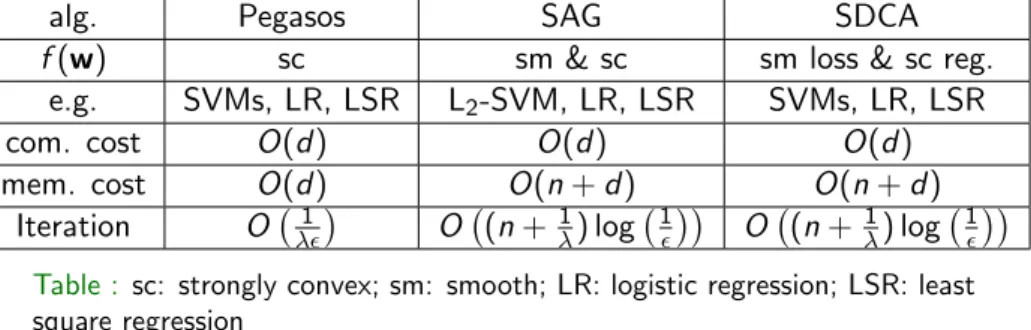
Let us compare Theoreticallyfirst
alg. Pegasos SAG SDCA
f(w) sc sm & sc sm loss & sc reg.
e.g. SVMs, LR, LSR L2-SVM, LR, LSR SVMs, LR, LSR
com. cost O(d) O(d) O(d)
mem. cost O(d) O(n+d) O(n+d)
Iteration O λ1 O (n+λ1) log 1 O (n+λ1) log 1
Table : sc: strongly convex; sm: smooth; LR: logistic regression; LSR: least
What about
`
1regularization?
min w∈Rd 1 n n X i=1 `(w>xi,yi) +σ K X g=1 kwgk1 | {z }Lasso or Group Lasso
Issue: Not Strongly Convex Solution: Add`22 regularization
min w∈Rd 1 n n X i=1 `(w>xi,yi) +σ K X g=1 kwgk1+ λ 2kwk 2 2 setting λ= Θ(1/)
Outline
1 STochastic OPtimization (STOP) and Machine Learning
2 STOP Algorithms for Big Data Classification and Regression
3 General Strategies for Stochastic Optimization
General Strategies for Stochastic Optimization
General strategies for StochasticGradient Descent Coverage:
SGD for various objectives
Accelerated SGD for Stochastic Composite Optimization Variance Reduced SGD
Stochastic Gradient Descent
min
x∈Xf(x)
stochastic gradient∇f(x;ω): ω is a random variable SGD updates:
xt ←ΠX [xt−1−γt∂f(xt−1;ωt)]
ΠX[ˆx] = minx∈Xkx−ˆxk22
Stochastic Gradient Descent
min
x∈Xf(x)
stochastic gradient∇f(x;ω): ω is a random variable SGD updates:
xt ←ΠX [xt−1−γt∂f(xt−1;ωt)]
ΠX[ˆx] = minx∈Xkx−ˆxk22
Why Stochastic Gradient Descent Works?
Why decreasing step size? GD vs SGD
xt =xt−1−η∇f(xt−1)
∇f(xt−1)→0
xt=xt−1−ηt∇f(xt−1;ωt) ∇f(xt−1;ωt)6→0, ηt →0
How to decrease the Step size?
SGD for Non-smooth Function: Convergence Rate
kx−yk ≤D and k∂f(x;ω)k∗ ≤G,∀x,y∈ X. Step size: γt = √ct,c usually needed to be tuned Convergence rate of final solutionxT: O
D2 c +cG 2logT T
Are we good enough? Close but not yet
minimax optimal rate : O√1
T
SGD for Non-smooth Function: Convergence Rate
kx−yk ≤D and k∂f(x;ω)k∗ ≤G,∀x,y∈ X.
Step size: γt = √ct,c usually needed to be tuned Convergence rate of final solutionxT: O
D2 c +cG 2logT T
Are we good enough? Close but not yet
minimax optimal rate : O√1
T
SGD for Non-smooth Function: Convergence Rate
kx−yk ≤D and k∂f(x;ω)k∗ ≤G,∀x,y∈ X.
Step size: γt = √ct,c usually needed to be tuned
Convergence rate of final solutionxT: O
D2 c +cG 2logT T
Are we good enough? Close but not yet
minimax optimal rate : O√1
T
SGD for Non-smooth Function: Convergence Rate
kx−yk ≤D and k∂f(x;ω)k∗ ≤G,∀x,y∈ X.
Step size: γt = √ct,c usually needed to be tuned
Convergence rate of final solutionxT: O
D2 c +cG 2logT T
Are we good enough? Close but not yet
minimax optimal rate : O√1
T
SGD for Non-smooth Function: Convergence Rate
minimax optimal rate : O√1
T Averaging: ¯ xt = 1−1 +η t+η ¯ xt−1+ 1 +η t+ηxt, η≥0 η= 0 standard average ¯ xT = x1+· · ·+xT T Convergence Rate of ¯xT: O η D2 c +cG2 1 T
SGD for Non-smooth Strongly Convex Function:
Convergence Rate
λ-Strongly Convex minimax optimal rate: O(T1) Step size: γt = λ1t Convergence Rate ofxT: O G2logT λT Averaging: ¯ xt = 1−1 +η t+η ¯ xt−1+ 1 +η t+ηxt, η≥0 Convergence Rate of ¯xT: O ηG2 λT
SGD for Smooth function
Generally No Further improvement uponO√1
T
Special structure may yield better convergence
General Strategies for Stochastic Optimization
General strategies for StochasticGradient Descent Coverage:
SGD for various objectives
Accelerated SGD for Stochastic Composite Optimization
Variance Reduced SGD
Stochastic Composite Optimization
min x∈X f|{z}(x) smooth + g(x) |{z} nonsmooth Example 1 min w 1 n n X i=1 log(1 + exp(−yiw>xi)) +λkwk1 Example 2 min w 1 n n X i=1 1 2(yi −w >x i)2+λkwk1Stochastic Composite Optimization
Accelerated Stochastic Gradient
auxiliary sequence of search solutions
maintain three solutions: xt (action solution), ¯xt (averaged solution),
xm
t (auxiliary solution)
Similar toNesterov’s deterministic method several variants
Stochastic Dual Coordinate Ascent min w∈Rd 1 n n X i=1 `(w>xi,yi) +σ K X g=1 kwgk1+ λ 2kwk 2 2
G. Lan’s Accelerated Stochastic Approximation
Iteratet = 1, . . . ,T
1. compute auxiliary solution
xmt =βt−1xt+ (1−βt−1)¯xt
2. update solution
xt+1=Pxt(γtG(x
m
t ;ωt))(think about projection)
3. update averaged solution ¯
xt+1= (1−βt−1)¯xt+βt−1xt+1 (Similar to SGD)
Accelerated Stochastic Approximation
1. β−t1 = t+12 : ¯ xt+1= 1− 2 t+ 1 ¯ xt+ 2 t+ 1xt+12. γt = t+12 γ: Increasing, Never like before
3. Convergence rate of ¯xT: O L T2 + M+σ2 √ T
Variance Reduction: Mini-batch
Batch gradient: gt= b1 Pb i=1∂f(xt−1, ωti) Unbiased sampling: Egt =E∂f(xt−1, ω). Variance reduced: Vgt = 1bV∂f(xt−1, ω).Tradeoff the batch computation for variance decrease. Batch size
1 Constant batch size;
2 Increasing batch size as proportion tot.
Variance Reduction: Mixed-Grad
(Mahdavi et. al, Johnson et al. ’13)Iterate s = 1, . . . ,
Iterate t = 1, . . . ,m
xst =xst−1−η(∇f(xst−1;ωt)− ∇f(¯xs−1;ωt) +∇f(¯xs−1))
| {z }
StoGrad−StoGrad+Grad
update ¯xs
how variance is reduced?
if ¯xs−1 →x∗,∇f(¯xt−1)→0,∇f(xt−1;ωt)− ∇f(x∗;ωt)→0
¯
xs =xsm or ¯xs =Pm
t=1xst/m
Constant learning rate
Better Iteration Complexity.: O((n+1λ) log 1) for sm&sc, O(1/) for smooth
Distributed Optimization: Why?
data distributed over multiple machines moving to single machine suffers
lownetwork bandwidth
limiteddisk or memory
benefits from parallel computation
clusterof machines GPUs
A Naive Solution
Data w1 w2 w3 w4 w5 w6 w= 1 k k X i=1 wiDistribute SGD is simple
Mini-batch
synchronization
Mini-batch SGD
Good: reduced variance, faster conv.
Bad: synchronizationis expensive
Solutions:
asynchronized update
convergence: difficult to prove
lesser synchronizations
Distribute SDCA is not trivial
issue: data are correlated
∆αi = arg max−φ∗i(−αti −∆αi)− λn 2 wt+ 1 λn∆αixi 2 2
Not Working
Distribute SDCA
(T. Yang NIPS’13)The Basic Variant
mR-SDCA running on machine k
Iterate: for t = 1, . . . ,T
Iterate: for j = 1, . . . ,m
Randomly pick i ∈ {1,· · · ,nk} and let ij =i
Find ∆αk,i byIncDual(w=wt−1,scl =mK) Set αt k,i =αt −1 k,i + ∆αk,i Reduce: wt ←wt−1+λ1nPmj=1∆αk,ijxk,ij ∆αi = arg max−φ∗i(−αti −∆αi)− λn 2mK wt+ mK λn ∆αixi 2 2
Distribute SDCA
(T. Yang NIPS’13) The Practical VariantInitialize: u0t =wt−1
Iterate: for j = 1, . . . ,m
Randomly pick i ∈ {1,· · · ,nk} and let ij =i
Find ∆αk,ij byIncDual(w=ujt−1,scl =k) Updateαtk,ij =αkt−,ij1+ ∆αk,ij Updateujt=ujt−1+λ1nk∆αk,ijxk,ij ∆αij = arg max−φ∗ij(−αtij−∆αij)− λn 2K ujt−1+ K λn∆αijxij 2 2
Using Updated Information and Large Step Size
Distribute SDCA
(T. Yang NIPS’13)The Practical Variant is much faster than the Basic Variant
0 20 40 60 80 100 −9 −8 −7 −6 −5 −4 −3 −2 −1 0 iterations log(P(w t ) − D( α t )) duality gap DisDCA−p DisDCA−n
Outline
1 STochastic OPtimization (STOP) and Machine Learning
2 STOP Algorithms for Big Data Classification and Regression
3 General Strategies for Stochastic Optimization
Implementations and A Library
In this section, we present some techniques for efficient implementations and a practical library
Coverage:
efficient averaging Gradient sparsification pre-optimization: screening
pre-optimization: data preconditioning distributed (parallel) optimization library
Efficient Averaging
Update rule:
xt = (1−γtλ)xt−1+γtgt
¯
xt = (1−αt)¯xt−1+αtxt
Efficient update when gt has many 0, or gt is sparse,
St = 1−λγt 0 αt(1−λγt) 1−αt St−1, S1 =I yt =yt−1−[St−1]11γtgt ˜ yt = ˜yt−1−([St−1]21+ [St−1]22αt)γtgt xT = [ST]11yT ¯ xT = [ST]21yT+ [ST]22˜yT When Gradient is Sparse
Gradient sparsification
Sparsification by importance sampling
Rti =unif(0,1)
˜
gti =gti[|gti| ≥ˆgi] + ˆgsign(gti)[ˆgiRti ≤ |gti|<ˆgi]
Unbiased sample: Eg˜t =gt.
Tradeoff variance increase for the efficient computation.
Pre-optimization: Screening
Screening for Lasso (Wang et al., 2012)
Distributed Optimization Library: Birds
The birds library implements distributed stochastic dual coordinate
ascent (DisDCA) for classification and regression with a broad support.
For technical details see:
”Trading Computation for Communication: Distributed Stochastic Dual Coordinate Ascent.” Tianbao Yang. NIPS 2013.
”On the Theoretical Analysis of Distributed Stochastic Dual Coordinate Ascent” Tianbao Yang, etc. Tech Report 2013.
The code is distributed under GNU General Publich License (see license.txt for details).
Distributed Optimization Library: Birds
Whatproblems does it Solve? Classification and Regression Loss
1 Hinge loss (SVM): L-1 hinge loss, L-2 hinge loss 2 Logistic loss (Logistic Regression)
3 Least Square Regression (Ridge Regression)
Regularizer
1 `2norm: SVM, Logistic Regression, Ridge Regression 2 `1norm: Lasso, SVM, LR with`1norm
Distributed Optimization Library: Birds
Whatdata does it Support?
dense, sparse txt, binary
Whatenvironment does it Support? Prerequisites: Boost Library
Tested on A cluster of Linux Servers (up to hundreds of machines) Tested on Cygwin in Windows with multi-core
How about kernel methods?
Stochastic/Online Optimization Approaches: (Jin et al., 2010;
Orabona et al., 2012),
Linearization + STOP for linear methods
the Nystr¨om method(Drineas & Mahoney, 2005) Random Fourier Features(Rahimi & Recht, 2007) Comparison of two(Yang et al., 2012)
References I
Drineas, Petros and Mahoney, Michael W. On the nystrom method for
approximating a gram matrix for improved kernel-based learning. J.
Mach. Learn. Res., 6:2153–2175, 2005.
Jin, Rong, Hoi, Steven C. H., and Yang, Tianbao. Online multiple kernel
learning: Algorithms and mistake bounds. InProceedings of the 21st
International Conference on Algorithmic Learning Theory, pp. 390–404,
2010.
Ogawa, Kohei, Suzuki, Yoshiki, and Takeuchi, Ichiro. Safe screening of
non-support vectors in pathwise svm computation. InICML (3), pp.
1382–1390, 2013.
Orabona, Francesco, Luo, Jie, and Caputo, Barbara. Multi kernel learning
with online-batch optimization. Journal of Machine Learning Research,
References II
Rahimi, Ali and Recht, Benjamin. Random features for large-scale kernel
machines. InNIPS, 2007.
Wang, Jie, Lin, Binbin, Gong, Pinghua, Wonka, Peter, and Ye, Jieping.
Lasso screening rules via dual polytope projection. CoRR,
abs/1211.3966, 2012.
Yang, Tianbao, Li, Yu-Feng, Mahdavi, Mehrdad, Jin, Rong, and Zhou, Zhi-Hua. ”nystrom method vs random fourier features: A theoretical