Nonsingular model of magnetized black hole based on nonlinear electrodynamics
S. I. Kruglov 1
Department of Physics, University of Toronto, 60 St. Georges St., Toronto, ON M5S 1A7, Canada
Department of Chemical and Physical Sciences, University of Toronto Mississauga,
3359 Mississauga Road North, Mississauga, Ontario L5L 1C6, Canada
Abstract
We find solutions of a magnetically charged non-singular black hole in some modified theory of gravity coupled with nonlinear electrody-namics. The metric of a magnetized black hole is obtained which has one (an extreme horizon), two horizons, or no horizons (naked singu-larity). Corrections to the Reissner-Nordstr¨om solution are found as the radius approaches to infinity. The asymptotic of the Ricci and Kretschmann scalars are calculated showing the absence of singular-ities. We study the thermodynamics of black holes by calculating the Hawking temperature and the heat capacity. It is demonstrated that phase transitions take place and we show that black holes are thermodynamically stable at some range of parameters.
1
Introduction
It is well-known that the General Relativity (GR) is ultraviolet (UV) incom-plete. In addition, there is a problem of singularities in the classical Einstein theory of gravity. Thus, solutions of the Einstein equations for neutral (the Schwarzschild metric), charged (the Reisner-Nordstr¨om metric) and rotated (the Kerr metric) black holes (BHs) have curvature singularity in the cen-ter (r = 0). Therefore, the GR should be modified when the curvature is high. There are some attempts to overcome problems in the classical Ein-stein theory of gravity. So, if one adds curvature terms of the higher order or terms with higher derivatives, the UV behaviour of the Einstein gravity
1E-mail: [email protected]
will be improved [1]. But the price for this is the existence of ghosts (non-physical degrees of freedom). A ghost free modification of the GR, which is UV-complete, was considered in [2], [3], [4]. But such theory is non-local and has an infinite number of derivatives. Because the fundamental quantum gravity theory (UV-complete) is absent some phenomenology models can be useful to solve problems of singularities. We suppose that there is a critical energy µand the corresponding lengthl=µ−1 in such a way that the metric
is modified when the spacetime curvature be in the order of l2 [5].
In this paper we consider the spherically symmetric nonsingular model of BH based on nonlinear electrodynamics (NED). In some NED, the electric field in the center of point-like charges is finite [6]-[10] and the self-energy of charges is finite unlike classical electrodynamics. It worth mentioning that quantum corrections to Maxwell’s electrodynamics lead to NED [11]. The universe inflation also can be explained in the GR coupled with NED [12]-[19].
Here, we study regular BH solutions in some modified theory of gravity coupled with NED proposed in [20]. The BH thermodynamics and phase transitions are investigated. In [21] and [22] authors also considered BH solutions in modified theory of gravity based on NED proposed in [23] and [24], respectively.
The paper is organized as follows. In Section 2 the modified GR with NED is studied and we obtain the asymptotic of the metric and mass functions as
r →0 andr → ∞. Corrections to the Reissner-Nordstr¨om (RN) solution are found. The asymptotic of the Ricci and Kretschmann scalars are calculated and we show that curvature singularities are absent. In Section 3 we calculate the Hawking temperature and heat capacity of BHs. We demonstrate that the second-order phase transitions occur. It is shown that in some range of parameters BHs are stable. Section 4 is a conclusion.
2
A regular magnetized BH solution
Let us consider the action of the GR coupled with NED
I = Z
d4x√−g
1
2κ2R+L
where κ2 = 8πG
N and GN is the Newton constant. We use the Lagrangian density of NED [20] as follows:
L =− F
cosh2q4 |
βF |, (2)
where F = (1/4)FµνFµν = (B2−E2)/2 and the field tensor isFµν =∂µAν−
∂νAµ. The parameterβ possesses the dimension of (length)4 and at the weak field limit when βF 1 the Lagrangian density (1) becomes L → −F, i.e. the correspondence principle holds. We consider the regular BH with the spherical symmetrical line element
ds2 =−f(r)dt2+ 1
f(r)dr
2+r2(dϑ2+ sin2ϑdφ2), (3)
with [25]
f(r) = 1− 2Gm0r 2
r3+ 2Gm 0l2
, (4)
where m0 being the mass of a neutral BH and l is the fundamental length.
The metric (3) corresponds to a solution of a modified theory of gravity. At l = 0 we come to the Schwarzschild metric of a BH which is a solution to Einstein’s equation without sources. Now we suppose that the BH is magnetically charged and the source of gravity is describes by the Lagrangian density (2). Then the mass m0 should be replaced by the mass function
depending on r,
M(r) =m0+
Z r
0
ρ(r)r2dr=m0+
Z ∞
0
ρ(r)r2dr−
Z ∞
r
ρ(r)r2dr, (5)
where ρ(r) is the magnetic energy density and mM =
R∞
0 ρ(r)r2dr is the
magnetic mass of the BH. At E= 0 the magnetic energy density is given by [26]
ρ(r) = −L= F cosh2q4|βF |
, (6)
where F = B2/2 = q2/(2r4), and q is a magnetic charge. Then the mass
function (5) becomes
M(r) = m0+mM −
q3/2
23/4β1/4 tanh
β1/4√q
21/4r
!
where the BH magnetic mass is
mM =
Z ∞
0
ρ(r)r2dr= q
3/2
23/4β1/4. (8)
The total BH mass ism =m0+mM. Then the metric function of a modified theory of gravity corresponding to a charged BH is
f(r) = 1− 2GM(r)r 2
r3 + 2GM(r)l2, (9)
where M(r) is given by (7).
For a convenience we introduce the dimensionless parameterx= 21/4r/(β1/4√q).
Then from Eqs. (7)-(9) one obtains the metric function
f(x) = 1− Ax 2g(x)
x3+Bg(x), (10)
where
A= √
2Gq
√
β , B=
2Gl2
β , C =
23/4β1/4m 0
q3/2 , g(x) = C+ 1−tanh
1
x
. (11)
From Eqs. (10) and (11) we find the asymptotic of the metric function as
r → ∞and r→0
f(r) = 1− 2Gm
r + Gq2
r2 − G r4
√
βq3
3√2 −4Gl
2m2
!
+O(r−5) r→ ∞, (12)
f(r) = 1−r 2
l2 + r5
2Gm0l4
+O(r6) r→0. (13)
Equation (12) shows the corrections to the RN solution that are in the order of O(r−4). At l = 0 and m
0 = 0 (when the total BH mass is the magnetic
mass) Eq. (12) is converted into the equation obtained in [26] corresponding to Einstein’s theory of gravity. As r → ∞ we have f(∞) = 1, and the spacetime becomes Minkowski’s space. According to Eq. (13) limr→0f(r) =
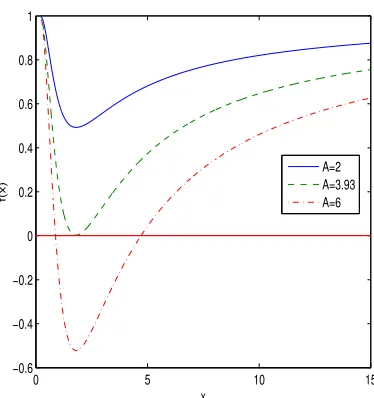
1. Thus, the BH is regular. If β = 0 one has the RN solution. The plot of the function f(x) is depicted in Fig. 1. In Accordance with Fig. 1 at
0 5 10 15 −0.6
−0.4 −0.2 0 0.2 0.4 0.6 0.8 1
x
f(x)
A=2 A=3.93 A=6
Figure 1: The plot of the function f(x) for B = 1 and C = 0 (m0 = 0).
Dashed-dotted line corresponds to A = 6, solid line corresponds to A = 2 and dashed line corresponds to A= 3.93.
have two horizons. The horizons xh take place when the equationf(xh) = 0 is satisfied. From Eq. (10), at B = 1, C = 0 one finds the inner x−
(x− = 21/4r−/(β1/4
√
q)) and outer x+ (x+ = 21/4r+/(β1/4 √
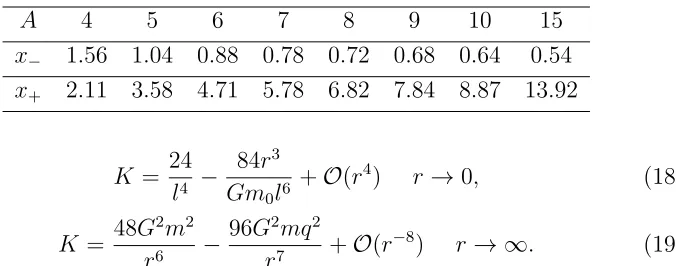
q)) horizon radii of the BH that are given in Table 1.
The asymptotic of the Ricci and Kretschann scalars can be obtained from the relations
R =−f00(r)−4
rf
0
(r)−2f(r)−1
r2 , (14)
K =f002(r) + 2f
0(r)
r
!2
+4 (f(r)−1)
2
r4 . (15)
From Eqs. (14) and (15) we find
R= 12
l2 −
21r3 Gm0l4
+O(r4) r→0, (16)
R =−86Gm
r3 +
12Gq2 r4 −
34G r6
√
βq3
3√2 −4Gl
2 m2
!
Table 1: The BH inner and outer horizon radii (B = 1, C = 0)
A 4 5 6 7 8 9 10 15
x− 1.56 1.04 0.88 0.78 0.72 0.68 0.64 0.54
x+ 2.11 3.58 4.71 5.78 6.82 7.84 8.87 13.92
K = 24
l4 −
84r3 Gm0l6
+O(r4) r→0, (18)
K = 48G
2m2
r6 −
96G2mq2
r7 +O(r
−8
) r → ∞. (19)
Asr→ ∞the Ricci scalarRvanishes and spacetime becomes flat. Equations (16)-(19) indicate that solutions obtained in modified theory of relativity are regular. In Einstein’s theory of gravity (l = 0) based on NED [26], singularities are still present.
3
Thermodynamics and phase transitions
Let us study the thermal stability of magnetized BHs and the possible phase transitions. The Hawking temperature is given by
TH =
κs 2π =
f0(rh)
4π , (20)
where κs is the surface gravity and rh is the horizon radius. Making use of Eqs. (10) and (20) we obtain the Hawking temperature
TH =
√
qG
25/4πβ3/4(x3+Bg(x))
−2xg(x)
− 1
cosh2(1/x)+
g(x)(B + 3x4cosh2(1/x))
(x3+Bg(x)) cosh2(1/x)
. (21)
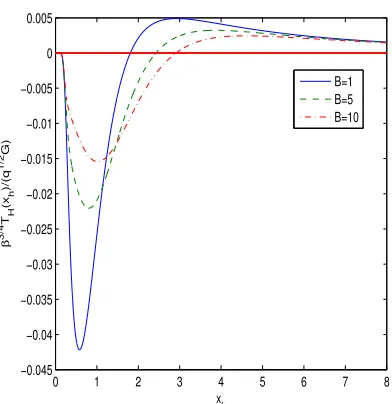
The plot of the function TH(xh) is depicted in Fig. 2 for different values of the parameter B. When the Hawking temperature is negative the BH does not exist. The heat capacity at constant charge is defined by the relation
Cq =TH
∂S ∂TH
!
q
= TH∂S/∂rh
∂TH/∂rh
= 2πrhTH
G∂TH/∂rh
0 1 2 3 4 5 6 7 8 −0.045
−0.04 −0.035 −0.03 −0.025 −0.02 −0.015 −0.01 −0.005 0 0.005
x h
β
3/4
TH
(x
h
)/(q
1/2
G)
B=1 B=5 B=10
Figure 2: The plot of the function TH √
qβ1/4 vs. horizons x
h for C = 0 (m0 = 0). Dashed-dotted line corresponds toB = 10, solid line corresponds
to B = 1 and dashed line corresponds to B = 5.
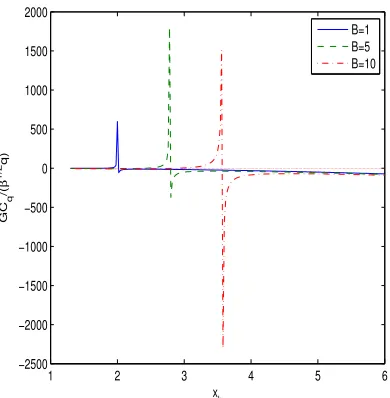
The entropy obeys the Hawking area low S = A/(4G) = πr2h/G. When the Hawking temperature has extremum (∂TH/∂rh = 0) the heat capacity is singular and the second-order phase transition takes place. In Fig. 3 the function GCq/(
√
βq) vs. the horizon xh for different values of B for C = 0 (m0 = 0) is presented. In accordance with Fig. 3 when the parameter B is bigger the second-order phase transition of the BH (the heat capacity possesses a discontinuity) occurs ant larger value of the horizonxh. For large value of xh the BH is unstable (Cq<0).
4
Conclusion
Solutions of a magnetically charged regular BH in modified theory of gravity coupled with NED were obtained. We found the mass and metric functions that can have one (an extreme horizon), two horizons, or no horizons (naked singularity) (see Fig. 1). Corrections to the RN solution that are in the or-der of O(r−4) were obtained as the radius approaches to infinity. As r→ ∞
1 2 3 4 5 6 −2500
−2000 −1500 −1000 −500 0 500 1000 1500 2000
x h
GC
q
/(
β
1/2
q)
B=1 B=5 B=10
Figure 3: The plot of the function CqG/( √
βq) vs. xh for C = 0 (m0 = 0).
Dashed-dotted line corresponds to B = 10, solid line corresponds to B = 1 and dashed line corresponds to B = 5.
Kretschmann scalars as r→ ∞ and r →0 showing the absents of singular-ities. Thus, our solution describes nonsingular BH with the finite curvature everywhere including r= 0. The Hawking temperature and heat capacity of the BH were found demonstrating that second-order phase transitions take place. For small values of the horizon radius, depending on the parameters of the model, the Hawking temperature is negative (see Fig. 2) indicating the absence of the BH. The thermodynamic stabilities of black holes were studied and it was shown that in some horizon radii the BHs are stable (the heat capacity is positive) (see Fig. 3).
References
[1] K. S. Stelle, Gen. Rel. Grav.9, 353371 (1978); Phys. Rev. D16, 953969 (1977).
[2] T. Biswas, E. Gerwick, T. Koivisto, and A. Mazumdar, Phys. Rev. Lett.
[3] T. Biswas, A. Conroy, A. S. Koshelev, and A. Mazumdar, Class. Quant. Grav. 31, 015022 (2014).
[4] L. Modesto, Phys. Rev. D 86, 044005 (2012). [5] V. P. Frolov, Phys. Rev. D 94, 104056 (2016).
[6] M. Born and L. Infeld, Proc. Royal Soc. (London) A 144, 425 (1934). [7] D. M. Gitman and A. E. Shabad, Eur. Phys. J. C 74, 3186 (2014). [8] S. I. Kruglov, Ann. Phys. 353, 299 (2015).
[9] S. I. Kruglov, Annalen Phys. (Berlin) 527, 397 (2015). [10] S. I. Kruglov, Commun. Theor. Phys. 66, 59 (2016). [11] W. Heisenberg and H. Euler, Z. Physik, 98, 714 (1936).
[12] R. Garc´ıa-Salcedo and N. Breton, Int. J. Mod. Phys. A15, 4341 (2000). [13] C. S. Camara, M. R. de Garcia Maia, J. C. Carvalho, and J. A. S. Lima,
Phys. Rev. D 69, 123504 (2004).
[14] M. Novello, S. E. Perez Bergliaffa, and J. M. Salim, Phys. Rev. D 69, 127301 (2004).
[15] M. Novello, E. Goulart, J. M. Salim, and S. E. Perez Bergliaffa, Class. Quant. Grav. 24, 3021 (2007).
[16] D. N. Vollick, Phys. Rev. D 78, 063524 (2008). [17] S. I. Kruglov, Phys. Rev. D 92, 123523 (2015).
[18] S. I. Kruglov, Int. J. Mod. Phys. A 31, 1650058 (2016). [19] S. I. Kruglov, Int. J.Mod. Phys. D 25, 1640002 (2016). [20] K. A. Bronnikov, Phys. Rev. D 63, 044005 (2001). [21] A. Ali and K. Saifullah, Phys. Lett. B 792, 276 (2019).
[23] S. I. Kruglov, Ann. Phys. 378, 59 (2017).