http://www.sciencepublishinggroup.com/j/ijll doi: 10.11648/j.ijll.20190706.25
ISSN: 2330-0205 (Print); ISSN: 2330-0221 (Online)
Comparison Among Some View Points Upon Second
Language Acquisition Theory
Tran Thi Thanh Dieu
Faculty of English Linguistics and Literature, University of Social Sciences and Humanities, Viet Nam National University, Ho Chí Minh City, Vietnam
Email address:
To cite this article:
Tran Thi Thanh Dieu. Comparison Among Some View Points Upon Second Language Acquisition Theory. International Journal of Language and Linguistics. Vol. 7, No. 6, 2019, pp. 358-363. doi: 10.11648/j.ijll.20190706.25
Received: October 25, 2019; Accepted: December 2, 2019; Published: December 10, 2019
Abstract:
This study focuses on the comparison and contrast among the theories of second language acquisition. The theories chosen for comparison are the Behaviorist's theory, the Nativist's theory, the Interactionist's theory, the Information Processing theory, the Vygotsky's theory, and the Halliday's theory. The comparison of the six main theories are designed in the form of a table based on some main and important points; such as, the history, the scholars and their books, the Concept (Keyterm & their meaning), the Key to learning, the Leaning process, as well as Evaluating Human Being and Evaluating Language. Especially, in the summary table, the second language acquisition theories are analyzed to find out which theories adapt the viewpoints of the learners, based on the effects of learning process, learners and the phases of learning a language. As a result, this researrch can be seen as a brief dictionary of many key terms and the authors’ viewpoints on second language acquisition analyzed in the theories applied in over the world.Keywords:
Imitation, Reward & Punishment, Habit Fomrmation, Thinking, Self Producing1. Introduction
“Language is not an abstract construction of the learned, or of dictionary-makers, but is something arising out of the work, needs, ties, joys, affections, tastes, of long generations of humanity, and has its bases broad and low, close to the ground” has been put by Walt Whitman in An Introduction to Language by Fromkin V. (2011: 429) [1]. Therefore, no-one
can deny that to study a language in general and a foreign language in particular, is a vexed question now that every language in the world has its own characteristics which are nearly completely different from one another. To solve this problem, many linguists have created their theories of second language acquisition, such as Behaviorist's theory, Nativist's theory, Interactionist's theory, Information Processing theory, Vygotsky's theory, Halliday's theory, Sociolinguistic's theory.
However, learning processes has their own features leading to how to choose which theory to suit learners. In general, we can divide the learning process into two phases. The first is for beginners who do not have background knowledge of the language they are studying so this phase is the phase of inputting knowledge through the behavior of repetition to
become the habit (1958: 35) [2],. Therefore, this process is relevant to the Long-term Memory of The Information Processing Theory, analyzing the time for learners to store up knowledge that will become the background knowledge (schemata) of the second phase [5]. At this point, the philosophy of the Behaviorist can give a help to answer this question as “One of the logical ways is imitation and repetition through observable behaviors with the two kinds of Reinforcement [2]. At this phase. the external factors, such as environment, teacher, materials are very important due to tthe fact that learners usually use knowledge of his L1 to produce the L2. The second phase is the phase of improving the language the learners have studied [3, 4, 6]. With the background knowledge accumulated in the first phase, learners can become more self-controlled in their learning process in which people can create new, own sentences based on gained background knowledge. Therefore, at this stage, learning is not only imitation and drilling but also creating, so internal factor - their brain (deep thinking)….. is also important, as the viewpoint of the Nativist Theory (1999: 55) [6].
clear that every theory is necessary for a certain phase of language learning. Therefore, to suitably apply, the features
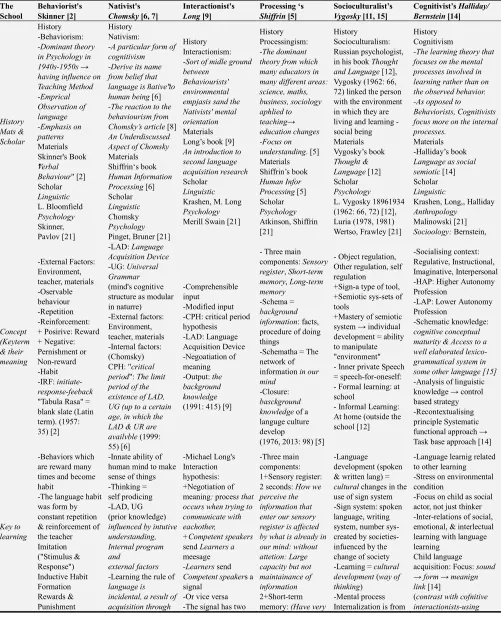
of some main schools has been compared and briefly summarized in a table for distinguishing and choosing.
2. The Table of Brief Analysis Comparison
Table 1. The six -- school Theories of Second language Acquisition.
The School
Behaviorist's Skinner [2]
Nativist's
Chomsky [6, 7]
Interactionist's
Long [9]
Processing ‘s
Shiffrin [5]
Socioculturalist’s
Vygosky [11, 15]
Cognitivist’s Halliday/ Bernstein [14]
History Mats & Scholar History -Behaviorism: -Dominant theory in Psychology in 1940s-1950s → having influence on Teaching Method -Emprical Observation of language -Emphasis on patterns Materials Skinner's Book "Verbal Behaviour" [2] Scholar
Linguistic
L. Bloomfield
Psychology
Skinner, Pavlov [21]
History Nativism:
-A particular form of cognitivism -Derive its name from belief that language is "native" to human being [6]
-The reaction to the behaviourism from Chomsky’s article [8]
An Underdiscussed Aspect of Chomsky
Materials Shiffrin‘s book
Human Information Processing [6] Scholar
Linguistic Chomsky
Psychology
Pinget, Bruner [21]
History Interactionism: -Sort of midle ground between
Behaviourists' environmental empjasis sand the Nativists' mental orientation Materials Long’s book [9]
An introduction to second language acquisition research
Scholar
Linguistic
Krashen, M. Long
Psychology
Merill Swain [21]
History Processingism: -The dominant theory from which many educators in many different areas: science, maths, business, sociology aphlied to teaching→ education changes -Focus on understanding. [5] Materials Shiffrin’s book
Human Infor Processing [5]
Scholar Psychology Atkinson, Shiffrin [21] History Socioculturalism: Russian psychologist, in his book Thought and Language[12],
Vygosky (1962: 66, 72) linked the person with the environment in which they are living and learning - social being Materials Vygosky’s book Thought & Language[12] Scholar Psychology
L. Vygosky 18961934 (1962: 66, 72) [12], Luria (1978, 1981) Wertso, Frawley [21]
History Cognitivism
-The learning theory that focuses on the mental processes involved in learning rather than on the observed behavior. -As opposed to
Behaviorists, Cognitivists focus more on the internal processes.
Materials -Halliday’s book
Language as social semiotic [14] Scholar
Linguistic
Krashen, Long,, Halliday
Anthropology
Malinowski [21]
Socioology: Bernstein,
Concept (Keyterm & their meaning -External Factors: Environment, teacher, materials -Oservable behaviour -Repetition -Reinforcement: + Posirive: Reward + Negative: Pernishment or Non-reward -Habit -IRF: initiate-response-feeback
"Tabula Rasa" = blank slate (Latin term). (1957: 35) [2]
-LAD: Language Acquisition Device
-UG: Universal Grammar
(mind's cognitive structure as modular in naturre) -External factors: Environment, teacher, materials -Internal factors: (Chomsky) CPH: "critical period": The limit period of the existence of LAD, UG (up to a certain age, in which the LAD & UR are availvble (1999: 55) [6]
-Comprehensible input
-Modified input -CPH: critical period hypothesis -LAD: Language Acquisition Device -Negoatiation of meaning -Output: the background knowledge
(1991: 415) [9]
- Three main components: Sensory register, Short-term memory, Long-term memory
-Schema =
background information: facts, procedure of doing things
-Schematha = The network of information in our mind
-Closure:
basckground knowledge of a languge culture develop
(1976, 2013: 98) [5]
- Object regulation, Other regulation, self regulation
+Sign-a type of tool, +Semiotic sys-sets of tools
+Mastery of semiotic system → individual development = ability to manipulate "environment" - Inner private Speech = speech-for-oneself: - Formal learning: at school
- Informal Learning: At home (outside the school [12]
-Socialising context: Regulative, Instructional, Imaginative, Interpersonal -HAP: Higher Autonomy Profession
-LAP: Lower Autonomy Profession
-Schematic knowledge:
cognitive conceptual maturity & Access to a well elaborated lexico-grammatical system in some other language[15]
-Analysis of linguistic knowledge → control based strategy -Recontextualising principle Systematic functional approach → Task base approach [14]
Key to learning
-Behaviors which are reward many times and become habit
-The language habit was form by constant repetition & reinforcement of the teacher Imitation ("Stimulus & Response") Inductive Habit Formation Rewards & Punishment
-Innate ability of human mind to make sense of things -Thinking = self prodicing -LAD, UG (prior knowledge)
influenced by intutive understanding, Internal program and
external factors
-Learning the rule of
language is incidental, a result of acquisition through
-Michael Long's Interaction hypothesis: +Negotiation of meaning: process that occurs when trying to communicate with eachother,
+Competent speakers
send Learnersa
meesage
-Learners send
Competent speakers a signal
-Or vice versa -The signal has two
-Three main components: 1+Sensory register: 2 seconds: How we perceive the information that enter our sensory register is affected by what is already in our mind: without attetion: Large capacity but not maintainance of information
2+Short-term memory: (Have very
-Language
development (spoken & written lang) =
cultural changes in the use of sign system -Sign system: spoken language, writing system, number sys-created by societies-infuenced by the change of society -Learning = cultural development (way of thinking)
-Mental process Internalization is from
-Language learnig related to other learning -Stress on environmental condition
-Focus on child as social actor, not just thinker -Inter-relations of social, emotional, & interlectual learning with language learning
Child language acquisition: Focus: sound → form → meanign link[14]
The School
Behaviorist's Skinner [2]
Nativist's
Chomsky [6, 7]
Interactionist's
Long [9]
Processing ‘s
Shiffrin [5]
Socioculturalist’s
Vygosky [11, 15]
Cognitivist’s Halliday/ Bernstein [14]
("Positive" & "Negative" Reinforcement") -Operant conditioning -IRF: initiate-response-feeback -L2: +Imitation +Operant conditioning & Habit Formation +Reward & Punishment +Explanation of L2 is grounded in part on an explanation of L1 learningrely for evidence on natuarallist research +Paying special attention to grammarticl form - →Crucial diffence bet SLA&L1 Acquisi-tion
-Learner no longer "Tabula Rasa" -L1 pattern already "habit"
-L1 habit may INTERFERE with learning "correct" L2 pattern (1957: 38) [2]
the interal resource at work. This happen as learners focus on meaning
(in Krashen' sense of the word) [6]
cases:
+Possitive signal: the
message has been
understood
+Negative signal: not understood → resend
adjusted message until success (negotiation of meaning) -Strategies in negotiation of meaning [9] 1+Comprehension check: The S ask the L if they understood 2+Confirmation check: the L check to understand the right meaning
3+Clasification request: the L ask the S what is meant 4+Request for repitition, greater volume, explanation 5+Self-repetition or paraphrase
-Merill Swain'(1985) output Hypothesis Output: acquisition (comprehensible output) - for Hypothesis testing confirm or reject their ideas about the language
Interation between internal & external factors
limited capacities: 7 pieces of
information): require attention, require continued attention and use to maintenent information where we hold and process information just for a few seconds. Information enters short-term memory from 2 sources:
+Source 1:
information which we have selected from the sensory register
+Source 2: long-term memory
3+Long-term memory:
(information enters & stay there for life: require use and organization to maintenent information Where information is organized into network: Schemata (the fancy term) = outlines or semantic maps[5]
inter-psychological functioning (social-bet
minds) to intra psychological functioning (individual
plane-within mind) - Zone of proximal development (ZPD):
Central notion in Vygosky's Theory =
stage between actual & potential development
-ZPD can be
+at any age, +for a particular area of knowledge [13]
social interaction for learning, which is still mainly psychological) [18]
Leaning process "Operant Conditioning" -"Stimulus" → Immitation "response
1957: 293) [2] + Reward (possitive renforcement) →
repeat → reward → repeat → … → → Habit = KNOWLEDGE +Punishment/ Non-reward ("negative reinforcement") → No repeat → Stop → LEARNING AGAIN
-Language making as public reproductive activty (as individualisitc activity) Assumes universal pprocess of
-Innate, internal rule making using the LAD or UG, after being influenced by external factors or intutive
understanding or internal programme
-Language-making as private creative activity (as individualistic activity
-Assume universal process of cognition (as universal) [2]
-Krashen's Monitor Model: 5 Hypothesis
1. Acquisition & Leaning hyp: 2 process: Acquisition-subconscious; Learning- concious 2. Input Hyp: Comprehensive input (I+1, I+2, I+3):
Michael Long's Hypothesis: 1-Interation →
2-Negotiation of meaning → 3-Modified input→
4-Comprehensible input → 5-Acquisiton →
6-Output (Output Hypothesis) → 7-Acquisition
Note:
Acquisition enable +Result of acqusition
+Coprehensible input +Contribute to acqusition
+Interaction between internal & external factor
→
Testing Hyp → → → Acquisition [9]
The process of -Inputing knowledge
from
-Sensory register component
to
-Short-term memory.
And to
-Long-term memory
to form -the output or the background knowledge
[5]
Learning process = Mediation
(= Change from inter-psychological functioning (social-bet minds) to intra psychological functioning) from [Object regulaton] to [Other regulaion] to [Self regulation] = Three phases of learning process: 1. Object regulation::
directly controlled by things & activities in the environment (e.g. school textbook& syllabuses, model letters,
2. Other regulation:
through instruction, teachers use
Primary Tool =
Language (= the
crucial Semiotic
3 phases:
-1. Protolan: the beginning
+Soundmeaning: realising sounds produced canbe used to things +Largely monologic: child's world egocentric, immediate
+Microfunction: instrumental, regulatory, interactional, …. -2. Holophrastic- the transition
+Emerge of lanuage form- recognizable voc & syntax of mother tongue +From monologue to dialogue
+Emergence of 2 speech roles: commenting & demanding
The School
Behaviorist's Skinner [2]
Nativist's
Chomsky [6, 7]
Interactionist's
Long [9]
Processing ‘s
Shiffrin [5]
Socioculturalist’s
Vygosky [11, 15]
Cognitivist’s Halliday/ Bernstein [14] cognition (as
universal) (1957: 52) [2]
factor enables acquisition, 3. Condition (motivation, attitude) enabling optional processing of input 4. Natural order hyp need a predictable natural order +5. Learner edit his own language and alternation: main goal of
communication [6]
system) to erase the bridges gap = the Inter but not co-incidental relation between actual (existing, measurable) & potential (capable of achieving, in peer)
development in ZPD 3-Self regulation:
controlled by oneself[12]
+Knowing the linguistic system & its meaning potential
+Ability to interact in varied situatuion in culture +Macrofunction envolve into metafunctions of adult lan
*Idealtional (field of disc) *Interpersonal (tenor of dis)
*Textual (mode -discourse) (1978: 25-26) [14]
Evaluatin g Human Being
-Human beeings are like animal (although people are more complex being than animals) -Babies mind: "Tabula Rasa" = blank slate (Latin term)
-Cognitively & Socially Passive
[8]
-Human being:
Native language learning
-People has thinking -Thinking makes people unique –Intetnal elements are more important than external elements
[2]
-Human being: innate or native language learning -People has cognitiion = thinking
(inner working of the mind)
-Thinking makes people unique, different from animals
-Internal elements are
more important than external elements [10]
-Human can store information and that information become
Schemata
-Human can have
deep thinking[5]
-Regard human activity as a tool of achieveing, changing, themselves -A human beeing is
social-beeing, -Only human beeing were able to master change brought from makeshifts tools by their use of specifictools-Sign [13]
Human beeings are influenced by environment: Society, Culteral……[19]
-
Evaluatin g Language
-Focus on form
-External elements
more important -Accordng to Behaviourist & structuralist, Language is defined by
consistent formal patterns
-Learning a languge to produce these patterns correctly as a matter of habit
1957: 311) [2]
-Internal elements
(LAD&UG) are also important → need external
-Because of "critical period", L2 learner has to rely on other source
-Output is the result not the cause of
acqusition
-At Issue; Is L1=L2? [6]
+Belief applied to
SLA
-Internal elements (LAD&UG) are also important, but there is "critical period"
(after which LAD&UG are no longer available) -(Critical period hypothesis-Eric Lenneburg) → need external help to notice and learn the rule of language = be given explicit information about the language and its rules through formal and informal means, Learning is
intentional, focus on
form[9]
+In SLA, apllied because of belief that UG or LAD no longer in operation +Some specific theories
-Gestalt Psychology
for runner of information processing theories: stress the internal element in behavior, that people perceive is shaped by prior knowledge
-Schema Theory
-Anderson's ACT model (not in current module) [5]
-Language= Social tool for mediation and learning
-Tool for others-regulation -Tool for self-regulation
+Language both object of learning as well as means of learning -Language interact with cognitive and behavioural systems ands serves their continuos development -The relation between the language and thought, the social and the individual, the spoken and the written word = Intimate[12]
-Language: a social semiotic, a system of resource: Lexico; gram; generic structure, to make meaning in context -Context:
Context of situation -context of culture, Field+Tenor+Mode: Function & meaning -Discource: social purposes
-3 simultaneous meaning: -Idealtional function: -Interpersonal function -Textual function: -Mood: structure, elements
Theme-rheme, cohesion
[18]
3. Analyzing Conclusion
To begin with, we are of the opinion that learning process is influenced by not only internal but also external factors [6]. We believe in the existence of Language Acquisition Device (LAD), and Universal Grammar (UG) of the Nativist's point of view or the IQ as Vygosky's that can be regarded as the Internal factors. The external factors also play a very important role in learning process such as: environment, teacher's direction, materials, interest, relevance, expectancy, culture,
the learning process should happen in three steps to gain the mediation: From Object-Regulation to Other-Regulation to Self-Regulation. Without the Self-Regulation is like just looking at something without being sure that we can see it or not, Self-regulation is a step for learners to check themselves by doing on their own with deep thinking, the factor leading to cognition. We should base on the view: Zone of proximal Development (ZPD) of Vygotsky’s philosophy to check the result of learning process [12].
In addition, we are also in favour of the view about the difference between ‘learning process’ and ‘acquisition process’. Learning process is a more conscious process, but acquisition process is subconscious. Many people have the same learning process because they are studying in the same class, for instance, our students, but they have the different acquisition process because of different of innate ability of learning (different LAD-different innate ability of human mind to make sense of things- different IQ), different prior knowledge (background knowledge-UG), different way to study, different effort, different environment & situation. And I think this is also the reason why there are many objects to homework [6]. They say that if the pupils are given the same homework but they do the homework in different situation, for instance, one does the homework in a very comfortable room with air-conditioning but the other must do the homework in a small house in a labour-area with noise, how can we compare the result and does the result really reflect the learners ability or quality? [3, 4]
Another importance should be mentioned is the situation of learning. If we live in a place where people use that language in communication, the progress will happen faster and more easily. Therefore, communication or interaction is an important factor to gain input through Negotiation of meaning of Michael Long's Interaction Hypothesis with many strategy such as: comprehension check, Confirmation check, Classification request, Request for repetition, self repetition or paraphrase [10].
About the result of learning process, we find something logical in the Imput hypothesis of Nativist philosophy [6]. Comprehensible input must be i+1, i+2. i+3…. Because "i" is something like prior or background knowledge, without "…+1,…+2…" no progress happen. This comprehensible enables acquisition and then output created (speaking, writing) is the result of and also the contribution to acquisition (comprehensible output) providing opportunities for Hypothesis testing that help learners confirm or reject their ideas about the language. This Output Hypothesis of Merill Swain gives a step to make the learning process become a circle with the main and last goal is Acquisition the language [10].
Moreover, language learners are, first and foremost, human being. Therefore, through the experiment of teaching beginners and intermediate learners, using the points of some second language acquisition theories, we have found out the following points. First, we would like to analyze the individual characteristics of the language learners. We do not quite agree with the Behaviorist view that people are like animals although they are more complex beings [2-4]. Our
philosophy runs quite parallel to Cognitive here as we believe that human being has innate ability of human mind to make sense of thing and thinking (= cogitation) that makes people unique and different from animals. We also believe in the existence of the Language Acquisition Device (LAD), and Universal Grammar (UG) of the Nativist's point of view or the IQ as Vygotsky's that can be regarded as the Internal factors. But In my opinion, the view of Critical Period Hypothesis (CPH) is open to doubt. The interactions think that L2 is different from L1 because of the CP. When studying L2, the CP appears and learners must rely mainly on the external factor [5, 6, 11, 14].
However, we usually wonder if there is the existence of Critical Period and especially the time when this happen. May we show our opinion on this point through our own experience of learning L1 and L2. In our opinion, people learn L1 better and quickly than L2 partially because of the context of using language. Moreover, after we gain some background knowledge, we could create our own way to master the rules to teach my own students. This happens not only to English but also to other subjects. Therefore, we do not think the second or foreign language learning capacity is limited by the Critical Period. However, in our opinion, the ability of learning decreases when we become rather old, at the time our brains are so tired after a long time working so hard. It's also the time our body become biologically weaker because of old age, the biological rule. In the other word, it begins when we are old and our memory device can not work well anymore [3, 4 , 10].
Last but not least, as Halliday's point of view, a child in particular and human being in general is a social factor, not just a thinker [3, 4, 14, 18, 19]. Human being has the social characteristics because they are members of a particular family, community, and of course of society. We can say that language learner is a “social being”. They are subjects that have feeling and emotion so they are certainly influenced by the external factors such as the culture, ethnicity…. Á a result, learner's social identity may be defined in terms of his nationality, socio-economic class….., this means the social identity has a strong affect on his learning opportunities and practise, as well as his attitudes towards the language and hence, his motivations and capacity to learn it. Therefore, no-one can deny that every school has their value in different situation of studying, learners, and the phase of learning as well.
References
[1] Fromkin V, Roadman R, Hyams N. (2011). An Introduction to Language. Nineth American Edition: Wadsworth Cengage learning, Canada.
[2] Skinner B. F. (1957). Verbal Behavior. Appleton Century Crofts, Inc.
[4] Trần Thị Thanh Diệu. (2018). The Strategies to Develop Bilingual Ability for Vietnamese. International Journal of Language and Linguistics USA ISSN 2330-0221 – 2018; 6 (2).
[5] Shiffrin R. M. (eds.), Chubb C., Dosher B., Lu Z. L. (1976, 2013). (Decade of Behavior) - Human Information Processing - Vision, Memory, and Attention. American Psychological Association (APA).
[6] Bruner J., S. (1999). The Process of Education. Harvard University Press.
[7] Chomsky N., Belletti A., Rizzi L. (2002). On nature and language. Cambridge University Press.
[8] Chomsky N. (1959). An Underdiscussed Aspect of Chomsky. PubMed.
[9] Long H. M., Freeman D. L. (1991). (Applied linguistics and language study) An introduction to second language acquisition research. Longman.
[10] Long M. H. (2005). Second Language Needs Analysis. (Cambridge Applied Linguistics). Cambridge University Press.
[11] Vygotsky L. S. Luria, A. R. (1993). Studies on the History of Behavior: Ape, Primitive, and Child. New Jersey Hove and London.
[12] Vygotsky L. S. (1962, 1986). Thought and Language - Revised Edition. Cambridge, MA MIT Press.
[13] Vygotsky L. S. (1978). Mind in Society -The Development of Higher Psychological Processes. Harvard University Press.
[14] Halliday M. A. K. (1978). Language as social semiotic - The social interpretation of language and meaning. International Publishing Group.
[15] Bernstein B. (2003). Theoretical Studies Towards a Sociology of Language – Class, Codes and Control. The MIT Press.
[16] Bernstein B. (2005). Class, Codes and Control. Volume I: Theoretical Studies towards a Sociology of Language. London and New York.
[17] Byrnes H. (2006). Advanced language learning - the contribution of Halliday and Vygotsky. Continuum International Publishing Group.
[18] Halliday M. A. K. (2007). Language and Education (Collected Works of M. A. K. Halliday). Continuum International Publishing Group.
[19] Halliday M. A. K, Webster J. (2004). The Language of Early Childhood (Collected Works M. A. K. Halliday). Continuum International Publishing Group.
[20] McGilvray J. (2005). The Cambridge Companion to Chomsky. Cambridge University Press.
[21] Seameo Regional language Center – Singapore. (2003). Language Acquisition. Social & Psychological Dimension: SEAMEO.
[22] Seameo Regional Language Center. (2003). Research Methodology. Singapore: Seameo Regional Language Center.
[23] Vygotsky L. S. (1999). The Collected Works of L. S. Vygotsky - Volume 6: Scientific Legacy (Cognition and Language - A Series in Psycholinguistics). Springer.
[24] Vygotsky L. S. René van der Veer (ed.), Jaan Valsiner (ed.). (1994). The Vygotsky Reader. Blackwell.
[25] Vygotsky L. S. (1997). Educational Psychology. St. Lucie Press.