The State of Experimental Research on Community
Interventions to Reduce Greenhouse Gas Emissions - A
Systematic Review
Anthony Biglan 1, Andrew C. Bonner 2, Magnus Johansson 3,*, Jessica L. Ghai 4, Mark J. Van Ryzin 1,
Tiffany L. Dubuc 5, Holly A. Seniuk 6, Julia H. Fiebig 7 and Lisa W. Coyne 8
1 Oregon Research Institute 2 University of Florida
3 Oslo Metropolitan University 4 Boston University
5 University of Nevada
6 Behavior Analyst Certification Board 7 Ball State University
8 Harvard Medical School
* Correspondence: [email protected]; Magnus Johansson, Department of Behavioural Science, Oslo Metropolitan University, P.O. Box 4, St. Olavs plass, NO-0130 Oslo, Norway; ORCID 0000-0003-1669-592X
Abstract: This paper reviews research on community efforts to reduce greenhouse gas emissions. We conducted a systematic search of relevant literature and supplemented our findings with an analysis of review papers previously published on the topic. The results indicate that little experimental evaluation exists on community interventions to reduce greenhouse gases, limiting the conclusions which can be made about the efficacy of these efforts. As a result, we are not accumulating effective interventions and some communities may be implementing strategies that are not effective. We advocate the development of interdisciplinary programs of research that experimentally evaluate comprehensive community interventions. Such interventions would attempt to engage every sector of the community in identifying and implementing policies and practices to reduce emissions. Such interventions are likely to have synergistic effects, such that the total impact is greater than the sum of impact of individual components. We describe the value of interrupted time-series designs as an alternative to randomized trials because these designs are more feasible for evaluating strategies in entire communities.
Keywords: systematic review, community intervention, greenhouse gas emissions, climate change
1. Introduction
This paper presents a systematic review of literature on research on community interventions to reduce greenhouse gas emissions, with particular attention to experimental evaluations of these interventions. The threats posed by climate change are well documented. Indeed, there is mounting evidence that earlier predictions of the impacts of global warming consistently underestimated the extent and seriousness of the damages.1, 2 Furthermore, the rate of greenhouse gas (GHG) emissions is
increasing; in 2018, the rate of GHG emissions reached an all-time high,3 following yearly increases since the 1980's. For this reason, the Coalition of Behavioral Science Organizations created a Task Force on Climate Change to examine the state of research on reducing greenhouse gas emissions.
Community interventions are one viable path forward to reducing emissions. Such interventions have the potential to create synergistic effects because changes in any one sector, for example adopting industrial GHG reduction policies, could influence other sectors such as households. However, although there has been a fair amount of research on reducing individual and household emissions of greenhouse gases,4-8 less evidence exists on the impact of community interventions.
Experimental evaluations of community interventions have been conducted to address a variety of psychological, behavioral, and health problems. Studies have tested whether cardiovascular disease could be reduced in the entire population of a community.9, 10 The National Cancer Institute funded a randomized controlled trial conducted in eleven matched pairs of communities which tested whether the prevalence of smoking could be reduced through a community-wide campaign11. Research on the prevention of adolescent problems has used randomized trials to evaluate interventions to prevent smoking,12 other substance use 13, and substance use and delinquency14 in entire communities. All of these interventions involved organizing multiple sectors of communities in small to moderately sized
communities (population 2,000 to 125,000) to implement multiple strategies for affecting the targeted outcomes. Although the studies focused on adult health had a limited impact, the just-cited studies on preventing youth problems all had beneficial effects.
The present review sought to analyze the extent of literature on community-based interventions that target the reduction of GHG emissions. Our goal was to identify the most promising strategies so that further research can build on existing evidence by: (1) strengthening the effectiveness of strategies showing positive effects; and, (2) scaling up the best strategies so that they are employed more widely.
Certainly, community interventions are not the only strategy through which emissions can be reduced. For example, national policies to increase the cost of emissions have the potential to reduce emissions15, 16 and experimental research evaluating strategies for getting such policies adopted is badly needed. Absent a strong and widespread governmental commitment to such policies, however,
community interventions may represent the most readily accessible tool to address climate change on a global level.
We focused on experimental evaluations of community interventions for three reasons. First, experimental methods provide the most efficient and accurate way of determining the efficacy of an intervention. Despite the fact that there are many worldwide efforts to reduce greenhouse gas emissions in communities,17-23 it is unclear how effective these efforts were and which strategies are most effective. Without precise information about the impact of intervention strategies, it is impossible to know which strategies should be widely implemented and could be adapted to other settings. In the absence of a robust process of experimental evaluation, numerous communities may expend valuable resources implementing strategies that fail. Furthermore, research demonstrating that a particular strategy has a reliable impact on emissions provides a basis for all further community interventions to build upon that strategy and for informing the development of policy that supports the dissemination of the strategy.
REVIEW OF COMMUNITY INTERVENTIONS TO REDUCE GHG EMISSIONS
3
effect are retained. Those that fail to have an effect are abandoned or modified. With experimentalevaluation, we have the possibility of identifying promising interventions which can be further
strengthened by testing innovative variations of the intervention. In essence, routine use of experimental evaluation will yield increasingly powerful strategies that have the potential to accelerate reductions in GHG emissions and address climate change. This view is supported by the extensive progress that experimental research has made possible in medicine,24 clinical psychology,25 prevention science,26 and other areas of behavioral science.27
Third, strategies that are empirically demonstrated to be effective and are published in the literature become available to communities and, if adopted, will contribute to accelerating progress in reducing emissions. In the absence of such evidence, communities are more likely to continue to use strategies that are less effective than they could be or may even be counterproductive. Arguably, policy and practice informed by strong science could be our most powerful tool.
2. Method
2.1 Eligibility Criteria
This review was organized to identify experimental research on community interventions. We defined a community intervention as an approach that (a) organized multiple sectors of the community, and (b) was applied throughout an entire geopolitical entity no larger than a city (e.g., neighborhoods, villages, towns, or cities).
Examples of community intervention strategies would include organizing neighborhoods to reduce emissions, getting a city council to adopt ordinances that would affect emissions, or attempts to influence local business organizations to reduce their emissions. To qualify as a community intervention, the strategy was required to have targeted the entire community and been characterized by the
aforementioned definitive features. Experimental evaluations were defined as those using a group-based design with at least one control and one intervention group, or an interrupted time-series design.
2.2 Information Sources
Studies were identified for inclusion by conducting searches using the databases Web of Science and Scopus. These were selected because of their broad reach in the areas of social and behavioral science. The Scopus search was conducted on July 25th, 2019, and the Web of Science search on July 29th, 2019.
2.3 Search
The precise terms used in the search are shown in Table 1, using Scopus syntax. No limit on publication year was used and only peer-reviewed English language publications were searched. Additional articles were identified by reviewing the results from Gelino et al.28 who conducted a systematic review of six behavior analytic journals for articles related to GHG emissions. Articles identified in their review were included in ours if they fit the inclusion criteria.
Table 1
Exact Search Terms used with Scopus database
TITLE-ABS-KEY("climate change" OR "global warm*" OR "greenhouse gas*" OR ghg OR "carbon emission*" OR "co2 emission*") AND
TITLE-ABS-KEY(trial* OR random* OR "interrupted time-series" OR "multiple baseline" OR "time-series design" OR "experiment*" OR single-case OR interven*) AND
TITLE-ABS-KEY(energy OR electricity OR food OR plant-based OR diet OR refriger* OR cool* OR chlorofluorocarbon OR cfc OR cryogenic* OR "heat remov*" OR "heat recov*" OR "heat exchange") AND
( Exclude ( subjarea , "chem" ) or exclude ( subjarea , "ceng" ) or exclude ( subjarea , "phys" ) or exclude ( subjarea , "mate" ) ) and ( exclude ( subjarea , "bioc" ) or exclude ( subjarea , "medi" ) or exclude ( subjarea , "comp" ) or exclude ( subjarea , "math" ) or exclude ( subjarea , "immu" ) or exclude ( subjarea , "nurs" ) or exclude ( subjarea , "phar" ) or exclude ( subjarea , "arts" ) or exclude ( subjarea , "vete" ) or exclude ( subjarea , "heal" ) )
As shown in Table 1, titles, abstracts, and keywords were searched for the word “community” or “communities”, in combination with terms relevant to climate change and experimental research designs. A search string targeting the three areas most likely to have the largest impact on emissions, based on Hawken's29 Project Drawdown website (https://drawdown.org/solutions), was added. These were
identified as related to food, energy/electricity, and refrigeration/cooling, and are described in more detail in Table 1. Papers that focused on the physical sciences and other areas deemed unlikely to produce relevant results were filtered out. These areas were manually screened prior to exclusion and are listed in the bottom section of Table 1.
2.4 Study Selection
All relevant articles were identified across three stages of coding (see Appendix A for full
documentation of coding stages). Two doctoral students in behavioral science oversaw the coding process and completed stage one coding. Before stage one coding began, a training module was created to
increase reliability. A quasi-random set of 20 articles was selected and coded by trainees independently. Coders’ records were separately compared to an expert consensus record using the block-by-block method30 with three separate codes: (a) irrelevant, (b) relevant, and (c) a review and/or needed to read the entire article to code properly. Codes where observers agreed were treated as complete agreements, and codes where observers disagreed were treated as complete disagreements. The total number of
agreements was divided by the total number of codes and averaged across all articles. Mastery criterion was set at 80% agreement and the two coders’ reliability coefficients during training equaled 90% and 100%, respectively. During stage one, a second trained observer coded 28% of all articles and reliability equaled 95% (range, 33% to 100%).
During stage one, coding was conducted based on titles and abstracts. All articles that met one of the following criteria were retained for the next stage of coding: (a) described an experimental evaluation of an intervention aimed at reducing GHG emissions (e.g., lowering electricity consumption or gas usage) using real-world data (not simulated or conducted in a lab setting), (b) a literature review or a meta-analysis of interventions to reduce emissions, or (c) seemed relevant but could not be determined based on the abstract, and the entire article needed to be read to determine eligibility for inclusion. Each paper could be coded as more than one category. For example, a paper that was a review but also required full-text reading to code properly would have been coded as such (in fact, this was the case for 21 papers). If an article did not satisfy any of the conditions mentioned above, it was coded as irrelevant.
REVIEW OF COMMUNITY INTERVENTIONS TO REDUCE GHG EMISSIONS
5
directly, by observation or by self-report, intervention components utilized, and the overall impact of the intervention was coded for each article. Articles that did not contain an experimental evaluation of a community intervention were excluded.During stage three, full-text articles coded as a systematic review or meta-analysis were obtained. The reference section of each article was inspected to identify additional articles that satisfied the
inclusion criteria previously described. Any additional articles identified were then submitted to a stage-two coding.
2.5 Data Extraction Process
Experimental design. To evaluate experimental rigor, the type of design utilized was classified. According to Shadish et al.,31 the most rigorous group designs are characterized by three critical features: (a) observation of dependent variables before and after the application of an independent variable, (b) the presence of a no-intervention control group, and (c) random assignment. According to Kazdin,32 the most rigorous interrupted time-series designs are characterized by three critical features. First, repeated measurement of dependent variables within each experimental condition (i.e., baseline and one or more intervention conditions). Second, there must be at least one opportunity to compare the level and slope of the time series between the baseline condition and an intervention condition. Third, there must be at least one opportunity to test the replicability of an intervention effect. These features were coded for each type of experimental design. A strong design of either type was defined as having all three features present; a weak design was missing at least one of these features. The community size for each study was also noted.
Dependent variables. To evaluate the primary dependent variables, data collection methods were analyzed first. Objective data were defined as being collected directly or by observation if records were produced automatically (e.g. electricity consumption reported by utility) or by an independent observer (e.g. inspecting a consumer’s natural gas meter). Subjective data were defined as being collected indirectly (e.g. surveys and interviews). Next, the nature of the dependent variables was characterized, such as food waste or electricity consumption, and the units (e.g., kWh) were coded.
Intervention components. Intervention components were coded in detail and grouped thematically. Next, interventions were cast broadly as antecedent-based and/or consequent-based. Antecedent-based interventions were defined as those involving manipulations that occurred before behavior was emitted (e.g., antecedent information, social marketing campaigns, prompting). Consequent-based interventions were defined as those involving manipulations that occurred after behavior occurred (e.g., incentives, performance feedback). Finally, we determined the differential effectiveness of the overall intervention package based on inferential statistics presented in text, or visual analysis based on descriptive statistics.
3. Results
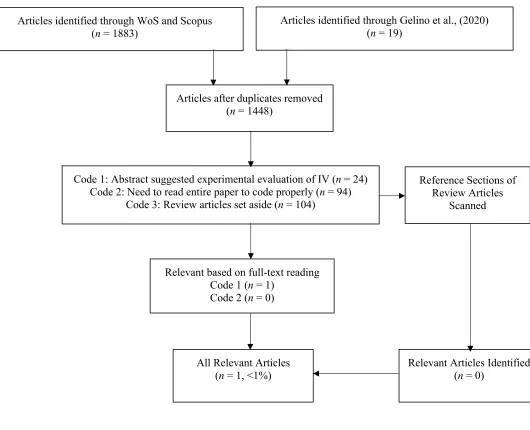
procedures yielded only one study identified as containing an experimental evaluation of a community intervention aimed at reducing GHG emissions, which represents less than one percent of all articles found in our searches.
Figure 1
Flow Chart of Article Inclusion and Exclusion by Stage
Articles identified through WoS and Scopus (n = 1883)
Ide
nt
if
ic
at
ion
Articles identified through Gelino et al., (2020)(n = 19)
Articles after duplicates removed (n = 1448)
S
cr
ee
ni
ng
Inc
lude
d
E
li
gi
bi
li
ty
Reference Sections of Review Articles
Scanned Code 1: Abstract suggested experimental evaluation of IV (n = 24)
Code 2: Need to read entire paper to code properly (n = 94) Code 3: Review articles set aside (n = 104)
Relevant based on full-text reading Code 1 (n = 1)
Code 2 (n = 0)
Relevant Articles Identified (n = 0)
REVIEW OF COMMUNITY INTERVENTIONS TO REDUCE GHG EMISSIONS
Alberts et al.,33 was the only study we identified that contained the defined characteristics of an experimental evaluation of a community intervention to reduce GHG emissions. At the time of their study, firewood was the primary source of energy for cooking in Nicaragua and was found to be one of the two main causes of deforestation throughout the country. Out of concern over deforestation, and in line with a community-based participatory research approach (wherein community members dictate the problems and solutions to be addressed), Alberts et al. conducted a community intervention by
mobilizing several sectors of two Nicaraguan communities to shift consumption of firewood to kerosene for cooking. Residents of two rural villages were surveyed to establish a baseline level of firewood use for cooking. Next, residents were offered the opportunity to purchase a kerosene stove at a 35% discount. Furthermore, the stove could be financed over 6 months to accommodate the limited resources of community members. Finally, a second survey of community residents was carried out to estimate the impact of the intervention on firewood use. Results showed that the vast majority of subjects adopted kerosene stoves as a result of the intervention and that use of firewood throughout the two rural communities decreased by 50% which in turn led to reductions in GHG emissions.
Strengths of this study include the mobilization of multiple sectors of the Nicaraguan rural communities. The Foundation for Social and Economic Development of the Rural Area, who carried out the study, utilized their broad reach into Nicaraguan community affairs to mobilize multiple sectors. In general, they mobilized local populations to participate in the rural development program centered on equity and reforestation, and in turn, translated public aspirations and strategies into generalized policy recommendations to improve the rural situation. Their policy recommendations were supported, and the project received funding from other community sectors to carry it out. A second strength of this study is that the intervention contained multiple components (i.e., stove discounts and financing) that were applied throughout two entire geopolitical entities (in this case, villages). The multifaceted approach likely contributed to the effectiveness of the intervention. However, this study is not without its
shortcomings. Survey data were collected by self-report and as such, the accuracy of the data is difficult to verify. Also, the experimental design (pre-post) lacks critical elements of strong group designs. Randomization of subjects to a no-intervention control group was not included as a design feature thereby threatening internal validity. Despite these weaknesses, it nonetheless satisfied our definition of an experimental evaluation of a community intervention to reduce GHG emissions.
4. Discussion
The most important conclusion drawn from the present analysis is that there is too little
experimental research testing the impact of community strategies for affecting GHG emissions. Despite a comprehensive search, only one study (less than one percent of all studies) was identified that evaluated community interventions to reduce GHG emissions using some form of experimental design. Given the number and variety of community interventions that are being adopted worldwide,18, 19, 21, 23 this result indicates a significant missed opportunity to identify and accumulate increasingly effective strategies.
The dearth of experimental evaluations is not due to a lack of community interventions to affect emissions. Indeed, the report of European Network for Community-Led Initiatives On Climate Change and Sustainability19 indicated that “the scope and diversity of community-led action on sustainability and climate change in Europe, while unknown, is vast.” Similarly in the U.S. at least 392 mayors34 have joined in an effort to reduce emissions in their communities.34
significantly increased through experimental evaluation. This is not to say that experimental evaluation will necessarily result in successful outcomes. Rather, we are saying that over time and multiple studies, we will be able to retain interventions that have positive effects and eliminate or modify strategies that experimentation has shown had no benefit.
The use of experimental evaluations in the human sciences has yielded an enormous body of evidence relevant to improving human well-being. Specifically, through the application of experimental methods, tested and effective interventions have been developed to address a wide range of problems. In clinical psychology, efficacious interventions have been evaluated and refined for the treatment of the most common and costly psychological and behavioral problems, including depression, anxiety, physical inactivity, obesity, antisocial behavior, and substance use disorders.35 Similarly, prevention scientists using experimental evaluations have developed family and school interventions that have proven benefit in preventing the development of all of the most common and costly problems of childhood and
adolescents, including depression, anxiety, academic failure, antisocial behavior, and substance use.26, 36-41 A wide variety of other fields have also embraced experimental methods, including medicine, political science 42, economics, and public policy.43-46 We submit that similar progress will occur in the field of climate change if greater use is made of these methods. In what follows, we discuss the experimental methods that we believe are most likely to accelerate the ability of communities to reduce GHG emissions and highlight relevant examples.
One of the most surprising things in our review of the literature is the number of papers that describe community interventions in multiple communities but do not provide empirical evidence of the impact of the interventions on greenhouse gas emissions. There are qualitative case studies of various community interventions, with no information about their impact.47, 48 Some rely on reports of the intervention organizations’ impact, but do not indicate how measures were obtained. Others provide qualitative analyses of the types of interventions being tried, but do not report on the impact of
interventions.23 Thus, they provide little guidance to communities that are seeking to implement the most effective strategies.
4.1 Limitations
One limitation of our analysis is that it was restricted to only three of the strategies for reducing global warming—refrigeration, energy generation, and food waste. It is possible that we missed
experimental evaluations of community interventions focused on other areas, such as the education of girls, and family planning. It is also possible that we missed community interventions focused on policy adoption, although an ongoing search of that literature has thus far failed to reveal such studies.
4.2 Experimental Methods
Given the paucity of experimental evaluations that our literature review has documented, there exists little understanding of the most effective ways to influence the climate-related behavior of individuals, households, and organizations. Pinpointing powerful functional relationships is foundational for developing interventions that can then be scaled up to affect behavior in entire communities.
REVIEW OF COMMUNITY INTERVENTIONS TO REDUCE GHG EMISSIONS
9
assignment controls for the possible effects of other variables, thereby increasing our confidence that observed differences are due to the intervention and enhancing our ability to make causal inferences.There is, however, another form of experimental design which is less widely used but is likely to be more profitably applied when it comes to community interventions. It is variously referred to as Single Case Designs or Interrupted Time Series Designs.50 Relatedly, there is already a body of research showing the value of these designs for identifying interventions that affect environmentally-relevant behaviors.28 In what follows, we describe these methods, then illustrate their use with examples of two experimental evaluations of interventions to affect electricity consumption.
Interrupted time series designs involve the application of an independent variable to an outcome that is repeatedly measured over time (i.e., a time series).50 For example, an intervention to decrease the use of electricity during peak hours of use might involve a discount to customers for use of electricity in off-peak hours. The impact of this incentive would be measured by increases in use during off-peak hours and decreases during peak hours. The impact could be measured in terms of the mean use during each time period and in terms of changes in the slope of use for each period.
The two most common single case designs are the ABA design and the multiple baseline design (sometimes referred to as a stepped wedge design.51 In an ABA design, a baseline measure of the targeted outcome is obtained for a period of time (i.e., the A stage). Once the baseline rate is stable, an intervention is implemented (the B stage) and its impact on the rate of the outcome is evaluated. Any change in rate suggests that the intervention had an effect. However, in a subsequent stage, the intervention is removed and the A stage is reinstated. If the rate of the event returns to its baseline level, this is further evidence that the intervention was responsible for the change.
Figure 2
An ABA design showing electricity consumption reported by Kohlenberg et al. (1976)
REVIEW OF COMMUNITY INTERVENTIONS TO REDUCE GHG EMISSIONS
Figure 3
A multiple baseline design showing percent of rooms with lights left on reported by Clayton and Nesnidol (2017)
(Figure 3 © Taylor and Francis. Reuse not permitted)
REVIEW OF COMMUNITY INTERVENTIONS TO REDUCE GHG EMISSIONS
13
persuasive communication designed to influence support for a community effort to reduce greenhouse gas emissions by randomly assigning people to receive or not receive such a message. However, this is a time-consuming and costly approach that may fail entirely if the persuasive message is ineffective. A better strategy would be to test the message with a series of individuals or small groups, modifying the message in light of its impact with each successive group, as with a multiple baseline design. In essence, single-case designs encourage the ongoing refinement of interventions, in light of the immediate feedback provided by data as interventions are systematically evaluated. This feedback may guide coursecorrections and suggest changes to the intervention or its implementation, based upon the most recent results of its use.
Traditional randomized trials require the involvement of a relatively large number of communities, random assignment to conditions, and standardization of the intervention across communities. Few organizations or communities have the wherewithal to have multiple communities agree to simultaneously implement an intervention, let alone to agree to be in a control condition. It is likely that these barriers are responsible for the lack of randomized trials in the literature we reviewed.
Interrupted time-series designs can be used in every community. They can be used to evaluate individual components of comprehensive interventions so that over time these component interventions become more effective. Moreover, single-case designs provide a system for managing an intervention since they involve ongoing monitoring of the targeted behavior in a way that gives the project feedback about what is and what is not working and enables course corrections.
We believe that time-series methods have a role to play in the management of interventions. With frequent incoming data, the practices of an intervention can be shaped by immediate feedback about what is working and what is not. This is not just a matter of building a body of literature on what works. It is a matter of guiding our work in each community in an ongoing way.
Although we strongly advocate for the increased use of interrupted time series designs, this does not preclude alternative methodologies for conducting climate change research. Rather, we believe that variation and selection is our best hope for evolving not only effective interventions, but more effective experimental designs. Guastaferro & Collins54 describe the Multiphase Optimization Strategy (MOST) that involves a factorial design for assessing the relative impact of multiple intervention components. For example, one might have a community intervention consisting of three components: a school intervention to involve students in emission reduction, a household component to influence emission behavior, and a policy initiative to require organizations to audit and reduce their emission. With multiple communities, one could randomly assign communities to get zero, one, two, or all three of the components. The utility of this design is that it would not only reveal the impact of each component; it will also test the
synergistic effects among components. The challenge in such a design would be to get the resources to work in a large number of similar communities. However, given the extent to which we are failing to reduce emissions, massive increases in expenditures on experimental evaluations are imperative.
In summary, all experimental methods – including both randomized trials and single-case designs – allow us to select strategies that work. Testing a wide variety of strategies for affecting greenhouse gas emissions using a variety of experimental methods, will accelerate the identification of the most effective strategies for reducing GHG emissions and contribute to the prevention of further climate change.
4.3 The Nature of Community Interventions
Stern et al.56 have suggested design principles for any effort to reduce greenhouse gas emissions. First, prioritize high-impact actions. Second, provide sufficient financial incentives to motivate people to make major changes to their lives. Third, strongly market whatever programs are being implemented. Fourth, provide valid information from credible sources at the points of decision. Fifth, keep it simple. Sixth, provide quality assurance.
A variety of community intervention strategies should be tested. These include efforts to get policies adopted by municipalities, the implementation of policies in communities, media campaigns to influence households and organizations in the community, and school-based programs in all the schools in the community. We suggest that the most promising interventions are those that systematically organize support for emission reduction in every sector of the community. This has been the most common strategy in the community interventions conducted to affect health behavior in communities and thus formed the foundation for our definition of a community intervention.9, 12-14, 57, 58In the context of GHG emissions, this strategy consists of educating and engaging leaders of every sector of the
community about the need for reductions in greenhouse gas emissions, forming a cross-sector coalition of organizations that leads a community-wide process of identifying policies and practices that have been shown to have some impact on emissions, implementing those policies and practices, and creating a “backbone” organization59 to monitor implementation and the impact of each strategy on its targeted outcomes. Vandenbergh and Gilligan60 have made a strong case for the extent to which progress can be made in reducing emissions through the actions of business and other nongovernmental organizations. Community interventions can be a vehicle for increasing these actions and for business organizations influencing governments actions.
Among the strategies that would be offered for the leadership’s consideration are policies that would increase the cost of emissions, policies that provide incentives for reductions,61 and policies that require ongoing measurement of emissions and feedback of that information to the community as a whole and to specific sectors of the community (e.g., households, businesses, government, transportation, schools). Programs that could be implemented might include (a) assistance to businesses in measuring their emissions and adopting policies and programs that help them reduce emissions, (b) feedback and incentives to utility customers for reducing emissions,62 (c) school programs that educate students about reducing emissions and have the students interview their parents 63 in a way that increases parental involvement in reducing emissions, (d) neighborhood organizing to enhance social cohesion and promote emission reduction, and (e) enhancing social recognition for efforts to reduce emissions.
REVIEW OF COMMUNITY INTERVENTIONS TO REDUCE GHG EMISSIONS
15
Experimental methods—especially interrupted time-series designs—would be useful not only in assessing the overall impact on emissions in a community but in assessing the impact of each initiative. A multiple baseline design across communities65 could be used to assess effects on total emissions of communities. But such designs could also be used to assess the impact of student interviews or utility incentives on household emissions. As a form of continuous quality improvement, the latter designs would provide ongoing feedback about what was working and what needed to be abandoned or modified.4.4 The Power of Behavioral Science Research
This analysis, and others that we are conducting, have revealed a surprising dearth of funding for behavioral science research on reducing greenhouse gas emissions. Ultimately, all emissions are a matter of human behavior. Yet we find that far more resources are being put into technological efforts to mitigate emissions than into changing the behavior of individuals, households, organizations, or entire communities.66 A vast body of knowledge about influencing human behavior accumulated thanks to experimental evaluations of treatment and prevention programs.26
Author contributions:
AB wrote the first draft of the manuscript, contributed extensive editing and feedback throughout the manuscript production, and coordinated the task force effort.
ACB developed the coding process together with MJ and JLG, contributed to the method section and wrote the results section, coded papers, coordinated the snowball sampling, produced the figures and table, and edited all sections of the paper.
MJ conducted the database searches, wrote the method section, developed the coding process together with ACB and JLG, and edited most parts of the manuscript.
JLG developed the coding process together with MJ and ACB, coded papers, conducted the snowball sampling with ACB, provided feedback and edits for all sections of the manuscript.
MJVR coded papers, wrote portions of the discussion, and edited all sections of the manuscript. TLB coded papers, wrote portions of early drafts of abstract and introduction, and edited all sections of the manuscript.
HAS coded papers, and edited all sections of the manuscript.
JHF coded papers, edited all sections of the manuscript, re-wrote the abstract, and wrote parts of the introduction.
LWC provided feedback and edited all sections of the manuscript.
Funding: This research received no external funding
REVIEW OF COMMUNITY INTERVENTIONS TO REDUCE GHG EMISSIONS
17
Appendix ADescriptions and instructions of 3 stages of article coding Stage 1
Goal: To identify articles that used experimental design (e.g., between-groups design, single-case design) to evaluate real life effects of an intervention on some form of GHG-emission related outcome (e.g., electricity use, food waste, gasoline consumption, CO2 emissions, etc.). We include quasi-experimental designs, but exclude computer modeling/simulations, lab experiments, etc.
Instructions: Indicate relevant codes by putting the number 1 in the corresponding column(s) for the appropriate code(s). If a particular code is not indicated, leave the cell blank.
Step 1: Open the corresponding Excel spreadsheet and locate the rows assigned to you for coding (i.e., cell A3).
Step 2: Navigate to the correct row and read the article title.
Step 3: Indicate Code 0a (code descriptions below) if the paper is clearly irrelevant based on title. If 0a is not immediately obvious, then go to step 4. If Code 0a is indicated, continue to next article and repeat. Step 4: Read the abstract (you may need to double click the cell to view the whole abstract).
Step 5: Indicate Code 0b if the paper is irrelevant based on abstract. If indicated, continue to next article and repeat. If Code 0b not indicated, continue to Step 6.
Step 6: Indicate Codes 1-4 where relevant. Repeat for all articles. Step 7: Return completed template by email to volunteer coordinators
Stage 1 Code Descriptions
Code 0a: Irrelevant based on title. If 0a is not immediately obvious, then read abstract and code 0b if appropriate. Code 0a should only be indicated if the title is obviously and definitively unrelated. Code 0b: Irrelevant based on abstract. If Code 0a or 0b indicated (do not indicate both), do not indicate code 1-4.
Code 1a: Experimental method/design is used to evaluate real life effect of an intervention on some form of GHG-emission related outcome (ie. electricity use, food waste, food selection, co2 emission, etc). Include quasi-experimental designs, but not computer modeling simulations, lab experiments, or game theory approaches. Self-report measures are ok at this stage, as long they are related to GHG-emission outcomes (e.g., reports of ambient home temperature before and after intervention).
Code 1b: Which experimental method/design? Copy and paste the relevant information directly from the abstract. If unsure, just leave blank.
Code 2: This is a review of literature, interventions or policies aiming to reduce GHG emissions in some way. Can for instance be retrospective longitudinal data, evaluating outcomes based on different policies. Code 3: This is a meta-analysis of interventions or policies (same as Code 2, but effect-size measures are reported).
Code 4: Need to read the whole paper to code properly. Use this code sparingly when Code 1a is uncertain.
Stage 2
Instructions: Indicate relevant codes by putting the number 1 (or listing with words where indicated) in the corresponding column(s) for the appropriate code(s). If a particular code is not indicated, leave the cell blank
Step 1: Open the corresponding Excel spreadsheet and locate the rows assigned to you for coding (i.e., cell A3).
Step 2: Navigate to the correct row to locate the assigned article title. Retrieve the assigned article and read it.
Step3: If the article does not contain a community intervention aimed at reducing greenhouse gas emissions indicated Code 0 (code descriptions below). If Code 0 is indicated, continue to the next article and repeat.
Step 3: Indicate Codes 1-8 where relevant. Repeat for all articles Step 4: Return completed template by email to volunteer coordinators
Stage 2 Code Descriptions
Code 0: Irrelevant based on full-text reading.
Code 1: Data collected directly (i.e., by automated measurement or observation) Code 2: Data collected indirectly (i.e., by self-report or survey)
Code 3: What type of design was used (group or interrupted time series?)
Code 4: Indicate the exact design arrangement by selecting the cell which correctly depicts the design (O=observation, X=intervention, R=Random assignment)
Code 5: Indicate all dependent variables and units (e.g., electricity consumption in KwH)
Code 6: List all the intervention components (e.g., incentives, performance feedback, information etc). Code 7: What type of community was targeted (e.g., village, town, city)
Code 8: Describe the overall impact of the intervention using descriptive statistics (e.g., 10% reduction in electricity) or inferential statistics (e.g., statistically significant difference between groups) presented in text.
Stage 3
Goal: To search the reference sections of articles indicated as Code 2 or 3 from Stage 1 for relevant titles.
Instructions: Paste relevant citations beside assigned articles. All new citations will undergo Stage 2 coding procedures.
Step 1: Open the corresponding Excel spreadsheet and locate the rows assigned to you for coding (i.e., cell A3).
Step 2: Navigate to the correct row to locate the assigned article title. Retrieve the assigned article and navigate to the reference section.
Step 3: Scan each article in the reference section looking for article titles that suggest a relevant evaluation may be contained therein.
Step 4: If relevant citation is found, paste it beside article title in corresponding spreadsheet. Step 5: Repeat for all articles assigned.
REVIEW OF COMMUNITY INTERVENTIONS TO REDUCE GHG EMISSIONS
19
References1. DeFries, R. S.; Edenhofer, O.; Halliday, A. N.; Heal, G. M.; Lenton, T.; Puma, M.; Rising, J.; Rockström, J.; Ruane, A. C.; Schellnhuber, H. J.; Stainforth, D.; Stern, N.; Tedesco, M.; Ward, B. A., The missing economic risks in assessments of climate change impacts. The London School of Economics and Political Science 2019.
2. Oreskes, N.; Oppenheimer, M.; Jamieson, D., Scientists have been underestimating the pace of climate change. In Observations, Scientific American ScientificAmerican.com, 2019.
3. Friedlingstein, P.; Jones, M. W.; O'Sullivan, M.; Andrew, R. M.; Hauck, J.; Peters, G. P.; Peters, W.; Pongratz, J.; Sitch, S.; Le Quéré, C.; Bakker, D. C.; Canadell, J. G.; Ciais, P.; Jackson, R. B.; Anthoni, P.; Barbero, L.; Bastos, A.; Bastrikov, V.; Becker, M. H.; Bopp, L.; Buitenhuis, E.; Chandra, N.; Chevallier, F.; Chini, L. P.; Currie, K. I.; Feely, R. A.; Gehlen, M.; Gilfillan, D.; Gkritzalis, T.; Goll, D. S.; Gruber, N.; Gutekunst, S.; Harris, I.; Haverd, V.; Houghton, R. A.; Hurtt, G.; Ilyina, T.; Jain, A. K.; Joetzjer, E.; Kaplan, J. O.; Kato, E.; ... Zaehle, S., Global carbon budget 2019. Earth System Science Data 2019,11 (4), 1783-1838.
4. Abrahamse, W.; Steg, L.; Vlek, C.; Rothengatter, T., A review of intervention studies aimed at household energy conservation. Journal of Environmental Psychology 2005,25 (3), 273-291.
5. Fischer, J.; Dyball, R.; Fazey, I.; Gross, C.; Dovers, S.; Ehrlich, P. R.; Brulle, R. J.; Christensen, C.; Borden, R. J., Human behavior and sustainability. Frontiers in Ecology and the Environment 2012, 10 (3), 153-160.
6. Osbaldiston, R.; Schott, J. P., Environmental Sustainability and Behavioral Science:Meta-Analysis of Proenvironmental Behavior Experiments. Environment and Behavior 2012,44 (2), 257-299. 7. Steg, L.; Vlek, C., Encouraging pro-environmental behaviour: An integrative review and research
agenda. Journal of Environmental Psychology 2009,29 (3), 309-317.
8. Wynes, S.; Nicholas, K. A.; Zhao, J.; Donner, S. D., Measuring what works: quantifying greenhouse gas emission reductions of behavioural interventions to reduce driving, meat consumption, and household energy use. Environmental Research Letters 2018,13 (11), 113002. 9. Luepker, R. V.; Murray, D. M.; Jacobs, D. R.; Mittelmark, M. B.; Bracht, N.; Carlaw, R.; Crow,
R.; Elmer, P.; Finnegan, J.; Folsom, A. R., Community education for cardiovascular disease prevention: risk factor changes in the Minnesota Heart Health Program. American Journal of Public Health 1994,84 (9), 1383-1393.
10. Fortmann, S. P.; Varady, A. N., Effects of a community-wide health education program on cardiovascular disease morbidity and mortality: The Stanford Five-City Project. Am J Epidemiol 2000,152 (4), 316-23.
11. Community Intervention Trial for Smoking Cessation (COMMIT): I. cohort results from a four-year community intervention. American journal of public health 1995,85 (2), 183-192.
12. Biglan, A.; Ary, D. V.; Smolkowski, K.; Duncan, T.; Black, C., A randomised controlled trial of a community intervention to prevent adolescent tobacco use. Tobacco Control 2000,9 (1), 24-32. 13. Pentz, M. A.; Dwyer, J. H.; MacKinnon, D. P.; Flay, B. R.; Hansen, W. B.; Wang, E.; Johnson, C.
A., A multicommunity trial for primary prevention of adolescent drug abuse. Effects on drug use prevalence. Journal of American Medical Association 1989,261 (22), 3259-3266.
14. Oesterle, S.; Kuklinski, M. R.; Hawkins, J. D.; Skinner, M. L.; Guttmannova, K.; Rhew, I. C., Long-Term Effects of the Communities That Care Trial on Substance Use, Antisocial Behavior, and Violence Through Age 21 Years. American Journal of Public Health 2018,108 (5), 659-665. 15. Murray, B.; Rivers, N., British Columbia’s revenue-neutral carbon tax: A review of the latest
“grand experiment” in environmental policy. Energy Policy 2015,86, 674-683.
17. Axon, S.; Morrissey, J.; Aiesha, R.; Hillman, J.; Revez, A.; Lennon, B.; Salel, M.; Dunphy, N.; Boo, E., The human factor: Classification of European community-based behaviour change initiatives. Journal of Cleaner Production 2018,182, 567-586.
18. Castán Broto, V.; Bulkeley, H., A survey of urban climate change experiments in 100 cities. Global Environmental Change 2013,23 (1), 92-102.
19. Penha-Lopes, G.; Henfrey, T., Reshaping the Future: How local communities are catalysing social, economic and ecological transformation in Europe. ECOLISE, the European network for
community-led initiatives on climate change and sustainability: Mountain View, CA, 2019. 20. Ford, J. D.; Berrang-Ford, L.; Paterson, J., A systematic review of observed climate change
adaptation in developed nations. Climatic Change 2011,106 (2), 327-336.
21. Landholm, D. M.; Holsten, A.; Martellozzo, F.; Reusser, D. E.; Kropp, J. P., Climate change mitigation potential of community-based initiatives in Europe. Regional Environmental Change 2018,19 (4), 927-938.
22. McNamara, K. E.; Buggy, L., Community-based climate change adaptation: a review of academic literature. Local Environment 2016,22 (4), 443-460.
23. Moloney, S.; Horne, R. E.; Fien, J., Transitioning to low carbon communities—from behaviour change to systemic change: Lessons from Australia. Energy Policy 2010,38 (12), 7614-7623.
24. Grimshaw, J., So what has the Cochrane Collaboration ever done for us? A report card on the first 10 years. CMAJ : Canadian Medical Association journal = journal de l'Association medicale canadienne 2004,171 (7), 747-749.
25. Zettle, R. D.; Barnes-Holmes, D.; Hayes, S. C.; Biglan, A., The Wiley handbook of contextual behavioral science. John Wiley & Sons: New York, NY, 2016.
26. Biglan, A., The nurture effect: How the science of human behavior can improve our lives and our world. New Harbinger: Oakland, CA, 2015.
27. O'Connor, R. E.; Vadasy, P. F., Handbook of Reading Interventions. The Guilford Press: New York, NY, 2011.
28. Gelino, B.; Erath, T.; Reed, D. D., Review of sustainability-focused empirical intervention published in behavior analytic outlets. 2020, Coded summary of empirical articles--focused on sustainable living--published in behavior analytic journals through 2019.
29. Hawken, P., Drawdown: The most comprehensive plan ever proposed to reverse global warming. Penguin: 2017.
30. Mudford, O. C.; Taylor, S. A.; Martin, N. T., Continuous recording and interobserver agreement algorithms reported in the Journal of Applied Behavior Analysis (1995-2005). Journal of applied behavior analysis 2009,42 (1), 165-169.
31. Shadish, W. R.; Cook, T. D.; Campbell, D. T., Experimental and quasi-experimental designs for generalized causal inference. Houghton Mifflin Co: Boston, MA, US, 2002.
32. Kazdin, A. E., Single-case research designs: Methods for clinical and applied settings (2nd ed.). 2nd ed.; Oxford University Press: 2011.
33. Alberts, H.; Moreira, C.; Perez, R. M., Firewood substitution by kerosene stoves in rural and urban areas of Nicaragua, social acceptance, energy policies, greenhouse effect and financial implications. Energy for Sustainable Development 1997,3 (5), 26-39.
34. Climate Mayors Climate Mayors Launches Steering Committee to Strengthen Climate Action. http://climatemayors.org/ (accessed June 14, 2020).
35. Hayes, S. C., A Liberated Mind: How to Pivot Toward What Matters. Penguin Publishing Group: 2019.
REVIEW OF COMMUNITY INTERVENTIONS TO REDUCE GHG EMISSIONS
21
37. Farrington, D. P.; Welsh, B. C., Family-based Prevention of Offending: A Meta-analysis.Australian & New Zealand Journal of Criminology 2003,36 (2), 127-151.
38. Kumpfer, K. L.; Alvarado, R., Family-strengthening approaches for the prevention of youth problem behaviors. American Psychologist 2003,58 (6-7), 457-465.
39. Van Ryzin, M. J.; Roseth, C. J., Cooperative learning effects on peer relations and alcohol use in middle school. Journal of Applied Developmental Psychology 2019.
40. Van Ryzin, M. J.; Roseth, C. J., Effects of cooperative learning on peer relations, empathy, and bullying in middle school. Aggressive behavior 2019,45 (6), 643-651.
41. Van Ryzin, M. J.; Roseth, C. J.; Fosco, G. M.; Lee, Y. K.; Chen, I. C., A component-centered meta-analysis of family-based prevention programs for adolescent substance use. Clin Psychol Rev 2016, 45, 72-80.
42. Green, D. P.; Gerber, A. S., The underprovision of experiments in political science. Annals of the American Academy of Political and Social Science 2003,589, 94-112.
43. Arceneaux, K., The Benefits of Experimental Methods for the Study of Campaign Effects. Political Communication 2010,27 (2), 199-215.
44. Cohen, A. M.; Stavri, P. Z.; Hersh, W. R., A categorization and analysis of the criticisms of Evidence-Based Medicine. International Journal of Medical Informatics 2004,73 (1), 35-43.
45. Kagel, J. H.; Roth, A. E., The handbook of experimental economics. Princeton University Press: 2016; Vol. 2.
46. Sherman, L. W., Misleading Evidence and Evidence-Led Policy: Making Social Science more Experimental. The ANNALS of the American Academy of Political and Social Science 2003,589 (1), 6-19.
47. Wolfram, M., Cities shaping grassroots niches for sustainability transitions: Conceptual reflections and an exploratory case study. Journal of Cleaner Production 2018.
48. Heiskanen, E.; Jalas, M.; Rinkinen, J.; Tainio, P., The local community as a “low-carbon lab”: Promises and perils. Environmental Innovation and Societal Transitions 2015,14, 149-164.
49. Flay, B. R.; Biglan, A.; Boruch, R. F.; Castro, F. G.; Gottfredson, D.; Kellam, S.; Moscicki, E. K.; Schinke, S.; Valentine, J.; Ji, P.; Committee, S. f. P. R. S. o. E. Standards of evidence: Criteria for efficacy, effectiveness, and dissemination; Washington, DC, 2004, 2004.
50. Biglan, A.; Ary, D. V.; Wagenaar, A. C., The value of interrupted time-series experiments for community intervention research. Prevention Research 2000,1 (1), 31-49.
51. Brown, C. A.; Lilford, R. J., The stepped wedge trial design: a systematic review. BMC Medical Research Methodology 2006,6 (1), 54.
52. Kohlenberg, R.; Phillips, T.; Proctor, W., A behavioral analysis of peaking in residential electrical-energy consumers. Journal of Applied Behavior Analysis 1976,9 (1), 13-18.
53. Clayton, M.; Nesnidol, S., Reducing Electricity Use on Campus: The Use of Prompts, Feedback, and Goal Setting to Decrease Excessive Classroom Lighting. Journal of Organizational Behavior Management 2017,37 (2), 196-206.
54. Guastaferro, K.; Collins, L. M., Achieving the Goals of Translational Science in Public Health Intervention Research: The Multiphase Optimization Strategy (MOST). American journal of public health 2019,109 (S2), S128-S129.
55. Stern, P. C., A reexamination on how behavioral interventions can promote household action to limit climate change. Nature Communications 2020,11 (1), 918.
57. Bracht, N.; Finnegan, J. R., Jr; Rissel, C.; Weisbrod, R.; Gleason, J.; Corbett, J.; Veblen-Mortenson, S., Community ownership and program continuation following a health demonstration project. Health Education Research 1994,9 (2), 243-255.
58. COMMIT, Community Intervention Trial for Smoking Cessation (COMMIT): I. cohort results from a four-year community intervention. American Journal of Public Health 1995,85 (2), 183-192. 59. Cabaj, M.; Weaver, L. Collective impact 3.0: An evolving framework for community change; Tamarack
Institute: Waterloo, Ontario Canada, 2016; pp 1-14.
60. Vandenbergh, M. P.; Gilligan, J. M., Beyond Politics: The Private Governance Response to Climate Change. Cambridge University Press: Cambridge, UK, 2017; p 494.
61. Hutton, R. B.; McNeill, D. L., The Value of Incentives in Stimulating Energy Conservation. Journal of Consumer Research 1981,8 (3), 291-298.
62. Dietz, T.; Gardner, G. T.; Gilligan, J.; Stern, P. C.; Vandenbergh, M. P., Household actions can provide a behavioral wedge to rapidly reduce US carbon emissions. Proceedings of the National Academy of Sciences 2009,106 (44), 18452-18456.
63. Biglan, A.; Ary, D.; Yudelson, H.; Duncan, T. E.; Hood, D., Experimental evaluation of a modular approach to mobilizing antitobacco influences of peers and parents. American Journal of Community Psychology 1996,24 (3), 311-339.
64. Stern, P. C., Individual and household interactions with energy systems: Toward integrated understanding. Energy Research & Social Science 2014,1, 41-48.
65. Biglan, A.; Ary, D. V.; Koehn, V.; Levings, D.; Smith, S.; Wright, Z.; James, L.; Henderson, J., Mobilizing positive reinforcement in communities to reduce youth access to tobacco. American Journal of Community Psychology 1996,24 (5), 625-638.
66. Coalition of Behavioral Science: Climate Change Task Force, A review of research funding for reducing greenhouse gas emissions. in prep.