R E S E A R C H A R T I C L E
Open Access
Mechanical ventilation modulates Toll-like
receptor-3-induced lung inflammation via a
MyD88-dependent, TLR4-independent pathway:
a controlled animal study
Carrie D Chun
1, W Conrad Liles
1,4, Charles W Frevert
3, Robb W Glenny
1,2, William A Altemeier
1*Abstract
Background:Mechanical ventilation augments lung inflammation resulting from exposure to microbial products. The objective of this study was to test the hypothesis that ventilator-associated immune modulation requires MyD88-dependent signaling. Because MyD88 is a critical adapter protein utilized for pro-inflammatory signaling by all Toll-like receptors (TLRs), with the exception of TLR3, as well as by the IL-1 and IL-18 receptors, MyD88
dependence would implicate generation of an endogenous soluble ligand recognized by one or more of these receptors during mechanical ventilation and would provide an opportunity for a potential future therapeutic intervention.
Methods:We compared the effect of mechanical ventilation on lung inflammation and permeability between poly (I:C) exposed mice with or without expression of MyD88. Poly(I:C) is a synthetic ligand for TLR3, the only MyD88-independent TLR, allowing isolation of the effect of MyD88 deletion on ventilator-augmentation of lung
inflammation. Lung inflammation was assessed by cytokine concentration in lung tissue homogenate and polymorphonuclear cell (PMN) number in bronchoalveolar lavage fluid (BALF). Lung permeability was assessed by total protein, IgM, and intravenously injected FITC-dextran concentrations in BALF.
Results:We found that MyD88 was required for mechanical ventilation augmentation of TLR3-induced lung inflammation and permeability. Because TLR4 is the most commonly reported receptor for endogenous ligands generated during tissue injury, we performed a second experiment comparing wildtype and TLR4-/- mice. We found that mechanical ventilation increased TLR3-mediated inflammation and permeability independent of TLR4. Conclusion:These data support the hypothesis that mechanical ventilation with moderate tidal volumes generates an endogenous ligand(s) recognized by MyD88-dependent receptor(s) other than TLR4, and that this mechanism can contribute to the development of ventilator-associated lung inflammation and injury. Identification of these ligands and/or receptors could lead to new pharmacological treatments for ARDS.
Background
Acute lung injury (ALI) and its more severe presenta-tion, the acute respiratory distress syndrome (ARDS), are important causes of mortality and health care expen-diture in the United States and elsewhere. The estimated incidence of ALI in the United States is 196,000 cases
annually with an estimated mortality of 38.5% [1]. Most patients with ARDS require mechanical ventilation, and multiple clinical studies have demonstrated that a lung protective ventilatory strategy employing lower tidal volumes alone or combined with end-expiratory pres-sure sufficient to prevent expiratory alveolar collapse reduces mortality in patients with ARDS [2-4].
Most clinical studies have focused on ventilator-asso-ciated lung injury (VALI) in the setting of pre-existing ARDS, but a retrospective case review by Gajic et al. * Correspondence: [email protected]
1
Department of Medicine, University of Washington, 1959 NE Pacific St, Seattle, WA 98195, USA
Full list of author information is available at the end of the article
reported that 24% of patients without clinical lung injury at the onset of mechanical ventilation eventually developed ALI and that the risk of developing ALI was positively correlated with the magnitude of tidal volume used during ventilation [5]. A second retrospective study by Jia et al. also identified tidal volume magnitude as an independent risk factor for the subsequent development of ALI in mechanically ventilated patients without pre-existing lung injury [6]. Studies using animal models support this finding. In rabbits, mechanical ventilation during endotoxemia synergistically increases alveolar polymorphonuclear cell (PMN) recruitment and cyto-kine expression in BALF beyond that seen with either endotoxin or mechanical ventilation alone [7,8]. In mice, mechanical ventilation modulates cytokine expression following both intra-tracheal lipopolysaccharide (LPS) instillation and intra-peritoneal LPS administration [9,10]. Mechanical ventilation augments PMN recruit-ment, cytokine expression, and lung permeability in murine models of Staphylococcus aureus pneumonia [11] and viral pneumonia [12]. Augmented lung inflam-mation and injury with mechanical ventilation also occurs with a variety of non-microbial insults such as hyperoxia [13,14] and intra-tracheal acid instillation [15]. Thus, these data suggest that ventilation with a strategy that does not independently cause clinically sig-nificant inflammation or injury may amplify the host response to pro-inflammatory stimuli, such as bacterial or viral infection, resulting in the development of acute lung injury.
How mechanical ventilation modulates lung inflamma-tion and injury in response to microbial products or other inflammatory insults remains unknown. One pos-sibility is that mechanical ventilation causes release of one or more endogenous ligands (i.e. signaling mole-cules generated by the host such as secreted cytokines or products resulting from tissue injury) for transmem-brane receptors, associated with pro-inflammatory sig-naling. These ligands could be either classical cytokines, such as IL-1b, IL-18, TNFa, or Fas ligand (CD178), or other damage-associated molecular patterns (DAMPs) released during cellular injury and recognized by pattern recognition receptors such as the Toll-like receptors. Multiple DAMPs have been described for the cell sur-face TLRs 2 and 4 [16-18]. Mechanical ventilation with very large tidal volumes generates hyaluronan fragments recognized by TLR4 [19]; however, whether this occurs at lower tidal volumes is unknown. Additionally, there is increasing evidence that the intracellular TLRs 3, 7, 8, and 9 can also respond to endogenous nucleotides and may therefore play an important role in inflammation resulting from tissue damage [20-24].
Evaluating these multiple different receptors individu-ally presents a significant challenge. However, an
alternative strategy takes advantage of the fact that all of the TLRs, with the exception of TLR3, as well as many of the early response cytokine receptors utilize the adap-ter protein, myeloid differentiation factor 88 (MyD88) [25,26]. In contrast TLR3 requires the Toll/IL-1 receptor domain containing adapter inducing interferon (TRIF) adapter protein [27]. Unique among members of the TLR family, TLR4 can signal via both the MyD88 and TRIF adapter proteins [28,29].
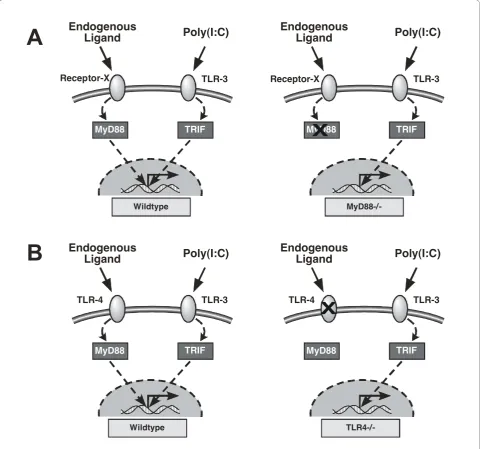
We hypothesized that mechanical ventilation with conventional tidal volumes releases one or more endo-genous ligand(s) recognized by a MyD88-dependent receptor(s) and that the resulting intracellular signal augments the inflammatory response to concurrent exposure to exogenous or microbial TLR ligands. By combining a TLR3-specific ligand and mice lacking functional MyD88, we were able to evaluate whether mechanical ventilation modulated inflammatory responses via a MyD88-dependent mechanism (Figure 1A). We found that mechanical ventilation with conven-tional tidal volumes modulates inflammation and lung permeability via MyD88-dependent pathways. Because TLR4 is the most commonly implicated MyD88-depen-dent receptor for damage-associated endogenous ligands, we evaluated the role of TLR4-dependent sig-naling during mechanical ventilation by measuring the inflammatory response of wild-type (WT) and TLR4-/-mice to a TLR3 ligand (Figure 1B). However, mechanical ventilation with moderate tidal volumes did not require TLR4 for augmentation of inflammation.
Methods
Reagents and Mice
The TLR3 specific ligand polyinosinic:polycytidylic acid (poly(I:C)) was purchased from Invivogen, diluted to a concentration of 10 mg/mL in sterile pyrogen-free PBS (Gibco), and stored in small aliquots at -20°C. Aliquots were thawed immediately before each experiment. Reagents for multiplex bead immunoassays were pur-chased from Millipore (Lincoplex).
The University of Washington Office of Animal Wel-fare approved these experiments. MyD88-/- (C57Bl/6 background) and TLR-4-/- (C57Bl/6 background) mice originally generated by Shizuo Akira (Osaka University) were obtained from Thomas Hawn (University of Washington) and Chris Wilson (University of Washing-ton), respectively. Control C57Bl/6 mice were purchased from Jackson Laboratories. All mice were housed in a specific-pathogen free facility. MyD88-/- and TLR-4-/-mice were bred at the University of Washington and genotype confirmed by PCR followed by gel electrophor-esis. Additionally, phenotype was confirmed in select lit-termates by hypo-responsiveness to Pam3CysSerLys4, a
(TLR-4-/-). Mice between 8 and 14 weeks of age were used for the experiments.
Experimental protocol
All mice were anesthetized with 5% isoflurane for 5 min, suspended by the front teeth at a 60° angle, and intra-tracheally inoculated with 2μL per gram body weight of poly(I:C) as previously described [9]. All mice were then returned to their cages.
30 min after instillation, mice were assigned to either mechanical ventilation or spontaneous respiration. Mice assigned to mechanical ventilation were anesthetized with ketamine 0.66 mg and xylazine 0.04 mg i.p. injec-tion and 5% isoflurane for 5 min and suspended by the front teeth at a 60° angle to allow direct visualization of the vocal cords by external laryngeal trans-illumination. Mice were orally intubated with a 20-gauge angiocath-eter (BD Biosciences) cut to 30 mm length with a
MyD88 TRIF
Receptor-X TLR-3
Endogenous
Ligand
Poly(I:C)
MyD88 TRIF
Receptor-X TLR-3
Endogenous
Ligand
Poly(I:C)
Wildtype
MyD88-/-MyD88 TRIF
TLR-4 TLR-3
Endogenous
Ligand
Poly(I:C)
MyD88 TRIF
TLR-4 TLR-3
Endogenous
Ligand
Poly(I:C)
X
Wildtype
TLR4-/-A
B
X
Figure 1Schematic of study strategy to test whether pro-inflammatory endogenous ligands are generated during mechanical
beveled tip. The catheter was positioned to a depth of 20 mm at the teeth and secured with a drop of glue. Mice were connected to a volume-cycled mouse ventila-tor (Minivent; Harvard Biosciences) with the following settings: tidal volume of 10 mL/kg body weight, respira-tory rate of 150 breaths per minute, positive end-expira-tory pressure of 3 cm H2O, and FiO2 0.21. Mice
received a 500 μL subcutaneous injection with dextrose 5% lactated Ringer’s solution (D5LR; Baxter) at the start of mechanical ventilation, followed by continuous sub-cutaneous infusion of D5LR at 250 μL/hr. Anesthesia and neuromuscular blockade were achieved with contin-uous inhaled 1% isoflurane and pancuronium 10μg/hr i.p., respectively. Three hours after the start of mechani-cal ventilation, mice were injected with 100 μL of 14 mM 70-kD fluorescein isothyocyanate dextran (FITC-D; Invitrogen) in sterile water into the retro-orbital vascular sinus for subsequent determination of lung permeability. Parameters measured continuously during mechanical ventilation included: airway pressure, temperature (via rectal thermistor) and mixed expiratory CO2
(Novame-trix). Blood pressure and heart rate were measured every 30 min (SC-1000, Hatteras Instruments). At the end of 6 hr of mechanical ventilation, mice were eutha-nized under isoflurane anesthesia by cardiac puncture and exsanguination.
Mice assigned to spontaneous ventilation remained in their cages with access to food and water for 6 hours. Three hours prior to the end of the experiment, each mouse was anesthetized with 5% isoflurane for 5 min in order to undergo retro-orbital injection with 100μL of 14 mM FITC-D. Mice were returned to their cages for the remainder of the experiment. After 6 hours of spon-taneous ventilation, mice were sedated with ketamine (0.66 mg) and xylazine (0.04 mg) i.p. and 5% isoflurane for 5 min and then euthanized by cardiac puncture and exsanguination.
Lung Homogenate and Bronchoalveolar Lavage Fluid (BALF) Preparation and Analysis
After euthanasia, the left lung was removed, weighed, and homogenized in 1 mL sterile water with protease inhibitor cocktail (cOmplete mini EDTA-free, Roche Diagnostics). Lung homogenate was vortexed with 32
μL of a 20× cytokine lysis buffer (final concentration: 0.5% Triton X-100, 150 mM NaCl, 15 mM Tris, 1 mM CaCl, 1 mM MgCl, pH 7.40). After 30 min incubation at 4°C and 20 min centrifugation at 10,000-g, the super-natant was stored in aliquots at -80°C for subsequent cytokine determination. Multiplex bead immunoassay (Lincoplex) was performed according to the manufac-turer’s protocol on the Luminex 100 platform to measure concentrations of KC/CXCL1, MCP-1/CCL2, MIP-1a/CCL3, IL-6, and TNF-a.
Bronchoalveolar lavage of the right lung was per-formed using three 0.5 mL aliquots of PBS containing 0.6 mM EDTA. A portion of the pooled BALF was set aside for total cell count by hemacytometer and for dif-ferential cell count using a cytospin preparation with Wright stain. The remaining BALF was centrifuged at 1500-g and 4°C for 10 min. BALF supernatant was removed and FITC-D concentration was determined by fluorescence spectroscopy at an excitation wavelength of 494 nm and emission wavelength of 521 nm (Perkin Elmer LS-50B). The fluid was then stored in small ali-quots at -80°C for subsequent determination of total protein concentration by Bradford Assay (Pierce Bio-technology) and IgM concentration by ELISA (Bethyl Laboratories).
Statistical Analysis
Data were analyzed by two-way ANOVA, using presence or absence of mechanical ventilation and genotype as the main effects. Additionally, our model included an interaction term to determine whether the effect of mechanical ventilation was dependent on genotype. Post-hoc comparisons, using a Bonferroni correction, were performed between genotypes for both ventilation conditions if either the genotype term or the mechanical ventilation · genotype interaction term were significant. Airway pressures were compared between the mechani-cally ventilated groups over time, using a repeated mea-sures ANOVA. Post-hoc comparisons for each time point were done using a Bonferroni correction. Statisti-cal significance was assigned at p≤ 0.05. All analyses were performed using Prism software (Graphpad). Data are presented as mean ± standard error of the mean (SEM).
Results
In the first experiment evaluating MyD88, 42 male mice were studied. Results from 40 mice are presented (10 per group). Two mice were excluded from analyses because of errors in FITC injection. In the second experiment evaluating TLR4, 40 mice of both genders were studied. Six male and 4 female mice were included in each experimental group. Results from all 40 mice are presented.
Role of MyD88 in ventilator-associated augmentation of TLR3-induced lung inflammation
genotype, was observed for expression of KC/CXCL1 and MIP1a/CCL3. A trend towards an interaction between mechanical ventilation and genotype was observed for IL-6 (p = 0.056) and MCP-1/CCL2 (p = 0.080).
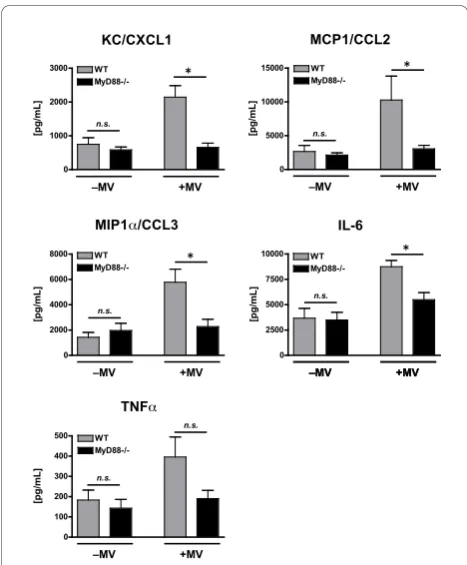
There were no observed differences in any of the cyto-kine levels between WT and MyD88-/- mice treated with poly(I:C) in the absence of mechanical ventilation (Figure 2). This was anticipated as TLR3 is a TRIF-dependent, MyD88-independent receptor and confirms that there were no contaminating exposure to ligands, which would be recognized by a MyD88-dependent receptor (e.g. LPS). In contrast, the lungs of mechani-cally ventilated, poly(I:C)-treated WT mice had signifi-cantly greater levels of KC/CXCL1 (2143 ± 340 vs. 657 ± 125 pg/mL), MCP1/CCL2 (10,283 ± 3554 vs. 3063 ± 513 pg/mL), MIP1a/CCL3 (5775 ± 1033 vs. 2280 ± 575 pg/mL), and IL-6 (8750 ± 624 vs. 5497 ± 696 pg/mL) as compared to the lungs of similarly treated MyD88-/-mice (Figure 2). Additionally, there was a non-significant trend towards more TNFa in ventilated WT mice as compared with MyD88-/- mice (396 ± 98.7 vs. 191 ± 40.5 pg/mL, p = 0.07). These data indicate that
augmentation of poly(I:C)-induced cytokine response during mechanical ventilation occurs primarily via a MyD88-dependent pathway.
Similar to lung cytokine measurements, there was an overall significant effect of both mechanical ventilation and genotype on BALF PMN count in poly(I:C)-treated mice (Figure 3A). Additionally, there was a strong inter-action effect, indicating that the effect of mechanical ventilation on BALF PMN count was genotype depen-dent. Consistent with this, there were more PMNs in the BALF of mechanically ventilated WT mice as com-pared with mechanically ventilated MyD88-/- mice (5.4 ± 0.5 × 10⁵ vs. 3.6 ± 0.6 × 10⁵ PMN, p < 0.05, Figure 3A). There was no difference in BALF PMN count between non-ventilated WT and MyD88-/- mice exposed to poly(I:C).
Mechanical ventilation increased both BALF total pro-tein (Figure 3B) and 70 kD FITC-D (Figure 3C) concen-trations in mice exposed to poly(I:C). There was no effect of genotype and no mechanical ventilation · geno-type interaction on either total protein or 70 kD FITC-D concentration in the BALF; although, there was a non-significant trend towards a mechanical ventilation · genotype interaction effect on 70 kD FITC-D BALF concentration (p = 0.081, Figure 3C). In contrast to total protein and FITC-D, there were significant effects of both mechanical ventilation and genotype on BALF concentration of IgM (Figure 3D). A strong interaction effect between genotype and mechanical ventilation was
KC/CXCL1 0 1000 2000 3000 WT MyD88-/-–MV +MV n.s. * [pg/mL]
MIP1α/CCL3
0 2000 4000 6000 8000 WT MyD88-/-n.s. –MV +MV * [pg/mL] TNFα 0 100 200 300 400 500 WT MyD88-/-n.s. n.s. –MV +MV [pg/mL] IL-6 0 2500 5000 7500 10000 WT MyD88-/-–MV +MV n.s. –MV +MV * [pg/mL] MCP1/CCL2 0 5000 10000 15000 WT MyD88-/-–MV +MV n.s. * [pg/mL]
Figure 2Cytokine concentrations in lung homogenate from
WT and MyD88-/- mice treated with intra-tracheal poly(I:C), a TLR3 agonist, in the presence or absence of concurrent mechanical ventilation (MV).n = 10/group.⁎- p < 0.05, comparing different genotypes within the same mechanical ventilation condition. BALF PMN 0 1 2 3 4 5 6 WT MyD88-/-n.s. –MV +MV *
Neutrophils x 10
5
BALF Total Protein
0 100 200 300 400 500 WT MyD88-/-–MV +MV n.s. n.s. [ µ g/mL]
BALF 70kD Dextran
0 20 40 60 80 WT MyD88-/-–MV +MV n.s. n.s. Relativ e Fluorescence BALF IgM 0 20 40 60 80 WT MyD88-/-–MV +MV n.s. * [ng/mL] A B C D
present for BALF IgM concentration, resulting in a sig-nificant difference between mechanically ventilated WT and MyD88-/- mice (55.0 ± 5.1 vs. 29.0 ± 4.0 ng/mL) but not between spontaneously breathing WT and MyD88-/- mice (Figure 3D). Because IgM exists primar-ily as a pentameric molecule with a molecular weight of ~900-kD, these data suggest that MyD88-dependent sig-naling contributes to ventilator-associated disruption of the alveolar-capillary barrier sufficient to allow leakage of large plasma proteins into the airspace. Interestingly, in contrast to cytokine production, both PMN recruit-ment and vascular permeability resulting from the com-bination of mechanical ventilation and poly(I:C) treatment were only partially attenuated in MyD88-/-mice, suggesting the presence of MyD88-independent pathways by which mechanical ventilation modulates the host response toTLR3 activation.
Peak airway pressures significantly increased over time during mechanical ventilation for both WT and MyD88-/- poly(I:C)-treated mice. However, there was no effect of genotype on peak airway pressures and no differences were observed between genotypes at any time (Figure 4A).
To summarize the first set of experiments, mechanical ventilation amplified cytokine expression following TLR3 stimulation via MyD88-dependent pathway(s). Both MyD88-dependent and MyD88-independent path-ways were required for maximal PMN recruitment and vascular permeability resulting from the combination of mechanical ventilation and poly(I:C) treatment.
Role of TLR4 in ventilator-associated augmentation of TLR3-induced lung inflammation
The first set of experiments demonstrated that mechani-cal ventilation augments TLR3-induced cytokine pro-duction, PMN recruitment, and lung permeability via one or more MyD88-dependent pathways. MyD88 is an adapter protein, linking transmembrane receptors involved in innate immune signaling and subsequent
pro-inflammatory responses. Therefore, these data sug-gest that mechanical ventilation causes release of endo-genous ligand(s) recognized by one or more MyD88-dependent receptors. TLR4 is a frequently identified receptor for tissue damage-associated endogenous ligands, particularly in the setting of sterile tissue reper-fusion injury, and is involved in reperreper-fusion injury to the lung [30], heart [31,32], liver [33,34], kidney [35], and brain [36]. Additionally, TLR4 was recently reported to contribute to inflammation in the setting of low tidal volume ventilation [37]. We therefore tested whether mechanical ventilation with normal tidal volumes aug-mented inflammatory responses via a TLR4-dependent mechanism. To test this hypothesis, we compared poly (I:C)-treated WT and TLR4-/- mice randomized to either spontaneous breathing or mechanical ventilation.
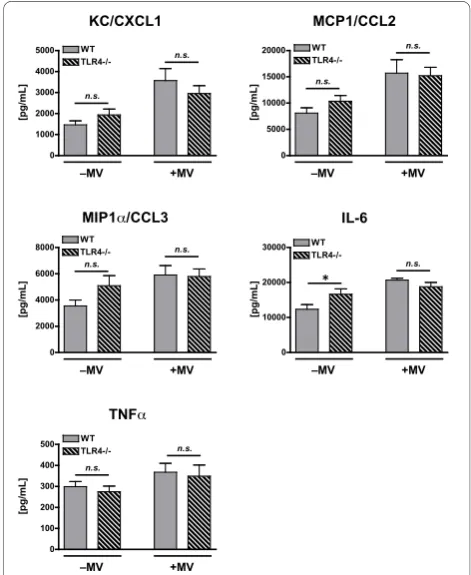
Consistent with the first experiment, there was a sig-nificant effect of mechanical ventilation on lung levels of KC/CXCL1, MCP1/CCL2, MIP1a/CCL3, and IL-6 in poly(I:C)-treated mice (Figure 5). A similar though non-significant trend was observed for TNFa(p = 0.056, Fig-ure 5). In contrast to the first experiment there was no
Peak Airway Pressure WT vs.
MyD88-/-0 1 2 3 4 5 6
0 5 10 15 20 25
WT
MyD88-/-Hours of Mechanical Ventilation
PAW
(cmH
2
O)
Peak Airway Pressure WT vs.
TLR4-/-0 1 2 3 4 5 6
0 5 10 15 20 25
WT
TLR4-/-Hours of Mechanical Ventilation
PAW
(cmH
2
O)
A B
Figure 4Peak airway pressures in mechanically ventilated,
poly(I:C)-treated WT and MyD88-/- mice (A) and WT and TLR4-/- mice (B).n = 10/group.
KC/CXCL1
0 1000 2000 3000 4000
5000 WT
TLR4-/-–MV +MV
n.s.
n.s.
[pg/mL]
MCP1/CCL2
0 5000 10000 15000
20000 WT
TLR4-/-n.s.
n.s.
–MV +MV
[pg/mL]
MIP1α/CCL3
0 2000 4000 6000
8000 WTTLR4-/- n.s.
n.s.
–MV +MV
[pg/mL]
IL-6
0 10000 20000 30000
n.s.
WT
TLR4-/-–MV +MV
*
[pg/mL]
TNFα
0 100 200 300 400
500 WT
TLR4-/-–MV +MV
n.s. n.s.
[pg/mL]
Figure 5Cytokine concentrations in lung homogenate from
genotype effect on cytokine expression and no interac-tion effect between mechanical ventilainterac-tion and genotype for any cytokine with the exception of IL-6. This inter-action effect for IL-6 was associated with significantly greater IL-6 in unventilated TLR4-/- mice as compared with unventilated WT mice. There was no difference in IL-6 between the ventilated, poly(I:C)-treated mice (Fig-ure 5).
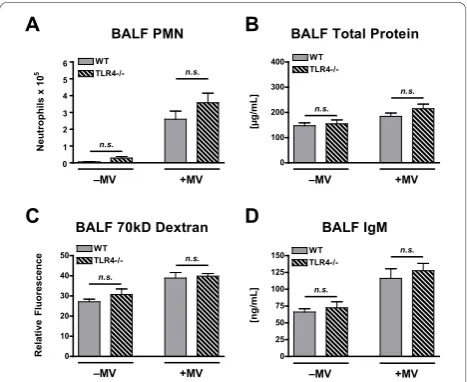
There was a significant effect of mechanical ventilation on BALF PMN counts in both WT and TLR4-/- poly(I: C)-treated mice, and there were no differences between WT and TLR4-/- mice under either spontaneous breathing or mechanical ventilation conditions (Figure 6A). There was a significant mechanical ventilation effect on lung permeability of poly(I:C)-treated mice as measured by BALF total protein, 70 kD FITC-D, and IgM concentrations (Figure 6B-D). There were no signif-icant effects from genotype or from a genotype · mechanical ventilation interaction for any of these per-meability measurements.
Peak airway pressures significantly increased over time during mechanical ventilation for both WT and TLR4-/-poly(I:C)-treated mice. However, there was no effect of genotype on peak airway pressures and no differences were observed between genotypes at any time (Figure 4B).
In summary, this set of experiments yielded results similar to those observed in the first set of experiments in which mechanical ventilation augmented inflamma-tion and lung permeability in the setting of TLR3
activation. There were no significant differences between WT and TLR4-/- mice responses to mechanical ventila-tion. These data show that mechanical ventilation does not require TLR4 to augment lung inflammation and injury associated with TLR3 activation.
Discussion
Prior studies demonstrated that mechanical ventilation alone, using tidal volumes of 10 mL/kg, does not inde-pendently cause significant cytokine production, neutro-phil recruitment, or lung permeability in mice. However, mechanical ventilation does augment both lung inflammation and injury in the presence of a variety of pro-inflammatory stimuli, including LPS, bacterial pneu-monia, and viral pneumonia [9-12]. We hypothesized that mechanical ventilation with a tidal volume of 10 mL/kg generates endogenous ligands, either classical cytokines and/or damage-associated molecular patterns (DAMPs), which are recognized by MyD88-dependent transmembrane receptors, resulting in amplification of the inflammatory response from concurrently adminis-tered poly(I:C), a TLR3 ligand. Because all known TLRs except for TLR3, as well as many early response cyto-kine receptors, signal via the MyD88 adapter protein, we studied the effect of mechanical ventilation in the set-ting of TLR3 activation in normal (WT, MyD88+/+) mice and in MyD88-/- mice. The main findings of this study were: 1) mechanical ventilation augmented cyto-kine expression, PMN recruitment, and lung permeabil-ity, during TLR3 activation; and 2) maximal cytokine response, PMN recruitment, and vascular permeability induced by mechanical ventilation required the MyD88 adapter protein.
Because TLR4 signals via MyD88 and has been impli-cated as a primary receptor for DAMPs, we tested whether mechanical ventilation at normal tidal volumes resulted in TLR4-dependent signaling. The role of TLR4 in ventilator-associated lung injury is uncertain with conflicting data in the literature. Held and co-authors previously reported that high tidal volume ventilation causes NF-B nuclear translocation and cytokine expression in lungs isolated from C3H/HeJ mice, which have a genetic polymorphism, resulting in a non-func-tional TLR4 [38]. In contrast, Vaneker and co-authors reported that low-tidal volume ventilation caused inflammation in wildtype but not in TLR4-/- mice [37]. Other studies have looked at the role of TLR4 in mechanical ventilation; however, these studies have also used concurrent LPS administration or bacterial infec-tion, making it difficult to separate out the contribution of mechanical ventilation on TLR4-dependent signaling [39,40]. We found that mechanically ventilated, TLR4-/-mice concurrently exposed to the TLR3 ligand, poly (I:C), did not have significantly different cytokine BALF PMN
WT
TLR4-/-0 1 2 3 4 5 6
n.s.
n.s.
–MV +MV
Neutrophils x 10
5
BALF Total Protein
0 100 200 300 400 WT
TLR4-/-n.s. n.s.
–MV +MV
[
µ
g/mL]
BALF 70kD Dextran
0 10 20 30 40
50 WTTLR4-/- n.s.
n.s.
–MV +MV
Relative Fluorescence
BALF IgM
0 25 50 75 100 125 150 WT
TLR4-/-n.s.
n.s.
–MV +MV
[ng/mL]
A B
C D
concentrations, PMN recruitment, or lung permeability as compared to similarly treated WT mice. Our data support the work of Held et al that mechanical ventila-tion with normal tidal volumes does not generate endo-genous ligands recognized by TLR4. The explanation for the different finding by Vaneker and colleagues is unclear but may relate to inadvertent LPS exposure dur-ing animal preparation or possibly an unanticipated interaction effect between the mechanical ventilation and the elevated inspired oxygen fraction (0.4) used in this study. Indeed interaction effects between ventilation and hyperoxia on inflammatory responses have been previously reported in animal models [13,14].
Selective attenuation of the mechanical ventilation effect on cytokine expression, PMN recruitment, and lung permeability in MyD88-/- mice suggests a role for signaling via the MyD88 adapter protein in ventilator-associated lung injury. The most likely mechanism involves stretch-induced generation of endogenous ligands, which signal via MyD88-dependent receptors. Known MyD88-dependent receptors include all of the TLRs with the exception of TLR3 [25], the IL-1 receptor [41], the IL-18 receptor [42], and Fas (CD95) [43]. There are no published data examining the effect of moderate tidal volume ventilation on signaling by these receptors; however, there is one report of increased IL-1a and IL-1brelease induced by low tidal volume venti-lation [44]. Identification of the MyD88-dependent path-ways by which mechanical ventilation modulates innate immune responses could provide therapeutic avenues to reduce the risk of acute lung injury in mechanically ven-tilated patients; however, a thorough examination of these different pathways is beyond the scope of the cur-rent work.
Interestingly, mechanical ventilation is reported to increase expression of TLR4 and its associated co-adap-ter, CD14 [39,40,45,46]. Thus, upregulation of TLRs is one potential mechanism by which mechanical ventila-tion could modify inflammatory responses. Although we did not specifically measure TLR3 expression in the cur-rent study, review of our previously published microar-ray study indicates that TLR4 mRNA but not TLR3 mRNA is increased in mice mechanically ventilated with a tidal volume of 10 mL/kg as compared with control mice [9]. Therefore, upregulation of TLRs is unlikely to be the only mechanism through which mechanical ven-tilation can amplify inflammation during concurrent exposure to TLR ligands.
An important additional observation from these experiments was that ventilator-induced augmentation of PMN recruitment and lung permeability was only partially attenuated in MyD88-/- mice, indicating the presence of parallel MyD88-independent pathways. One possible explanation for this result is stretch-induced
changes in endothelial cells. High tidal volume ventila-tion increases lung endothelial cell P-selectin and focal adhesion molecule expression [47]. These changes may promote vascular PMN demargination independent of TLRs and their respective adapter proteins. Another possibility is that the combination of mechanical ventila-tion and TLR3 activaventila-tion causes cellular injury sufficient to release mitochondrial-derived, formylated proteins, which have recently been reported as a mechanism for neutrophil recruitment in the setting of sterile tissue injury [24].
Conclusion
In summary, mechanical ventilation with tidal volumes of 10 mL/kg augmented inflammation and lung perme-ability in response to TLR3 activation. Mechanical venti-lation exerted its effects primarily via a MyD88-dependent but TLR4-inMyD88-dependent mechanism. Because MyD88 functions as an adapter protein for transmem-brane receptors, this study supports a role for receptor recognition of endogenous ligands in the pathogenesis of ventilator-associated lung injury. Further investigation to identify the relevant ligands and associated receptors will provide critical insight into designing new interven-tions to limit lung injury associated with mechanical ventilation.
Grant Support
This research was supported by National Institutes of Health Grants HL086883, HL73996, HL07287 and Canada Research Chair in Infectious Diseases and Inflammation (WCL)
Acknowledgements
MyD88-/- mice and TLR4-/- mice were used with the permission of Dr. Shizuo Akira of Osaka University. We thank Dowon An for her assistance with animal experiments and Wilson Slaid Jones and Tricia Lozon for their assistance with permeability and cytokine assays. Carrie Chun’s current address is: Scripps Clinic Medical Group, 10666 N Torrey Pines Rd MC 207W, La Jolla, CA 92037.
Author details
1Department of Medicine, University of Washington, 1959 NE Pacific St,
Seattle, WA 98195, USA.2Department of Physiology and Biophysics, University of Washington, 1705 NE Pacific St, Seattle, WA 98195, USA. 3Department of Comparative Medicine, University of Washington, 1959 NE
Pacific St, Seattle, WA 98195, USA.4Department of Medicine, McLaughlin-Rotman Centre for Global Health, McLaughlin Centre for Molecular Medicine, Toronto General Research Institute, University of Toronto, Toronto, ON, M5G 2C4, Canada.
Authors’contributions
CDC performed all experiments, and participated in data analysis and manuscript preparation. WCL, CWF, and RWG contributed to experimental design, data interpretation, and manuscript preparation. WAA oversaw all experiments, data analysis, and manuscript preparation. All authors read and approved the final manuscript.
Competing interests
Received: 10 August 2010 Accepted: 19 November 2010 Published: 19 November 2010
References
1. Rubenfeld GD, Caldwell E, Peabody E, Weaver J, Martin DP, Neff M, Stern EJ, Hudson LD:Incidence and outcomes of acute lung injury.N Engl J Med 2005,353(16):1685-1693.
2. Amato MB, Barbas CS, Medeiros DM, Magaldi RB, Schettino GP, Lorenzi-Filho G, Kairalla RA, Deheinzelin D, Munoz C, Oliveira R,et al:Effect of a protective-ventilation strategy on mortality in the acute respiratory distress syndrome.N Engl J Med1998,338(6):347-354.
3. The ARDS Network:Ventilation with lower tidal volumes as compared with traditional tidal volumes for acute lung injury and the acute respiratory distress syndrome. The Acute Respiratory Distress Syndrome Network.N Engl J Med2000,342(18):1301-1308.
4. Villar J, Kacmarek RM, Perez-Mendez L, Aguirre-Jaime A:A high positive end-expiratory pressure, low tidal volume ventilatory strategy improves outcome in persistent acute respiratory distress syndrome: a randomized, controlled trial.Crit Care Med2006,34(5):1311-1318. 5. Gajic O, Dara SI, Mendez JL, Adesanya AO, Festic E, Caples SM, Rana R, St
Sauver JL, Lymp JF, Afessa B,et al:Ventilator-associated lung injury in patients without acute lung injury at the onset of mechanical ventilation.Crit Care Med2004,32(9):1817-1824.
6. Jia X, Malhotra A, Saeed M, Mark RG, Talmor D:Risk factors for ARDS in patients receiving mechanical ventilation for > 48 h.Chest2008, 133(4):853-861.
7. Altemeier WA, Matute-Bello G, Frevert CW, Kawata Y, Kajikawa O, Martin TR, Glenny RW:Mechanical ventilation with moderate tidal volumes synergistically increases lung cytokine response to systemic endotoxin. Am J Physiol Lung Cell Mol Physiol2004,287(3):L533-542.
8. Bregeon F, Delpierre S, Chetaille B, Kajikawa O, Martin TR, Autillo-Touati A, Jammes Y, Pugin J:Mechanical ventilation affects lung function and cytokine production in an experimental model of endotoxemia. Anesthesiology2005,102(2):331-339.
9. Altemeier WA, Matute-Bello G, Gharib SA, Glenny RW, Martin TR, Liles WC: Modulation of lipopolysaccharide-induced gene transcription and promotion of lung injury by mechanical ventilation.J Immunol2005, 175(5):3369-3376.
10. O’Mahony DS, Liles WC, Altemeier WA, Dhanireddy S, Frevert CW, Liggitt D, Martin TR, Matute-Bello G:Mechanical ventilation interacts with endotoxemia to induce extrapulmonary organ dysfunction.Crit Care 2006,10(5):R136.
11. Dhanireddy S, Altemeier WA, Matute-Bello G, O’Mahony DS, Glenny RW, Martin TR, Liles WC:Mechanical ventilation induces inflammation, lung injury, and extra-pulmonary organ dysfunction in experimental pneumonia.Lab Invest2006,86(8):790-799.
12. Bem RA, van Woensel JB, Bos AP, Koski A, Farnand AW, Domachowske JB, Rosenberg HF, Martin TR, Matute-Bello G:Mechanical ventilation enhances lung inflammation and caspase activity in a model of mouse
pneumovirus infection.Am J Physiol Lung Cell Mol Physiol2009,296(1): L46-56.
13. Quinn DA, Moufarrej RK, Volokhov A, Hales CA:Interactions of lung stretch, hyperoxia, and MIP-2 production in ventilator-induced lung injury.J Appl Physiol2002,93(2):517-525.
14. Sinclair SE, Altemeier WA, Matute-Bello G, Chi EY:Augmented lung injury due to interaction between hyperoxia and mechanical ventilation.Crit Care Med2004,32(12):2496-2501.
15. Gurkan OU, O’Donnell C, Brower R, Ruckdeschel E, Becker PM:Differential effects of mechanical ventilatory strategy on lung injury and systemic organ inflammation in mice.Am J Physiol Lung Cell Mol Physiol2003, 285(3):L710-718.
16. Kaczorowski DJ, Mollen KP, Edmonds R, Billiar TR:Early events in the recognition of danger signals after tissue injury.J Leukoc Biol2008, 83(3):546-552.
17. Miyake K:Innate immune sensing of pathogens and danger signals by cell surface Toll-like receptors.Semin Immunol2007,19(1):3-10. 18. Tsan MF, Gao B:Endogenous ligands of Toll-like receptors.J Leukoc Biol
2004,76(3):514-519.
19. Jiang D, Liang J, Fan J, Yu S, Chen S, Luo Y, Prestwich GD,
Mascarenhas MM, Garg HG, Quinn DA,et al:Regulation of lung injury and
repair by Toll-like receptors and hyaluronan.Nat Med2005, 11(11):1173-1179.
20. Brentano F, Schorr O, Gay RE, Gay S, Kyburz D:RNA released from necrotic synovial fluid cells activates rheumatoid arthritis synovial fibroblasts via Toll-like receptor 3.Arthritis Rheum2005,52(9):2656-2665.
21. Hoffman RW, Gazitt T, Foecking MF, Ortmann RA, Misfeldt M, Jorgenson R, Young SL, Greidinger EL:U1 RNA induces innate immunity signaling. Arthritis Rheum2004,50(9):2891-2896.
22. Kariko K, Ni H, Capodici J, Lamphier M, Weissman D:mRNA is an endogenous ligand for Toll-like receptor 3.J Biol Chem2004, 279(13):12542-12550.
23. Krieg AM, Vollmer J:Toll-like receptors 7, 8, and 9: linking innate immunity to autoimmunity.Immunol Rev2007,220:251-269.
24. Zhang Q, Raoof M, Chen Y, Sumi Y, Sursal T, Junger W, Brohi K, Itagaki K, Hauser CJ:Circulating mitochondrial DAMPs cause inflammatory responses to injury.Nature2010,464(7285):104-107.
25. Janssens S, Beyaert R:A universal role for MyD88 in TLR/IL-1R-mediated signaling.Trends Biochem Sci2002,27(9):474-482.
26. Medzhitov R, Preston-Hurlburt P, Kopp E, Stadlen A, Chen C, Ghosh S, Janeway CA Jr:MyD88 is an adaptor protein in the hToll/IL-1 receptor family signaling pathways.Mol Cell1998,2(2):253-258.
27. Oshiumi H, Matsumoto M, Funami K, Akazawa T, Seya T:TICAM-1, an adaptor molecule that participates in Toll-like receptor 3-mediated interferon-beta induction.Nat Immunol2003,4(2):161-167. 28. Hoebe K, Du X, Georgel P, Janssen E, Tabeta K, Kim SO, Goode J, Lin P,
Mann N, Mudd S,et al:Identification of Lps2 as a key transducer of MyD88-independent TIR signalling.Nature2003,424(6950):743-748. 29. Yamamoto M, Sato S, Hemmi H, Hoshino K, Kaisho T, Sanjo H, Takeuchi O,
Sugiyama M, Okabe M, Takeda K,et al:Role of adaptor TRIF in the MyD88-independent toll-like receptor signaling pathway.Science2003, 301(5633):640-643.
30. Shimamoto A, Pohlman TH, Shomura S, Tarukawa T, Takao M, Shimpo H: Toll-like receptor 4 mediates lung ischemia-reperfusion injury.Ann Thorac Surg2006,82(6):2017-2023.
31. Hua F, Ha T, Ma J, Li Y, Kelley J, Gao X, Browder IW, Kao RL, Williams DL, Li C:Protection against myocardial ischemia/reperfusion injury in TLR4-deficient mice is mediated through a phosphoinositide 3-kinase-dependent mechanism.J Immunol2007,178(11):7317-7324. 32. Oyama J, Blais C Jr, Liu X, Pu M, Kobzik L, Kelly RA, Bourcier T:Reduced
myocardial ischemia-reperfusion injury in toll-like receptor 4-deficient mice.Circulation2004,109(6):784-789.
33. Tsung A, Hoffman RA, Izuishi K, Critchlow ND, Nakao A, Chan MH, Lotze MT, Geller DA, Billiar TR:Hepatic ischemia/reperfusion injury involves functional TLR4 signaling in nonparenchymal cells.J Immunol2005, 175(11):7661-7668.
34. Wu HS, Zhang JX, Wang L, Tian Y, Wang H, Rotstein O:Toll-like receptor 4 involvement in hepatic ischemia/reperfusion injury in mice.Hepatobiliary Pancreat Dis Int2004,3(2):250-253.
35. Wu H, Chen G, Wyburn KR, Yin J, Bertolino P, Eris JM, Alexander SI, Sharland AF, Chadban SJ:TLR4 activation mediates kidney ischemia/ reperfusion injury.J Clin Invest2007,117(10):2847-2859.
36. Hua F, Ma J, Ha T, Xia Y, Kelley J, Williams DL, Kao RL, Browder IW, Schweitzer JB, Kalbfleisch JH,et al:Activation of Toll-like receptor 4 signaling contributes to hippocampal neuronal death following global cerebral ischemia/reperfusion.J Neuroimmunol2007,190(1-2):101-111. 37. Vaneker M, Joosten LA, Heunks LM, Snijdelaar DG, Halbertsma FJ, van
Egmond J, Netea MG, van der Hoeven JG, Scheffer GJ:Low-tidal-volume mechanical ventilation induces a toll-like receptor 4-dependent inflammatory response in healthy mice.Anesthesiology2008, 109(3):465-472.
38. Held H-D, Boettcher S, Hamann L, Uhlilg S:Ventilation-Induced Chemokine and Cytokine Release Is Associated with Activation of Nuclear Factor-{kappa}B and Is Blocked by Steroids.Am J Respir Crit Care Med2001,163(3):711-716.
39. Hu G, Malik AB, Minshall RD:Toll-like receptor 4 mediates neutrophil sequestration and lung injury induced by endotoxin and hyperinflation. Crit Care Med38(1):194-201.
41. Burns K, Martinon F, Esslinger C, Pahl H, Schneider P, Bodmer JL, Di Marco F, French L, Tschopp J:MyD88, an adapter protein involved in interleukin-1 signaling.J Biol Chem1998,273(20):12203-12209. 42. Adachi O, Kawai T, Takeda K, Matsumoto M, Tsutsui H, Sakagami M,
Nakanishi K, Akira S:Targeted disruption of the MyD88 gene results in loss of IL-1- and IL-18-mediated function.Immunity1998,9(1):143-150. 43. Altemeier WA, Zhu X, Berrington WR, Harlan JM, Liles WC:Fas (CD95)
induces macrophage proinflammatory chemokine production via a MyD88-dependent, caspase-independent pathway.J Leukoc Biol2007, 82(3):721-728.
44. Vaneker M, Halbertsma FJ, van Egmond J, Netea MG, Dijkman HB, Snijdelaar DG, Joosten LA, van der Hoeven JG, Scheffer GJ:Mechanical ventilation in healthy mice induces reversible pulmonary and systemic cytokine elevation with preserved alveolar integrity: an in vivo model using clinical relevant ventilation settings.Anesthesiology2007, 107(3):419-426.
45. Moriyama K, Ishizaka A, Nakamura M, Kubo H, Kotani T, Yamamoto S, Ogawa EN, Kajikawa O, Frevert CW, Kotake Y,et al:Enhancement of the endotoxin recognition pathway by ventilation with a large tidal volume in rabbits.Am J Physiol Lung Cell Mol Physiol2004,286(6):L1114-1121. 46. Villar J, Cabrera NE, Casula M, Flores C, Valladares F, Diaz-Flores L, Muros M,
Slutsky AS, Kacmarek RM:Mechanical ventilation modulates TLR4 and IRAK-3 in a non-infectious, ventilator-induced lung injury model.Respir Res11:27.
47. Bhattacharya S, Sen N, Yiming MT, Patel R, Parthasarathi K, Quadri S, Issekutz AC, Bhattacharya J:High tidal volume ventilation induces proinflammatory signaling in rat lung endothelium.Am J Respir Cell Mol Biol2003,28(2):218-224.
Pre-publication history
The pre-publication history for this paper can be accessed here: http://www.biomedcentral.com/1471-2466/10/57/prepub
doi:10.1186/1471-2466-10-57
Cite this article as:Chunet al.:Mechanical ventilation modulates Toll-like receptor-3-induced lung inflammation via a MyD88-dependent,
TLR4-independent pathway: a controlled animal study.BMC Pulmonary
Medicine201010:57.
Submit your next manuscript to BioMed Central and take full advantage of:
• Convenient online submission
• Thorough peer review
• No space constraints or color figure charges
• Immediate publication on acceptance
• Inclusion in PubMed, CAS, Scopus and Google Scholar
• Research which is freely available for redistribution