6732
Adaptive Irrigation System Based On Fuzzy
Logic
Chiragkumar Aboti, Chinmay Sagade, Ajay Mehta, Mayur Lohana
Abstract: Conventional methods for irrigation system like canal, wells and rainfall are time consuming and seasonal. By using automated land irrigation system, water, time and energy can be conserved. The system consists of a moisture sensor, and temperature and humidity sensor which will sense the moisture content of the soil, and surrounding temperature and humidity respectively. It will accordingly notify the controller. ESP32 with equipped Wi-Fi module and microcontroller is used as the controller, in which fuzzy logic is used. It consists of mapped input/output values with membership functions. Input involves soil moisture and air humidity content and outputs of designed controller consist of water flow timing control operation. As the soil moisture content and air humidity varies due to surrounding conditions, the multiple-logic-level member functions are implemented accordingly. The motor ON-timing will vary according to the varying moisture and humidity levels. Also, an ultrasonic sensor is used to check and manage the water level in the tank through which the water is supplied to the crops. The Wi-Fi module is used to send the necessary information like the value of soil moisture, surrounding temperature, air humidity, water level in tank, motor ON-timings, etc. to a computer server, which will notify the user about all the important details, only when any event occurs. Event can be anything like sudden fall or rise in moisture/temperature, or drop in water level of supp ly tank below a certain threshold, etc. Data will also be sent to the server, if no event occurs in a time period of 3 hours. The usage of such automatic irrigation system will not only increase crop-production but also decrease expenses, water requirement, and provide power optimization, with increased efficiency.
Index Terms: Smart Irrigation, Agriculture, Farming, Temperature, Moisture, Humidity, Secure IoT Network, Fuzzy Logic.
————————————————————
1 INTRODUCTION
1.1 Background
ater is an important component for agriculture. Conventional methods for irrigation system like canal, wells and rainfall are time consuming and seasonal. By using adaptive irrigation system, maximum area can be irrigated in less time. The crux of this research is to design and simulate a fuzzy controller for automatic land irrigation. This controller is mathematically designed and simulated in MATLAB. It consists of mapped input/output values with membership functions. Input involves water level categorization and time. Output of designed controller consists of motor operation and power source. Software and calculated evaluation have been done on input controlling outputs. We calculate outputs to get minimum percentage error difference between calculated and simulated results. The usage of such adaptive irrigation system will not only increase crops production but also decrease expenses and solve frequent disconnection problem of tube well from grid due to load shedding. Due to large number of users in wireless environment communication paradigm also have shifted to the concept of Cognitive Radio Networks [7],[8] for better utilization of wireless spectrum.
1.2 Relevance
Computing and communications have undergone remarkable changes in recent decades. Computation is preferred on the go with a huge demand of mobility support in communicating [9, 10]. Conventional methods for irrigation system like canals, wells and rainfall are time consuming and seasonal. By using automated land irrigation system, water, time and energy can be conserved. The system consists of a moisture sensor which will sense the moisture content of the soil and will accordingly notify the controller. ESP32 microcontroller equipped with Wi-Fi module, is used as the controller, in which fuzzy logic is used. It consists of input/output values and membership functions. Input involves soil moisture content, temperature and humidity, and outputs of designed controller consist of water-flow timing control operation. As the moisture content of the soil varies according to surrounding conditions, the multiple-logic level functions are implemented accordingly. The motor ON timing of water used, will vary according to the varying moisture level. Also, an ultrasonic sensor is used to check and manage the water level in the tank through which the water is supplied to the crops. The Wi-Fi module is also used to send the necessary information like the values of soil moisture, temperature, humidity, motor ON- timing, etc. to a computer server, which will notify the farmer about all the important details. The usage of such automatic irrigation system will not only increase crop production but will also decrease expenses and provide power optimization.
1.2 Motivation
Till now our agricultural systems are followed by conventional method whereas developed countries use automated systems to control their economy and to grow more products than before, using same lands and weathers. Agricultural water’s low use efficiency, shortage and waste are big problems of current development of irrigated agriculture. Drought is the major environmental stress factor for crop growth, which sums up more than all other factors. It is more frequent in middle-eastern countries, African countries, etc. Irrigation is a system that directly supplies filtered water, fertilizer or other chemical agents to soil with slow and regular supply. Efficient irrigation system is thus important to resolve the effects of drought. Over the years, most of our irrigation systems were controlled by W
________________________________
• Chiragkumar D. Aboti is currently pursuing master of technology in cyber security in Marwadi University, Rajkot-India,
CELL-9898986178. E-mail:
• Chinmay N. Sagade is currently working as Graduate Apprentice in Space Application Centre in ISRO, Ahmedabad-India, CELL-7744917651. E-mail: [email protected]
• Ajay M. Mehta is currently pursuing master degree program in electronic and nano science in Vellore Institute of Technology,
Vellore-India, CELL-8793238873. E-mail:
manual experience, without real-time data collection and analyzation. Thereby, study of automatic irrigation system has a great significance. Another downside of climate change is not able to produce a wide range of items like fruits and crops. So, we have considered something which will bring arrangement by presenting some controlled framework that will control the moisture of the soil in which the plants are growing, and feed the plants in dry session to deliver yields. If we can utilize mechanized framework in development process, we can produce a wide range of harvests in every season which will chop down import expense and besides work expense will decrease maintenance cost considerably as controlling soil moisture, we can keep up immaculate climate for plants.
2
LITERATURE
REVIEW
With the passage of time, requirement for food and crops are increasing. Water is main component for agriculture. There are a wide range of IoT equipment available in the market for various agriculture related services. But most of the pieces of equipment available are costly and in countries like India, Israel, Tanzania, etc. where 80 percent of farmers are still small and marginal, and buying this product for them is not economically viable. We all well know the problems a farmer in India has to face. Fuzzy logic gives opportunity and chance to utilize real world attributes/linguistics in computing. As a result, precision, optimization and efficiency of design increase and implementation time decreases.
2.1 H. Navarro-Hellin, J. Martinez-del-Rincon, R. Domingo-Miguel, F. Sotto-Valles, and R.Torres- Sanchez Elsevier, ―A Decision Support System for managing Irrigation in Agriculture‖, June 2016 [1]. In this paper, an automatic Smart Irrigation Decision Support System, SIDSS is proposed to manage irrigation in agriculture. This system estimates the weekly irrigation needs of a plantation, on the basis of both soil measurements and climatic variables gathered by several autonomous nodes deployed in field. Performance is tested against decisions taken by the human expert.
2.2 Tetiana Ivanovna Balanovskауa, Zoreslava Petrovna Boretska, ―Application of fuzzy inference system to increase efficiency of management decision-making in agricultural enterprises‖, 2014 [2].Application of fuzzy inference system to increase efficiency of management decision making in agricultural enterprises. A simulation example of a quality management system for agricultural products on the basis of the theory of fuzzy sets and fuzzy logic has been proposed.
2.3 Zohaib Mushtaq, Syeda Shaima Sani, Khizar Hamed, Amjad Ali, Aitizaz Ali, Syed Muhammad Belal, Abid A.Naqvi, ―Automatic Agricultural Land Irrigation System By Fuzzy Logic‖, 3rd International Conference on Information Science and Control Engineering, 2016 [3].The crux of this research is to design and simulate a fuzzy controller using MATLAB for automatic land irrigation. This controller is mathematically designed and simulated in MATLAB. It consists of inputs/outputs values with membership functions. Input involve agricultural land water level categorization and time. Output of designed controller consist of tube well operation and power source. Software and calculated evaluation have been done on input controlling outputs.
2.4 Ravi Kishore Kodali and Borade Samar Sarjerao, ―A
Low-Cost Smart Irrigation System Using MQTT Protocol‖ [4]. This paper tries to design a simple water pump controller by using a soil moisture sensor and Esp8266 NodeMCU-12E. A Message Queue Telemetry Transport protocol is used for transmitting and receiving sensor information. Depending on the status of soil moisture content. NodeMCU-12E controls a water pump action and displays the soil moisture sensor data and water pump status on a web page or mobile application. In this way, a secure, flexible, trust-able and economical system is developed to solve agricultural irrigation problem.
2.5 Girma Megersa and Jemal Abdulahi, ―Irrigation System in Israel: A review‖ [5].The objective of this paper was to review the irrigation system of Israel and to identify the most common irrigation methods for safe, efficient and sustainable agricultural production in arid semi-arid regions of the world. The main water source for agriculture is drip irrigation systems. Drip irrigation has highest water efficiency in agriculture reaching a 70-80% rate, versus open irrigation, which achieves 40%. Recycled use of water, waste water, adding nutrients mixed in with water and desalination are the recent new innovation to solve problem of water scarcity in Israel.Therefore, technology currently innovated to alleviate problem of irrigation water resource by Israel should have been adopted in arid and semi-arid of the world to increase productivity.
2.6 Kadeghe Fue, John Scheuller, Arnold Schumann, Siza Tumbo, ―A Solar-powered, Wi-Fi Re- programmable Precision Irrigation Controller‖ [6]. This study proposed a reprogrammable control system prototype design and implementation that can be used for African countries, particularly in Tanzania. The proposed integrated controller is a solar-powered system that uses low cost electronic devices to automate drip irrigation and to determine when to irrigate and how much to irrigate. The controller has been tested under African farms and achieved a high level of reliability and maintainability. The controller is a high-tech tool that can be reprogrammed or updated wirelessly using a laptop and the data can be downloaded using any android based smart phone. The system automates data cleaning while collecting instant information of the soil moisture, temperature, humidity and rainfall.
3
DESIGN
AND
DRAWING
3.1 Introduction
6734
3.1 Block Diagram
A Power Supply provides required power to whole system. The soil moisture, air humidity and temperature will be sensed by moisture sensor, and temperature and humidity sensor respectively. The level of supply water tank will be sensed by ultrasonic sensor. All of these sensed parameters will be provided to the ESP32 Wi-Fi module with equipped microcontroller. It will select appropriate fuzzy logic function, and water supply timing will be varied according to various inputs, by using an electromechanical relay. Also, the user will be notified about all these values by means of a computer server, using Wi-Fi, whenever any event like sudden change in temperature/moisture, etc. takes place.
SECTIONCRITERIA:
ESP32 is used, as it is an Arduino IDE compatible equipped microcontroller that uses integrated TCP/IP protocol stack, 32-bit processor, with built in wireless connectivity, RAM, ROM and less voltage and current consumption capabilities.
Soil moisture sensor, Delta-T-ML2x, is used to obtain reliable, and accurate soil moisture measurements, penetrable up to 2m deep in soil or water, which can also be used even in very saline soils.
Ultrasonic sensor, HC-SR04, is used for distance measurement and sensing, as it provides a practical measuring distance up to 400cm, with 3mm accuracy,covering a measuring angle of greater than 15o and less power consumption.
Electromechanical relay is used, as it supports a wide range of signal characteristics, from low voltage/current to high voltage/current and from DC to GHz frequencies providing fast switching speed (approximately 1-2ms).
Temperature and Humidity sensor, DHT-11 uses digital-signal-acquisition technique and temperatureand humidity sensing technology, to provide a composite digital output.
SYSTEMSPECIFICATION:
ESP32 is capable of functioning reliably in industrial environments, with an operating temperature ranging from –40°C to +125°C. Powered by advanced calibration circuitries.
It can perform as a complete standalone system or as a slave device to a host MCU, reducing communication stack overhead on the main application processor.
It uses wireless protocol 802.11b/g/n.
ESP32 has 34 GPIO pins which can be assigned various functions by programming the appropriate registers.
ESP32 integrates 12-bit SAR ADCs and supports measurements on 18 channels (analog- enabled pins).
Two 8-bit DAC channels can be used to convert two digital signals into two analog voltage signal outputs.MOISTURESENSOR:
It uses capacitance to measure the water content of soil (by measuring the dielectric permittivity of the soil, which is a function of the water content).
It has ±1% accuracy.
It provides easy data logger connection (DC in DC out).
It has excellent temperature and salinity stability.ULTRASONICSENSOR:
The sensor determines the distance to a target by measuring time lapses between the sending and receiving of the ultrasonic pulse.
It uses ultrasonic sound, that vibrates at a frequency above the range of human hearing.
It uses a single transducer to send a pulse and to receive the echo, and gives information about an object’s proximity.RELAY:
The contact on electromechanical relay tends to be larger and more robust than some other relay types.
It has the ability to withstand unexpected surge currents caused by parasitic capacitances present in load circuit.
It provides flexibility in switching capabilities.TEMPERATUREANDHUMIDITYSENSOR:
It is a composite sensor that contains a calibrated digital signal output of temperature and humidity.
It has temperature measurement range of 0°C to 50°C with accuracy of ±1°C.
It has humidity measurement range of 20% to 90% with accuracy of ±1%.SYSTEMDESIGN:
Firstly, all the respective sensors will sense the soil moisture, surrounding temperature, humidity, and water level in supply tank.
If water level is not sufficient, all the sensed data will be sent to server, to notify the user.
If it is sufficient, sensed input variables i.e. soil moisture and humidity will be fuzzified and de-fuzzified to obtain the appropriate output variable i.e. motor ON-timing. Then the motor will remain ON for specified time to restore the soil moisture value back to its sufficiency range.All the data will be sent to the computer server to notify the user, only when any event occurs. Event can be anything like a sudden drastic change in moisture or temperature, drop in the water level of tank below a certain threshold, etc. Data will also be sent to the server, if no event occurs in a time period of 3 hours.
Fig. 2. System Flow
4
MANUFACTURING
4.1 PCB Designing
The most vital element in electronic circuits and equipment is the Printed Circuit Board (PCB). It is also possible to build an electronic circuit with bread boards and zero boards, but the method is a low level and less efficient one wherein the designing circuit is prone to damage and the designing involves a complex process of placing the components of the circuit.
4.1 Designing Process
Depend on printed circuit board manufacturer, there are numerous ways available for designing PCBs. This circuit board design can be manufactured as bulk using several machines in PCB fabrication industries including drilling, punching, plating and final fabrication processes that are performed through highly automated machines. Laser drilling with CNC machines, automatic plating machines, strip etching machines, and use of optical inspection equipment, flying probe testers for electrical testing of printed circuit board process result in high-quality PCBs (with a greater production yield).For a reader to understand this concept at the basic level of printed circuit board design, the following step- by-step procedures of designing a PCB board at various levels will help and guide diligently.
Step 1: Design the PCB circuit with Eagle
Draw the schematic circuit diagram of PCB layout using Eagle software. This type of PCB design software contains a library of components that can be used to build the circuit. It is also possible to change the circuit design position and then to modify according to your convenience and requirement. Here we have selected Eagle software to design the circuit and its procedure is as follows:
Open the Eagle circuit board design software. A window with a menu bar appears.
Click on the file menu.
Select ―new design‖ from the drop-down menu. Click on the library menu.
Select ―pick devices/symbol‖ from the drop-down menu. Select a relevant comment by double clicking on it, so that
the component appears on the window.
Add all the components and draw the circuit with proper connections as shown in the figure. Enter the rating of each component according to the requirement.
Go to Command Toolbar and click Text editor varriages, click on the Varriages, and then close the window.
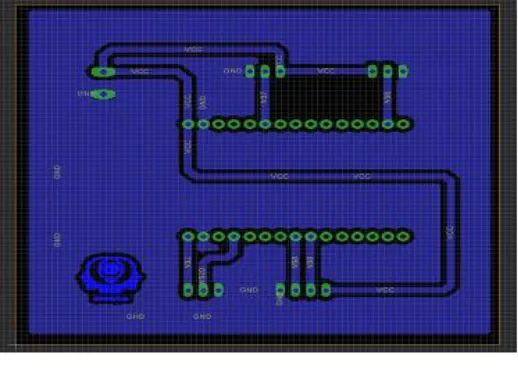
Next, a black screen appears which is of the layout or the film diagram of the circuit as shown in the below figure, and save this as an image format.
Fig. 3. PCB Layout
6736 The film is generated from the finalized circuit board diagram
of the PCB layout software which is send to the manufacturing unit where the negative image or mask is printed out on a plastic sheet.
Step 3: Select Raw Material
The bulk of the printed circuit board is made with an unbreakable glass or fiberglass having copper foil bonded unto one or both the sides of the board. Thus, the PCBs made from unbreakable paper phenolic with a bonded copper foil are less expensive and are often used in household electrical devices. Mostly 0.059 industry standard thick, copper clad laminate, either single- or double-sided board is required. Panels may be sheared to contain May boards of different sizes.
Step 4: Preparing Drill Holes
Machines and carbide drills are used to put holes on the printed circuit board. There are two types of machines available to drill the PCBs; they include hand machines and CNC machines. The hand machines require human intervention or effort to drill the holes, whereas CNC machines are computer-based machines that work-based on the machine timetables or programs that run both automatic as well as manually. The drilled pattern is stored in the computer like drill bit sizes, number of holes per panel, drilled stack, drilled time per load, etc. The PCB boards are placed into the CNC machine and the holes are drilled according to the determined pattern to place printed circuit board components.
Step 5: Apply Image
The printed circuit layout can be printed in different ways on PCBs like manual pen, dry transfers, pen plotters and printers. The laser printers are a better way to print the layouts on printed circuit boards. The following steps are used to print the PCB layout through a laser printer.
Step 6: Stripping and Etching
This process involves removing the unwired copper on the PCBs by using different types of chemicals like ferric chloride, ammonium per-sulphate, etc. Make the solvent by mixing 1% of sodium hydroxide and 10 grams of sodium hydroxide pellets to one litre of water and mix it until everything is dissolved. Next, the PCB is put on a chemical bowl and cleaned up with a brush. During this process, if the PCB is still greasy, due to applied sunflower or seed oil, the developing process may take about 1 minute.
Step 7: Testing
After finishing the manufacturing process of the Printed Circuit Board, the Board undergoes a testing process to check whether the PCB is working properly. Nowadays many automatic testing equipment are available for the high-volume testing of the PCBs. The two different types of testing equipment available today that test your circuit boards include ATG test machines that are flying probe, fixtureless testers and in addition to a universal grid testing capability as well.
Fig. 4. Designed PCB
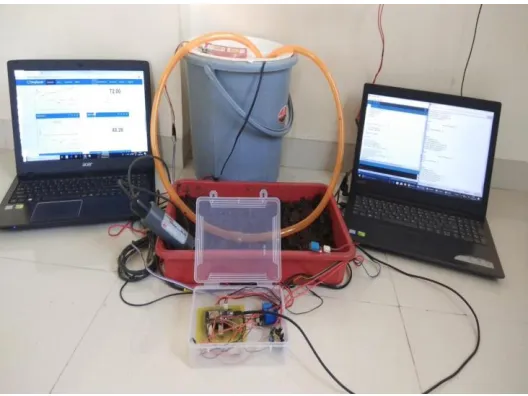
Step 8: Hardware Setup
Fig. 5. Hardware Setup
5
EXPERIMENTATION
5.1 Introduction
In an attempt to obtain the simulated results as well as to compute the design specifications, various designing tools and software tools are needed to be used. Hence it is important to have a deep understanding about these software and tools.
5.2 Software Tools
MATLAB v.R2014a
MATLAB (matrix laboratory) is a programming platform designed specifically for engineers and scientists developed by MathWorks. The heart of MATLAB is the MATLAB language, a matrix-based language allowing the most natural expression of computational mathematics.
Using MATLAB, we can:
Develop algorithms and
Create models and applications.The language, apps, and built-in math functions enable you to quickly explore multiple approaches to arrive at a solution. MATLAB lets you take your ideas from research to production by deploying to enterprise applications and embedded devices,
as well as integrating with Simulink® and Model-Based Design.
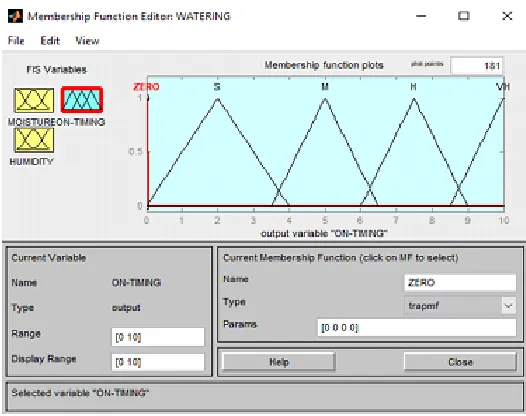
FIS Editor GUI
The FIS Editor GUI tool allows us to edit the higher-level features of the fuzzy inference system, such as the number of input and output variables, the defuzzification method used, and so on. Refer to The FIS Editor for more information about how to use the GUIs associated with fuzzy. The FIS Editor is the high-level display for any fuzzy logic inference system. It allows us to call the various other editors to operate on the FIS. This interface allows convenient access to all other editors with an emphasis on maximum flexibility for interaction with the fuzzy system.
Fig. 6. FIS Editor GUI Tool
5.3 Hardware Tools
Digital Multi-meter (DMM) Soldering Gun
6
ANALYSIS
AND
RESULT
6.1 Analysis
Fig. 7. MATLAB Command Window
Fig. 8. Input Membership-Moisture Function Window
6738
Fig. 10. Rules for Fuzzy Logic Window
Fig. 11. Surface Viewer Window
TABLE1
RESULT TABLE
6.2 Output
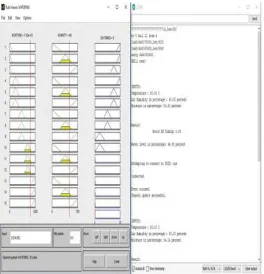
Fig. 12. MATLAB Rule Viewer and Arduino Console Window
for Output-1
Fig. 13. MATLAB Rule Viewer and Arduino Console Window
for Output-2
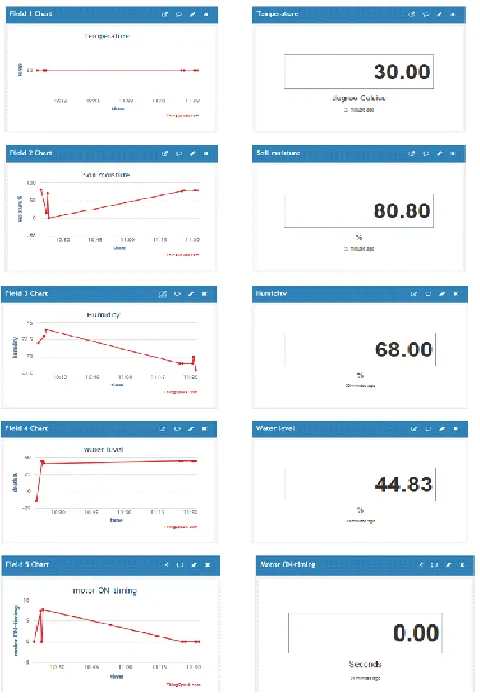
Temperature Soil
Moisture Humidity
Motor ON-Timing
Water Level
30.00 80.80 68.00 0.00 44.83
Fig. 14. Output-1 from Server
Fig. 15. Output-2 from Server
7 ADVANTAGES
AND
APPLICATIONS
7.1 Advantages
Increase efficiency of management decision-making in agricultural enterprises.
Increase farmer profitability & productivity. Optimized water usage.
Time conservation Labor conservation
7.1 Applications
The system can be used in drought prone areas or areas having high scarcity of water.
Supplying irrigation system to vineyards.
Providing water to those crops, whose water requirements are intricate.
8
CONCLUSION
AND
FUTURE
SCOPE
8.1 Conclusion
Alongside the use of traditional approaches to the practical problems that can arise today in management systems of agricultural enterprises, the application of the theory of fuzzy sets and the fuzzy logic built on its basis, is becoming more and more popular. The synthesis of classic and innovative methods in management and decision-making allows achieving a maximal effectiveness that has positive impact on quality of products.
8.2 Future Scope
Along with sensing the moisture level of the soil, other parameters such as temperature, pH, salinity, purity, oil content, etc. can also help to interpret the need of water for irrigation.
Establishing larger sensor network, substantial area can be brought under system coverage.
It can help in determining the future trends under varied scenarios such as: population growth, ground water exploitation, change in agricultural cropping pattern, effect of climate changes, water conservation, etc.
Crop-specific system can be generated according to varied requirements of varied crops.
REFERENCES
[1]. H. Navarro-Hellin, J. Martinez-del-Rincon, R. Domingo-Miguel, F. Sotto-Valles, and R.Torres-Sanchez, ―A Decision Support System for managing Irrigation in Agriculture‖ published in Elsevier.,Computer and Electronics in Agriculture., Volume 124(June 2016). [2]. Tetiana Ivanovna Balanovskауa, Zoreslava Petrovna
Boretska, ―3Application of fuzzy inference system to increase efficiency of management decision-making in agricultural enterprises‖ published Scientific Journal Warsaw University of Life Sciences SGGW Problems of World Agriculture volume 14 (XXIX), number 4, 2014: 15–24.
6740 System By Fuzzy Logic‖ published in 3rd International
Conference on Information Science and Control Engineering 2016.
[4]. R. K. Kodali and B. S. Sarjerao, "A low cost smart irrigation system using MQTT protocol," 2017 IEEE Region 10 Symposium (TENSYMP), Cochin, 2017, pp. 1-5.
[5]. Girma Megersa and Jemal Abdulahi. "Irrigation system in Israel: A review." International Journal of Water Resources and Environmental Engineering 7, no. 3 (2015): 29-37.
[6]. K. Fue, J. Schueller, A. Schumann and S. Tumbo, "A solar-powered, Wi-Fi re-programmable precision irrigation controller," Proceedings of the 2nd Pan African International Conference on Science, Computing and Telecommunications (PACT 2014), Arusha, 2014, pp. 171-176.
[7]. N. Dutta, HKD Sarma and Z. Polkowski, ―Cluster based routing in cognitive radio Adhoc networks: reconnoitering SINR and ETT impact on clustering‖, Com. Com., (Elsevier), pp. 10-20, vol. 115, 2018.
[8]. N. Dutta and HKD Sarma, ―A probability based stable routing for cognitive radio Adhoc networks‖, Wire. Net., (Springer), vol.23(1), pp. 65-78, 2017.
[9]. N. Dutta and IS Misra, ―Mathematical modelling of HMIPv6 based network architecture in search of an optimal Performance‖, IEEE 15 th ADCOM, Guwahati, India, pp. 599-605, 2007.