Licensed under Creative Common Page 84
http://ijecm.co.uk/
ISSN 2348 0386
BANK RESTRUCTURING AND FINANCIAL PERFORMANCE
Angela Mucece Kithinji
PhD Candidate, University of Nairobi, School of Business, Department of Finance and Accounting, Nairobi, Kenya
E-mail: [email protected]
Mirie Mwangi
Senior Lecturer, University of Nairobi, School of Business, Department of Finance and Accounting, Nairobi, Kenya
E-mail: [email protected]
Kate Litondo
Senior Lecturer, University of Nairobi, School of Business, Department of Management Science, Nairobi, Kenya
E-mail: [email protected]
Martin Ogutu
Professor of Business Administration, University of Nairobi, School of Business, Department of Business Administration, Nairobi, Kenya
E-mail: [email protected]
Abstract
This study envisaged to establish the relationship between bank restructuring and financial
performance of commercial banks in Kenya. Positivism research philosophy and descriptive and
inferential causal research design were used in this study. The study was based on 39
commercial banks that were consistently in business for the period 2002 to 2014. Bank
restructuring was disaggregated into financial restructuring, capital restructuring, operational
restructuring and asset restructuring. The empirical findings were as follows: Commercial banks
use all the four types of bank restructuring. There was a direct association between bank
Licensed under Creative Common Page 85 only variables found to have significant positive and negative influence respectively on the
performance of commercial banks in Kenya. Financial and operational restructuring were found
not to have a significant effect on financial performance of commercial banks in Kenya. The
study outcome therefore reveals that the hypothesis that the relationship between bank
restructuring and financial performance is not significant is rejected. The conclusion is that
banks should focus more on capital restructuring and asset restructuring so as to influence their
profitability. The study recommends that there is need to institute policy reforms geared towards
viable restructuring and that to continuously improve bank performance banks should
encourage more funds from shareholders while focusing on asset quality.
Keywords: Financial Restructuring, Capital Restructuring, Operational Restructuring, Asset
Restructuring, Financial Performance
INTRODUCTION
Bank restructuring is usually undertaken to address the problems in individual banks experiencing banking crisis or to solve the problems affecting the entire banking system (Hoenig & Morris, 2012). Restructuring of banks is intended to restore and maintain faith and confidence in the banking system and profitability and efficiency in the individual banks (Nor, et. al., 2009). Mario (2014) states that bank restructuring also refers to increasing surveillance and prudential regulation in order to increase the intermediation process of the banking system Bank restructuring is majorly undertaken to enhance financial performance and sometimes, to impose checks and balances to reduce the possibility of a financial crisis which may either have local or global implications (Birchil & Simmons, 2010). Hoggarth et. al. (2004) and Emilia, Gupta and Weisin (2007) state that failure to recognize and take action with regard to individual banks can lead to a build up of problem assets and institutions which increase the possibility of, and at the same time, hide more systemic problems calling for pre/non crisis bank restructuring). Diagonising banking problems before banking crisis ensue is necessary for ensuring a sound financial system (Hawkins & Turner, 1999).
Licensed under Creative Common Page 86 are other aspects that might influence the level and extent of bank restructuring (Stefan & Hoelscher, 2005). The need to increase banks branch network so as to improve service delivery and access many customers to be in tandem with economic development and economic growth forces banks to undertake operational restructuring (Miller, 1996). Suehiro (2002) observes that successful restructuring of the banking system is dependent not only on the implementation of institutional reforms initiated by the government in accordance with the global standards but also to the development of self-efforts undertaken by leading local commercial banks.
Dziobek (1998) and Dziobek and Pazarbasioglu (1998) states that there are four main types of bank restructuring and they include; financial restructuring, operational restructuring, asset restructuring and capital restructuring. Financial restructuring focuses on the financial structure of the banking institution and is usually concerned about the liability and capital structures of banking institutions. The most significant part of the banks liabilities is customer deposits and long term debt tends to form a very small proportion of the financial structure of banking institutions. Operational restructuring focuses on reorganizing the activities of banks including their governance structure and also entails closing down or downsizing poorly performing entities or branches, downsizing and closing down product lines to reduce costs of bank operations.
Asset restructuring entails reducing the poor performance in banks by increasing the liquidity of assets by holding more of current assets while ensuring that a large proportion is financial assets, and reducing the level of non-performing loans through provisioning for problem loans and selling off bad loans. Capital restructuring involves increasing the financial performance in banks by way of substitution of short-term debt and junior long-term debt with longer- term debt obligations (by converting debt to equity) to increase the financial structure of banks (John, Daunders & Senbet, 1995; Karacadag & Taylor, 2000; Wall & Peterson, 1995). It sometimes involves direct capital injection by the shareholders and other times a bailout by government whereby additional capital is channeled into the banking entity by government (Dziobek and Pazarbasioglu, 1998; Rose, 1994). Other types of bank restructuring identified by Bonish and Monte-Negret (1998) and Franks and Sanzbar, (2002) include; market-based solutions, carving out bad assets, establishing an asset recovery agency, changing the guard, creating phoenixes, recapitalization, change of ownership structure, restructuring borrowers, institutional arrangements, counting the monetary and fiscal costs, appointment of interim management, operational reforms and legal, regulatory and policy review.
Licensed under Creative Common Page 87 transaction costs. When banks are inefficient in extending their financial services, they normally undergo restructuring by way of increasing the capital base, dealing with the problem of nonperforming loans or increasing their functions while maintaining or changing the status quo. Other strategies that commercial banks engage in to improve financial intermediation include mergers and acquisitions. The financial intermediation theory contends that if savers and borrowers had a better way of convergence, and where financial market participants are able to access market information the role of financial institutions and financial regulation would significantly diminish. Where financial institutions including commercial banks exist information asymmetry, moral hazard and transaction costs are reduced (Klein et. al., 2005).
Kaplan and Norton (1996) states that financial performance metric is essentially the ultimate measure of institutional performance. The author contends that the balanced scorecard approach is from the perspective that non-financial data and financial data which is necessary for measuring financial performance of firms is essentially obtained from credible sources. Kaplan & Norton (2001) states that the performance measurement framework includes the aspects of financial perspective, internal business environment perspective, customer perspective and product innovations perspective. Every scorecard relies on the typical financial objectives of profitability, earnings of assets and mobilization of revenue. The financial perspective objective of the scorecard enables senior management of businesses to specify not only the metric by which the long-term success of the enterprise will be measured, but also the final result objectives. The measure of a manager’s ability and effort is at the peak when the
balanced score card is used and an interactive control system is put in place (Lipe & Satterio, 2000).
Leah (2008) defined financial performance as the measurement of the outcome of a firm’s strategies, policies and operations in monetary terms. The outcomes are reflected in the firm’s return on assets and return on investments. Financial performance is also defined as the
Licensed under Creative Common Page 88 performance of a firm take both the accounting and market based dimensions (Waweru, 2008; Waggoner, Neely & Kennerley, 1999)
According to Roberts (2007) the best performance measures contain inputs which facilitate organizations to focus their actions in achieving their long-term objectives. Measures of performance can be described as accounting measures, market based measures, the Tobin’s
Q, the Economic Value Added (EVA) and the non-accounting measures. Market based measures are futuristic and long-term in nature and they represent the expectations of the shareholders on the firm’s future performance (Omran & Pointon, 2004). Many capital market
studies therefore rely on market based measures for determining the financial performance of firms quoted at the stock exchange.
Accounting measures are majorly financial measures of performance which rely on balance sheet and income statement data. Financial performance measures rely on financial information which may be qualitative or quantitative and are return on assets (ROA), return on equity (ROE) and return on sales (ROS) (Ho & Mckay, 2002). Rose (1994) states that the main measures of performance of financial institutions are return on assets, return on equity, equity capital ratio, net interest margin, and the spread which is the difference between incomes from interest bearing assets and the expenses from interest paying liabilities.
The current study uses return on assets (ROA) as a measure of financial performance. Financial restructuring relied on changes in longterm debt to asset ratio, capital restructuring relied on changes in return on equity (ROE) and asset restructuring focused on the asset quality as measured using changes in nonperforming loans, which are accounting measures. Operational restructuring on the other hand relied on changes in Bank branches and Automated Teller Machines (ATMs) which is an operational variable and has cost implication, which again is another accounting measure.
LITERATURE REVIEW
Licensed under Creative Common Page 89 measured using long-term debt to total assets while asset quality was measured using non-performing loans to total loans and loan provisions to total loans. Regression results showed that the banks that restructured reported positive and consistent increase in net profitability following bank restructuring.
De Young and Rice (2003) establish a number of research links between noninterest income of banks, business strategies, market conditions, technological change, and financial performance of banks for the period 1989 and 2001. Diversification into non-interest activities enabled the financial institution to increase its profitability. The results indicate that banks that are managed properly expand more slowly into noninterest activities to diversify their profits, and that increases in noninterest income marginally is associated with poorer risk-return tradeoffs on average. These findings suggest that the co-existence of noninterest income does not replace interest income from the intermediation activities that remain the core financial services function of banks.
Kwaning et. al. (2014) uses a study of cases to explore the motivators of restructuring banks and the effects of bank restructuring on financial performance of one of Ghana’s largest
bank, Agricultural Development Bank (ADB). The findings of the study of ADB as an institution on restructuring shows that the factors that motivated ADB’s restructuring were changes in the
business environment, weak governance, poor strategic control, and poor performance. The impacts on the ADB’s corporate governance, organizational structure and strategic control,
performance, and employee costs led to improved governance, a modified organizational structure, increased employee costs and a decrease in ADB’s profitability.
Ithiri (2013) studied corporate restructuring and its effects on Kenya Commercial Bank performance. A descriptive survey was used and data was collected from 100 randomly selected sample respondents using a questionnaire. Descriptive statistics was used to analyze the data. The findings of the research were that the main drivers for restructuring were competition, new company strategy, budgetary cuts, public pressure and change in government policy.
Licensed under Creative Common Page 90
Research Problem
Bank restructuring is important for enhancing the financial intermediation of a country’s banking
system. Intervention through financial innovations, increasing the capital base to address the aspect of size and legal and regulatory framework review are important to ensure successful bank restructuring to record increased financial performance (Kwaning et. al., 2014). The financial sector in many economies is the main intermediary between savers who are interested in safe-keeping of their deposits and earning of interest income and borrowers who obtain loans at market rates of interest to finance profitable activities Suehiro (2002).
In Kenya, commercial banks are increasingly offering new services such as mobile banking, agency banking, bank-assurance, faceless banking and integrating microfinance in their banking system (CBK, 2014). Well-capitalized banks provide a safety net for depositors, owners and even borrowers making them more preferable than their under-capitalized counterparts. Commercial banks in Kenya have undertaken restructuring to be more competitive, to improve bank solvency, to increase the banking sector capacity for financial intermediation and to improve performance.
Although some commercial banks restructure as part of survival strategy, the CBK may require all banks experiencing a crises to restructure to reduce costs with the objective of increasing financial performance (CBK, 2014). The mergers and acquisitions of commercial banks in Kenya in the mid 1980’s and late 1990’s gave rise to bigger and more complex banking
institutions which was aimed at improving profitability of the merged banks (Ithiri, 2013). To improve efficiency commercial banks have embraced modernized banking halls, broad ATM network, state of art technology, widespread branch network and agency banking (Das & Ghosh, 2006).
Licensed under Creative Common Page 91 The studies above provide input to conceptual and methodological aspects to be used in this study, therefore emphasizing their relevance in this study.
METHODOLOGY
The study relied on positivism philosophy and adopted descriptive causal research design for it involved analyzing of the relationship between bank restructuring and financial performance to determine the cause-effect implications. The study population was the 44 commercial banks operating in Kenya out of which 39 banks qualified as units of analysis as having data for the study period. Data was collected from the audited financial statements of the study banks using a standardized data collection sheet. The longitudinal panel data obtained covered a period of thirteen years for the period 2002 to 2014. Using SPSS version 21, inferential analysis was performed was the variables using hierarchical regression models. The financial performance was the independent variable and was operationalized using return on assets. Bank restructuring was the dependent variable and was measured using four proxies; namely, financial restructuring, capital restructuring, operational restructuring and asset restructuring. The linear regression model developed for the study was as follows:
ROA it = ά r11 + βrf1 FRrit + βrc1 CRrit + βro1 ORrit + βra1 ARrit + ε r11 ………...….1
Where:
ROA is return on assets, FR is financial restructuring, CR is capital restructuring, OR is operational restructuring, AR is asset restructuring, αr11, is the constant term, βrf1, βrc1, βro1, and
βra1 are the regression coefficients, i is income for bank i and t is the year when the bank earns
the income while εr11 is the error term.
Data on bank restructuring was analyzed using descriptive statistics of mean, standard deviation, skewness and kurtosis while hierarchical regression analysis was employed in establishing the relationship between the variables.
RESULTS AND DISCUSSION
Licensed under Creative Common Page 92 Table 1: Summary of Descriptive Statistics for Financial Performance
N Minimum Maximum Mean Std.
Deviation Skewness Kurtosis
Statistic Statistic Statistic Statistic Statistic Statistic Std. Error
Z -
Value Statistic Std. Error
Z - Value
Financial
Performance 507 .00 0.37 0.0275 0.02396 5.832 0.108 0.019 76.931 .217 0.003
Table 2: Summary of Descriptive Statistics for Bank Restructuring
N Minimum Maximum Mean Std.
Deviation Skewness Kurtosis
Statistic Statistic Statistic Statistic Statistic Statistic Std. Error
Z -
Value Statistic Std. Error
Z - Value
Financial
restructuring 507 .00 .94 .0622 .15726 3.855 .108 0.028 14.929 .217 0.015 Capital
restructuring 507 .00 .46 .1393 .07365 .787 .108 0.137 1.794 .217 0.121 Operational
restructuring 507 .00 .40 .0510 .04151 3.567 .108 0.030 19.884 .217 0.011 Asset
restructuring 507 .00 .84 .0845 .11099 3.181 .108 0.034 13.020 .217 0.017
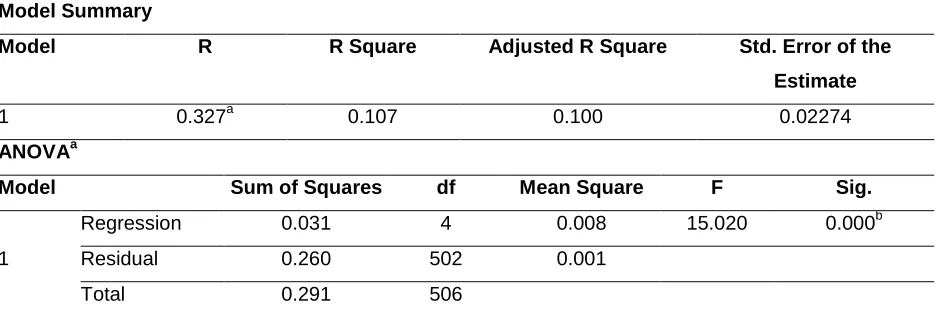
Table 3: Regression Results for Bank Restructuring as Explanatory Variable and Financial Performance as the Response Variable
Model Summary
Model R R Square Adjusted R Square Std. Error of the
Estimate
1 0.327a 0.107 0.100 0.02274
ANOVAa
Model Sum of Squares df Mean Square F Sig.
1
Regression 0.031 4 0.008 15.020 0.000b
Residual 0.260 502 0.001
Licensed under Creative Common Page 93
Coefficientsa
Model Unstandardized
Coefficients
Standardized Coefficients
t Sig. 95.0% Confidence Interval for B
B Std. Error Beta Lower
Bound
Upper Bound
1
(Constant) 0.016 0.002 7.010 0.000 0.012 0.021
Financial
restructuring 0.012 0.006 0.078 1.828 0.068 -0.001 0.025 Capital
restructuring 0.106 0.015 0.326 7.223 0.000 0.077 0.135 Operational
restructuring -0.037 0.025 -0.065 -1.493 0.136 -0.087 0.012 Asset restructuring -0.031 0.010 -0.144 -3.224 0.001 -0.050 -0.012 a. Dependent Variable: Financial Performance
In interpreting the results of multiple regression analysis, the R squared was used to estimate how well the model fitted the data (Anderson & Darling, 1954). This research study sought to determine whether the independent variables (financial restructuring, capital restructuring, operational restructuring and asset restructuring) have an influence on the dependent variable (financial performance) of commercial banks in Kenya.
Table 3 illustrates the regression results of these construct variables and the dependent variable which is the financial performance. The model summary of a linear relationship between financial performance and bank restructuring variables provided an estimated R2 value of 0.107. This means that a combination of financial restructuring, capital restructuring, operational restructuring and asset restructuring accounted for 10.7% of the variations in financial performance of commercial banks in Kenya. This could indicate that there exist other factors not included in the study which can explain the remaining 89.3% of variation in the financial performance. Therefore, this could imply that the presence of the other factors would improve the predictive model of bank restructuring on financial performance. The findings are in line with Rose (1994) who found out that the banks that restructured their operations reported positive and consistent profits. Osoro (2014) also found that there exists an insignificant positive effect of financial restructuring on financial performance of commercial banks quoted in Kenya as the estimated coefficient of determination was 26.7% which is higher than the one estimated by this study.
The ANOVA of regression model provided the regression sum square of 0.031 and a model residual’s of 0.260 with a mean square of 0.008 for the regression and 0.001 for the
Licensed under Creative Common Page 94 residuals. The Analysis of Variance (ANOVA) results produced an F-significance value 15.020 and a p < 0.000. This is an indication that the probability of this model giving false prediction is 0.0%. According to Rumsey (2011) p – value is a number between 0 and 1 and interpreted as
follows: a small p – value (typically ≤ 0.05) indicates strong evidence against the null
hypothesis, thus under such circumstances, we reject the null hypothesis; a large p – value (>
0.05) indicates weak evidence against the null hypothesis, so we fail to reject the null hypothesis; and p-values very close to the cut off (0.05) are considered to be marginal, and thus either accept or reject the null hypothesis. Therefore, this study’s hypothesis that there is no
significant relationship between bank restructuring and financial performance of commercial banks in Kenya is rejected.
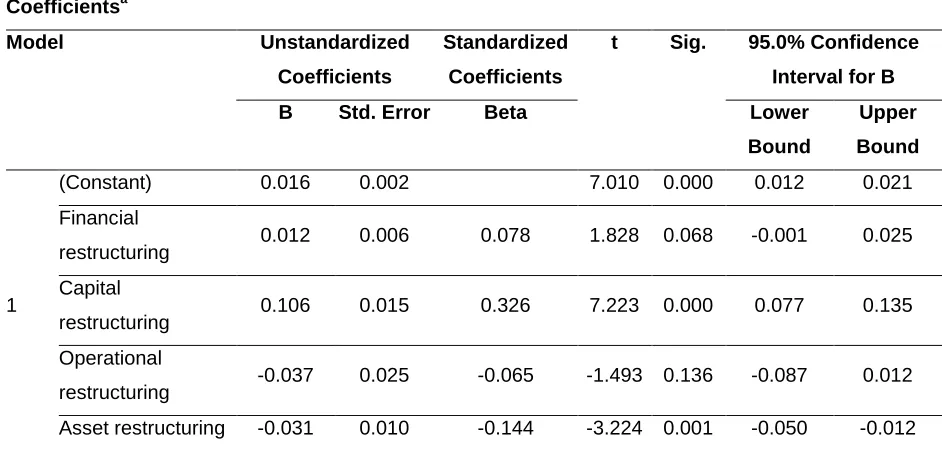
The regression model further gives the results of coefficients of independent variables used in the model which indicate that these variables have variance relationship to the dependent variable. The model provided a constant value of 0.016 (t – value = 7.010) with a p –
value of 0.000. Capital restructuring was found to be a major determinant of financial performance as it had a significant positive coefficient of 0.106 with a t – value of 7.223 and a p
– value of 0.000.
Additionally, financial restructuring too had a significant influence on financial performance of commercial banks. An increase in financial restructuring causes an increment in financial performance by 1.2%, (t – value = 1.828) and p – value of 0.068. Capital restructuring
increases financial performance by 10.6%, (t – value = 7 .223) and p – value of 0.000. The effect of capital restructuring on financial performance is significant. On the other hand, operational restructuring and assets restructuring did not have significant influence on the financial performance of commercial banks in Kenya since they had coefficient values of -3.7% (t – value = -1.493) and p – value of 0.136 and -3.1% (t – value = - 3.224) and p – value of
0.001 respectively.
The study used the regression model below to test hypothesis one of which the dependent variable was profitability and was measured using Return on Assets (ROA).
ROA it = ά r11 + βrf1 FRrit + βrc1 CRrit + βro1 ORrit + βra1 ARrit + ε r11
The resulting model is given by;
ROA it = 0.016 + 0.012FR + 0.106CR - 0.037OR - 0.031AR
The output of regression model arising from the data analysis presented in Table 3 reveal new predictor model indicated as follows:
Licensed under Creative Common Page 95 This is an indication that capital restructuring had a significant positive effect on profits while asset restructuring was found to have a significant negative effect on financial performance of commercial banks in Kenya and therefore were able to fairly predict the financial performance of these banks. The finding on capital restructuring conflicts with the study by Kwaning (2014) who found that restructuring of government owned banks lead to a decrease in profitability. However, the findings on asset restructuring support those of Anandarajan, Hasan and Lozano-Vivas (2005) who discovered that restructuring assets reduces profitability of commercial banks according to this study. Operational restructuring and financial restructuring in the estimation have an insignificant relationship between bank restructuring and financial performance of commercial banks operating in Kenya which conflicts the findings by Rose (1994) that operational restructuring increases profitability of banks. This revelation also conflicts with those by Osoro (2014) who found out that there exists a positive effect of financial restructuring on the financial performance of commercial banks in Kenya. Osoro however relied on only 11 commercial banks listed at the Nairobi Securities Exchange (NSE) operating in Kenya for the period of between 2008 and 2013 which was a smaller population. Debt ratio, dividend payout and equity ratio were used as measures of financial restructuring in his study whereas this study uses the long term debt to asset ratio. The revelation conflicts with that by Nor et. al. (2008) who found that bank restructuring was not found to be justifiable because restructured banks ended up being less focused, had weak corporate governance, reported poor management debt ratios and poor profitability. This study also conflicts with that by Rose (1994) who found out that financial and operational restructuring increases bank profitability. This study finds out the reverse.
CONCLUSIONS
Licensed under Creative Common Page 96 Asset restructuring on the other had has the main intention of increasing the asset quality as measured using the nonperforming loan ratio. Reducing the nonperforming loans in the loan book tend to be associated with huge provisioning of non-performing loans which is an expense and therefore reduces bank profits. This explains the negative effect of asset restructuring on profitability of commercial banks in Kenya. Incidentally, operational restructuring appears to have no effect on bank financial performance. This might be explained by the fact that restructuring bank operations usually has the effect of expanding the customer base and access to financial services which might not necessary be associated with profitability.
The disappointing revelation that bank restructuring only contribute to 10.2% of the profits of commercial banks is a pointer that whenever commercial banks are keen on significantly increasing financial performance, they should focus on other factors other than having to rely on bank restructuring. This contradicts the theory of financial intermediation that contends that for commercial banks to improve their financial performance, they need to improve their operations through improved processes, institutional capacity building and institutional innovation, as well as coming up with new products and services to increase their market share and therefore capture a wider customer base. This only explains outreach but also enhances financial inclusion.
To continuously improve financial performance and avoid instances of capital restructuring following a banking crisis, banks need to continuously restructure their operations by increasing their branches, widening their ATM network and emphasis on agency and mobile banking to enhance financial inclusion.
Bank restructuring is a current practice in the Kenya banking sector. Bank restructuring is however expected to increase the level of outreach while contributing to profits. If banks concentrate more on outreach at the expense of financial performance then the benefits that are expected to be realized from bank restructuring are compromised. Banks therefore need to strike a balance between enhancing their operations through operational restructuring or improving profits by focusing on aspects that have a direct positive effect on profits.
LIMITATIONS OF THE STUDY
While the study established among other variables the relationships between bank restructuring and financial performance, the study did not establish causal relationships. Nevertheless, the results are useful as they establish the basis to enable interested researchers to determine causality. The explanatory power of the model was low meaning that there other factors which can influence the dependent variable used in the study.
Licensed under Creative Common Page 97
REFERENCES
Adams, G. R., & Schvaneveldt, J. D. (1991). Understanding research methods, 2e, Longman Publishing Group.
Anandarajan, A., Hasan, I. & Lozano-Vivas, A. (2005). Loan loss provision decisions: An empirical analysis of the Spanish Depository Institutions. Journal of International Accounting, Auditing and Taxation 14; 55 – 77
Anderson, T. W. & Darling, D. A. (1954). A test of the goodness of fit. Journal of the American Statistical Association, 49(268), 765 – 769.
Birchil, J. & Simmons, R. (2010). The co-operative reform process in Tanzania and Sri Lanka. Annals of Public and Co-operative Economics. 81(3), 467 – 500.
Bonish, M. & Montes-Negret R. (1998). Restructuring distressed banks in transition economies: Lessons from Central Europe and Ukraine, The World Bank, Washington.
Central Bank of Kenya (2014). Central Bank of Kenya Bank Supervision Report
Claessens, S., Pazarbasioglu, C., Luc, L., Dobler, M., Valencia, F., Oana, N., & Katharine, S. (2011). Crisis management and resolution: Early lessons from the financial crisis, IMF Staff Discussion Note No.5.
Das, A. & Ghosh, S. (2006). Financial deregulation and efficiency: An empirical analysis of Indian banks during the post reform period. Review of Financial Economics 15, 193 – 221.
De Young, R. & Rice, T. (2003), Noninterest income and financial performance at U.S. commercial banks; Supervision and Regulation Department: Federal Reserve Bank of Chicago.
Demirguc-Kunt A. & Huzinga, H. (1999). Determinants of commercial bank interest margins and profitability: Some International Evidence. The World Bank Economic Review, 13 (2), 379 – 408.
Dubel, H. J. & Berlin, F. (2013). The Capital structure of banks and practice of bank restructuring; Eight case studies on current bank restructuring in Europe; Center for Financial Studies; University of Frankfurt. Dziobek, C. & Pazarbsioglu, C. (1998). Lessons from systemic bank restructuring; Economic Issues NO. 14, IMF.
Dziobek, C. (1998). Market-based policy instruments for systemic bank restructuring, IMF Working Paper, 98/113, IMF, Washington D.C.
Emilia, I., Gupta, D. D. & Weisin, P. (2007). Toward developing a structured approach to the diagnosis and resolution of non-performing loans. The Case of China and India; School of Public Policy, George Mason University.
Espana, B. (2015). Public financial assistance in the restructuring of the Spanish banking sector. Journal of Financial Economics. 17, 211 – 256
Franks, J. & Sanzbar, S. (2002). Equity issues by distressed firms. London Business School.
Hawkins, J. & Turner, P. (1999). Bank restructuring in practice – An overview, in BIS, Bank Restructuring in Practice. BIS Policy Paper No. 6, Bank of International Settlements, Basel Switzerland.
Ho, S. J. K. & Mckay, R. B. (2002). Balanced scorecard: Two perspectives. The CPA Journal. 12 (3) 20 – 25
Hoenig, T. M. & Morris, C. S. (2012). Restructuring the banking system to improve safety and soundness, Federal Deposit Insurance Corporation and Federal Reserve Bank of Kansas City.
Hoggarth, G., Reidhill J. & Sinclair P. (2004). On the resolution of banking crises: Theory and evidence, Working Paper No. 229, Bank of England.
Licensed under Creative Common Page 98 John, K., Daunders, A. M., & Senbet L. W. (1995). A theory of capital regulation and bank management compensation, Journal of Banking and Finance, 19, 23 – 57.
Kaplan, R. S. & Norton, D. P. (1996). The balanced scorecard: Translating strategy into action. Havard Business School.
Kaplan, R. S. & Norton, D. P. (2001). Transforming the balanced scorecard from performance measurement to strategic management. Harvard Business School.
Klein, P., Sharpiro, D. & Young, J. (2005). Corporate governance, family ownership and firm value, the Canadian evidence. Corporate Governance: An International Review, 13 (6), 769 – 784.
Kwaning, C. O., Churchill, R. Q. & Opuku, .A. K. (2014). The impact of organisational restructuring on the financial performance of public banks; A post restructuring assessment of Agricultural Development Bank, Ghana. Journal of Financial Accounting, 5, 106 – 112
Lipe, M. & Salterio, S. (2000). The balanced scorecard: Judgemental effects of common and unique performance measures. The Accounting Review. 287 – 298.
Mario, D. (2014). Bank restructuring and the economic recovery; The European Central Bank Eurosystem; Speech by the President of the ECB at the Presentation Ceremony of the Schumpeter Award, Oesterreichische National Bank, Vienna, March. Accessed from http://www.ecb.europa.eu. Merton, R. C. (1995). Financial innovation and the management and regulations of financial institutions. Journal of Banking and Finance, 19, 461 – 481.
Miller, G. P. (1996). Is deposit insurance inevitable? Lessons from Argentine. International Review of Law and Economics, 16(2), 211 – 232.
Nor, F. M., Alias, N. & Yaacob, M. H. (2009). Corporate restructuring, firm characteristics and performance, Jurnal Pengurusan, 27, 129 – 141
Omran, M. & Pointon, J. (2004). Dividend policy, trading characteristics and share prices: Empirical evidence from Egyptian firms. International Journal of Theoretical and Applied Finance, 7(2), 121-133 Osoro, P. M. (2014). The effect of financial restructuring on the financial performance of commercial banks in Kenya. Doctoral dissertation, University of Nairobi.
Roberts, M. R. (2007). Surprise and sense-making. What newcomers experience when entering unfamiliar organizational settings. Administrative Science Quarterly, 25, 226 – 251.
Rose, P. S. (1994). The rescue of troubled banks; consequences for corporate strategies to deal with financial and operating stress. Journal of Financial and Strategic Decisions. 7(2), 1 – 17
Stefan, I. & Hoelscher, D. S (2005). The resolution of systemic banking system crises, in systemic financial crises: Resolving large bank insolvencies, edited by Douglas Durrel Evanoff, George G. Kaufman, World Scientific Publishing.
Suehiro, A. (2002). Restructuring and re-engineering of local commercial Banks in Thailand, Institute of Social Science, and University of Tokyo.
Waggoner, D. Neely, A. & Kennerley, M. (1999). The forces that shape organizational performance measurement systems. An interdisciplinary review. International Journal of Production Economics, 60(61), 533-60.