Research Article
CODEN: IJPNL6
A VALIDATED STABILITY-INDICATING HPLC METHOD FOR DETERMINATION
OF TICAGRELOR IN BULK AND ITS FORMULATION
L. Kalyani, A. Lakshmana Rao
**
V.V. Institute of Pharmaceutical Sciences, Gudlavalleru- 521 356, A.P., India.
*Corresponding author e-mail: [email protected]
ABSTRACT
A simple, rapid, accurate and precise stability-indicating HPLC method was developed and validated for the determination of Ticagrelor in bulk and its tablet dosage forms. Separation of the drug was achieved on Hypersil BDS C18 column (100 mm x 4.6 mm, 5 µ) as stationary phase with mobile phase consisting of phosphate buffer pH 3.0 and acetonitrile in the ratio of 70: 30 V/V. The method showed a good linear response in the concentration range of 22.5-135 µg/mL with correlation coefficient of 0.999. The flow rate was maintained at 1.0 mL/min and effluents were monitored at 254 nm. The retention time was 3.215 min. The percentage assay of Ticagrelor was 99.9%. The method was statistically validated for accuracy, precision, linearity, ruggedness, robustness, solution stability, selectivity and forced degradation studies. The results obtained in the study were within the limits of ICH guidelines and hence this method can be used for the determination of Ticagrelor in pharmaceutical dosage forms.
Keywords: Ticagrelor, HPLC, Degradation, Validation.
INTRODUCTION
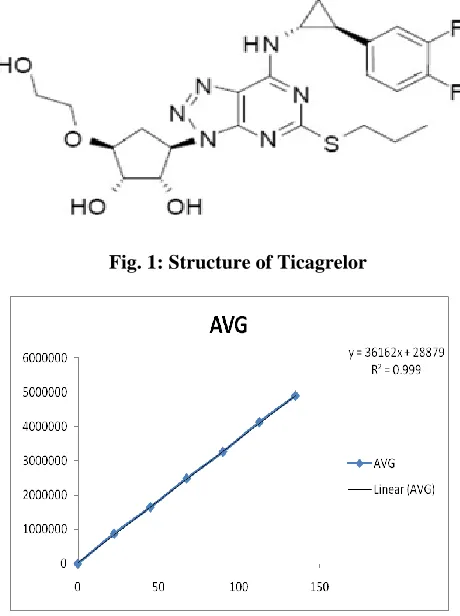
Ticagrelor (Fig. 1) is an orally active antiplatelet agent, inhibitor of platelet activation and aggregation mediated by the P2Y12 ADP-receptor
1
. Chemically it is (1S,2S,3R,5S)-3-[7-{[(1R,2S)-2-(3,4-difluorophen yl)cyclopropyl]amino}-5-(propylthio)-3H-[1,2,3]-tria zolo[4,5-d]pyrimidin-3-yl]-5-(2-hydroxyethoxycyclo pentane-1,2-diol2. Ticagrelor is indicated to reduce the rate of thrombotic cardiovascular events in patients with acute coronary syndrome3. Ticagrelor and its major metabolite reversibly interact with the platelet P2Y12 ADP-receptor to prevent signal
transduction and platelet activation, which inhibits platelet aggregation and thrombus formation in atherosclerotic disease4-6.
Literature survey revealed that few LC-MS7-8 methods were reported for the estimation of Ticagrelor. No author reported the HPLC method for determination of Ticagrelor in pharmaceutical formulations. Hence an attempt has been made to develop and validate a novel, simple, rapid and sensitive RP-HPLC method9 in accordance with ICH
guidelines10 for the estimation of Ticagrelor in bulk drug and its tablet formulation.
MATERIALS AND METHODS
Chemicals and solvents: The working standard of Ticagrelor was provided as gift sample from Spectrum Labs, Hyderabad, India. The market formulation BRILINTA tablets (Ticagrelor 90 mg) were procured from local market. HPLC grade acetonitrile, methanol and water were purchased from E.Merck (India) Ltd, Mumbai, India. Potassium dihydrogen phosphate and orthophosphoric acid of AR grade were obtained from S.D. Fine Chemicals Ltd, Mumbai, India.
Instrumentation: To develop a high pressure liquid chromatographic method for quantitative estimation of Ticagrelor using Waters HPLC system on Hypersil BDS C18 column (100 mm x 4.6 mm, 5 μ) was used. The instrument is equipped with an auto sampler and UV detector. A 10 μL rheodyne injector port was
International Journal of Pharmacy
used for injecting the samples. Data was analyzed by using Empower2 software.
Chromatographic conditions: A mixture of
phosphate buffer pH 3.0 and acetonitrile in the ratio of 70: 30 V/V was found to be the most suitable mobile phase for ideal chromatographic separation of Ticagrelor. The solvent mixture was filtered through 0.45 μ membrane filter and sonicated before use. It was pumped through the column at a flow rate of 1.0 mL/min. Injection volume was 10 µL and the column was maintained at a temperature of 300C. The column was equilibrated by pumping the mobile phase through the column for at least 30 minutes prior to the injection of the drug solution. The detection of the drug was monitored at 254 nm. The run time was set at 7 min.
Preparation of phosphate buffer pH 3.0: 2.72 grams
of potassium dihydrogen phosphate was weighed and transferred into a 1000 mL beaker, dissolved and diluted to 1000 mL with HPLC water. pH was adjusted to 3.0 with orthophosporic acid.
Preparation of mobile phase and diluents: 700 mL of the phosphate buffer was mixed with 300 mL of acetonitrile. The solution was degassed in an ultrasonic water bath for 5 minutes and filtered through 0.45 µm filter under vacuum. The solvents methanol and water mixture was used as diluent.
Preparation of standard solution: 10 mg of
Ticagrelor was accurately weighed, transferred to 10 mL volumetric flask and is dissolved in 7 mL of the diluent. Sonicated the solution for few minutes to dissolve the drug completely. Then it is filtered through 0.45 μ filter and the volume is made up to 10 mL with diluent to get a concentration of 1 mg/mL stock solution. Further pipetted 0.225 mL of the above stock solution into a 10 mL volumetric flask and diluted up to the mark with diluent to obtain required concentrations.
Preparation of sample solution:Twenty commercial
tablets were weighed and powdered. A quantity of the powder equivalent to 10 mg of Ticagrelor was accurately weighed, transferred to 10 mL volumetric flask and is dissolved in 7 mL of the diluent. Sonicated the solution for few minutes to dissolve the drug completely. Then it is filtered through 0.45 μ filter and the volume is made up to 10 mL with diluent to get a concentration of 1 mg/mL stock solution. Further pipetted 0.225 mL of the above stock solution into a 10 mL volumetric flask and diluted up to the mark with diluent to obtain required concentrations of Ticagrelor in pharmaceutical
dosage form. Inject 10 µL of the above solutions into the HPLC system. All experiments were conducted in triplicate.
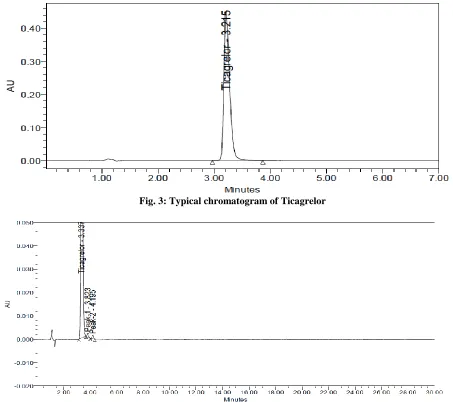
Linearity: Several aliquots of standard solution of Ticagrelor was taken in different 10 mL volumetric flasks and diluted up to the mark with diluent such that the final concentrations of Ticagrelor were in the linearity range of 22.5-135 µg/mL. Evaluation of the drug was performed with UV detector at 254 nm, peak area was recorded for all the peaks. The response for the drug was linear and the regression equation was found to be y=36162x+28879 and correlation coefficient value of Ticagrelor was found to be 0.999. The results show that an excellent correlation exists between peak area and concentration of drug within the concentration range indicated.
Limit of detection and limit of quantification: The limit of detection (LOD) and limit of quantification (LOQ) of the developed method were determined by injecting progressively low concentrations of the standard solution using the developed HPLC method. The LOD and LOQ for Ticagrelor were found to be 0.092 µg/mL and 0.281 µg/mL respectively.
System suitability: System suitability parameters like retention time, theoretical plates and tailing factor were calculated and compared with standard values.
Accuracy:The accuracy of the method was assessed
by recovery study of Ticagrelor in the dosage form at three concentration levels. A fixed amount of preanalyzed sample was taken and standard drug was added at 50%, 100% and 150% levels. Each level was repeated three times. The content of Ticagrelor per tablet was calculated. The percentage recovery ranges from 99.77-100.54% and the mean recovery of Ticagrelor was 100.08% that shows there is no interference from excipients and the lower values of RSD of assay indicate the method is accurate.
Precision: The precision was determined for
Ticagrelor in terms of intra-day and inter-day precision. For intra-day precision evaluation, a standard solution of fixed concentration was injected at various time intervals and %RSD for Ticagrelor was 0.30% (limit %RSD < 2.0%). In addition, the inter-day precision was studied by injecting the same concentration of standard solution on consecutive days and the %RSD for Ticagrelor was 0.70% (limit %RSD < 2.0%).
operators using different columns of similar types. Robustness of the method was determined by making slight changes in the chromatographic conditions like changes in flow rate and mobile phase composition. It was observed that there were no marked changes in the chromatograms, which demonstrated that the HPLC method so developed is rugged and robust.
Solution stability: The stability of solution under study was established by keeping the solution at room temperature for 24 hrs. The result showed no significant change in concentration and thus confirms the stability of the drug in the solvent used for the analysis.
Analysis of the marketed formulations: The
proposed method was applied to the determination in Ticagrelor in pharmaceutical formulatons. 10 µL of each standard and sample solution were injected and from the peak area of Ticagrelor, amount of each drug in samples were computed. The result of assay undertaken yielded 99.9% of label claim of Ticagrelor. The assay obtained is more than 99% and no interference of impurity peak observed in Ticagrelor peak.
DEGRADATION STUDIES
Acid degradation studies: To 1 mL of stock solution of Ticagrelor, 1 mL of 2N hydrochloric acid was added and refluxed for 30 mins at 600C. The resultant solution was diluted to obtain 90 µg/mL solution and 10 µL solution were injected into the system and the chromatograms were recorded to assess the stability of sample.
Alkali degradation studies: To 1 mL of stock
solution of Ticagrelor, 1 mL of 2N sodium hydroxide was added and refluxed for 30 mins at 600C. The resultant solution was diluted to obtain 90 µg/mL solution and 10 µL solution were injected into the system and the chromatograms were recorded to assess the stability of sample.
Oxidative degradation studies: To 1 mL of stock solution of Ticagrelor, 1 mL of 20% hydrogen peroxide (H2O2) was added separately. The solutions
were kept for 30 min at 600C. The resultant solution was diluted to obtain 90 µg/mL solution and 10 µL solution were injected into the system and the chromatograms were recorded to assess the stability of sample.
Thermal degradation studies: The standard
Ticagrelor solution was placed in oven at 1050C for 6 hrs to study dry heat degradation. The resultant
solution was diluted to obtain 90 µg/mL solution and 10 µL solution were injected into the system and the chromatograms were recorded to assess the stability of the sample.
Neutral degradation studies: Stress testing under neutral conditions was studied by refluxing the Ticagrelor in water for 6 hrs at a temperature of 60ºC. The resultant solution was diluted to obtain 90 µg/mL solution and 10 µL solution were injected into the system and the chromatograms were recorded to assess the stability of the sample.
Photostability studies: The photochemical stability of the Ticagrelor was studied by exposing the 100 µg/mL solution to UV light by keeping the beaker in UV chamber for 7 days or 200 Watt hours/m2 in photo stability chamber. The resultant solution was diluted to obtain 90 µg/mL solution and 10 µL solution were injected into the system and the chromatograms were recorded to assess the stability of sample.
RESULTS AND DISCUSSION
plates was 4867 and tailing factor was 1.46 for Ticagrelor, which indicates efficient performance of the column. Typical chromatogram of drug Ticagrelor was shown in Fig. 3. Selectivity of the method was demonstrated by the absence of any interfering peaks from other coexisting excipient substances at the retention time of the drug.
The limit of detection and limit of quantification for Ticagrelor were found to be 0.092 µg/mL and 0.281 µg/mL, which indicate the sensitivity of the method. A system suitability test was performed to evaluate the chromatographic parameters and the summary of system suitability parameters were shown in Table 6. Validated method was applied for the determination of Ticagrelor in commercial formulations. The % assay was found to be 99.9% for Ticagrelor and the assay results were shown in Table 7.
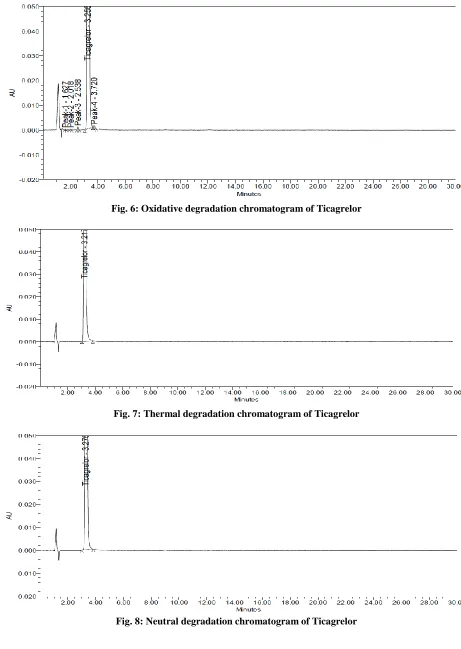
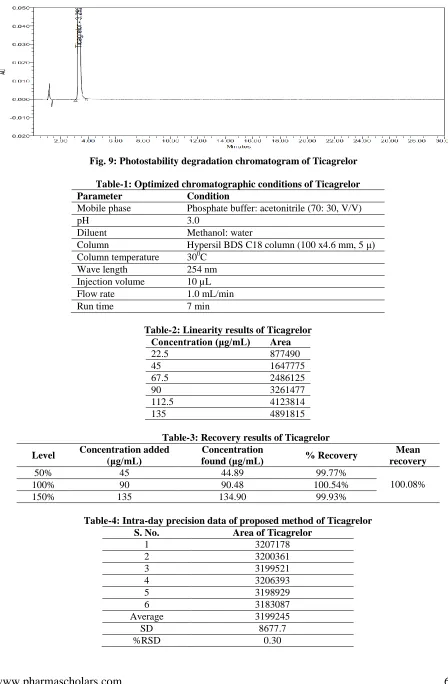
HPLC studies of Ticagrelor under different stress conditions indicated the following degradation behavior. In acid degradation, the degradation product of Ticagrelor was appeared at retention time of 3.337 min. In alkali degradation, the degradation product of Ticagrelor was appeared at retention time of 3.274 min. In oxidative degradation, the degradation product of Ticagrelor was appeared at
retention time of 3.256 min. In thermal degradation, the degradation product of Ticagrelor was appeared at retention time of 3.217 min. In neutral degradation, the degradation product of Ticagrelor was appeared at retention time of 3.276 min. In photostability degradation, the degradation product of Ticagrelor was appeared at retention time of 3.292 min. The results of analysis are given in Table 8. The typical chromatograms of degradation behavior of Ticagrelor in different stress conditions are shown in Figure 4 to Figure 9.
CONCLUSION
A simple, accurate and precise stability-indicating RP-HPLC method for determination of Ticagrelor was developed and validated. No interfering peaks were found in the chromatogram of the formulation within the run time indicating that excipients used in the formulation did not interfere with the estimation of the drug by the proposed HPLC method. Hence this method can be easily and conveniently used for the routine analysis of the drug Ticagrelor in pharmaceutical formulations.
Fig. 1: Structure of Ticagrelor
Fig. 3: Typical chromatogram of Ticagrelor
Fig. 4: Acid degradation chromatogram of Ticagrelor
Fig. 6: Oxidative degradation chromatogram of Ticagrelor
Fig. 7: Thermal degradation chromatogram of Ticagrelor
Fig. 9: Photostability degradation chromatogram of Ticagrelor
Table-1: Optimized chromatographic conditions of Ticagrelor
Parameter Condition
Mobile phase Phosphate buffer: acetonitrile (70: 30, V/V) pH 3.0
Diluent Methanol: water
Column Hypersil BDS C18 column (100 x4.6 mm, 5 μ) Column temperature 300C
Wave length 254 nm Injection volume 10 µL Flow rate 1.0 mL/min Run time 7 min
Table-2: Linearity results of Ticagrelor Concentration (μg/mL) Area
22.5 877490 45 1647775 67.5 2486125 90 3261477 112.5 4123814 135 4891815
Table-3: Recovery results of Ticagrelor
Level Concentration added (μg/mL)
Concentration
found (μg/mL) % Recovery
Mean recovery
50% 45 44.89 99.77%
100.08% 100% 90 90.48 100.54%
150% 135 134.90 99.93%
Table-4: Intra-day precision data of proposed method of Ticagrelor
S. No. Area of Ticagrelor
Table-5: Inter-day precision data of proposed method of Ticagrelor
S. No. Area of Ticagrelor
1 3188212 2 3168907 3 3163433 4 3163574 5 3162146 6 3172393 Average 3378111 SD 23787.7 %RSD 0.70
Table-6: Summary of system suitability parameters of Ticagrelor
Parameter Results
Linearity range (μg/mL) 22.5-135 Correlation coefficient 0.999
Theoretical plates (N) 4867 Tailing factor 1.46 LOD (μg/mL) 0.092 LOQ (μg/mL) 0.281 Retention time (min) 3.215
Table-7: Assay results of Ticagrelor
Formulation Label claim Amount found %Assay
BRILINTA 90 mg 89.97 mg 99.9%
Table-8: Degradation studies of Ticagrelor Stress conditions Degradation
time
Area of peak % Degradation % of active drug present after degradation
Standard Drug - 3246294 - - Acidic 30 mins 3102931 4.42% 95.58% Alkaline 30 mins 3067202 5.52% 94.48% Oxidative 30 mins 2936072 9.56% 90.44% Thermal 6 hours 3064686 5.60% 94.40% Neutral 6 hours 3185320 1.88% 98.12% Photostability 7 days 3097682 4.58% 95.42%
REFERENCES
1. Khaleel A, Rohit S, Kashyap P, Anad S, Ambrish S. Ticagrelor: a new reversible oral antiplatelet agent. Int. Res. J. Pharm. 1(1): 62-69 (2010).
2. Teng R, Butler K. Pharmacokinetics, pharmacodynamics, tolerability and safety of single ascending doses of Ticagrelor, a reversibly binding oral P2Y12 receptor antagonist in healthy subjects. Eur. J. Clin. Pharmacol. 66: 487-496 (2010).
3. Husted S, Giezen J. Ticagrelor: the first reversibly binding P2Y12 receptor antagonist. Cardiovasc Ther.
27: 259-274 (2009).
5. Teng R, Oliver S, Hayes MA, Butler K. Absorption, distribution, metabolism and excretion of Ticagrelor in healthy subjects. Drug Metab. Dispos. 38(9): 1514-1521 (2010).
6. National institute for health and excellence. Ticagrelor for the treatment of acute coronary syndromes. Nice technology appraisal guidance 236, pp. 1-45 (2011).
7. Sillen H, Cook M, Davis P. Determination of Ticagrelor and two metabolites in plasma samples by liquid chromatography and mass spectrometry. J. Chromatogr. B. 878(25): 2299-2306 (2010).
8. Sillen H, Cook M, Davis P. Determination of unbound Ticagrelor and its active metabolite
(AR-C124910XX) in human plasma by equilibrium dialysis and LC-MS/MS. J. Chromatogr. B. 879(23): 2315-2322 (2011).
9. Snyder LR, Kirkland JJ, Glajch JL. Practical HPLC Method Development. 2nd ed., New York: John Wiley and Sons. pp. 184-185 (1997).