Original Research Article
Analysis of Indonesia’s community health volunteers (kader) as
maternal health promoters in the community integrated health service
(Posyandu) following health promotion training
Patricia Tumbelaka
1*, Ralalicia Limato
1, Sudirman Nasir
2, Din Syafruddin
1,2,
Hermen Ormel
3, Rukhsana Ahmed
1,4INTRODUCTION
Indonesia faces challenges in the area of maternal health and is working towards decreasing its current maternal
mortality ratio (MMR) of 305 maternal deaths per 100,000 live births, to attain the target MMR figure of <70 maternal deaths per 100,000 live births by 2030 set out in the SDGs.1 The nation aims to achieve this by
ABSTRACT
Background: Maternal health promotion is a task allocated to the kader (community health volunteers) in the community integrated health services called Posyandu. Yet, they are inadequately trained to perform this task. We present an analysis of the kader as maternal health promoters after their health promotion training with use of counselling card.
Methods: Between March-April 2015, 14 participatory workshops were conducted and 188 kader in four villages in Ciranjang sub-district were trained. Data were collected through in-depth interviews and focus group discussions from community members, health care providers and policy makers in the four villages. A total of 44 interviews were conducted prior to health promotion training and 48 interviews post- training. In 46 Posyandu, kader were observed during their practice of health promotion within 3 consecutive months of post training. Data was transcribed and analysed in NVivo 10.
Results: Most kader acknowledged that health promotion training improved their knowledge of maternal health and counselling skills and changed their attitude towards pregnant women at the Posyandu. They could confidently negotiate health messages and importance of health facility delivery with antenatal women. The kader also found the counselling cards helped pregnant women understand the health messages more clearly. The participatory training method involving role play and direct discussions boost kader confidence to deliver health promotion. As a result, the kader gained community appreciation which enhanced their motivation about their job.
Conclusions: Appropriate health promotion training, provided the kader with adequate knowledge and skills to become resourceful maternal health promoters in the community.
Keywords: Health promotion, Participatory training, Community health volunteers, Kader, Maternal health, Indonesia
1
Eijkman Institute for Molecular Biology, Jakarta, Indonesia
2
Faculty of Public Health, Universitas Hasanuddin, Makassar, Indonesia
3
Royal Tropical Institute, KIT Health, Amsterdam, Netherlands
4
Department of Clinical Sciences, Liverpool School of Tropical Medicine, Liverpool, UK
Received: 15 January 2018
Accepted: 01 February 2018
*Correspondence:
Mr. Patricia Tumbelaka, E-mail: [email protected]
Copyright: © the author(s), publisher and licensee Medip Academy. This is an open-access article distributed under the terms of the Creative Commons Attribution Non-Commercial License, which permits unrestricted non-commercial use, distribution, and reproduction in any medium, provided the original work is properly cited.
promoting healthy pregnancies and safe childbirth, using the health care system which was developed with an emphasis on community health and community empowerment. Under this, three services, namely the Community Health Centres (Puskesmas), the village midwife programme and, the community integrated health services at the village level called Posyandu have brought maternal health care closer to the community.2 The result of these programs has improved the maternal health services, specifically the antenatal care (ANC) service and the proportion of births assisted by health providers.3
These health services also provide curative, disease management and rehabilitative services with focus on promotive and preventive services to improve maternal and child health care in the community.2 The preventive and promotive health activities mainly take place in the Posyandu. The key health care providers in the Posyandu are the village midwives and the community health volunteers (known in the community as the kader). The task of the village midwife in the Posyandu is to offer reproductive health services through antenatal and postnatal care. The kader on the other hand is the agent to engage the community and promote the utilisation of the Posyandu services.
The kader is a community member who lives and works in the villages they serve. Typically, a kader has basic literacy with school certification. They are selected by the village head and the village community, with involvement of the Puskesmas. Most of the kader are members of the Family Welfare Movement (PKK), an organisation under the Ministry of Home Affairs, which is formed in the community level to assist the family in improving their welfare including revitalisation of the Posyandu services.4 They receive a monthly financial incentive of 50,000 Rupiah (US$4) for their volunteering work. Once appointed, they should receive a 30 hours training about their tasks in the Posyandu.5This usually takes place in the form of lectures. Their tasks include registration of Posyandu attendees, weighing children under five and pregnant women, fill in the record book, provide health promotion and nutritional counselling and help the village midwives in maternal health services.6 Each Posyandu is served by 3 – 5 kader and the tasks are divided between them.
Presence of well-trained kader in the Posyandu is
important for providing quality maternal health promotion services, especially in rural areas. In a country context analysis done by us in the year 2013 and reported elsewhere, we found that maternal health was not prioritised during the kader‟s induction training.3 The kader also stated that due to inadequate training and lack of knowledge and skills for conveying health messages they lacked confidence to provide health promotion. For these reasons the kader neglected the health promotion task and they continued with other assigned tasks which were easier, such as registering and weighing children.3
This qualitative study draws on broader community health worker research undertaken in the framework of the five-year (2013-2018) REACHOUT research project, focusing on community health worker performance. REACHOUT is a multi-country consortium with partners in Africa, Asia and Europe, (www.reachoutconsortium. org). In Indonesia, REACHOUT aims to strengthen maternal health services. In our context analysis we found that low attendance at health facilities for childbirth was due to poor perception by the community on the benefits of giving birth in the health facility.3 The
majority of rural women attend the Posyandu for
antenatal care; therefore enabling staff to deliver proper safe motherhood and reproductive health messages would benefit the community and improve facility deliveries.
In order to maximise the potential of kader to promote maternal health at community level, we provided health promotion training to the kader in Cianjur district in West Java as part of the REACHOUT research intervention. The current study presents the outcomes of the training and an analysis of the viewpoints of different stakeholders and kader themselves regarding provision of
maternal health promotion to community after
completing the health promotion training.
METHODS
A qualitative study was conducted in Ciranjang sub-district in Cianjur sub-district in West Java Province after health promotion training was completed.
Study sites and setting
Kader in four villages in Ciranjang sub-district participated in the health promotion trainings and follow-up activities. Ciranjang sub-district has nine villages and a population of 77,134 people.7 In this sub-district, antenatal attendance defined by first antenatal contact was 106.5% and completion of four antenatal visits and health facility deliveries were 104.58% and 86.98% respectively.8 The four villages included in the study
were Ciranjang, Mekargalih, Karangwangi and
Sindangsari. These villages are where REACHOUT has been conducting research and were chosen based on their maternal health indicators (antenatal attendance and health facility deliveries) and distance to the sub-district health centre.9
Participants
Table 1: The number of health promotion trainings and proportion of kader trained in each study village.
Village No. of trainings Number of kader trained Total kader in village Proportion of kader trained (%)
Ciranjang 6 72 96 75
Karangwangi 3 39 49 79.5
Mekargalih 3 49 56 87.5
Sindangsari 2 28 32 89.6
Total 14 188 233 80.6
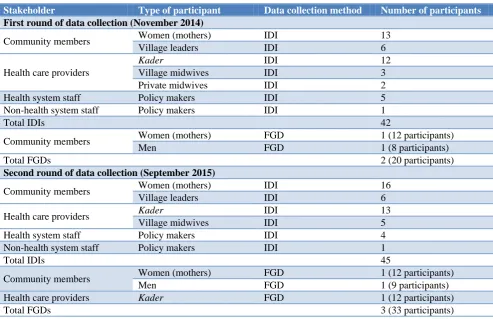
Table 2: Distribution of participants across data collection methods.
Stakeholder Type of participant Data collection method Number of participants
First round of data collection (November 2014)
Community members Women (mothers) IDI 13
Village leaders IDI 6
Health care providers
Kader IDI 12
Village midwives IDI 3
Private midwives IDI 2
Health system staff Policy makers IDI 5
Non-health system staff Policy makers IDI 1
Total IDIs 42
Community members Women (mothers) FGD 1 (12 participants)
Men FGD 1 (8 participants)
Total FGDs 2 (20 participants)
Second round of data collection (September 2015)
Community members Women (mothers) IDI 16
Village leaders IDI 6
Health care providers Kader IDI 13
Village midwives IDI 5
Health system staff Policy makers IDI 4
Non-health system staff Policy makers IDI 1
Total IDIs 45
Community members Women (mothers) FGD 1 (12 participants)
Men FGD 1 (9 participants)
Health care providers Kader FGD 1 (12 participants)
Total FGDs 3 (33 participants)
Table 3: Overview of topic guide contents per participant type.
Topic addressed Community members Health care providers Policy makers
Role and responsibility X
Motivation factors X
Health promotion X X X
Supervision X X
Coordination/partnership X X X
Community engagement X X
Equity X X X
REACHOUT intervention X X X
Awareness of health system and health policy
X
Health promotion training
A total of 14 participatory health promotion training workshops, of five days each, were conducted during
as part of their current role in the Posyandu. During the workshops, teaching counselling card, other materials and facilitation methods were used to help participants to discuss health messages with their community clients (women) to overcome barriers to attend antenatal care, understand danger signs of pregnancy and identify complication that occur during childbirth. In addition, the trainings involved role play by the kader with women from the community, to get the kader prepared for situations that could occur in the Posyandu.
A training manual and counselling card was developed by the REACHOUT team for use in the training.10 The manual consists of sections on basic communication, negotiation techniques, the use of counselling card, topics of antenatal and postnatal care, danger signs in pregnancy, birth preparedness, labour signs, nutrition in pregnancy and contraception. In addition, there were sections on newborn care, danger signs in newborns and roles, responsibilities and management of the Posyandu. Counselling cards addressed similar maternal health topics covered in the training manual.
After completion of training, the study team observed the kader providing the health promotion in the Posyandu and assessed them delivering health messages and interaction with antenatal women. Three rounds of observations were carried out. The first round was in July-August 2015, two months after completion of training, second round in October-November 2015 and third round in January-February 2016. During these sessions, the study team provided support and feedback to the kader.
Data collection
Qualitative data was collected at two-time points. First round was in November 2014, before the health promotion workshops. A total of 42 in-depth interviews (IDIs) and two focus group discussions (FGDs) were conducted with community members, health care providers and policy makers (Table 2). The IDIs and FGDs aimed to explore the understanding and
perceptions regarding health promotion and its
implementation at the Posyandu. The IDIs assured that participants could be interviewed in their rural homes and offices, allowing sensitive areas to be probed and avoiding issues of hierarchy affecting group discussion. On the other hand, the FGDs used group interaction to generate findings to help understand community and organisational norms, common health issues and the need for access and use of healthcare services.11-13 Second round of interviews (45 IDIs and three FGDs) were conducted in September 2015, almost six months after the kader completed training.
Sampling of study participants was based on their involvement in community health programmes; variation in respondents was achieved based on demographic and geographical characteristics; community members and
health care providers came from across the four communities where kader came for the trainings.
The REACHOUT Consortium had developed a conceptual framework, modelling the factors influencing community health worker performance, reported on elsewhere.14,15 Using this unifying framework approach,16 the Indonesia REACHOUT team developed topic guides for the study IDIs and FGDs. These were developed for the various types of informants, with some differences in topics based on whether they were community members, health care providers or policy makers (Table 3).
For health care providers (kader and midwives), the objective was to explore the practice of health promotion, before and after their training by the REACHOUT team, the motivational factors and the experiences with supervision they received. The objectives of the interviews for the community members and policy makers were to explore their understanding regarding the implementation of health promotion by health care providers and its impact on the community, before and after the training. Since our interest was on the ability of kader to provide health promotion, in this study the findings related to the kader only are presented.
The IDIs and FGDs were conducted in Indonesian language and lasted between one to two hours. Written informed consent was obtained from the participants before the interview or FGDs. All IDIs and FGDs were digitally recorded, transcribed by field staff, translated to English by external translators and checked by the research assistants regarding any diversion in meanings of the content of the interviews. The coding process used open-coding, combined with a pre-defined framework of factors that could influence community health workers’ performance.17 Transcripts were coded using NVivo 10 software and emerging themes were discussed, and the coding refined based on research team consensus. The coded transcripts were further analysed, “charted” and summarised in narratives for each theme and sub-theme.
RESULTS
There were four main themes that emerged from our analysis. They were: 1) increased knowledge and skills
regarding health promotion; 2) improved kader’s
motivation and confidence; 3) the usefulness of counselling card in providing health promotion; 4) the benefit of participatory training approach. They are presented with illustrative quotes.
Increased knowledge and skills regarding health promotion
Most kader acknowledged that the health promotion
“After the training, we are more confident to talk and courageous to ask pregnant women to deliver in the health facility, because now we are capable of giving explanations about the risk of not giving birth in a health facility.” (IDI, kader, round-2)
Most of the pregnant women who were the recipients of the health promotion also recognised that knowledge of kader had improved after they attended the training.
“I used to ask something to the kader, but only Mrs. E could answer it and other kader were unable to answer. This might be because of their limited knowledge. Now, they are able to provide comprehensive information with examples and what are the things that pregnant women must do if the labour signs starts.” (IDI, mother, round-2).
Majority of the community members and health care providers also noted an improvement of health promotion skills of the kader. The village midwives, expressed that kader performed better health counselling, communication and negotiation skills. Kader, themselves, mentioned that they could communicate better and deliver the health counselling topics and negotiate better with pregnant women after the training.
“Relating to the counselling, the kader spoke loudly when they did counselling at the Posyandu. Previously, they just said that they would do it, but in fact they didn‟t. But after they got training, they did counselling even if only one or two of them did it. The communication between the kader and the mother is better now. The kader didn‟t feel awkward to speak out.” (IDI, village midwife, round-2)
Additionally, one of the stakeholders from sub-district hihglighted that a kader from one of the Posyandu at Karangwangi village participated in a health counselling competition at district level and used the techniques they learnt during the participatory health promotion training held by the REACHOUT team.
“Previously the kader didn‟t do counselling or didn‟t really understand what they should do at a Posyandu, but now they do health promotion with counselling card. Moreover, some of them joined the counselling competition at the district. I was surprised that they still remembered what they got from the REACHOUT training. Now they have the capability to do counselling and thank God, Posyandu Kamboja got ranked in top 6.” (IDI, health system stakeholder, round-2)
Improved motivation and confidence
Most kader acknowledged that the health promotion
training played an important role in increasing their motivation. Many kader mentioned that they were more enthusiastic in performing their tasks at the Posyandu, particularly health counselling, because their knowledge
and skills had improved. Moreover, they also felt motivated because they saw changes in the behaviour and attitude of the community as a result of the health promotion they delivered in the Posyandu.
“Because we know better about the topics of counselling and how to do the counselling, now we are confident to deliver the health promotion. „Oh, I have read this topic before. I can do the counselling.‟ I feel more motivated to do it again. And when my colleagues see it, they also feel motivated to do the same.” (IDI, kader, round-2)
All the kader stated that the training helped them to deliver information and counselling with courage and confidence while they had been reluctant to do so previously.
“Before the training, we didn‟t have the courage to speak up because we were afraid our knowledge was lacking. However, after the training, we are more confident to talk and courageous to ask pregnant women to deliver in health facility, because now we are capable of giving explanations about the risk of not giving birth in health facility.” (IDI, kader, round-2)
The usefulness of counselling cards
Most of the kader found that counselling cards helped them to provide information on the risk of pregnancy, pregnancy care and the importance of delivering in the health facility to the pregnant women without difficulty.
“Counselling cards helped me to give explanations to pregnant women and postnatal mothers. The availability of counselling cards for counselling is very helpful to me because I can see the explanation of the topic at the back in case I encounter difficulties when delivering the counselling.” (IDI, kader, round-2)
The kader mentioned that there were various health promotion aids such as the “maternal and child health book”, “toddler’s family coaching (BKB) card” and “healthy card” available at the Posyandu previously. Yet, they had not received training on how to use those and therefore, they rarely used it for health counselling. Several kader also mentioned that previous counselling cards were not comprehensive with insufficient information on maternal and child health issues, and that the illustrative pictures in those counselling cards were small and not user friendly.
“There is counselling card about BKB (toddler‟s family coaching), but we did not know the order and how to use the counselling card.” (IDI, kader, round-2)
issues illustrated in the new cards and it made them want to attend the Posyandu.
“The pregnant women understand the counselling topic easily because I used the picture in the card to make them interested in the topic. Through those pictures, they understood about the information I said, and answered my question related to their problem.” (IDI, kader, round-2)
“I understood (the information) because the messages concerned our daily life, such as headache. The kader also showed us a picture with arrows. In case the symptoms as shown on the pictures appeared, we should go to the midwife‟s place or Puskesmas. I just saw the pictures and listened to the explanation.” (IDI, mother, round-2)
The benefit of participatory training approach
Several kader mentioned that the participatory approach of the training used by the REACHOUT team was different with the trainings they attended previously. The workshops provided an opportunity for the kader to participate actively through discussion during the training, role play and interactive learning, which was different to the long lectures that were used during the earlier trainings, with a much larger number of participants.
“Training by REACHOUT is different from (former) training for counselling presented by the Puskesmas. During the former training, kader were grouped in big numbers and only were taught how to give counselling in general. Meanwhile during REACHOUT training, kader were grouped into a smaller size, of maximum 20 persons and were taught to counsel in detail including on how to call the mothers and encounter a lot of people. Kader were more focused during this training.” (IDI, kader, round-2)
Furthermore, some of the kader stated the different approach to training as well as the Posyandu observations conducted after the training helped them remember the topics and conduct better health counselling.
“The health promotion training by REACHOUT made a significant change because of the way it was presented. In my previous training, we were used to just look at the screen and never had monitoring afterwards. This makes us often forget. Now, the participants are provided with books (counselling cards) and are being observed in the Posyandu, so that the participants remember the training materials.” (IDI, kader, round-2)
DISCUSSION
The provision of health promotion training had substantially improved the health promotion role of kader
in the Posyandu. The kader acknowledged their
knowledge and understanding of maternal health topics improved which made them deliver health counselling to pregnant women with confidence. They were able to communicate better and discuss topics on pregnancy issues and benefits of giving birth at health facility with antenatal women. As a result, pregnant women valued kader‟s counselling which motivated the kader to conduct health promotion and counselling during the Posyandu. With appropriate training, a positive change of kader as health promoters was anticipated and is comparable to what was described in previous studies.
18-20
For example, a study in India described how trained village health workers became the heart of the community programs and plays important role in empowering the women in the rural area towards better health awareness.21
The counselling cards in the form of pictorial aids greatly helped the kader perform their health promotion task. The pictorial booklet we provided illustrated the counselling topics and made it easier for them to deliver the information and make the pregnant women understand the given information. Similar results on the effectiveness of pictorial aids in improving the knowledge of the recipients were described in past studies.22,23 A drawback of the previously available counselling cards was that the kader had not received training to use them although they were kept in the Posyandu. This was indicated in a study conducted about
the use of the MCH booklet.21,24,25 Taking into
consideration the shortcomings of the previous trainings, the kader were trained to use the counselling cards during the current workshops. It made them familiar with the illustrations and comfortable to use the counselling cards in the Posyandu during health promotion.
The type of training and duration is important for effective practice of what is taught. From the kader‟s point of view, the participatory workshops helped them be prepared for everyday situations of health promotion in the Posyandu, unlike previous conventional trainings they attended, and contributed to improve their knowledge and skills of communication. To this effect, several studies have shown the benefits of participatory approach in increasing knowledge, skills, attitude and behaviours of the health providers in providing service.26,27 Other authors have shown that duration of training matters, and that small group of participants increased the focus of the participants and understanding of the topics discussed.28,29 Likewise, our findings showed that the kader benefited from the participatory training and made them actively practice health promotion.
follow-up training sessions could reinforce the skills and knowledge learned during the initial training and also
building additional knowledge and skills.27 While
supervision helps, kader‟s would need to provide health promotion independent of trainer observations. Although our training has helped the kader in the four study villages to actively provide health promotion, our findings may not be generalisable to other areas of Indonesia.
In conclusion, proper training has equipped the kader with knowledge and skills and motivated them to confidently function as maternal health promoters. The pregnant women and the community, both benefited from the health promotion kader practiced in the Posyandu
using the counselling cards. A comprehensive
participatory training accompanied with regular
supportive supervision should be considered for kader in Indonesia for them to be resourceful maternal health promoters that could engage the community.
ACKNOWLEDGEMENTS
We thank the Cianjur DHO and Puskesmas Ciranjang for their support during the health promotion training. We also thank the Heads of Villages in Ciranjang, Mekargalih, Karangwangi and Sindangsari for facilitating the health promotion training and providing the training venue. We are very grateful to dr. Amelia Magdalena (former Research Assistant REACHOUT) for conducting the health promotion trainings and for all the hard work of REACHOUT field staff: Asep Wijanah Kusumah, Astri Wulandari, Della Mutiara Aprilia, Dian Rahma Ardiyanti, Dwi Putri Kusuma Wardani, Euis Latifah, Indri Tiara Hernayanti, Listika Jayanti, Rosi Alfi Aulia, Teti Nurjanah, Tutyarni, Yuli Hendrika Sugiharti and study drivers. We also thank Korrie de Koning of the KIT Royal Tropical Institute, Netherlands, for her valuable input in developing the topic guides and Setia Pradipta for his input in producing the pictorial guides. We acknowledge the translators of the transcripts. We also express our gratitude for the informants in this study, for their willingness to be interviewed and share their insights.
Funding: This study is part of the REACHOUT Consortium programme. The REACHOUT Consortium is funded by the European Union FP7 grant (number 306090)
Conflict of interest: None declared
Ethical approval: The study was approved by the Ethics Committee of Research in Health, Medical Faculty of Hasanuddin University, Makassar, Indonesia (No. 02260/H4.8.4.5.31/PP36-KOMETIK/2014) and by the Royal Tropical Institute (KIT), in Amsterdam
REFERENCES
1. World Health Organisation. Health in 2015: from
MDGs to SDGs. 2015. Available at
http://apps.who.int/iris/bitstream/10665/200009/1/9 789241565110_eng.pdf?ua=1. Accessed on 19 December 2017.
2. Heywood P, Choi Y. Health system performance at
the district level in Indonesia after decentralisation. BMC Int Health Hum Rights. 2010;10(3).
3. Nasir S, Ahmed R, Kurniasari M, Limato R, De
Koning, K, Tulloch O, et al. Context analysis: close-to-community maternal health providers in South West Sumba and Cianjur, Indonesia. REACHOUT linking communities and health system, 2014. Available at: http://www.reachoutconsortium.org/ media/1831/indonesiacountryanalysisjuly2014comp ressed.pdf. Accessed on 29 September 2017.
4. Kementerian Kesehatan Republik Indonesia.
Pedoman umum pengelolaan Posyandu. 2011. Available at: https://www.google.co.id/url?sa=t&rct =j&q=&esrc=s&source=web&cd=1&cad=rja&uact =8&ved=0ahUKEwi4zpGZq9HWAhVJX5QKHQD lBJ4QFggoMAA&url=http%3A%2F%2Fperpustak aan.depkes.go.id%3A8180%2Fbitstream%2F12345
6789%2F1649%2F2%2FBK2011-170912- 4.pdf&usg=AOvVaw0amk827CK2qpDam4gTMT-y. Accessed on 2 October 2017.
5. Kementerian Kesehatan Republik Indonesia.
Kurikulum dan modul pelatihan kader Posyandu. 2012. Available at: https://slidedokumen.com/
kurikulum-dan-modul-pelatihan-kader-posyandu_59fca5d31723dd9e40a32e01.html. Accessed 29 September 2017.
6. Nasir S, Magdalena A, Limato R, Tumbelaka P,
Syafrudin D, Ahmed R. Impact of health promotions training of community health providers on community maternal health services in Cianjur, Indonesia. Presented at: 4th Global Symposium on Health Systems Research; November 16, 2016;
Vancouver, Canada. Available at:
http://www.reachoutconsortium.org/media/9993/pac 00288_impact-of-health-promotion-trainings-of-community-health-providers.pdf. Accessed on 29 September 2017.
7. Badan Pusat Statistik Kabupaten Cianjur.
Kabupaten Cianjur dalam angka. 2015. Available at https://cianjurkab.bps.go.id/index.php/publikasi/85. Accessed 10 August 2017.
8. Dinas Kesehatan Kabupaten Cianjur. Laporan Akhir
Tahun Kesehatan Ibu Kabupaten Cianjur. 2015.
9. Nasir S, Ahmed R, Kurniasih M, Limato R, Tulloch
O, Syafruddin D, et al. Challenges that hinders parturients to deliver in health facilities: a qualitative analysis in two districts of Indonesia. Makara J Health Res. 2016;20(3):79-87.
10. REACHOUT Consortium. New maternal health
promotion resources from Indonesia. 2017.
Available at: http://reachoutconsortium.org/news/ new-maternal-health-promotion-resources-from-Indonesia/. Accessed on 15 January 2018.
11. Pope C, Mays N. Qualitative research: reaching the
qualitative methods in health and health services research. BMJ. 1995;3(11):42–45.
12. Mack N, Woodsong C, MacQueen KM, Guest G,
Namey E. Qualitative research methods: a data collector’s field guide. 2005. Family Health International. https://www.fhi360.org/sites/default/ files/media/documents/Qualitative%20Research%20 Methods%20-%20A%20Data%20Collector%27s% 20Field%20Guide.pdf. Accessed 19 December 2017.
13. Ritchie J, Spencer L, O’Connor W. Carrying out qualitative analysis. In: Ritchie J, Lewis J, eds. Qualitative Research Practice: A Guide for Social Science Students and Researchers. London: SAGE; 2003: 219-261.
14. Kok MC, Dieleman M, Taegtmeyer M, Broerse
JEW, Kane SS, Ormel H, et al. Which intervention design factors influence performance of community health workers in low- and middle-income countries? A systematic review. Health Policy Plan. 2015;30:1207-27.
15. Kok MC, Kane SS, Tulloch O, Ormel H, Theobald
S, Dieleman M, et al. How does context influence performance of community health workers in low- and middle-income countries? Evidence from the literature. Health Res Policy Syst. 2015;13:13.
16. Dixon-Woods M. Using framework-based synthesis
for conducting reviews of qualitative studies. BMC Med. 2011;9:39.
17. Charmaz K. Constructing grounded theory. 2nd ed. London: SAGE; 2014.
18. Limato R, Ahmed R, Magdalena A, Nasir S,
Kotvojs F. Use of most significant change (MSC) technique to evaluate health promotion training of maternal community health workers in Cianjur
district, Indonesia. Evaluation and Program
Planning. 2017;66(2018):102-10.
19. Gunanti IR, Devi SR, Adriani M. Pemberdayaan
kader posyandu melalui penerapan metode
konseling gizi dalam upaya meningkatkan kualitas
pembinaan program keluarga sadar gizi
(KADARZI). Buletin Penelitian Sistem Kesehatan. 2005;8(1):47-58.
20. Sukiarko E. Pengaruh pelatihan dengan metode
belajar berdasarkan masalah terhadap pengetahuan dan keterampilan kader gizi dalam kegiatan Posyandu: studi di kecamatan Tempuran kabupaten Magelang. Masteral thesis, Universitas Diponegoro Semarang. 2007.
21. Kermode M, Herrman H, Arole R, White J,
Premkumar R, Patel V. Empowerment of women and mental health promotion: a qualitative study in
rural Maharashtra, India. BMC Public Health. 2007;7:225.
22. Setiyarini T. Efektivitas Pendidikan kesehatan
menggunakan media leaflet dan penyuluhan
individual terhadap pengetahuan pencegahan
kekambuhan asma. Bachelor thesis, Universitas Muhammadiyah Surakarta. 2016.
23. Yustisa PF, Aryana IK, Suryasa ING. Efektivitas penggunaan media cetak dan media elektronika dalam promosi kesehatan terhadap peningkatan pengetahuan dan perubahan sikap siswa SD. Jurnal Kesehatan Lingkungan. 2014;14(1):29-39.
24. Widagdo L, Husodo BT. Pemanfaatan buku KIA
oleh kader Posyandu: Studi pada kader Posyandu di wilayah kerja Puskesmas Kedungadem Kabupaten Bojonegoro. Makara J Health Res. 2009;13(1):39-47.
25. Sistiarani C, Nurhayati S, Suratman. Peran kader dalam pengunaan buku kesehatan ibu dan anak. Kemas. 2013;8(2):99-105.
26. Fu C, Zhu M, Yu TSI, He Y. Effectiveness of
participatory training on improving occupational health in small and medium enterprises in China. Int J Occup Environ Health. 2013;19(2):85-90.
27. Tripathy P, Nair N, Barnett S, Mahapatra R, Borghi
J, Rath S et al. Effect of a participatory intervention with women’s groups on birth outcomes and maternal depression in Jharkhand and Orissa, India: a cluster-randomised controlled trial. Lancet. 2010;375:1182-1192.
28. Hien LTT, Takano T, Seino K, Ohnishi M,
Nakamura K. Effectiveness of a capacity-building program for community leaders in a health living
environment: a randomized community-based
intervention in rural Vietnam. Health Promot Int. 2008;23(4):354-364.
29. Javanparast S, Baum F, Labonte R, Sanders D,
Rajabi Z, Heidari G. The experience of community health workers training in Iran: a qualitative study. BMC Health Serv Res. 2012;12:291.
30. Kaysin A. Empowerment of community health
workers as agents of change. Masteral thesis, Johns Hopkins Bloomberg School of Public Health, Baltimore. 2010.
Cite this article as: Tumbelaka P, Limato R, Nasir S, Syafruddin D, Ormel H, Ahmed R. Analysis of Indonesia’s community health volunteers (kader) as maternal health promoters in the community