ISSN (e): 2250-3021, ISSN (p): 2278-8719
Vol. 09, Issue 5 (May. 2019), ||S (VIII) || PP 13-17
Digital Glove for Gesture Recognition using Flex Sensor
Ms. Divyani Shende
1, Prof. Nakul Nagpal
2, Prof. Mayuri Chawla
31(Department of M. Tech (VLSI Design), Jhulelal Institute of Technology, India) 2(Department of ETC Engineering, Jhulelal Institute of Technology, India) 3
(Department of ETC Engineering, Jhulelal Institute of Technology, India)
Abstract:
People communicate with each other to convey their ideas, thoughts to the people around them. But this is impossible with deaf and mute people all over the world as they face struggle in expressing their feelings to other normal people. Sign language is the only solution to this problem which helps deaf-mute people to communicate. The aim behind this work is to develop a flex-sensor based gesture recognition module for recognizing the Sign Languages, which provides communication between people with speech impairment and normal people. The flex sensors and accelerometer are fitted over the data glove. The voltage signals will then processed by microcontroller and sent to voice module where the outputs are stored and produce appropriate voice with the help of speaker.Keywords:
Gesture Recognition, Sign Languages, Flex Sensors, Accelerometer.I.
Introduction
People who are suffering from speech impairment and hearing impairment uses sign languages so that they can communicate with the normal people in the society. Establishing an interaction with deaf and mute people is very important nowadays. Gestures are basically the physical action form performed by a person to convey some meaningful information. Gestures are a powerful mean of communication among humans. In fact gesturing is so deeply rooted in our communication that people often continue gesturing when speaking on the telephone. There are various signs which express complex meanings and recognizing them is a challenging task for people who have no understanding for that language [1]. Sign language includes hand gestures, facial gestures other non-verbal behaviors to convey their meaning. The sign languages have different origin and hence it is difficult to interpret. The conventional idea for gesture recognition is to use a camera based system to track the hand gestures. The camera based system is comparatively less user friendly as it would be difficult to carry around. In addition, it would not be feasible to use it in crowded areas [2]. So the motivation for developing such helpful application came from the fact that it would prove to be of utmost importance for socially aiding people and how it would help increasingly for social awareness as well [1]. The sign language to speech conversion system translate finger signs to speech, using flex sensors and accelerometer which sense the gestures made by person. The modules to be present in the proposed system are flex sensor based gesture recognition and Voice module.
II.
Literature Survey
proposed [9]. [10] Propose Transition movement models (TMMs) to handle transition parts between two adjacent signs in large-vocabulary continuous sign language recognition, experiments over a large vocabulary of 5113 Chinese signs was conducted with average accuracy of 91.9%. Models using Microsoft kinect system are proposed in [7,8,11] which uses the hand tracking feature of the device to perform hand gesture spotting. Computer vision based technique for gesture recognition of alphabets for Bangladeshi and Indian sign language are proposed in [6, 13] respectively.
III.
Proposed Methodology
This project consists of two main modules, one is flex sensor based gesture recognition module and another is voice module. Flex sensors and accelerometer are mounted on the glove and they are fitted along the length of each of fingers. They are used for sensing the hand movements. Flex sensors are used to measure the degree to which the fingers are bent. Accelerometer within the gesture recognition system is used as a tilt sensing element, which in turn finds the degree to which the finger is tilted. The flex sensor is interfaced with the digital ports of Arduino uno microcontroller. The output data stream from the flex sensor and accelerometer are fed to the Arduino microcontroller, where it is processed and converted to its corresponding digital values. Microcontroller compares these readings with the predefined values and the corresponding gestures are recognized and text is displayed. This text output obtained from the sensor based system is then sent to the voice module. Voice module consists of eight channels, in which eight words can be recorded. Voice recording and play back module is used for giving audio information to the person. So that sign alphabets will be available in audio format through speaker.
IV.
Hardware Specifications
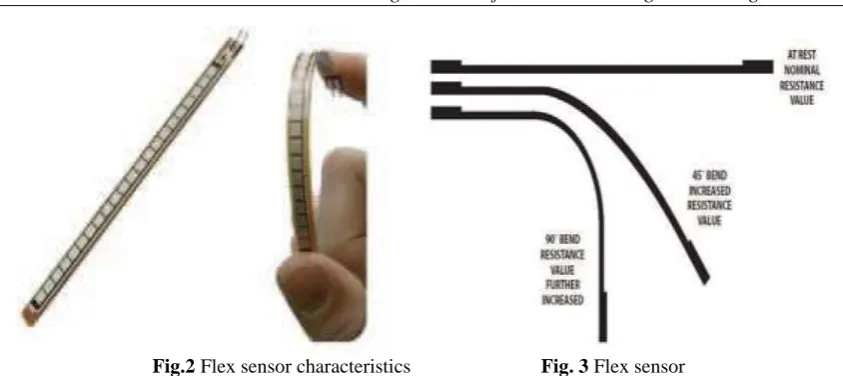
4.1 Flex sensorFig.2 Flex sensor characteristics Fig. 3 Flex sensor
4.2 Arduino
It is an electronics prototyping platform based on user-friendly software and easy-to-use hardware and it is available as an open-source. Arduino runs on Mac, Windows, and Linux. Atmega328 is a microcontroller unit present in the Arduino board. Atmega328 (Shown in Fig. 4) has 14 digital I/O pins out of which 6 can be used for Pulse width modulation outputs, 6 for analog inputs.
Fig. 4 Arduino
1.3 Accelerometer
It is an electromechanical device that measures the force of acceleration due to gravity in g unit. It can be used in applications requiring tilt sensing. The ADXL335 measures acceleration along X, Y and Z axes and gives analog voltage output proportional to the acceleration along these 3 axes. Microcontrollers can process these voltages by converting them to digital signals using ADC.
4.4 Voice play back module
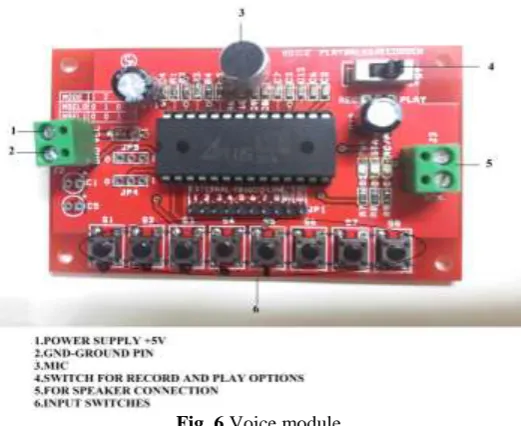
APR33a3 Voice play back provides high quality recording and playback with 11 minutes audio at 8 KHz sampling rate with 16 bit resolution. The aPR33A series C2.x is specially designed for simple key trigger, user can record and playback the message averagely for 1, 2, 4 or 8 voice message(s) by switch, it is suitable in simple interface or need to limit the length of single message.
Fig. 6 Voice module
V.
Expected Result
In this project, the flex sensor and accelerometer mounted on glove will sense the hand movement and sent to the microcontroller which processed the data and sent to the voice module which generates the constant words which can be heard by normal people with the help of the speaker.
Fig. 6 Experimental setup of Digital Glove
VI.
Conclusion
Acknowledgment
I would like to express sincere gratitude and appreciation to all those who gave me the possibility to complete this paper. A special thanks to my Project Guide Prof. Mayuri Chawla and Project Co-Guide Prof. Nakul Nagpal Whose help, stimulating suggestions and encouragement, helped to coordinate project especially in writing this paper.
References
[1]. Sakshi Goyal, Ishita Sharma, Shanu SharmaSign, ―Language Recognition System For Deaf And Dumb People,‖ International
Journal of Engineering Research & Technology (IJERT), April – 2013.
[2]. Abhijith Bhaskaran K, Anoop G Nair, Deepak Ram K, Krishnan Ananthanarayanan, H R Nandi Vardhan, ―Smart Gloves for Hand Gesture Recognition Sign Language to Speech Conversion System,” International Conference on Robotics and Automation for
Humanitarian Applications (RAHA), 2016.
[3]. Yun, L., ―A sign component based framework for sign language for Chinese sign Language Recognition Using Accelerometer and Semg Data,‖ IEEE Transaction on Biomedical Engineering, 2012.
[4]. Preetham c, ―Hand Talk Implementation of a Gesture Recognizing Glove,‖ India Educators’ Conference (TIIEC), Texas Instruments, 2013.
[5]. Delliraj, M. and S. Vijayakumar., ― Design of Smart e- Tongue for the physically challenged people‖ International conference on
Recent Trends in Information Technology (ICRTIT), 2013.
[6]. Begum, S. and M. Hasanuzzam, ―Computer vision based Bangladeshi Sign Languages Recognition System,‖ 12th International
Conference on Computer and Information Technology ICCIT, 2009.
[7]. Chao. S,―Discriminative Exemplar Coding for Sign Languages Recognition with Kinect,‖ IEEE Transaction on Cybernetics, 2013. [8]. Chikkanna, M. and R.M.R Guddeti, ―Kinect based real time gesture spotting using HCRF‖ International Conference on Advances
in Computing, Communications and Informatics (ICACCI), 2013
[9]. Choudhury, A., A.K. Talukdar, and K.K. Sarma, ―A Conditional Random Field Based Indian Sign Languages Recognition System under Complex Background‖, International Conference on Communication system and Network Technologies (CSNT), 2014. [10]. Gaolin, F., G. Wen, and Z. Debin, ―Large Vocabulary Continuous Sign Language Recognition Based on Transition Movement
Model‖ IEEE Transaction on system, Man and Cybernetics, Part A: System and Humans, 2007.
[11]. Geetha. M., ―A Vision based Dynamic Gesture Recognition of Indian Sign Languages on Kinect based depth Images‖ International
Conference on Emerging Trends in Communication, Control, Signal Processing and Computing Applications (C2SPCA), 2013.
[12]. Hee-Deok, Y.S.Sclaroff, and L. Seong-Whan, ―Sign Languages Spotting with a Threshold Model Based on Conditional Random Fields‖, IEEE Transaction on Pattern Analysis and Machine Intelligence, 2009.