www.pharmascholars.com
69
Research Article
CODEN: IJPNL6
DOCKING STUDIES OF SWINE FLU NEURAMINIDASE WITH HERBAL
COMPOUNDS
Jayasree Ganugapati *, Archana Battu, Aishwarya Aare
Associate Professor, Department of Biotechnology, Sreenidhi Institute of Science and
Technology, Ghatkesar. A.P., INDIA
*Corresponding author e-mail: [email protected]
ABSTRACT
Swine Flu is a seasonal viral infectious disease caused due to H1N1. The aim of the present study is to identify natural compounds found in dietary resources that can inhibit neuraminidase, a protein that plays a crucial role in the H1N1 infection and invasion into the human host tissues. The X-Ray Crystallographic structure of the protein Neuraminidase was retrieved from RCSB -PDB and 3D structures of the selected ligands were obtained from NCBI PubChem in SDF format. Lipinski Rule was analyzed using Mol inspiration. Docking studies were performed using ARGUSLAB, AUTODOCK 4.0 and AUTODOCK VINA to study the interactions of the protein with the ligands. The compounds having affinity towards the protein’s active site region were identified. Docking results indicate that all the six compounds interact with neuraminidase with varied binding energies. From our observations It can be concluded that the six compounds selected for analysis bind with neuraminidase and our further studies suggest that the activity of neuraminidase can be inhibited by Curcumin and Gingerol since they have a better binding energy and interact with active site residues.
Key words: AUTO DOCK ; Curcumin; H1N1; influenza; Swine flu
INTRODUCTION
Swine Flu is a seasonal infectious disease caused due to H1N1 virus. In 1976, WHO urged extreme caution in developing live vaccines against swine flu (H1N1) because of the possible danger of spreading from pig to susceptible human and from human to human. [1] Previous influenza pandemics had occurred in 1947, then in 1957, then in 1968, then in 1976 and so on; This established the concept of 10-11 years influenza A virus pandemics patterns.[2] People especially pregnant women are thought to be at a higher risk of contacting swine flu worldwide .[3] Transmissibility and severity of the swine flu encouraged to develop and to devise more effective public health measures against infectious disease.[4] Swine influenza is known to be caused by influenza A subtypes H1N1, H1N2, H2N3], H3N1, H3N2. [5, 6]
All Influenza A viruses has Similar Physical Structure. The virions or virus particles are enveloped and can be either spherical or filamentous in form.
The total genome size of influenza A virus is 13,588 bases and is contained eight RNA strands that code for eleven proteins. [7] Influenza virus, an enveloped virus, has an outer lipid layer membrane which is taken from the host cell within which the virus multiplies. Embedded into this lipid layer are a group of glyco-proteins which not only determine the type and subtype of the influenza virus but also facilitate the attachment and release of the viral particle from the host cell. Two main types of glycoprotein exist on the capsid of these viruses, they are, hemagglutinin (HA) and neuraminidase (NA). Hemagglutinin helps the virus bind to the sialic acid residues present on the epithelial cells of the lungs and throat, results in the infection of the upper respiratory tract. Neuraminidase is an enzyme sialidase with the active site in a pocket, hydrolyzing the glycosidic linkage between the hemagglutinin and sialic acid residue. It consists of a single polypeptide chain made up of six conserved polar amino acids, followed by hydrophilic and variable amino acids.
International Journal of Pharmacy
www.pharmascholars.com
70
The orientation of this polypeptide is generallyopposite to that of the hemagglutinin antigen. This is indispensable for the virus to infect neighboring host cells. HA and NA are essential for the proper identification and binding of the virus to the host cell surface, which is the initial stage of viral infection. Because of the relative deep active site in which low molecular weight inhibitors can make multiple favorable interactions and approachable methods of designing transition state analogues in the hydrolysis of sialosides, the sialidase (NA) becomes more attractive anti-influenza drug target than the hemagglutinin (HA). [8]
Two of the most commonly used drugs as neuraminidase inhibitors include Zanamivir (Relenza) and Oseltamivir (Tamiflu). These inhibitors occupy the active sites of the neuraminidase protein thus preventing the cleavage of the bond between sialic residues and hemagglutinin. This prevents the release of new viral particles from the infected cells. But the compounds of synthetic drugs after metabolism in the body may be toxic to the body producing many side effects. Adverse Drug Reactions (ADRs) associated with oseltamivir therapy include neurological and psychological disorders as possible adverse effects, including impaired consciousness, abnormal behavior, and hallucinations .[9] After inhalation, zanamivir is concentrated in the lungs and oropharynx, where up to 15% of the dose is absorbed and excreted in urine. Dosing is limited to the inhaled route. This restricts its usage, as treating asthmatics could induce bronchospasm .[10]
Natural products, either as pure compounds or as standardized plant extracts, provide unlimited opportunities for new drug leads because of the unmatched availability of chemical diversity .[11]
It is shown that naturally available compounds can be used as anti-viral agents to treat many viral infections
.[12,13] Some of the compounds that exhibit antiviral activity are Curcumin, (a natural phenol that is responsible for the yellow color of turmeric.),Gingerol (an active constituent of fresh ginger), Limonene (a cyclic terpene), Naringenin (a flavonoid) ,ellagic acid etc., Studies show that these compounds have significant anti-inflammatory, antimicrobial, antioxidant, anticarcinogenic and more recently discovered antiviral properties. [14]
The objective of the present study is to identify a natural herb that can inhibit neuraminidase activity.
MATERIAL AND METHODS
In the present study, docking studies were performed with the enzyme neuraminidase from H1N1 virus with the natural ligands to identify a compound that
can be considered as a potential neuraminidase inhibitor. Docking studies were carried out using three softwares viz, Auto dock 4.0, AutoDock Vina and Arguslab 4.0.1.
Protein
The three dimensional crystallographic structure of the protein Neuraminidase in complex with Zanamivir was retrieved from RCSB-PDB (3B7E).
Ligands
Herbal compounds that were known to have antiviral properties were identified from the available literature. The CID files of these ligands were obtained from NCBI PubChem. The compounds that were selected for analysis are Gingerol (CID90942); Curcumin (CID969516); Naringenin (CID932); Ellagic acid (CID5281855); Propolis (CID35370); Limonene (CID22311). The protein and ligands were subjected to energy minimization so as to refine them and prepare for docking .This was performed by implementing GROMOS using Swiss PDB Viewer. [15]
Molecular properties
The molecular properties of the compounds were calculated using Mol inspiration tool. The compounds with violations were eliminated by Lipinski’s rule of five and only the compounds with no violations were further selected for docking studies.
Active Site Analysis
Active site analysis of the Protein Neuraminidase with Zanamivir was performed using Swiss PDB Viewer. The residues found in the binding site of Neuraminidase were identified as ARG-118, ASP-151, ARG-152, TRP-178, GLU-227, GLU-276, ARG-292, and ARG-371.
Docking Studies
www.pharmascholars.com
71
significantly improves the average accuracy of thebinding mode predictions compared to AutoDock 4.0.
RESULTS
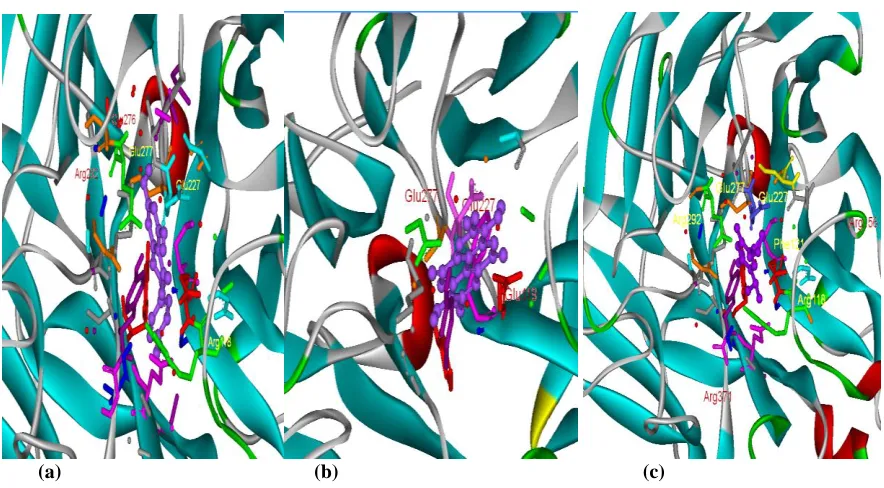
Quantitive structure-activity relationship of the compounds was obtained by molinspiration. The QSAR property values from Mol inspiration analysis indicates that all the six compounds can be considered as drugs since they do not violate Lipinski’s rule.(Table 1 ).Docking results (Table 2, Fig 1 and Fig 2 ) indicate that all the six compounds interact with neuraminidase with best binding energies.
DISCUSSION
Argus lab binding energy for Curcumin was -7.62 and that of Autodock and autodock Vina aws -5.07 and -5.5 respectively.Curcumin is forming hydrogen bonds with Arg 118 and Glu 227 which are active site residues. Gingerol has a binding energy of -7.92 with Argus Lab and Autodock and autodock Vina binding energies were found to be -4.4 and -4.4 respectively. The compound was found to interact with many residues of which Arg 118 and Glu 227 are known active site residues.Limonene has a binding energy of -7.79 in Argus lab and -6.78 in Autodock and -3.6 in Autodock Vina. The binding energy obtained for Naringenin with Argus lab was -7.52.with Autodock -5.27 and with Autodock Vinait was -5.0. Ellagic acid has a binding energy of -7.75
with Argus Lab and Autodock and autodock Vina binding energies were found to be -5.29 and -6.0 respectively. Argus lab binding energy for Propolis was -7.65 and that of Autodock and autodock Vina was -6.02 and -3.6 respectively.
CONCLUSION
The 3-dimensional structure of the Protein neuraminidase in complex with Zanamivir was used in the present study. The binding energy of the protein neuraminidase with various natural compounds such as Curcumin, Gingerol, Naringenin, Propolis, Ellagic acid and Limonene was obtained using three docking softwares namely Argus lab,Autodock and Auto dock Vina . The interactions were also visualized using Accelrys DS Visualiser 2.0. It can be concluded from our observations Gingerol and Curcumin are found to interact with few active site residues like ARG 118 and GLU 227. Of all these compounds Curcumin and Gingerol can be considered as potent inhibitors since they have a better binding energy and also interact with active site residues. This has to be further investigated by wet lab studies.
ACKNOWLEDGEMENTS
We would like to thank the management of Sreenidhi Institute of Science and Technology (SNIST) for their encouragement and support in carrying out the work.
Table 1 : Molinspiration Analysis of selected Natural compounds
Ligand Violations nOH nOHNH Volume Mol. Wt. Log P
Gingerol 0 4 2 295.61 294.391 3.217
Curcumin 0 6 2 332.182 368.385 2.303
Naringenin 0 5 3 230.261 272.256 2.117
Ellagic acid 0 8 4 221.776 302.194 0.943
Propolis 0 9 2 224.063 267.245 0.099
Limonene 0 0 0 157.296 136.238 3.615
Table 2 Docking Results Natural compounds with their Binding Energies
S.No. Ligand Arguslab
B.E
AutoDock B.E
AutoDock Vina B.E
1 Gingerol -7.92 -4.4 -4.4
2 Curcumin -7.62 -5.07 -5.5
3 Naringenin -7.52 -5.27 -5.0
4 Ellagic acid -7.75 -5.29 -6.0
5 Propolis -7.65 -6.02 -3.6
www.pharmascholars.com
72
(a) (b) (c)
Fig 1: (a) Interaction (hydrogen bonds indicated by green dotted lines) of Curcumin ( represented in dark red color ) with neuraminidase (b) Interaction (hydrogen bonds indicated by green dotted lines) of gingerol ( green color ) with neuraminidase (c) : Interaction (hydrogen bonds indicated by green dotted lines) of limonene ( represented in purple color ) with neuraminidase
(a) (b) (c)
www.pharmascholars.com
73
REFERENCES
1. Sunil Kumar, Gaurav Sharma, Mathew George. Inventi Rapid Pharmacy Practice, 2011 ;97(11):1-7 2. Walter R. Dowdle. Emerg Infect Dis , 2006 ;12(1): 34–39.
3. M. Toal, K. Agyeman-Duah, A. Schwenk, W. Yoong. Journal of Obstetrics & Gynaecology, 2010; 30(2): 97-100.
4. G James Rubin, Richard Amlôt, Lisa Page, Simon Wessely. BMJ, 2009; 339( b2651):1-8 5. Wenjun Ma, Amy L., Vincent Marie, R. Gramer, Christy B. Brockwell, Kelly M. Lager,Bruce H.
Janke, Phillip C. Gauger, Devi P. Patnayak, Richard J. Webby, Jürgen A. Richt. Proceedings of the
National Academy of Sciences of the United States of America, 2007; 104 (52): 20949–54.
6. Shin JY, Song MS, Lee EH, Lee YM, Kim SY, Kim HK, Choi JK, Kim CJ. Journal of Clinical
Microbiology , 2006; 44 (11): 3923–27.
7. Drickamer, Kurt; Taylor, Maureen P. Oxford [Oxfordshire]: Oxford University Press: 2006, pp .177–178. 8. Parry, Richard Lloyd. Japan issues Tamiflu warning after child deaths. The Times (London): 2009,
pp.05-05.
9. Hayden FG. Philosophical Transactions of the Royal Society of London. Series B, Biological Sciences , 2001;356 (1416): 1877–84.
10. Paul Cos, Arnold J. Vlietinck, Dirk Vanden Berghe, Louis Maes. Journal of Ethno pharmacology ,2006 ; 106(3): 290-302.
11. Dominique Schols, Sofie Struyf, Jo Van Damme, José A. Esté, Geoffrey Henson Erik De Clercq. JEM ,1997 ; 186(8): 1383-1388.
12. Shi-you Li, Cong Chen, Hai-qing Zhang, Hai-yan Guo, Hui Wang, Lin Wang, Xiang Zhang, Shi-neng Hua, Jun Yu, Pei-gen Xiao, Rong-song Li, Xuehai Tan. Antiviral Research ,2005 ; 67(1): 18-23.
13. Kolev, Tsonko M.; et al. International Journal of Quantum Chemistry (Wiley Periodicals) ,2005 ; 102(6): 1069–79.
14. Alexios S. Strimpakos and Ricky A. Sharma. Antioxidants & Redox Signaling ,2008 ; 10(3): 511-546. 15. Guex N & Peitsch MC, Protein Data Bank Quaterly Newsletter:1996 , pp. 7