Analysis of Uncertainty Multi-attribute Group
Decision Making Process Based on D-S Evidence
Theory
Jialin Liu
School of Management, Anhui University of Architecture, Hefei, 230022, China Email: [email protected]
Bengang Gong
School of Management Engineering, Anhui Polytechnic University, Wuhu 241000, China Email: [email protected]
Abstract—Group decision-making problem is a common and crucial human activity. By the characteristic of group decision making process, the model of multi-attribute group decision making (MAGDM) process based on evidence theory is proposed. The interacting process for MAGDM is analyzed, and the consensus analysis and the improving approach in group experts’ decision making based on similarity is given. By introducing the concept of experts’ relative reliability, the Dempster’s rule of combination is improved, and new aggregate method for group experts’ decision making. An example is presented to demonstrate the implementation of this improved method.
Index Terms—D-S Evidence theory, uncertainty,
multi-attribute group decision making, similarity, relative reliability
I. INTRODUCTION
Owing to the complexity of construction engineering, a single expert or decision maker cannot often comprehensively consider all the aspects of one thing, so a complex decision usually has to be made by integrating a group of experts' knowledge and experiences. Therefore, the practice of multiple attribute group decision making (MAGDM) is to invite internal experts or external experts or their combination of related fields to evaluate each attribute of every alternative individually. At present, the problem of multiple attribute group decision-making has become a new international research hotspot [1-3]. Because of the complexity of objective things, uncertainty and ambiguity of human thinking and other reasons, more multi-attribute group decision is carried out in the uncertain environment. It’s of theoretical and practical importanceto study such a kind of uncertain multi-attribute decision making problem [4-7].
The Dempster-Shafer evidence theory of (the D-S evidence theory) [8, 9] provides an appropriate framework to model ignorance whilst fuzziness can be well treated using fuzzy set theory [10-12]. The D-S theory has been developed by Yang et al and Wang et al. for multiple attribute decision analysis under uncertainty [12-18]. Due to the power of the MADM approach based on D-S theory in handing and representing uncertainties, so far, it have been applied to many areas, such as environmental impact assessment [12], pipeline leak detection[19], bridge condition assessment[20], etc. In addition, a novel reliability prediction technique based on the evidential reasoning algorithm is developed and applied to forecast reliability in turbocharger engine systems [3].
Multi-attributive group decision analysis (MAGDA) problems can be viewed as decision situations where a group of experts express their preference on multiple attributes (criteria) to a problem to be solved and try to find a common solution. Similarly, MAGDA problem under various uncertainties can also be modeled using the extensions of the decision making approach based on D-S theory [12]. Different from most conventional MAGDA methods, the D-S evidence theory approach describes each attribute at an alternative by a distributed assessment using a belief structure [12]. As part of the effort to deal with uncertainty MAGDM problems with uncertainties and subjectivity, the D-S evidence theory has been devised, developed. Reference [4] proposed incomplete partial in order to express the uncertain multiple attribute decision making information, integrated the uncertainty information by using evidential reasoning algorithm. Reference [5, 6] proposed the synthesis of incomplete information based on the evidence put forward recursive algorithm for reasoning to express the uncertain information of multi-attribute group decision making. Reference [7] used a number of fuzzy languages into a precise number of methods and proposed multi-attribute group decision making based on evidence theory method of decision making to solve the linguistic assessment incomplete information. Reference [3] proposed a GC Manuscript received April 10, 2010; revised June 10, 2010; accepted
(group consensus) based ER (evidential reasoning) approach on the basis of the ER approach associated with belief structures in order to find a GC based solution to a MAGDA problem.
However, the above methods does not take into account the characteristics of focal element of the similarity which given by different experts, and with little consideration to the reliability of expert opinion is also an important aspects to measure the importance of experts. This paper was first given the uncertainty multi-attribute group decision making process model based on D-S evidence theory. This decision making process model are mainly for the “Revised process” and “Synthetic process” in two phases; then give a analysis and adjustment method based on the consistency of group interaction of focal element of the similarity; finally, introducing the concept of experts’ relative reliability, making improvements to the Dempster’s rule of combination, coming up with a new synthetic method, and showing the synthetic method is reasonable by experiments.
The paper is organized as follows. The uncertain multi-attribute group decision making process model based on D-S theory is described in Section 2; the analysis and adjustment of expert group decision (Revised process) is described in Section 3; The Dempster’s rule of combination of the improvement(Synthetic process) is described in Section 4; the conclusion is presented in Section 5.
II. UNCERTAIN MULTI-ATTRIBUTE GROUP DECISION MAKING PROCESS MODEL BASED ON D-S THEORY The D-S evidence theory [8, 9] provides a technique of evaluating a decision alternative’s basic probability assignment (bpa) even when the decision matrix is incomplete [21]. For a MAGDM problem under uncertainty environment, the uncertainty MAGDM process model based on D-S evidence theory is proposed in this paper. Before the introduction, some basic concepts of the D-S evidence theory and Group decision making process model are discussed.
A. Basics of Dempster-Shafer theory
The D-S evidence theory was first developed by Dempster in the 1960s and later extended and refined by Shafer in the 1970s [8, 9]. The D-S evidence theory is related to Bayesian probability theory in the sense that they both can update subjective beliefs given new evidence [8, 9, 12]. The major difference between the two theories is that the evidence theory is capable of combining evidence and dealing with ignorance in the evidence combination process. The basic concepts and definitions of the evidence theory relevant to this paper are briefly described as follows.
Let Θ =
{
a1, ,aN}
be a collectively exhaustive andmutually exclusive set of decision alternatives, called the frame of discernment. A basic probability assignment (bpa) is a function m: m: 2Θ→[0,1], which is called a mass function, satisfying
( ) 0
m ∅ = and ( ) 1
A m A ⊆ Θ
=
∑
where ∅ is an empty set, A is any subset of Θ, and 2Θ is the power set of Θ, which consists of all the subsets of
Θ, i.e., 2
{
,{ } { } {
a1 ,..., aN , a a1, 2} {
,..., a a1, N}
,...,}
Θ= ∅ Θ
. The assigned probability (also called probability mass) m (A) measures the belief exactly assigned to A and represents how strongly the evidence supports A. All the assigned probabilities sum to unity and there is no belief in the empty set (∅). The assigned probability toΘ, i.e.m( )Θ , is called the degree of ignorance. Each subset A⊆ Θ such that m (A) > 0 is called a focal element of m. All the related focal elements are collectively called the body of evidence.
Associated with each bpa are a belief measure (Bel) and a plausibility measure (PlS) which are both functions:
: 2 [0,1]
m Θ → , defined by the following equations, respectively:
Definition 1. Let Θ be the frame of discernment, each
bpa is a belief measure (Bel), which is a function: m: 2Θ →[0,1] , defined by the following equations:
( ) ( )
B A
Bel A m B
⊆
=
∑
for all ∀ ∈A 2Θwhere A and B are subsets of Θ. Bel (A) represents the exact support to A.
Definition 2. Let Θ be the frame of discernment, and
each bpa is a plausibility measure (Pls), which is a function m: 2Θ →[0,1] , defined by the following equations
( ) 1 ( ) ( )
B A
pls A Bel A m B
≠Φ
= − =
∑
∩
, for all∀ ∈A 2Θ
where A and B are subsets of Θ, and
A
denotes the complement of A. ∀ ⊆ ΘA , Pls(A) represents the possible support to A, i.e. the total amount of belief that could be potentially placed in A.The kernel of the D-S evidence theory is the Dempster’s rule of combination by which the evidence from different sources is combined. The rule assumes that the information sources are independent and use the orthogonal sum to combine multiple belief structures
1 2 K
m
=
m
⊕
m
⊕ ⊕
m
, where⊕
represents the operator of combination. With two belief structuresm
1 andm
2, the Dempster’s rule of combination is defined as follows:1 2
1 2
1 2
0
( ) ( )
[ ]( )
1 ( ) ( )
A B C
A B
C
m A m B
m m C
C m A m B
∩ = ∩ =∅
= ∅ ⎧
⎪
⊕ = ⎨ ≠ ∅
⎪ − ⎩
∑
∑
and
[
m1⊕m2]
( )C itself is a bpa. The denominator,1 2
1 ( ) ( )
A B∩ =∅m A m B
−
∑
is called the normalizationfactor, 1( ) 2( )
A B
k=
∑
∩ =∅m A m B is called the degree of conflict, which measures the conflict between the pieces of evidence.With (n n≥3) belief structures
m m
1,
2,
,
and
m
n the Dempster’s rule of combination is defined as follows:{
[( 1 2) 3] ...}
nm= m ⊕m ⊕m ⊕ ⊕m
B. Group decision making process model
Let
[
( ,i s)]
N P
T= f a d × be a decision matrix given by experts, where ( ,f a di s) is called the value of decision alternative a ii( =1,..., ;N i≥2), which is a judgment value of expert ds giving, where d ss
(
=1,..., ;P s≥2)
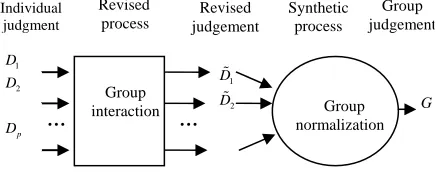
is a non-empty finite set, ds represents expert s, and ai is decision alternative i. If there exists at least an attributeCj(j=1,...,M), ( ,f a di s) includes some values with various kinds of uncertainties such as ignorance, fuzziness, interval data, and interval belief degrees, then the uncertainty MAGDM problem is called a MAGDM problem. Group decision making are mainly research groups that how to together progress in a choice of joint action, structure group of preference relation, and ranks group of preference to the selected program in accordance with the properties of problem. The essential difference form group decision making and individual decision making, it is clearly reflected in the decision making process models. Two processes was abstracted for group decision making process model as follows: amendment process of individual preferences and synthetic process of individual preferences (See Figure 1)[22].The process model in Figure 1 shown that group decision making process is the characteristics of the combination between behavioral assembly and quantity assembly.In Figure 1,D ii
(
=1,2,...,p)
shows the first i decision makers to judge the value.D ii(
=1, 2,...,p)
shows theconsideration of the group interactions and the amended decision to judge the value.G shows the results of group decision making . “Revised process” is the initial decision makers to change the course of the individual
preferences of individuals reflects the group’s interaction process, “Synthetic process” is the group decision making process that individual preference values by amended which was synthesis. There is the difference for two main processes as follows: the amendment process of the preference value is occurred in individual judgment value of group decision makers, and the assembly process of preference value is occurred in the whole group.
C. Uncertainty multi-attribute group decision making process model based on D-S theory
D-S evidence theory is a kind of uncertain reasoning, which can express the uncertain problem among the experts’judgments by constructing belief function, thus it will make more accurate assessment about it. When we integrate multi-expert opinions, a more satisfactory outcome results from the application of the Dempster’s rule of combination [8, 9]. The evidence theory was first introduced to deal with multi-attribute decision making problem under uncertainty in the early 1990s [13] by designing a novel belief decision matrix to model a multi-attribute decision making problem and creating a unique attribute aggregation process based on the Dempster’s rule of combination[3]. But the D-S evidence theory are processed and synthesized to the evidence by different experts, and different experts can give evidence according to their professional knowledge as far as possible, so that the focus of the two trust function elements do not intersect, which evidences are in conflict. The conflict is not caused by a single evidence of focal element, but it may be caused by the error of two evidences, some ignorance or uncertain reasons, and external disturbances factors and so on. However, the Dempster’s rule of combination will produce conclusions inconsistent with the intuition in the synthesis of conflict evidence [23-25], which brings up a series of problems of conflicting evidence. Therefore, how to achieve the effective integration of multiple expert judement values in sharp evidence conflict is an urgent problem to be solved. Current approaches for solving the synthesis problem of evidence conflicts can be sorted into three categories: the first is to modify the Dempster’s rule of combination [24, 26]. The researchers of the first category believe that the two focal element of belief function that intersection is empty is not properly processed in the synthesis of evidence, so as to produce the situation in which synthesis results are inconsistent with the intuition. To solve the conflict is mainly to solve how to redistribute conflict. Another category is to modify the source of evidence, but the Dempster’s rule of combination keeps unchanging [25, 27, 28]. The researchers of another category believe that there is nothing wrong with the Dempster’s rule of combination itself. Firstly, we should be pretreated the sharp evidence conflict, and its purpose is to reduce or eliminate conflict of evidence, and then reuse the Dempster’s rule of combination. Based on these two categories, the third is to provide evidence fusion mechanism based on decision-making utility and pattern theory, whose aim is to make the result of evidence synthesis close to intuitive decision or decision-making mechanism infinitely [29, 30]. On
G
1 2
D
D
… … normalizationGroup
1 2
p
D D
D
Individual judgment
Synthetic process Revised
judgement Revised
process
Group judgement
Figure 1. The process model of group decision making Group
the basis of the above three solution strategies, when uncertainty multi-attribute group decision making process based on D-S evidence theory is analyzed, the two main stages of “Revised process” and “Synthetic process” are treated respectively. Firstly, the paper analyzes and adjusts the consistency of decision making results by different experts (see in Section 3).Then the traditional Dempster’s rule of combination is revised, and it is synthesized by using the revised rule of combination to the basic belief degrees given by the different experts, then getting the decision making results of MAGDM [6, 23] (see in Section 4). Figure 2 displays the specific model of decision making process.
III. ANALYSIS AND ADJUSTMENT OF EXPERT GROUP DECISION (INTERACTION PROCESS)
According to figure 2, we have to analyze the consistency of the results to decision making between different experts before making the synthesis of the
judgement results of different experts. Thus the analysis of consistency results of decision making between different experts, it’s essentially analyze to similarity degree of focal element attribute which given by different experts.
Consistency analysis of decision making results for different experts is essentially analyzed the similarity degree
(
,)
(
,{
1,2,...,}
)
i j
d d
S m m i j∈ P of focal element attribute values given by different experts, where ,
i j
d d
m m are separately displays the focal element attribute value which given by expertdi anddj; p is the number of experts of participation in decision making. If the higher similarity degree
(
,)
i j
d d
S m m for any two focal elements given by different experts is, then the higher consistency for different experts giving the decision results is, and vice versa. If
(
,)
i j
d d
S m m value is lower, it indicates that there is the lower consistency of the decision making results of different experts. At present, many approaches have been developed to measure the similarity degree of focal element attribute [23, 31]. Amongst these approaches, the measuring approach originally proposed by Jousselme et al. [31], has been widely used in measuring the similarity degree of focal element attribute.
According to the measuring method proposed by Jousselme et al. [31], in the process of analyzing the similarity degree of different focal element attributes given by different experts, we must first define a threshold δ in advance, and then any similarity degrees
(
,)
i j
d d
S m m for two focal element attributes are calculated under different evidence sources. If
(
,)
i j
d d
S m m ≥δ, the decision results given by experts have remarkable consistency. If
(
,)
i j
d d
S m m <δ, the decision results have unapparent consistency, and then the bpa value will be modified by communicating and exchanging between experts. The
(
,)
i j
d d
S m m will be recalculated by the modified bpa value and its consistency is analyzed until all the experts work out the decision results to meet the consistency. If
(
,)
i j
d d
S m m <δ , it indicates that the opinion which given by different experts does not satisfy the consistency requirement, so it needs to communicate and interact between experts, thus the primary belief function value is modified. The
(
,)
i j
d d
S m m will be recalculated by the modified bpa value and its consistency is analyzed until all the experts work out the decision results to meet the consistency [28].
Specially to pay attention, when analyzing the consistency of expert’s opinions, the enacting threshold
δ is very critical. If the enacting δ is too large, it was excessive for demanding on the convergence of group opinions. If the enacting δ is too small, the opinions of individual experts at a large extent of deviation from the opinions of groups have been ignored. In practical ...D1 D2 . . . Dp
NO YES
Individual judgments
Calculated values of focus element bpa under different experts
ij S ≥δ
Getting synthesis of values under more experts’ opinion, which constitute the confidence
interval
Calculated properties of any two focal element similarities between any two different experts:
(
,)
i j
d d
S m m
…
Amended focus element of
the trust function value under
different experts
Figure2.Uncertainty multi-attribute group decision making process based on D-S evidence theory.
Using combination rule of the mended evidence theory
to synthesize the trust function value
Evaluating and ranking decision making program according to the
application of thresholdδ , decision makers through simulation and calculation can suitably enact the size of threshold δ according to the actual need to make decisions [31, 32].
V. THE IMPROVEMENT OF DEMPSTER’S RULE OF COMBINATION(SYNTHETIC PROCESS) A. A kind of improvement method of Dempster’s rule of combination
As the differences from knowledge, understanding and preference between the various experts, the opinion on reliability extent of assessments given by each expert may be not the same. Hypothesis: in a group of experts, the experts of the maximum weight have the highest reliability of judgment results, and other experts, in addition to their own experience, preferences and other factors, judge the relative reliability associated with the highest authority of the relative differences of knowledge. In order to do this, the article introduces the concept of experts’ relative reliability, and calculates the values of conflict evidence between the relative reliability of different experts and different sources of evidencek; then according to the size of value about the relative reliability of different experts to distribute valuek of the conflict evidence, obtaining the improved combination rule, and according to the improved combination rule to synthesize the opinion of different experts in the end gets the final results. The following is the definition of normalization of experts to judge the relative reliability:
(
)
(
)
max
max 1
1 1
s s
s P
s s
s
d d
D
d d
λ
λ
=
− −
⎡ ⎤
⎣ ⎦
=
− −
⎡ ⎤
⎣ ⎦
∑
(1) It is assumed that d d1, 2,...,dP are respective weight of experts, and
1 1
P
s s
d =
=
∑
; dmax=max( ,...,d1 dP) ;( 1, 2,.... )
s s P
λ = , they reflects experience of experts
s
and preference coefficient respectively. Generally access0.9≤λs ≤1.Hypothesis 1( 1),.., p( p)( 1, , ; 2 )N
t t
m G m G t= …q q< corresponds to the evidence group is 1 2
,. .., P
t t t
G ,G G ,
the level of conflict between the evidence K is defined as follows:
1 2
1 2
1 1 2 2 , ,...,
...
( ) (
)...
P(
). (2)
P t t t
P t t t
P
t t t
G G G
G G G
k
m G m G
m G
⊂Θ =∅
=
∑
∩ ∩ ∩
When assembling the opinion of group decision making, the experts’ opinion which has the relative higher reliability should have the greater impact on the result of assembly. Especially when there are larger conflicts between the opinions, we should distribute opportunities into the expert s’ opinion which has the relative higher reliability should have the greater impact on the result of assembly. At the same time, when we can not make reasonable choices on the conflict opinion, part
of the trust should be classified into unknown areaΘ.
Thus, the following is the improved evidence rules of combination.
{ }
1 2
1 2
( ) ( ) ... ( )
1
( ) ( ) ( )... ( )
( ),
( ) 1 ( ), ( ) 0, , . (3)
P
t t t
P
t t t
m G m G m G E
P s s s
m E m G m G m G
k D m E
m m E m E
∩ ∩ ∩ =
=
=
+
Θ = − ∅ = ∀ ≠ ∅ Θ
∑
∑
∑
According to the formula (3), the improved combination rule is expressed: even though there is a conflict between the evidence, they are also available in part, and its available extent depends on the experts’ relative reliability. The improved rule of combination compares with the Dempster rule of combination.When
kis less, conflict of evidence is less, and their synthesis result is similar to Dempster. Whenk=0, the improved combination rule is equivalent to Dempster rule of combination. Whenk→1, evidence is highly conflict, Dempster rule of combination will have counterintuitive results. When k=1, evidence is completely conflict, synthetic results value of the improved combination rule is determined by the
1
( )
P s s s
k D m E
=
∑
; at the same timeDempster rule of combination of the denominator is zero, and it can not be synthesized. The following is the main difference between the improved combination rule and Yager’s combination rule[24]:when conflict evidence is synthesized by Yager , he makes that part of the probability of conflict supported by conflict evidence assign to theΘ, therefore, he thinks the conflict evidence can not provide any valuable information ; yet the improved combination rule believes that even if there is a conflict between the evidences, they are also available in part, and it can be used by the relative reliability of experts. The following is difference between the improved combination rule and the combination rule given by Q.Suan and others[25].When conflict evidence is synthesized by Q.Suan and others, they make the probability of evidence conflict assign on the basis of adding up to the average supporting level of each proposition. However, when the improved combination rules synthesize conflict evidence, the availability of the probability of evidence conflict depends on the experts on the relative reliability of each proposition.
B. Experimental results and discussion
( )
( )
( )
( )
( )
( )
( )
( )
( )
1 1 1 1
2 2 2 2 3 3 3 3
: 0.98, 0.01, 0.01
: 0, 0.01, 0.99
: 0.9, 0, 0.10.
m m A m B m C
m m A m B m C
m m A m B m C
= = =
= = =
= = =
For the above three evidences use different rules of combination, then synthesis results are shown in Table 1.
TABLE 1.
RESULTS OF FOUR KINDS OFDIFFERENT COMBINATION RULES
combination rule k m A( ) m B( ) m C( ) m( )Θ Dempster [7] 0.9990 0 0 1 0
Yager[9] 0.9990 0 0 0.0010 0.9990
Q.Suan and others [10]0.9990 0.321 0.003 0.188 0.488
This article 0.9990 0.6614 0.00709 0.3317 0
Seen from the data in Table 1, in the above example, the opinion given by three experts is highly conflicting, the degree of conflict is k=0.9990. Among these three experts, there are almost two experts supporting decision making program A, then, after synthesizing the experts’ opinion the probability of supporting A should be close to 2/3. However, the results of Dempster rule of combination and Yager’s rule of combination are
( ) 0
m A = , which is clearly contrary to common sense; for
the Dempster rule of combination, although the expert 1 and expert 3 on the decision making program C have very low support degree, the synthesis of the results is completely positive for the decision making program C, that is m C
( )
=1; for Yager's combination rule , evidence of the original conflict is completely negated, and after being synthesized, the unknown probability is nearly 1.The result of Q.Suan and others’ rule of combination is( )
0.321m A = ,obviously, in comparison with the effect of the previous two rules, it has improved, even if there are almost two experts supporting decision making program A among these three experts, and for theresults of the synthesis form A
( )
=0.321, it still has a certain gap between above conclusions. Only the combination rules proved by this paper coincide with the conclusion, and are more consistent with decision-making environment.V. CONCLUSION
This paper, basing on the general model of group multi-attribute decision-making, puts forth uncertain multi-attribute group decision process model on evidence theory, and makes a detailed analysis about the two-stage model of decision-making process. Firstly, the article analyzes the consistency of expert opinions, and gives a method of consistency analysis and adjustment based on similarity degree of focus element; then focuses on the analysis on decision making process model of “synthetic phase”, which introduces concept of experts’ relative reliability, and introduces a new synthetic method by making improvements on Dempster’s rule of combination. The synthetic method is an extension on
Yager’s rule of combination, and gives a more ideal combination rule, which first amends sources of evidence from different experts, then assigns available degree of the probability of evidence conflict according to the experts on the relative reliability of each proposition so as to make the handling of evidence conflict no longer deny it uncritically and improve the synthesis results of the reliability and rationality.
Seen from the experimental results, not only new synthesis rules can have an effect on synthesis of sharp conflict evidence, but also synthesis results are better than Dempster’s rule of combination, Yager’s rule of combination and the combination rule of Q.Sun and others.
ACKNOWLEDGMENT
This work was supported in part by the Natural Science Key Foundation of Anhui Province Higher Education (No.KJ2010A039), Anhui Provincial Natural Science Foundation (No.11040606M24), and Social Science & Research Foundation of Ministry of Education (No.10YJA630042).
REFERENCES
[1] K.S.Chin, Y.M.Wang, G.K.Poon,and J.B.Yang, “Failure mode and effects analysis using a group-based evidential reasoning approach,” Computers and Operations Research vol. 36, pp.1768-1779, June 2009.
[2] S.M.Chen, and S.J.Niou, “Fuzzy multiple attributes group decision-making based on fuzzy preference relations,” Expert Systems with Applications, vol. 38, pp.3865-3872, April 2010.
[3] C. Fu, and S.L. Yang, “The group consensus based evidential reasoning approach for multiple attributive group decision analysis,”European Journal of Operational Research, vol.206, pp. 601-608, November 2010.
[4] X. W. Liao, Y. Li and Mao D. G. “Study a class problem of multiple attribute decision making problems under uncertain information”, Journal of Xi’an Jiaotong University, vol. 28, pp.792-796 , December 2005.
[5] M. Guo, J. B. Yang, K. S. Chin and H. W. Wang, “Evidential reasoning based preference programming for multiple attribute decision analysis under uncertainty”, European Journal of Operational Research, vol.182, pp.1294-1312,November 2007.
[6] B. Gao, L. Zhou and N. M. Fang, “Improved ER algorithm in Uncertain multi-attribute decision making”, Systems Engineering, vol.25, pp.105-107 ,July 2007.
[7] B. G. Gong, Z. S. Hua and D. S. Tan, “Multi-attribute group decision making method based on a language evaluation with incomplete information,” Chinese Journal of Management Science, vol.15, pp.88-93, January 2007. [8] A.P. Dempster, “A generalization of Bayesian inference
(with discussion) ,” Journal of the Royal Statistical Society Series B, vol.30, pp.205-247,February 1968.
[9] G. Shafer, “A mathematical theory of evidence,” Princeton: Princeton University Press, 1976.
[11]Zadeh, L.A., “Fuzzy sets as a basis for a theory of possibility,” Fuzzy Sets and Systems, vol.1,pp.3-28, January 1978.
[12]J.B.Yang, Y.M.Wang, D.L.Xu, and K.S. Chin, “The evidential reasoning approach for MADA under both probabilistic and fuzzy uncertainties,”European Journal of Operational Research, vol.171, pp.309-343, May 2006. [13]J.B.Yang,and P.Sen, “A general multi-level evaluation
process for hybrid MADA with uncertainty,” IEEE Transactions on Systems, Man, and Cybernetics , vol.24,pp.1458-1473, August 1994.
[14]J.B.Yang, “Rule and utility based evidential reasoning approach for multi-attribute decision analysis under uncertainties,”European Journal of Operational Research vol.131, pp.31-61, May 2001.
[15]J.B.Yang, and D.L.Xu, “On the evidential reasoning algorithm for multi-attribute decision analysis under uncertainty,” IEEE Transactions on Systems, Man, and Cybernetics, Part A: Systems and Humans, vol.32, pp.289-304, December 2002.
[16]Y.M.Wang, R.Greatbanks, and J.B.Yang, “Interval efficiency assessment using data envelopment analysis,”Fuzzy Sets and Systems, vol.153, pp. 347-370, August 2005.
[17]Y.M.Wang, J.B.Yang, and D.L.Xu, “Environmental impact assessment using the evidential reasoning approach,” European Journal of Operational Research ,vol.174,pp. 1885-1913,November 2006.
[18]Y.M.Wang, J.B.Yang, D.L.Xu, and K.S.Chin, “The evidential reasoning approach for multiple attribute decision analysis using interval belief degrees,” European Journal of Operational Research, vol.175, pp.35-66, November 2006.
[19]D. L.Xu, J.Liu, J. B.Yang, L G. P.iu, and J.Wang, et al., “Inference and learning methodology of belief-rule-based expert system for pipeline leak detection,” Expert Systems and Applications,vol.32,pp.103-113,January 2007
[20]Wang, Y. M., and E T. M. S.lhag, Evidential reasoning approach for bridge condition assessment. Expert Systems with Applications, vol.34, pp.689-699. January 2008. [21]Z.S. Hua, B.G. Gong, and X.Y. Xu, “A DS-AHP approach
for multi-attribute decision making problem with incomplete information,” Expert Systems with Applications vol.34, pp. 2221-2227, April 2008.
[22]L. Yang. “Group decision theory and applications”, Beijing: Economic Science Press, 2004.
[23]Z. M. Chen, “Study group decision making of evidence theory and application in the group decision making environment”, Hefei: Hefei University of Technology PhD thesis, June 2007.
[24]R.R. Yager, “On the D-S framework and new combination rules”, Information Sciences, vol.41, pp.93-137, February 1986.
[25]Q. Sun, X. Q. Ye, and W. K. Gu, “A new synthesis of the formula based on evidence theory”, Journal of Electronics , vol.28, pp.117-119, August 2000.
[26]R. Haenni, “Are alternatives to Dempster's rule of combination real alternatives?” Information Fusion, vol.3, pp.237-239, August 2002.
[27]C. K. Murphy, “Combining belief functions when evidence conflicts”, Decision Support Systems, vol. 29, pp.1-9, July 2000.
[28]Y. Deng, W. K. Shi, Z. F. Zhu, and Q Liu, “Combining belief functions based on distance of evidence,” Decision Support Systems, ,vol.38,pp.489-493, Dec.2004
[29]H.Wang, J. Liu, and J. C.Augusto, “Mass function derivation and combination in multivariate data spaces,” Information Sciences, vol.180, pp. 813-819·March 2010. [30]C.Y.Liang, C.S.Ye, and E.Q. Zhang, “A New Method of
Combination Rules of Evidences Based on Concordance Evidences Conflict,” Chinese Journal of Management Science, vol.18, pp.152-157, August 2010.
[31]A.L. Jousselme, D.Grenier, and E. Bosse, “A new distance between two bodies of evidence”, Information Fusion, vol.2, pp.91-101, June 2001.
[32]J. X. Yuan, and Q. Z. Wu, “Multi-attribute group decision making algorithm and consistency analysis”, Mathematics in Practice and Theory, vol.34, pp.51-57, August 2004.
Jialin Liu was born in Jinzhai County, Anhui Province China, on Dec, 20th, 1972. He got his MBA degree in 2003, from Graduate School of University of Science and Technology of China, which is located in Hefei, Anhui Province. He is concentrated in the areas of business administration and logistics management.
From 2004, He has been a lecturer of Anhui Institute of Architecture, which is located in Hefei, Anhui Province. Before that, He had served as a project manager and a HR manager in Anhui Tiancheng Construction Co,Ltd from 1997 to 2001. His major studies are listed as follows:1. Study on Ability of Enterprise Partners Based On Supply Chain,published by Technology Economics, 2005, Vol 12; 2. Study on the Researcher’s Potential Evaluation Based on Core Competence
,published by Science Technology and Industry, 2008 Vol.8; 3. On Credit Evaluation of Supply Chain Partners Based on Attribute Analysis, co-authored with Chaoyang Wang, published by Journal of West Anhui University, 2009, Vol.4. For years, Mr Liu has been concentrated in areas of modern enterprise system, modern enterprise informationization, and modern logistics management.
Mr. Liu is now an advanced member of Chinese Society of Technology Economics.
Bengang Gong was born in Liuan City, Anhui Province China, on Nov, 24th, 1973. He got his PhD degree in 2007, from University of Science and Technology of China, which is located in Hefei, Anhui Province. He is concentrated in the areas of management decision analysis, logistics management.