Controlled Secret Leakage
Tianjie Cao, Shi Huang, Hui Cui, Yipeng Wu, Qihan Luo School of Computer, China University of Mining and Technology
Xuzhou, 221116, China
National Mobile Communications Research Laboratory, Southeast University Nanjing, 210096, China
Email:[email protected]
Abstract— Privacy is the claim of individuals, groups and institutions to determine for themselves, when, how and to what extent information about them is communicated to others. How to leak authoritative secrets in an elegant way? The paper aims to solve this problem. The desired security properties i.e. Semantic-Security; Recipient-Designation; Verification-Dependence; Designated-Verifier Signature-Verifiability; Public Signature-Signature-Verifiability; Recipient-Ambiguity; Designated-Verifier Recipient-Verifiability; Public Recipient-Verifiability; Ambiguity; Signer-Verifiability are specified in secret leakage. Based on Chow-Yiu-Hui’s ID-based ring signature scheme and techniques of zero-knowledge proof, an ID-based controlled secret leakage scheme is proposed. The proposed scheme satisfies all specified security properties and can be used in trust negotiation.
Index Terms— privacy, ring signature, authenticated encryption, zero-knowledge proof
I. INTRODUCTION
The rapid growth of the electronic commerce, commonly known as e-commerce or eCommerce, is raising new research questions since the spread of the Internet, a great number of which are centered around security, trust, and privacy. Security, trust, and privacy has objectives including confidentiality (secrecy), data integrity (non-alteration), authentication (identity corroboration of an entity and data origin), and non-repudiation (prevents the denial of previous commitments).
Privacy is important because privacy helps individuals maintain their autonomy and individuality. The most common definition of privacy is the one by Westin: “Privacy is the claim of individuals, groups and institutions to determine for themselves, when, how and to what extent information about them is communicated to others” [1]. According to Westin’s definition, individuals as well as groups and institutions have a right to privacy. In a fully networked society, privacy is seriously endangered and cannot be sufficiently protected by privacy legislation. Cryptography technologies now are valuable tools for privacy protection in addition to privacy legislation.
We consider the following scenario of secret leakage [2]: If a police wants to arrest a criminal but knows few
clues about him, so it promises to give an award to a person in some group who could provide the most important clue after the criminal is arrested. A group member Alice can provide something to a designated policeman Bob, but she is not sure whether her message could be the most important one. How to leak this clue in an elegant way? To protect the authoritative secret from propagating and anonymity of the member Alice and the policeman Bob, we propose controlled secret leakage scheme.
It is unsuitable to use traditional authentication on the network where entities are not foreknown to each other. Trust negotiation is now wide used in electronic commerce [3]. In order for strangers to conduct secure transactions, a sufficient level of mutual trust must be established. Trust negotiation is an approach to establishing trust between strangers through the exchange of authoritative secrets. Thus, controlled secret leakage scheme can be used in trust negotiation.
Often when two parties communicate over a network, they have two main security goals: privacy and authentication. Privacy means that a passive adversary who views the ciphertext cannot “understand” the content of the message. Authenticity means that an active adversary cannot successfully fabricate a ciphertext in such a way that Bob will believe that Alice was the originator. Horster et al. first proposed an authenticated encryption scheme [4]. Authenticated encryption scheme aimed to achieve the purpose that the signature can only be verified by some specified recipients while keeping the message secret from the public.
anonymous signature from "a high-ranking White House official", without revealing which official signed the message.
Lv et al. combined the two notations of ring signature and authenticated encryption together and obtained a new type of authenticated encryption, called ring authenticated encryption [2]. Ring authenticated encryption has the following security properties: semantic-security, recipient-designation, verification-dependence, verification-convertibility, ambiguity, recipient-verifiability, signer-ambiguity and signer-verifiability. In [2], Lv et al. also presented a ring authenticated encryption scheme based on discrete logarithm problem. In [6], Cao et al. found some weaknesses in Lv et al.’s scheme that Lv et al.’s scheme cannot achieve signer-verifiability and recipient-signer-verifiability properties. Cao et al. also proposed an improved ring authenticated encryption scheme to eliminate these weaknesses.
Identity based public key cryptography proposed by Shamir in 1984 [7] can simplify key management and remove the necessity of public key certificates. This is desirable, especially for these applications which involve a large number of public keys in each execution, such as ring signatures. Recently the bilinear pairings have been found advantageous in designing various cryptographic schemes, especially for those using identity-based public keys, e.g. the based encryption and the identity-based signature. In [9][10], Boneh and Frankliny proposed a fully functional identity-based encryption scheme. The scheme has chosen ciphertext security in the random oracle model assuming BDHP is hard. In [11], Zhang and Kim presented an ID-based ring signature scheme, which can be built on any GDH group. Their scheme satisfies the unconditional ambiguity and the non-forgeability properties. In [8], based on Boneh and Frankliny’s ID-Based encryption scheme [9][10] and Zhang and Kim’s ID-Based ring signature scheme [11] Cao et al. construct an ID-based ring authenticated encryption scheme from bilinear pairings.
In 1985, Goldwasser et al. introduced the notion of zero-knowledge (ZK) proof [12]. A zero-knowledge proof is an interactive method for one party (the prover) to prove to another (the verifier) that a statement is true, without revealing anything other than the verity of the statement. An interactive proof usually takes the form of a challenge-response protocol, in which the prover and the verifier exchange messages and the verifier outputs either “accept” or “reject’ at the end of the protocol. Zero-knowledge proofs have the following properties:
Completeness. The verifier always accepts the proof if the fact is true and both the prover and the verifier follow the protocol.
Soundness. The verifier always rejects the proof if the fact is false, as long as the verifier follows the protocol.
Zero-knowledgeness. The verifier learns nothing beyond the validity of the fact and cannot even later prove the fact to anyone else.
Demonstrating in zero-knowledge the possession of digital signatures can protect the privacy of signature holders from dissemination of signatures by verifiers and
have many cryptographic applications such as anonymous authentication, identity escrow, publicly verifiable secret sharing and group signature. Given the designated-signature, the designated-verifier can verify that the message was signed by the signer, but is unable to convince anyone else of this fact.
In this paper, our main contribution is to specify security properties of secret leakage, define controlled secret leakage scheme to protect the secret from propagating and anonymity of the participants, design an ID-based controlled secret leakage scheme. The rest of the paper is organized as follows. In the next section, we give the definition of the controlled secret leakage scheme and the desired security properties. In Section 3, we describe the basic concept on bilinear pairings. In Section 4, we construct our controlled secret leakage scheme. In Section 4, we show the proposed scheme satisfies correctness property and security properties. A conclusion will be given in Section 5.
II. DEFINITIONS
A. Definition of Controlled Secret Leakage Scheme
Definition 1: (Controlled secret leakage scheme).
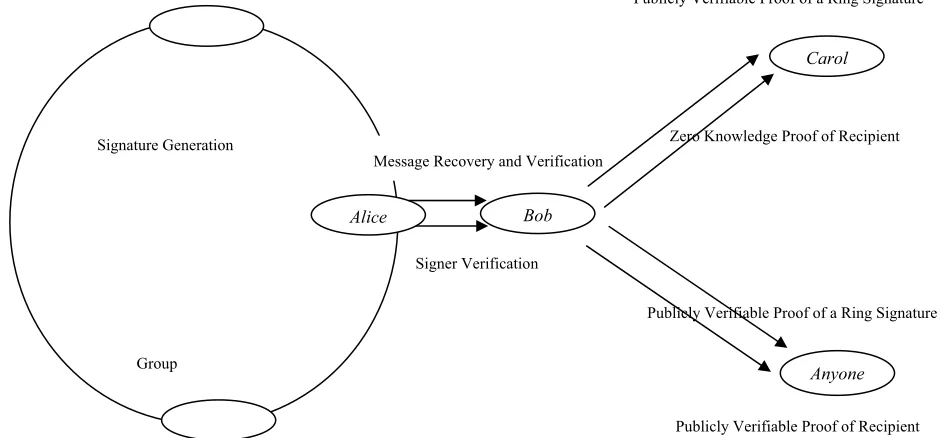
The controlled secret leakage scheme is specified by seven algorithms (protocols). The specification of the controlled secret leakage scheme is shown in Fig. 1.
Signature Generation: The algorithm takes as input message M, the recipient Bob’s public key, the signer
Alice’s private key and all the ring members’ identity list
L which includes the signer Alice, and outputs a ring signature S. The ring signature S will be published in Bulletin Board System (BBS) or send to the recipient
Bob. We assume that anyone can intercept the signature S
in transit.
Message Recovery and Verification: The algorithm takes as input a signature S and the recipient Bob’s secret key, outputs the authenticated message M and returns 1 or 0 meaning accept or reject the information that the signature S is created by a ring member, respectively. We require that the algorithm outputs the authenticated message M and returns 1 if the ring signature S is generated by the signer honestly.
Zero Knowledge Proof of a Ring Signature: Zero-knowledge proof of a ring signature is a method for the recipient Bob to prove to a verifier Carol that the message M is signed by a ring member listed in the ring set L without revealing any other information. Zero-knowledge proof can control the secret leakage and prevent secret propagation. The algorithm takes as input a signature S, a message M, the verifier’s private key and a parameter '1 that can only be computed by the recipient Bob, and outputs 1 or 0 meaning accept or reject the information that the signature S is really created by a ring member, respectively. We require that the algorithm l returns 1 if two parties do the protocol honestly.
other information. The algorithm takes as input a signature S, a message M, the verifier’s private key and a parameter /1 that can only be computed by the recipient Bob, and outputs 1 or 0 meaning accept or reject the information that the signature S is really sent to Bob, respectively. We require that the algorithm returns 1 if two parties do the protocol honestly.
Publicly Verifiable Proof of a Ring Signature: The algorithm takes as input a signature S, a message M and a parameter '2 that can only be computed by the recipient Bob, and outputs 1 or 0 meaning accept or reject the information that the signature S is really created by a ring member, respectively. We require that the algorithm returns 1 if Bob does the protocol honestly.
Publicly Verifiable Proof of Recipient: The algorithm takes as input a signature S, a message M and a parameter
/2 released by Bob, and outputs 1 or 0 meaning accept or
reject the information that the signature S is really sent to
Bob, respectively. We require that the algorithm returns 1 ifBob is the real recipient.
Signer Verification: The algorithm takes as input the signature S and a parameter 6 produced when Alice
creates the signature, and outputs 1 or 0 meaning accept or reject the information that Alice is the actual signer, respectively. We require that the algorithm returns 1 if the signature S is really produced by Alice. The algorithm should satisfy the condition that only the actual signer
Alice could provide such a parameter 6 that makes it equal 1 corresponding to the certain signature S and that will not release the signer’s private key.
B. Security Properties of Controlled Secret Leakage Scheme
Definition 2: (Security properties of controlled
secret leakage scheme). A controlled secret leakage
scheme has the following security properties.
Semantic-Security: Any computationally-bounded adversary cannot determine whether his guessed message is the actual message signed by the original signer, although he gets a valid signature.
Recipient-Designation: Only the designated recipient can recover the message and verify the ring signature.
Verification-Dependence: If the actual signer and the legal recipient do not reveal some parameters, any verifier cannot check the validity of the signature even though he gets the message and the corresponding signature.
Designated-Verifier Signature-Verifiability: A designated verifier can be convinced that the message M
is signed by a ring member listed in the ring set L by the actual signer or the legal recipient, but the designated verifier is unable to convince anyone else of this fact.
Public Signature-Verifiability: Anyone can verify whether a ring signature is actually produced by at least one of the possible signers after the recipient reveals some parameters.
Recipient-Ambiguity: Anyone cannot know to whom a signature is sent while verifying its validity except the actual signer and the legal recipient.
Designated-Verifier Recipient-Verifiability: A designated verifier can be convinced who is actually the designated recipient by the legal recipient, but the designated verifier is unable to convince anyone else of this fact.
Figure 1. Controlled secret leakage scheme.
Alice Bob
Carol
Anyone
Signature Generation
Message Recovery and Verification
Publicly Verifiable Proof of Recipient Publicly Verifiable Proof of a Ring Signature Publicly Verifiable Proof of a Ring Signature
Zero Knowledge Proof of Recipient
Signer Verification
Public Recipient-Verifiability: Anyone can be convinced who is actually the designated recipient by the actual signer or the legal recipient.
Signer-Ambiguity: Anyone cannot determine the identity of the actual signer in a ring of size r with probability greater than 1/r if the actual signer is unwilling to expose himself.
Signer-Verifiability: The actual signer can prove to the recipient that it is he who actually signs the signature.
Trust negotiation enables two parties with no pre-existing relationship to establish the trust necessary to perform sensitive transactions via the mutual disclosure of the sensitive content. Therefore, controlled secret leakage scheme can be used in trust negotiation.
III. BILINEAR PAIRINGS
Let G1 be a cyclic additive group, whose order is a
prime q, and G2 be a cyclic multiplicative group with the
same order q: Let e:G1uG1oG2 be a bilinear pairing
with the following properties:
Bilinearity: e(aP,bQ) = e(P,Q)ab for all P,QG1,a, bZq
Non-degeneracy: There exists P, Q G1 such that
e(P, Q) z 1, in other words, the map does not send all pairs in G1uG1 to the identity in G2.
Computability: There is an efficient algorithm to
compute e(P,Q) for all P,QG1.
A bilinear map satisfying the three properties above is said to be an admissible bilinear map. We note that the Weil and Tate pairings associated with supersingular ellipticcurves or abelian varieties can be modified to create such bilinear maps.
Suppose that G1 is an additive group. Now we describe
five mathematical problems.
Discrete Logarithm Problem (DLP): Given two group elements P and Q, find an integer n, such that Q = nP
whenever such an integer exists.
Decision Diffie-Hellman Problem (DDHP): For a,b,c
Zq*, given P,aP,bP,cP decide whether c{ab mod q. If so, (P, aP, bP, cP) is called a valid Diffie-Hellman tuple.
Bilinear Diffie-Hellman Problem (BDHP): For a,b,c
Zq*, given P,aP,bP,cP compute abcP.
Computational Diffie-Hellman Problem (CDHP): For
a,bZq*, given P,aP,bP, compute abP.
Gap Diffie-Hellman Problem (GDHP): A class of problems where DDHP is easy while CDHP is hard.
When the DDHP is easy but the CDHP is hard on the group G1, we call G1 a Gap Diffie-Hellman (GDH)
group. Such groups can be found on supersingular elliptic curves or hyperelliptic curves over finite field, and the bilinear parings can be derived from the Weil or Tate pairing e:G1uG1oG2.
We have the relationship of the BDHP and CDHP that the BDHP in < G1,G2,e> is no harder than the CDHP in
G1 or G2. In other words, an algorithm for CDHP in G1 or
G2 is sufficient for solving BDHP in < G1,G2,e>.
We assume through this paper that BDHP is intractable, which means there is no polynomial time
algorithm to solve BDHP, CDHP or DLP with nonnegligible probability.
IV. ID-BASEDCONTROLLED SECRETLEAKAGE SCHEME
Our scheme can be built from any bilinear map e:G1u
G1oG2 between two groups G1,G2 as long as BDHP in
G1 is hard and the DDHP in G1 is easy.
Setup: Let (G1, +) and (G2,x) denote cyclic groups of
prime order q, let P be a generator of G1 and the bilinear
pairing is given as e:G1uG1oG2. Pick a random sZq* and set Ppub = sP. Choose cryptographic hash function H: {0, 1}* o Zq*, H1: {0, 1}*oG1*, H2:G2 o{0, 1}n, H3:
{0, 1}nu{0, 1}no Zq* and H4: {0, 1}no{0, 1}n. Choose a
pseudorandom generator F: {0, 1}noG1. The message
space is M = {0, 1}n. The master-key is sZq*. Extract: For a given string ID {0, 1}*
the PKG computes QID = H1(ID) , and sets the private key dID to be dID = sQID where s is the master key.
Signature Generation: Let IDi be a ring member’s identity, and
i ID
d
be the private key associated with IDifor i = 0, 1, …, N 1, where N is the measure of the anonymity set. Let L = {IDi: 0 didN – 1} be the set of identities. The real signer Alice’s identity IDAlice is ring member IDk listed in L.
Step 1. To sign a message M {0, 1}n
, the signer,
Alice say, who knows the identity IDBob of the recipient
Bob, whose corresponding secret key is
Bob ID
d
. Using Boneh-Frankliny’s ID-based encryption scheme [9][10]Alice encrypts M under the public key IDBob. Compute
Bob ID
Q
=H1(IDBob) G1*,z Choose a random V {0, 1}n ,
z Setr = H3(V;M),
z Set the ciphertext of M to be <U,V,W>:U = rP,
V = V 2
(
)
Bob r ID
H g
andW = MH4(V) whereBob ID
g
=e(Bob ID
Q
,Ppub) G2.Step 2. Choose a random r1 Zq*, and compute X =
r1P,Y = 1
Bob r ID
g
andZ = H(U || V || W || M || X || Y).Step 3. To sign Z Alice utilizes Chow-Yiu-Hui’s ID-based ring signature scheme [13].
z Choose a random seed A {0, 1}n
, for i = k + 1, …,N – 1, 0, 1, …, k 1(i.e., the value of i all modulo N), compute Ai = F((A + i – k) mod N), andhi = H(Z,L,Ai).
z Choose a random integer r’Zq*, compute Ak =
r’
k ID
Q
–(
)
i i i ID i k
A
h Q
z¦
.z Compute hk = H(Z,L, Ak) and c = (hk + r’)
k ID
d
where
k Alice ID ID
d
d
.z Choose a random r2 Zq*, and compute X1=r2P, Y1 = 2
Bob r ID
g
andc1 = c + H1(Y1).X,A0, …, AN–1, X1,c1).
Step 4. Finally, Alice sends Sto the recipient Bob and keeps the seed Asecret. An adversary can intercept S in this step.
Message Recovery and Verification: After receiving the signature S = (L, U,V,W,X,A0, …, AN–1, X1,c1), the
recipientBob does the following. Step 1. If UG1* reject the signature.
z Compute V = VH2(e(
Bob ID
d
,U)).z Compute M = WH4(V) .
z Set r = H3(V,M). Test that U = rP. If not, reject
the signature. Step 2. Compute Y = e(
Bob ID
d
,X) and Z = H(U || V || W|| M || X || Y).
Step 3. Compute Y1 = e(
Bob ID
d
,X1) and c = c1H1(Y1).Step 4. The validity of the signature is verified by checking that hi = H(Z,L,Ai) (0 didN – 1) and that
e(P, c) = e(Ppub,
1
0
(
)
i N
i i ID i
A
h Q
¦
)Zero Knowledge Proof of a Ring Signature: If Bob (or the signer Alice) wants to prove to any designated verifier
Carol that the message M is signed by a ring member listed in L without revealing any other information, they can do as follows.
Step 1. Bob computes W1 = e(
Q
IDCarol ,c) and sends themessage M, the parameter Y and the parameters (L, U,V,
W,X,A0, …, AN–1,W1) to Carol.
Step 2. Carol computes Z = H(U || V || W || M || X || Y).
Carol can be convinced that the message M is signed by a ring member listed in L if hi = H(Z,L,Ai) (0 didN – 1)
andW1 = e(
Carol ID
d
, 1 0(
)
i Ni i ID i
A
h Q
¦
).Zero Knowledge Proof of Recipient: If Bob wants to prove to any designated verifier Carol that the signature S
is actually sent to Bob without revealing any other information, they can do as follows:
Step 1. Bob chooses a random nonce r3{0, 1}n and
computes W1 = e(
Carol ID
Q
,c).Step 2. Bob sends the message M, the nonce r3, the
parameter Y and the parameters (L, U, V,W, X,A0, …, AN–1,W1) to Carol.
Step 3. Carol computes Z = H(U || V || W || M || X || Y).
Carol can be convinced that the message M is signed by a ring member listed in L if hi = H(Z,L,Ai) (0 didN – 1)
and W1 = e(
Carol ID
d
, 1 0(
)
i Ni i ID i
A
h Q
¦
). Otherwise,terminate the protocol.
Step 4. Carol chooses random integers r4,r5,r6 Zq*, and computes T1 = r4P + r5X,U1 = r6
Carol ID
Q
,V1 = (r6 +H(r3, T1, U1))
Carol ID
d
. Carol sends (T1, U1, V1) to Bob.Here to sign (r3,T1)Carol utilizes Cha-Cheon’s ID-based
signature scheme [14].
Step 5. Bob checks the freshness of r3 and the validity
of the signature of (r3,T1) by checking whether (P,Ppub, U1 + H(r3,T1,U1)
Q
IDCarol ,V1 ) is a valid Diffie-Hellmantuple.
Step 6. Bob computes W2 = H(e(
d
IDBob,T1)) and thensendsW2 to Carol.
Step 7: Carol checks whether W2 = H( 4Bob
r ID
g
·Y
r5)
where
Bob ID
g
= e(Bob ID
Q
, Ppub). Only if they hold doesCarol accept that the signature is sent to Bob.
Publicly Verifiable Proof of a Ring Signature: If Bob
(or the signer Alice) wants to prove to any verifier that the message M is signed by a ring member listed in L, they can do as follows.
Step 1. Bob publishes the message M, the parameter Y
and the parameters (L, U,V,W,X,A0, …, AN–1,c).
Step 2. The verifier computes Z = H(U || V || W || M || X
|| Y). The validity of the ring signature is verified by checking that hi = H(Z,L,Ai) (0 didN – 1) and that
e(P, c) = e(Ppub,
1
0
(
)
i N
i i ID i
A
h Q
¦
).Publicly Verifiable Proof of Recipient: If Bob (or the signer Alice) wants to prove to any verifier that the signature S is actually sent to Bob, they can do as follows:
Step 1. Bob publishes the message M, the parameter Y, V and the parameters (L, U,V,W,X,A0, …, AN–1,c).
Step 2. The verifier computes Z = H(U || V || W || M || X
|| Y). The validity of the ring signature is verified by checking that hi = H(Z,L,Ai) (0 didN – 1) and that
e(P, c) = e(Ppub,
1
0
(
)
i N
i i ID i
A
h Q
¦
). Otherwise, terminate the protocol. Step 3. The verifier does the following.z Compute
Bob ID
Q
=H1(IDBob),z Setr* = H3(V;M),
z Compute U* = r*P,V* = V 2
(
*)
Bob r ID
H g
andW*=MH4(V) where
Bob ID
g
=e(Bob ID
Q
,Ppub). Step 4: The verifier checks whether U* = U, V* = V, and W* = W. Only if they hold does the verifier accept that the signature is sent to Bob.Signer Verification: The actual signer Alice’s identity
IDAliceis a ring member listed in L. If Alice is willing to prove to the recipient Bob that she actually leaked the message M, then she does the following.
Step 1. Bob verifies that the signature S = (L, U,V,W,
X,A0, …, AN–1, X1,c1) is sent to him. The method is same
as Message Recovery and Verification.
Step 2. Alice sends the seed A and her identity IDAlice to
Bob.
Step 3. For i = k + 1, …, N – 1, 0, 1, …, k 1, compute
*
i
V. ANALYSIS OF THE PROPOSED SCHEME
A. Correctness
The following theorems are trivially true.
Theorem 1: If the (N + 7)-tuple (L, U,V,W,X,A0, …, AN–1, X1,c1) is a signature of a message M produced by Alice honestly, the recipient Bob will surely recover and verify the message M correctly from the signature.
Theorem 2: If the prover executes Zero Knowledge
Proof of a Ring Signature; Zero Knowledge Proof of Recipient; Publicly Verifiable Proof of a Ring Signature; Publicly Verifiable Proof of Recipient; and Signer Verification honestly, an honest verifier can always achieve the stated aim of the protocol.
Number footnotes separately in superscripts 1, 2, …. Place the actual footnote at the bottom of the column in which it was cited, as in this column. See first page footnote as an example.
B. Security Properties
In this subsection, we will examine the security of the proposed scheme.
Semantic-Security: After an adversary gets the signature (L, U,V,W,X,A0, …, AN–1, X1,c1), he cannot
guess the corresponding message M and c, since he cannot correctly compute the parameter Y from X and the parameter Y1 from X1. If the adversary tries to compute Y
and Y1 without known private key
Bob ID
d
, he has to compute r1 from X and r2 from X1, that is a hard DLproblem. So our scheme can provide semantic security of the message M and can prevent gauss attacks.
Recipient-Designation: The proposed ring authenticated encryption scheme uses Boneh and Frankliny’s identity-based encryption [9][10]. Anyone cannot recover the message M without the private key
Bob ID
d
. Only the designated recipient can recover the message M and the parameter Y,Z,c. Using M, Y,Z,c, the recipient can verify the ring signature.Verification-Dependence: If the actual signer and the legal recipient do not reveal the parameter Y, any verifier cannot compute Z, therefore cannot verify the validity of the signature, even he knows the message M and the signature S. If the adversary tries to compute Y without known private key
Bob ID
d
, he has to compute r1 from X,that is a hard DL problem.
Designated-Verifier Signature-Verifiability: Completeness of Zero Knowledge Proof of a Ring
Signature has been show in theorem 2.
Here we examine soundness of Zero Knowledge Proof of a Ring Signature.
Only the designated verifier Carol, with the private key
Carol ID
d
, can varify that the message M is signed by a ring member listed in L through the equation hi = H(Z,L,Ai) (0 d i d N – 1) and W1 = e(
Carol ID
d
,1
0
(
)
i N
i i ID i
A
h Q
¦
). Anyone without with the private keyCarol ID
d
cannot compute e(Carol ID
d
,1
0
(
)
i N
i i ID i
A
h Q
¦
). Only the designated recipient Bob or the signer Alice, with the secret parameter c, can prove to the verifierCarol that the message M is signed by a ring member listed in L. Anyone without the secret parameter ccannot compute e(
Carol ID
Q
,c). If the adversary tries to compute cfrom (X1,c1), he need compute Y1 = e(
d
IDBob,X1) and it ishard problem without private key
Bob ID
d
.We then show Zero Knowledge Proof of a Ring Signature is perfect zero-knowledge. Zero- knowledge proof of a ring signature can prevent the secret propagation. For a given message Mand a ring member list L, Carol can construct a simulation of a proof transcript (L, U,V,W,X,A0, …, AN–1,W1,Y) as follows:
Step 1. Choose random parameters (L, U,V,W,X,A0,
…,AN–1,Y).
Step 2. Compute Z = H(U || V || W || M || X || Y). Step 3. Compute hi = H(Z,L,Ai) (0 didN – 1) and W1
= e(
Carol ID
d
,1
0
(
)
i N
i i ID i
A
h Q
¦
).Public Signature-Verifiability: If the designated recipient reveals the message M, the parameter Y and the parameters (L, U, V, W, X,A0, …, An–1, c), any verifier
can check its validity by following the steps in Publicly Verifiable Proof of a Ring Signature. Once a ring member creates a valid signature, the designated recipient can always prove to any verifier that the message M is signed by a ring member.
Recipient-Ambiguity: If the actual signer and the legal recipient do not reveal the parameter V, then any verifier cannot determine who is the real recipient, even though he gets M, Y and (L, U, V, W, X, A0, …, AN–1, c) in
Publicly Verifiable Proof of a Ring Signature. It is difficult for an adversary to drive the parameter V. Since
H4 is one-way hash function, the adversary cannot drive
the parameter V from the equation W = MH4(V). If he
tries to compute the parameter V from U = rP, V = V 2
(
)
Bob r ID
H g
without known private keyBob ID
d
, he has to compute r from U, that is a hard DL problem.Designated-Verifier Recipient-Verifiability: Completeness of Zero Knowledge Proof of Recipient has
been show in theorem 2.
Here we examine soundness of Zero Knowledge Proof of Recipient.
Only the designated verifier Carol, with the private key
Carol ID
d
, can be authenticated by Bob throughchecking whether (P,Ppub,U1 + H(r3,T1, U1)
Carol ID
Q
,V1 )is a valid Diffie-Hellman tuple. Anyone without private key
Carol ID
d
cannot generate the signature of (r3,T1). Ifforgery a legitimate signature of (r3, T1), that is a hard
problem.
Only the authenticated verifier Carol, with the private key
Carol ID
d
, can verify that the message M is signed by a ring member listed in L through the equation hi = H(Z,L,Ai) (0 d i d N – 1) and W1 = e(
d
IDCarol,1
0
(
)
i N
i i ID i
A
h Q
¦
). Only the authenticated verifierCarol, with the secret parameter r4,r5, can verify that the
corresponding ring signature is sent to Bob through the equation W2 = H( 4
Bob r ID
g
·Y
r5) where Bob IDg
= e(Bob ID
Q
,Ppub). Anyone without the secret parameter r4 and r5
cannot compute H( 4 Bob r ID
g
·Y
r5).Only the designated recipient Bob, with the secret parameter c and private key
Bob ID
d
, can prove to the verifier Carol that the corresponding ring signature is sent to Bob. Anyone without the secret parameter cand private keyBob ID
d
cannot compute e(Carol ID
Q
, c) andH(e(
Bob ID
d
,T1)).Zero Knowledge Proof of Recipient is also perfect zero-knowledge. For a given message M and recipient
IDBob listed in a ring member list L,Carol can construct a simulation of a proof transcript (r3,r4,r5,r6,L, U,V,W, X,A0, …, AN–1,Y,h0, …, hN–1,T1,U1,V1, Z, W1, W2) as
follows:
Step 1. Choose random parameters (r3,r4,r5,r6, L,U, V,W,X,A0, …, AN–1,Y).
Step 2. Compute T1 = r4P + r5X,U1 = r6
Q
IDCarol ,V1 =(r6 + H(r3,T1,U1))
Carol ID
d
.Step 3. Compute Z = H(U || V || W || M || X || Y). Step 4. Compute hi = H(Z,L,Ai) (0 didN – 1) and W1
= e(
Carol ID
d
,1
0
(
)
i N
i i ID i
A
h Q
¦
).Step 5: Compute W2 = H( 4Bob
r ID
g
·Y
r5) where
Bob ID
g
=e(
Bob ID
Q
,Ppub).Public Recipient-Verifiability: If the actual signer or the legal recipient reveals the message M, the parameter
Y,V and the parameters (L, U,V,W,X,A0, …, AN–1,c),
any verifier can check its validity by following the steps in Publicly Verifiable Proof of Recipient. Once a ring member creates a valid signature, the actual signer or the legal recipient can always prove to any verifier that who is actually the designated recipient. If the illegal recipient
Eve obtains the message M, the parameter Y and the parameters (L, U, V, W, X, A0, …, AN–1, c) in Publicly
Verifiable Proof of a Ring Signature and tries to prove that he is the legal recipient, he will seek two parameters V*
and r* such that r* = H3(V*; M), U = r*P, V = V*
2
(
*)
Eve r ID
H g
andW = MH4(V*). But, it is extremelyunlikely to have the corresponding parameters.
Signer-Ambiguity: For a given signature, any verifier can only be convinced that the ring signature is actually produced by at least one of the possible signers. If the actual signer does not reveal the seed A, then any verifier cannot determine who is the actual signer. The limited anonymity is computational and depends on the security of the pseudorandom generator F.
Signer-Verifiability: According the analysis of Chow-Yiu-Hui [13], the underlying ring signature scheme is non-forgeable. Only a ring member can generate a valid signature, the legal recipient can determine the possible signers. If the actual signer IDk reveals the seed A, which was used to generate all the nonsigners’ parameters Ai (i
zk), the recipient can check its validity by following the steps in Signer Verification. If a nonsigner IDl (lzk) tries to misuse this technique to prove that he is the signer, he will seek a seed to generate all the parameters Ai (iz l). But, it is extremely unlikely to have a corresponding seed.
VI. CONCLUSION
In this paper, we defined secret leakage scheme which consist of seven procedures to protect the secret from propagating and anonymity of the participants. We also specified ten security properties of secret leakage scheme, i.e. Semantic-Security; Recipient-Designation; Verification-Dependence; Designated-Verifier Signature-Verifiability; Public Signature-Signature-Verifiability; Recipient-Ambiguity; Designated-Verifier Recipient-Verifiability; Public Recipient-Verifiability; Ambiguity; Signer-Verifiability. At last, based on Chow-Yiu-Hui’s ID-based ring signature scheme and techniques of zero-knowledge proof we construct an ID-based controlled secret leakage scheme. We showed that the proposed scheme satisfies all security properties. The proposed scheme can also be used to establish trust in electronic commerce applications.
ACKNOWLEDGMENT
This work is supported by the Jiangsu Provincial Natural Science Foundation of China (BK2007035), the open research fund of National Mobile Communications Research Laboratory, Southeast University (W200817) and the Science and Technology Foundation of CUMT (0D080309).
REFERENCES
[1] A. Westin, Privacy and Freedom. New York, Atheneum, 1967.
[2] J. Lv, K. Ren, X. Chen and K. Kim, “Ring authenticated encryption: a new type of authenticated encryption”, The 2004 Symposium on Cryptography and Information Security, Sendai, Japan, Jan.27-30, 2004, pp.1179-1184. [3] E. Bertino, E. Ferrari, A. Squicciarini, “Trust negotiations:
concepts, systems, and languages”, Computing in Science and Engineering, vol. 06(4), pp. 27-34, 2004.
[5] R.L.Rivest, A.Shamir and Y.Tauman, “How to Leak a Secret”, Advances in Cryptology- ASIACRYPT2001, LNCS 2248, Springer-Verlag, 2001, pp.257-265.
[6] T. Cao, D. Lin and R. Xue, “Improved ring authenticated encryption scheme”, Tenth Joint International Computer Conference, International Academic Publishers World Publishing Corporation, 2004, pp.341-346.
[7] A. Shamir, “Identity-based cryptosystems and signature schemes”, Advances in Cryptology-Crypto 84, LNCS 196, Springer-Verlag, 1984, pp.47-53.
[8] T. Cao, D. Lin and R. Xue, “ID-based Ring Authenticated Encryption”, 19th International conference on Advanced Information Networking and Applications, IEEE Computer Society, pp591-596, 2005
[9] D. Boneh and M. Franklin, “Identity-based encryption from the Weil pairing”, Advances in Cryptology-Crypto 2001, LNCS 2139, Springer-Verlag, 2001, pp.213-229. [10] D. Boneh and M. Franklin, “Identity-based encryption
from the Weil pairing”, SIAM Journal on Computing, 32(3), 2003, pp.586-615.
[11] F. Zhang and K. Kim, “ID-based blind signature and ring signature from pairings”, Asiacrpto02, December 1-5, Queenstown, New Zealand, LNCS 2501, Springer-Verlag, 2002, pp. 533-547.
[12] S. Goldwasser, S. Micali, and C. Rackoff, “Knowledge Complexity of Identification Proof Schemes”, 17th ACM Symposium on the Theory of Computing STOC, pp 291– 304. SACM, 1985.
[13] Sherman S.M. Chow, S.-M. Yiu, and Lucas C.K. Hui, “Efficient identity based ring signature”, Applied Cryptography and Network Security, Third International Conference, ACNS 2005, LNCS 3531, Springer-Verlag, pp.499-512
[14] JC Cha, JH Cheon, “An identity-based signature from gap Diffie-Hellman groups”, Practice and Theory in Public Key Cryptography - PKC'2003, LNCS 2567, Springer-Verlag 2003, pp. 18-30.