BER Performance Comparison of Combined
Modulation with Coded Algorithm for MIMO
Technique
Annalakshmi G Jainthi K
Assistant Professor Assistant Professor
Department of Electronics & Communication Engineering Department of Electronics & Communication Engineering Alpha College of Engineering & Technology, Puducherry,
India
Alpha College of Engineering & Technology, Puducherry, India
Kuppuraj R Assistant Professor
Department of Electronics & Communication Engineering Alpha College of Engineering & Technology, Puducherry, India
Abstract
In this paper we compare the error performance of combined modulation with coded algorithm. Then the 4x4 matrix with different transmitter spacing and different positions of the receiver array is used to detect error in that algorithm. The following two coded algorithms are considered: Space time block code (STBC) and Trellis code (TC). After that we combine these two algorithm into Spatial Modulation(SM) because it is achieve reducing the decoding complexity at receiver side and eliminate the Inter channel Interference (ICI).The obtained STBC-SM and TC-SM is compared to the separate SM(Spatial Modulation).This comparison gives, the STBC-SM and SM-TC is efficient than SM. So we compare STBC-SM and TC-SM. As the result of this comparison TC-SM efficient than STBC-SM.
Keywords: Inter channel Interference, MIMO, Spatial Modulation, Trellis Coded and Space Time Block Coded
________________________________________________________________________________________________________
I.
I
NTRODUCTIONRecently increasing demand level for high data rate in wireless communication system. It needs transmission techniques which achieve high spectral efficiency. Multiple inputs and multiple outputs have high date rate application. MIMO have received considerable attention researcher due to their potential to dramatically increase spectral efficiency and sending single information to their corresponding user at receiver side in wireless system .MIMO have multiple transmitter and multiple receiver antenna. It will achieve the diversity gain. To deduce decoding complexity at receiver side using modulation technique, in this paper we use spatial modulation for this purposes. To choose transmitter antenna and symbol depends upon the input bits for MIMO wireless communication system. The main concept of SM is to map the input to single antenna index which is determined by multiple transmitter antenna and then select symbol from constellation diagram. During transmission only one antenna will be active condition, it will eliminate ICI and also reduce decoding complexity at minimum level .In SM transmitter antenna needs Radio frequency chain and to retrieve original information from input block using antenna number and data symbol at receiver side .Trellis code is one of coded algorithm it combined to modulation technique we got more advantage. It does not have power requirement without expanding bandwidth. Trellis code modulation is nothing but developed SM .It will give better error performance in both correlated and uncorrelated. Trellis code spatial modulation transmitting input sequence, it is divided by two sequence first sequence is given to Trellis encoded and encoded sequence is fed to SM mapper. In TC-SM transmitter side encode block and mapper are jointly together. After that this input sequence emitted by active antenna through wireless channel. The receiver received input sequence and fie into Viterbi decoder through SM demapper. It uses the Unger becks partitioning which partition signal constellation into subset called costs. These ways of partition increase minimum Euclidian distance between two points. The Euclidian distance increase reduce decoding complexity .STBC-SM is a fundamental of both spatial modulation and space time block code to provide high spectral efficiency and also provide transmit diversity. To derive the maximum likelihood detection used for reducing decoding complexity. In this paper remaining parts are general system model and transmission and reception of TC-SM in section II. Introduction of coded with modulation algorithm in section III. Comparison result of this algorithm explanation in section IV. Finally conclude of this paper in section V.
II.
S
YSTEM MODELr= (1)
Where n is the sum of shot light noise and thermal noise. It is real valued additive white Gaussian noise AWGN). The value of mean is zero and value of variance is , where is represent the variance of shot light noise and is represent the variance of thermal noise. Thus the noise power is given by = , where is noise power spectra density and isthe
bandwidth. The transmitter signal vector is s=[ ] .The s indicates which signal is emitted by each optical transmitter. The channel matrix L is given by
L=(
) (2)
Where represent the transfer factor of wireless link between transmitter and receiver .Trellis code spatial
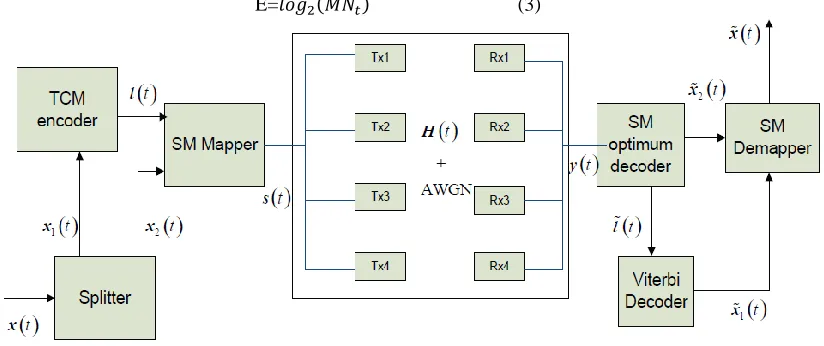
modulation Shown in the figure TC-SM has receiver antenna and transmitter antenna. Using M-PSK modulation technique to define
E= ( ) (3)
Fig. 1: Trellis Coded Spatial Modulation System Model
In transmitter side SM mapper and Trellis encoder are jointly together. Trellis encoder is called convolution encoder. The input sequence is divided by two, the first sequence is given to convolutional encoder it is used to encode the input sequence at a rate x/(x+1) and mapped into SM mapper. The Mapper maps the single antenna index from multiple transmitter antennas which can be determined by ( ) bits and then map the symbol from signal constellation which can be determine by ( ) bits. The active antenna emits this signal and passes through the wireless channel. Due to the different spatial position occupied by transmitted antenna in the antenna array. During transmission only one antenna will be active condition at that time no one power radiated at any other antenna.
The receiver detects this signal. Channel impulse responses ( ) need to be estimated which depends upon the number of transmitting and receiving antennas. At the receiver side, a Viterbi decoder is used which is fed with Soft information. This information is supplied by the SM decoder in order to produce the estimate input information sequence.
Ungerboek Set Partitioning A.
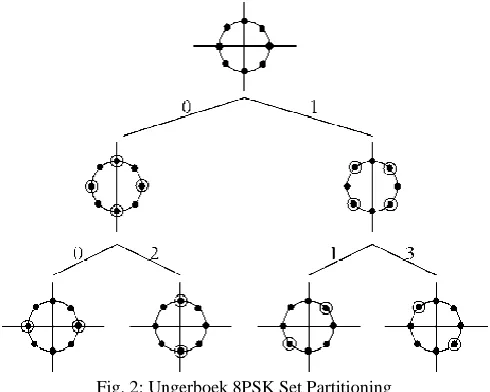
The functions of TCM is the combined effect of a convolution coder of a code rate R = X / (X +1) and an M-ary signal mapper that maps M = 2X input points into a larger constellation of M = 2X+1 constellation points. For X= 2, and code rate of 2/3that takes a QPSK signal (M=4) and put out an 8- PSK signal (M=8). So instead of expanding the bandwidth as the signal goes from QPSK to 8PSK, it instead doubles the constellation points. Thus it conserves bandwidth by doubling the number of constellation points of the signal. Assume any two point (A1, B1) and (A2, B2), then the Euclidean distance between the point is calculated by given formula
Euclidean distance=√( ) ( ) (4)
Fig. 2: Ungerboek 8PSK Set Partitioning
Initially the 8 points constellation is subdivided into two 4 point subsets shown in fig 2.The minimum Euclidian distance increase 2 then this 4 point constellation is subdivide into two 2 point subsets with The minimum Euclidian distance2 increase 4 . This process continues on the subsets until each subset has only two points.
III.
C
ODED WITH MODULATION TECHNIQUESThe simplest MIMO transmission technique is STBC-SM which consists STBC and SM, both are combined together to take advandage of both.In STBC-SM,It has both STBC symbols and the indices of transmit antennas which are use for transmitted carry information.For poroposed STBC-SM a low complexity Maximum likelihood (ML) is derived.This system choosed Alamouti‟s code which transmits the only one symbol per chennel,it povide the advantage of spectral efficiency and simplified ML detection. It also achieve better error performance compare to Orthogonal space time block code.The another MIMO technique is TC-SM which design the trellis encoder and the SM mapper jointly at transmitter side .At receiver side used Viterbi decoder which is used to receive the soft information from active antenna through demapper. It derives the conditional pair wise error probability (CPEP) for TC-SM and unconditional pair wise error probability (UPEP) is obtained with path length. To obtain the optimum code with optimize distance using code design criteria. It achieves the better error performance and reduces the decoding complexity.
IV.
S
IMULATION RESULTSThe simulation results and compared output are shown in figure. The modulation techniques are compared to coded algorithm of STBC and TC.
Comparison of SM-TC to SM A.
Fig.1. shows the spatial modulation trellis code has outperformed conventional scheme. Higher value of r give better error performance compared to spatial modulation which is need for wireless communication system.
Comparison of SM and STBC-SM B.
In Fig. 2. it is clearly proved that the STBC-SM achieve better error performance and give SNR value is 3.5dB than SM using Under Rayleigh fading condition.
Comparison of SM-STBC and SM-TC C.
Fig. 1: Comparison of SM and SMTC
R
EFERENCES[1] ThiloFath and Harald Haas, „„Performance Comparison of MIMO Techniques for Optical Wireless Communications in Environments‟‟IEEE transactions on communications Vol 61,no 2,pp 732-742,Dec 2012.
[2] Y. Tanaka, T. Komine, S. Haruyama, and M. Nakagawa, “Indoor visible communication utilizing plural white LEDs as lighting,” in Proc. 2001 IEEE International Symp. Personal, Indoor Mobile Radio Commun., vol. 2, pp. 81–85.
[3] T. Komine and M. Nakagawa, “Fundamental analysis for visible– light communication system using LED lights,” IEEE Trans. Consumer Electron., vol. 50, no. 1, pp. 100–107, Feb. 2004.
[4] S. Navidpour, M. Uysal, and M. Kavehrad, “BER performance of freespace optical transmission with spatial diversity,” IEEE Trans. Wireless Commun., vol. 6, no. 8, pp. 2813–2819, Aug. 2007.
[5] L. Zeng, D. O‟Brien, H. Minh, G. Faulkner, K. Lee, D. Jung, Y. Oh, and E. T. Won, “High data rate multiple input multiple output (MIMO) optical wireless communications using white LED lighting,” IEEE J. Sel. Areas Commun., vol. 27, no. 9, pp. 1654–1662, Dec. 2009.
[6] R. Mesleh, H. Haas, S. Sinanovi´c, C. W. Ahn, and S. Yun, “Spatial modulation,” IEEE Trans. Veh. Technol., vol. 57, no. 4, pp. 2228–2241,July 2008. [7] R. Mesleh, M. Di Renzo, H. Haas, and P. M. Grant, “Trellis coded spatial modulation,” IEEE Trans. Wireless Commun., vol. 9, no. 7, pp. 2349–2361, July
2010.
[8] E. Basar, U. Aygolu, E. Panayirci, and V. H. Poor, “Space-time block coded spatial modulation,” IEEE Trans. Commun., vol. 59, no. 3, pp. 823–832, Mar. 2011.