www.ijres.org Volume 6 Issue 7 Ver. I ǁ 2018 ǁ PP. 40-45
Effect Of Temperature On Linear Alkylbenzene (Lab) Yield
From Rerun Column Of Lab Plant Using Aspen Hysys
Simulation
Ipeghan J. Otaraku*
1, Achus H.Got
2,Ishioma L. Egun
3*1Department of Chemical Engineering, University of Port Harcourt, Port Harcourt, Nigeria 2
Department of Chemical Engineering, University of Port Harcourt, Port Harcourt, Nigeria
3
Department of Chemical Engineering, University of Port Harcourt, Port Harcourt, Nigeria Corresponding Author:Ipeghan J. Otaraku
Abstract
The aim of this paper is to determine the effect oftemperature o linear alkylbenzene (LAB) yield from a Nigeria Refinery LAB plant. The rerun (LAB) column was simulated using Aspen HYSYS. The simulation was done at temperatures between 280oC and 360oC at temperature difference of 20oC (ΔT =20°C). There was an increase in the average weight percentage fraction of linear alkylbenzenes at the bottom stream temperature from 280oC to 340oC and a slight decrease at 360oC. Bottom stream temperature280oC and pressure of 115Kpa yielded the highest LAB percentage yield of 99.4%.
Keywords:
Rerun column Top stream temperature, Rerun column bottom streamand Linear alkylbenzene Yield. --- --- Date of Submission: 27-07-2018 Date of acceptance: 11-08-2018 --- ---I. INTRODUCTION
Linear alkyl benzene (LAB) is a family of organic compounds with C6H6 – CnH2+1 𝐶𝑛𝐻2+1 (n is between 10 and 16). The C12 – C15, C10 – C13 LABs are used for detergent production and are produced by the
reaction between paraffins and Benzene [5]. LABs are currently being used as a liquid scintillator in neutrino detector due to its good optical transparency, its high yield, low amount of radioactive impurities and high flash points [5]. It is also a suitable material that is being used in a secret Neutrino Interaction Finder (SNIF), it is also used as an antineutrino detector design to detect the presence of nuclear reactor at a distance of 100 – 500KM [5].
After the HF acid has been stripped out by the HF stripper, the benzene in the stream is then recycled to the alkylation reactor section from the overhead of the benzene column, while n-paraffins are recycled to the PACOL unit from the overhead of the paraffin column [7, 8].
The product of alkylation unit serves as feed to the HF stripper column – after benzene has been reacted with mono-olefins to form linear alkylbenzene (LAB) in the presence of HF acid catalyst [6, 9].
Linear Alkyl benzene is a vital raw material in the production of liner alkyl benzene sulphonate [1, 2]. The LABs C10H22C6C6, C11H24C6C6, C12H26C6C6, C13H28C6C6 and C14H30C6C6 produced by the reaction
between paraffins and benzene are essential raw materials for producing detergent [5, 9].
The factors that can affect biodegradability of linear alkylbezene sulphonate (Detergent) includes the structure of side hydrocarbon chain in molecule and the share of 2-phenylalkane among other isomers [4].
1.1.1 Fractionation Section
The light ends produced by cracking reaction are removed in the stripper column. The off -gas from the stripper is sent to the fuel gas, but flared if it is under high pressure[3]. And the paraffins and olefins in the column bottom stream are fed to the linear alkyl benzene alkylation unit. In order to recover enough heat from the bottom stream, it is necessary by passing where the paraffin stream is heated [3].
1.1.2 Aspen HYSYS
This is a chemical process design software or application used for designing, monitoring trouble shooting and analyzing the technical and economic performance of a chemical process plant [6].
The steps used for running flow sheet simulation in Aspen HYSYS were as follows: i. Components selection.
ii. Thermodynamic options selection.
iv. Creating a flow sheet. v. Naming the feed stream.
vi. Equipment parameters computation.
vii. Collection of result from the simulated environment [6].
Figure1: Linear alkylbenzene flow diagram (UOP 2009[2])
1.2 THE SIMULATION
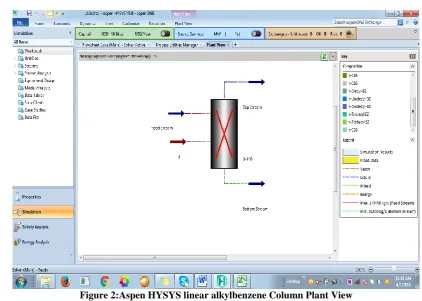
1.2.1 The Linear alkylbenzene (rerun column) was simulated at steady state using a distillation column template of ASPEN HYSYS 8.8. Peng Robinson was selected as the fluid package.
Figure 2:Aspen HYSYS linear alkylbenzene Column Plant View 1.2.2 Rerun column Design specifications
Table 1 represents the rerun column design specification.
Table 1: Rerun Column, Specification. Specification
Striping Column diameter 2800mm
Rectification Section diameter 5600mm
Tray spacing 600mm
Number of tray holes 1942
Hole diameter 13mm
Number of Trays above feed 15 trays, 16 stages (with condenser) Number of Trays below feed 21 trays, 22 stages (with re-boiler) 𝑄𝑐 (Condenser heat duty) 31212 MJ/hr
𝑄𝑟 (Re-boiler heat duty) 22363 MJ/h
1.2.3 Feed Components and composition
Table 2 indicates the LAB column feed stream components the composition in wt. % fraction.
Table 2: Feed Components used and their Composition in weight % fraction.
Components Chemical Formula Composition (wt. % fraction)
1. N-Decane nC10H22 0.0003
2. N-Undecane nC11H24 0.0033
3. N-Dodecane nC12H26 0.0046
4. N-Tridecane nC13H28 0.0058
5. N-Tetradecane nC14H30 0.0065
6. N-Pentadecane nC15H32 0.1086
7. N-Hexadecane nC16H34 0.0166
8. Decylbenzene nC169H26 0.1439
9. N-undecylbenzene nC17H28 0.1775
10. N-dodecylbenzene nC18H30 0.2032
11. N- tridecylbenzene nC19H32 0.1626
12. N-tetradecylbenzene n-C20H34 0.1071
13. Heavy Alkylates n-C26H54 0.0599
2.2.4 Rerun column Operating Conditions
Table 3 Operating Conditions used in this Simulation are as stated below. Feed Top Stream (Distillate) Bottom
Temperature °C 178 93 232
Pressure Kpa 200 9.0 20
Enthalpy MJ/h -95850 -98130 -125900
Mass Flow-rates Kg/h 140400 108900 14290
II. RESULT AND DISCUSSION The results obtained are as discussed below
1.3.1 LAB Average Weight fraction.
(i)
At Top stream Operating temperatures ΔT=20oCThe average weight fraction of n-decylbenzene, n-undecylbenzene and n-dodecylbenzene increased at the top stream operating temperature of 280oC – 300oC and decreased at 320oC – 360oC. While n-tridecylbenzeneand n-tetradecylbenzene decreased at 280oC – 300oC and increased at 320oC – 360oC.
Table 4:Average Weight fraction of LAB at Top Stream Operating Conditions ΔT=20oC.
Linear Alkylbenzenes (LAB) Operating Temperatures(oC)
280 300 320 340 360
n-decylbenzene 0.2792 0.2984 0.2849 0.2791 0.2740
n-undecylbenzene 0.2177 0.2800 0.2740 0.2714 0.2694
n-dodecylbenzene 0.2842 0.2762 0.2807 0.2820 0.2832
n-tridecylbenzene 0.1658 0.1566 0.1638 0.1675 0.1705
n-tetradecylbenzene 0.0885 0.0832 0.0889 0.0927 0.0950
Figure 3: Average Weight fraction of LAB at Bottom Stream Operating Conditions
(ii)
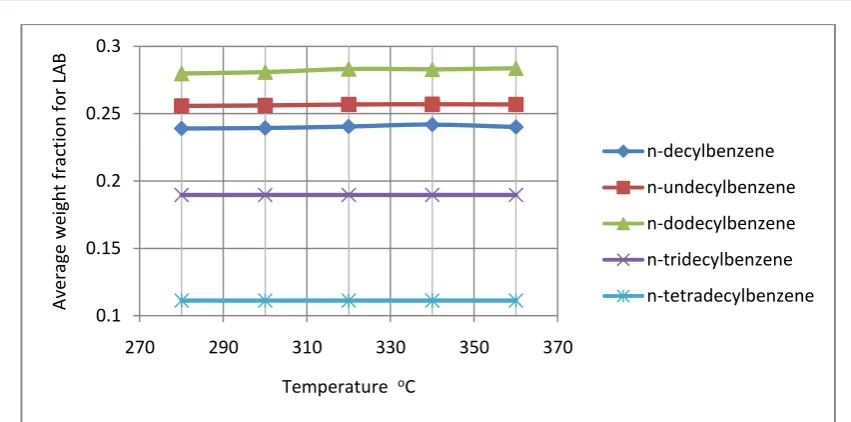
At Bottom stream Operating temperatures ΔT=20oCThe average weight fraction of n-decylbenzene, n-undecylbenzene and n-dodecylbenzene increased at the bottom stream operating temperature of 280oC – 320oC and decreased at 340oC – 360oC. While that of n-tridecylbenzene and n-tetradecylbenzene remains constant. Table 4 and Fig.4
Table 4: Average Weight fraction of LAB at Bottom Stream Operating Conditions ΔT=20oC. 0.05 0.1 0.15 0.2 0.25 0.3
270 290 310 330 350 370
Av era ge Wt . % f ra ctio n o f L AB
Temperature oC
n-decylbenzene
n-undecylbenzene
n-dodecylbenzene
n-tridecylbenzene
n-tetradecylbenzene
Linear Alkylbenzenes Operating Temperatures(oC)
280 300 320 340 360
n-decylbenzene 0.2390 0.2393 0.2404 0.2419 0.2401
n-undecylbenzene 0.2558 0.2561 0.2568 0.2569 0.2568
n-dodecylbenzene 0.2797 0.2808 0.2831 0.2829 0.2837
n-tridecylbenzene 0.1897 0.1897 0.1897 0.1897 0.1897
Figure 4: Average Weight fraction of LAB at Bottom Stream Operating Conditions
4.2.4 LAB Average wt. % fraction Yield
The calculated LABs percentage Yield from the average LAB weight fraction is as shown in Table 4.3
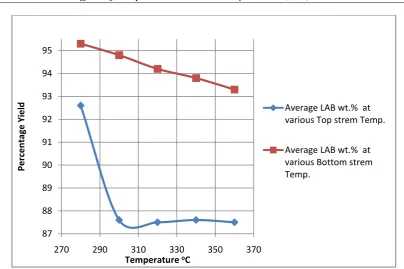
The calculated percentage yield of average LAB wt. % fraction indicated a higher percentage yield at the top and bottom stream temperature of 280oC. At this temperature the obtained yield of top and bottom streams are 92.2% and 95.3 %. Table 5 and Figure
Table 5: LAB Average wt. % fraction Percentage Yield
Operating *Temperatures (0C)
Percentage Yield of Average LAB wt.%at various Top Stream operating condition
Percentage Yield of Average LAB wt.% at various Bottom Stream operating condition
280 92.2 95.3
300 87.6 94.8
320 87.5 94.2
340 87.6 93.8
360 87.5 93.3
0.1 0.15 0.2 0.25 0.3
270 290 310 330 350 370
Av
era
ge
w
eight
f
ra
ctio
n
for
LAB
Temperature oC
n-decylbenzene
n-undecylbenzene
n-dodecylbenzene
n-tridecylbenzene
Figure 5:LAB Average wt. % fraction Percentage Yield
5 Percentage Yield of LAB in the distillate at TBottom= 280 0C.
The bottom stream operating temperature of 280 0C has the highest average percentage yield of linear alkylbenzenes (LABs). The percentage yield of the linear alkylbenzene was calculated by keeping the operating temperature at 280 0C and varying the operating pressure at 17Kpa, 42Kpa, 67Kpa, 92Kpa and 115Kpa. The highest yield obtained is 99.4% which is at 115Kpa. This is as shown in Table 6. And figure 6
Table 6: Percentage Yield of LAB in the distillate.
Pressure Kpa Percentage Yield Of LAB in the Distillate
17 89.1%
42 95.4%
67 97.9%
92 98.97%
115 99.4%
Fig.6:LAB % Yield at TBottom= 280oC.
87 88 89 90 91 92 93 94 95
270 290 310 330 350 370
Per
ce
n
tage
Yi
e
ld
Temperature oC
Average LAB wt.% at various Top strem Temp.
Average LAB wt.% at various Bottom strem Temp.
88 90 92 94 96 98 100
0 50 100 150
LA
B
%
Yi
e
ld
Pressure Kpa.
III. CONCLUSION
It was observed that the rerun column bottom stream temperature has greater effect on the linear alkylbenzene yield than the temperature variation of the top stream. At higher temperature of both streams, lower percentage yield of average wt. % of linear alkylbenzene was obtained with that of the top stream being the lowest at 87.5% as against 93.3% for the bottom stream. The highest linear alkylbenzene yield of 99.4%was recorded at bottom stream temperature of 280oC and pressure of 115Kpa.
REFERENCES
[1]. Abiola K. “Strategy for Development of the Petrochemicals Industry in Nigeria” A paper submitted to the Department of chemical Engineering, University of Lagos.
[2]. Aderogba, K. A. (2011)” Significance of Kaduna River to Kaduna Refining and Petrochemicals Complex” African Journals, Vol. 5 (5), Serial No. 2 Pp.83-98.
[3]. Ahmad Daaboul. “LAB Project - Environmental Impact Assessment” Section 3 pp. 4 – 42
[4]. Irena O. D, Dolganov I.M and Ivanshkina E.N (2001) “Development of Computer Modeling System as a Tool for Improvement of Linear Alkylbenzene Production” J. Petroleum and Coal. Vol. 53, No.4, Pp. 244 – 250
[5]. SadalO.I.MarwaS.M.,Wala T.A. (2012) “Linear Alkylbenzene Production from Kerosene” Seminar presented to the Department of Chemical engineering University of Khartoum.
[6]. Thaer, A. A. (2010), “Process Simulation Analysis of HF Stripping Column Using HYSYS Process Simulator” J. of Engineering Sciences /Vol.17/No.2, pp.87 – 96.
[7]. UOP (1990) “Linear Detergent Alkylation Unit, General Operating Manual” pp. 1 –610. [8]. UOP (2004) “Linear Detergent Alkylation Unit, General Operating Manual” Pp. 1 – 112.
[9]. Xiaoming J, Gang Rong and Shuqing Wang (2003), “Modelling and Advanced Process Control (APC)For Distillation Columns of Linear Alkylbenzene Plant Key Lab of Industrial Control Technology, Institute of Advanced Process Control, Zhejiang University, pp1-6.