ISSN (e): 2250-3021, ISSN (p): 2278-8719
Vol. 09, Issue 10, October. 2019, Series -II, PP 45-51
An Improved Method of WSN Based on New SWPT Algorithm
Rama Krishna Bandam
1, Dr. K. Venkata Rao
2 1M.Tech (CSE), Dept. of Computer Science and Systems Engineering,2Professor, Dept. of Computer Science and Systems Engineering, Andhra University College of Engineering (A),
Visakhapatnam, Andhra Pradesh, India.
Received 30 September 2019; Accepted 15 October 2019
Abstract: The sensor nodes have constrained energy in their essential power storage unit, and this energy might be immediately depleted if the sensor node stays operational over significant lots of time. To survive, the energy efficient improvement in the network node is the development for the following stage to the specialists clustering has demonstrated a successful methodology for sorting out a huge scale WSN into associated gatherings expanding the lifetime and the unwavering quality of such networks. Separation of the nodes from the base station and between node separations can impact saving energy and broadening the network lifetime. The Simultaneous Wireless Information and Power Transfer (SWIPT) is proposed, it will work dependent on asset designation for the cluster nodes by the energy effectiveness instrument This algorithm will expand the length of the network lifetime by diminishing the power wastage on supplanting the node. Wireless Sensor Networks (WSNs) are significant in supporting persistent ecological checking, where sensor nodes are sent and should stay operational to gather and move information from nature to a base-station. Be that as it may, sensor nodes have constrained energy in their essential power storage unit, and this energy might be immediately depleted if the sensor node stays operational over significant lots of time. In this way, gathering encompassing energy from the prompt surroundings of the sent sensors, to energize the batteries and to legitimately power the sensor nodes, has as of late been proposed. The organization of energy gathering in natural field frameworks dispenses with the reliance of sensor nodes on battery power, radically decreasing the support costs required to supplant batteries.
Keywords: wireless sensor networks, dynamic power allocation,Sensor Deployment, Energy Holeand Sensor Scheduling.
I.
INTRODUCTION
application prerequisites in WSN. From existing exploration strategies, upgrading energy dispersal for correspondence turns out to be exceptionally basic. For amplifying lifetime of the WSN, some portion of an energy utilization of every sensor has a significant job while imparting among different sensors. This paper centers around energy preservation in every sensor by utilizing PSO-based clustering algorithm. The cluster head is chosen utilizing PSO, in view of the good ways from the cluster part node to sink and the lingering energy in that node.
II.
RELATED WORK
Chun-Cheng Lin Elsevier proposes a molecule swarm advancement (PSO) approach, and, from a hypothetical angle, gives the combination and dependability examination of the PSO with narrowing coefficient, which is a lot less difficult than the past investigation. Test results demonstrate the nature of the proposed methodology through affectability examination, just as the versatility to the topology changes at various occasions. MarcinMolgaet. al. Wiley Online Library 2005 gives the survey of writing benchmarks (test capacities) normally utilized so as to test enhancement strategies committed for multidimensional, persistent advancement task. Extraordinary consideration has been paid to numerous outrageous capacities, treated as the quality test for "safe" advancement techniques (GA, SA, TS, and so forth.). Writer said that Quality of improvement systems (those definitely known and these recently proposed) are much of the time assessed by utilizing normal standard writing benchmarks. There are a few classes of such test works, every one of them are ceaseless: (a) unimodal, raised, multidimensional, (b) multimodal, two dimensional with few nearby limits, (c) multimodal, two-dimensional with gigantic number of neighborhood boundaries (d) multimodal, multidimensional, with tremendous number of nearby boundaries, . Class (a) contains pleasant capacities just as malignant cases making poor or moderate union single worldwide extremum. Class (b) is intercede among (an) and (c)- (d), and is utilized to test nature of standard improvement techniques in the threatening condition, to be specific that having couple of nearby limits with single worldwide one. Classes (c)- (d) are prescribed to test nature of insightful "safe" streamlining strategies, for instance GA, SA, TS, and so forth. These classes are considered as hard test issues. Amol P. Bhondekaret. al. IMECS 2009 have shown the utilization of hereditary algorithm based node position approach for a wireless sensor network. A fixed wireless network of sensors of various working modes was considered on a framework arrangement and the GA framework chose which sensors should be dynamic, which ones ought to work as cluster-in-control and whether every one of the staying dynamic ordinary nodes ought to have medium or low transmission extend. The network format configuration was enhanced by thinking about application explicit parameter, availability parameters and energy related parameters. From the development of network attributes during the advancement procedure, Author infers that it is desirable over work a generally high number of sensors and accomplish lower energy utilization for correspondence purposes than having less dynamic sensors with therefore bigger energy utilization for correspondence purposes. What's more, GA-created plans contrasted positively with arbitrary structures of sensors. Consistency of detecting purposes of ideal structures was good, while availability limitations were met and operational and correspondence energy utilization was limited. Creator likewise demonstrated that dynamic use of the algorithm in WSN format configuration can prompt the expansion of the network's life expectancy, while keeping the application explicit properties of the network near ideal qualities. The algorithm indicated refined attributes in the choice of sensors' action/idleness plan just as the revolution of working modes (X, Y and Z modes). In any case, there still exists part of degree for future work to manage the improvement of heuristic systems for ideal steering of powerfully chosen cluster-in-control sensors, through some multi-bounce correspondence conventions. Additionally, techniques could be produced for dynamic mix of battery limit. PreranaShrivastavaet. al. IJETAE 2014 proposed methodology the sensors position is first assessed by the evaluated venture forward measurement and afterward the molecule swarm enhancement algorithm is utilized to limit the limitation mistakes. This outcomes in precise limitation data about the different sensors. The reproduction results demonstrated that the different exhibition measurements like the parcel conveyance proportion, start to finish deferral and energy utilization demonstrated a lot of progress when contrasted with the customary technique for confinement Scheme. The work can further be reached out by considering the effect of PSOLS on node thickness, node network and area estimation error.
III.
METHODOLOGY
factors, the overall network lifetime can be improved [11]. In this section, various energy optimization using PSO based on clustering algorithms for WSN was discussed, which aims to extend network lifetime.
PSO-Clustering
Guru et al. have proposed four variants of PSO, namely, PSO with time varying inertia weight (PSO-TVIW), PSO with time varying acceleration constants (PSO-TVAC), hierarchical PSO-TVAC (HPSO-TVAC) and PSO with supervisor student mode (PSO-SSM) for energy-aware clustering[12]. PSO assigns nodes to each of the cluster- heads, such that the total energy loss due to physical distances is minimum. This is defined in (4), where is the distance between cluster-head and the sink
In PSO-TVIW, the inertia weight is decreased linearly in each iteration. In PSO-TVAC, inertia weight is set constant and acceleration constants and are varied linearly in every iteration. In HPSOTVAC, the particle update is not influenced by the velocity in previous iteration; but, reinitialization of velocity is done when the velocity stagnates in the search space. Finally, in PSO-SSM,
Whereis a constant called momentum factor? Clustering is based on a simple idea that for a group of nodes that lie in a neighborhood, the node closest to the sink becomes the cluster head. A detailed comparative analysis of the algorithms for optimal clustering is presented. This scheme considers only the physical distances between nodes and their assigned cluster heads, but not the energy available to the nodes
PSO-C
Latiff et al. consider both residual energy and physical distances between the nodes and their cluster heads. Each particle represents a combination of cluster heads. The fitness function for the centralized PSO (PSO-C) is defined as C where is the maximum average Euclidean distance of nodes to their associated cluster heads and is the ratio of total initial energy of all nodes to the total energy of the cluster-head candidates in current round.
This ensures that only the nodes that have above-average energy resources are elected as the cluster heads, and that the average distance between the nodes and the cluster heads is minimum. They compare the results of the algorithm with those of LEACH and the LEACH-C algorithms. The PSO-based clustering algorithms outperform GA, LEACH and LEACH-C in terms of the network lifetime and the throughput.
MST-PSO
Cao et al. have considered an interesting case in which a node and its cluster-head engage in a multi-hop communication. The method computes a distance-based minimum spanning tree of the weighted graph of the WSN. The best route between a node and its cluster-head is searched from all the optimal trees on the criterion of energy consumption. Cluster heads are elected based on the energy available to the nodes and the Euclidean distance to its neighbor node in the optimal tree. The authors compare the performances of three mechanisms of cluster-head election based on energy, auto-rotation and probability. Routing and cluster-head rotation are treated as optimization problems and tackled through PSO. The results show that the PSO-based clustering methods ensure longer network life.
PSO-MV
PSO-MV protocol is based on PSO method and the residual energy of cluster heads is higher than other nodes, the purpose of the approach is energy balance. In the PSO-MV method, to choose the best two nodes as cluster heads, namely Master Cluster Head (MCH) and other as Vice Cluster Head (VCH) and the tasks between the nodes can be categorized, where the MCH is responsible for data collecting and transmission and VCH is responsible for inter-cluster communications or intra –cluster communications to sink. PSO-MV clustering algorithm is based on routing of clusters included generation steps and transmission of data according to the set of nodes into clusters and threshold energy that shows tois chosen as follow. But the weakness of this algorithm is in selection the number of cluster heads optimum.
Sensor Scheduling
In addition, to schedule the sensor nodes such that the theoretical upper bound of network lifetime can be achieved, the existing system proposes a weight-based method for determining the cover sets. It includes the following main steps: Weight assignment Cover formation Cover optimization Cover activation and Energy reduction
Sensor Deployment
Since the upper bound of network lifetime can be computed, we have to find the deployment locations such that the network lifetime is maximum. First use a heuristic to compute the deployment locations and then we use ABC and PSO algorithms to compute the locations.
Heuristic for sensor deployment
If any sensor node is idle (without monitoring any target), the node is moved to the least monitored targets’ location. This is to ensure that all sensor nodes play their part in monitoring the targets. The sensor nodes are then sorted based on the number of targets it cover. The sensor node is placed at the middle of all the targets it covers. The next nearest target is identified and the sensor node is placed at the middle of all these targets. If it can cover this new target along with targets it was already monitoring, allow this move, and else discard the move. This is done till the sensor node cannot cover any new target. At the end, upper bound is computed. The drawback of this approach is that it depends on the initial position of the sensor nodes. Though it may perform well for dense deployments, consistency cannot always be guaranteed.
IV.
PROPOSED METHODOLOGY
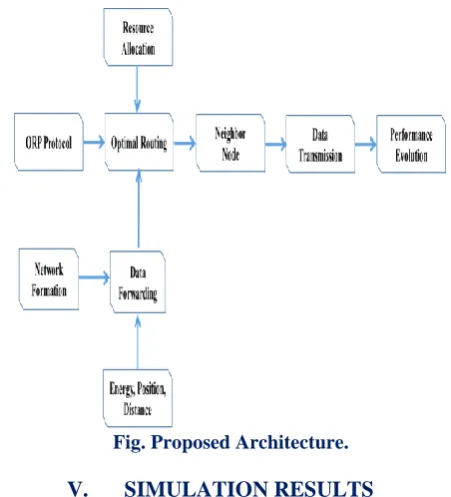
Propose three main features such as Energy Efficiency, Simultaneous Wireless Information and Power Transfer, Resource allocation. For attain the adaptive routing we use energy, position of each node in the wireless network and distance as parameter. The result of adaptive routing is to provide the best cluster node. In optimal routing we maintain a packets throughout the destination using ORP protocol. Meanwhile congestion window is maintained. If the node is further from source then volunteer is participated depends on the distance.
Fig. Proposed Architecture.
V.
SIMULATION RESULTS
VI.
CONCLUSION
The simulation had been conducted for the network of fifty `nodes. The simulation result shows that how the Fermat Point based SDAP in heterogeneous network can help in minimizing the total energy consumption and maximizing the lifetime improving the energy efficiency of a WSN by reducing the number of packets needed, and enabling a high increase in energy efficiency. Thus our proposed process attain an energy efficient, optimal and volunteer participation. Simulation result shows our proposed system provides better message success rate than other protocols.
Future Work
International organization of Scientific Research
51 | Page
REFERENCES
[1]. IrfanAzam,NadeemJavaid“Balanced Load Distribution with Energy Hole Avoidance in Underwater” Communications Magazine, IEEE, vol. 5, Published on 27 January 2017.
[2]. FatihSene,KemalAkkaya,TurgayYilma, “Autonomous Deployment of Sensors for Maximized Coverage and Guaranteed Connectivity in Underwater Acoustic Sensor Networks”, 38th Annual IEEE Conference on Local Computer Networks,2013.
[3]. TiansiHu,YunsiFei, “DSH-MAC: Medium Access Control Based on Decoupled and Suppressed Handshaking for Long-delay Underwater Acoustic Sensor Networks,” 10 March 2014.
[4]. Fahad Ahmad Khan,Saad Ahmad Khan,“Scheduling Multiple Mobile Sinks in Underwater Sensor Networks” 07 January 2016.
[5]. Bilal Gonen,KemalAkkayaandFatihSenel, “Efficient Camera Selection for Maximized Target Coverage in Underwater Acoustic Sensor Networks” in Networking 07 January 2016
[6]. J.-H. Cui, J. Kong, M. Gerla, and S. Zhou. Challenges: Building Scalable and Distributed Underwater Wireless Sensor Networks (UWSNs) for Aquatic Applications. UCONN CSE Technical Report: UbiNet-TR05-02 (BECAT/CSE-TR-05-5), January 2005.
[7]. J. Heidemann, Y. Li, A. Syed, J. Wills, and W. Ye. Underwater sensor networking: Research challenges and potential applications. USC/ISI Technical Report ISI-TR-2005-603, 2005.
[8]. I. S. Kulkarni and D. Pompili, “Task allocation for networked autonomous underwater vehicles in critical missions,” Selected Areas in Communications, IEEE Journal on, vol. 28, no. 5, pp. 716–727, 2010. [9]. D. Pompili, T. Melodia, and I. F. Akyildiz. Three-dimensional and Two-dimensional Deployment
Analysis for Underwater AcousticSensor Networks.Ad Hoc Networks (Elsevier), 7(4):778–790, June 2009.
[10]. J. Li and P. Mohapatra, “Analytical modeling and mitigation techniques for the energy hole problem in sensor networks,” Pervasive and Mobile Computing, vol. 3, no. 3, pp. 233-254, 2007.