Usage of any items from the University of Cumbria’s institutional repository ‘Insight’ must conform to the following fair usage guidelines.
Any item and its associated metadata held in the University of Cumbria’s institutional repository Insight (unless stated otherwise on the metadata record) may be copied, displayed or performed, and stored in line with the JISC fair dealing guidelines (available here) for educational and notforprofit activities
provided that
• the authors, title and full bibliographic details of the item are cited clearly when any part of the work is referred to verbally or in the written form
• a hyperlink/URL to the original Insight record of that item is included in any citations of the work • the content is not changed in any way
• all files required for usage of the item are kept together with the main item file. You may not
• sell any part of an item
• refer to any part of an item without citation
• amend any item or contextualise it in a way that will impugn the creator’s reputation • remove or alter the copyright statement on an item.
The full policy can be found here.
F
orests occupy about one third of the land area of our planet. They include some of the most diverse and vital of ecosystems and have environmental, social and economic values. Their loss or degradation has impacts on soil and slope stability, biodiversity, local and regional climates, renewable resources and people. In the UK we have one of the least forestedlandscapes in Europe, with only 12% forest cover, so we rely on imports for over 80% of our timber-based requirements. Policies that encourage sustainable forest manage-ment are in place so that woodlands con-tinue to meet the needs of current and future generations.
If forestry was simply about the harvest-ing of timber it might cause a loss of critical
habitats, damage to forest soils and reduc-tions in water quality that would lead to permanent degradation of the forested land-scape. In fact, many forests are managed for other purposes: environmental, ecological or social. Although some activities in the forest are compatible with more than one forest purpose (or ‘value’), other situations require sensitivity. Foresters must have a detailed knowledge of each value and must plan beyond the timescale it takes to grow a crop of trees. The day-to-day work of forestry requires thinking that is global, but action that is very local.
The criteria for forest sustainability are described in the UK Forest Standard and interpreted to meet the needs of England, Scotland and Wales in respective forestry strategies. The forest at Thirlmere Reservoir has a complex and sometimes conflicting set of management objectives, making it an excellent case study for modern approaches to sustainable forest management.
Sustainable forest
View of Thirlmere showing woodland around the lower slopes of the valley. The mountain on the far side is Helvellyn
This article presents a case study of sustainable forest management at
Growing biomass
Carbon storage
Wood for
industry Non-timber products
Human health
Cultural heritage Recreational
services
Public participation Local
employment
Juniper ecosystems Ancient semi-natural
woodlands Research and
education Forest area under management Balance between
growth and harvest Wood as
renewable energy Maintain forest area
Protect against insect pests Air pollution
Natural disturbance
Nutrient balance and acidity
Water chemistry Soil erosion
Shelter
and exposure Water conservation
Red squirrels Old growth
trees
Biodiversity in productive
forests Coarse woody debris/deadwood Sustainable
forest management Forest resources
and global
carbon cycles functions ofProductive forests
Socio-economic
aspects
Biological diversity Protective
functions of forests Forest
health and vitality
Thirlmere Reservoir
Thirlmere Reservoir is owned and operated by United Utilities and has been the major source of water for the City of Manchester since around 1900. The reservoir is in the northern Lake District, 6 km south of Keswick, and was formed by damming a valley that originally contained two small lakes. The valley forms the major north– south transport corridor through the National Park and the eastern slopes lead up to the summit of Helvellyn, England’s third highest mountain. At the time of the reservoir’s creation the landscape was largely barren, except for a few small patches of broadleaved woodland, and a programme of tree planting was undertaken on the steep slopes of the surrounding hills. Fast-growing conifers were preferred, to quickly cover the ground and stabilise the soils.
These trees have matured into a forest of magnificent Douglas fir, larch and spruce, with areas of ancient semi-natural wood-land (ASNW). The forest plays several important roles:
I the conservation of water quality
I a prominent landscape feature within the Lake District National Park
I a destination for low-impact recreation activities
I a habitat for wildlife such as red squirrel and otters
I a source of renewable natural resources including high-quality timber
Sustainable forest
management principles
Forest planning takes place at both strate-gic and local levels. Stratestrate-gic planning involves high-level decisions about the most important attributes of a forest and the purpose of forest management. At the level of individual forests, management plans detail all the actions to take place over a designated period. Typically, man-agement plans are produced and reviewed every 5 years with a minimum planning horizon of 20 years. They can be revised to take account of changing policies, new sci-entific discoveries, natural disturbance events and priorities of the forest users (stakeholders).Foresters usually divide the forest into ‘working circles’ or zones with a specific primary management objective. Working circles range from areas of intensive timber
production to areas where there is mini-mum management intervention. In the timber production areas a wide range of operations take place, including large-scale harvesting of timber, tree planting and road construction. Areas of minimum
intervention might be designated to protect certain species or landscape features, while intermediate working circles might be designated for more mixed-use activities.
For the first 5-year period of the plan, detailed information about each activity is
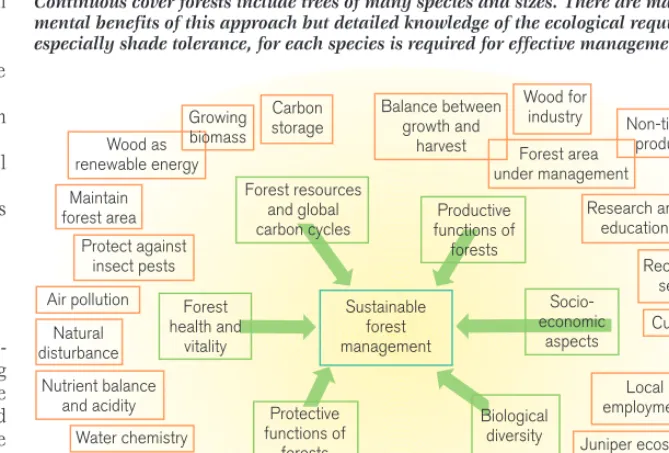
Figure 1 Diagram of sustainable forestry values at Thirlmere forest
Continuous cover forests include trees of many species and sizes. There are many environ-mental benefits of this approach but detailed knowledge of the ecological requirements, especially shade tolerance, for each species is required for effective management
management
Edward Wilson
laid out, including the volume of timber to be harvested, projected costs and revenues, staffing allocations, habitat conservation measures, and road construction or repairs. Effective planning requires an accurate inventory of the forest (soils, flora, fauna and cultural features), ecological site clas-sification (ESC) and mapping of areas where activities are scheduled. An import-ant principle is that the volume of timber harvested in any one period is no greater than the volume of forest growth. The remaining 15 years of a plan has less detail but helps ensure the forest is being man-aged on a sustainable basis.
Management planning usually involves a multidisciplinary team of experts in
ecology, animal conservation, biochem-istry, geographic information systems, soci-ology, economics, harvesting technology and engineering, in addition to the key role of the forester. Increasingly, management plans are certified by third party organisa-tions to ensure that they are sustainable. In Britain the UK Woodland Assurance Scheme (UKWAS) carries out this role.
Stakeholder organisations are invited to contribute ideas or comment on draft copies of the plan. This is vital for species groups such as birds, insects and plants (including lichens and mosses) where specialist knowledge is often required. Consultation with local communities is also vital.
Silviculture
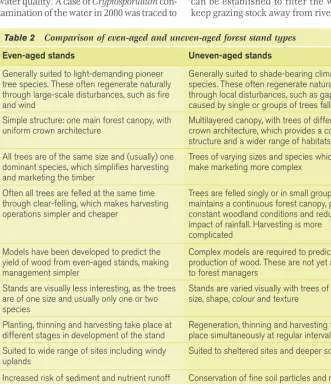
A core skill of every forester is silviculture — controlling the regeneration, growth, composition, health and quality of forests. Stands of trees can be even-aged (all trees in the stand are roughly the same age) or uneven-aged (trees in the stand vary from young seedlings through to large, mature trees) (Table 2), single species (mono-culture) or mixed species. There is there-fore a spectrum in terms of structural complexity from even-aged monocultures to uneven-aged stands of many tree species. Each silvicultural approach has its own ben-efits and drawbacks.
Thirlmere: a case study
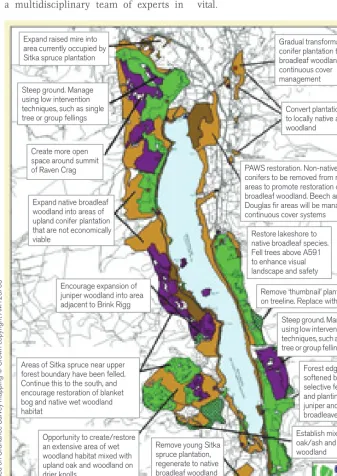
Although only 800 ha in size, the forest at Thirlmere demonstrates how modern sustainable forestry in Britain is able to inte-grate a wide range of management objec-tives. Figure 1 shows how forest values (green) relate to the main management pri-orities at Thirlmere (orange). Zonation of activities within working circles makes it possible to integrate a range of objectives and priorities across the forest (Figure 2).
Protective functions of the forest United Utilities is a major utilities company and its most important objective at Thirlmere is to sustain and enhance the quality of drinking water. Water quality has an important impact on human health and breaching the legal water quality standards can result in large fines. The main function of the forests at Thirlmere is to act as the primary raw water filter to ensure the supply of clean water. This filtration has the advantage of reducing operational costs and
Figure 2 Land-use map of Thirlmere showing the major forest types and
management considerations for future development of the forest
PAWS restoration. Non-native conifers to be removed from most areas to promote restoration of native broadleaf woodland. Beech and Douglas fir areas will be managed in continuous cover systems
Convert plantations to locally native ash woodland
Gradual transformation of conifer plantation to native broadleaf woodland using continuous cover management
Restore lakeshore to native broadleaf species. Fell trees above A591 to enhance visual landscape and safety Create more open
space around summit of Raven Crag Steep ground. Manage using low intervention techniques, such as single tree or group fellings
Expand raised mire into area currently occupied by Sitka spruce plantation
Steep ground. Manage using low intervention techniques, such as single tree or group fellings
Forest edge to be softened by selective felling and planting of juniper and broadleaves
Remove young Sitka spruce plantation, regenerate to native broadleaf woodland Opportunity to create/restore
an extensive area of wet woodland habitat mixed with upland oak and woodland on drier knolls
Areas of Sitka spruce near upper forest boundary have been felled. Continue this to the south, and encourage restoration of blanket bog and native wet woodland habitat
Continuous cover management
Current areas of native broadleaved woodland Expansion of native broadleaved woodland Managed under low intervention
Juniper conservation area Red squirrel conservation area Recreation area/car park Dam location
Remove ‘thumbnail’ plantation on treeline. Replace with juniper Encourage expansion of
juniper woodland into area adjacent to Brink Rigg Expand native broadleaf woodland into areas of upland conifer plantation that are not economically viable
Establish mixed oak/ash and juniper woodland
Source: United Utilities
Based on Ordnance Survey mapping © Crown copyright AM126/08
Table 1 A classification of the main
tree species used in British forestry according to their seedling light requirements
The more shade-tolerant species are better suited to continuous cover silvicultural systems, including shelterwoods and selection systems
Shade tolerance rating Light
demanding Intermediate Shade-tolerant
amounts of chemical used when the water reaches the treatment works.
In the hydrological cycle (Figure 3), forests increase transpiration and evapora-tion, reducing water yield. The litter layer of forest soils can act like a sponge, reduc-ing overland flow and the peak flows that can cause flooding. Forests can also have beneficial effects on water quality — the roots of the trees bind the soil, reducing ero-sion and hence sedimentation in the reser-voir. Trees can help change the chemical characteristics of the water, for example, water can become more acidic as it moves through soils in coniferous forest.
Since 2005, much of the forest at Thirlmere has been managed under contin-uous cover forestry (CCF). This aims to reduce the risk of erosion by maintaining a permanent tree canopy, often using uneven-agedforest stands. Although conifers domi-nate the forest there are also large areas of mixed and broadleaved woodland, ensuring that the throughflow is not too acidic and minimising the release of soil nitrate. Main-taining forest rather than grazing in the catchment has other positive effects on water quality. A case ofCryptosporidium con-tamination of the water in 2000 was traced to
sheep droppings in the catchment. Greater emphasis is now placed on fencing along river corridors so that areas of new woodland can be established to filter the water and keep grazing stock away from river banks.
Socioeconomic aspects
The area around the reservoir attracts an estimated 100,000 visitors per year. Car parks, toilet facilities and paths are provided as part of an open public access policy. The car park at Swirls, for example, is a major access point for Helvellyn, low-level walks through the woods and a path down to the lakeshore. Car parking charges are an important source of revenue for the catch-ment team, enabling them to offer facilities such as toilets and nature interpretation. The reservoir acts as a honeypot, attracting visitors into the area and benefiting local businesses. Managing the woodlands pro-vides income for local forestry workers and contractors.
Biological diversity
There are some important habitats in the Thirlmere catchment, including small areas of ASNW — mainly oak-birch woodland. Here the stable environment maintained by a woodland canopy over hundreds of years, and the low levels of air pollution, allow pop-ulations of sensitive woodland species, such as rare mosses, to develop. Standing dead trees and woody debris provide habitats for cavity nesting birds and many insects, espe-cially beetles. Forest management in the ASNW is largely non-intervention, with the main focus being removal of hazard trees and branches near to public areas for safety. The main objective in UK forestry for much of the twentieth century was to expand the productive forest resource. This involved planting upland sites with conifers such as Sitka spruce. ASNW was sometimes felled and replaced with conifers, which damaged ancient woodland ecology. These sites are now being restored. United Utili-ties has identified sites with potential for restoration or conversion to native
Deep groundwater flow Shallow throughflow
Overland flow
Stream
Evaporation: interception and transpiration Precipitation
Infiltration into soil Water table
Figure 3 Hydrological pathways in forested watersheds
Table 2 Comparison of even-aged and uneven-aged forest stand types
Even-aged stands Uneven-aged stands
Generally suited to light-demanding pioneer tree species. These often regenerate naturally through large-scale disturbances, such as fire and wind
Generally suited to shade-bearing climax tree species. These often regenerate naturally through local disturbances, such as gaps caused by single or groups of trees falling Simple structure: one main forest canopy, with
uniform crown architecture Multilayered canopy, with trees of differentcrown architecture, which provides a complex structure and a wider range of habitats All trees are of the same size and (usually) one
dominant species, which simplifies harvesting and marketing the timber
Trees of varying sizes and species which can make marketing more complex
Often all trees are felled at the same time through clear-felling, which makes harvesting operations simpler and cheaper
Trees are felled singly or in small groups, which maintains a continuous forest canopy, providing constant woodland conditions and reducing impact of rainfall. Harvesting is more complicated
Models have been developed to predict the yield of wood from even-aged stands, making management simpler
Complex models are required to predict production of wood. These are not yet available to forest managers
Stands are visually less interesting, as the trees are of one size and usually only one or two species
Stands are varied visually with trees of different size, shape, colour and texture
Planting, thinning and harvesting take place at
different stages in development of the stand Regeneration, thinning and harvesting takeplace simultaneously at regular intervals Suited to wide range of sites including windy
uplands Suited to sheltered sites and deeper soils
Increased risk of sediment and nutrient runoff following clear-felling, especially on steep slopes
Conservation of fine soil particles and mineral nutrients due to continuous cover of vegetation
Increased likelihood of release of soil carbon following harvesting operations due to increased solar radiation on the exposed forest floor
woodland and is gradually removing the conifer overstorey through thinning and clear-felling, which allows native broad-leaves to establish through either direct planting or natural regeneration.
Management of the forest is also focused on conservation of certain species, includ-ing otters and the endangered native red squirrel. The Lake District is a refuge for the red squirrel, which has been displaced in England by the North American grey squir-rel. Red squirrels thrive in forests of conifers or small-seeded broadleaves, such as birch. Continuous cover forestry with conifers means there are older trees of seed-bearing age in most forest stands, and these provide food supply and habitat. Other measures include the removal of any invad-ing grey squirrels, red squirrel monitorinvad-ing and close engagement with the local com-munity and the Save our Squirrel Project.
Production functions of the forest Wood is a renewable, low-energy source of material suitable for buildings, furniture, fuel and other uses. Production of wood is less important than some of the other objectives at Thirlmere, but it contributes approximately 40% of total estate income, and helps to offset forest management costs. In the UK conifers generally grow faster than broadleaved trees and offer a better
economic return. The continuous cover system makes it possible to grow large, high value Douglas fir timber while fulfilling soil and species conservation objectives. At the same time it minimises leaching of nitrate and other soil compounds that degrade water quality.
Forest resources and global carbon cycles
In recent years, rising fossil-fuel prices and awareness of climate change have spurred interest in the use of wood as a source of ‘green energy’. If there is a balance between the carbon fixed in the trees’ tissues through photosynthesis and that released by com-bustion, producing energy from the forest is carbon-neutral. The only additional inputs are fertilisers, pesticides, and the fossil fuel required for mechanised operations and transport.
United Utilities is exploring a project with the local community to supply wood fuel to a combined heat and power installation in the Thirlmere valley. This will supply affordable heating to local households and company offices, create secure local employment, and provide a local market for small-diameter and low value timber.
Forest health and vitality
The greatest threat to the health of forests worldwide, including those at Thirlmere, is climate change. Predictions for Britain over the course of this century include signifi-cant increases in mean monthly tempera-tures, changes in the pattern of rainfall and an increase in the number and severity of storm events. Stands of mixed species with uneven-aged structures are potentially more resilient than monocultures to natu-ral disturbances. For example, only a small proportion of trees in a mixed stand will be blown over by high winds while in mono-culture large patches may be lost. Multi-species stands are less likely to suffer serious pest damage as most pests favour one or a small number of host species. Transforming most of the forest to continu-ous cover, with stands of mixed species and
Glossary
Ancient semi-natural woodland (ASNW) Woodland composed of native species that have not obviously been planted, and are known to have existed since 1600 in England and Wales or 1750 in Scotland. Such woods have many ancient trees and are important for biodiversity conservation.
Clear-felling A silvicultural system where all trees in a stand are felled at one time. In the UK, a new stand is then established by planting. It is grown for a time and then felled. The resulting stand is even-aged.
Continuous cover forestry Any silvicultural system that creates and maintains an uneven-aged woodland structure. Regeneration, thinning and harvesting of trees take place simultaneously on the same site. CCF is often considered for sensitive sites, to protect soils and landscape and where the woodland is managed for multiple objectives.
Ecological site classification (ESC) A tool used by foresters to provide an ecological basis for sustainable forest management decisions. ESC uses a combination of soils, moisture regime, environmental and climate information to determine the limitations and opportunities for forest growth.
Exotic species Species introduced to the UK by human activity since approximately 7500 BP. More than 1,500 species of trees have been introduced, mainly since the 1600s. Sitka spruce, Douglas fir, Norway spruce and a small number of other conifers have been planted in large areas for commercial forestry.
Forest stand Community of trees that are similar enough in composition, age, arrangement, or con-dition to be distinguishable from adjoining areas and form a distinct management entity.
Native species Indigenous species to the UK that were present or colonised by natural means after the last Ice Age and before isolation from the European mainland by rising sea levels. There are approximately 30 broadleaf and 3 conifer species recognised as native to the UK.
Selection system A method of forest regeneration and maintaining an uneven-aged structure by removing some trees in all size classes either as single trees or in small groups or strips. Regen-eration is usually by natural means.
Shade tolerance The capacity of a species to become established and persist under the shade of canopy trees. This is an important ecological feature of a species that influences the choice of silvicultural system.
Shelterwood Any silvicultural system designed to encourage regeneration under the protection of the existing canopy, and where the resulting stand will be more or less even-aged.
Silvicultural system An approach to coordinating regeneration, tending and harvesting of trees within a stand.
age, should make it more able to withstand changes in our climate. In addition, such forests are effective in the long-term stor-age of carbon, in both the vegetation and the soil.
Landscape and ‘sense of place’ Thirlmere is an important cultural land-scape in the Lake District National Park. Care must be taken to ensure that new tree planting and harvesting operations do not have a negative impact. At the landscape level, popular or significant views on roads and at major access points must be pre-served. More locally, buildings, drystone walls and other artefacts that contribute to the identity of the area must be conserved. United Utilities also recognises the import-ance of archaeological and culturally signif-icant sites, which are protected from disturbance during forestry operations.
Conclusion
Thirlmere is an excellent example of modern approaches to sustainable forest management in the UK. The most import-ant priority in the valley is the conservation of water quality and supply for the people of the northwest, but the forest fulfils many other functions. Integrated land use and resource management requires complex
field assessments, zonation of land use and planning. The great benefit of a modern approach is that we are more able than at any time in the past to meet current needs as well as considering those of future gener-ations. The vision of foresters, engineers and geographers who created the Thirlmere estate is a magnificent legacy for future gen-erations, and a demonstration of how sus-tainability can be achieved in the heart of England’s Lake District.
References and further
reading
DEFRA (2007) A Strategy for England’s Trees, Woodlands and Forests.
Forestry Commission (2003) Forest and Water Guidelines, 4th edn.
Mason, B., Kerr, G . and Simpson, J. (1999) What is continuous cover forestry? FCIN29 Forestry Commission (available online at www.forestry. gov.uk).
Websites
UK Forestry Commission: www.forestry.gov.uk
United Utilities: www.uuplc.co.uk
Forest Research: www.forestresearch.gov.uk
British Trees: www.british-trees.com
Continuous Cover Forestry Group: www.ccfg.org.uk
FAO Department of Forestry: www.fao.org/forestry
Unasylva, a free online forestry journal: www.fao.org/ forestry/unasylva
Edward Wilsonis at the School of Medicine and Biomedical Sciences, University of Sheffield. Andrew Leslieis at the National School of Forestry, University of Cumbria. They would like to thank Paul Clavey and Vicky Pearson, foresters with the Thirlmere Catchment Team of United Utilities for advice and assistance in the preparation of this article.
13 April2009
Key points
I The UK is one of the least forested coun-tries in Europe and woodlands must usually be managed to fulfil multiple objectives.
I Strict international standards for sustain-ability and criteria for the conservation of bio-diversity are employed in UK forestry.
I Forests are complex ecosystems that serve a wide number of environmental, economic and social purposes at the local, regional and global scales.
I Forests play a major role in the landscape and in environmental processes, including the hydrological cycle.
I Forests are important for the conservation of water resources at Thirlmere. They protect the slopes, filter and regulate water flow through the soil, exclude stock and influence water chemistry.
AQA AS
Geography
AQA A2
Geography
Amanda Barker, David Redfern & Malcolm Skinner
Edexcel AS
Geography
Edexcel A2
Geography
Sue Warn, Cameron Dunn, David Holmes, Bob Hordern, Simon Oakes & Michael Witherick
OCR AS
Geography
OCR A2
Geography
Michael Raw
I Detailed and accessible coverage of the new AQA, OCR and Edexcel AS and A2 specifications
I Original case studies to develop key studies
I Extensive illustration of geographical processes
I Free CD or online support with sample exam questions and answers
I Just £19.99 each
To order any of these titles, use the order form bound into this magazine, order online and view sample pagesat www.philipallan.co.uk, or contact our Customer Services Department on 01235 827720.
May 2009
May 2009