© 2016 IJSRSET | Volume 2 | Issue 3 | Print ISSN : 2395-1990 | Online ISSN : 2394-4099 Themed Section: Engineering and Technology
Comparison of On-Demand Virtual Resource Allocation
Algorithm on Cloud Environment
K. Jegadeeswari*, T. Pavalakurunji, Dr. C. Senthamarai
Department of Computer Science, Government Arts College, Salem, Tamilnadu, India
ABSTRACT
Cloud computing provides computing resources as per user requirement. Infrastructure as a Service (IaaS) enables datacenter hardware to get virtualized using virtualization component of cloud computing. Virtual machines (VM) are utilized to satisfy user requirement and it is placed on physical machine (PM) of cloud such a way that utilize hardware resources and power in cloud. This paper discusses on On-demand virtual resource allocation using bin packing algorithm with the target of Quality of service (QoS) requirements such as maximum utilization of available resources and lower resource usage costs, Minimize the number of running physical machine and the power consumption. The cost of datacenter gets reduced by efficiently allocating the virtual resource to cloudlets. Cloudsim plays virtual resource allocation strategies.
Keywords: Cloud Computing, Virtual Machines, Cloudlets, Bin Packing, Resource Allocation, Cloudsim.
I.
INTRODUCTION
As density of data is increasing day by day, due to which it need a high processing power and high cost resources. These resources are not affordable by the user. So, this requirement of users has led to the development of Cloud Computing [1] technology in which high cost infrastructure resources are installed in a single datacenter and are accessed by the user through internet. A cloud computing service can give the following type of services to the end users: SaaS(Software as a Service), PaaS(Platform as a Service)[1], IaaS(Infrastructure as a Service)[2], and DSaaS(Data Storage as a Service). These services are used by users on pay-as-you-use manner.
A. Infrastructure as a Service (IaaS)
It provides fundamental computing resources such as processing power, storage, networking components middleware or in terms of VMs. The consumer can control the operating system, storage, deployed applications.
B. Platform as a Service (PaaS)
The consumer uses a hosting environment for their applications. The consumer controls the applications that run in the environment (and possibly has some control over the hosting environment), but does not control the operating system, hardware or network infrastructure on which they are running. The platform is typically an application framework.
C. Software as a Service (SaaS)
Provide on-demand applications over the SaaS. The applications are accessible from various client devices through either a thin client interface, such as a web browser (e.g., web-based email), or a program interface.
II.
METHODS AND MATERIAL
1. Related Work
management algorithms to improve the performance of applications [7, 8], resources allocation and management methods to improve the utilization of resources [9, 10], economics based cloud resources allocation model[11, 14], resource allocation and management model to reduce energy consumption as well as resource costs. Cloud computing service must meet the service level agreement (SLA). SLA is negotiated between the user and the service provider (such as Amazon EC2, IBM Blue Cloud, Microsoft Windows AZure, and Sales force Sales Force). Cloudlet specifies the set of user requests. It models the cloud-based application services. Cloudlet placement attempt is made starting with the first VM on the list, and continuing until all VMs have been placed or until the set of qualified VMs is exhausted.
Cloudsim3.0 [3] is the latest version of cloud simulator released on Jan 11, 2012 .It is designed in java and is an open source simulator and works both windows and UNIX/Linux. The cloudsim3.0 updates are new VM scheduler, new datacenter, cloudlet, new model, new VM allocation and selection policies, new power models new workload tracks, supports for external workloads. Removal of some classes have been done like cloud coordinator, sensor and powered list some API changes some bug fixes in this version.
A. Overview of CloudSim functionalities
Support for wide range cloud computing datacenters which contain more number of host and VM.
Support for virtualized server hosts, with customizable policies for management of VM on host and resources utilization of host is improved. Support for power aware computational resources Support for inter connected clouds.
Support for dynamic insertion of simulation components, stop and resume of simulation
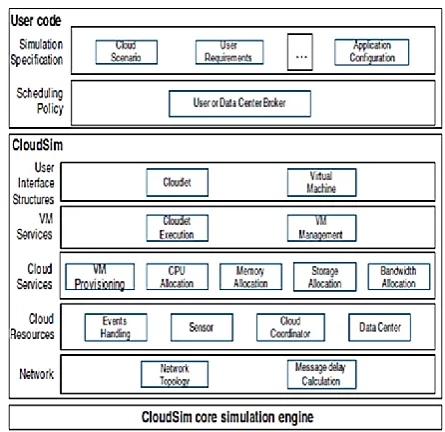
Figure 1. Layered Cloudsim Architecture.
B. VM scheduling techniques in cloudsim
Virtual Machine scheduling [8] is a mapping between virtual machines to physical machines. CloudSim is developed for simulation of cloud computing platform and support system modeling of datacenters, resource management and task scheduling. In CloudSim, the task of virtual machine placement is mainly completed by VmAlloctionPolicySimple class which selects a physical machine with the most number of available process units to create virtual machine iteratively. The virtual machine placement policy will use up all physical machine as long as the number of virtual machines is greater than the number of physical machines in datacenter, and this motivated us to design a virtual resource allocation on cloud infrastructure.
Better scheduling strategy of VM placement is to decrease running physical machines, increase the performance of infrastructure, maximizing the usage of available resources, saving the power of datacenter in cloud.
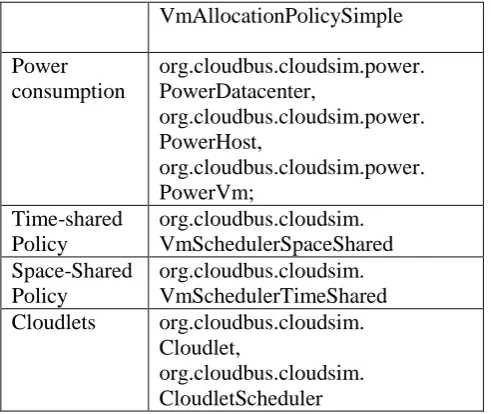
Table I. Important Classes of Cloudsim
VM, Cloudlet scheduling Technique
Important Classes
VM Selection org.cloudbus.cloudsim.power. RunnerAbstract.java
org.cloudbus.cloudsim.power. PowerVmSelectionPolicy YourSelection.java VM
Placement
VmAllocationPolicySimple
Power consumption
org.cloudbus.cloudsim.power. PowerDatacenter,
org.cloudbus.cloudsim.power. PowerHost,
org.cloudbus.cloudsim.power. PowerVm;
Time-shared Policy
org.cloudbus.cloudsim. VmSchedulerSpaceShared Space-Shared
Policy
org.cloudbus.cloudsim. VmSchedulerTimeShared Cloudlets org.cloudbus.cloudsim.
Cloudlet,
org.cloudbus.cloudsim. CloudletScheduler
2. Methodology
The problem of virtual resource (RAM, Bandwidth and CPU) can be formulated as a variant of multidimensional bin packing algorithms. For this problem, several heuristics have been developed, such as FF (First Fit), FFD (First Fit Decreasing), BF (Best Fit), WF (Worst Fit) which can quickly provide sub-optimal solution.
VMs are scheduled on physical hosts in a timeshared and space shared policies. After scheduling of VMs on hosts, Cloudlets are sending to VMs to execute. After completion of cloudlets execution VMs get destroyed from the datacenter based on on-demand access.
Figure 2. Cloudlet Processing
A. Comparison of Algorithms
1) First fit : while placing the cloudlets, first fit algorithm can be seen as a locally optimal algorithm in greedy manner. When a cloudlet request arrives, the firstly scanned one with sufficient available resources will be selected to host the cloudlet. To avoid unnecessary scanning, the fully loaded VMs are not scanned. If there is no VM with sufficient available resources, a new VM will start up and create the requested cloudlet on the newly started VM. It is a greedy manner to place the cloudlets and, by this way, we can achieve a local optimization.
2) First Fit Decreasing : The items are ordered by non-increasing order (VMs and cloudlets are sorted from high capacity to least capacity). Once both virtual machines and cloudlets are arranged, First fit process takes place.
3) Best Fit: The third strategy places the next cloudlet in the *tightest* spot. That is, each cloudlet chooses a Virtual machine such that minimum empty space will be left after the item is packed. FFD gives an optimal solution as reported
4) Worst Fit : It works exactly same as FF except that instead of choosing each cloudlet to each VM.
III.
RESULTS AND DISCUSSION
To evaluate on-demand virtual machine allocation algorithm, we implement bin packing algorithm in cloudsim. Experiment results to compare with different bin packing algorithms.
We define three types of resources representing different types of virtual machine respectively. The characteristics of each type of virtual machine, cloudlets are described in Table2, Table3.
Table II. Virtual Machine Resources
VM Category
CPU(MIPS) RAM (MB)
BW (Mbit/s)
VM1 200 512 1000
VM2 400 1024 600
Table III. Cloudlet Resources
Cloudlets Category
CPU (MIPS)
RAM (MB)
BW (Mbit/s)
CL1 200 256 500
CL2 200 500 400
CL3 100 256 200
The results are compared with different types of bin packing algorithms. FF and BF is effective scheduling algorithms of the cloudlets to reducing physical machine.
The output results are shown in Table 4.
Table IV. Result Table
CL/VM FF FFD BF WF
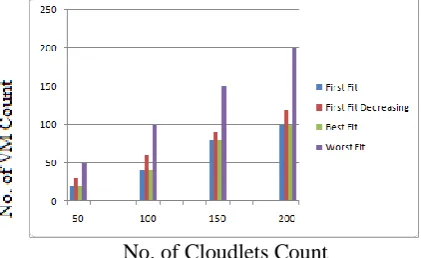
50/200 20 30 20 50
100/200 40 60 40 100
150/200 80 90 80 150
200/200 100 120 100 200
The experimental results are plot in figure 3.
No. of Cloudlets Count
Figure 3. Analysis Report
IV.
CONCLUSION
VMs are scheduled on physical hosts in a timeshared and space shared policies, after scheduling of VMs on hosts. Cloudlets are sending to VMs to execute. After completion of cloudlets execution VMs get destroyed from the datacenter based on on-demand access. The problem of virtual resource (RAM, Bandwidth and
CPU) can be formulated as a variant of multidimensional bin packing algorithms. FF and BF is effective scheduling algorithms of the cloudlets. On-demand virtual resource allocation algorithms target of Quality of service (QoS) requirements such as maximum utilization of available resources and lower resource usage costs, Minimize the number of running physical machine and the power consumption. The cost of datacenter gets reduced by efficiently allocating the virtual resource to cloudlets.
V.
REFERENCES
[1] http://www.servicearchitecture.com/articles/cloud computing/cloud_computing_definition.html [2] O. D, "Cloud computing service models , part1:
Infrastructire as a service," CEO, Creative RIA, Jan. 2011, doi:10.1109/COASE.2010.5584153. [3] Tarun Goyal, Ajit singh, Aaknaksha agrawal,
"cloudsim: simulator for cloud computing infrastructure and modelling," procedia engineering 38(2012)3566- 3572.
[4] R. N. Calheiros, Rajiv Ranjan, Anton Beloglazov, C.A.F. De Rose, Rajkumar Buyya, "CloudSim: A toolkit for modeling and simulation of cloud computing environments and evaluation of resource provisioning algorithms", Software Practice and Experience, Wiley publishers, 2010. [5] http://www.cloudbus.org/cloudsim/
[6] R. N. Calheiros, R. Ranjan, C. A. F. D. Rose, and R. Buyya, "Cloudsim: A novel framework for modeling and simulationof cloud computing infrastructures and services," CoRR, vol. abs/0903.2525, 2009.
[7] H. N. Van, F. D. Tran and J. M. Menaud, "SLA-aware virtual resource management for cloud infrastructures", Proceedings of the 9th International Conference on Computer and Information Technology, (2009), pp. 357-362. [8] Chirag J. athod," A Survey on Different Virtual
Machine Placement Algorithms ," International Journal of Advance Research in Computer Science and Management Studies, Volume 2, Issue 2, February 2014.
[9] W. Gui-yi, A. Vasilakos A and Z. Yao, "A game-theoretic method of fair resource allocation for cloud computing services", The Journal of
0 50 100 150 200 250
50 100 150 200
First Fit
First Fit Decreasing
Best Fit
Supercomputing, vol. 54, no. 2, (2010), pp. 252-269.
[10] L. Wei-Wei, J. Z. Wang and L. Chen, "A Threshold-based Dynamic Resource Allocation Scheme for Cloud Computing", Procedia Engineering, vol. 23, (2011), pp. 695-703.
[11] I. Goiri, J. Guitart and J. Torres, "Economic model of a Cloud provider operating in a federated Cloud", Information Systems Frontiers, vol. 14, no. 4, (2012), pp. 827-843.
[12] W. F. de la Vega and G. S. Lueker, "Bin packing can be solved within 1+epsilon in linear time." Combinatorica, vol. 1, no. 4, pp. 349–355, 1981. [13] Chirag J. athod," A Survey on Different Virtual
Machine Placement Algorithms ," International Journal of Advance Research in Computer Science and Management Studies, Volume 2, Issue 2, February 2014 .
[14] G. Hong-qing, X. Ying, "Research on cloud
resource management model based on