http://www.sciencepublishinggroup.com/j/ijaaa doi: 10.11648/j.ijaaa.20170303.12
ISSN: 2472-1107 (Print); ISSN: 2472-1131 (Online)
Providing a New Pattern for Iran House of Culture in
Austria with an Approach to Be Designed in Harmony with
the Climate
Maryam Movahed
1, Gholam Hossein Mohammadi Zadeh
21
Departement of Architecture, Jolfa Branch, Islamic Azad University, Jolfa, Iran 2Department Branch, Islamic Azad University, Roudhen, Iran
Email address:
[email protected] (M. Movahed)
To cite this article:
Maryam Movahed, Gholam Hossein Mohammadi Zadeh. Providing a New Pattern for Iran House of Culture in Austria with an Approach to Be Designed in Harmony with the Climate. International Journal of Architecture, Arts and Applications. Vol. 3, No. 3, 2017, pp. 38-43. doi: 10.11648/j.ijaaa.20170303.12
Received: August 12, 2016; Accepted: August 26, 2016; Published: May 27, 2017
Abstract:
The fundamental role of culture and art in the structure of today's society is obvious. Modern human is trying to improve his level of knowledge and culture by all means. Despite rapid notification in the present era of broadcasting media, cultural exchange is done far more than before. Today, culture and art are presenting as Impartible and important part of human life. In such arrangements, it is necessary and inevitable to create some centers to develop culture, art and human communities in cities. In this paper, we first examine Austria characteristics, then we will offer a new model for designing the Austria house of culture with approach of harmony with its climate. It has many advantages to use offered model in design and construction of house of cultures in Europe, including appearing Iranian identity, sense of belonging, a sense of peace and satisfaction and so on.Keywords:
Architecture, House of Culture, Austria, Consistent with the Climate1. Introduction
Providing human spiritual and material needs are the main objective of creating any type of human habitats. Due to large physical dimensions, dominating the roadway, disunion of jobs and leisure and despite from natural environment in new cities, it is difficult to create a balance in human-environmental communications and way of providing the environment - psychological needs and that's why the new issues and requirements in the field of urbanism have been revealed. According to fundamental changes in urbanization and architecture, it is obvious that providing spiritual and cultural needs of human in beg cities is no longer possible like in the past and It needs a new approach and new features is required. Perhaps we can barely find an art that is linked with people’s life as well as architecture. There are various phenomena and factors that play an important role in shaping the architectural spaces. Culture is one of the important factors that should be considered in the architectural space formations. Some experts may consider culture even more
important than the primarily climate factors. As we encounter with three main factors in the world urban history: ideology, economy and climate. Culture presence in architectural and urban spaces happens in different ways. For example, we can point at its presence in shape of elements, designs, ornaments, specific compounds in plans. Each construction as a part of Architecture culture is objectivity up a mental thought through his outward form to measure the expression.
Of course the role of culture in shaping all architecture areas, is not the same of other factors and have been more effective in organizing cultural, religious and public places. An attempt often is made to build a construction for a special performance and it’s forgotten that every building is a cultural witness. Culture manifested signs in space, have special meanings and contents. These symptoms are often univocal and sometimes are ambiguous and they can be explicit, half explicit or implicit.
universal that has specific identity attributes. In some cultural monuments, the explicitly or the implicitly are often reflecting the identity and tradition, while it is ignored in others. We should pay a profound attention in the past architectural in order to achieve the goal of linking past and present architecture and also creating continuity between these two architectures.
According to Iran's rich culture and its architectural identity, contemporary specialists try to recovery architecture, history and traditional features. According to common features of Iran and Austria in architecture, a new chapter between these two countries can be reached and also these overlapping can effect on improving relation and communications in between. However by considering the culture extent, to understand the connection between them, on how culture affects the forms of architecture, it requires further restricts on funds or dimensions in direct contact and close interact with the design concept.
In this paper, we first review Austria characteristics, then we'll offer a new model to design house of culture in harmony with the climate of Austria. Using this model in the design and construction of house of cultures in Europe, has many advantages including, appearing Iranian identity, sense of belonging, sense of peace, satisfaction, and so on.
Methodology
In this paper, the analysis method is based on descriptive -analysis method. Data collection method is as followed:
• Library and Internet resources • Surveying books and articles • Sample Case Analysis • Observation
• And discussions with experts
2. Plan Approach
Checking weather and climate in different regions is necessary for developing, logic planning. Checking house of culture design, is inevitable as well.
This is why the regional designing will be arose. The effects of climatic factors on building, is one of the practical aspects of climate that building designers have been considered in the past few decades. Today due to high cost of energy, the Geography Department has become increasingly important in the world and building designers use the maximum potential of each region climate with the help of climatologists.
Using natural forces in building a construction will lead to save on fuel consumption and most importantly, increase comfort and health quality for residential environment. Housing design, according to a region weather conditions, is the first defense line against external factors. (Mahdavi, Qobadian, 1971).
When human treated the issues with the approach of natural, logical and the practical ways in the past, his steps was compatible with industry and they were reasonable and it was established. He used all of the environmental factors, the factors that are annoying today. He linked between the
artificial phenomenon and natural factors in consistent and harmonious way. Its result, was creating a favorable atmosphere. All natural factors had played positive role in creating a favorable environment. However it proves its effects in traditional architecture which has long remained manifested. But today, architecture has been under effect of imported factors that has made it milestone noted way and what is considered in the design, is its appearance and it is also largely derived from Western views and it's not compatible on Iran's proposed conditions, such as traditions and beliefs. (Ghayyour, 1995).
The society emphasis on true community of resources and development management. Human's optimum utilization of the resources, has made the scientists to use all human sciences as main routes to achieve this goal. Because of the human’s environment is surrounded by the atmosphere and the most of human’s activities are in this area, so changes in the atmosphere plays a major role in his life and activities (Alijani, 1994).
So the region's climate has a major role in the development planning and in fact it guides us. Climate science is the most practical science (Stringe. 1982).
The patterns or designs, that meet specific climatic considerations, are designed to be exist without imposing changes in today's accepted patterns and without imposing any additional costs on the design or implementation of building ، utilizes natural and non- fossil energy in the environment to extent and providing the local climate conditions and the type of building to demand. The building is harmony with its natural surroundings, climatic design.
In many areas, the appropriate thermal conditions can be presented to the residents and deliver it without the need for fossil fuel consumption and also without need for using mechanical controllers through the year. Changes in temperature, humidity, airflow, the constantly changing interior lighting spaces such buildings, can provide residents of these buildings, comfortable and enjoyable environment in all seasons of the year. (Kasmaee, Morteza, 1984).
Most people still live in rural and low-density scattered settlements in tropical regions, where urbanization has mutated in the past four or five decades. They treat the housing problems in the same way that their predecessors treated. The traditional rural buildings have provided the correct solutions for problems in the tropical climate but the most urgent need for housing is urban housing in the tropic areas. Because the originality of the traditional forms in the life and the economy of rural communities, these are rarely useful in urban conditions. The existing problems in hot and dry areas cannot be solved by accepting the Technology and Western patterns that have different climatic, cultural and economic sources. (Azimi, 2000).
To provide the comfort for the building residents, we should try to apply the correct scientific method and optimum use of facilities, materials and manufacturing methods, in addition to increase the building’s lifetime and large-scale economic savings.
Austria is, having perfect information from its culture as well as its climate.
3. Providing a New Pattern for Iran
House of Culture in Austria with an
Approach to Be Designed in Harmony
with the Climate
3.1. Climate
Now a day, Utilization a comfortable new generation climate indicator is known as the psychology-temperature indicator. In urban climate studies and other functional areas, including tourism (Matzarakis: 2001), (Zolfaghari: 2009) (Ismaili & cooperation: 2011) Health (Deesa 2003), (Gation, 1996), it has been highly regarded by researchers. One of the most popular and widely used index, is the index of Physiological Equivalent Temperature was PET. It is based upon the balance of human body energy and cognitive impact of weather conditions, short and long radiation frequency, air temperature, relative humidity, wind speed, and Thermophysiology and make human’s activity on the human anatomy.
Once we define this indicator for the position of outdoor temperature, we can say, “It's the temperature during a sample room. Body heat balance, the metabolic basal rate and metabolic rate with an 80-watt light work and the failure clothes at 9.0 CLS, in balance, with ambient temperature of the skin and core body’s temperature in outdoor conditions.” (Zolfaghari, 2009).
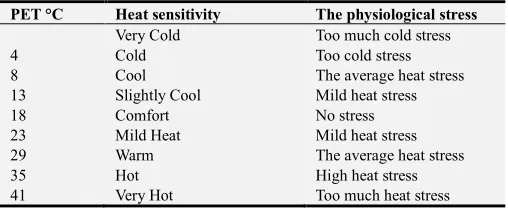
In Table 1, we have a view of a numerical classification index by descriptive status and heat sensitivity in a physiological condition.
Table 1. Threshold values in various degrees of sensitivity in PET index (Source: Matzarakis and Meyer, 1996).
PET °C Heat sensitivity The physiological stress
Very Cold Too much cold stress
4 Cold Too cold stress
8 Cool The average heat stress
13 Slightly Cool Mild heat stress
18 Comfort No stress
23 Mild Heat Mild heat stress
29 Warm The average heat stress
35 Hot High heat stress
41 Very Hot Too much heat stress
In order to calculate the index, we require four types of data in the following:
1. The first category are situational variables such as length, width and height of the study area.
2. The second category are meteorological variables; in terms of °C dry air temperature, water vapor pressure in terms of hpa layer, in percent relative humidity, wind speed in meters per second and the cloudiness in terms of ACTA.
3. The third category are characteristic variables that includes effective physiological containing height, weight, age and gender.
4. The fourth category are the variables related to types of cover and activities.
Climate Austria
1.Geographical location
According to geographical, political, historical and cultural features, Austria has a special place in the heart of Europe. This country by 83.870 square kilometers (one hundred and seventh country), is located in the northern hemisphere, eastern hemisphere in the middle of Europe. 82.444 square kilometers of the country is land. The inland waters are an area about 1426 square kilometers. The eastern Alps and the Danube region are the most important geographical symbols for this country. Austria is a landlocked country and it doesn't have any ways to open seas, but historically, it was known as the "Gem of European countries". It was confluence of trade routes and transit, as well as its place as the confluence of culture from all over the Europe. The Austria's neighborhoods in the West, are Switzerland and Liechtenstein; in the south are Italy and Yugoslavia, Hungary is in the East and Czechoslovakia and the West Germany are in the north. The sum of Austria's borders with neighboring countries is about 2562 km. The longest territorial border from West to East is 580 km and its thinnest area width from north to south is 30 kilometers (Austria Statistics center, 2005: p 12).
The most important reasons that given this country, the geographical location and political care, are its locating in the heart of Europe and its position on the way of North, South and East to West, surrounding by neighbors including NATO members (Italy and Germany) or Warsaw (Hungary and Czechoslovakia) and the Non-Aligned Movement members (Yugoslavia) and most importantly having the last frontier Eastern and Western European countries with neutrality policy.
2.Natural Features
A large part of Austria is surrounded by Alps. Other mountains are located in West and South. Eastern and northern areas are partly low heighted. Because of the special geographical and natural position, this country has different and varied climatic conditions, diverse landscapes and plenty of green spaces. The country is located in the temperate zone, with cold weather in winter and it is also mild with rain in the summer.
It is cold in the Alps slopes. The summers are short and winters are long. There are granites in areas. It has wet and Mediterranean climate in environs of the Lake of Neusiedler. The rainfall is about six millimeters per year. The average of rainfall in height, is about two thousand millimeters per year. Three-quarters of the Austria, includes mountains. Flat lands are only a quarter of its environment. Nearly 40 percent of the country, is more than 1,000 meters above the sea level. Austria territory, in terms of natural conditions, has separated to five mountainous areas and the plain is divided as following:
1. Eastern Alp region
4. Vienna Plain
5. Granite and gneiss zone heights
Austria is one of the most forested countries in central Europe and generally, 6.38 percent of its area is covered with dense forests. In the Alpine forests, it continues to pasture and agricultural lands. Natural park in Central Europe has the country's wild animals and all kinds of animals live in there. For example, The Pannon animal park is one of the most beautiful animal park in the Europe.
3.major cities
The most important Austria cities, in term of economic, political and cultural are the following:
1. Vienna 2. Salzburg 3. Innsbruck 4. Lindsay 5. and Graz
4.Nations, Races and Their relationships
1000 BC, a branch of Indo-European "Tribal and Free" settled on the territory of Austria. They were an advanced civilization. About 400 BC, from the North West of Austria, the Celtic tribes came into this area. It was just a part of general influx of Celts. They also swept across the Europe later. Celtics were warrior tribes who were at war with each other permanently. Before Christ, The Romans entered the country from the south and brought the area under their control. They learned Celts, correct way of life, culture and plant breeding. They gradually made a great empire in slopes of the Alps and the Danube area. Norikam, the roman province, the former King of the Celts, is nearly included the today Austria. With the Romans dominated, the Alps and the Danube region flourished with an economy and culture. Generally the history of Austria, encounter nomad tribes and ethnicities that were not of the same races, they have always led to conflicts and clashes. The migration is one of them. Along with the birth of Jesus Christ, barbarians, made Celts and the Romans hardly under pressure and thus, the Celts abandoned to different regions of Europe and they went to Ireland. About the fourth century AD, Germanic started tribes’ large migration to the territory of Austria and over the centuries gradually, Huns, Avars, Slavs and Magyars, had dwelt on the land and ruled in this land.
The Austrian are white. The minority ethnic people who live in Austria are Slavs, Italians and Hungarians. The result of this races and people-mixing is, they are not the Austrian pure race. Some tall and slim with fair skin, blue eyes and fair hair and others with dark skin and brown hair, brown eyes, and a few are different from the two mentioned groups.
5.Determinative role of geographical factors and Natural Resources
Austria is one of the most attractive European countries. Because of its special geographical position and natural beauty, millions of foreign tourists and people come to Austria from all around the world every year. By locating this country over the Europe roads and the establishment of international organizations, business, political and cultural, businessmen, politicians, attracted countless culture-lover
every year to being informed of its rich and abundant natural resources, benefits and considerable mobility in the tourism industry. In this country, Alps mountains extends from West to East, canyons, thoroughfares, rivers, forests and animals, each plays an important role in the Austrian economy in turn. Danube is the country's other natural attractions which had a major role in the historical events. Crusaders in the twelfth century and the fourteenth century, when heading to the Holy Land, chose the Danube as their main highway and in the prime of carrying salt ships with the aid of the river flow, they traced their homes. This river and other rivers streams flowing in the country's mountain, while on their way to the valley of plantation and livestock, in addition to the majority of exports, it accounted for consumes cheap and free energy and hydroelectric plant and metallurgical plants, including the giant stirs. Austrian will be change to skier’s paradise in winter. The towns at height of two thousand feet, have enough snow for winter sports. Austria's border villages of inland lakes, are the community center for skate lovers. Austria's position in terms of Skiing, is attracting people from other countries and travelers to the country, it could make a considerable income to the country. Austrian woods with red deer, antelope and plentiful black bear, attract thousands of predators and athletes to the country. Forest wood of mountain slopes are appropriate to taking furniture factories and pulp for paper-making, and also some of these woods are exporting to foreign countries. Abundant mineral resources of this land, also play an important role in the economy. Large deposits of coal that's near the earth surface and its near Graz located, is considered as one of the greatest wealth sources of the country. Mark Steyr's State is enriched by copper and silver resources. Turquoise mines, fireclay and reserves in Austria are lucrative resources that taking full advantage and they still not completely extracted. Currently, coal, crude oil, copper and aluminum is extracted over the other sources.
3.2. Deployment Building Direction
One of the most important factors that affects the formation of human environment, is the building settlement direction and available networks. In determining the building settlement direction, we should consider the special features such as wind, useful and harmful radiation. In addition, factors such as accessibility, slope and topography, the communication with the surrounding buildings and the landscape, should be also considered (Kasmaee 110, 1984).
By considering all mentioned factors, the building settlement priorities, can be cited as the following:
1. Gaining a minimum solar energy in hot times of the year 2. Preventing or reducing the impact of hot or harmful winds to the interiors and exteriors of building.
3. Gaining solar energy in cold times of the year
plane perpendicular to the rotation angle of the sun at different times of year, summer and winter, is calculated to be theoretical and according to minimum and maximum energy. It is very essential in the cold and warm season.
3.3. New Pattern for the Design of the House of Culture
By considering the above sentences, the following model is recommended to be used by architects when designing the house of culture in Austria.
Fig. 1. Proposed Model for designing the house of culture in Europe with an approach consistent with the climate.
The advantages of the proposed model
Some of the proposed model advantages in this paper are as follow:
1. Understanding the Iranian's culture to introduce its underlying values
2. Paying attention to Iranian-Islamic identity design concept
3. Create a deeper sense of belonging 4. Client satisfaction and comfort
5. Lower missing, surplus and undefined spaces
4. Conclusion and Summary
Cultural environment is an urgent need, not only for artists but also for all types of people. In fact, this is the environment for growth of community attitudes and also people thoughts that can have a great impact on the whole society. It is the environment for this group of people to flourish their talents. One of the most basic and most important aspects of development in any society, is people's awareness and knowledge in society. In this regard, one of the cultural collections and the House of Culture goals, is to inform the public and acquainting the public with the culture in the society. It is evident that public awareness about the culture, history and current status, can have effective role in
the transformation of society and culture with today's needs and keep pacing with technological advancements and also keep the information. Preventing the blind imitation and provide an informed and positive imitation.
Designing of Socio-cultural spaces, specially designing of the cultural centers and neighborhood houses, are such notable topics in Iranian contemporary architecture, and it is an unavoidable necessity.
In this paper, we first reviewed the common characteristics of Austrian cultural ties with Iran. Then a new model was provided to design the Iranian House of culture in Austria by an approach consistent with the climate. Using the offered model in the design and construction of house of cultures in Europe, has many advantages including, appearing Iranian identity, sense of belonging and a sense of peace and satisfaction, and so on.
Acknowledgement
This article is extracted from Master's Thesis, Islamic Azad University Iran Jolfa as the House of Culture in Europe (Austria) to approach harmony with the climate by writing of Maryam Movahed, Gholam Hossein Mohammadi-Zadeh as the supervisor doctor.
References
[1] Green Book Mark Steyr province, Islamic Republic of Iran, in 2004.
[2] Studies and Research Institute of Commerce, country studies, Austria, Tehran, 1989.
[3] Austrian market knowledge and ways to achieve them, the Institute of Studies and commercial Research, Tehran, 2004.
[4] Esmaeili, Reza, Adab, Hamed; Hataminezhad, Hossein 2011 architectural harmony with the climate (case study: the city of Faizabad), Geography, Geography space, No. 32, 53 and 74.
[5] Survey the barriers and cultural development factors in Sistan Baluchestan and South Khorasan "a step towards understanding the culture, referring to the concept of cultural lag", Parvin Sazgara, p. 419.
[6] Cultural evolution in modern industrial society, the translation of Maryam Vatr, p.19.
[7] Heidarzadeh Naini, Mohammad Reza 2003. = Green Book Upper Austria province, Islamic Republic of Iran, Vienna, p. 3.
[8] Keyhan 72, Page 314.
[9] Speech at the opening ceremony of the meeting of Foreign Minister Ms. Blasnyk foreign cultural, Austria, Embassy of the Islamic Republic of Iran, 22.09.2008.
[10] Journal notification, Issue 1, Volume I, article "Information, fourth vital element and its impact on the culture of other nations", translation M. Tootoonchian, Page 67.
[12] The introduction of home culture / home constituencies, culture, social sciences, culture, Issue 1, 116 to 117.
[13] Yazdanfar, Abbas Hosseini, B; Zarvadi, M. 2014. Culture and the Case Study Houses: Ramsar and Tonekabon city Traditional Homes, art and architecture, housing and rural environment, No. 144, 17 and 32.
[14] Austria Statitics center (OSTAT), wien, 2005.
[15] Austrian Aging Population, WHO, Vienna 2002.
[16] Dr. Esra Lagro, European Consortium for political Research, EU Enlargment…, 21-23 sep. 2005. Istanbul.
[17] Europe media Governance, the national and regional dimentions, published by (www.intellectbooks.com) jan. 2008.
[18] Givoni B. (1997), "Estimation of the effects of climate on man: Development of a new thermal index, Report to Unesco building", Research Statistics: 85-136.
[19] Olgay, V. (1973), "Design with Climate", Princeton University Press, p. 185.
[20] OMV yearbook 2006 printed in: www.OMV.org/.
[21] Otto Hietsch, Austria Land of Enchanment, University ofgensburg, wien, 2002.
[22] Petra Lambeck, Grossansicht des Bildes Mit Der Bilduntershrift, 12.11.2007, in: www.Dw-World.de.
[23] Program of the Austrian Federal Government for the 23rd legislative period. Austrian Parliament, sep. 2007.
[24] Spagnolo, J. and de Dear, R. A. (2003), "Field study of thermal comfort in outdoor and semi outdoor environments in subtropical Sydney Australia", Building and Environment 38: 721-738.
[25] Statik Austria, jahrbuch 2005 (02-bevoelkerung).
[26] Statistik Austria, Jahrbuch 2003 (02-Bevoelkerung).
[27] The Astrian Eu Presidency, Federal Ministry of Foreign Afffaires, Jan 2006.
[28] The Disability Concept of the Austrian Government, second edition, Federal Ministry for Labor…, 1998.