Coronary Diseases: Modeling Of Some Risk
Factors Using Artificial Intelligence Techniques
Boucena N., Bouharati K., Khenchouche A., Amrane M., Boussouf K., Foudi N., Kendri S., Djaber Y.,
Bouharati S.
Faculty of Natural Sciences and Life. UFAS Setif1 University, Algeria
Laboratory of Health and Environment. Faculty of Medicine, UFAS, Setif1, Algeria.
Laboratory of the research for genetic and nutritional cardiovascular diseases, UFAS, Setif1, Algeria.
Laboratory of Intelligent Systems, UFAS, Setif 1, Algeria.
Abstract: Objective. To estimate the variation in the major risk factors for cardiovascular disease (prevalence of smoking, obesity and systolic blood pressure), we try preventing according coronary heart disease risk factors observed in elderly men and women in the region of Setif – Algeria. Participants.100 men and women aged 26 to 86 years for whom the physiological parameters were recorded. These parameters are risk factors for cardiovascular disease. Main outcome measures. The expected analysis was estimated using an artificial intelligence model including the principles of fuzzy logic. Risk factors are inputs of the system and the number of patients with coronary heart disease is output. The observed data recorded from Analysis Central Laboratory of Setif university hospital - Algeria. Results. Factors that promote coronary heart disease are inaccurate and uncertain. The effect of these factors varies from person to person. Their consideration as fuzzy variables is perfectly adequate. Conclusion. A database is established. Fuzzy inference rules are highlighted according to the recorded values. An algorithmic application is established making it possible to read instantly the number likely the person with a coronary disease just by the random introduction of the variables at the input of the system.
Keywords: Coronary diseases, Risk factors, Artificial intelligence, Fuzzy logic
1.
Introduction
Cardiovascular disease is the leading cause of death in the industrialized world, and a number of well-characterized factors, including advanced age, hypertension, dyslipidemia, diabetes and smoking, contributes to cardiovascular risk [1]. Coronary heart disease continues to be a leading cause of adult morbidity and mortality in Europe. Different risk factors are widely studied. However, the weight of each factor varies according to people. The phenomenon is very complex. Modeling such factors by classical mathematical techniques becomes very difficult if not impossible. Several attempts were made. Different models are proposed, but this remains in the realm of probability and approximation. In recent years, artificial intelligence has found its application in solving various complex problems. The use of fuzzy logic systems as an intelligent system is a very powerful tool for solving, classifying and making decisions in an uncertain environment, especially in the medical field. In this study, after giving an overview of the risk factors for coronary heart disease according to the literature, we conclude that these factors are analyzed numerically in all models. In order to get closer to the precision and the expected accuracy, we propose the analysis of these factors by the techniques of artificial intelligence in particular the principles of fuzzy inference. For this purpose, we give a general overview on the fundamental notions of fuzzy logic in order to facilitate the understanding of its application. Some main risk factors (age, sex, BMI, tobacco and blood pressure) are considered as input variables to the fuzzy system. The possibility of coronary heart disease is expressed in degrees as an output variable. Given the nature of the effect of these imprecise factors,
we consider them to be fuzzy variables. A base rule is established according values recorded by the analysis laboratory of patient. The algorithm established allows the instantaneous reading of the degree of attack by the coronary disease. To do this, it is sufficient to randomly enter values at the input system to read the result.
2. Risk Factors
older women represent a higher risk for men [5]. Conventional risk factors such as diabetes mellitus, hypertension, high serum cholesterol, low serum cholesterol, smoking, physical inactivity and a family history of were widespread in the state [6]. Women have many risk factors that predispose them to coronary artery disease; Most of which are age-related and some of which are exclusive to women [7]. It has been recognized in recent years that women are a distinct subpopulation in patients with coronary artery disease [8]. Qualitative examinations of cardiovascular risk factors in children have been widely identified by referring to widely available computer databases (Ovid MEDLINE, Ovide EMBASE, PubMed, PsycInfo, and Cochrane Library). However, these databases have coded numerical values for boys or girls, the age subdivided into age groups as children, pediatric, adolescent or young adult. Boolean operators are introduced AND; OR. Obesity, for example, is coded into obese and overweight. The set of parameters are thus coded in numerical intervals. To reduce the amount of information, this research strategy focused on children or adolescents; Studies with representative samples; and recent publications that reported sex or gender specific results [7]. Overweight and obesity are the most frequent nutritional disorders in industrialized countries among children and adults [9]. Diabetes and low-density lipoprotein cholesterol are associated with each other and a higher risk of coronary heart disease in women. In addition, both are strongly associated with obesity [10]. Smoking is not a specific problem for a region. It seems to be very similar all over the world. Globally, about 80,000 to 100,000 young people start to smoke every day, and most of them come from developing countries [11]. This may suggest that adolescent smoking rates are likely to increase in the coming years and indicates an obvious problem with potential smokers [12]. High blood pressure is considered a major factor in coronary artery disease. Coronary artery disease is a major
component of cardiovascular death. Systolic blood pressure, cholesterol, body mass index, smoking, diabetes and physical inactivity are major risk factors for cardiovascular diseases [13]. Also, we can consider body mass index, and hyper cholesterolemia are the most common risk factors. In comparison with persons of fertile age arterial hypertension is more common in postmenopausal women [6].
3. Fuzzy modelling
In Booleans theory, an element belongs or does not belong to a set. However, this essential notion does not make it possible to account for situations that are simple and frequently encountered. An element X in classical logic, whether it belongs to a set X or that it does not belong to it; there is no third solution. In fuzzy logic, X can belong to a fuzzy set with a degree of belonging equal to 0.8 for example. We then express the truth in degree between the 1 and the 0. In natural language, there are many terms referring to the imprecise, such as "sick", for example, the disease is in a wide range, expressed in different degrees. The vague or fuzzy character of information lies in the absence of a well-defined contour of the set of values assigned to the objects it describes. So there is imprecise and fuzzy knowledge and inaccurate but not fuzzy knowledge [14]. Fuzzy systems find their application in
decision making with uncertain or approximate reasoning, especially for the system with a mathematical model difficult to describe and it is difficult to circumvent all factors. Fuzzy logic allows decision making with incomplete estimated values or uncertain information. A major contribution of the fuzzy set theory is its ability to represent vague data. The theory of fuzzy sets has been used to model systems that are difficult to define precisely. As a methodology, the theory of fuzzy sets integrates imprecision and subjectivity in the formulation of the model and the solution process [15]. Fuzzy logic is a superset of conventional (Boolean) logic that has been developed to manage the concept of partial truth. It was introduced by Lotfi A. Zadeh in 1965 [16], as a way to model language uncertainty. Therefore, uncertainty (inaccuracy, non-specificity, vagueness, inconsistency, etc.) is considered unscientific. According to the other point of view, uncertainty is considered essential to science [17].
2.1 Fuzzy variables
Unlike the binary variables that are defined by the two states "true" or "false", in binary the (1 and 0), the fuzzy variables present a gradation between the value "true" and the value "false". Two remarks are necessary about this representation: On the one hand, it is preferable to represent the state of the variable using its degree of truth by associating the value 1 (degree of truth of 100%) with the value "true" and the degree of truth zero at "False" value. On the other hand, we see that this way of doing things is very far from the reality and what the human being does when he solves this kind of problem.
3.1 Fuzzy intervals
These intervals define the number of fuzzy variables associated with an input variable. In the case of people's ages, for example, fuzzy intervals are used: "Adult" and "Old". Moreover, each interval refers to a membership function which allows defining the degree of truth of the corresponding fuzzy variable according to the age of the person and therefore his belonging.
3.2 Fuzzyfication of the membership function
Every fuzzy subset A of U can be defined by a particular mathematical function which gives a weighting to each element XU. This function is called membership function, it is denoted by A:xUA
x
0,13.3 Inferences rules
A fuzzy implication between two elementary propositions is a relation R between the two sets U1 and U2, quantifying
the degree of truth of the proposition: If (X is A) Than (Y is B).
3.4 Fuzzification
In order to make fuzzyfication, the linguistic expressions below are used. The proposed fuzzy logic factors impact control system consists of five inputs variables.
Fuzzy variable “Age” has the linguistic values young; old; very old
Fuzzy variable “BMI” has the linguistic values normal; obese; very obese
Fuzzy variable “blood pressure” has the linguistic values: lower, normal, higher.
Sex variable is not fuzzyfied, we attribute (1 for male; 2 for female).
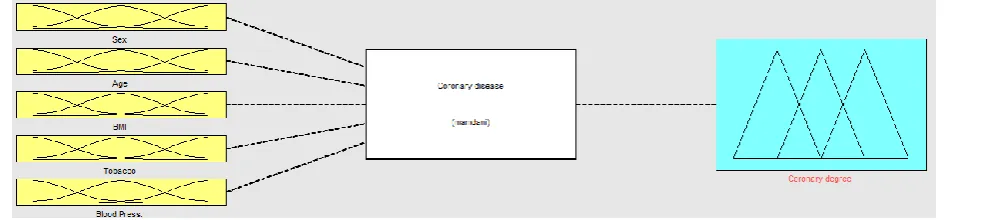
The mapping values of input variable through the membership function are the linguistic values. The linguistic values of inputs are shown as a result: A bloc system is constructed (Fig. 1) with five inputs and one output
[System]
Name='Coronary' Type='mamdani' Version=2.0 NumInputs=5 NumOutputs=1 NumRules=0 AndMethod='min' OrMethod='max' ImpMethod='min' AggMethod='max' DefuzzMethod='centroid'
Figure 1. Block diagram
The variable 'Sex' is not fuzzyfied, we attribute numerical values for each sex, (1 for Male and 2 for Female)
[Input1] Name='Gender' Range=[0 3] NumMFs=2
MF1='Male':'trimf',[1 1 1] MF2='Female':'trimf',[2 2 2]
Fuzzyfication of the input variable "Age"
The input that represents the age is expressed by three fuzzy intervals and membership functions defining the young; old; very old.
[Input2] Name='Age' Range=[0 100] NumMFs=3
MF1='Very.Old':'trimf',[50 70 10000000] MF2='Old':'trimf',[30 50 70]
MF3='Young':'trimf',[0 20 40]
Fuzzyfication of the input variable "BMI"
The input that represents the age is expressed by three fuzzy intervals and membership functions defining the normal; obese; very obese.
[Input3] Name='BMI' Range=[20 50] NumMFs=3
MF1='Normal':'trimf',[20 25 30] MF2='Obese':'trimf',[25 30 35]
MF3='Very.Obese':'trimf',[30 35 10000000]
Fuzzyfication of the input variable "Tobacco"
The input that represents the age is expressed by three fuzzy intervals and membership functions defining the normal, middle, high.
[Input4]
Name='Tobacco' Range=[0 4] NumMFs=3
MF1='Normal':'trimf',[0 1 2] MF2='Middle':'trimf',[1 2 3] MF3='High':'trimf',[2 3 4]
Fuzzyfication of the input variable "Blood pressure"
The input that represents the age is expressed by three fuzzy intervals and membership functions defining the: lower, normal, higher.
[Input5] Name='HTA' Range=[0 100] NumMFs=3
MF1='Lower':'trimf',[0 20 40] MF2='Normal':'trimf',[30 50 70] MF3='Higher':'trimf',[60 80 100]
Fuzzyfication of the output variable "Coronary degree"
In the same way, the output variable that represents the degree of coronary disease is expressed by three fuzzy intervals and membership functions defining the: low risk, Middle risk, high risk.
[Output1]
Name='Coronary.Degree' Range=[0 4]
NumMFs=3
MF1='Middle.Risk':'trimf',[1 2 3] MF2='Low.Risk':'trimf',[0 1 2] MF3='High.Risk':'trimf',[2 3 4]
In according with the recorded values (Table 1), the fuzzy rules are established. These rules are in the form: IF ‘Sex’ is X1, AND ‘Age’ is X2, AND ‘BMI’ is X3 AND ‘Tobacco’ is X4, AND ‘Blood Pressure is X5 THAN ‘Coronary degree’ is Y.
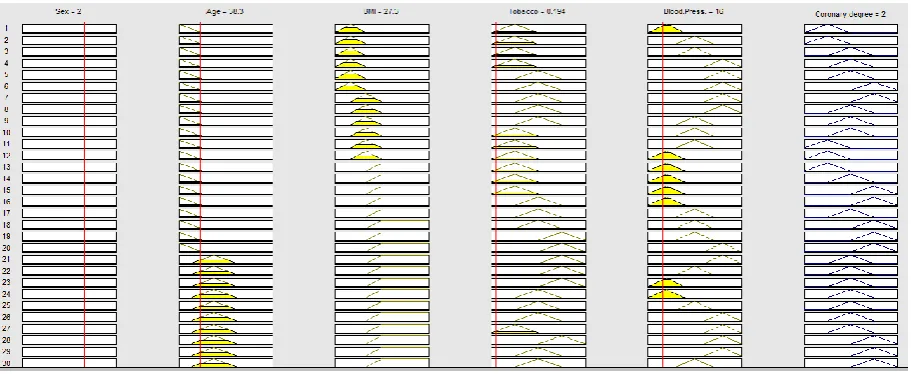
Figure 2: Reading the degree of coronary disease at the output by fixing random values at the inputs.
Table 1. Variables recorded by patients (Sex, Age, BMI, Tobacco and blood pressure)
Patient Sex Age BMI Tobacco HTA Patient Sex Age BMI Tobacco HTA
1 0 77 37,58 0 1 51 1 55 26,3 1 0
2 1 78 32,27 0 0 52 0 72 29,52 0 1
3 0 67 24,77 0 1 53 0 58 24,65 0 0
4 1 82 24,22 0 0 54 0 78 23,44 0 0
5 1 51 31,7 0 0 55 0 70 28,44 0 0
6 1 53 20,7 1 1 56 0 73 25,95 0 0
7 1 81 23,67 0 1 57 0 57 27,73 0 0
8 1 70 21,26 1 0 58 0 63 31,25 0 1
9 1 78 29,76 0 1 59 1 63 24,82 1 1
10 1 68 27,68 1 1 60 1 50 23,94 1 0
11 1 88 25,39 1 1 61 1 56 28,4 0 1
12 0 82 32,46 0 1 62 1 83 23,31 0 1
13 1 66 33,95 0 0 63 1 61 29,04 1 1
14 1 64 21,97 1 0 64 1 42 24,02 1 0
15 1 55 28,13 1 0 65 0 46 26,85 0 0
16 1 68 19,36 1 1 66 1 68 19,03 0 1
17 0 73 24,98 0 0 67 1 26 23,53 0 0
18 1 64 25,25 0 1 68 0 80 22,43 0 1
19 0 58 32,87 0 1 69 1 53 23,66 1 0
20 1 78 19,03 1 1 70 1 69 22,48 1 0
21 1 48 29,4 1 0 71 1 77 24,22 1 1
22 0 63 31,22 0 1 72 1 40 24,77 0 0
23 0 65 22,77 0 1 73 0 68 23,31 0 1
24 0 65 24,01 0 0 74 0 61 30,36 0 0
25 1 68 19,04 1 0 75 1 59 23,71 1 0
26 1 55 26,99 1 0 76 0 50 28,7 0 1
27 1 80 19,57 1 1 77 1 56 25,71 1 1
28 0 74 25,15 0 0 78 1 63 23,51 1 0
29 1 59 21,77 1 1 79 1 53 25,16 1 0
30 0 42 34,52 0 0 80 1 72 26,57 1 0
31 1 56 33,61 1 1 81 1 61 24,34 1 0
32 1 76 21,3 0 1 82 1 62 34,26 1 0
33 1 63 24,69 1 0 83 0 75 34,67 0 1
34 0 80 25,1 0 1 84 1 80 27,28 0 0
35 1 61 31,83 1 1 85 1 58 25,59 0 1
36 1 30 26,23 1 0 86 0 53 27,82 0 0
37 0 58 26,84 0 1 87 1 57 24,22 1 0
38 0 52 33,06 0 0 88 0 44 28,85 0 0
39 0 65 27,47 0 1 89 0 66 24,44 1 0
40 0 86 23,73 0 0 90 1 59 20,75 1 0
41 1 77 32,87 1 0 91 0 49 25,39 0 1
42 1 76 25,47 1 0 92 1 40 27,77 1 0
43 0 42 37,5 0 1 93 0 70 25,39 0 1
44 0 64 25,39 0 0 94 1 72 22,66 0 0
45 1 61 25,8 1 1 95 0 67 28 0 1
46 1 67 21,85 1 1 96 1 81 19,59 0 0
47 1 50 26,87 1 0 97 0 38 19,98 0 0
48 0 84 24,61 0 1 98 1 61 23,66 0 0
49 1 73 20,57 1 0 99 0 64 24,44 0 1
Conclusion
Once the rule base is established, it becomes possible to instantly read the degree of coronary heart disease (Figure 2). The result is the collaboration of the set of rules that support all input variables. Since the input variables are considered as fuzzy variables by expressing them by linguistic variables, this gives an analysis as precise as possible. Also the output variable is expressed in linguistic terms concerning the degree of attack by a coronary disease. This also gives the possibility of reading a result in a wide numerical and symbolic range. At the end, the resulting application makes it possible to randomly display values at the input to read the result at the output. If all of the factors are taken in a precise manner and the rules are established correctly and encompassing all possibilities, it becomes possible to predict the onset of coronary heart disease without making appropriate diagnoses. This tool can be considered as an aid to doctors in their diagnosis, prevention and treatment of coronary patients.
References
[1] WF Peter, B Wilson, D Ralph, D. Levy, M Albert, BS Belanger, H Silbershatz, B William, MD Kannel. Prediction of Coronary Heart Disease Using Risk Factor Categories. Circulation. 97:1837-1847.
[2] WF Peter, MD Wilson.. Assessing Coronary Heart Disease Risk with Traditional and Novel Risk Factors. Clin. Cardiol. Vol. 27 (Suppl. III), III-7–III-11. 2004
[3] J Pekka, L Tiina, P Markku, B Katja, M Satu, J Antti, S Veikko, H Kennet, P Pekka, V Erkki.. Primary prevention and risk factor reduction in coronary heart disease mortality among working aged men and women in eastern Finland over 40 years: population based observational study BMJ; 352:i721. 2016. http://dx.doi.org/10.1136/bmj.i721
[4] L Min, H Xiaolan, Y Fan, K Li, Z Xiaowei, H Wenshang & T Zhenyu. Hyperuricemia and the risk for coronary heart disease morbidity and mortality a systematic review and dose-response meta-analysis. www.nature.com/scientificreports/ Scientific Reports. 6:19520. DOI: 10.1038/srep19520. 2016
[5] YT Yen, MG Gerrie-Cor, T Yvonne van der Schouw. Gender differences in risk factors for coronary heart disease. Maturitas. 65: 149–160. 2010.
[6] F Gasimova. Comparative analysis of risk factors coronary heart disease among women in fertile age and in monopauze. Journal of the American college of cardiology. vol. 68, no.16, suppls. 2016.
[7] P Louise, D Kaberi, G Veena, HH Karin, Jennifer N McG, Colleen, R Doreen, T Johanne, A Arsham, B Tracie, C Jafna, AG William, G Sherry, H Pavel, H Teresa, K Susan, L Marie, L Danielle, O’L Jennifer, P Gilles, P Milan, T Vicky. A comprehensive view of sex-specific issues related to cardiovascular disease CMAJ. 176 (6 suppl): S1-44. 2007.
[8] E Jeanine, LH Roeters van, WD Tineke, E Willem, Ernst E van der Wall. Risk factors for coronary heart disease: implications of gender. Cardiovascular Research. 53: 538–549. 2002.
[9] McG Jennifer, B Tracie, L Marie, O’L Jennifer, P Gilles, A Arsham and H Teresa. Cardiovascular risk factors in girls and boys CMAJ. 176(6 suppl):S1-44. 2007.
[10]G Tavia, P William, MD Castelli, C Marthana, Hjortlan, B William, Kannel, R Thomas, Dawber, G Tavia, P William Castelli, , C Marthana, Hjortland B William, Kannel, R Thomas, Dawber. Diabetes, Blood Lipids, and the Role of Obesity in Coronary Heart Disease Risk for Women: The Framingham Study. Ann Intern Med. 87(4):393-397. DOI: 10.7326/0003-4819-87-4-393. 1977.
[11]World Health Organization (WHO).. A Policy Framework for Tobacco Control. New Delhi: Regional office for South East Asia, World Health Organization. 2000
[12]L Agima, Z,Elvir and S Marija. Tobacco use among youth: findings from the global youth tobacco survey in montenegro tobacco use among youth. Arh Hig Rada Toksikol. 59:183-189 DOI: 10.2478/10004-1254-59-2008-1874. 2008.
[13]C Koopman, I Vaartjes, A Blokstra, WMM Verschuren, M Visser, DJH Deeg, ML Bots and. I Van Dis. Trends in risk factors for coronary heart disease in the Netherlands BMC Public Health. 16:835 DOI 10.1186/s12889-016-3526-7. 2016.
[14]D Dubois and H Prade. Theorie des possibilites. Masson.PARIS.FRANCE. 2EME
EDITION.1987.
[15]K Cengiz, Murat G and K Özgür. Applications of Fuzzy Sets in Industrial Engineering: A Topical Classification. Applications of Fuzzy Sets in Industrial Engineering: A Topical Classification, StudFuzz. 201, 1–55. 2006.
[16]LA Zadeh. Fuzzy sets Information and Control. Volume 8, Issue 3. P: 338-353. 1965.