Original Research Article
Prescribing pattern and awareness about anemia among in-patients
in a tertiary care teaching hospital
Mohammed Sarfaraz
1*, A. S. Archana
2, Bhavana Kalwa
2, Monish Abraham Mathew
2,
Shilpa Anna Kuriakose
2, Doddayya H.
1INTRODUCTION
Anemia is defined as a condition in which the number of red blood cells (RBC), and consequently their oxygen-carrying capacity is insufficient to meet the body’s physiological needs. Iron deficiency is the most common cause of anemia globally, but other nutritional deficiencies (folate, vitamin B12, and vitamin A), acute and chronic inflammation, parasitic infections, inherited and acquired disorders of haemoglobin (Hb) synthesis, RBC’s production or RBC’s survival, can all cause anemia.
Anemia is an important public health problem globally. World Health Organization (WHO) estimates that 1.62 billion people globally are affected with anemia which corresponds to 24.8% of the world population. The public health significance of anemia among populations in India needs no reiteration.1
Prescribing practices are a reflection of health professional’s abilities to determinate among the various choices of drugs and determine the ones that will most benefit the patients. The study of prescribing pattern is a part of the medical audit and seeks to monitor, evaluate
ABSTRACT
Background: Anemia is a major public health problem in India affecting people in all age groups with major consequences for human health as well as economic development. Hence the study aims to assess prescribing pattern of physicians in anemia and to create awareness among in-patients in a tertiary care teaching hospital.
Methods: A prospective and observational study was carried out in 180 in-patients admitted to General Medicine department in a tertiary care teaching hospital diagnosed with anemia for 6 months. Data was collected from case sheets of patients and assessed for prescribing pattern and direct interview was conducted with patients using standardized KAP questionnaire on anemia.
Results: Among 180 in-patients, 126 patients (70%) were females and 54 patients (30%) were males. As part of the
therapy, folic acid with vitamin combinations (37 prescriptions) followed by elemental iron with folic acid combinations (32 prescriptions) were most prescribed drugs. KAP questions were scored appropriately and compared with hemoglobin levels. Knowledge level of patients was not significantly correlated (i.e., p=0.254) with their haemoglobin levels. There was a highly significant positive correlation (i.e., p=0.006) between attitude scores of patients and haemoglobin levels. A significant positive correlation (i.e., p=0.001) was found between practice scores of patients and hemoglobin levels.
Conclusions: This study clearly showed that prescribing pattern of drugs in anemia patients’ needs to be continuously
evaluated. To address the issue of anemia, the patient’s awareness should be enhanced.
Keywords: Anemia, Hemoglobin, KAP, Iron deficiency, Red blood cells, Prescribing pattern
1
Department of Pharmaceutics, 2Department of Pharmacy Practice, NET Pharmacy College, Raichur, Karnataka, India
Received: 08 June 2018
Accepted: 19 July 2018
*Correspondence:
Dr. Sarfaraz Md,
E-mail: [email protected]
Copyright: © the author(s), publisher and licensee Medip Academy. This is an open-access article distributed under
the terms of the Creative Commons Attribution Non-Commercial License, which permits unrestricted non-commercial use, distribution, and reproduction in any medium, provided the original work is properly cited.
and if necessary, suggest modification in prescribing practices to make medical care rational and cost effective.2 Prescribing pattern studies are powerful exploratory tools to ascertain the role of drugs in the society. They seek to monitor, evaluate and if necessary suggest modifications in prescribing practices.3
The treatment of anemia is based on its severity and types. The treatment starts with oral therapy. The oral drugs include ferrous salts, polysaccharide iron complex, carbonyl iron, and folic acid and vitamin B12 tablets. Parenteral iron is used when patient cannot take oral drugs or when patient experience gastrointestinal intolerance, oral iron therapies cause limited absorption, low tolerability and side effects therefore intravenous iron alone or in association with erythropoietin therapy is considered as an alternative for treatment.4
Generally, awareness refers to "The state of feelings or the ability to perceive, or to be conscious of events, sensory patterns or object" or can be defined more broadly and simply as "the state of being aware of something”.5
For the development of intervention programme there is a need to assess the existing knowledge level of patients.6 Questionnaire based knowledge, attitude and practice (KAP) studies assess and explore the people’s KAP relating to nutrition, diet, foods and closely related hygiene and health issues. KAP studies have been used for two main purposes:
1. To collect key information during a situation analysis, which can then feed into the design of nutrition interventions and
2. To evaluate nutrition education interventions. Since anemia has become very common in India due to various reasons like poverty, poor sanitation, dietary habits there is a need for bringing awareness among people about anemia and its further complications.7
The present study is planned with the objective to study the prescribing pattern and to assess the knowledge, attitude and practice of patients regarding anemia using KAP Questionnaire.
METHODS
A prospective and observational study was carried out in 180 in-patients admitted to General Medicine department of Navodaya Medical College Hospital and Research Center (NMCH & RC), Raichur, Karnataka, India, a 1000 bedded multi-specialty tertiary care teaching hospital diagnosed with anemia from September 2017 to February 2018. In-patients with anemia who were admitted to General medicine department of study hospital were included in the study. Out-patients, pregnant women, paediatric patients, patients not willing to participate and in adequately filled questionnaires were excluded from the study. The study was approved by Institutional Ethics
Committee of NMCH & RC by issuing ethical clearance certificate.
Data collection
The study was planned with a total number of 180 patients to obtain information on anemia. Informed consent was obtained from each patient after explaining the purpose of study. A data entry format for
incorporating in-patient details which contains
Information on name and address of subject, gender, age, occupational status, economic profile, social habits,
laboratory investigations, co-morbidities, drug
combination, length of hospital stay, drug-drug interactions, clinical outcome were collected. Only those patients who satisfied the inclusion criteria were included in the study.
In this project, printed KAP questionnaire on anemia was adopted from FAO guidelines and project articles. The questionnaire was used to collect information from patients in general medicine ward who are anemic. It consists of questions regarding anemia and its awareness. The questionnaire initially consists of section to record patient details and later the questions are printed. In the KAP questionnaire, questions are divided into 3 sections. Question numbers 1-6 are related to knowledge, 7-12 are related to attitude and question numbers 13-16 are related to practice.
The relevant information was recorded in the KAP Questionnaire. The IPD departments were visited daily by the project team as per schedule.
Data evaluation
The prescribing pattern was assessed and KAP scores were analysed with the help of Microsoft excel and statistical package for the social science (SPSS).
RESULTS
Gender wise distribution of anemia
The present study was carried out for a period of 6 months. During this period, a total of 180 in-patients were included in the study and it was observed that 126 (70%) were females and 54 (30%) were males (Table 1).
Table 1: Gender wise distribution of anemia.
Gender No of patients
(N=180) % of population
Male 54 30
Female 126 70
Occupational status
Table 2 shows the occupational status of patients. Among 180 patients, about 95 (52.78%) patients were housewives followed by 42 (23.34%) farmers.
Table 2: Occupational status of patients.
Occupation Frequency (N=180) Percentage (%)
Employed 18 10
Farmer 42 23.34
House wife 95 52.78
Business 5 2.77
Others 20 11.11
Social habits
Majority of the patients did not have any sorts of social
habits i.e., about 143 (79.45%) and there were only 37 (20.55%) patients who had social habits.
Respiratory rate
On admission day 104 (57.78%) patients were having increased respiratory rate and on discharge day majority of patients i.e., 172 (95.56%) were having normal respiratory rate.
WHO categorisation of hemoglobin
Out of 180 patients about 66 (36.67%) patients were having Mild anemia in which majority were females (43 patients) and few males (23). 44 patients (24.44%) were having Moderate anemia and another 44 patients were having Life threatening anemia in which also females were more than males, Severe anemia were 26 (14.45%), in which 20 were females and 6 were males (Table 3).
Table 3: Distribution of patients based on WHO categorisation of haemoglobin.
WHO categorisation of hemoglobin Male Female Total patients (N=180) Percentage (%)
Mild (11.5-10 gm/dl) 23 43 66 36.67
Moderate (9.9-8 gm/dl) 10 34 44 24.44
Severe (7.9-6.5 gm/dl) 6 20 26 14.45
Life threatening (<6.5 gm/dl) 15 29 44 24.44
Table 4: Distribution of patients based on types of anemia.
Types of anemia No of patients (n=180) Percentage (%)
Microcytic hypochromic 86 47.78
Normocytic normochromic 78 43.33
Dimorphic 16 8.89
Hematological tests
On admission day among 180 patients majority were having decreased hemoglobin value i.e., (100%), normal WBC value i.e., (77.22%) and decreased RBC value i.e., (82.22%). On discharge day majority were having normal hemoglobin value i.e., (95%), normal WBC value i.e., (99.35%) and normal RBC value i.e., (98.43%). On admission day among 83 patients majority were having decreased MCV value i.e., (60.24%), decreased MCH value i.e., (60.24%), normal MCHC value i.e., (55.42%) and decreased PCV value i.e., (97.60%). On discharge day majority were having normal MCV value i.e., (98.2%), normal MCH value i.e., (96.82%), normal MCHC value i.e., (98.5%) and normal PCV value i.e., (95%).
Types of anemia
Majority of cases, 86 patients (47.78%) were diagnosed to have microcytic hypochromic anemia, around 78 patients (43.33%) were diagnosed to be normocytic
normochromic anemia and 16 patients i.e., (8.89%) were having dimorphic anemia (Table 4).
Co-morbidities
Out of 180 patients majority of the patients i.e., 59 (32.78) were having other co-morbid conditions followed by 49 (27.22%) single cases of anemia and about 16.67% cases due to fever.
Drugs prescribed in anemia
Drug-drug interactions
Among 180 cases 126 drug-drug interactions (70%) were found. In our study most of the drug-drug interactions were moderate 112 (68.71%), followed by mild interactions 46 cases (28.22%) and severe interactions were 5 cases (3.07%).
Clinical outcomes
Among 180 cases almost 170 patients (94.44%) condition got improved and 10 patients conditions got (5.56%) stable.
Knowledge, attitude and practice level of the patients regarding anemia
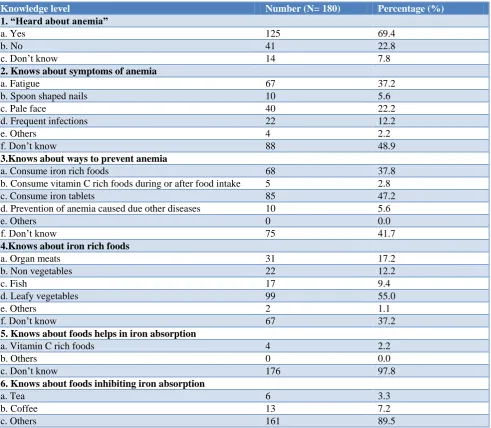
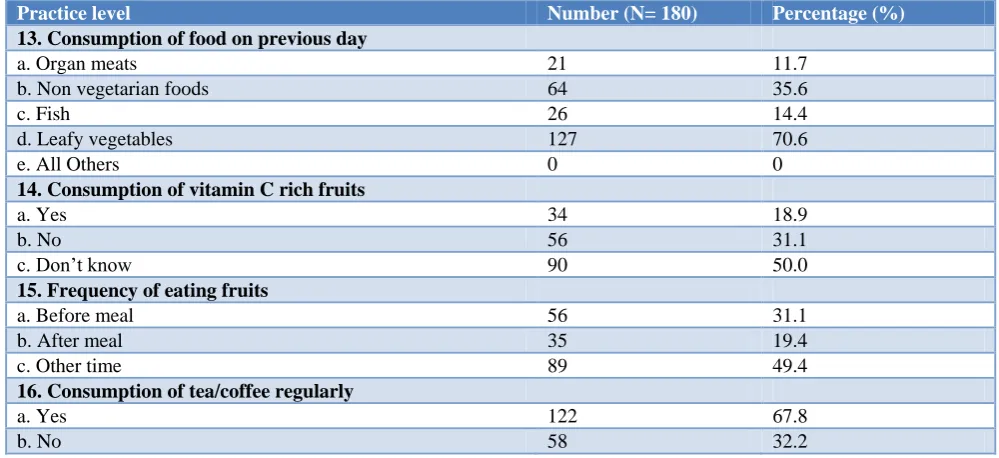
Knowledge, attitude and practice level of the patients were collected through direct interview by using KAP questionnaire and the results are shown in following Table 5, 6 and 7.
Correlation analysis between knowledge score and hemoglobin level
Knowledge level of patients was not significantly correlated (i.e., p=0.254) with their hemoglobin levels.
Correlation analysis between attitude score and hemoglobin level
There was a highly significant positive correlation (i.e., p=0.006) between attitude scores of patients and hemoglobin levels.
Correlation analysis between practice score and hemoglobin level
A significant positive correlation (i.e., p=0.001) was found between practice scores of patients and hemoglobin levels.
Table 5: Knowledge level of the patients regarding anemia.
Knowledge level Number (N= 180) Percentage (%)
1. “Heard about anemia”
a. Yes 125 69.4
b. No 41 22.8
c. Don’t know 14 7.8
2. Knows about symptoms of anemia
a. Fatigue 67 37.2
b. Spoon shaped nails 10 5.6
c. Pale face 40 22.2
d. Frequent infections 22 12.2
e. Others 4 2.2
f. Don’t know 88 48.9
3.Knows about ways to prevent anemia
a. Consume iron rich foods 68 37.8
b. Consume vitamin C rich foods during or after food intake 5 2.8
c. Consume iron tablets 85 47.2
d. Prevention of anemia caused due other diseases 10 5.6
e. Others 0 0.0
f. Don’t know 75 41.7
4.Knows about iron rich foods
a. Organ meats 31 17.2
b. Non vegetables 22 12.2
c. Fish 17 9.4
d. Leafy vegetables 99 55.0
e. Others 2 1.1
f. Don’t know 67 37.2
5. Knows about foods helps in iron absorption
a. Vitamin C rich foods 4 2.2
b. Others 0 0.0
c. Don’t know 176 97.8
6. Knows about foods inhibiting iron absorption
a. Tea 6 3.3
b. Coffee 13 7.2
Table 6: Attitude level of the patients regarding anemia.
Attitude level Number (N= 180) Percentage (%)
7. Self-awareness regarding anemia
a. Aware 45 25.0
b. Not aware 82 45.6
c. Don’t know 53 29.4
8. Attitude regarding seriousness of anemia
a. Anemia is a serious health problem 94 52.2
b. Anemia is not a serious health problem 38 21.1
c. Don’t know 48 26.7
9. Attitude on importance of including iron rich foods in diet
a. Important 114 63.3
b. Not important 10 5.6
c. Don’t know 56 31.1
10. Attitude regarding preparation of iron rich foods
a. Very difficult 5 2.8
b. Not difficult 128 71.1
c. Don’t know 47 26.1
11. Self-confidence in preparing iron rich foods
a. Confident 108 60.0
b. Not confident 28 15.6
c. Don’t know 44 24.4
12. Feels that iron rich foods are tasty
a. Yes 153 85.0
b. No 8 4.4
c. Don’t know 19 10.6
Table 7: Practice level of the patients regarding anemia.
Practice level Number (N= 180) Percentage (%)
13. Consumption of food on previous day
a. Organ meats 21 11.7
b. Non vegetarian foods 64 35.6
c. Fish 26 14.4
d. Leafy vegetables 127 70.6
e. All Others 0 0
14. Consumption of vitamin C rich fruits
a. Yes 34 18.9
b. No 56 31.1
c. Don’t know 90 50.0
15. Frequency of eating fruits
a. Before meal 56 31.1
b. After meal 35 19.4
c. Other time 89 49.4
16. Consumption of tea/coffee regularly
a. Yes 122 67.8
b. No 58 32.2
Table 8: Correlation analysis between knowledge score and hemoglobin level.
Variables Mean SD Correlation coefficient P value
Knowledge level 4.789 2.598
0.085 0.254>0.05
Table 9: Correlation analysis between attitude score and hemoglobin level.
Variables Mean SD Correlation coefficient P value
Attitude level 3.083 1.398
0.203 0.006<0.05
Hemoglobin level (g/dl) 8.262 2.202
Table 10: Correlation analysis between practice score and hemoglobin level.
Variables Mean SD Correlation coefficient P value
Practice level 2.622 1.427
0.243 0.001<0.05
Hemoglobin level (g/dl) 8.262 2.202
DISCUSSION
Gender wise distribution of patients
The majority of the patients in our study i.e., among 180 patients 126 were females (70%) and 54 were males (30%). This data was shown in Table 1. The study conducted by Malhotra et al, also showed the similar results.8 The possible reason for females to get anemic may be due to an increased workload on females in Indian society, like taking care of their family, household work and poor balanced diet. Our study clearly shows that majority affected patients were females which easily helps to explain that menstrual or gynaecological problem could also be a possible reason for them to have an anemic condition.
Occupational status
Majority of the patients were housewives i.e., 95 (52.78%) which signifies that the patients were unemployed followed by farmers 42 (23.34%) as shown in Table 2. The study being conducted by Eldho et al, showed the same result.4 As the majority of the patients were females, the patients could have been illiterate or might have restricted from further education due to early marriage and so this could be the reason why they became unemployed. Therefore these patients may be ignorant about the importance of proper diet and could be a possible reason why they might have become anemic.
Social habits
In our study, majority of the patients did not have any sorts of social habits i.e., about 143 (79.45%) and there were only 37 (20.55%) of patients who had social habits. Our results are similar to the study conducted by Eldho et al.4 The current pattern of social habits in our study may be due to local advertisements regarding the harmful effects of smoking; tobacco chewing and alcohol as well as majority of the patients in our study were females. Most people are reluctant to disclose their social habits fearing their family and society. When a person smokes, thousands of harmful chemicals could enter the lungs. These chemicals are absorbed into the blood and carried over to the different parts of the body. The blood is one
chemicals and by products of cigarette smoking. Smoking induces anemia by variety of ways such as causes significant reduction of vitamin C and iron, inducing ulcer, decreasing folic acid levels and by causing cancer.
Respiratory rate
On admission day 104 (57.78%) patients were having increased respiratory rate. In anemia shortness of breath or rapid breathing are seen because there is a deficit of RBC or an impairment of the ability of the RBCs to carry oxygen which causes increase in the respiratory rate as the body attempts to bring more oxygen in. On discharge day i.e., 172 (95.56%) patients were having normal respiratory rate indicating the condition of patients got improved.
WHO categorisation of hemoglobin
About 66 (36.67%) of patients were having mild anemia in which majority were females (43 patients) and males (23) followed by 44 patients (24.44%) were having moderate and life threatening anemia in which also females were more than males, severe anemia was 26 (14.45%), in which 20 were females and 6 were males as shown in Table 3. The study done by Verma et al also share the same results.9
Hematological tests
On admission day all 180 patients were having decreased hemoglobin value (100%) and decreased RBC value (82.22%) which indicated anemic condition. They had normal WBC value (77.22%). On discharge day most of them were having normal hemoglobin value (95%), WBC value (99.35%) and normal RBC value (98.43%).
hemoglobin concentration (MCHC). MCHC is the average concentration of hemoglobin in RBCs. Most of the patients (97.60%) showed decreased Packed Cell Volume (PCV). PCV is the percentage of red blood cells in the circulating blood and the decreased value indicates RBC loss from variety of reasons like cell destruction, blood loss and failure of bone marrow production. On discharge day majority were having normal MCV value i.e., (98.2%), normal MCH value i.e., (96.82%), normal MCHC value i.e., (98.5%) and normal PCV value i.e., (95%).
Types of anemia
Majority of cases 86 patients (47.78%) were diagnosed to have microcytic hypochromic anemia in which 66 (52.38%) patients were female followed by 20 (37.03%) patients were male. Around 78 patients (43.33%) were diagnosed to be normocytic normochromic anemia in which 52 (41.27%) patients were females followed by 26 (48.16%) patients were males. 16 patients i.e., (8.89%) were having dimorphic anemia in which 8 (6.35%) patients were female and 8 (14.81%) patients were male as shown in Table 4. It is in contrast to the study conducted Uria et al, also had the similar results.10
Co-morbidities
Our study shows that majority of the patients i.e., 59 (32.78) were having other co-morbid conditions followed by 49 (27.22%) single cases of anemia and about 16.67% cases due to fever. Other major co-morbidities included respiratory infections such as COPD, Asthma and Tuberculosis, gastrointestinal infections such as peptic ulcer, liver diseases and parasite infections such as malaria, helminthes infection. The relationship between anemia and infection remains controversial. However, it is generally accepted that excess or deficiency of iron result in changes in immune response.
Drugs prescribed in anemia
In 180 cases, most commonly prescribed drug was Tab. Elemental iron with Folic acid combinations (Orofer XT) for microcytic hypochromic anemia (32 prescriptions) as iron is an essential element for blood production. About 70 percent of body's iron is found in the red blood cells of blood called hemoglobin and in muscle cells called myoglobin. Hemoglobin is essential for transferring oxygen in blood from the lungs to the tissues. Folic acid helps body produce and maintain new cells, and also helps prevent changes to DNA that may lead to cancer. As a medication, folic acid is used to treat folic acid deficiency and certain types of anemia (lack of red blood cells) caused by folic acid deficiency. They also help the nervous system function properly. Folic acid is the synthetic form of B9, found in supplements and fortified foods, while folate occurs naturally in foods. Folic acid also works closely with vitamin B12 to help make red blood cells and help iron work properly in the body.
These combinations are having more additive effect and so prescribed for microcytic hypochromic anemia.
For normocytic normochromic anemia the commonly used drug was Tab. biotin, cyanocobalamin, elemental chromium, elemental selenium, elemental zn, folic acid, glycine, inositol, l-glutamic acid, n-acetylcystine, niacinamide, pyridoxine (Fourts-B) (37 prescriptions). Fourts B tablet is an effective nutritional supplement which provides iron to the blood, vitamins to the body and ensures the normal functioning of the cells, nerves, muscles and bones. It is also used to treat or prevent vitamin deficiency due to poor diet, certain illnesses,
alcoholism. Cyanocobalamine prevents vitamin
deficiency due to poor diet, prolonged illness. L-Glutamic acid maintains a healthy digestive system by reducing cravings for sugar and alcohol, both of which disrupts the intestinal flora balance. Inositol is responsible for nerve conduction.
Tab. elemental iron with folic acid (Livogen, Orofer XT, Orofer) and Tab. folic acid with ferrous fumarate (Vitcofol) and vitamin combination drugs (7 prescriptions each) was given to dimorphic anemia.
The prescribing pattern for all the 180 cases were collected, analysed and observed that every prescription contains an iron supplement, folic acid, multivitamins and the drugs and doses were according to National Iron-plus Initiative guidelines. Some drugs were given above the normal doses considering their socio-economic factors. The study conducted by Bhandare et al, also showed the similar results.11
Drug drug interactions
In our study, drug- drug interactions were an essential part of the prescribing. Among 180 cases 126 drug-drug interactions (70%) were found. Most of the drug-drug interactions were moderate 112 interactions (68.71%), followed by mild interactions 46 cases (28.22%), severe interactions were 5 cases (3.07%). Drug interactions were assessed with the help of tertiary resources such as Micromedex, Medscape.
Clinical outcome
Almost 170 patients (94.44%) condition got improved, 10 patients conditions got (5.56%) stable as a result of the treatment given. This shows the effectiveness of the treatment provided in our hospital.
KAP of patients regarding anemia
Knowledge level of the patients regarding anemia
that consuming iron tablets could prevent anemia (question no.3). Also 99 (55%) thought that leafy vegetables were rich in iron (question no.4). 176 patients (97.8%) don’t know that vitamin C rich foods helps in iron absorption (question no.5) and most of them 161 (89.5%) did not know about the food items that inhibits iron absorption (question no. 6). This data was depicted in Table 5.
Attitude level of the patients regarding anemia
Many of the patients 82 (45.6%) were not aware whether they were anemic or not (question no. 7). Most of the total patients 94 (52.2%) knew that the anemia is a serious condition (question no. 8). Majority of them 114 (63.3%) considered iron rich foods were important for the prevention of anemia (question no.9). Many of them 128 (71.1%) had no difficulty in preparing iron rich foods (question no.10) and were confident in preparing the iron rich foods 108 (60%) (question no.11). Majority of the patients 153 (85%) liked the taste of the iron rich foods (question no.12) as shown in Table 6.
Practice level of the patients regarding anemia
Little more than half of the patients 127 (70.6%) consumed leafy vegetable on the previous day of the survey (question no.13). Majority of them 90 (50%) don’t know the consumption of vitamin C rich fruits (question no.14). Most of them 89 (49.4%) consumed fruits some other time rather than before or after meal (question no.15). 122 patients (67.8%) consumed tea/coffee regularly (question no.16). This data was shown in Table 7.
Correlation analysis between knowledge score and hemoglobin level
Knowledge, attitude and practice questions were scored appropriately and compared with hemoglobin levels, correlation coefficient was computed to elucidate any possible relation between the variables.
Knowledge level of patients was not significantly correlated (i.e., p=0.254) with their hemoglobin levels as shown in Table 8. This response was in contradictory to the study done by Jose et al.12 This indicates that whether the patients knew about anemia, its symptoms, causes, consequences or dietary prevention methods, it did not improve their hemoglobin levels at all.
Correlation analysis between attitude score and hemoglobin level
There was a highly significant positive correlation (i.e., p=0.006) between attitude scores of patients and hemoglobin levels. This data was depicted in Table 9. Study conducted Yusoff et alsuggested the same result.13 This indicates that self-awareness regarding anemia,
importance of including iron rich foods in diet, attitude regarding preparation of iron rich foods and self-confidence in preparing iron rich foods resulted in better hemoglobin levels.
Correlation analysis between Practice score and hemoglobin level
A significant positive correlation (i.e., p=0.001) was found between practice scores of patients and hemoglobin levels as shown in Table 10. Practices like consumption of food on previous day like eating leafy vegetables etc., consumption of vitamin C rich fruits, frequency of eating fruits and not consuming tea/coffee regularly etc. resulted in better Hemoglobin levels of patients.
CONCLUSION
Drug prescribing study continuously helps to rule out and modify if any irrational prescribing of drugs is present. It is often necessary to treat anemia based on the lab values obtained and categorizing anaemia based on lab values which could help to increase quality adjusted life year (QALY). Hence prescribing pattern of drugs needs to be evaluated further in anemia cases, thereby promoting the more rational prescribing of drugs.
Continuous practice of unhealthy foods habits and patterns lead to serious effects upon nutritional status as well as overall health status of an individual. Achieving the desired change of behaviour towards nutrition and
health greatly depends upon gaining sufficient
knowledge, change in attitude and developing good practices related to health and nutrition. Knowledge, attitude and practice (KAP) assessment tool is a suitable instrument to assess and evaluate patients current knowledge, attitude, and practices towards a specific problem under investigation.
Rationale of present study is: identification of correlation between Hb levels and KAP of patients which will enable the investigators to assess the dietary habit of the patients and as there are a few studies regarding the prescribing pattern of anemia our study can be used for further references.
Funding: No funding sources Conflict of interest: None declared
Ethical approval: The study was approved by the Institutional Ethics Committee
REFERENCES
1. Sahana KS, Ghaliyah K, Anitha P, Prakash S. Study
of anemia in hospitalized infants at a tertiary care hospital. Ntl J of Community Med. 2015;6(2):22-7. 2. Sireesha G, Thomas JC, Patil PB, Doddayya H. A
for paediatrics in a tertiary care teaching hospital. World J Pharm Pharm Sci. 2016;5(10):654-66.
3. Vishwanath M, Narayana RS, Sahana D.
Assessment of drug utilization in hospitalized children at a tertiary care teaching hospital. J Chem Pharm Res. 2014;6(2):592-8.
4. Chippy SE, Kumaraswamy M, Ariya C, Nevin JG, Abel AT, Laxman W. Drug prescribing practice among anemic patients in a tertiary care teaching hospital. World J Pharm Res. 2017;6(4):858-87.
5. Sonkar VK, Khan NM, Domple VK, Inamdar IF.
Knowledge and practise of pregnant womens regarding the iron supplement during pregnancy. Int J community med public health. 2017;4(8):2891-4.
6. George M, George N, Ramesh N. Awareness
regarding anemia, gestational diabetes and
pregnancy induced hypertension among antenatal women attending outpatient department in a rural hospital. Ntl J of Community Med. 2016;7(5):362-7. 7. Chellan R, Paul L. Prevalence of iron-deficiency anaemia in India: J Pop Soc Stud. 2010;19(1):60-80. 8. Malhotra V, Hari K, Divya B. An epidemiological study on prevalence of anemia among elderly population residing in rural Nalgonda, Telangana, India. Sch J App Med Sci. 2015;3(4):1641-4.
9. Verma A, Rawal VS, Kedia G, Kumar D, Chauhan
J. Factors influencing anemia among girls of school
going age, Department of community medicine, B J college Ahmedabad. Indian J Community Med. 2014;29(1):6-25.
10. Uria AG, Naik PK, Midde M, Yalla PS, Pakam R. Prevalance and severity of anemia stratified by age and gender in rural India. Anemia. 2014;1-5:176182.
11. Bhandare B, Satyanarayana V, Safina K.
Prescribing pattern of iron preparations in antenatal women in a tertiary care hospital. J Int Med Dentistry. 2014;1(1):23-7.
12. Shilpa J, Sreni CA, Betty RI. Impact of knowledge, attitude and practice on anemia status among
women in coastal Kochi, Kerala. Int J
Multidisciplinary Current Res. 2016;4:295-8. 13. Yousof H, Daud W. Nutrition education, attitude
and haemoglobin status of Malasian adolescents. Southeast asian J trop med public health. 2012;43(1):192-200.
Cite this article as: Sarfaraz M, Archana AS, Kalwa