Self Adaptive Firefly Algorithm for Economic
Load Dispatch
Dr. B. Suresh Babu
Professor, Electrical and Electronics Engineering, Vaagdevi College of Engineering Bollikunta, Warangal – 506005, Telangana State
Abstract – Economic load dispatch (ELD) is an important operational problem of the power system, aiming to minimize the fuel cost. The firefly algorithm (FA), a heuristic numeric optimization algorithm inspired by the behavior of fireflies, appears to be a robust and reliable technique. This paper presents a self adaptive FA for the solution of the ELD problem. The proposed algorithm (PA) is applied to the standard IEEE 14 and 30 bus test systems and the results are presented to demonstrate its effectiveness.
Keywords: economic load dispatch, firefly algorithm.
NOMENCLATURE
i i i b c
a fuel cost coefficients
i i e
d coefficients of valve point effects of the generator
ELD economic load dispatch FA firefly algorithm
C
F net fuel cost
i
I
light intensity of the
i
-th fireflymax
Iter maximum number of iterations for convergence check.
nd
number of decision variablesnf number of fireflies in the populations ng number of generators
PA proposed algorithm )
, (V
p real bus power as a function of voltage magnitude and voltage angle
) , (V
q reactive bus power as a function of voltage magnitude and voltage angle
Gi
P and QGi real and reactive power generation at
i
-th bus respectivelyDi
P and QDi real and reactive power demand at
i
-thbus respectively
min
Gi
P and PGimax lower and upper limits of PGi min
Gi
Q and QGimax lower and upper limits of QGi
ij
r Cartesian distance between the
i
-thand j-th firefly SAFA self adaptive FA
t iteration counter
i
x
i
-th fireflyj i,
attractiveness between thei
-th and j-th fireflyo
and maximum attractiveness and light intensity absorption coefficient respectively
I. INTRODUCTION
Present day power systems have the problem of deciding how best to meet the varying power demand that has a daily and weekly cycle in order to maintain a high degree of economy and reliability. Among the options that are available for an engineer in choosing how to operate the system, economic load dispatch (ELD) is the most significant. ELD is a computational process whereby the total required generation is distributed among the generating units in operation so as to minimize the total generation cost, subject to load and operational constraints. The objective of ELD is to minimize the total generation cost of a power system for a given load while satisfying various constraints [1].
Over the years numerous methods with various degrees of near-optimality, efficiency, ability to handle difficult constraints and heuristics, are suggested in the literature for solving the dispatch problems. These problems are traditionally solved using mathematical programming techniques such as lambda iteration method, gradient method, linear programming, dynamic programming method and so on. Many of these methods suffer from natural complexity and converge slowly. However, the classical lambda-iteration method has been in use for a long time. The additional constraints such as line flow limits cannot be included in the lambda iteration approach and the convergence of the iterations is dependent on the initial choice of lambda. In large power systems, this method has oscillatory problems that increase the computation time [1,2].
artificial bee colony and particle swarm optimization have been applied in solving ELD [3-8]. Having in common processes of natural evolution, these algorithms share many similarities; each maintains a population of solutions that are evolved through random alterations and selection. The differences between these procedures lie in the representation techniques they utilize to encode candidates, the type of alterations they use to create new solutions, and the mechanism they employ for selecting the new parents. The algorithms have yielded satisfactory results across a great variety of power system problems. The main difficulty is their sensitivity to the choice of the parameters, such as temperature in SA, the crossover and mutation probabilities in GA and the inertia weight, acceleration coefficients and velocity limits in PSO.
Recently, firefly algorithm (FA) has been suggested for solving optimization problems [9,10]. It is inspired by the light attenuation over the distance and fireflies’ mutual attraction rather than the phenomenon of the fireflies’ light flashing. In this approach, each problem solution is represented by a firefly, which tries to move to a greater light source, than its own. It has been applied to a variety of ELD problems [11-14] and found to yield satisfactory results. However, the choice of FA parameters is important in obtaining good convergence and global optimal solution.
A self adaptive FA (SAFA) for obtaining the global best solution has been suggested in this paper. The proposed algorithm (PA) has been tested on the IEEE 14 and 30 bus test systems to illustrate the performance.
II. PROBLEM FORMULATION
The ELD problem is formulated as an optimization problem of minimizing the fuel cost while satisfying several equality and inequality constraints. Usually the network loss is calculated using constant B-loss coefficients, which may lead to sub-optimal solution due to approximations in the computations of these coefficients. More accurate solution can be obtained, if network loss is calculated from load flow. In this paper, Newton-Raphson load flow technique [15] is used to calculate the loss. The constrained optimization problem involving load flow is formulated as follows:
Minimize
ng 1 i
i G i
G i i i i G i 2 i G i
C a P b P c d e P P
F sin( ( min ))
(1) Subject to:
Real and Reactive power generation limits
max min
Gi Gi
Gi P P
P : ι1,2,3,ng (2)
max min
Gi Gi
Gi Q Q
Q : ι1,2,3,ng (3)
Load flow equations
0 V p P
PGi Di ( ,) (4)
0 V q Q
QGi Di ( ,) (5)
III. SELF-ADAPTIVE FIREFLY ALGORITHM
The FA is a Meta heuristic, nature-inspired, optimization algorithm which is based on the social flashing behavior of fireflies, or lighting bugs, in the summer sky in the tropical temperature regions. It was developed by Dr. Xin-She Yang at Cambridge University in 2007, and it is based on the swarm behavior such as fish, insects, or bird schooling in nature. It is similar to other optimization algorithms employing swarm intelligence such as PSO and ABC. But FA is found to have superior performance in many cases [9,10]. FA initially produces a swarm of fireflies located randomly in the search space. The initial distribution is usually produced from a uniform random distribution. The position of each firefly in the search space represents a potential solution of the optimization problem. The dimension of the search space is equal to the number of optimizing parameters in the given problem. The fitness function takes the position of a firefly as input and produces a single numerical output value denoting how good the potential solution is. A fitness value is assigned to each firefly. The FA uses a phenomenon known is bioluminescent communication to model the movement of the fireflies through the search space. The brightness of each firefly depends on the fitness value of that firefly. Each firefly is attracted by the
nd
i 2 i 1 ii x x x
x , , (6)
The search space is limited by the following inequality
) ( )
(min x x max
xk k k : k1,2,,nd (7)
Initially, the positions of the fireflies are generated from a uniform distribution using the following equation
x max x min
rand minx
xik k( ) k( ) k( ) (8)
Here, rand is a random number between 0 and 1, taken from a uniform distribution. Eq. (8) generates random values from a uniform distribution within the prescribed range defined by Eq. (7). The initial distribution does not significantly affect the performance of the algorithm. Each time the algorithm is executed, the optimization process starts with a different set of initial points. However, in each case, the algorithm searches for the optimum solution. In case of multiple possible sets of solutions, the algorithm may converge on different solutions each time. But each of those solutions will be valid as they all will satisfy the requirements.
The light intensity of the
i
-th firefly, Ii is given by) ( i i Fitness x
I (9)
The attractiveness between the
i
-th and j-th firefly,j i,
is given by
2
j i o
j
i, exp r,
(10)
Where ri,j is Cartesian distance between
i
-th and j-th firefly
nd
1 k
2 k
j k i j
i j
i x x x x
r, (11)
o
is a constant taken to be 1. is another constant whose value is related to the dynamic range of the solution space. The position of firefly is updated in each iterative step. If the light intensity of j-th firefly is
larger than the intensity of the
i
-th firefly, then thei
-th firefly moves towards the j-th firefly and its motion att-th iteration is denoted by the following equation:
x t 1 x t 1
rand 05
1 t x t
xi() i( )i,j j( ) i( ) .
(12)
is a constant whose value depends on the dynamic range of the solution space. At each iterative step, the intensity and the attractiveness of each firefly is calculated. The intensity of each firefly is compared with all other fireflies and the positions of the fireflies are updated using (12). After a sufficient number of iterations, all the fireflies converge to the same position in the search space and the global optimum is achieved.
In the above narrated FA, each firefly of the swarm explores the problem space taking into account the results obtained by others, still applying its own randomized moves as well. The influence of other solutions is controlled by the value of attractiveness of Eq. (10), which can be adjusted by modifying two parameters oand . The first parameter describes
attractiveness at ri,j 0 i.e. when two fireflies are found
at the same point of solution space. In general o[0,1] should be used and two limiting cases can be defined: The algorithm performs cooperative local search with the brightest firefly strongly determining other fireflies positions, especially in its neighborhood, wheno = 1
and only non-cooperative distributed random search witho= 0.
On the other hand, the value of determines the variation of attractiveness with increasing distance from communicated firefly. Setting as 0 corresponds to no variation or constant attractiveness and conversely putting as results in attractiveness being close to zero which again is equivalent to the complete random search. In general in the range of [0,10] can be chosen for better performance. Indeed, the choice of these parameters affects the final solution and the convergence of the algorithm.
The self-adaptive control of these two parameters during the search process effectively leads the algorithm to land at the global best solution with minimum computational effort. Each firefly with nd decision variables in the FA will be defined to encompass nd+2 FA variables in a self-adaptive method, where the last two variables represent oand . A firefly can be represented as
oi i
nd i 2 i 1 i
i x x x
x , , ,
, ,
(13)Each firefly possessing the solution vector, o,iand i
undergo the whole search process of the FA, thereby resulting in better off-springs during the search with lower computational effort. Eq. (10) is accordingly modified as
2
j i i i
o j
i, , exp r,
The self adaptive scheme attempts to prevent sub-optimal solution and enhance the convergence of the algorithm.
IV. PROPOSED ALGORITHM
The proposed SAFA based solution process involves representation of problem variables oand ; and
formation of a light intensity function.
IV.1 Representation of decision variables
The decision variables in the PA are real power generation at generator buses except slack bus, oand
. Each firefly in the PA is defined to denote these decision variables in vector form as
] , , ,
[PG2 PGng
o,
x (15)
IV.2 Intensity Function
The SAFA searches for optimal solution by maximizing an intensity function, denoted by Ii, which is formulated
from the objective function, Eq. (1).
C i
F 1
1 I Max
(16)
It is to be noted that the real power generation, which includes network loss, at slack bus is obtained from the load flow.
IV.3 Stopping Criterion
The process of generating new swarm can be terminated either after a fixed number of iterations or if there is no further significant improvement in the global best solution.
IV.4 Solution Process
An initial swarm of fireflies is obtained by generating random values within their respective limits to every individual in the swarm through Eq. (2). The intensity is calculated by considering the values of each firefly and the movements of fireflies are performed for all the fireflies with a view of maximizing the intensity. The iterative process is continued till convergence. The pseudo code of the PA is as follows.
Read the Power System Data
Choose the number of fireflies in the population, nf
and Itermax for convergence check.
Generate the initial population of fireflies Set the iteration counter
t
0
while (termination requirements are not met) do for i1:nf
Alter the system data and
o accordingto i-th firefly values
Run load flow and obtain slack bus power Evaluate
F
C andI
i using Eqs. 1 and 16respectively for j1:nf
Alter the system data according to j -th firefly values
Run load flow and obtain slack bus power
Evaluate
F
C andI
j using Eqs. 1 and 16respectively if Ii Ij
Compute rijusing Eq. (11)
Evaluate
ijusing Eq. (14)Move j-th firefly towards
i
-thfirefly through Eq. (12)end-(if) end-( j)
end-(
i
) Rank the fireflies end-(while)V. SIMULATIONS
Table 1 FA parameters
Parameter Value
nf 30
max
Iter 300
Table 2 Results of IEEE 14 bus test system Control
Variables (p.u)
Before
Optimization PA
1 G
P 188.974 213.487970
2 G
P 35 20
3 G
P 20 15.994770
6 G
P 12 10
8 G
P 12 10
o
--- 0.212654
--- 0.827210Load
Demand 259 259
Loss 8.9737 10.4827
Cost ($/h)
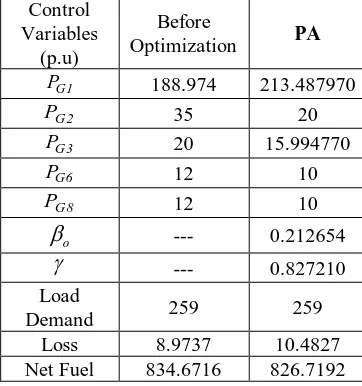
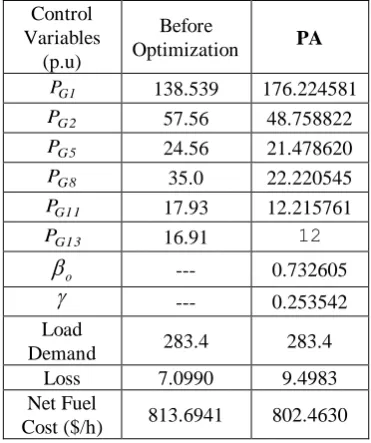
The PA is tested on IEEE 14 and 30 bus test systems, whose data have been taken from Ref. [16]. The fuel cost coefficients, lower and upper limits for real power generations for these three test systems are given in Tables A.1-A.2 of the appendix. Programs are developed in Matlab 7.5 and executed on a 2.3 GHz Pentium-IV personal computer. Newton Raphson technique [15] is used to carry out the load flow during the optimization process. The parameters chosen for the PA are given in Table 1.
Table 3 Results of IEEE 30 bus test system Control
Variables (p.u)
Before
Optimization PA
1 G
P 138.539 176.224581
2 G
P 57.56 48.758822
5 G
P 24.56 21.478620
8 G
P 35.0 22.220545
11 G
P 17.93 12.215761
13 G
P 16.91 12
o
--- 0.732605
--- 0.253542Load
Demand 283.4 283.4
Loss 7.0990 9.4983
Net Fuel
Cost ($/h) 813.6941 802.4630
The optimal solution obtained by the PA for 14 and 30 bus test systems are given along with the initial solution before optimization in Tables 2 and 3 respectively. It is very clear from these tables that the algorithm is able to reduce the fuel cost to the lowest possible values of 826.7192 and 802.4630 $/h from the initial values of 834.6716 and 813.6941 $/h respectively for the three test systems. The resulting loss after optimization is higher for 14 and 30 bus systems, as the objective of the problem is only the minimization of fuel cost in all the test cases. It is to be noted that the loss can further be reduced by adding the loss in the objective function.
VI. SUMMARY
Indeed the FA is a powerful novel population based method for solving complex optimization problems. The convergence and searching capability can be improved with a view to prevent sub-optimal solution through self-adaptive control of FA parameters. In this paper, SAFA solution technique for ELD problem is developed and tested on three IEEE test systems. The algorithm uses NR load flow technique for computing the slack bus
power that includes network loss and is able to offer the global best solution at lower computational burden.
ACKNOWLEDGEMENT
The author gratefully acknowledge the authorities of
Vaagdevi College of Engineering for their continued support, encouragement and the facilities provided to carry out this work.
APPENDIX
Table A.1 Generator Data for IEEE 14 bus test system
Bus a b c d e min
Gi
P PGimax
1 0.0016 2.00 150.0 0.0630 50.0 50 300 2 0.0100 2.50 25.0 0.0980 40.0 20 80 3 0.0625 1.00 0.0 0.0 0.0 15 50 6 0.00834 3.25 0.0 0.0 0.0 10 35 8 0.025 3.00 0.0 0.0 0.0 10 30
Table A.2 Generator Data for IEEE 30 bus test system
Bus No a b c d e min Gi
P PGimax
1 0.00375 2.00 0 0 0 50 200 2 0.01750 1.75 0 0 0 20 80 5 0.06250 1.00 0 0 0 15 50 8 0.00834 3.25 0 0 0 10 35 11 0.02500 3.00 0 0 0 10 30 13 0.02500 3.00 0 0 0 12 40
REFERENCES
1.Wood. AJ and Woolenberg. BF. (1996). Power generation, operation and control, John Willey and Sons, New York
2.Chowdhury.BH and Rahman. S. (1990). A review of recent advances in economic dispatch, IEEE Trans. on Power Systems, 5(4), 1248-1259.
3.Panigrahi. CK, Chattopadhyah. PK, Chakrabarti. RN and Basu. N. (2006). Simulated annealing technique for dynamic economic dispatch, Electric Power Components and Systems, 34(5), 577-586. 4.Adhinarayanan. T and Sydulu. M. (2008). Diretional search genetic
algorithm applications to economic dispatch of thermal units, International Journal for Computational Methods in Engineering Science and Mechanics, 9(4), 211-216.
5.He Da-Kuo, Wang Fu-li and Mao Zhi-zhong. (2008). Hybrid genetic algorithm for economic dispatch with value-point effect, Electric Power Systems Research, 78, 626-633.
6.JB. Park, KS. Lee, JR. Shin and KY.Lee. (2005). A particle swarm optimization for economic dispatch with nonsmooth cost function, IEEE Trans Power Syst, 20(1): 34-42.
7.Subbaraj. P, Rengaraj. R, Salivahanan. S and Senthilkumar. TR. (2010) Parallel particle swarm optimisation with modified stochastic acceleration factors for solving large scale economic dispatch problem, Electrical Power and Energy Systems, 32(9), 1014-1023. 8.A.Pereira-Neto, C.Unsihuay and OR.Saavedra. (2005). Efficient
evolutionary strategy optimization procedure to solve the nonconvex economic dispatch problem with generator constraints. IEEE Proc Gener Transm Distrib., 152(5): 653-660.
9.X. S. Yang, Nature-Inspired Meta-Heuristic Algorithms, Luniver Press, Beckington, UK, 2008.
10. X. S. Yang. (2009). Firefly algorithms for multimodal optimization, in Proceedings of the Stochastic Algorithms: Foundations and Applications (SAGA ’09), Vol. 5792 of Lecture Notes in Computing Sciences, pp. 178–178, Springer, Sapporo, Japan. 11. Kuldeep Kumar Swarnkar. (2012). Economic load dispatch problem
12. K. Vinod Kumar and G. Lakshmi Phani. (2011). Combined economic emission dispatch-pareto optimal front approach, International journal of computer applications, 30(12): 16-21. 13. M. H. Sulaiman, M. W. Mustafa, Z. N. Zakaria, O. Aliman and S.
R. Abdul Rahim. Firefly Algorithm Technique for Solving Economic Dispatch Problem, 2012 IEEE International Power Engineering and Optimization Conference (PEOCO2012), Melaka, Malaysia: 6-7 June 2012.
14. K.Chandrasekaran and Sishaj P Simon. (2012). Tuned Fuzzy Adapted Firefly Lambda Algorithm for Solving Unit Commitment Problem, J. Electrical Systems,8(2): 132-150.
15.W.F. Tinney and C.E. Hart. (1967). Power flow solution by Newton’s method, IEEE Trans. PAS-86: 1449-1460.