http://www.sciencepublishinggroup.com/j/ajns doi: 10.11648/j.ajns.20190803.13
ISSN: 2328-5745 (Print); ISSN: 2328-5753 (Online)
Establishment and Implementation of Standardized
Management Mode for Specialist Nurses in Intensive Care
Unit
Wang Jun
1, *, Gong Juan
2, Liu Ke
2, Ma Zhiqun
3, Chen Bing
4, Liu Rong
5, Liu Maoling
6,
Zhang Kechun
71
Department of Surgical, People’s Hospital of Leshan, Leshan, China
2
Department of Intensive Care Unit, People’s Hospital of Leshan, Leshan, China
3Department of Union President, People’s Hospital of Leshan, Leshan, China 4
Department of Nursing, People’s Hospital of Leshan, Leshan, China
5
Department of Outpatient, People’s Hospital of Leshan, Leshan, China
6Department of Cardiac Surgery, People’s Hospital of Leshan, Leshan, China 7
Department of Otolaryngology, People’s Hospital of Leshan, Leshan, China
Email address:
*
Corresponding author
To cite this article:
Wang Jun, Gong Juan, Liu Ke, Ma Zhiqun, Chen Bing, Liu Rong, Liu Maoling, Zhang Kechun. Establishment and Implementation of Standardized Management Mode for Specialist Nurses in Intensive Care Unit. American Journal of Nursing Science.
Vol. 8, No. 3, 2019, pp. 97-103. doi: 10.11648/j.ajns.20190803.13
Received: December 23, 2018; Accepted: March 18, 2019; Published: April 13, 2019
Abstract:
Objective: To discuss the application of the Standardized Management System in Intensive Care Units (ICU) for specialist nursing and the effectiveness of this system in improving working performance within the unit. Methods: Specialty nurses were trained by the Standardized Management System that is a series of goal, position, and responsibilities setting. In addition to this development, a standardized method for evaluation is implemented. The affection was evaluated through the Quality Inspection Approach, Teaching Research, Clinical Data, and Job Satisfaction Questionnaire. Results: In terms of Quality of Care and Teaching Satisfaction, we have the best scores within the hospital. Specialty ICU nurses carried out seventeen new technological and research techniques with great success and did much the practice of detailed care within the clinic. In addition, due to the attention and care provided by the ICU Nurses, these nurses received a higher satisfaction score than any other department. (4.331±0.669 vs. 3.607±0.402,P=0.001). Conclusion: The specialty nurses with the Standardized ManagementSystem were showed improved ICU quality care and teaching level. In addition, the application of the Standardized Management System instilled a greater level for the development of ICU nursing Furth more, the specialty nurses was well satisfied with their jobs.
Keywords:
Intensive Care Unit, Specialty Nurses, Standardized, Management1. Introduction
Intensive care unit is a specialized department for intensive care and treatment of critical patients and high-risk patients during the perioperative period. With the rapid development of critical care medicine in recent years, ICU nursing work faces an enormous challenge. Training and use of specialized nurses with professional expertise and advanced technology is
essential difference between the use of specialized nurses and general nurses, which affects the specialized nurses’ work initiative and enthusiasm to a certain extent [2]. There are 15 specialized nurses in our department, including intensive care specialist, Intravenous therapy specialist, wound and colostomy specialist, rehabilitation specialist. We began to explore the management mode of setting target, setting position, setting duty and standardized assessment from 2013, and adopted the management strategy of training by setting goals, using by setting the position, management by setting duty, assessment by setting standards, and achieved some results, such as under the spot report. The report is as follows.
2. Methods
2.1. Setting Goals
The training of specialized nurses includes the certification training of the Chinese Nursing Association and the Provincial Nursing Association, and the continuous training of the departments in the process of using. 1) Certification training for setting specialty objectives, and in our department, the selection of specialized nurses is carried out according to the procedure of defining the specialty target - individual registration - department review - nursing department review - conversation before training - certification training. Defining the specialty target refers to the determination of specialty and number of training specialized nurses according to the short and long-term nurse care work plan and job demand. Personal registration, candidates need to submit personal interest in the target profession and the job assumption of the position, in addition to meet the basic conditions of more than 3 years’ ICU work, sense of responsibility, strong learning ability and willing to long stay in the ICU. Conversation before training, the department and the training nurses work out the training objectives and work tasks after training jointly, guide nurses to participate in training with purpose and guarantee training effect. 2) The continuous training of defining refined objectives. According to the nursing characteristics of ICU, we carried out clinical meticulous nursing work in our
department. We have established a fine nursing specialty including respiratory treatment, postoperative management of heart operation, CRRT care, Intravenous therapy and catheter care, critical patients’ skin management. The Department carried out the continuous training of the specialized nurses who completed the certification training according to the procedure of designated fine target- individual application - department review - postgraduate training. Specialized nurses can choose fine development direction according to personal interests. 4 specialized nurses in our department have participated in 3~6 months’ mid-long term training, and 3 specialized nurses have participated in 1 months’ short-term training. At the same time, the department provided a large number of fine professional continuing education opportunities for specialized nurses. In 2016, our specialized nurses participated in 2.5 academic conferences per person at municipal, provincial, national or international levels.
2.2. Setting the Position
1) The establishment of full-time posts in departments. We began to gradually set up positions of critical Specialty, hospital infection monitoring, and respiratory tract management from 2013. They are daily posts, and mainly rotated by the specialized nurses. 2) Refine nursing professional group. At this stage, there is a widespread problem of specialist nurses re-cultivating and lightly using them [9]. We have established several fine professional nursing teams in our department so far, including CRRT nursing group, respiratory management group, hospital infection management group, wound management group, cardiac surgery nursing group, intravenous therapy, and catheter group, nursing ultrasound group, rehabilitation nursing group. Each group has a team leader and 3~5 core members. All these positions are held by specialized nurses. 3) In post arrangement, we reduce the time of engaging in general clinical nursing posts for specialized nurses as far as possible. In addition to specialized jobs, they hold more key positions such as foreman, quality control, teaching and other.
Table 1. Comparison of basic information between specialized nurses and non-specialized senior or nurses in ICU.
specialized nurses (n=15) Non-specialized senior nurses (n=13) t/χ2 p
Age 31.07±4.62 30.08±4.96 0.547 0.589
Education 0.000 1.000
Junior College 2 (13.3) 2 (15.4)
Undergraduate 13 (86.7) 11 (84.6)
Title 1.000*
Primary nurse 1 (6.60) 2 (15.3)
Senior nurse 7 (46.7) 6 (46.2)
Supervisor nurse 7 (46.7) 5 (38.5)
Table 2. Comparison of general clinical work between specialized nurses and non specialized senior nurses in ICU in 2016.
Items specialized nurses
(15)
non specialized senior nurses (13)
the lower amount of clinical workload of specialized nurses than that of non-specialized nurses with same seniority The per capita amount of patients
management (person-time) 188 261 -73
Table 3. Data of undertaking key positions for specialized nurses in ICU in 2016.
Items Numbers served by specialized nurses The proportion of specialized nurses in single post
Foreman in night shift (times) 498 68.20%
Quality control posts (terms) 20 86.96%
Teaching leader posts 4 100%
Professional group leader posts 7 100%
Critical specialized post (times) 365 100%
Hospital infection monitoring posts (times) 285 78.08%
Respiratory management posts (times) 322 88.21%
2.3. Occupational Management
Expect the position statement of quality assurance specialist, head counselor, the nurse foreman, and other regular responsibilities, as a full-time post, the specialist nurse is made strict responsibilities, job content, and work procedure. 1) Crisis Specialist Responsibilities. They rotational nurses should be the nurses certificated qualification of a specialist nurse for critical diseases, and they should be responsible for solving the problem of clinical problems and should guide the clinical nurses to observe the disease, critic the thinking, first aid disposal and so on. Their job content is to take part in the rounds of doctors and neutralists, and to put forward to the nursing advice, revise the long-term nursing plan and formulate the day’s nursing plan and nourishment plan, provide disease acknowledge, observation points and nursing guideline for clinical nurse, urge the nursing quality, transfer the patient situation for night foreman, to embody the continuity of nursing. 2) Responsibility for the management of respiratory tract. Mainly guide the clinical nurse to evaluate the patient’s airway, to oxygen therapy for patient, choose wetting methods, and enforce clinical nurses carrying out, implement SBT text and patient sequential off-line text, implement the lungs, prone position ventilation, postural drainage, capsular fluid on the clean-up operation, protect critical patients to check out. 3) Hospital Monitoring Post. Mainly responsible to guide the implementation to prevent respiratory related pneumonia, CRBSI, CA-UTI, to gather the hospital monitoring system, and manage the hospital quality with hospital doctors. 4) The professional nursing team responsibilities. A Professional team is responsible to make the guidance, process, and specification of the professional work, to plan and implement the training activities, to control the quality of the daily job. Meanwhile, to open the introduction and research work of professional new technology. The professional team leader is responsible for the trade and staffs.
2.4. Standardized Evaluation
The department makes evaluation criteria to rely on the professional nurse’s job responsibilities and tasks, and carry out the professional nurse treatment depend on the test results. 1) Including three parts, the first part is put every job responsibilities of position as daily evaluation criteria. The second part is the «Quality evaluation standard of nurses in intensive medicine», including the task compliments, quality evaluation, results of 3 parts of 25 entries, in which each term values 5 or 3 grades according to its importance or input time.
The department management team e value professional nurses’ work process and quality results through the criteria, 80 grades or more is excellent, 71~80 grades is passing mark, and 60 grades and less is flunked. The third part is the «Annual Evaluation of Specialized nurses Implementation» made by the Ministry of Nurse, including three parts: target, plan, and implementation. The nursing job and plan for a total of 15 points, separated by individual evaluation (1/3) and department evaluation (2/3), each sore = the score* weight coefficient (weight coefficient is: good 1, not bad 0.8, general 0.6, not good 0.4, bad 0.2). Evaluate by the annual performance combines with the nurses job description and commitment to lecture, the numbers of organizing discussion cases and rounds, the numbers of consultations, the leading new technology/innovation projects, the completed papers and scientific research results and other data. Comprehensive evaluation scores = the complete professional nursing tasks and plan points + annual performance scores. If score≥100, it is excellent; If scores≥85 and≤99, it is qualified; if scores ≥60 and ﹤85, it is passing mark; If score <60, it is unqualified. 2)
Implementation. Department management team monthly evaluate the job responsibilities of the leader of nurses team, teaching team leader, nursing professional team foreman, night shift foreman, quality control members, and other positions, and give post allowance for qualified members. The department semiannually assesses the professional nurses rely on the «Evaluation criteria on critical specialist nurses job quality »; The ministry of nursing assesses the professional nurses as«Annual evaluation form on specialist nurses’ job», and the latter two results assess the rewards and evaluation in different rates by four grades: excellent, good, qualified and unqualified. In 2016, about the treatment, our specialist nurses were 31.1% higher than non-specialist nurses.
2.5. The Survey of Job Site Faction
The use of a case-control method of our department 15 specialist nurses and another ward of our hospital care unite 48 specialists nurses in accordance with age, education and title factors for 1:1 individual match. Pick 15 specialist nurses as a control group by concise and fuzzy match (age±4), then to accept job satisfaction survey through the questionnaire form.
2.6. Evaluation Tool
2.6.1. Nursing Quality Evaluation
the (Refer to «Sichuan hospital nursing quality assessment evaluation material 2014 edition» revised). Special inspection through the hospital medical department, nursing department, quality control department and other departments in accordance with the medical care system and other standards for the quality of ward care evaluation.
2.6.2. Job Satisfaction Scale
Use the Job Satisfaction Inventory by Hackman & Lawler to assess the job satisfactorily, a total of 22 entries, and divided into 8 dimensions, such as attention, tasks, development, leaders’ attitude, treatment, team relationship, and belonging. In which use Likert 5 grades evaluation: very dissatisfied (1 point), not dissatisfied (2 points), general satisfied (3 points), quite satisfied (4 grades), very satisfied (5grades), the more satisfied the high grades. The validity of the questionnaire Cronbach is 0.985, the validity of questionnaire Kaiser-Meyer-Olkin is 0.612, greater than 0.6. The result of
Bartlett is 0.000, less than 0.05, which expresses the scale has good reliability and validity.
2.7. Statistical Methods
Data entry and statistical analysis using SPSS 22.0 statistical software.
3. Results
3.1. Quality Control
In 2016, our specialist nurses develop and revise the department work-flow or guidelines, quality management practices, work standards and other 53. The 86.96% daily quality control projects are charged by specialist nurses, and they are the best in nursing quality and safe score in the hospital nursing quality inspection comprehensive ranking.
Table 4. Annual inspection data on the quality of intensive care.
Project 2013 2014 2015 2016
The comprehensive scores on inspection 97.75 98.03 97.98 97.7
The nursing department checks regularly 13 15 19 44
The number of special inspection of hospitals 10 9 10 12
The number of nursing units in the year (endemic area) 20 20 20 24
Comprehensive ranking of safety quality annual safety of intensive care medicine 4 1 1 1
Note: The comprehensive grades is 100, the whole year inspection (The nursing department checks regularly and special inspection of hospitals) average grade is 90%, saving 1%, intensive saving 1%, recovery 1%, the national comprehensive goal 7%.
3.2. Teaching
In 2016, our specialist nurses organized and implement nursing rounds, case discussion, theory, skills training, and other teaching projects 105 times. In the evaluation ranking of nursing students to teach satisfaction of our hospital for the practice, our department ranked the first three for three consecutive years. In 2016, our ministry ranked first regulation
nurses most satisfied with teaching department ranked.
3.3. Discipline Development
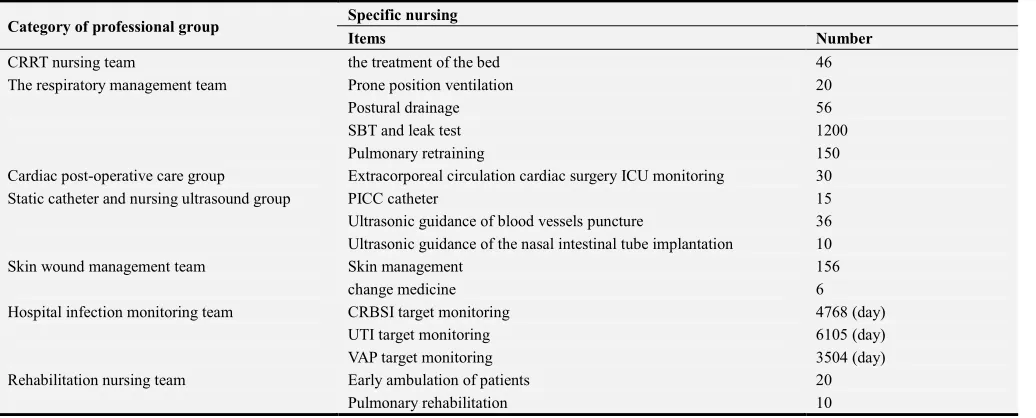
The specialist nurse mainly implement new nursing technology and new business research projects 17. Each nursing specialist team carry out a lot of fine, professional care activities.
Table 5. Detailed nursing work carried out by specialist nurses in ICU in2016.
Category of professional group Specific nursing
Items Number
CRRT nursing team the treatment of the bed 46
The respiratory management team Prone position ventilation 20
Postural drainage 56
SBT and leak test 1200
Pulmonary retraining 150
Cardiac post-operative care group Extracorporeal circulation cardiac surgery ICU monitoring 30
Static catheter and nursing ultrasound group PICC catheter 15
Ultrasonic guidance of blood vessels puncture 36 Ultrasonic guidance of the nasal intestinal tube implantation 10
Skin wound management team Skin management 156
change medicine 6
Hospital infection monitoring team CRBSI target monitoring 4768 (day)
UTI target monitoring 6105 (day)
VAP target monitoring 3504 (day)
Rehabilitation nursing team Early ambulation of patients 20
Pulmonary rehabilitation 10
3.4. Results of Satisfaction Survey
Table 6. The analysis of survey of the professional nurses’s atisfactory (n=30).
Items The number of people Scores (x±s) t/F P
Specialist nurse in ICU 15 4.331±0.669
3.92 <0.01
Specialist nurse in other wards control group 15 3.607±0.402
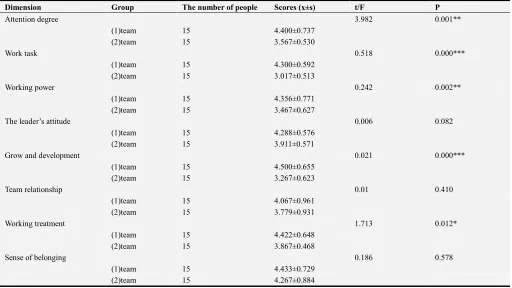
Table 7. Analysis of scores of specialists in different dimensions (n=30).
Dimension Group The number of people Scores (x±s) t/F P
Attention degree 3.982 0.001**
(1)team 15 4.400±0.737
(2)team 15 3.567±0.530
Work task 0.518 0.000***
(1)team 15 4.300±0.592
(2)team 15 3.017±0.513
Working power 0.242 0.002**
(1)team 15 4.356±0.771
(2)team 15 3.467±0.627
The leader’s attitude 0.006 0.082
(1)team 15 4.288±0.576
(2)team 15 3.911±0.571
Grow and development 0.021 0.000***
(1)team 15 4.500±0.655
(2)team 15 3.267±0.623
Team relationship 0.01 0.410
(1)team 15 4.067±0.961
(2)team 15 3.779±0.931
Working treatment 1.713 0.012*
(1)team 15 4.422±0.648
(2)team 15 3.867±0.468
Sense of belonging 0.186 0.578
(1)team 15 4.433±0.729
(2)team 15 4.267±0.884
Note: *P<0.05, **P<0.01, ***<0.001;(1) specialist nurse in ICU (2) specialist nurses in other control groups
4. Discussion
First, the standardized management mode of setting goals, setting posts, setting responsibilities and standardizing evaluation is a key to the improvement of nursing quality and teaching level in the department of Critical Care Medicine to realize the development of nursing disciplines.
Intensive care involves multidisciplinary and multispecialty. It is a place where the number of specialized nurses is concentrated. The effectiveness of specialized nurses is closely related to the quality of the department and the development of the discipline. Specialized nurses participate in nursing quality control, can timely find and feedback the problems existing in the clinical implementation process, and track the effect of rectification that makes the nursing quality greatly improved [3]. Meanwhile, our specialized nurse in hospital infection, quality control, and other positions take a lot of work that fully play its important role and effectively improve the quality of care level. In addition, specialist nurses who have comprehensive professional knowledge and skills participate in teaching management for enhancing the level of teaching and training.
level of the nurses by leading refine nursing team to formulate nurse guidelines or process and revision work standards, to carry out the training and other measures to effectively regulate the behavior of the clinical nursing. At the same time, they through developing new technology, new business, scientific research and other works to promote the development of intensive care medicine discipline refinement process.
Second, the effect of specialist nurse training is the most important indicator for evaluating the training level of specialist nurses [10]. The training effect is concentrated in the quality of teaching. The comprehensive scores of teaching quality before and after the implementation of the standardized management model of our specialist nurses are statistically significant (P), which is reflected in the quality of teaching, allowing specialist nurses with strong professional knowledge background to serve as teaching teachers to develop and implement high-level teaching. Activities have also achieved remarkable results in improving the quality of departmental teaching.
Third, the job satisfaction scores of ICU specialized nurses and other wards specialized nurses’ is (4.331 + 0.669) and (3.607 + 0.402) respectively which the condition is range very satisfies from satisfactory and there are significant differences (P<0.01) between the two. Through the score analysis of each dimension, we can find that the differences of satisfaction between the two groups are mainly reflected on1)Attention degree2)work tasks (job content, job value, professional expertise, technical tasks)3)Growth and development (development planning, continuing education)4)Working power (right of speech, autonomy, decision-making power), 5)Work treatment (salary comparison, performance plan). However, there was no significant difference in leadership attitude, team relationship, and a sense of belonging.
Building a platform for specialized nurses to progress, not only can continue to enhance their professional ability but also play a role in they are the field of specialist nursing [2]. The first element for specialized nurses is the establishment of clear and detailed post requirements and management objectives [4]. Our department has formulated a clear post and work content for specialized nurses and established clinical nursing experts, quality managers, educators, researchers and other roles for specialized nurses. We are based on the development planning of intensive care unit’s using, then establishment the specialized nurses’ training and continuous training objectives, and to provide a variety of learning and training opportunities which can make the nurses constantly to update their knowledge, expand and improve, maintain a professional leading position [2]. In addition, the department allows specialized nurses to have more initiative and decision-making power in professional work by post management. At the same time, through the regular work assessment to promote the nurses continue self-improvement [2]. The standardized examination and evaluation system makes professional nurses' work performance quantified that not only stimulated their work enthusiasm, but also prompted them to actively carry out the work, and achieved the
corresponding remuneration through the work efficiency. These standardized management measures are the important reasons for improving the satisfaction of specialized nurses in ICU.
Limitation
First, our department lacks 2013~2015 year specialized nurses to carry out professional and meticulous nursing work data. Second, compared with the two groups of specialized nurses, there is no contrast with other wards, specialist nurse management mode, which may have a certain impact on the findings.
5. Conclusion
The management mode of setting goals, post, responsibilities, and standardized evaluation is the effective strategy to improve ICU nursing quality, the level of teaching and promote the development of nursing science and enhance job satisfaction of specialized nurses.
Appendix
ICU Specialist Nurse Job Satisfaction Questionnaire Dear specialist nurse:
This questionnaire is for academic research analysis only, please fill in the truth according to your actual feelings and opinions.
This survey does not include the head nurse and deputy head nurse.
First, the degree of attention
1. The importance of specialist nurses is widely recognized by colleagues in our department [Multiple choice questions] [Required questions].
○ 1 ○ 2○ 3○ 4○ 5
2. Specialist nurses can get the universal respect of colleagues in our department
[Multiple choice questions] [Required questions]. ○ 1 ○ 2○ 3○ 4○ 5
Second, Work task
3. My work content is significantly different from that of ordinary nurses
[Multiple choice questions] [Required questions] ○ 1 ○ 2○ 3○ 4○ 5
4. My work content can reflect my professional value [Multiple choice questions] [Required questions] ○ 1 ○ 2○ 3○ 4○ 5
5. My position can give full play to professional and technical expertise
[Multiple choice questions] [Required questions] ○ 1 ○ 2○ 3○ 4○ 5
6. My work tasks are challenging, but I can work hard to complete them.
[Multiple choice questions] [Required questions] ○ 1 ○ 2○ 3○ 4○ 5
Third, Work power
[Required questions] ○ 1 ○ 2○ 3○ 4○ 5
8. In the work, as long as I think it is reasonable, I have the right to make important decisions [Multiple choice questions] [Required questions]
○ 1 ○ 2○ 3○ 4○ 5
9. I have greater autonomy and decision-making power in the responsible work project [Multiple choice questions] [Required questions]
○ 1 ○ 2○ 3○ 4○ 5
Fourth, Growth and development
10. My personal professional development plan can be valued by the department
[Multiple choice questions] [Required questions] ○ 1 ○ 2○ 3○ 4○ 5
11. I am satisfied with the continuing education opportunities offered by the hospitals and departments [Multiple choice questions] [Required questions]
○ 1 ○ 2○ 3○ 4○ 5 Fifth, Leadership attitude
12. My work plan can be supported by leaders and implemented [multiple choice questions] [required questions]
○ 1 ○ 2○ 3○ 4○ 5
13. Managers usually discuss with me daily work problems and procedures
[Multiple choice questions] [Required questions] ○ 1 ○ 2○ 3○ 4○ 5
14. Leaders and colleagues are satisfied with my work [Multiple choice questions] [Required questions] ○ 1 ○ 2○ 3○ 4○ 5
Sixth, Work treatment
15. My current salary level is quite satisfactory compared with the same-year general nurse [Multiple choice questions] [Required questions]
○ 1 ○ 2○ 3○ 4○ 5
16. The current performance plan of our department can reflect the difference in post value [Multiple choice questions] [Required questions]
○ 1 ○ 2○ 3○ 4○ 5
17. The current performance plan of our department can reflect the difference in labor intensity. [Multiple choice questions] [Required questions]
○ 1 ○ 2○ 3○ 4○ 5
Seventh, Team relationship
18. In the department, there is a good team spirit between different levels of nursing staff [Multiple choice questions] [required questions]
○ 1 ○ 2○ 3○ 4○ 5
19. When the work is busy, colleagues in the department can help each other.
[Multiple choice questions] [Required questions] ○ 1 ○ 2○ 3○ 4○ 5
20. Work encounters problems and can be supported by department heads and colleagues [Multiple choice questions] [required questions]
○ 1 ○ 2○ 3○ 4○ 5
Eighth, Sense of belonging
21. In the department, I have the feeling of home [Multiple choice questions] [Required questions] ○ 1 ○ 2○ 3○ 4○ 5
22. I have a sense of identity and belonging to the department
[Multiple choice questions] [Required questions] ○ 1 ○ 2○ 3○ 4○ 5
References
[1] Wang Jianlin, WuLi, LiLuliu, YueLichun, Liangjuan. Investigation and Analysis on the status of first ICU specialistnurses in Jiangxi [J]. Journal of nursing, 2015, 22(14):35-37.
[2] Wu Xinjuan, LiJiaqian, LiZhen, CaoJing. Strengthening the training and use of specialistnurses, assisting nursing development by leaps and bounds [J]. Chinese Nursing Management, 2017, 17(07):872-874
[3] Liu Xueyu, LuoPing, ZhiSuzhen. Role and effect evaluation of specialist nurses in hospital nursing quality control, 2011, 17(27):19-21.
[4] Chen Miaoxia, WangXuehua, MaYingying. Using and managing of ICU specialistnurses [J]. Chinese Nursing Management, 2011, 11(09):18-20.
[5] Liang Xinrui, ZhangLingjuan, CaoJie, LuXiaoying. Current status and thinking of full-time post management of clinical nurses. [J]. Chinese Journal of nursing, 2013, 48(02):187-189.
[6] Zhang Qine, Li Qiujie, GaoBeilei, Hong Su, Wang Ying. Study on the full-time post management of specialist nurses in Heilongjiang. [J]. Journal of Nursing Science, 2014, 29(07):10-13.
[7] Cheng Shouzhen, GaoMingrong, Wang Yuexiu, Barry Ping, Gong Fengqiu. Training and use for ICU specialist nurses [J]. Chinese Nursing Management, 2013, 13(04):15-17.
[8] Xiao Jiangqin, Li Ping. Investigation on the status and training needs of ICU specialist nurses in Xinjiang [J]. Journal of Nursing Science, 2009, 24(2):62:64.
[9] Qiao Xiaofei, Jiang Qicheng, Song Geqi, et al. The current situation and management strategies of human resources in college nurses in Anhui Province [J]. China Nursing Management, 2014, 14 (110: 1180-1183.