A NOVEL CONTROL SCHEME OF STATIC
SYNCHRONOUS SERIES COMPENSATOR FOR
FREQUENCY OSCILLATION CONTROL
Thota Sivaiah
1, M. Phani Raju
21
M.Tech Scholar (PS),
2Asst. Professor Deptt of EEE
Nalanda Institute of Engg and Tech. (NIET), Siddharth Nagar, Guntur, A.P. (India)
ABSTRACT
Here in this paper Low frequency oscillations (LFO) are a common opposing phenomenon which raise the risk of insecurity for the power system and consequently decrease the total and existing transfer capability. In this paper a clear examines the damping presentation of the static synchronous series compensator (SSSC) prepared with an auxiliary fuzzy logic controller (FLC). Here in this paper at the outset an improved Heffron-Phillips design model of a single machine infinite bus (SMIB) system integrated with SSSC is recognized. In this paper examined the following an auxiliary Fuzzy Logic Controller for SSSC is well calculated to improve the transient stability of the power system. So that estimate the operating performance of the recommended Fuzzy Logic Controller in damping LFO the SMIB power system is exposed to a disruption such as deviations in mechanical power. The whole digital simulations are implemented in the MATLAB and Simulink platform to deliver complete accepting of the issue. The achieved Simulation responses are demonstrated that the established Fuzzy Logic Controller would be more operative in damping electromechanical fluctuations in comparison with the traditional proportional integral (PI) controller.
INDEX TERMS: Low Frequency Oscillations, Static Synchronous Series Compensator (SSSC),
Single Machine Infinate Bus (SMIB) Power System, Heffron-Phillips Design, Fuzzy Logic
Controller.
I.INTRODUCTION
The existed interconnecting the huge power systems utilities have accomplished more continuity and economic
sustainability. Though, low frequency fluctuations with the frequencies in the limit of 0.2 to 2 Hz are one of the
straight outcomes of the huge intersected power systems. The power fluctuations may come up to complete
rating of a transmission line like they are covered on steady state line flow. Hereafter, these alternations would
control the entire and available transfer capability by demanding higher safety limitations. Here these
electromechanical approaches of fluctuations are generally poorly damped which may rise the risk of instability
of power system. Consequently in order to sustain the stability of the complete system it is critical to damp the
electromechanical alternations as soon as conceivable.
Various kinds of approaches also suggested alleviating the deviations in the power system. Since many years the
in the transmission lines. In authors have established the damping function for the SSSC. It is a familiar fact that
by appropriately designing an auxiliary power fluctuation damping controller the SSSC would be capable of
destroying the instabilities as an ancillary duty.
Here in this collected works various kinds of approaches are also suggested to design a POD controller for
SSSC. For example authors have utilized the phase balance technique to improve a additional damping
controller for SSSC. Here the important difficulty associated with these approaches is that the control procedure
is based on the linear zed machine design. The other regularly utilized method is the proportional Integral (PI)
controller. Even though the PI controllers proposal simplicity and ease of constructional design their operating
characteristics depreciates when the system operating points vary extensively or large instabilities happens. Now
in this operating situation some novel steadying control explanations for power system have been explained.
Newly the fuzzy logic controllers (FLCs) have appeared as an capable tool to circumvent these disadvantages.
A novel Fuzzy Logic Controller incorporates qualitative and quantitative knowledge about the system operating
characteristics through some grading. So as to advance more accurate fuzzy logic affords a general concept for
description and quantity of systems. The entire fuzzy logic systems encode human reasoning into a program in
order to attain at conclusions or to regulate a system. The effective Fuzzy logic contains fuzzy sets which are a
way of demonstrating non statistical improbability along with estimated reasoning and in fact consist of the
operating conditions utilized to make suggestions. There are some documents which have authenticated the
successful application of Fuzzy Logic Controller for transient permanence improvement of a power system. The
Limying charone have utilized fuzzy supplementary controller with the purpose of accomplishing low frequency
fluctuations damping.
II.POWER SYSTEM MODELING
Here in this section is dedicated to abstract an particular linearized Heffron-Phillips design model for the
inspected power system. As represented in Fig. 1 a single machine infinite bus (SMIB) system connected with
SSSC is measured as the sample power system. In the following figure XT is the transformer reactance and XL
resembles to the reactance of the transmission line. And also Vt and Vb denotes the generator terminal voltage
and infinite bus voltage respectively. A simple SSSC comprising of a three-phase GTO based voltage source
converter is combined in the transmission line. It is expected that the SSSC operating performance is based on
the very familiar pulse width modulation methodology. The operating principle of SSSC is the transformer
leakage reactance VINV is the series injected voltage CDC is the common DC link capacitor VDC is the voltage
Fig. 1 A Single Machine Infinite Bus Power System with A SSSC
2.1Nonlinear Dynamic Design of the Power System with SSSC
As the initial step a nonlinear dynamic design model for the investigated system is derived by omitting the
resistance of all the components along with generator, static transformer, and transmission line and series
converter transformer line and series converter transformer.
III.DESIGN OF DAMPING CONTROLLERS
Targeting to damp the low frequency fluctuations two sorts of damping controllers are considered and compared
with each other. In the examined system as stated earlier the SSSC series converter amplitude modulation index
namely m affords a control signal to yield better damping of variations. In the consequent segments each
controller is individually discoursed in detail.
3.1 Conventional Proportional-Integral (PI) Controller
The various kinds of damping controllers are designed so as make available an extra electrical torque in phase
with the speed abnormality in order to improve the damping of fluctuations in Fig. 2 shows the traditional PI
controller arrangement. With respect to this figure it can be observed that the first block compares the generator
rotor speed with the mention speed. In the sequel the error is served to a Proportional Integral controller to
generate the appropriate amplitude modulation index for the SSSC converter. There are many different
approaches to design PI controllers such as try and error method pole-placement, Ziegler Nichols and so forth.
In this investigation try and error method is used to fix proper values for PI controller gains.
Fig.2 Traditional PI Damping Controller
3.2 Auxiliary Fuzzy Logic Damping Controller
A described in the earlier sections though the PI controller‟s proposal simplicity and ease of constructional
design their operating performance depreciates when the system operating situations differ extensively or large
instabilities occur. Accordingly to certify the operative performance of damping controller over extensive range
of system processes and also to enhance the transient stability of the system a supplementary fuzzy logic
Fig. 3 Fuzzy Logic Damping Controller Structure
The accessible FLC has a very simple in constructional design structure. Here we can measure the membership
functions of the input and output signals are presented in following. There are two various kinds of linguistic
variable for each input variable comprising „Positive‟ (P) and „Negative‟ (N). And also the output variable there
are three linguistic variables specifically „Positive‟ (P), „Zero‟ (Z), and „Negative‟ (N).
IV.SIMULATION RESULTS AND DISCUSSION
For the purpose to compare the suggested fuzzy logic damping controller performance with the traditional PI
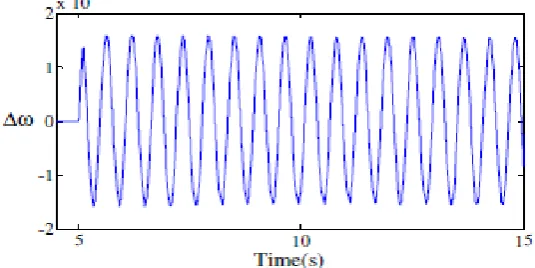
damping controller some beneficial simulations are conveyed. The eventuality simulated is a step change in
mechanical power (𝐷𝑃𝑚 = 0.01 ) which ensues at t=5sec and lasts for certain time as 0.1 sec.
In the start the SSSC has no damping controller. For this case the angular velocity abnormality and also the load
angle abnormality responses are displayed in Fig.4. This figure exposes that when there is no damping controller
the Low Frequency Oscillation damping is very poorlater an auxiliary damping controller is basicallymandatory
to increase the transient stability of the system.
In the second case simulations are executed with the same contingency in mechanical power but the SSSC has
been prepared with a damping controller. The Simulation results are presented in following Fig. With respect to
this figure it is expected that the fuzzy logic controller displays improved damping than the traditional PI
controller. Similarly the power system transient stability is improved when the SSSC is prepared with the fuzzy
logic damping controller. The Simulation results authenticate the efficiency of the recommended fuzzy logic
V. CONCLUSION
This paper functions an exact exploration to achieve a whole linearized Heffron-Phillips prototype for a single
machine infinite bus power system prepared with an SSSC to study Low Frequency Oscillations damping with
an auxiliary Fuzzy Logic Controller. It was exposed that a contingency in power system will cause to initiate
power instabilities. Here in this sequel two various kinds of controllers specifically the traditional PI and the
Fuzzy Logic Controller were calculated to damp the system fluctuations. The proportional study between the
Fuzzy Logic Controller and PI controller demonstrations that the recommended Fuzzy Logic Controller has
greater operating performance and effect in transient stability improvement and alternations damping. The
Simulation results authenticate the efficiency of the recommended fuzzy logic damping controller and its
improved operating performance is highlighted. Subsequently the fuzzy logic controller would be a enhanced
opportunity in the design of damping controllers.
REFERENCES
[1] P. Kundur. Power system stability and control. Prentice-Hall,N. Y, U. S. A, 1994.
[2] E. V. Larsen and D. A. Swann, “Applying power system stabilizers, P-III, practical considerations,” IEEE
Trans. Power App. Syst., vol. 100, no. 6, pp. 3034–3046, Dec. 1981.
[3] X. Lei, E. N. Lerch, and D. Povh, “Optimization and coordination of damping controls for improving
system dynamic performance,” IEEE Trans. Power Syst., vol. 16, pp. 473–480, Aug. 2001.
[4] N.G. Hingorani, L. Gyugyi, Understanding FACTS: Concepts and technology of flexible ac transmission
system, IEEE Press, NY, 2000.
[5] J.G. Douglas, G.T. Heydt, “Power Flow Control and Power Flow Studies for Systems with FACTS
Devices,” IEEE Trans. Power Syst, vol. 13, No. 1, 1998, pp. 60-65.
[6] H. Taheri, S. Shahabi, Sh. Taheri, A. Gholami “Application of Static Synchronous Series Compensator
(SSSC) on Enhancement of Voltage Stability and Power Oscillation Damping ,” IEEE Conf, pp. 533 – 539,
28 Sept-1 Oct, 2009.
[7] E.V. Larsen, J.J. Sanchez-Gasca, J.H. Chow, and “Concepts for Design of FACTS Controllers to Damp
M.Phani Raju, working as an Asst.professor (EEE) at Nalanda institute of Engineering and Technology (NIET), Siddharth Nagar, Kantepudi village, satenepalli Mandal, Guntur