Implementing Potentially Better Practices for Improving Family-Centered
Care in Neonatal Intensive Care Units: Successes and Challenges
Kimberly A. Cisneros Moore, RNC, BSN*; Kara Coker, RN, MSN‡; Allison B. DuBuisson, MS§; Betsy Swett, RNC㛳; and William H. Edwards, MD¶
ABSTRACT. Objective. Multidisciplinary teams from 11 medical center neonatal intensive care units collabo-rated in a quality improvement project with a focus on family-centered care.
Methods. Through a process of self-analysis, litera-ture review, benchmarking site visits, and expert consul-tation, 10 potentially better practice (PBP) areas were defined. Improvement activities in 4 of the 10 areas are given as examples of successes and challenges that indi-vidual centers encountered. The 4 areas are vision and philosophy, unit culture, family participation in care, and families as advisors.
Results. Centers were at different places for all of the PBPs at the beginning and throughout the collaboration. Seven centers developed or revised their vision or phi-losophy of care statements about family-centered care. Incorporating the vision and philosophy of care into performance appraisals, hiring of new personnel, and changing unit culture to a more family-centered practice were more challenging than developing the statements. Full parent participation in care requires unrestricted access to the neonatal intensive care unit. The shift from considering parents to be “visitors” to being partners in caring for their child was more difficult for centers with restricted visitation policies. All centers developed, ex-panded, or started plans for establishing family advisory councils. The experience of 2 centers is described.
Conclusions. Family-centered care is more of a jour-ney than a destination. Collaborating centers in this project found themselves at different places in that jour-ney. Through perseverance in implementing the PBPs, all have moved further along the path. Pediatrics
2003;111:e450 –e460. URL: http://www.pediatrics.org/cgi/ content/full/111/4/e450;family-centered care, parental in-volvement, parent advisory council, collaborative quality improvement, multidisciplinary, neonatal intensive care, NIC/Q 2000.
ABBREVIATIONS. NICU, neonatal intensive care unit; NIC/Q 2000, Neonatal Intensive Care Unit Quality Improvement Collab-orative Year 2000; PBPs, potentially better practices.
KEY POINTS OF ARTICLE
• Family-centered care is less a destination than a journey.
• Neonatal intensive care units (NICUs) that are seeking to provide family-centered care may begin at very different places and proceed along differ-ent paths.
APPLYING LESSONS LEARNED TO PRACTICE • Family-centered care vision and philosophy of
care statements are meaningful only when they are incorporated into the culture and daily prac-tice of the NICU.
• Families can be effective partners both in caring for their own child and in providing advice to improve care in NICUs.
E
leven centers that participated in the Vermont Oxford Network Neonatal Intensive Care Unit Quality Improvement Collaborative Year 2000 (NIC/Q 2000) chose to focus on family-centered care as a strategy to improve the care of infants in NICUs and their families. The project was supported by collaboration with the Institute for Family-Centered Care. Through a process of self-analysis, literature review, benchmarking site visits, and expert consul-tation, potentially better practices (PBPs) were de-fined.1In this article, some of the successes andchal-lenges encountered by the centers as they
implemented these practices are described. Exam-ples are taken from 4 of the 10 PBP content areas: vision and philosophy, unit culture, family partici-pation in care, and families as advisors.
VISION AND PHILOSOPHY
• Vision and philosophy of care statements articu-late the unit’s commitment to family-centered care.
• Family-centered vision and philosophy is consis-tently applied to unit policies, practices, and pro-grams.
A vision and/or a philosophy of care statement that incorporates the principles of family-centered care provides a foundation for a NICU’s policies, decisions, goals, and new directions. Without a vi-sion and core belief system, the culture has no clear direction. This can result in inconsistent family-cen-tered care practices and decision making. The impor-tance of an expressed vision or philosophy of care was evident at all benchmark site visits as well as in
From the *Children’s Hospital at Providence Alaska Medical Center, An-chorage, Alaska; ‡DeVos Children’s Hospital, Grand Rapids, Michigan; §Women’s Hospital of Greensboro, Greensboro, North Carolina;㛳Woman’s Hospital, Baton Rouge, Louisiana; and ¶Children’s Hospital at Dartmouth, Lebanon, New Hampshire.
Received for publication Aug 13, 2002; accepted Oct 24, 2002.
Address correspondence to William H. Edwards, MD, Children’s Hospital at Dartmouth, One Medical Center Dr, Lebanon, NH 03756-0001. E-mail: [email protected]
published reports.1,2 The 11 centers in the family-centered care focus group started the project at dif-ferent places for this practice. Some had already de-veloped statements, others dede-veloped or revised them during the project, and some were still working on them at project end. The individual vision and philosophy statements from 7 centers are included in Appendix A.
Yakima Valley Memorial Hospital developed its vision statement as part of this quality improvement project. After discussion and brainstorming, a mul-tidisciplinary committee that included families pro-posed several potential statements. Keeping the vi-sion statement short and concise was a priority. The statements were widely presented for input and dis-cussion by nursery staff, physicians, and families, and a single choice was made by consensus. The proposed statement was then communicated to nurs-ery personnel for input by a variety of mechanisms. A banner of the proposed statement was displayed in the NICU and conference room. Newsletters and bulletin boards were dedicated to development of the statement. Over 2 weeks, written and verbal feedback was sought and comments were tran-scribed onto a board for communications about cur-rent issues. All feedback was reviewed, and the state-ment was revised into its current version: “Memorial and families: Partners in care.” It is especially appro-priate that the idea for this vision statement origi-nated with a comment from a mother who described the neonatal care team as being “partners in caring for her infant.”
After creating the vision statement, the Yakima Valley Memorial improvement team took steps to make it a part of their culture. They incorporated the vision statement on paperwork used for the unit, including meeting agendas and minutes and statio-nery letterheads. They mailed information about the vision to all nursery staff and placed signs with the vision statement in various places throughout the unit. When a planned survey was conducted of all nursery personnel, 80% both knew the unit had a vision statement and were able to state it.
The philosophy of care statement devised by the NICU at Fairview University Medical Center reflects the key principles of family-centered care: “We rec-ognize the family is the most important and constant factor in each infant’s life. Our goal is to establish a collaborative partnership between parents and the health care team to promote communication, respect diversity, and empower families.”
The Fairview team used the process of developing their philosophy of care statement and incorporating it into the NICU’s policies and parent information to stimulate ideas for promoting family-centered care. One outcome measure for this improvement project was that 86% of nursery staff were able to give examples of ways they could promote family-cen-tered care.
The Children’s Hospital at Providence Alaska Medical Center had created a vision statement before this project. Although it existed on paper, it was not a living document in the NICU. The Developmental Care Council, the Family Advisory Board, and the
Parent and Community Coordinator (a paid parent position) together analyzed and rewrote the vision statement, drawing from insights gained during the benchmarking visits and the development of the 10 PBPs. A professionally designed poster of the new vision and mission statements was prominently placed at the main entrance to the NICU. The family-centered vision and mission statements are now im-portant components for hiring new personnel. Poten-tial employees are asked to “define family-centered care” during the interview process. Including family-centered care as a key competence in staff perfor-mance appraisals led to counseling some staff to relocate to other positions within the hospital. The commitment to a family-centered care philosophy has not been easy.
UNIT CULTURE
• Vision and philosophy of care statements are de-veloped collaboratively by representatives of all disciplines working on the unit and by family representatives.
• Committees that develop programs and practices have members who represent all disciplines work-ing on the unit, and family representatives. • Accountability for patient and family outcomes is
shared by all unit staff.
The process of developing a vision or philosophy of care statement can be a positive affirmation of the core beliefs of a NICU. Once developed, the chal-lenge is to compare systematically current reality with the ideal and make improvements until the vision and philosophy accurately reflect the NICU’s culture. This PBP concept naturally follows and over-laps with vision and philosophy.
Presbyterian St. Luke’s Medical Center in Denver, Colorado, confronted a substantial barrier to imple-menting family-centered care. Two different units providing neonatal care within the center each had separate staffing and different goals. Communica-tion between the 2 units was poor, and project lead-ers sensed a general apathy about implementing family-centered care in both. They formed a multi-disciplinary committee called INFO (Implementing Neonatal and Family Outcomes) drawn from the standing committees of both units. The purpose of INFO was to find ways to bring family-centered care principles back to the standing committees. Collab-oration between the 2 units was further enhanced by establishing daily meetings between the 2 units and setting up e-mail accounts for every staff member. Signs of a positive effect have been an increase in staff involvement in committees and projects and a renewed enthusiasm for providing primary care nursing.
incorporated and voted into the by-laws as an equal partner in the intensive care nursery shared gover-nance model. The chair of the parent council is a voting member of the coordinating council, com-posed of the chairs of each of the shared governance councils and the unit nursing and medical directors.
FAMILIES’ PARTICIPATION IN CARE • Families are viewed as integral members of the
care team and as primary caregivers to their in-fants (not as visitors).
• Families are seen as the primary decision makers for their infants.
• Families are asked how they would like to partic-ipate in their infants’ care and are given the edu-cation, resources, and support to participate to the level they desire.
• Families have the opportunity to discuss and record observations of their infant.
• The unit welcomes families 24 hours a day, includ-ing durinclud-ing rounds and change of shift.
The differences among the centers collaborating on improving family-centered care were nowhere more evident than in policies and practices about family participation in care. Some centers encouraged par-ents’ participation in rounds and nursing shift changes, whereas others had rules excluding parents. This PBP required each center to reevaluate its visi-tation policies. When family-centered care is prac-ticed, parents and family are collaborators, or part-ners, in care and not “visitors.” Many centers rewrote guidelines to distinguish parent and family partici-pation in care from visitation guidelines for extended family and friends. Making changes in visitation guidelines was difficult for some centers. DeVos Children’s Hospital’s experience illustrates the bar-riers and challenges in changing visitation policies.
At DeVos Children’s Hospital, an interdisciplinary committee called the “Home Sweet Home” commit-tee was created to improve the nursery environment so that families were better supported to participate in care. The committee was presented with informa-tion from several sources: preliminary work by the NIC/Q 2000 collaborative focus group on family-centered care, including benchmarking site visit re-sults, information from the Institute for Family-Cen-tered Care, and information from the DeVos parent satisfaction survey. The committee identified and prioritized several ideas for improvement. Reevalu-ation of the current visitReevalu-ation policy with emphasis on sibling visitation was selected as the first priority. Changes to the visitation policy were made in stages over 1 year to receive staff input and address their concerns. These stages were conducted as improve-ment cycles using the improveimprove-ment method of plan-do-study-act (Table 1). The overall aim was to pro-mote family visitation by allowing siblings to visit when most convenient for parents.
The existing visitation policy allowed parents to “visit” any time except change of shift. Grandparents could also visit at any time with a parent. Siblings and other family members could visit only when accompanied by a parent on Thursday night from 7:30 to 9:30 or Sunday afternoon from 2:00 to 4:00. The neonatal unit was closed to all visitors except parents during respiratory syncytial virus season, which typically began in the fall and ended in late spring. The committee believed that these rules were too restrictive and set a goal of creating an environ-ment where families would always feel welcome. Initial reactions to liberalization of visitation guide-lines were mixed. Concerns were expressed that in-fection rates would increase, infants would become overstimulated from increased noise, and the in-creased number of people visiting would interrupt workflow.
The first improvement cycle included gathering information on the rationale and safety of the pro-posed change and presenting it to nursery staff and to the infection control department. The infection control department was particularly skeptical be-cause of concern for potentially introducing into the unit communicable diseases such as chicken pox and respiratory syncytial virus.
The second improvement cycle involved drafting new visitation guidelines, training personnel, and initiating a pilot trial. Some staff initially believed that having families with children on the unit more frequently would adversely affect their workflow. After initial issues were addressed, most staff ex-pressed feeling less stress with more open sibling visitation. Expanded sibling visitation reduced crowding that had been a problem during the previ-ous sibling visitation hours. Problems encountered with lack of supervision of toddler-age siblings and an incident involving a toddler pulling on critical tubing led to a decision to continue to restrict visita-tion by siblings below age 3 to 1 brief visit per week. The third improvement cycle was designed to ad-dress concerns about the potential infection risk with a more open visiting policy. The committee reviewed literature and asked other NICUs with more liberal policies how they managed infection risks.3A simple questionnaire was developed to screen for recent fever, runny nose, flu- and cold-like symptoms, and exposure to chickenpox. The unit secretary was as-signed to help families answer the questionnaire and maintain documentation of the screening. When a child was cleared for entering the unit, he or she received a fun sticker of his or her choice, which served to identify that the sibling had been screened. The secretary documented the initial screening in a notebook. At each subsequent visit, the secretary and family would repeat the questions and the date would be recorded. The process was stressful for the secretaries initially. They did not feel qualified to screen families about health. Assigning the clinical managers and charge nurses to serve as resources for the secretaries solved their concerns. Since changing to a more liberal sibling visitation policy, acquired infection as a result of transmission by siblings has not yet been suspected.
The fourth improvement cycle was designed to decrease noise and distraction in the patient care areas by discontinuing the practice of announcing the arrival of parents over an intercom. Staff were concerned that a family member might walk into the patient care area during a procedure or resuscitation. A system of calling out to the desk to inform the secretaries when such an event was happening was initially developed but over time became unneces-sary. In the rare instance when a family member may walk in during a procedure or resuscitation, a staff member will assume the responsibility of explaining what is happening and supporting the parent if nec-essary. Not only has the elimination of added noise from the intercom been an improvement, nurses no longer have to stop what they are doing to answer the telephone when a parent arrives.
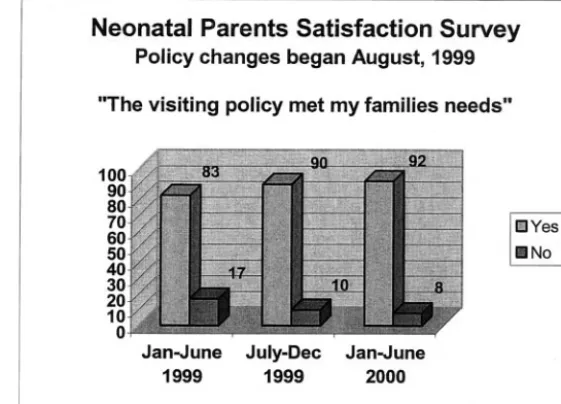
satisfaction survey of whether the visiting policy met their needs showed improvement (Fig 1). Before ini-tiation of the project, 83% of parents indicated that the policy met their needs compared with 92% after the cycles were completed. Introducing change in small increments was believed to be key to success. Although visitation policies at DeVos are more re-strictive than in some of the other centers, progress was made and staff accepted the changes.
FAMILIES AS ADVISORS • Families serve on family advisory boards.
• Families are included as members of family-cen-tered steering committees.
• Families provide family-to-family support within the unit.
• Opportunities exist for families to serve on other hospital committees and task forces.
• Paid positions are established for former family members to serve as family consultants or family liaisons.
• Families serve as faculty and trainers in orienta-tion and other educaorienta-tion and training activities.
Ad hoc family advisory committees have been advo-cated and incorporated into building programs for new or remodeled NICU facilities for many years.4 The concept of having standing parent advisory councils or boards is relatively new.5,6 Parent-to-par-ent support for various neonatal conditions has de-veloped largely outside the hospital environment. Parent-to-parent groups for supporting families of children with special needs are active in 30 states. Parents’ providing family-to-family support within the NICU environment are a recent development.7 Some children’s hospitals and nurseries are now even incorporating paid positions for parents of pre-vious patients to serve more formally as consultants, support for current parents of hospitalized infants and children, and liaisons for families. At all bench-mark site visits, there were active examples of fami-lies participating in advisory and support roles. Rainbow Babies and Children’s Hospital in Cleve-land established a Family Advisory Board in 1991,
introducing parent input into all aspects of unit pro-cess, including physical design, one-on-one parent support, and parent education materials. The NICU at the University of Massachusetts in Worcester em-ployed a parent as librarian and aid to parents in seeking resource materials in print or on the Internet. Utah Valley Regional Medical Center in Provo has an extensive system of parent-to-parent support offered to the family of every NICU admission, in addition to 3 paid parent positions.
Developing strategies for including families as ad-visors at various levels has been 1 of the most active areas of improvement for centers in the family-cen-tered care focus group. There have been challenges to engaging families as advisors. It is not easy to negotiate the working relationships among parents who are volunteers, parents who are employees, and hospital staff. Medical and nursing caregivers may be defensive and find it difficult to hear and respond to what parents have to say. The parent volunteers or advisors may feel intimidated at first or over-whelmed by the emotional recall of their own hos-pital experience. Examples of how family advisory activities have evolved in 2 centers follow.
Legacy Emanuel Children’s Hospital
From collaboration with the family-centered care focus group, particularly as a result of benchmarking site visits, staff and interested parents from the NICU at Legacy Emanuel Children’s Hospital in Portland, Oregon, began planning a parent-to-parent support program. They used 2 existing family-centered care groups to plan and implement the program: a family advisory board and a multidisciplinary family-cen-tered care committee.
gan spending blocks of time in the unit, reconnecting with staff and meeting current NICU families. Their schedules appear alongside unit staffing schedules to boost visibility and integration. They wear special buttons to distinguish them from “regular” hospital volunteers. The parents of a newly admitted infant will find a “calling card” at the infant’s bedside, giving information about the program. If the parents express interest, then a family volunteer will be asked (usually by the bedside nurse) to meet with them. The interaction and support are tailored to each family’s interests and needs during their child’s inpatient stay. A family volunteer is on call around the clock to talk with parents by telephone.
The new program, called Precious Beginnings, has a mission “to touch the life of each family in the NICU in a positive and lasting way.” Precious Be-ginnings has incorporated as a nonprofit organiza-tion in the state of Oregon. This has been an impor-tant step that allows them to engage in tax-exempt fundraising. In addition to parent-to-parent support activities, participating volunteers publish a family newsletter monthly and hold pizza night twice a month to broaden their network of support to par-ents.
Benefits from the Legacy Family Advisory Board and Precious Beginnings are
• Increased support presence on the NICU • Education of families
• A growing network of committed volunteers • Promoting Legacy Emanuel Children’s Hospital as
a champion of family-centered care
Establishing a collaborative and even collegial rela-tionship between parent volunteers and NICU staff has been a goal and will be a key to success. Accep-tance of the parent-to-parent program has depended on the enthusiasm and energy of the family volun-teers, the grateful responses of NICU parents, and the emerging visibility of the program. The volun-teers have found that their strong commitment to making the NICU experience less stressful for par-ents makes a lasting and favorable impression on staff.
Children’s Hospital at Dartmouth
Founding and establishing a parent advisory council has been one of the most important changes that has resulted from Children’s Hospital at Dart-mouth’s participation in the family-centered care fo-cus group. Founded officially in October 1999, the idea originated with the Parent Care Initiative, an ad hoc multidisciplinary task force that preceded the NIC/Q 2000 project. That task force developed the intensive care unit philosophy statement: “We be-lieve the parent-child relationship is essential. We believe in providing a nurturing environment where the child is part of a family, and the family is part of the care team.”
Several factors contributed to the successful initi-ation of the parent advisory council. Multidisci-plinary teams including staff nurses and parents par-ticipated in the benchmarking site visits. The
enthusiasm generated on return from the visits was a major factor in developing and promoting improve-ment ideas for family-centered care. A second factor was the commitment to a bidirectional free flow of ideas. Nursery staff members are encouraged to par-ticipate in monthly parent advisory council meetings and to present new ideas and initiatives for family input. Conversely, representatives from the parent council frequently serve on ad hoc nursery commit-tees for specific improvement projects. A third factor has been support for the parent council in the form of space to meet at the medical center, food for meet-ings, and on-site child care. Incorporating the parent advisory council into the shared governance of the unit was described in the section “Unit Culture.”
There have been several challenges to starting the parent advisory council. Some nurses were con-cerned that parents would be overly critical and make demands for changes without understanding all of the issues that nurses encounter. Open commu-nication and collaboration have largely dispelled this concern. Because the intensive care nursery is a re-gional referral center, most parents reside a distance away from the medical center. This creates obvious logistic problems in recruitment of council members and participation. Some strategies have been to use speakerphones to connect to the meetings and devel-oping tasks that can be done by communication over electronic mail rather than attendance at meetings. A problem shared by most parent councils is getting representation from parents across the cultural, age, and economic spectrum. Finally, strategies for fund-ing activities have not been fully resolved. Fundrais-ing efforts done by the parent council may conflict with similar activities by Children’s Hospital at Dart-mouth. Clearly defining the goals and needs has led to success in designating the proceeds of certain fundraising activities for the parent advisory council. A brief list of accomplishments by the parent ad-visory council include
• Creating a combination parent information guide and journal called “Special Beginnings” to be given along with a gift bag to the parents of every admission to the intensive care nursery
• Successfully advocating with nursery staff for a toll-free call-in line for parents
• Supporting and explaining why eliminating exclu-sion of parents from nursing “change of shift” was important
• Teaching nursery staff about parents’ perspectives during mandatory “Skills Days” and during ori-entation of new staff
• Participating in interviewing and recruiting nurses and physicians
• Participating in fundraising and promoting Chil-dren’s Hospital at Dartmouth
• Expressing parents’ perspective on the issue of parents presence during teaching and patient care rounds and collaborating to address issues of con-fidentiality
• Contributing articles to the unit’s monthly news-letter
Future goals of the parent advisory council include developing a parent-to-parent support program and helping to establish a salaried permanent parent sup-port liaison.
Parent volunteer programs have special chal-lenges, and each hospital has had to answer crucial questions during their evolution. When is a parent “ready” to serve in an advisory role? How can parent councils address issues of diversity and language barriers? What is the best way to “support” a family in the NICU? Welcoming families to serve as advi-sors requires commitment from the organization and from departmental leaders. Like most new pro-grams, it requires time, money, and enthusiasm, as well as sensitivity to the resistance that may arise from introducing a new “culture” to the workplace.
DISCUSSION
In 1992, a group of parents met with neonatal professionals to discuss how care providers could collaborate more effectively with parents of sick newborn infants. Subsequent to that meeting, an ar-ticle summarizing “The Principles for Family-Cen-tered Neonatal Care” was published.8These princi-ples have since been reflected in statements from the American Academy of Pediatrics as well as other organizations, supporting the role of families in de-cision making.9 –11Although progress has been made to include families in major decisions, intensive care units remain environments where nurses and physi-cians maintain most of the control.
Families dealing with the stress of sick infants who require critical care often feel lost, out of control, and in unfamiliar surroundings.12–14Parents have repeat-edly expressed their need to be an integral part of the care of their children. Unfortunately, examples of breakdowns in the relationships between neonatal care providers and parents abound.15–17 The prob-lems in neonatal intensive care are not unique but are representative of a broader problem. The current health care system often falls short of meeting the needs of the population. Improving the care pro-vided will require a change in the fundamental be-liefs and philosophy of care.
The Institute of Medicine proposed changes needed to improve the quality of health care in the United States for the 21st century.18 The proposed rules address patient and provider relationships.
Recommendations include customizing care accord-ing to patient needs and values, recognizaccord-ing the pa-tient as the source of control, and placing the papa-tient and family in the center of choices about care—all principles consistent with family-centered care.
Changing the culture of care in NICUs is not easy. The experiences of centers in the family-centered care focus group illustrate challenges as well as suc-cesses. Family-centered care is more of a journey than a destination. Collaborating centers in this project found themselves at different places in that journey. Through perseverance in implementing the PBPs, all have moved further along the path.
REFERENCES
1. Saunders RP, Abraham MR, Crosby MJ, Thomas K, Edwards WH. Evaluation and development of potentially better practices for improv-ing family-centered care in neonatal intensive care units. Pediatrics. 2003;111(suppl):e437– e449
2. Nyqvist KH, Karlsson KH. A philosophy of care for a neonatal intensive care unit.Scand J Caring Sci.1997;11:91–96
3. Montgomery LA, Kleiber C, Nicholson A, Craft-Rosenberg M. A re-search-based sibling visitation program for the neonatal ICU.Crit Care Nurse.1997;17:29 –39
4. White R, Martin GI, Graven SN. Newborn intensive care unit design: scientific and practical considerations. In: Avery GB, Fletcher MF, Mac-Donald MG, eds.Neonatology: Pathophysiology and Management of the Newborn.Philadelphia, PA: Lippincott Williams & Wilkins; 1999:49 –59 5. Jeppson E, Thomas J.Essential Allies: Families as Advisors.Bethesda, MD:
Institute For Family-Centered Care; 1995
6. Jeppson E, Thomas J.Families as Advisors: A Training Guide for Collabo-ration.Bethesda, MD: Institute For Family-Centered Care; 1995 7. Roman LA, Lindsay JK, Boger RP, et al. Parent-to-parent support
initi-ated in the neonatal intensive care unit.Res Nurs Health.1995;18:385–394 8. Harrison H. The principles for family-centered neonatal care.Pediatrics.
1993;92:643– 650
9. AAP Committee on Bioethics Policy Statement. Ethics and the Care of Critically Ill Infants and Children.Pediatrics.1996;98:149 –152 10. AAP Committee Fetus and Newborn Policy Statement. The initiation or
withdrawal of treatment for high-risk newborns. Pediatrics.1995;96: 362–363
11. AAP Committee on Fetus and Newborn and ACOG Committee on Obstetric Practice Policy Statement. Perinatal care at the threshold of viability.Pediatrics. 1995;96:974 –976
12. Gordin P, Johnson BH. Technology and family-centered perinatal care: conflict or synergy.J Obstet Gynecol Neonatal Nurs.1999;28:401– 408 13. Meck NE, Fowler SA, Claflin K, Rasmussen LB. Mother’s perceptions of
their NICU experience 1 and 7 months after discharge.J Early Interv. 1995;19:288 –301
14. Wereszczak J, Miles MS, Holditch-Davis D. Maternal recall of the neo-natal intensive care unit.Arch Psychiatr Nurs.1997;11:118 –125 15. Stinson R, Stinson P.The Long Dying of Baby Andrew.Boston, MA: Little,
Brown; 1983
16. Mehren E.Born Too Soon: The Story of Emily, Our Premature Baby.New York, NY: Doubleday; 1991
17. Woodwell WH Jr.Coming to Term: A Father’s Story of Birth, Loss, and Survival.Jackson, MI: University Press of Mississippi; 2001
2003;111;e450
Pediatrics
William H. Edwards
Kimberly A. Cisneros Moore, Kara Coker, Allison B. DuBuisson, Betsy Swett and
in Neonatal Intensive Care Units: Successes and Challenges
Implementing Potentially Better Practices for Improving Family-Centered Care
Services
Updated Information &
0
http://pediatrics.aappublications.org/content/111/Supplement_E1/e45
including high resolution figures, can be found at:
References
0#BIBL
http://pediatrics.aappublications.org/content/111/Supplement_E1/e45
This article cites 11 articles, 4 of which you can access for free at:
Subspecialty Collections
http://www.aappublications.org/cgi/collection/hospital_medicine_sub
Hospital Medicine
sub
http://www.aappublications.org/cgi/collection/fetus:newborn_infant_
Fetus/Newborn Infant
following collection(s):
This article, along with others on similar topics, appears in the
Permissions & Licensing
http://www.aappublications.org/site/misc/Permissions.xhtml
in its entirety can be found online at:
Information about reproducing this article in parts (figures, tables) or
Reprints
http://www.aappublications.org/site/misc/reprints.xhtml
2003;111;e450
Pediatrics
William H. Edwards
Kimberly A. Cisneros Moore, Kara Coker, Allison B. DuBuisson, Betsy Swett and
in Neonatal Intensive Care Units: Successes and Challenges
Implementing Potentially Better Practices for Improving Family-Centered Care
http://pediatrics.aappublications.org/content/111/Supplement_E1/e450
located on the World Wide Web at:
The online version of this article, along with updated information and services, is
by the American Academy of Pediatrics. All rights reserved. Print ISSN: 1073-0397.