636 | P a g e
EXPANSIVE SOIL STABILIZATION USING
INDUSTRIAL SOLID WASTES A REVIEW
Tiza Michael
1, Sitesh Kumar Singh
2, Anand Kumar
31
M. Tech Scholar, Department of Civil Engineering,
Career Point University, Kota, Rajasthan, (India)
2
Assitant Professor, Department of Civil Engineering,
Career Point University, Kota, Rajasthan, (India)
3
B. Tech Scholar, Department of Civil Engineering,
Career Point University, Kota, Rajasthan, (India)
ABSTRACT
This paper highlights the results of works done by different researchers on soil stabilization using different waste materials that primarily emanate from industries all over the globe, it is seen that most of the materials used for this purpose have proven to be very effective in improving the engineering properties of expansive soils. material wastes such as cement kiln dust, red mud, copper slag, brick dust, ceramic dust, polyvinyl waste, fly ash etc. laboratory tests such as California bearing ratio (CBR), unconfined compression strength test (UCS), free swell index, liquid limit, plastic limit, x-ray diffraction, compaction etc. were conducted, the research methods and results are discussed in this article.
Keywords: California bearing ratio (CBR), black cotton soil, expansive soil, soil stabilization,
industrial wastes etc.
I. INTRODUCTION
The importance of soil for construction purpose in civil and highway engineering is of great significance.
Virtually all civil engineering infrastructure has their foundation on the soil, in order to have a structure that
will stand its design life, accurate studies of the engineering properties of soil in the proposed site of
construction is to be conducted and if the soil is found wanting, adequate engineering techniques that have
been tested and proven worthy are then applied to improve these wanting Engineering properties.
The improvement of soil engineering properties to meet up the standard for economical, safe and long lasting
structures is what is termed as soil stabilization. Most wastes materials have been used in this process and
have been found very effective, for this article, we will discuss the effect of industrial solid wastes even as
mentioned below.
637 | P a g e
The review is aimed at reviewing and presenting recent works found in different recent literature works in
stabilization of black cotton soil or expansive soil using industrial solid wastes, to obtain the gaps noticeable in
this area of study that needs to be bridged,
1.2 Cement Kiln Dust
Wastes emanating from various processes in industries are called industrial wastes, these wastes could be solid,
Liquid or gaseous, however our concern here is about the solid wastes and not the rest. Some of the research
done in soil stabilization using these solid wastes from industries is as shown below.
Rahman et al (2011) did a literature review on cement kiln dust usage in soil and waste stabilization and
experimental investigation and found that results from experiments showed the use of 34% CKD has the
potential to bring the pH of sludge above 10, which is enough to stabilize the sludge.
Table 1: Basic properties and Typical Oxide composition of Cement Kiln dust.
Oxide
CaO
Al
2O
3SiO
2Fe
2O
3Mn
2O
3Na
2O
K
2O
pH
Gs
Concentration
(%)
50.81
4.71
-
1.92
0.002
0.001
1.35
11.2
2.22
Sourc: Moses and Saminu (2012)
Hesham (2013) studied cement kiln dust chemical stabilization of expansive soil exposed at El-Kawther
Quarter, Sohag Region, Egypt, Chemical analysis was conducted on both cement Kiln dust and lime. 16% was
found optimum for (CKD) while 14% (CKD) and 3 %( L) Was found optimum percent for the combination of
both (CKD) and (L).
Keerthi (2013) did an investigation on Stabilization of clayey soil using cement kiln waste. Maximum dry
density, Unconfined Strength tests and other tests were conducted, MDD increased but at appoint started
decreasing and, same was noticed for UCS.it was observed that 50% of CKD was optimum percentage for
clayey soil stabilization.
Peethamparan and Olek (2008) studied the stabilizing impact of four cement kiln dusts that possessed varying
chemical and physical properties on Na-Montmorillonite clay. On addition of cement kiln dust, there was a
significant decrease in the plasticity index (Ip), increment in the, initial pH value, UCS and stiffness of the
clay.
Vivek and Rajesh (2015) studied Effect of Cement Kiln Dust (CKD) on Engineering Properties of Black
Cotton Soil. Samples of Soil were tested with CKD from 0% to 25% of dry weight of the soil, result showed a
significant increase in soaked CBR and UCS values. DFS of the expansive soil was found to reduce from
(31%) to (5%).Compaction test showed an increase in maximum dry density (MDD) from 1.73 gm/cc to
2.03gm/cc and a considerable reduction in optimum moisture content (OMC) from 20.04% to 10.94%.
Permeability was noticed to have increased from 4.80x10⁻⁴ cm/s to 1.43x10⁻³ cm/s. It was thus, concluded
that CKD has the potential of increasing the desirable engineering properties of expansive soils.
Upma and (2015) studied effect of cement kiln dust and chemical additive on expansive soil at subgrade level.
638 | P a g e
additive RBI grade 81(Road Building International grade 81) at various percentages and for different curing
periods. Compaction, Atterberg’s limit, (C.B.R.), (U.C.S.) tests were the tests carried out on soil samples and
soil with stabilizers. It was noticed that there was a 67.80% reduction in increment in chemical additive RBI
grade 81 and CKD increased significantly strength of the soil. There was 450% increment in UCS value. The
optimum mix Obtained is soil: CKD: RBI Grade 81 in proportions of 81:15:04.
Sallahudeenet al. (2014) made an investigation on expansive soil with cement kiln dust. It was concluded that
cement kiln could be used for improving low volume roads and in lime stabilization as admixture, since
cement kiln dust has high loss on ignition(LOI) it was recommended that it should be avoided in avoided in
soil stabilization of expansive soils.
Heeralal and Praveen (2011) conducted a study on effect of fibre on cement kiln dust (CKD) stabilized soil.
The aim was to investigate the effects of discrete short polypropylene fibre (PP-fibre) on the strength and
mechanical behaviour of soil and soil+ CKD mix. PP-fibre content prepared at with soil mix at different
proportions (i.e. 0.25%,0.5%,1.0% by weight of the soil) and cement kiln dust content was as well treated in
three percentages of 3%,5%,8% by weight of the soil, other tests conducted were, UCS, direct shear test and
C.B.R tests. After 28 days of curing, UCC test was conducted. It was noticed that there was an increment in the
UCS, axial strain at failure, shear strength, decrement in stiffness, and a change in d soil’s brittle characteristics to one of higher ductility, the unsoaked CBR also increased significantly.
A study conducted by Srivastava et al (2010) on stabilisation of engine oil contaminated soil using cement kiln
dust, it was aimed at evaluating theeffectiveness of CKD as material for stabilization at varying proportions of
2%, 6%, and 14% on engineering characteristics of soil contaminated soil with engine oil. The result proved
that the specific gravity and consistency of contaminated soil limits increased significantly. The consistency
limits had a minimal change; plasticity index (PI) observed a minimal increase as a result of contamination.
CKD increased the consistency limits of soil. There was a decrease in compaction behaviour of stabilised soils.
Optimum moisture content (OMC) increased with increase in CKD. There was an increment in free swell
Index of contaminated soil 75% from 20% in uncontaminated soil. However, a decrement FSI decreased with
increase in CKD.UCS of soil increased AS there was an increment in CKD.It was thus concluded that CKD is
effective as stabilizing agent.
Bushra and Lubna (2012) studied Stabilization of Dune Sand by Using Cement Kiln Dust (CKD). The aim was
determining the engineering characteristics of Stabilized dune sand with the use of Cement Kiln Dust (CKD)
with the bias of accessing assessing the suitability of resting shallow foundation on it, Laboratory test were
conducted and the results showed that CKD caused a significant decrease in the liquid limit when mixed with
sand. The addition of CKD facilitated compaction of the soil at lower maximum dry unit weight and higher
optimum water content. There was a noticeable increase in angle of internal friction (φ) and Cohesion (c).
After curing for fourteen days; the strength characteristics were noticed to be constant. Thus CKD was
recommended for use even as it could have a huge advantage economically.
Ewa and Egbe (2013) investigated the use of cement kiln dust as partial replacement to ordinary Portland
cement in hollow lateritic blocks. Investigation on effect of partial replacement of cement with cement kiln
dust (CKD) on the compressive strength of laterized hollow block was conducted. A total of 270 number of
639 | P a g e
replacement by CKD ranging from 10-50%. The results showed that there was a decreases in e compressive
strength with increase in cement kiln dust content. The 28-day compressive strength for 10% CKD replacement
for 1:8 and 1:10 mixes were observed to exceed the minimum strength of 1.75N/mm2 required by the Nigerian
National Building Code for individual block. The strength of the laterized blocks however increased as the
curing age’s progresses.
Ali et al (2012) investigated the effectiveness of cement kiln dust in stabilizing recycled base materials using
both bench-scale resilient modulus and seismic modulus tests. Recycled materials included road surface gravel
(RSG) and recycled pavement material (RPM). Modulus generally increased with curing time with more
hydration; however, decrease in the modulus of the RPM mixed with 15% CKD during curing was attributed
to swelling potential of the CKD. Lower rate of increase in modulus of CKD mixtures compared with cement
mixtures with curing time was observed. Attributable to the combined effects of stiffness gain with continuing
hydration and stiffness reduction with freeze-thaw cycles, the final modulus of the recycled materials mixed
with CKD is 2 to 5 times higher than that of untreated RPM and RSG materials. This study also showed that
modulus change of stabilized granular materials can be estimated from seismic Young’s modulus.
Athraa et al (2015) studied the Characteristics of Cohesive Soils Stabilized by Cement Kiln Dust — Cement
kiln dust CKD is a waste obtained in the process of cement production, it constitutes environmental hazards if
not properly treated. The study was done with the bias of investigating the feasibility cement kiln dust
utilization in stabilization of soils. The properties of two kinds of soil where studied. The direct shear test /
unconfined compression tests, the coefficient of permeability, and durability tests (freezing-thawing and
wetting-drying) were reported. Treatment with cement kiln dust was found to be an effective option for
improvement of soil properties, based on the testing conducted as a part of this research. Strength was
improved and plasticity and coefficient of permeability were substantially reduced.
Ahmadi and Lubem (2014) studied the impact of cement kiln dust (up to 16%) on10% quarry fine stabilized
black cotton soil and found there was a reduction in IP, maximum dry density (MDD) and an increment in
California bearing ratio and optimum moisture content (OMC).
Mohie and Ahmed (2013) made a study on improving the strength of sandy silt soils by mixing with cement
kiln dust, the research studied the improving of sandy silt soils by mixing with cement kiln dust. Laboratory
tests were carried out to evaluate the improved soil properties. Three numerical models were built for an
embankment of a canal to examine the introduced method to overcome slope stability problems. The natural
soil slope stability safety factor was calculated from the first numerical model. The second model used to
calculate safety factor after applying the improved soil properties that were determined from the laboratory
works. The third numerical model was built to simulate improving natural soil by using the traditional soil
reinforcement technique. The results for the two improvement methods were compared. The results showed
that the proposed method caused significant improvement for slope stability.
Prasad and Sudeep (2016) investigated on Stabilization of Expansive Soil Using Cement Kiln Dust. Black
cotton also known as expansive soils undergo excessive changes in volume due to change in moisture content,
making their use in the construction of civil engineering projects very difficult. In this investigation Cement
Kiln Dust (CKD), was used as a chemical admixer to improve the characteristics of the expansive soil with
640 | P a g e
days) and many laboratory experiments were conducted. This investigation showed an improvement in the
properties of soil at varying proportions of CKD and with the curing.
Moses and Saminu (2012) made a study on effect of cement kiln dust (CKD) on stabilization of expansive soil.
It was found that the soil stabilized with CKD witnessed a significant reduction in California Bearing ratio,
unconfined compression test and durability tests, thus not considered for use in both base and sub-base
material.
1.3 Red Mud
Prabha and Ali (2015) studied soil improvement using red mud and fly ash. Different proportions of fly ash
and red mud were added to the disturbed soil, initially 3% Red Mud was added to soil with 3% fly ash then
CBR Value was 3.124 after then 6%, 12%, 18%, 24%, 30%, 36% Red Mud added to soil and 3% Fly ash then
CBR values were 3.924, 4.856, 5.957, 6.856, 7.354, 6.654 respectively obtained. 30% of Red Mud mixing and
CBR value of 7.354% was observed to be optimum value with soil and Fly ash for better improvement of soil
and its stabilization.
Table 2: Typical composition of Red Mud
Composition
Fe
2O
3Al
2O
3SiO
2Na
2O
CaO
TiO
2Percentage
30-60%
10-20%
3-50%
2-10%
2-8%
12-25%
Source; Prabha and Ali (2015).
Kusum et al (2014) evaluated characteristic properties of red mud for possible use as a geotechnical material in
civil construction. Tests conducted where Particle size distribution, Atterberg’s limit, OMC, Specific gravity,
and MDD. It was found that red mud is suitable for use in geotechnical works and as well in road base and
sub-base precisely for low volume roads.
Kalkan (2006) did investigated stabilized expansive clay with red mud and noticed a significant increase in
strength and a decrement in hydraulic conductivity.
Satayanarayana et al (2012) investigated the Characterization of Lime Stabilized Red Mud Mix for Feasibility
in Road Construction. In this study Red mud was stabilized with 2, 4, 6, 8,10and 12 percentages of lime and
unconfined compressive strength, split tensile strength and California bearing ratio tests were conducted at 1,
3, 7 and 28 days curing periods respectively. From the experimental findings it was observed that 10% lime
has shown higher values compared to other percentages. At 28 days it has shown maximum values than other
curing periods for all percentages of lime. The CBR value obtained for 10% lime at 28 days is 25% so that it
can be used as subgrade and sub base material in road construction.
Kuldip (2014) conducted analysis on utilization of cement kiln dust stabilized red mud for road construction. In
the experimental work the Red mud is stabilized with different percentage (i.e. 2, 4, 6, 8, 10 and 12%) of
Cement Kiln Dust and Unconfined Compressive strength, Compaction Strength at addition of higher
percentage of CKD has shown higher values up to 8% addition further addition of CKD does not play any vital
641 | P a g e
values at all percentages of CKD addition. The agglomeration of particles is very good as the percentage of
CKD increases. Red mud replaced with 8% CKD can be used effectively as a sub base and sub grade material.
II. COPPER SLAG
Havanagi et al. (2006) experimented by mixing copper slag which is by product in the production of copper
with fly ash and expansive soil. This was mixed in varying proportions and the suitability of these materials in
construction embankment, subbase and base courses were assessed. The stabilization process was done in
increasing proportions of 3%, 6% and 9%. of cement in order to ensure its suitability base course.
Table 3: Chemical Composition of Copper Slag.
Composition
Fe
2O
3Al
2O
3SiO
2Na
2O
CaO
MgO
Weight
56
3.4
34.4
0.57
0.5
3.2
Source; venkata and Nanthakumar (2016).
Venkata&Anthakumar (2016) investigated with both Copper slag and lime and these were used in different
percentages that ranged from 5% - 30% and 2%-10%. The results indicated that increase in copper slag lead to
a corresponding increase in strength properties of the soil under investigation with the maximum strength
obtained at 30% addition of copper slag.
Mary Jessy Dcruz, &AswathySasikumar. (2016). Studied effect of Lime and Cement on the Strength
Improvement of Copper Slag Stabilized Soil. It was observed that combination of 25% slag and 75% soil
showed about 86% improvement in Unconfined Compressive strength. When copper slag was varied between
20% -25% the strength increased significantly. At 6% lime or cement and 25% slag was found to be effective
for soil stabilization thus the optimum percentages. It was found that Cement showed to be a better additive as
compared to lime from strength consideration. Lime was considered more beneficial or economical as a result
its availability and cost. It was thus concluded that copper slag is a good stabilizing agent in improving the
engineering properties of week soils.
III. BRICK DUST
Sachin et al (2014) had studied the effect of burnt brick dust on engineering properties on expansive soil.
Laboratory tests were conducted which included swelling tendencies, Atterberg’s limits, compaction and linear
shrinkage of expansive soils in the natural state and then mixed with burnt bricks in varying proportions from
30%, 40% and 50%. The result showed that increase in brick dust significantly decreased the swelling
potentials of soil, with about 50% decrement observed. About 50% reduction in shrinkage was observed, while
Maximum dry density increased, optimum Moisture content decreased on increment of brick dust. Atterberg’s
limits values decreased. It was concluded that brick dust has positive impact on the soil and half of its dry
weight when replaced gave the optimum performance. It was thus, recommended for use due to its stabilizing
effect and waste reduction potential.
Abd EL-Aziz and Abo–Hashema (2013) made a study using expansive clay with lime and homra as stabilizing
agents, it was observed that the strength parameters of the soil improved significantly. There was an increment
642 | P a g e
decrement in the swelling potentials, consolidation settlement, plasticity of soil and maximum dry density
(MDD).
IV. POLYVINYL WASTE
Oyekan et al. (2013) made a study on the effect of ground polyvinyl waste on expansive soils, Laboratory tests
such as compaction, Unconfined compression test (UCS), California Bearing ratio(CBR), etc. The Unconfined
compression test (UCS) was observed to have about 60% increment, the California Bearing ratio(CBR)
(unsoaked) had 50% increment.
Table 4: Typical composition ofPolyvinyl Waste.
Mineral
content
Fe
2O
3Al
2O
3SiO
2Na
2O
CaO
MgO
K
2O
SO
3Amount
(%)
2.20
1.71
2.55
3.10
74.20
2.70
1.12
0.05
Source; Oyekan (2013)
V. CERAMIC DUST
Akshaya (2012) investigated the effects of waste ceramic dust on, Atterberg’s limits, California bearing ratio
(CBR), Unconfined compression test (UCS), compaction, swelling potentials and shear strength of expansive
soils. Ceramic dust was blended with soil at percentages varying from 5% to 30% with 5% increment in
ceramic dust at each stage. It was observed in the laboratory tests conducted that Atterberg’s limits, swelling
pressure, cohesion(C) and optimum moisture content(OMC) noticed a decrement, on the other hand, California
bearing ratio (CBR), unconfined compressive strength(UCS), maximum dry density(MDD) and internal angle
of friction were seen to have had a significant increment as ceramic dust was increased. It was concluded that
the optimum value of ceramic dust with effective stabilizing impact was 30% which was as well considered to
be very economical and found worthy of improving the soil strength parameters for construction of subgrade
of flexible pavements.
Table 5: Typical composition of Ceramic Dust.
Element
Fe
2O
3Al
2O
3SiO
2Na
2O
CaO
Content (%)
0.00014
0.000380
0.02300
0.30100
55.5600
Element
MgO
K
2O
P
2O
5MnO
TiO
2LOI
Content (%)
0.26000
0.03700
0.037300
0.00210
0.00O34
42.48
Note; LOI – Loss of Ignition.
643 | P a g e
Chen and Idusuyi (2015) studied the effect of waste Ceramic Dust (WCD) on Index and Engineering
Properties of Shrink - Swell Soil. It was found from the work that plastic limit(PL), plasticity index(PI), liquid
limit(LL), swelling pressure, free swell and optimum moisture content (OMC) decreased with increase in
WCD. While California bearing ratio (CBR), unconfined compressive strength (UCS) and maximum dry
density (MDD) increased with increment in Ceramic dust. X-ray diffraction analysis performed on the
shrink-swell soil indicated that the soil had high montmorillonite content and the primary element found. This
findingwas almost the same with the work done by Akshaya (2012) as it was noticed that the optimum value of
ceramic dust was 30%.
Jijo and Kasinatha (2016) made an investigation on effect of Micro Ceramic Dust on the Plasticity and Swell
Index of Lime Stabilized Expansive Soil The research indicated that ceramic dusts improved the swell
properties and plasticity characteristics of the soil.
while the soaked California Bearing ratio(CBR) had about 20% increment. The optimum percent of Polyvinyl
Waste was found to be 30%.
VI. FLY ASH
Karthik et al (2014) investigated the effect of fly ash stabilized soil, it was found that increase in Fly Ash lead
to a significant increase in the California bearing ratio(CBR) of the used soil. It was found that the optimum
percent of CBR was found to be 6%. Thus was concluded that the use of fly ash could reduce the pavement
thickness and as well improve the bearing capacity ofexpansive soil.
Gyanen et al (2013) studied the effect of fly ash on expansive soil, the soil was treated with fly ash 5%
increment at each stage this was 5%,10%,15%,20%, and 25%. At 20 % the Liquid limit (LL) was observed to
have reduced by 55%. Plasticity index reduced by 86% at 20%addition of fly ash. At 15% blending of fly ash
and soil, 75% decrease was noticed in the swelling index of the soil and the specific gravity of the soil thus
improved.
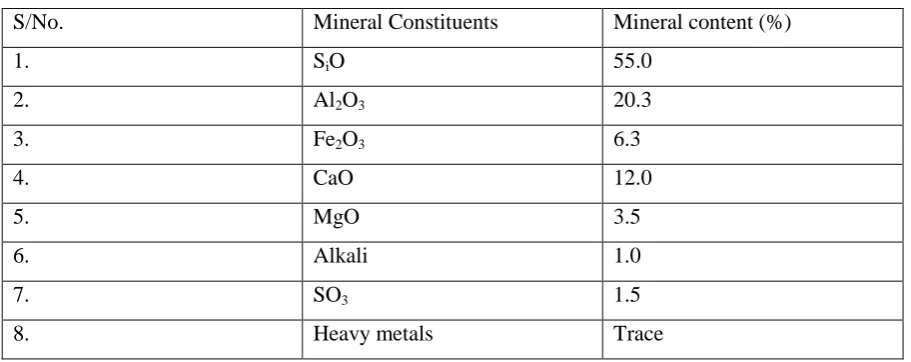
Table 6: constituents of Fly Ash.
S/No.
Mineral Constituents
Mineral content (%)
1.
S
iO
55.0
2.
Al
2O
320.3
3.
Fe
2O
36.3
4.
CaO
12.0
5.
MgO
3.5
6.
Alkali
1.0
7.
SO
31.5
8.
Heavy metals
Trace
644 | P a g e
VII. RECOMMENDATIONS
It is recommended from the review that cost analysis or economic consideration and possible comparison
between Unstabilized and stabilized roads should be done in further research works with much precision.
IX. CONCLUSION
It is observed that most research conducted on industrial solid wastes are bereft of economic details and
precision on how much cost will be saved as a result of using these wastes, longevity and reliability seem to be
minimal, methods and best construction equipment and processes are hardly mentioned, very few works
consider the mineral content of expansive soils in exact proportions through appropriate laboratory tests.
Generally, almost all the industrial wastes examined in this work have the ability to improve expansive soils.
REFERENCES
[1] Oyekan G. L, E. A. Meshida, & A. O. Ogundalu. (2013). Effect of ground polyvinyl waste on the
strength characteristics of black cotton clay soil. Journal of Engineering and Manufacturing Technology,
1-10.
[2] Jijo James, &Kasinatha Pandian. (2015). Effect of Micro Ceramic Dust on the Plasticity and Swell Index
of Lime Stabilized Expansive Soil. International Journal of Applied Engineering Research, 10(42),
30647-30649.
[3] Chen, James A, &Idusuyi, Felix O. (2015). Effect of W aste Ceramic Dust (WCD) on Index and
Engineering Properties of Shrink - Swell Soil s.International Journal of Engineering a nd Modern T
echnology, 1(8), 52-61.
[4] Akshaya Kumar Sabat. (2012). Stabilization of Expansive Soil Using Waste Ceramic Dust. The
Electronic Journal of Geotechnical Engineering, 17, 3915- 3926.
[5] Abd EI-AzizM.A.andAboHashema,M.A.(2013)―MeasuredEffectsonEngineeringPropertiesofClayey
Subgradeusing Lime-HomraStabiliser,‖International Journal ofPavement Engineering,14(4),321-332.
[6] Venkatasuresh .P, &Anthakumar.S. (2016). A Study on the Effect of Copper Slag and Lime Treated
Clay. In ternational Conference on Engineering Innovations and Solutions, 72-76.
[7] Mary Jessy Dcruz, &AswathySasikumar. (2016). Effect of Lime and Cement on the Strength
Improvement of Copper Slag Stabilized Soil. International Journal of Engineering Trends and
Technology, 36(7), 372-375.
[8] Havanagi, V., Prasad.P, Uruvittal, U.K, &Mathur , S. (2006). Feasibility of Utilization of Copper Slag –
Fly Ash – Soil Mixes for Road C onstruction. HIGHWAY RESEACH BULLETIN, 60-67.
[9] Sachin N. Bhavsar, Hiral B. Joshi, Priyanka k. Shrof, & A nkit J. Patel. (2014). Effect Of Burnt Brick
Dust On Engineering Properties On Expansive SOIL. international Journal of Research in Engineering
and Technology, 3(4), 433-441.
[10] Karthik.S, Ashok kumar.E, Gowtham.P, Elango.G, Gokul.D, &Thangaraj.S. (2014). Soil Stabilization
645 | P a g e
[11] Gyanen. Takhelmayum, Savitha.A.L, Krishna Gudi (2013).Laboratory Study on Soil Stabilization Using
Fly ash Mixtures.International Journal of Engineering Science and Innovative Technology
(IJESIT),2(1),477-481.
[12] Prabha Kant Pandey and A li Jawaid (2015). Soil Improvement Using Red Mud and Flyash. GJESR
Research,1 (12), 7-9.
[13] AltugSaygılı (2015). Use of Waste Marble Dust for Stabilization of Clayey Soil,Materials Science 21(4),
601-603.
[14] Moses G.K and Saminu. A (2012) - 825 - Cement Kiln Dust Stabilization of Compacted Black Cotton
Soil, The Electronic Journal of Geotechnical Engineering 12, 825- 826.
[15] Tiza Michael, Sitesh Kumar Singh and ManishKesharwani(2016) - Geotechnical Characteristics Of
Mango Shell Ash (MSA) On Black Cotton Soil As Pavement Material. International Journal Of
Innovative Research In Science And Engineering. (2) 19, 192-195.
[16] Tiza Michael, And Iorver Vitalis. "A Review of Literature on Effect of Agricultural Solid Wastes On
Stabilization Of Expansive Soil. ―International Journal for Innovative Research InMultidisciplinary
Field 2.7 (2016): 121 -132.
[17] Tiza Michael, Sitesh Kumar Singh."A Survey of Literature on Impact of Silica Fume (SF) and Saw Dust
Ash (SDA) On Expansive Soil", Volume 4, Issue VIII, International Journal for Research in Applied
Science and Engineering Technology (IJRASET) Page No: , ISSN : 2321-9653.
[18] HeshamIsmaiel. (2013). Cement Kiln Dust Chemical Stabilization Of Expansive Soil Exposed At
El-Kawther Quarter, Sohag Region, Egypt. International Journal of Geosciences, 04(10), 1416-1424.
Doi:10.4236/Ijg.2013.410139
[19] Keerthi, P. DivyaKanthi, N. Tejaswi, K. Shyam Chamberlin, B. Satyanarayana. (2013). Stabilization Of
Clayey Soil Using Cement Kiln Waste. International Journal of Advanced Structures and Geotechnical
Engineering, 2(2), 77-81.
[20] Peethamparan, S. And Olek, J. (2008) ―Study Of The Effectiveness Of Cement Kiln Dusts In Stabilizing
Na-Montmorillonite Clay,‖ Journal Of Materials In Civil Engineering, 20 (2), 137-146
[21] Vivek Singh and Rajesh Jain. (2015). Effect of Cement Kiln Dust (CKD) On Engineering Properties of
Black Cotton Soil. International Journal for Innovative Research in Science & Technology, 1(12), 86-90.
[22] Rahman. M.K, S. Rehman& O. S. B. Al-Amoudi. (2011). Literature Review on Cement Kiln Dust
Usage in Soil and Waste Stabilization and Experimental Investigation. IJRRAS, 7(2), 76-80.
[23] Upma, &Sudheer Kumar. (2015). Effect of Cement Kiln Dust and Chemical Additive on Expansive Soil
at Subgrade Level. International Journal of Innovative Research in Science, Engineering and
Technology, 04(06), 3851-3859. Doi:10.15680/Ijirset.2015.0406003
[24] Salahudeen, A.B., Eberemu,A.O. And Osinubi, K.J. (2014) ―Assessment Of Cement Kiln Dust-Treated
Expansive Soil For The Construction Of Flexible Pavements,‖ Geotechnical And Geological
Engineering, Doi 10.1007/S10706-014-9769-0
[25] Heeralal, & G.V. Praveen. (2011). A Study on Effect of Fibber on Cement Kiln Dust (CKD) Stabilized
646 | P a g e
[26] Bushra S. Albusoda and Lubna A. K. Salem. (2012). Stabilization Of Dune Sand By Using Cement Kiln
Dust (CKD). Journal of Earth Sciences and Geotechnical Engineering, 2(1), 131-136.
[27] Srivastava, L. Paramkusam, B.R. And Prasad, A. (2010). Stabilisation Of Engine Oil Contaminated Soil
Using Cement Kiln Dust. Indian Geotechnical Conference, 389-392.
[28] Ewa and E. A. Egbe. (2013). the Use of Cement Kiln Dust as Partial Replacement to Ordinary Portland
cement In Hollow Lateritic Blocks. Arpn Journal of Engineering and Applied Sciences, 8(9), 733-735.
[29] MohieElmashad and Ahmed Hashad. (2013). Improving The Strength Of Sandy Silt Soils By Mixing
With Cement Kiln Dust. Journal of Engineering Sciences, Assiut University, Faculty of
Engineering, 41(4), 1-8.
[30] Prasad Pujar&Sudeep M. (2016). Stabilization of Expansive Soil Using Cement Kiln Dust. Imperial
Journal of Interdisciplinary Research, 2(7), 1089-1094.
[31] Moses, G.K. And Saminu, A. (2012) ―Cement Kiln Dust Stabilization of Compacted Black Cotton Soil,‖
Electronic Journal of Geotechnical Engineering, 17(F), 825-836.
[32] Amadi, A.A., Lubem, S. (2014) ―Assessing Stabilization Effectiveness Of Combined Cement Kiln Dust
And Quarry Fines On Pavement Subgrades Dominated By Black Cotton Soil,‖ Geotechnical And
Geological Engineering, Doi 10.1007/S10706-014-9793- 0.
[33] KusumDeelwalKishanDharavath and Mukul Kulshreshtha3. (2014). Evaluation of Characteristic
Properties of Red Mud for Possible Use as A Geotechnical Material in Civil Construction. International
Journal of Advances in Engineering & Technology, 7(3), 1053-1057.
[34] Kalkan, E. And Akbulut, S. (2004) ―Positive Effects Of Silica Fume On The Permeability, Swelling
Pressure And Compressive Strength Of Natural Clay Liners,‖ Engineering Geology, 73, 145-156.
[35] Prabha and Ali. (2015). Soil Improvement Using Red Mud and Fly ash. GJESR Research, 1(12).
[36] Satayanarayana , Ganapati Naidu. P, S.Adiseshu,Ch. V. And Hanumanth Rao. (2012). Characterization
of Lime Stabilized Redmud Mix for Feasibility in Road Construction. International Journal of
Engineering Research and Development, 3(7), 20-25.
[37] Kuldip Singh, R K Pandey, C S Mishra, A K Rai, and Y K Bind. (2014). Analysis on Utilization of
Cement Kiln Dust Stabilized Red Mud for Road Construction. International Journal of Civil Engineering
and Technology (IJCIET), 5(8), 56-61.
[38] Robert Brook (2009). Soil stabilization with fly Ash and Rice Husk Ash. International Journal of