University of Pennsylvania
ScholarlyCommons
Publicly Accessible Penn Dissertations
Summer 8-14-2009
Permuted Inclusion Criterion: A Variable Selection
Technique
Shaun Lysen
University of Pennsylvania - Wharton School, [email protected]
Follow this and additional works at:http://repository.upenn.edu/edissertations
Part of theApplied Statistics Commons,Multivariate Analysis Commons,Statistical
Methodology Commons, and theStatistical Models Commons
This paper is posted at ScholarlyCommons.http://repository.upenn.edu/edissertations/28
For more information, please [email protected]. Recommended Citation
Lysen, Shaun, "Permuted Inclusion Criterion: A Variable Selection Technique" (2009).Publicly Accessible Penn Dissertations. 28.
Permuted Inclusion Criterion: A Variable Selection Technique
Abstract
We introduce a new variable selection technique called the Permuted Inclusion Criterion (PIC) based on augmenting the predictor space X with a row-permuted version denoted Xpi. We adopt the linear regression setup with n observations on p variables. Thus, our augmented space has p real predictors and p permuted predictors. This has many desirable properties for variable selection. For example, this preserves relations between variables, e.g. squares and interactions and equates the moments and covariance structure of X and Xpi. More importantly, Xpi scales with the size of X. We motivate the idea with forward selection. The first time we select a predictor from Xpi, we stop. As this depends on the permutation, we simulate many times and create a distribution of models and stopping points. This has the added benefit of quantifying how certain we are about stopping. Variable selection typically penalizes each additional variable by a prespecified amount. Our method uses a data-adaptive penalty. We apply this method to simulated data and compare its predictive performance to other widely used criteria such as Cp, RIC, and the Lasso. Viewing PIC as a selection scheme for greedy algorithms, we extend the PIC to generalized linear regression (GLM) and classification and regression trees (CART).
Degree Type
Dissertation
Degree Name
Doctor of Philosophy (PhD)
Graduate Group
Statistics
First Advisor
Andreas Buja
Keywords
variable selection, linear regression, permutation, CART, model selection
Subject Categories
Permuted Inclusion Criterion: A Variable Selection Technique
Shaun Lysen
A Dissertation
in
Statistics
Presented to the Faculties of the University of Pennsylvania in Partial
Ful-fillment of the Requirements for the Degree of Doctor of Philosophy
2009
Andreas Buja
Supervisor of Dissertation
Eric Bradlow
Acknowledgments
I would like to express my deepest gratitude to my advisor Andreas Buja. His unique
perspective on all areas of statistics, especially multivariate data, data visualization, and
statistical computing has had a profound impact on my way of thinking about data. A
big Thank You to Ed George and Abba Krieger for being on my Ph.D. committee and
providing me with useful feedback. I would also like to thank my fellow peers over the
past 4 years who have impacted my statistical thinking: Kenny, Kartik, Frank, Blake,
ABSTRACT
Permuted Inclusion Criterion: A Variable Selection Technique
Shaun Lysen
Andreas Buja, Advisor
We introduce a new variable selection technique called the Permuted Inclusion
Cri-terion (PIC) based on augmenting the predictor space X with a row-permuted version
denoted Xπ. We adopt the linear regression setup with n observations on p variables.
Thus, our augmented space has p real predictors and p permuted predictors. This has
many desirable properties for variable selection. For example, this preserves relations
between variables, e.g. squares and interactions and equates the moments and covariance
structure of X and Xπ. More importantly, Xπ scales with the size of X. We motivate
the idea with forward selection. The first time we select a predictor from Xπ, we stop.
As this depends on the permutation, we simulate many times and create a distribution of
models and stopping points. This has the added benefit of quantifying how certain we
are about stopping. Variable selection typically penalizes each additional variable by a
prespecified amount. Our method uses a data-adaptive penalty. We apply this method to
simulated data and compare its predictive performance to other widely used criteria such
as Cp, RIC, and the Lasso. Viewing PIC as a selection scheme for greedy algorithms, we
extend the PIC to generalized linear regression (GLM) and classification and regression
Contents
1 Introduction 1
1.1 The Need for Variable Selection . . . 3
1.2 Variable Selection in Linear Regression . . . 5
1.3 Building Candidate Models – Common Algorithms . . . 6
1.3.1 All Subsets . . . 6
1.3.2 Stepwise Methods . . . 7
2 Selection Criteria – When To Stop? 11 2.1 The Need for a Penalty . . . 11
2.1.1 Constantλ . . . 13
2.1.2 λas a function of p . . . 17
2.1.3 λas a function of pandk. . . 21
2.2 Other Variable Selection Schemes . . . 24
2.2.1 L1 methods . . . 24
2.2.3 Bayesian Methods . . . 34
2.3 False Selection Rate . . . 36
3 Permuted Inclusion Criterion 40 3.1 Augmenting the Data by Permutation . . . 40
3.2 Forward Selection with the PIC . . . 41
3.3 PIC applied to a single predictor . . . 43
3.4 Permutation Framework . . . 44
3.5 The Multivariate Case . . . 45
3.6 PIC as an adaptive choice ofλ . . . 49
3.7 How to Select the Model . . . 54
3.8 Choice ofα . . . 54
3.9 Relation to the False Selection Rate . . . 57
4 Rotations vs. Permutations 59 4.1 When is Permutation Valid? . . . 61
4.2 When is Rotation Valid? . . . 62
5 Extending the PIC 63 5.1 Generalized Linear Models . . . 63
5.2 PIC with GLM . . . 64
6.2 Simulations: p>n . . . 79
7 Permuted Selection and Trees 81 7.1 CART . . . 81
7.1.1 Traditional CART Stopping Criteria: Pruning . . . 83
7.1.2 Permuted CART Stopping Criterion . . . 84
7.1.3 How to Adjust and Select a Model . . . 85
7.1.4 Example . . . 86
7.1.5 Choice ofα . . . 91
7.2 Tree Extensions . . . 92
8 Conclusions 95
Chapter 1
Introduction
Variable selection has been of great interest to the statistical community for decades. It
is one of the most fundamental problems in statistical applications and has received a
great deal of theoretical input. Suppose we havenobservations of a response variabley
along with a potentially large number of predictor variablesX1,X2, . . . ,Xp and we seek
a model relating the predictors to the response. Not every predictor should be included
in the model and there are a few reasons why. First, a predictor may have no relation
to the response and thus has no reason to be included in the model. Second, although a
predictor may have a relation to the response, after we adjust for the variables already
included in the model, this relation becomes negligible. This often happens when our
predictors are highly correlated. Third, we desire simple models with as few predictors
as possible. This has a philosophical underpinning with Occam’s Razor, but also a
Identifying which subset of variables is “best” to build a model is precisely the variable
selection problem. For this reason, variable selection is synonymously known as subset
selection. More generally, subset selection is a special case of model selection where
each model corresponds to a distinct subset of the variables. In all that follows, our
pri-mary goal with variable selection will be prediction and we will measure goodness-of-fit
by squared error.
A fundamental problem with building a model is that we use the same data to both
select the subset and to evaluate its error rate, introducing bias into the selection problem.
As a result, the error rate will almost certainly be larger on a new data set. To correct
for this, many selection procedures have been developed. We propose a new selection
scheme called the Permuted Inclusion Criterion (PIC) that mitigates selection bias with
a penalty that adapts to the dimensionality and correlation structure of the data set. The
fundamental idea behind the PIC is the generation of a reference data set to serve as
fake data that has no relation to the response variable. We augment the predictor space
with this fake data so that we now have 2p variables. Suppose the real data has no
signal to explain the response. Then in theory, we should have no preference whether we
select a real predictor or a fake predictor. We will make all of this much more precise
in the following chapters, but this fundamental concept of augmenting the dataset with
nonsense predictors is essential. We will show this idea is much more general and can be
used with any greedy algorithm that selects a “best” variable.
we will motivate the PIC from this context. We will in later chapters, however, extend
the idea to generalized linear regression (GLM) and classification and regression trees
(CART).
This thesis is organized as follows. The remainder of Chapter 1 presents the need
and reasons for variable selection and the most common ways to build candidate models.
Chapter 2 provides an extensive overview of the most commonly used variable selection
criteria. In Chapter 3 we introduce and describe in detail the Permuted Inclusion
Cri-terion. Chapters 4 and 5 illustrate various extensions to the PIC including how under a
slightly different assumption, we can consider rotated versions of the data set. We also
extend it to Generalized Linear Models. In Chapter 6, we perform extensive simulations
and compare the performance of the PIC to other common schemes. We also illustrate
its use in the p > n case. In Chapter 7, we extend the PIC and apply it to building
Classification and Regression trees.
1.1
The Need for Variable Selection
We now consider a few reasons why variable selection is so important. Squared error
decouples into the squared bias plus the variance. These quantities nearly always trade
off against one another. When we include too few predictors in our model, we have
underfit which results in high bias with low variance. On the other hand, if we include too
many predictors, we have overfit which results in low bias with high variance. Delicately
suppose that we have a variable Xj that has a weak relationship with the response. By
including it in the model, we will decrease the bias. However, the addition of an extra
variable increases the model’s variance, and if this increase is larger than the decrease
in bias, we would be better off excluding this variable. Much of the variable selection
literature is devoted to balancing this tradeoffand developing good selection criteria to
select an optimal number of predictors.
An additional goal is interpretatation. The fewer predictors we include in our linear
model, the more interpretable the model is. In many scientific studies, the relationship
between inputs (predictors) and output (response) is paramount and this relationship is
better understood with fewer predictors. We clearly do not want to omit any important
variables, but we desire as simple of a model as possible.
Related to interpretability is a philosophical motivation from Occam’s razor that seeks
“the hypothesis with the fewest assumptions and fewest entities among competing
hy-potheses”. In our case, all the models have the assumptions of normally distributed
inde-pendent errors and a linear inβrelationship between predictors and response. The fewest
entities then correspond to the model with the fewest number of nonzero coefficients. All
else equal, we seek the most parsimonious model.
Finally, in the increasingly common case where the number of predictors pis greater
than the number of observations n, variable selection is a requirement. Including all
p variables is impossible since we have at most n linearly independent variables. We
intelligently choose which variables appear in our model.
1.2
Variable Selection in Linear Regression
As variable selection is most frequently studied in the linear regression case, we develop
our ideas in this framework. Linear regression models are the most prevalent in
appli-cations and often serve as a good first appoximation to nonlinear models. In all that
follows, we will assume the data is centered so that we do not concern ourselves with an
intercept1.
Consider the traditional linear regression setup:
y= µ+ =Xβ+ where y= (y1,y2, . . .yn)T ∈Rn
X=(X1,X2, . . .Xp)∈Rn
×p ∈
Rn with ∼ Nn(0, σ2In)
We adopt the residual sum of squares (RSS) as our error rate defined by:
RSS(β)= (y−Xβ)T(y−Xβ)
Variable selection requires two phases. First, we need to build a pool of candidate
models and second, we need to select the best model from this pool. In this chapter we
discuss building candidate models, devoting all of Chapter 2 to the selection problem.
1.3
Building Candidate Models – Common Algorithms
One of the primary problems of subset selection is that we have 2p possible models to
consider. For pof even moderate size, an exhaustive search is infeasible. For example,
with p = 30, we have a billion potential models. Moreover, suppose we did generate all
2p models. Unless pis small, this is generally a bad idea. The larger the pool of models
we select from, the larger the selection bias. Consequently, we seek a balance between
a computationally feasible strategy that also discovers “good” models. We next discuss
the most common methods: All Subsets, Forward Selection, Backward Elimination, and
Stepwise.
1.3.1
All Subsets
All Subsets seeks the best fitting model from all possible subsets of variables. Since we
build all possible models, all subsets is guaranteed to contain the globally optimal model.
No other model building strategy can guarantee this. When we have a small number of
predictors, all subsets can be a good idea. For example, suppose we have 10 predictors
and when looking at the best subsets of size 5, we always see the same 3 predictors
appearing in the list. This gives strong evidence these three variables should be in the final
model. Additionally, when we have a larger number of predictors, clever methods exist
for speeding up the algorithm such as branch and bound techniques (Furnival and Wilson,
1974), which eliminate infeasible models from consideration. However, all subsets still
1.3.2
Stepwise Methods
Forward Selection and Backward Elimination are similar methods that sequentially add
or delete one variable at a time, respectively. In Forward Selection, we start with the
null model with no predictors. At each step, we add the variable most correlated with
the current residual vector. We then orthogonalize the residual vector and all other
pre-dictor variables not yet selected with respect to the variable just added. The variable
“most correlated with the current residual vector” is equivalent to the most significant
predictor from software output. That is, we seek the variable with the smallest p-value
or equivalently, largest t-statistic in absolute value. We will however, focus on the square
of the t-statistic or the F-statistic for reasons that will be clear. We continue adding
vari-ables until we have added them all or we satisfy a stopping criterion. The most widely
used stopping criterion is the F-to-enter. We prespecify the F-to-enter before building the
model, and the first time the largest F-statistic is smaller than the F-to-enter, we stop.
Backward Elimination proceeds with all variables in the model and sequentially deletes
the variable least correlated with the current residual vector. We continue until we have
dropped them all or we have reached some stopping criterion. Analogous to forward
selection, the most widely used stopping criterion is the F-to-delete. We prespecify the
F-to-delete and the first time the smallest F-statistic is larger than the F-to-delete, we stop.
In the case p>n, backward elimination fails because we have ambiguity about where to
start. Anynlinearly independent variables span the entire space and yield a residual sum
Forward Selection and Backward elimination strike a sensible balance between
com-putational feasibility and finding good models but they do have their drawbacks. They
can select vastly different models. For example, we can create a data set where the first
variable to be added with Forward Selection is also the first variable to be deleted with
Backward Elimination. As a result, we often combine these two strategies into one
al-gorithm called Stepwise regression. Stepwise regression alternates between adding the
most significant variable and then deleting the least significant variable. One reason
Step-wise can be better than Forward Selection or Backward Elimination alone is collinearity.
That is, once a variable is added to the model, it may have made other variables already
in the model much less significant because of this collinearity and they should be
re-moved from the model. If we were strictly moving in a forward direction, this would not
be possible. Put another way, while all three of these strategies are greedy algorithms,
Stepwise is less greedy than Forward Selection or Backward Elimination alone. Since
we both add and delete variables, Stepwise requires both an F-to-enter and an F-to-delete
criteria. One natural question to ask is will this algorithm converge? With Forward
Se-lection and Backward Elimination, it’s clear when we stop. With Stepwise, we may not
be able to add an additional variable, but once we delete the least significant variable,
the F-statistics all change, meaning we may be able to add a variable now. A sufficient
condition for convergence is that the F-to-delete is smaller than the F-to-enter.
An additional problem with all three of these algorithms is that there is no reason
In fact, we can construct an example where the best subset of kvariables has an empty
intersection with the bestk+1 variables. The above stepwise procedures would require
the bestk variables to be a subset of the bestk+1 variables since we only consider the
addition or deletion of a single variable at a time. We might consider adding or deleting
2 or 3 variables at a time, but this increases the computational complexity, which was
one of the main reasons we decided on these methods in the first place. We can think of
these stepwise methods as sensible quick and dirty ways to build candidate models, but
to understand there is no reason to believe we will be anywhere near the global optimum.
For the rest of this paper, we will focus on Forward Selection as it is the clearest
framework to describe our method, and works in the case where p>n. We now describe
it in much more detail.
Forward Selection
Forward Selection starts out with the null model with no predictors selected. Then at
each step, we select the variable most correlated with the current residual vector.
We have the standard regression setup withnobservations of a responseyand p
pre-dictors arranged in a matrixX. We introduce the following notation. LetI={1,2, . . .p}
and let A be a subsetA ⊆ I andAc = I \ A. That is, Iis the index set of all the
variables, and we defineAas the active index set of variables currently in the model, and
Ac is the index set of variables yet to enter the model. We defineA
j as the active index
set for the first jvariables to enter. Thus we have the relation Aj
we letijbe the index of the jthvariable to enter. ThusAj =
n
i1,i2, . . .ij
o
. Because we are
working with Forward Selection where we do not delete variables we have the relation
A1 ⊆ A2 ⊆. . .⊆ Ap
Result: Forward Selection
Step 0. We initializeA0 =∅, µˆ0 =0, X0 = X
for j=1tomin(p,n)do
1. ij =argmaxi∈Ac j−1 cor
y−µˆj−1,X j−1 i
2. Aj = Aj−1∪ij
3. LetHj = 1
Xi jj−1TXi jj−1X
j−1 ij X
j−1T ij
4. ˆµj = µˆj−1+Hj
y−µˆj−1
5. Xj = I n−Hj
Xj−1
end
Algorithm 1: Forward Selection Algorithm: Step 1 selects the variable index most
correlated with the current residual vector. Step 2 adds that index to the active set. Step
3 computes the projection matrix to orthogonalize. Step 4 updates the current model fit
and Step 5 orthogonalizes all remaining variables not yet selected.
This algorithm gives a set of min(p,n)+1 models. From this set we need to choose our
“best” model. The following chapter gives common selection techniques. The interested
reader can find a nice, succinct overview of variable selection (George, 2000), or for a
Chapter 2
Selection Criteria – When To Stop?
All of the variable selection algorithms proposed in the last chapter share one big question
– When do we stop? We introduced the F-to-enter idea but without giving any idea to how
large it should be. We now put this question in terms of the canonical variable selection
problem.
2.1
The Need for a Penalty
There is an inherent problem with the RSS criterion. For a fixed number of k nonzero
coefficients, this is a sensible criterion to compare models. However, the addition of
a (k+1)st variable to the model will always have a smaller RSS than the model with k
variables. Therefore, in order to select between models of different sizes we need to
β∗
k,λ =arg minβ
(y−Xβ)T(y−Xβ)
σ2 +λk
where k is the number of nonzero predictors and λis the penalty. Each additional
variable is penalized by the constant term λ. This framework encompasses many of the
most common variable selection techniques with different choices of λ. Note that we
divide the RSS by the noise variance. Using this criterion with Forward Selection, we
add a variable if and only if
RSSk+1
σ2 +λ(k+1)≤ RSSk
σ2 +λk
or equivalently if
RSSk−RSSk+1
σ2 ≥ λ
Practically speaking, we never know the noise variance and thus must use an estimate ˆσ2.
We then have
(RSSk−RSSk+1)/σ2 ˆ
σ2/σ2
which follows the form of an F statistic. Under the null hypothesis that all remaining
variables have zero coefficients, this follows the F distribution on 1 and n-k degrees of
freedom. The estimate ˆσ is typically taken as the Root Mean Square Error (RMSE) of
the model with kvariables. Therefore, we see that we add a variable to the model if its
F-statistic is larger thanλ. We have a direct correspondence betweenλand the F-to-enter
schemes that can roughly be broken into 3 groups: constantλ,λas a function of p, andλ
as a function of both pandk.
2.1.1
Constant
λ
Searching for Significance: λ≈4
We start with a method that does not have a strong theoretical basis, but remains
ubiq-uitous in introductory regression courses. We term this “searching for significance.” We
start with a null model and keep adding the variable with the smallest p-value until no
variables have a p-value smaller thanα = .05. Using this cutoff, we add a variable if its
t-statistic is above approximately 2 in absolute value. This corresponds to an F-statistic
of 4. We mention it briefly to serve as an anchor for other methods, as we are certain it is
a criterion you have encountered in the past.
Mallows’ Cp: λ= 2
We defineCpas
Cp =
RSSk
ˆ
σ2 −n+2k
We see that this is exactly the variable selection formulation we have above with λ = 2
with the exception of subtractingn. Since the number of observations is the same for all
models we consider, this does not affect the ranking of models byCp. Mallows motivated
this statistic as an unbiased estimate of the model error scaled by the noise variance:
1
σ2kXβ−Xβkˆ
2 = 1
To directly show the bias-variance breakdown, we expand this (dropping theσ2for now)
Ekµ−µkˆ 2 =Ekµ−E( ˆµ)+E( ˆµ)−µkˆ 2 =Ekµ−E( ˆµ)k2+EkE( ˆµ)−µkˆ 2
These two terms are precisely the squared bias and the variance, respectively. The
vari-ance is exactly equal to kσ2. The squared bias can be estimated by RSSk −(n− k)σ2.
Practically speaking we have to estimateσ2which we typically take as the residual
vari-ance from fitting the full model. Plugging this value in forσ2and dividing both sides by
it, we deriveCp.
The bias we mention above is bias from omitting a variable. The other bias to be
very aware of is selection bias. WhileCpis an unbiased estimate of the model error1, the
moment we use it to choose among many models, it’s no longer unbiased. Mallows took
great care to warn against usingCpto select a best model.
“The discussion above does not lend any support to the practice of
tak-ing the lowest point on aCp plot as defining a “best” subset of terms. The
present author feels that the greatest value of the device is that it helps the
statistician to examine some aspects of the structure of his data and helps
him to recognize the ambiguities that confront him.”
Despite this,Cpis often used to select a best model, and moreover, attributed to him! See
also (Mallows, 1995)
AIC:λ= 2
Akaike (1973) formulated the Akaike Information Criterion (AIC) from an information
theory perspective. Suppose that the data was truly generated from a density g. If we
consider any other density f, the Kullback Leibler Divergence (KL) is defined as
KL(g||f)= Z ∞
−∞
g(x) logg(x)
f(x)dx = Z ∞
−∞
g(x) logg(x)−
Z ∞
−∞
g(x) logf(x)
=Eglogg(x)−Eglog f(x)
whereEgdenotes expectation with respect tog. We assume f is parameterized byθ∈Θ.
Our goal is to choose θ to minimize the KL between g and f. Note that the first term
Eglogg(x) only depends ongand is common to all models. Thus minimizing the KL is
equivalent to minimizing−Eglog f(x) – the expected negative log likelihood of f under
g. One key problem is that we do not knowg. However, we have a sample from it and
can form the sample mean
1
n
n
X
i=1
log f(xi)
In the traditional linear regression setup and assumingσ2is known, logf(x) is given by
the RSS/2σ2with some constants that do not matter. By doing a Taylor series expansion
to second order around the expectation of the minimizer, we arrive at
−Eglog f(x)≈ −RS S
2σ2 +k
where k is the dimensionality of θ. In our regression setup, θ is the β vector. Since
double the above quantity.
−2 log f(x)+2k
Consequently, this gives a penalty of λ = 2. We note that AIC is much more general
applying to any model with a parameterized likelihood. We only applied it to linear
regression in this context. Hurvich and Tsai (1989) derive a bias-corrected AIC more
appropriate for small sample sizes given by
AICC = AIC+
2(p+1)(p+2)
n−p−2
BIC:λ= log(n)
While BIC does not have constantλit’s often mentioned with AIC, and falls best within
this group. Schwarz (1978) motivated the Bayesian Information Criterion (BIC) from a
model consistency framework. That is, asymptotically we select the correct model with
probability approaching one. Forn≥8 it penalizes models more harshly than does AIC.
BIC is derived by the fact that maximum likelihoood estimators (MLE) are asymptotic
limits of Bayes estimators for a certain class of priors. If we expand these estimators to
a second term, we get the BIC penalty. BIC is asymptotically equivalent to selection by
Bayes factors.
BIC is further justified from a coding theory perspective. Rissanen (1978) formulated
linear regression from a compression perspective called the Minimum Description Length
(MDL). Simply stated, we prefer the model that compresses the data the most. MDL
dataDunder the modelHup to a prespecified precision (MacKay, 2003). Optimal codes
communicate the string sin−
log2p(s)
bits, wherepis the probability ofs(Cover and
Thomas, 2006). Ignoring rounding issues, this is precisely the negative log likelihood.
In the standard linear regression setup,Hcorresponds to which coefficients are nonzero.
Rissanen postulated a precision of log(√n) per parameter. Consequently, we have
−p(D|H)+|H|log(√n)=−RSS
2σ2 + 1
2log(n)k
If we multiply this by 2, this is equivalent to BIC.
2.1.2
λ
as a function of
p
Suppose all pvariables are normally distributed and orthogonal. That is
XTjXk = 0 ∀i, j
Additionally, we assume that we have a null model
y= ∼ N(0, σ2)
where all of the variables have a zero coefficient. AIC and other constant penalties
notori-ously include too many irrelevant predictors (Breiman and Freedman, 1983). A desirable
goal for our selection procedure would be to not overfit in this completely nonsense case.
It we letFidenote the F-statistic from including theithvariable in the model, we correctly
select the null model if
or equivalently,
max
i∈1,2,...pFi ≤ λ
Our choice of whether we add a variable to the model depends on the distribution of
the maximum of p (nearly) independent F statistics2. This distribution can look vastly
different from the F distribution. To quote Miller (2002), changing notation to match
ours,
“The use of the terms ‘F-to-enter’ and ‘F-to-delete’ suggests that the
ra-tiosFi have an F-distribution under the null hypothesis, i.e. that the model is
the true model, and subject to the true residuals being independently,
identi-cally and normally distributed. This is not so. Suppose that after k variables
have been entered, these conditions are satisfied. If the value of Fi is
cal-culated for one of the variables chosen at random, then the distribution is
the F-distribution. However, if we choose that variable which maximizes
Fi, then the distribution is not an F-distribution or anything remotely like an
F-distribution.”
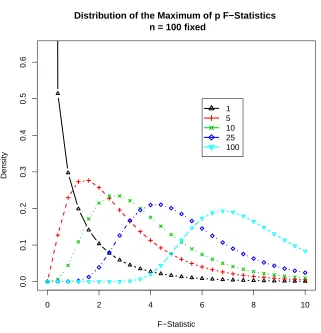
Below we show precisely what that distribution looks like for various values ofp. We
fix the number of observationsnat 100.
2Technically speaking, all F-statistics share the same denominator so they are not independent.
0 2 4 6 8 10
0.0
0.1
0.2
0.3
0.4
0.5
0.6
F−Statistic
Density
1 5 10 25 100
Distribution of the Maximum of p F−Statistics n = 100 fixed
Figure 2.1: Distribution of the maximum F-statistic for p independent normal random
variables with a response y that is also a normal random variable. This represents the
maximum F to enter in a model that is pure noise.
The above figure clearly shows that our choice ofλshould be increasing in p. This
is intuitively clear since the larger our pool of variables to select from, the larger we
expect this maximum to be. The leftmost distribution corresponds to p = 1. This is the
F-distribution that all standard software packages would calculate p-values with respect
Risk Inflation Criterion makes it rigorous.
RIC:λ= 2 log(p)
George & Foster motivate the Risk Inflation Criteria (Foster and George, 1994) by
con-sidering the worst possible inflation of risk due to selection, relative to the true model.
More specifically, define the Risk Inflation (RI) as
RI( ˆβ)= sup β
EkXβ−Xβˆk2
EkXβ−Xβˆ∗k2
where we define ˆβ∗ to be the estimated β vector if an oracle told us precisely which
coefficients are nonzero. Choosingλ=2 log(p) in the canonical variable selection
prob-lem yields a model that is minimax with respect to RI when the predictors are orthogonal.
This penalty is important. It is the first one that grows with the size of the predictor space.
As the graphs above demonstrate, this is a desirable trait. Additionally, the expected value
of the maximum F-statistic is asymptotically 2 logpmotivating this penalty even more.
This penalty also coincides with the universal threshold for wavelets developed
indepen-dently by Donoho and Johnstone (1994). Another illuminating connection is between the
RIC and the Bonferroni correction. When we are in a multiple testing framework with
ptests and seek control over the Familywise Error Rate (FWER) at levelα, we conduct
each individual test at levelα/p. If we translate theα/pquantile to the F-distribution, this
is asymptotically sandwiched for large pbetween 2 logpand 2 logp−log logp(Foster
2.1.3
λ
as a function of
p
and
k
Now suppose we remove the restriction of a null model so that the βvector might have
nonzero entries and that we have added the first variable. Is it fair to penalize the next
variable by the same 2 logp penalty? If the remaining p-1 variables truly have zero
coefficients, we are now selecting an F-statistic from one of two distributions. First,
if we added the first variable correctly, then we are selecting the largest of p − 1
F-statistics. If instead we added the first variable incorrectly, then we are selecting the
2nd largest of pF-statistics. Additionally, each of these distributions are truncated at the
value of the maximum F-statistic. In either case, we are selecting from a distribution that
is stochastically smaller than the largest F-statistic. The truncation only accentuates this
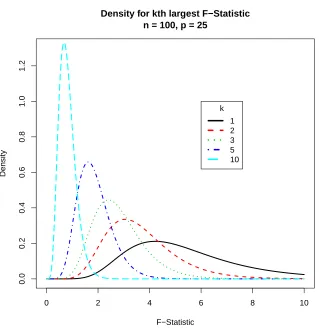
fact. So, intuitively, we should relax the penalty. We illustrate this graphically below.
We now ask more generally, suppose we have added k variables, how should we
penalize the addition of the (k+1)st variable.
False Discovery Rate
The penalty decreasing inkcan be motivated from an important statistical perspective –
the false discovery rate (FDR) (Benjamini and Hochberg, 1995). The false discovery rate
is a multiple testing procedure that controls the proportion of falsely rejected hypotheses.
In the variable selection context, a rejected hypothesis corresponds to adding a variable to
the model. A falsely rejected hypothesis corresponds to adding a variable that we should
0 2 4 6 8 10
0.0
0.2
0.4
0.6
0.8
1.0
1.2
Density for kth largest F−Statistic n = 100, p = 25
F−Statistic
Density
k
1 2 3 5 10
Figure 2.2: Distribution of various order statistics for the F-distribution for 100
observa-tions of 25 independent normal random variables with a response y that is also a normal
random variable. This motivates the idea whyλshould be decreasing ink.
by a smaller amount since the total number of rejections – the denominator of the FDR –
is increasing. For example, the addition of the first variable causes the FDR to be either
0 or 1 – a difference of 1; whereas the addition of the tenth variable causes the FDR to
differ by 1/10. Each variable added impacts the FDR less so we are more tolerant of an
Modern Methods: λ= 2 log(p/k)
Many of the most recently developed variable selection penalties share this trait. The
penaltyλshould be increasing in pwhile decreasing inkas we add additional variables.
Precisely, under the assumption that the number of nonzero predictors grows at a slower
asymptotic rate than the number of predictors, i.e. k=o(p), we have a family of penalties
that are approximately λ = 2 log(p/k). For the first variable, the penalty is the same as
RIC.
Foster and Stine (1999) derive the penaltyλ= 1/kPk
i=12 log(p/k) from information
theory. Assumingk =o(p), this is asymptotic to 2 log(p/k).
Tibshirani and Knight introduced the Covariance Inflation Criterion (CIC) (Tibshirani
and Knight, 1999b) which adjusts for overfitting by subtracting the average covariance
between the predicted and actual response on permuted versions of the dataset. When the
predictors are orthogonal, the penalty isλ=2/kPk
i=12 log(p/k). This penalty is twice as
large as Foster and Stine’s penalty.
George and Foster (2000) propose an Empirical Bayes approach where coefficients
are drawn from the mixture prior (1−w)δ0+w N(0,C).δ0is a point mass at 0 representing
a variable not in the model. They estimate the hyperparameters wandC from the data.
They argue that this estimator penalizes the kth variable by a quantity close to 2 log((p+
1−k)/k).
Birge and Massart (2001) studied model selection under a class of penalties including
Abramovich et al. (2005) connect asymptotic minimaxity and multiple testing for a
wide range of sparsity classes under a False Discovery Rate framework that penalizes
models closely to 2 log(p/k)
2.2
Other Variable Selection Schemes
2.2.1
L
1methods
All of the preceding methods can be viewed in another way: regularization of theβvector
by the L0norm. That is we selectβto minimize
β∗
k,λ =arg minβ
(y−Xβ)T(y−Xβ)
σ2 +λkβk0
wherekβk0 = Pp
i=1I(βi , 0)
As discussed above, one of the inherent difficulties of this problem is searching over
all 2p subsets which grows exponentially in p. One way to generalize this criterion is to
consider a different norm. Suppose we replace theL0norm with a generalLqnorm.
β∗
q,λ =arg minβ
(y−Xβ)T(y−Xβ)
σ2 +λkβkq
This is exactly what is known as bridge regression (Frank and Friedman, 1993).
Com-mon specific cases correspond toq= 2: Ridge regression (Hoerl and Kennard, 1970) and
q= 1: the Lasso (Tibshirani, 1996).
We can gain additional insight by considering a few base cases. Assume that the
common methods to the ordinary least squares estimates (OLS)
1. Ridge: q=2
ˆ
βRidge
j = (1+λ)
−1βˆOLS j
2. Lasso: q=1
ˆ
βLasso
j = sgn( ˆβ OLS
j )(|βˆ OLS
j | −
λ
2)+
3. Subset Selection (SS): q=0
ˆ
βS S j =β
OLS j I(|βˆ
OLS j | ≥λ)
Ridge shrinks theβvector by a multiplicative factor, but never setting any coefficients
to 0. The Lasso performs soft thresholding, shrinking each coefficient towards zero by
a constant amount. If this constant is greater than ˆβj, it sets the coefficient to 0. Subset
Selection performs hard thresholding, or the “keep or kill” strategy, by either leaving
each coefficient unchanged or setting it equal to 0.
Lasso
One fact about Bridge regression is whenq≥1, this penalized criterion performs
shrink-age of theβ vector as we see with the Lasso and Ridge penalties. The literature on the
benefits of shrinkage is vast. See (Stein and James, 1961; Lehmann et al., 1998) for its
origins in estimating the sample mean. For many shrinkage examples in modern statistics
where shrinkage improves prediction, see (Hastie et al., 2001). An additional benefit is
finding the “best” subset is NP-hard. Changing to a convex penalty, the solution is more
easily found through widely available convex optimization software. For a good
refer-ence on convex optimization see Boyd and Vandenberghe (2004).
On the other hand, Bridge regression whenq≤ 1, performs selection of theβvector,
setting some coefficients equal to 0. The Lasso withq = 1 sits right at the boundary of
these two operations. In fact, that is what Lasso stands for: Least Absolute Shrinkage
and Selection Operator. The Lasso can be viewed as the closest convex approximation
to the variable selection problem, replacing theL0 norm with theL1norm. Additionally,
the L1 penalty is continuous so that we are able to see the entire profile of regression
coefficients as we vary the penalty λ. At the two extremes, λ = 0 yields the full OLS
model whileλ=∞yields the null model. Figure 2.3 is an example. We also include the
more common Lasso coefficient profile where the x-axis is the fraction relative to the full
OLS fit.
Least Angle Regression
Least Angle Regression (LARS) (Efron et al., 2004) is one of the most fascinating recent
developments in the linear model literature. LARS can be viewed as a smooth, continuous
less-greedy version of Forward Selection. Forward Selection and LARS both start by
selecting the variable that is most correlated with the response. Where they differ is how
much they move in that direction. Forward Selection moves along that direction until
0 200 400 600 800 1000
−20
−10
0
10
20
Regression Coefficients for values of lambda
lambda
Coefficients
0.0 0.2 0.4 0.6 0.8 1.0
−20
−10
0
10
20
Regression Coefficients for fractions of OLS fit
|beta|/max|beta|
Coefficients
Figure 2.3: Coefficient profile for the Lasso as we varyλon the left, and as we vary the
fraction relative to the full OLS fit on the right. This is the diabetes data taken from Efron
et. al (2004)
direction until we reach a point where another variable is equally correlated, we stop and
change directions to the one that is equiangular to the two equally correlated variables.
This is best illustrated with a geometric example.
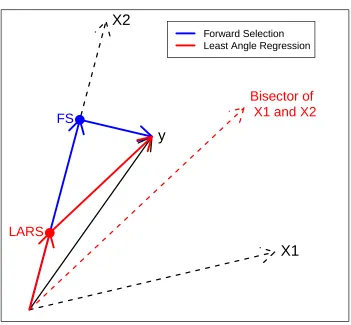
We have a response variableywith two predictor variables X1andX2. The variable
most correlated withyis equivalent to the variable which forms the smallest angle with
it. In this case, we selectX2first. Both Forward Selection (FS) and LARS proceed in this
direction. They differ by how far they travel.
Here we see the precise path that FS and LARS take. Forward Selection proceeds
along X2 until the residual vector is orthogonal to it. It then moves in this orthogonal
X1
X2
y
●
●
●
Bisector of
X1 and X2
LARS
FS
Forward Selection Least Angle Regression
Forward Selection vs. Least Angle Regression
Figure 2.4: Both Forward Selection and Least Angle Regression selectX2as the direction
to move. Forward Selection travels until the residual vector is orthogonal. Least Angle
Regression travels to the point where the residual vector is equally correlated withX1and
residual vector is equally correlated – equivalently forms the same angle – with X1 and
X2. It then proceeds in the direction equiangular toX1andX2 – the angle bisector.
Un-fortunately, we can only view this in two dimensions but the LARS algorithm generalizes
to more than two directions. We add a new variable to the model each time its correlation
with the current residual vector matches the correlation with those variables already in
the model. We then recompute the equiangular direction with the new variable added,
and proceed in that direction. LARS, just like Forward Selection, eventually reaches the
Ordinary Least Squares (OLS) solution. It just does so in a less greedy manner. The
geometric reasoning behind LARS is what gives it its name. At any given point in the
algorithm, those variables that form the least angle with the current residual vector are
included in the model. Any variables forming a larger angle are excluded.
Even more remarkable, with slight modifications of the algorithm, we can derive the
entire path of Lasso solutions and the infinitesimal forward stagewise solutions. We point
the interested reader to the original paper (Efron et al., 2004) and to a follow-up equating
Lasso and Forward Stagewise in an expanded predictor space (Hastie et al., 2007).
Dantzig Selector
The Dantzig Selector (Candes and Tao, 2007) is a recent development especially suited to
the p> ncase, where we can recover the nonzero components of theβvector with large
Selector is defined to be the solution to the convex problem
min β∈Rp
kβkl1 subject to
X
t
r
l∞ ≤ λσ
wherer =y−Xβis the residual vector. They recommendλ= p2 logp, which coincides
with the RIC penalty. Candes and Tao showed that the program can be recast as a linear
program, speeding up computation time. A remarkable result is that the mean squared
error of β is within a logarithmic factor of the mean squared error if an oracle told us
precisely which coefficients were nonzero. This result is not asymptotic. We should
note the mean squared error above is for the βvector, not the Xβ vector for prediction.
Efron et al. (2007) show the predictive performance of the Dantzig Selector relative to the
Lasso to be similar in some cases and inferior in others. In the rejoinder, Candes and Tao
specifically note the applications in biomedical imaging, genomics, and data conversion
where estimatingβis paramount.
2.2.2
Data Resampling Methods
Resampling methods attack variable selection from a different perspective by sampling
repeatedly from the data to mimic what would happen with new data.
Cross Validation
The fundamental idea behind cross-validation (CV) is to divide the data into two parts and
use the first part to build the model and the second part to evalute the fit. We generally
nearly equal) parts. We denote these parts by Γ1, . . .ΓK and let Γ(k) be the data with
Γk deleted, k = 1, . . . ,K. Suppose we have a sequence of forward selection models
M0,M1, . . .MpwithMjthe model with jvariables. Then for eachk, we carry out forward
selection on Γ(k) generating models M0k,M1k. . .Mkp with respective sizes 0,1, . . .p. Note
that there is no reason forMk
j to have the same jvariables as Mjsince Forward Selection
may select different variables on different subsets. Then for each model sizejwe evaluate
its cross-validated error (CVc) as
c
CV(j)= 1
n
K
X
k=1 X
(yi,xi)∈Γk
(yi−µˆk(xi,Mkj)) 2
where ˆµk is the predictand evaluated on the left out subsetΓk under model Mkj.
We select model sizek = arg minjCVc(j). Stone (1977) showed that leave-one-out
cross-validation (K = n) is asymptotically equivalent to AIC. However, Breiman and
Spector (1992) recommend five-fold cross validation for variable selection based on
sim-ulation results because leave-one-out CV tends to select the same model as the entire data
too often.
Both leave-one-out and five-fold CV are inconsistent for model selection. Shao
(1993) showed that they tend to include too many variables. He proves we can ensure
model consistency by letting the number of observations left out nv satisfynv/n → 1 as
Bootstrap
The bootstrap attacks the variable selection problem by sampling with replacement from
the empirical distribution. The bootstrap is typically applied in one of two ways. First,
we can bootstrap the residuals. We start by fitting the full model estimating regression
coefficients ˆβand the residualsei, i= 1, . . .n. We then studentize the residuals defined by
e∗i =ei/
√
1−hi wherehi is theith diagonal element of the hat matrixH =X(XTX)−1XT.
We then generate for each observation, a new y∗j = xjβˆ + e∗j where e
∗
j is sampled with
replacement from the studentized residuals. Crucial to bootstrapping residuals is that
they have constant variance. This method is suitable if we treatXas fixed.
Second, we can bootstrap by sampling with replacement from the observed (xi,yi)
pairs. This method is appealing if we are working in the random-Xcase. It also makes
no assumptions on the model, unlike the homoscedastic error assumption above.
Conse-quently, we can view bootstrapping (x,y) pairs as “more nonparametric” than
bootstrap-ping residuals. One problem that may arise in the p > ncase is each bootstrapped data
set has rank on average about 63% as large as the original data set.
Shao (1996) showed that this bootstrap scheme is not consistent. If we bootstrap
residuals, we can ensure consistency by increasing the variability of the residuals. If
we bootstrap pairs, we can ensure consistency by constructing smaller bootstrap samples
with size nb with nb/n → 0 asn → ∞. For a thorough treatment of the bootstrap see
Little Bootstrap
Breiman (1992) introduced the little bootstrap as an alternative toCp that does not suffer
from such severe selection bias. Suppose we fit a model with j coefficients denoted ˆµj.
The model error can be written as
ME( ˆµj)=kµ−µˆjk2 =RSSj−RSSp+kµ−µˆpk2−2(,µˆp−µˆj)
where the subscript pdenotes the full model with all predictors included and (·,·) is
the inner product. We also estimate the residual variance from the full model fit ˆµp. The
first two RSS terms are directly computed. We can estimatekµ−µˆpk2as pσˆ2 assuming
the full model has no bias. We need an estimate for this last term. Breiman proposes the
little bootstrap to estimate this term. We generate bootstrapped responses as
˜
yi =yi+˜i where ˜i ∼N(0,t2σˆ2)
Note that we add the error term to the original responseyand not the predicted response
ˆ
ylike the residual bootstrap of the previous section. We then fit the model using forward
selection to the (˜yi,xi) pairs with jvariables and all pvariables as above. Call these fits
˜
µjand ˜µp. We then calculate
1
t2(˜,µ˜p−µ˜j)
Repeat this Btimes and average. Breiman showed that
1
t2E(˜,µ˜p−µ˜j)≈ E(,µˆp−µˆj)
expression above.
d
ME( ˆµj)=RSSj−RSSp+ pσˆ2−
2
B
B
X
b=1
(˜b,µ˜bp−µ˜bj)
where the superscript bcorresponds to a particular bootstrap sample. Based on
simula-tions, Breiman recommends t = 0.6 and B = 40. The best model is then chosen with
respect to this model error estimate.
2.2.3
Bayesian Methods
The Bayesian view on variable selection has seen a great deal of research in the past two
decades. The fully Bayesian approach is as follows. Suppose that we have 2p models
denoted by M1,M2, . . . ,M2p each of which corresponds to a distinct subset of the
vari-ables{X1,X2, . . .Xp}. We need two prior probabilities. First, we need a prior probability
for the model Mγ which we denoteπ(Mγ) and given the model, we need priors for each
regression coefficient, denoted byπ(βj|Mγ), j =1,2, . . .p. The posterior probability for
model Mγis given by
π(Mγ|y,X)= pγ
(y|X)π(Mγ)
P2p
k=1pk(y|X)π(Mk)
where
pγ(y|X)= Z
p(y|βγ,X)πγ(βγ|Mγ)dβγ
Selection occurs based on these posterior probabilities. The clear obstacle is then
how do we choose the priors. Mitchell and Beauchamp (1988) introduced “spike and
(the spike) and a uniform distribution between −c andcfor some constant c (the slab).
One obvious drawback is the finite support of the prior. One common alternative is to put
normal priors on those variables appearing in the model. For the model itself, we put a
binomial probability
P(Mγ)= wk(1−w)p−k
where k is the number of variables in modelMγ. With this setup and fixingσ2, Chipman
et al. (2001) showed that under different parameterizations, we can generate the variable
selection problem for any penalty λ(e.g. AIC, BIC, RIC). Berger and Pericchi (1996)
take a different approach, similar to cross-validation, by proposing to use part of the data
to estimate the prior distributions and the remaining data to generate posterior
probabili-ties.
Research prior to the advent of Markov Chain Monte Carlo (MCMC) methods
fo-cused on developing priors that minimally influence the posterior. The development of
MCMC methods shifted the attention to fully specified prior distributions. The use of
MCMC allows for much easier posterior calculations. Consequently, the primary
obsta-cle now is how to intelligently search through the posterior. Markov Chain Monte Carlo
model composition (MC3) (Madigan et al., 1995; Raftery et al., 1997) proceeds similarly
to Efroymson’s stepwise algorithm. We start with a random subset of the variables. At
each step, just like stepwise, we either add or delete a variable. The key difference is the
choice of what variable to add or delete is stochastically guided. An alternative to MC3
allowing a mixture of two normal distributions, one with a very small variance. If the
regression coefficient is sampled from this distribution, we can safely say its coefficient
is 0 and should be left out of the model.
A related line of research in this context is Bayesian Model Averaging (Hoeting et al.,
1999) where we take a weighted average of models sampled by the posterior. While this
often gives better predictions, we lose our parsimonious goal of variable selection. Most
or all variables will appear in the averaged model. For a general overview of Bayesian
methods, see (Gelman et al., 2004).
2.3
False Selection Rate
We now discuss the the False Selection Rate (FSR) (Wu et al., 2007), a variable selection
scheme most similar to the one we propose in the next chapter. We develop the FSR in
detail in this section so that later we can contrast specific points with our method. We
define the important variables as those for which βj , 0 and unimportant variables as
those for which βj = 0. Ideally, we select all important variables and no unimportant
variables. The FSR attempts to control the proportion of falsely selected unimportant
variables. Suppose we specify an F-to-enter value that corresponds to significance level
α and perform forward selection. The model selects k(α) variables of which kI(α) are
important andkU(α) are unimportant. kU(α)+kI(α)=k(α). We of course do not observe
of falsely selected variables, given by
γ(α)=E kU(α)
1+k(α) !
We add 1 to the denominator to account for the intercept which is typically forced
in the model and to avoid division by zero. In their paper, Wu, et al. consider two
definitions, one the expectation of the ratio and another the ratio of expectations. We
focus on the expectation of the ratio as it is the one they use in their simulations. The key
goal is to select α∗ so that γ(α∗) = γ0 for some prespecified false selection rateγ0. To
ensure uniqueness, we take
α∗= sup{α:γ(α)≤ γ0}
For example, (kI,kU)=(3,1) and (kI,kU)= (7,2) both give an FSR of 0.2. We prefer the
larger model.
To control the FSR, they augment the predictor space with pseudo-variables that by
design have no relation to the response. Consequently, by monitoring the number of
pseudo-variables selected, and under the assumption that the pseudo-variables behave
like the unimportant real predictors, we can estimate the FSR. We make our notation
precise. Whenever we use p we mean the total number of predictors. If we attach a
subscript to p, we mean the total number of predictors of that type, e.g. pI is the total
number of important predictors, pU unimportant. We also introduceZ to be the
pseudo-predictors. Consequently, we have a total of p = pI + pU + pZ predictors and at entry
to control
γ(α)= kU(α) 1+kU(α)+kI(α)
The denominator does not need to be estimated since we know how many total
vari-ables we selected k(α) and we know how many of those are pseudo-predictorskZ(α), so
the denominator is simply 1 +k(α) −kZ(α). The numerator requires more effort. We
need to make an assumption that on average the proportion of selected unimportant real
predictors is equal to the proportion of selected pseudo-predictors for allα. That is,
EkU(α)
pU
=EkZ(α)
pZ
and if we solve forkU(α), we get
kU(α)=
pU
pZ
kZ(α)
Unfortunately, we also do not know pU. So, we take an optimistic estimate and assume
that among real predictors selected, we only selected important ones, i.e. kU(α)= 0. That
is
ˆ
pU = pU+ pI −kU(α)−kI(α)= p− pZ+k(α)−kZ(α)
Every quantity on the right hand side is directly observable. In practice, we repeat
this many times, generating new pseudo-variables and taking averages to estimate ˆpU,
k(α), andkZ(α). Wu et al. use B=500. We denote these averages as ¯ˆpU, ¯k(α) and ¯kZ(α),
respectively.
We now have our estimate of the FSR
ˆ
We then select
α∗∗ = sup{α: ˆγ(α)≤γ0}
Note that we estimateα∗∗from the augmented space with pseudo-predictors and that
it does not coincide with α∗estimated from the actual data. The final model is selected
by running forward selection with a p-to-enter ofα∗∗ on the real data.
One key issue we postponed until now involves the pseudo-variables. Namely, how
many of them do we include and how do we generate them? Wu et al. propose four
different methods.
1. Generate independent normal variables
2. Randomly permute the rows ofX
3. Generate independent normal variables and orthogonalize with respect toX
4. Randomly permute the rows ofXand orthogonalize with respect toX
The last two methods are simply the first two methods adjusted to ensure that every
pseudo-variable has zero correlation with every real predictor. The last two methods can
not be used in the case p > n, and also suffer in the case p > n/2 since the rank of the
pseudo-variables is at mostn− pwhich is smaller than the rank ofX. Methods 2 and 4
also restrict the number of pseudo-variables to be precisely the same as the number of real
variables pZ = pI +pU. In their simulations results, Wu et al. selected the fourth method
based on simulations. We will have more to say about the generation of pseudo-variables
Chapter 3
Permuted Inclusion Criterion
We now get into the heart of this thesis, describing the data augmentation procedure and
how we apply our variable selection scheme. We will show that in the univariate case,
our method coincides with Pitman’s classic permutation test. We will then go into detail
about how to adjust our predictors after each step of Forward Selection. In the last section
of this chapter, we will compare and contrast our method with the False Selection Rate.
3.1
Augmenting the Data by Permutation
Our procedure begins by augmenting the predictor spaceX, which we will call the actual
or real data with a copy of X, denotedXπ, in which the rows have been randomly
per-muted. We will call Xπ the permuted data or the fake data. We now have an augmented
predictor spaceXe= X|Xπwhich consists ofnobservations on 2pvariables. For each
the same marginal distributions since we only permuted the data. Additionally, if we let
var(X)=S,
var(X)=var(Xπ)=S
The covariance structure is exactly the same, because the inner products are left
un-changed. This is an extremely desirable property for variable selection because the
dis-tribution of test statistics depends on the correlation structure of the data. Furthermore,
Xπpreserves transformations and interactions between other variables. For example,
sup-poseX3 =X2·X1, thenXπ3= Xπ2·Xπ1. Lastly, a trivial yet important observation is that
Xπ scales with the size ofX. Both have pvariables. The larger the pool of predictor
vari-ables to select from, the larger the pool of fake predictors to penalize variable selection.
This coincides with the intuition of RIC that the penaltyλshould be increasing in p.
3.2
Forward Selection with the PIC
Forward Selection proceeds in a greedy fashion. We start out with the null model with
no predictors selected. Then at each step, we select the variable most correlated with
the current residual vector. Now suppose that instead of selecting the most correlated
predictor fromX, we select the most correlated predictor from the augmented dataeX. As
long as we have not yet chosen a permuted predictor fromXπ, this procedure is equivalent
to selecting fromX, since the order of variable entry is fixed conditional on observingX.
We propose a simple stopping criterion: as soon as we would select a predictor fromXπ,
the realized permutation. Thus, we will simulate many permutations and create an entire
distribution of model sizes to select our final model. Ideally, we would sample from all
n! permutations. However, this is prohibitively large for moderate n, so we simulateN
times. This seemingly ad-hoc stopping criterion possesses many sensible properties.
Suppose we have the null hypothesis thaty is a complete noise model: y = . Now
consider selecting from X and from Xπ separately. For X we select the variable with
the largest absolute correlation from a pool of ppredictors with covariance matrixSthat
has no relation to the response under the null hypothesis. ForXπ we select the variable
with the largest absolute correlation from a pool of ppredictors with covariance matrix
S that has no relation to the response because we broke the relationship by permuting.
They only differ in the reasons why they have no relationship with the responsey– one
hypothetical under the null hypothesis, and one actual because we manipulated the data
through permutation. If the largest absolute correlation from Xis larger than the largest
absolute correlation fromXπ, we add that variable to the model. Otherwise, we stop and
select the null model. Under the null hypothesis, we would expect the choice betweenX
andXπto be equally likely.
Before we delve into the details of how to adjust the variables and select a model, we
3.3
PIC applied to a single predictor
Suppose we have a single predictor variable denoted by lowercase x, and its permuted
analog byxπ. If we adopt the forward selection framework, we have two possible models
M0 :y= or M1 :xβ+
For a given permutationπ, we selectM0if|cor(y,xπ)|> |cor(y,x)|. Otherwise, we
se-lectM1. Suppose we now takeN total permutations and letπj denote the jthpermutation.
We sample πj from the universe of all n! permutations, which we denoteΠn. LetC0be
the count for the number of times we select M0. We have the following algorithm.
Result: Permuted Selection with a Single Predictor
We initializeN total permutations, and count variableC0 =0
fori=1toNdo
Sampleπj fromΠn
if|cor(y,xπj)| ≥ |cor(y,x)|then
SelectM0
C0←C0+1
else
SelectM1
end
end
Algorithm 2: Permuted Inclusion Criterion: Single Predictor Variable. We augment
the predictor space with xπj and we count the number of times that it has a larger
This looks strikingly familiar to the permutation test for correlation betweenxandy
(Pitman, 1937). In fact, let
ˆ
P= C0+1 N+1
then ˆP is the P-value for the test of correlation between x andy. This P-value is exact
up to simulation error and does not depend on the error distribution. The only fact we
need is independent data. We add one to the numerator and denominator because the
observed correlation is typically included in the reference set. Under the null hypothesis,
C0 is uniformly distributed on the integers {0,1, . . .N}. This connection should not be
surprising since adding a variable to the model is equivalent to testing whether its slope
is 0, and testing whether a slope is 0 is equivalent to testing whether its correlation is
0. We often view a permutation test for correlation by considering many realizations
of xπ alone, not augmented with x. However, we see that this alternative framework of
augmenting the data and then selecting is equivalent for the single predictor case. Before
we extend the PIC to the multivariate case, we develop some notation.
3.4
Permutation Framework
We defineΠto be the space of all row permutations. Note
|Π|=n!
We suppress the dependence onnsince we typically view the number of observations as
ofX.
Different realizations ofXπ will give different stopping points for Forward Selection.
We defineΠjto be the subset ofΠsuch that we have not stopped after jsteps. That is, we
have yet to select a variable from Xπ after jvariables have been selected. For example,
Π2 corresponds to those permutations where the first two variables selected came from
X. Since we stop the first time we select fromXπ, we have the relation that
Π= Π0⊇ Π1⊇ Π2. . .⊇Πp ⊇Πp+1 =∅
Clearly,Π0consists of all the permutations since we have not selected any variables yet.
Also, since we have preal variables to select from,Πp+1corresponds to the empty set.
3.5
The Multivariate Case
Until now, we avoided an important issue with forward selection. Recall that in
tradi-tional forward selection, we adjust not only the current residual vector but also all other
predictors yet to enter the model. We now examine how to adjust the augmented space
e
Xand how it impacts the selection of later variables. We adopt notation from chapter 1.
LetXj
andXπj denote the real and permuted spaces after we adjust for the first jvariables
entered in FS.
We have three desired goals with PIC.
1. At each step in the algorithm, we wantvar(Xj)=
2. AssumingXj has no signal to explain the response, the choice betweenXj andXπj
is equally likely
3. At step j,Xπj corresponds to a permutationπ ∈Πj
We mention these three goals because unfortunately, we will only be able to
simul-taneously satisfy at most 2 of these goals for different adjustment schemes. We desire
the first goal because one of the main motivations for the PIC over traditional methods
is that it adapts to the covariance structure of X. This means the F statistics have the
same correlations throughout all steps of forward selection. Traditional selection criteria
mentioned in chapter 2 do not address correlated test statistics. We already mentioned
the benefit of augmenting with permuted data is that var(X) = var(Xπ). This is true at
the start of the algorithm. However, as we proceed with Forward Selection this may not
continue to hold. It depends on how we adjust.
We desire the second goal because under the assumption that Xj posseses no more
signal to explain the current residual vector, we should be indifferent betweenXandXπ.
We desire the third goal because we want to be sampling from the right subset. For
example, why would we consider adding a 4th variable if we already stopped after the
2nd variable. This goal essentially prevents us from re-permuting at each step of Forward
Selection.
We adopt the notation X2:1 to mean X2 adjusted for X1. In regression terms, this
means we regressX2onX1and take the residuals. This is the part ofX2that is orthogonal