A Managerial Accounting Case Utilizing
Optimization And Simulation
Louise Miller, Robert Morris University, USA
ABSTRACT
This paper describes a unique management accounting case appropriate for use in introductory or upper level managerial accounting courses. Monte Carlo Simulation and Microsoft’s Excel’s Solver add-in are used to assist in managerial accounting decisions relating to factors influencing the profitability of a small manufacturing operation. Simulation and optimization spreadsheets illustrate the analysis of financial risk and uncertainties in factors affecting future profits that can provide useful information for decision-makers.
Keywords: Excel Solver; Optimization; Monte Carlo Simulation
INTRODUCTION
he website of the American Institute of Certified Public Accountants (AICPA) describes the AICPA Core Competency Framework which was developed for educators. This framework defines a set of competencies needed by students entering the accounting profession, and they advocate a skills-based curriculum which has long-term value. They describe technical competencies that include Decision Modeling in which students use strategic approaches to decision-making, where they consider issues and identify alternatives.
The AICPA also states, “Technology is pervasive in the accounting profession. Individuals entering the accounting profession must acquire the necessary skills to use technology tools effectively and efficiently. These technology tools can be used both to develop and apply other functional competencies.” (www.aicpa.org)
When interviewed for this paper and asked what are the critical skills of new business professionals, Sam Pearson, Director of Sales at ConAgra Foods, stated, “Spreadsheets!” and described a case where a long-term employee lost a key promotion due to poor spreadsheet modeling ability. Even though ConAgra uses sophisticated ERP software (PeopleSoft), directors, managers, and cost accountants are constantly tasked to make rapid analysis of key production, sales, and marketing options in their decision-making processes. Spreadsheet analysis is a key method to facilitate this process. Optimization analysis can be a valuable decision-making process for business managers concerned with future profits and investment returns. Spreadsheets have been heavily utilized to perform these investigations, and allowances for constraints and uncertainties can be introduced into the spreadsheet analysis for analyzing profits. Aliabadi and Salahi (2013) provide an example showing the impact of uncertainties in profit maximization.
Simulation is widely used in accounting practice for capital investment analysis and financial forecasting and budgeting to facilitate decision-making (O’Leary, 1983; Togo, 2007). It is also used in accounting education to introduce uncertainty modeling, risk analysis, and the unique accounting needs of smaller businesses such as make or buy decisions, production planning and control, and strategic analysis (Schiff and Smith, 2008). It is a very useful tool for developing students’ critical thinking skills (Cascini and Rich, 2007). Monte Carlo Simulation in particular has been heavily used in finance and finance education for option pricing and other financial instrument analysis (Jabbour and Liu, 2005).
available for analysts, purchase and use of these packages is not practical in a classroom setting. However, most students have Microsoft Excel available to them, and therefore they can take advantage of the many (and sophisticated) built-in statistical functions and add-ins provided by the program. This paper describes a business case using Microsoft Excel involving two parts - using the Excel add-in Solver and the use of a Monte Carlo Simulation model with Excel functions. These models are used to assist the owner of the manufacturing firm in decisions involving labor and advertising dollars allocation for optimal profit and to estimate projected profits when uncertainty in certain values is introduced. Working with simulation models without specialized software gives students a better understanding of the basic concepts and design behind the models.
OPTIMIZATION WITH EXCEL SOLVER
Often a simple application of Microsoft Excel Solver can be a valuable decision-making tool for business managers and a valuable learning aid for business students. Introduced in 1991, the Microsoft Excel Solver add-in has become the most widely used general-purpose optimization modeling tool. “In education, increasing numbers of MBA and undergraduate business instructors have adopted the Excel Solver as their tool for introducing students to optimization; most management science textbooks now include coverage of the Excel Solver, and several recent texts use it exclusively in the optimization chapters.” (Fylstra, et al, 1998) Optimization solutions in Microsoft Excel begin with Solver’s user interface, where an objective and constraints are specified by filling in a dialog box. Solver then analyzes the optimization model and produces the results in the spreadsheet. Solver’s optimizers can employ the simplex, generalized reduced gradient, or branch and bound methods to find the optimal solution.
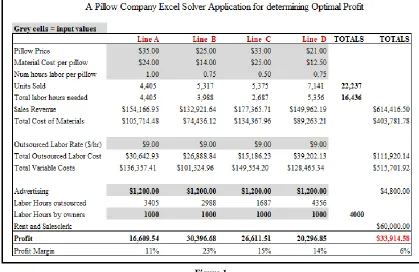
Figure 1
and the amount of advertising dollars spent. The owner sells more pillows in a certain line if more advertising dollars are spent on that line and if she works on them personally, rather than outsourcing the labor. Initially the advertising dollars and owner labor hours are split evenly over the four types of pillows. The goal is to find the optimal allocation of the owner’s labor and advertising dollars for maximum profit. In the first stage of using the Solver add-in, the target cell (the objective) is designated as the total profit and the changing value range is designated as the four labor hours cells of the four pillow lines. The constraint specified is that total hours for all four pillow lines cannot be more than 4,000 hours. Solver uses these inputs to find the optimal labor hours per pillow type for maximum total profit, subject to this labor constraint. For the second stage of optimization, a similar solver run is done with the advertising dollars allocation, subject to the constraint that the total dollars for all four lines cannot be greater than $4800 per year. Other “what-if” scenarios could be demonstrated with this spreadsheet, such as constraints on the cost of materials or outsourced labor hours used. This spreadsheet application illustrates to students that in real-world complex manufacturing operations, decisions regarding the allocation of resources affect profit outcomes of a company and sometimes are critical to the success or failure of a business.
THE MONTE CARLO SIMULATION MODEL
One area of interest for financial professionals, as well as investors, is the estimation of the future returns on investments. Managerial accountants are concerned with pro forma projections of future profits and other financial results. Sophisticated software programs and techniques have been developed over the past several decades to assist in estimating the returns of a structured portfolio and the results of other scenarios involving uncertain inputs and outputs.
Monte Carlo simulation is the process of using statistical trials to get an approximate solution to a problem. The Monte Carlo method is generally considered to have been formulated in 1944 by American scientists John von Neumann and Stanislaw Ulam. During work on the development of atomic reactors, von Neumann and Ulam made extensive use of probability theory in the computer solution of applied problems (Bauer, 1958). At first the Monte Carlo method was used primarily to solve complex problems of radiation transport theory and neutron physics for which traditional numerical methods were not suitable. It was subsequently applied to a large number of different problems in statistical mechanics. The method is now used in such areas as game theory, queuing theory, mathematical economics, and the analysis of financial portfolios. This method is often used when the model is complex, nonlinear, or involves more than just a few uncertain parameters.
Monte Carlo methods in finance are often used to evaluate investments in projects or to project future results. Monte Carlo simulation is a sampling method where inputs are randomly generated from probability distributions to simulate the process of sampling from an actual population. The output of the simulation can be represented as probability distributions or histograms. Any simulation model requires a method for generating random numbers. Microsoft Excel provides two uniform random number generators functions - RAND() and RANDBETWEEN(a,b). The inverse transformation method is a general method for transforming a standard uniform deviate into any other distribution. Excel’s built-in function NORMINV(probability, mean, std_dev) returns the inverse of the normal cumulative distribution for the specified mean and standard deviation. So, to generate a random number from a normal distribution in Excel, the following can be used: NORMINV(RAND(), mean, std_dev).
Figure 2
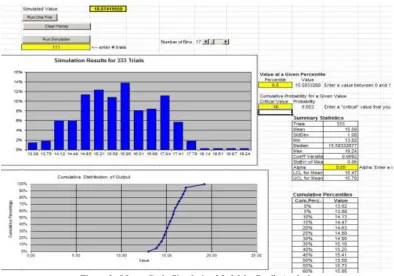
The remainder of the simulation model spreadsheet is presented in Figure 3. In this portion of the spreadsheet, the number of trials for the simulation is specified, as well as the number of bins for the results histogram. The “Simulated Value” cell is referenced from the total profit cell in Figure 2. When the “Run Simulation” button is pressed, the number of trials specified is executed and the profit values are dynamically displayed in the histogram as the trials progress. Summary statistics and a cumulative distribution graph are also displayed. The results provide the owner of the company insight into expected future profits and their probabilities. This spreadsheet illustrates the analysis of financial risk and uncertainties in factors affecting future profits and is an example of a financial tool in a spreadsheet that provides useful information for decision-makers.
CONCLUSION
Simulation is widely used in business practice to analyze scenarios and alternatives for a variety of managerial accounting problems. Optimization problem solutions are critical for the analysis of decisions related to resource allocations and the resulting future profits. This paper described a unique two-part management accounting demonstration case appropriate for use in introductory or upper level managerial accounting courses. Monte Carlo Simulation and Microsoft’s Excel’s Solver add-in are used to assist in decisions concerning factors influencing the profitability of a small pillow manufacturing operation. These spreadsheets illustrate the analysis of risk and uncertainties in factors affecting future profits and are examples of financial tools that provide useful information for decision-makers. These spreadsheet applications illustrate to students that in real-world complex business operations, decisions regarding uncertainties, and the allocation of resources are important and affect the profit outcomes of a business.
The specific learning objectives (functional competencies) of this case are for students to:
1. Understand the importance of spreadsheets to perform pro forma investigations.
2. Understand that optimization analysis can be a valuable decision-making process for business managers concerned with future profits and investment returns.
3. Understand the fundamentals of the application of Microsoft Excel Solver and how it can be a valuable decision-making tool for business managers.
4. Understand that in real-world manufacturing operations, decisions regarding the allocation of resources affect the profit outcomes of a company.
5. Gain an understanding of the fundamentals of simulation used in accounting practice for capital investment analysis, financial forecasting and budgeting, to facilitate decision-making.
6. Understand the basic concepts and design behind simulation models without the use of specialized software.
7. Understand how Monte Carlo simulation methods are used to analyze the future allocation of resources the probabilities of the resulting outcomes.
8. Understand the probability distributions and the sampling methods used as inputs and the statistics and histograms resulting from the execution of a Monte Carlo simulation.
By mapping the case activities and demonstrations to functional competencies and directly measuring multiple outcomes in these activities, these competencies can be assessed in the course as prescribed in the accounting department’s assessment plan.
AUTHOR INFORMATION
Dr. Louise Miller has a PhD in Management Science, an MBA and a BS degree in Electrical Engineering. Dr. Miller has over 10 years of experience in higher education and in addition, she spent 20 years as a software engineering specialist. Her research interests include accounting information systems and the integration of technology into accounting education. Dr. Miller also enjoys painting, web site design and programming. She teaches for Robert Morris University in Moon Township, Pennsylvania. E-mail: [email protected]
REFERENCES
1. ———. (2006). AICPA Core Competency Framework for Entry into the Accounting Profession (The Framework), Retrieved March 31, 2013 from
http://www.aicpa.org/interestareas/accountingeducation/resources/pages/corecompetency.aspx
2. Aliabadi, H., and Salahi, M. (2013). Robust Geometric Programming Approach to Profit Maximization with Interval Uncertainty. Computer Science Journal Of Moldova, 21(1) 86-96.
3. Bauer, W. F. (1958). The Monte Carlo Method. Journal of the Society for Industrial & Applied Mathematics, 6(4) 438-451.
5. Fylstra, D., L. Lasdon, J. Watson, and A. Waren. (1998). Design and Use of the Microsoft Excel Solver
Interfaces, 28(5) 29-55.
6. Jabbour, G. M. and Y. Liu. (2005). Option Pricing and Monte Carlo Simulations. Journal of Business & Economics Research, 3(9).
7. O’leary, D. E. (1983). The Use of Simulation in Accounting: A Managerial Emphasis. Proceedings of the IEEE Simulation Conference.
8. Schiff, A. D. and M. C. Smith. (2008). Margaret's Garden Shoppe: A Realistic Simulation of Accounting for Small Entities. Journal of Business Case Studies, 4(3).