Continuous Versus Intermittent
Vancomycin Infusions in Infants:
A Randomized Controlled Trial
Amanda Gwee, MBBS, FRACP, DTM&H,a,b,cNoel Cranswick, MBBS, FRACP, BMedSc,a,b,cBrendan McMullan, MBBS, FRACP, BMed(Hons),d,eElizabeth Perkins, RM,cSrinivas Bolisetty, MBBS, FRACP, MD,e,f Kaya Gardiner, BN,cAndrew Daley, MMed(ClinEpi),a,b,cMeredith Ward, MBBS, FRACP,e,fRoberto Chiletti, CICM, MD,a,c Susan Donath, MA,a,cRodney Hunt, BMBS, MMed, MRCP(UK), FRACP, PhD,a,b,c
Nigel Curtis, BA, MBBS, MA, DCH, MRCP, DTM&H, MRCPCH, FRCPCH, PhDa,b,c
abstract
BACKGROUND:In adults, continuous infusions of vancomycin (CIV) are associated with earlierattainment of target drug concentrations, require fewer blood samples for monitoring, and may reduce drug toxicity. We aimed to determine, in young infants, if CIV or intermittent infusions of vancomycin (IIV) better achieves target vancomycin concentrations at thefirst steady-state level and to compare the frequency of drug-related adverse effects.
METHODS:In a multicenter randomized controlled trial in 2 tertiary neonatal units over
a 40-month period, young infants aged 0 to 90 days requiring vancomycin therapy for at least 48 hours were randomly assigned to CIV and IIV.
RESULTS:Of 111 infants randomized, 104 were included in the intention-to-treat analysis.
Baseline characteristics were similar for both groups. The proportion of infants achieving target concentrations at thefirst steady-state level was higher for CIV compared with IIV (45 in 53 [85%] vs 21 in 51 [41%];P,.001). Fewer dose adjustments were required in the CIV group (median 0; range 0–1) compared with the IIV group (median 1; range 0–3;P,.001). The mean daily dose required to achieve target concentrations was lower with CIV compared with IIV (40.6 [SD 10.7] vs 60.6 [SD 53.0] mg/kg per day, respectively;P = .01). No drug-related adverse effects occurred in either group.
CONCLUSIONS:In young infants, CIV is associated with earlier and improved attainment of target
concentrations compared with IIV. Lower total daily doses are required to achieve target levels with CIV. There is no difference in the rate of drug-related adverse effects.
WHAT’S KNOWN ON THIS SUBJECT:In adults, continuous infusions of vancomycin (CIV) are associated with earlier attainment of target drug concentrations, require fewer blood samples for monitoring, and may reduce drug toxicity. There are no trials comparing CIV to intermittent infusions of vancomycin in children.
WHAT THIS STUDY ADDS:CIV is associated with earlier and improved attainment of target concentrations compared with intermittent infusions of vancomycin. Additionally, lower total daily doses are required to achieve target levels with CIV. There is no difference in the rate of drug-related adverse effects.
To cite: Gwee A, Cranswick N, McMullan B, et al. Continuous Versus Intermittent Vancomycin Infusions in Infants: A Randomized Controlled Trial.Pediatrics. 2019; 143(2):e20182179
aDepartment of Paediatrics, The University of Melbourne, Parkville, Australia;bThe Royal Children’s Hospital
Melbourne, Parkville, Australia;cMurdoch Children’s Research Institute, Parkville, Australia;dSydney Children’s Hospital, Randwick, Australia;eDepartment of Paediatrics, University of New South Wales, Sydney, Australia; and f
Royal Hospital for Women, Randwick, Australia
Sepsis is a leading cause of death in young infants worldwide.1In industrialized countries, infection with Gram-positive bacteria, particularly coagulase-negative staphylococci (CONS) and
Staphylococcus aureus, are among the most common pathogens causing late-onset sepsis. As a result,
vancomycin, a glycopeptide antibiotic, is often used in the treatment of young infants with suspected or proven sepsis, particularly in the hospital setting.
Vancomycin is routinely administered as intermittent infusions multiple times per day. Therapeutic drug monitoring (TDM) is required to ensure that antibiotic levels are sufficient for effective bacterial killing. In young infants, this involves the measurement of trough
concentrations (immediately before a dose), with target vancomycin levels ranging from 10 to 20 mg/L.2 There is no consensus on the optimal dosing regimen for vancomycin in this age group, and this is reflected by the wide diversity in the dosing regimens of intermittent infusions of vancomycin (IIV) used worldwide. Studies reveal that these current dosing recommendations result in poor attainment of target vancomycin levels.3–5Another problem with IIV dosing is the incorrect timing of trough samples, resulting in inappropriate dose adjustments.6
Continuous infusions of vancomycin (CIV) are an attractive alternative to IIV in young infants. Data from adult studies reveal an improved
attainment of target vancomycin levels and a reduced incidence of drug-related nephrotoxicity with CIV compared with IIV.7An additional benefit is that the timing of blood samples can be moreflexible because they can be taken any time at steady state rather than requiring trough levels. This allows for TDM sampling at the same time as other blood tests, which is particularly important in the NICU setting, where infants are often
having repeated blood tests.8 However, potential disadvantages of CIV include the risks of drug incompatibilities and reduced line availability.
We report a randomized controlled trial (RCT) of CIV versus IIV in young infants to determine which results in improved attainment of target concentrations at thefirst steady-state level.
METHODS
The complete study protocol is published in an open-access journal, and the trial was registered at www. clinicaltrials.gov (identifier
NCT02210169).9Ethics approval was obtained from The Royal Children’s Hospital (RCH) Melbourne Human Research Ethics Committee (34030) and the South Eastern Sydney Local Health District Human Research Ethics Committee (SSA 16/G/335).
Trial Design
This was a multicenter, nonblinded, RCT conducted over a 40-month period (September 2014–December 2017).
Three main changes were made to the initial trial protocol after
commencement: (1) the inclusion of infants with a postnatal age of 0 to 90 days (from 0 to 30 days) because many young infants in the neonatal unit were.30 days of age; (2) for vancomycin courses.7 days, baseline blood tests were repeated weekly instead of every 48 hours to minimize repeated blood tests; and (3) change in the timing of
vancomycin TDM for patients receiving 4-hourly dosing to
recommend that it is taken before the fourth dose instead of before the third dose.
Participants
The study sites included the NICU and PICU at RCH Melbourne and the NICU at The Royal Hospital for Women (RHW) in Sydney.
Participants were eligible if they were aged between 0 and 90 days and it was anticipated that vancomycin therapy would be administered for
$48 hours. Exclusion criteria included: corrected gestational age (CGA),25 weeks, known
glycopeptide allergy, renal impairment, infants receiving extracorporeal membrane oxygenation, vancomycin
administration within the previous 72 hours, and previous
randomization in the study.
Interventions
Before randomization, the treating clinician or study investigator provided both written and verbal information to the parents and obtained consent. Patients were randomly assigned in a 1:1 ratio to receive either standard care,
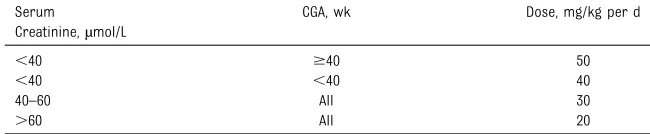
consisting of IIV (dose recommended in theBritish National Formulary for Children10), or CIV after a loading dose of 15 mg/kg infused over 1 hour (dose published by Patel et al6; Tables 1 and 2). The target trough level for IIV was 10 to 20 mg/L, and the steady-state level for CIV was 15 to 25 mg/L.6,11A protocol for dose adjustment was also provided (Tables 3 and 4).
All patients had the following blood tests taken at or before
randomization: full blood
examination; urea, electrolytes, and creatinine; C-reactive protein (CRP); albumin level; and blood culture if a new infection was suspected. A full blood examination and urea,
electrolytes, and creatinine testing was repeated every 48 hours for the first week then weekly thereafter during vancomycin therapy. Repeat measurements of CRP were done every 48 hours only if thefirst CRP measurement was elevated. A repeat blood culture was taken the day after clinical staff were notified of
a positive result whenever possible.
after thefirst dose (peak level), before (trough level), and peak level after the third dose. If the participant was receiving 4-hourly dosing, levels were measured before and after the fourth dose. If the trough vancomycin level fell within the target range of 10 to 20 mg/L, an additional trough level was taken before the sixth dose, and if this second level was within range, trough levels were then repeated every 3 days. If the trough
vancomycin level was,10 mg/L or
.20 mg/L, after dose adjustment, trough and peak levels were taken before and after the third
adjusted dose.
For those infants receiving CIV, a vancomycin level was measured immediately after the loading dose and 18 to 30 hours after the commencement of infusion. Samples were taken at the same time as other blood tests whenever possible. If the steady-state level was within the target range of 15 to 25 mg/L, the level was repeated 18 to 30 hours after the last level, and if this second level was within range, the level was repeated every 3 days. If CIV was paused to enable the administration of a drug that was incompatible with vancomycin, this was recorded.
Study involvement ceased when vancomycin therapy was
discontinued. Treating clinicians documented any adverse events.
Outcomes
The primary outcome measure was the difference in the proportion of participants achieving target vancomycin levels at theirfirst steady-state level (when the drug level is in equilibrium).
Secondary outcomes included (1) the difference in the proportion of participants who experienced drug-related adverse effects, (2) the time taken to achieve target vancomycin levels, and (3) determining the pharmacokinetics and
pharmacodynamics of vancomycin by using nonlinear mixed-effects modeling (outcomes 2 and 3 are reported in a separate article). No changes were made to the trial outcomes after commencement.
Sample Size Calculation
The sample size of 200 young infants was calculated by using Pearson’sx2 test to detect a difference of 20% in the proportion of participants achieving target vancomycin levels between the 2 groups with a power of 80%. An interim analysis was not done.
Randomization
The randomization schedule was prepared by an independent statistician using random permuted blocks and stratified by the 2 sites. Infants were randomly assigned by the treating clinician or a member of the study team. At RCH, allocation was concealed in consecutively numbered, opaque, sealed envelopes, and at RHW, an online randomization procedure in a Research Electronic Data Capture program was used.
Statistical Methods
Randomly assigned infants who had thefirst trough vancomycin level (IIV) or steady-state level (CIV) measured were included in the intention-to-treat analysis. The difference in proportions was assessed by using ax2test together with a 95% confidence interval (CI). Normally distributed continuous outcomes were compared by using pairedttests. Median values were compared by using a Wilcoxon rank test, and CIs for the difference of medians were compared by using bootstrap. Data were analyzed by using Stata 15 (Stata Corp, College Station, TX).
RESULTS
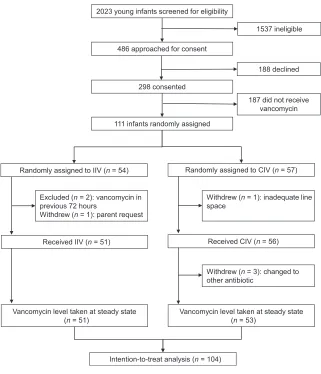
Over the 40-month study period, 2023 young infants were screened for eligibility. Of these, 486 were approached for consent, and we obtained consent for 298 (61%) of them. At RCH, infants who were thought likely to need vancomycin were preconsented for participation in the trial. In total, 111 young infants were randomly assigned, 54 to IIV and 57 to CIV, of whom 51 and 53, respectively, were included in the intention-to-treat analysis (Fig 1). On the basis of previous vancomycin usage at RCH, it was anticipated that recruitment would take 24 months. However, because of a change in antibiotic policy and the resultant reduced usage of vancomycin, the recruitment rate was slower than TABLE 1IIV Empirical Dosing Regimen
CGA, wk Dose, mg/kg per Dose Dose Interval
,29 15 24 hourly
29–35 15 12 hourly
36–44 15 8 hourly
.44 15 6 hourly
Adapted from Paediatric Formulary Committee.British National Formulary for Children 2011-2012. London, UK: Phar-maceutical Press; 2012.
TABLE 2CIV Empirical Dosing Regimen Serum
Creatinine,µmol/L
CGA, wk Dose, mg/kg per d
,40 $40 50
,40 ,40 40
40–60 All 30
.60 All 20
anticipated. Recruitment was therefore terminated after a 40-month period.
Baseline Characteristics
Of the 104 infants included in the intention-to-treat analysis, 44% were boys with a mean birth weight of 2271 g and current weight of 2549 g. The mean gestational age was
34.0 weeks and postnatal age was 23 days (Table 5). The most common underlying diagnoses were
prematurity (66%), exomphalos and/or gastroschisis (16%), bowel obstruction (13%), and congenital heart disease (12%). Indications for vancomycin therapy included suspected sepsis (65%), preceding positive blood culture result (11%),
skin and soft tissue infection (11%), necrotizing enterocolitis (5%), and surgical prophylaxis (5%). Of the 92 infants who had blood cultures taken, 23 (25%) had a positive result, with CONS (58%),Enterococcusspp (9%), and Gram-negative bacteria (9%) being the most frequently isolated. In 3 of the blood cultures, 2 CONS species were isolated and therefore deemed to be contaminants. The mean duration of therapy was 5 days. Baseline characteristics were similar between both groups.
Attainment of Target Levels
The proportion of infants who achieved target concentrations at the first steady-state level was 21 of 51 (41%) in the IIV group compared with 45 of 53 (85%) in the CIV group (P,.001). No patients in either group had supratherapeutic concentrations at thefirst steady-state level.
For the infants who received IIV, achievement of target levels was low in all CGA dosing groups, with 15 of 34 (44%) in the 36- to 44-week CGA group, 5 of 12 (42%) in the 29- to 35-week CGA group, and 1 of 5 (20%) in the,29-week CGA group attaining target levels. In the CIV group, achievement of target concentrations was 8 in 10 (80%) and 24 in 30 (80%) for infants with a serum creatinine of,40µmol/L and CGA of
$40 weeks and,40 weeks, respectively. Target concentrations were achieved in all infants receiving CIV with a serum creatinine of 40 to 60µmol/L (9 of 9; 100%) and
.60µmol/L (4 in 4; 100%).
Overall, 43 of 51 (84%) infants in the IIV group achieved target levels by the end of the study period compared TABLE 3IIV Dose Adjustment Protocol
Current Regimen Trough
,10 mg/L
Trough .20 mg/La
6 hourly 4 hourly 8 hourly
8 hourly 6 hourly 12 hourly
12 hourly 8 hourly 18 hourly
18 hourly 12 hourly 24 hourly
24 hourly 18 hourly 30 hourly
aIf the level is.20 mg/L, the dose is withheld, and the trough level is repeated before each due dose. Once the vancomycin level is#20 mg/L, dosing is restarted at a lower dose frequency.
Randomly assigned to IIV (n = 54)
111 infants randomly assigned
Excluded (n = 2): vancomycin in previous 72 hours
Withdrew (n = 1): parent request
Intention-to-treat analysis (n = 104)
Randomly assigned to CIV (n = 57)
Received IIV (n = 51) Received CIV (n = 56) Withdrew (n = 1): inadequate line space
Vancomycin level taken at steady state (n = 51)
Withdrew (n = 3): changed to other antibiotic
Vancomycin level taken at steady state (n = 53)
298 consented
2023 young infants screened for eligibility
486 approached for consent
1537 ineligible
188 declined
187 did not receive vancomycin
FIGURE 1
Consort diagram.
TABLE 4CIV Dose Adjustment Protocol CIV Dose Adjustment Calculation
with 51 of 53 (97%) infants in the CIV group (P= .04). The mean time to achieve the target concentration was greater for the IIV (33.6 hours; SD 38.8 hours) compared with the CIV group (27.1 hours; SD 10.8 hours;
P= .003). Fewer dose adjustments were required to achieve target levels in the CIV group (median 0; range 0–1) compared with the IIV group (median 1; range 0–3;
P,.001).
Six infants (12%) in the IIV group had supratherapeutic trough levels, ranging from 22 to 30 mg/L after the initial trough level. Similarly, there were 5 infants (9%) in the CIV group who subsequently had
supratherapeutic steady-state levels, ranging from 26 to 29 mg/L.
The overall mean daily dose required to achieve target
concentrations was 60.6 (SD 53.0) mg/kg per day with IIV and 40.6 (SD 10.7) mg/kg per day with CIV (P= .01; Table 6).
Adverse Events
Serum creatinine levels were
determined between 48 hours before initial dosing and 72 hours after vancomycin therapy in 48 of 51 (94%) infants in the IIV group and 51 of 53 (96%) infants in the CIV group. There was no increase in the creatinine levels at the end compared with at the start of therapy in the IIV group (35.4–31.2µmol/L; SD 19.6–16.2µmol/L;P= .01) or in the CIV group (29.3–28.1µmol/L; SD 12.1–10.7µmol/L;P= .50). One infant in each of the groups had a rise in creatinine level.1.5 times the baseline creatinine (IIV,
18–32µmol/L; CIV, 24–45µmol/L). Vancomycin was well tolerated, with no infants experiencing red man syndrome and no documented vancomycin-related adverse effects in either group.
Data on vascular access devices were available for 49 of 51 infants in the IIV group and all infants in the CIV
group. The median number of vascular access devices was 1 in the IIV group and 1.5 in the CIV group (P= .06; CI20.412 to20.003). One patient in the CIV group was administered a drug that was incompatible with vancomycin through the same line, with no clinical adverse effects observed for the patient.
Clinical Outcomes
Of the 9 infants in the IIV group and the 9 infants in the CIV group with Gram-positive bacteremia, repeat blood cultures were taken in 8 and 7 infants, respectively. The mean times to the clearance of bacteremia were 55.3 hours (SD 14.9 hours) with IIV and 46.1 hours (SD 10.3 hours) with TABLE 5Characteristics of Infants Included in the Intention-To-Treat Analysis
IIV (n= 51) CIV (n= 53)
Birth wt, g, mean (SD) 2294 (1033)a 2248 (1036)
Current wt, g, mean (SD) 2503 (1137) 2595 (970)
Gestational age, wk, mean (SD) 34.4 (5.2) 34.0 (4.4)
Postnatal age, d, mean (SD) 23 (21) 23 (19)
Male sex,n(%) 27 (53) 25 (47.2)
Underlying diagnosis,bn(%)
Prematurity 32 (63) 37 (70)
Exomphalos and/or gastroschisis 10 (20) 7 (13)
Bowel obstruction 7 (14) 7 (13)
Congenital heart disease 6 (12) 7 (13)
Chronic lung disease 5 (10) 3 (6)
Gastrointestinal atresia and/or TOF 3 (6) 6 (11)
HMD and/or RDS 3 (6) 4 (8)
Neurologic disease 3 (6) 3 (6)
Genetic disease (with T21) 3 (6) 5 (9)
NEC 2 (4) 4 (8)
CDH 2 (4) 3 (6)
IUGR 2 (4) 2 (4)
Surgical airway disease 1 (2) 4 (8)
Other 7 (14) 10 (19)
Indication for treatment,n(%)
Suspected sepsis 34 (67) 34 (64)
Preceding positive blood culture result 10 (20) 1 (2)
SSTI 5 (10) 6 (11)
Surgical prophylaxis 4 (8) 4 (8)
Gastrointestinal infection (including NEC) 3 (6) 5 (9)
Respiratory tract infection 2 (4) 2 (4)
Endocarditis 2 (4) 0
Septic ileus 1 (2) 1 (2)
Urinary tract infection 0 4 (8)
Other 2 (4) 4 (8)
Positive blood culture result,n(%) 12 of 46 (26) 11 of 46 (24)
CONS 7 (15) 6 (13)
Enterococcusspp 1 (2) 1 (2)
MSSA 0 1 (2)
GBS 0 1 (2)
Streptococcus mitisgroup 1 (2) 0
Gram-negative organism 1 (2) 1 (2)
2 different CONS bacteria 2 (4) 1 (2)
Days of treatment, mean (SD) 4.5 (2.6) 5.5 (9.0) Albumin level, g/L, mean (SD) 26.0 (6.0) 24.9 (5.6)c Time to repeat blood culture, h, mean (SD) 37.3 (16.6) 36.8 (21.8) Concomitant gentamicin use,nofN(%) 37 of 51 (72.5) 43 of 53 (81.1)
CDH, congenital diaphragmatic hernia; GBS, group BStreptococcus; HMD, hyaline membrane disease; IUGR, intrauterine growth restriction; MSSA, methicillin-sensitiveS aureus; NEC, necrotizing enterocolitis; RDS, respiratory distress syn-drome; SSTI, skin and soft tissue infection; TOF, tracheoesophagealfistula; T21, trisomy 21.
CIV (P= .62). The vancomycin minimum inhibitory concentration (MIC) (the lowest antibiotic concentration that will inhibit bacterial growth) was determined for 16 of the 18 Gram-positive isolates (Table 7). No infants died of sepsis; however, 1 infant in the CIV group died because of complications of congenital heart disease.
DISCUSSION
This is thefirst RCT of vancomycin dosing in a pediatric population. We show that, compared with IIV, CIV results in earlier and improved attainment of target levels, requires only 1 dose adjustment, and lower total daily doses to achieve therapeutic levels. Vancomycin dosing is an important issue in young infants because, as was found in our trial, current IIV dosing regimens are associated with subtherapeutic levels in the majority of young infants.3,4,6,12 Furthermore, difficulties with taking accurately timed trough samples in a busy clinical environment is a common problem.6One study in young infants reported that in 24% of vancomycin samples, the timing of the sample was missing, and 54% of samples required a repeat blood test because the time documented could not be interpreted. CIV provides an easier alternative for dosing and monitoring vancomycin in young infants.
The use of CIV was initially proposed to optimize the time above which the vancomycin concentration exceeds the bacterial MIC when the drug was thought to exhibit time-dependent bacterial killing. A retrospective cohort study of adults with methicillin-resistantS aureus
pneumonia revealed a reduction in mortality when vancomycin was administered as a continuous infusion.13However, a meta-analysis of 1 RCT and 5 observational studies in adults revealed no difference in mortality, but the authors did report a lower risk of nephrotoxicity associated with CIV (relative risk 0.6; 95% CI 0.4 to 0.9; P= .02).7Two subsequent systematic reviews revealed conflicting results: 1 revealed no difference in the rate of nephrotoxicity,14whereas the other revealed a reduction in the incidence of nephrotoxicity (relative risk 0.61; 95% CI 0.47 to 0.80;P,.001).15This difference was largely influenced by the inclusion of 1 retrospective observational study.16
CIV dosing regimens have been studied in 5 prospective cohort and 2 retrospective studies in young infants.6,11,17–21However, in only 2 studies was CIV compared with IIV. The 1 prospective study in which researchers compared the 2 dosing regimens revealed an improved attainment of target concentrations with CIV (82%) compared with IIV (46%).6A retrospective study also revealed that a greater proportion of patients achieved target levels with CIV compared with IIV (52.8% with CIV versus 34.1% with IIV). However, interpretation of this study is limited
because target trough levels for IIV were low (between 5 and 10 mg/L).20 Overall, 4 studies of CIV (each using different dosing regimens) in young infants reported attainment of target vancomycin levels.80%.6,17,19,21 Importantly, in these studies, CIV was not associated with drug
incompatibility6or infusion-related side effects.6,17As in our study, there was no difference in creatinine levels in young infants treated with IIV versus CIV.6
The evidence for target drug concentrations when using CIV is scarce. In a systematic review of adult studies in which researchers
compared IIV and CIV, 5 of 6 studies targeted concentrations of 20 to 25 mg/L or 20 to 30 mg/L,7whereas in the studies of young infants, target levels ranging from 10 to 15 mg/L to 25 to 30 mg/L have been used.8 Although existing data support a pharmacodynamic target forS aureusinfections of an area under the concentration-time curve over 24 hours (AUC24)/MIC.400, the
target for CONS infections (the most common pathogen causing late-onset sepsis in young infants) is poorly defined. The authors of in vitro pharmacodynamic studies have described time-dependent killing for
Staphylococcus epidermidis,22,23and the authors of an in vivo murine model reported no significant difference in the mortality rate in mice with a higher AUC24/MIC ratio.24
Although there are population pharmacokinetic models that allow for the calculation of AUC with IIV dosing,25the use of CIV enables the AUC24to be easily calculated by using
TABLE 6Dose in mg/kg per Day Required to Achieve Target Concentrations
CGA IIV, Mean (SD) CIV, Mean (SD) P Creatinine IIV, Mean (SD) CIV, Mean (SD) P ,29 37.0 (21.7) 25.0 (5.6) .33 ,40 72.9 (63.5) 45.4 (7.2) .01 29–35 40.8 (14.0) 33.9 (7.0) .21 40–60 41.9 (13.1) 29.6 (3.3) .01 36–44 67.7 (59.3) 43.8 (9.7) .02 .60 34.8 (7.9) 19.9 (0.2) .008
TABLE 7MIC Values Determined by Using Etest (bioMérieux, Crappone, France) of Gram-positive Isolates From Blood Cultures (n= 16)
Organism Vancomycin MIC
0.5 mg/L 1 mg/L 2 mg/L 4 mg/L
S epidermidis — — 4 5
Staphylococcus capitis — — 3 1
S mitisgroup 1 — — —
S aureus 1 1 — —
Enterococcus faecalis — — 1 —
the equation AUC24 = serum
concentration3 24 mg.h/L. Therefore, this also allows for the calculation of the target vancomycin level if the
pharmacodynamic target is known. For example, for aS aureusisolate with a specific MIC, using the formula AUC24/MIC .400 enables
the calculation of the target concentration (ie, target concentration = [4003 MIC]/ 24 mg/L). Similarly, CIV also allows for a simple linear calculation of dose adjustment as is used in our protocol. This resulted in
attainment of target concentrations in all infants in our study after 1 dose adjustment.
In contrast to studies in adults,14 our study revealed that
vancomycin-related adverse effects are extremely uncommon in young infants regardless of the method of administration. Importantly, infants in the CIV group required lower total daily doses of vancomycin compared with those in the IIV group. The relationship between vancomycin exposure and nephrotoxicity is poorly understood. However, a recent in vivo study of rats revealed that an increase in urinary acute kidney injury biomarkers was associated with the area under the
concentration-time curve over 0 to 24 hours and the maximum drug concentration over a 24-hour period.26 CIV is associated with lower maximum drug
concentrations over a 24-hour period and therefore theoretically could be associated with a reduced risk of nephrotoxicity. One of the barriers to the routine use of CIV is a concern about the need for additional line access and the associated potential risks (eg, infection and extravasation). Although our study was not powered to detect this, we did not observe any significant increase in the need for vascular access devices
or issues of drug incompatibility. This is likely explained by the fact that young infants in whom vascular access was limited were excluded, and in addition, CIV was paused to administer
incompatible drugs.
One limitation of our study is that it was not powered to detect
a difference in vancomycin-related nephrotoxicity or infection-related mortality because these events are infrequent; recruitment of
a sufficient sample size to detect this would not have been feasible.27,28 Instead, we are developing a population
pharmacodynamic model to assess this. A slow recruitment rate attributable to a change in empirical antibiotic guidelines required us to terminate our trial before reaching our planned sample size. However, because the effect size in our trial was
considerably larger than the estimate used in our sample size calculation, the primary outcome of our trial was statistically
significant. Our trial did not include an analysis of costs, although a RCT in adults revealed a significant reduction in 10-day treatment costs with CIV.29Audiology assessments were not done specifically for the study because the ototoxicity of vancomycin is controversial, particularly in a population of premature infants receiving concomitant aminoglycosides.2,30 AUC24/MIC ratios were calculated
by developing a nonlinear mixed-effects model and will be reported separately.
CONCLUSIONS
In young infants, CIV is associated with earlier and improved
attainment of target concentrations compared with the current
standard of care, IIV. Lower total daily doses and fewer dose adjustments are required to
achieve therapeutic levels with CIV. Vancomycin-related drug toxicity was rare with both CIV and IIV. Future studies should be focused on the impact of CIV compared with IIV on clinical outcomes of Gram-positive infections.
ACKNOWLEDGMENTS
We thank the staff, patients, and their families at RCH Melbourne and RHW in Sydney who were involved in the study. We also thank Prof Colin Powell, Drs Andrew Watkins and Yashwant Sinha, Mr Tibor Schuster, and Ms Lumine Na, who were on the data safety monitoring committee for this trial. We thank the Murdoch Children’s Research Institute, which funded the study. We also thank the National Health and Medical Research Council and Royal Australasian College of Physicians for Dr Gwee’s postgraduate scholarships. Dr Gwee had full access to all the data in the study and takes responsibility for the integrity of the data and accuracy of the data analysis.
ABBREVIATIONS
AUC24: area under the
concentration-time curve over 24 hours
CGA: corrected gestational age CI: confidence interval CIV: continuous infusions of
vancomycin
CONS: coagulase-negative staphylococci CRP: C-reactive protein IIV: intermittent infusions of
vancomycin
MIC: minimum inhibitory concentration
RCH: The Royal Children’s Hospital RCT: randomized controlled trial RHW: The Royal Hospital for
Women
This trial has been registered at www.clinicaltrials.gov (identifier NCT02210169).
DOI:https://doi.org/10.1542/peds.2018-2179
Accepted for publication Nov 20, 2018
Address correspondence to Amanda Gwee, MBBS, FRACP, DTM&H, Department of Paediatrics, The University of Melbourne, The Royal Children’s Hospital Melbourne, 50 Flemington Rd, Parkville, VIC 3052, Australia. E-mail: [email protected]
PEDIATRICS (ISSN Numbers: Print, 0031-4005; Online, 1098-4275).
Copyright © 2019 by the American Academy of Pediatrics
FINANCIAL DISCLOSURE:The authors have indicated they have nofinancial relationships relevant to this article to disclose.
FUNDING:Funded by the Murdoch Children’s Research Institute. Dr Gwee received the Royal Australasian College of Physicians Basser Research Entry Scholarship and the National Health and Medical Research Council Postgraduate Scholarship (GNT1150216).
POTENTIAL CONFLICT OF INTEREST:The authors have indicated they have no potential conflicts of interest to disclose.
REFERENCES
1. Vergnano S, Sharland M, Kazembe P, Mwansambo C, Heath PT. Neonatal sepsis: an international perspective.
Arch Dis Child Fetal Neonatal Ed. 2005;
90(3):F220–F224
2. Rybak M, Lomaestro B, Rotschafer JC, et al. Therapeutic monitoring of vancomycin in adult patients: a consensus review of the American Society of Health-System Pharmacists, the Infectious Diseases Society of America, and the Society of Infectious Diseases Pharmacists [published correction appears inAm J Health Syst
Pharm. 2009;66(10):887].Am J Health
Syst Pharm. 2009;66(1):82–98
3. Vandendriessche A, Allegaert K, Cossey V, Naulaers G, Saegeman V, Smits A. Prospective validation of neonatal vancomycin dosing regimens is urgently needed.Curr Ther Res Clin Exp. 2014;76:51–57
4. Madigan T, Teng CB, Koshaish J, Johnson KR, Graner KK, Banerjee R. Optimization of vancomycin dosing in very low-birth-weight preterm neonates.Am J Perinatol. 2015;32(1): 83–86
5. Sinkeler FS, de Haan TR, Hodiamont CJ, Bijleveld YA, Pajkrt D, Mathôt RA. Inadequate vancomycin therapy in term and preterm neonates: a retrospective analysis of trough serum
concentrations in relation to minimal inhibitory concentrations.BMC Pediatr. 2014;14:193
6. Patel AD, Anand D, Lucas C, Thomson AH. Continuous infusion of vancomycin in neonates.Arch Dis Child. 2013;98(6): 478–479
7. Cataldo MA, Tacconelli E, Grilli E, Pea F, Petrosillo N. Continuous versus intermittent infusion of vancomycin for the treatment of Gram-positive infections: systematic review and meta-analysis.J Antimicrob Chemother. 2012; 67(1):17–24
8. Gwee A, Cranswick N, Metz D, et al. Neonatal vancomycin continuous infusion: still a confusion?Pediatr Infect
Dis J. 2014;33(6):600–605
9. Gwee A, Cranswick N, Donath SM, Hunt R, Curtis N. Protocol for a randomised controlled trial of continuous infusions of vancomycin to improve the attainment of target vancomycin levels in young infants: The VANC trial.
BMJ Open. 2018;8(11):e022603
10. Paediatric Formulary Committee.
British National Formulary for Children
2011-2012. London, UK: Pharmaceutical
Press; 2012
11. Zhao W, Lopez E, Biran V, Durrmeyer X, Fakhoury M, Jacqz-Aigrain E.
Vancomycin continuous infusion in neonates: dosing optimisation and therapeutic drug monitoring.Arch Dis
Child. 2013;98(6):449–453
12. Patel AD, Anand D, Lucas C, Thomson AH. Intermittent versus continuous infusion of vancomycin in neonates.Arch Dis
Child. 2012;97:e20
13. Rello J, Sole-Violan J, Sa-Borges M, et al. Pneumonia caused by oxacillin-resistant Staphylococcus aureus treated with glycopeptides.Crit Care Med. 2005;33(9):1983–1987
14. Hanrahan T, Whitehouse T, Lipman J, Roberts JA. Vancomycin-associated
nephrotoxicity: a meta-analysis of administration by continuous versus intermittent infusion.Int J Antimicrob
Agents. 2015;46(3):249–253
15. Hao JJ, Chen H, Zhou JX. Continuous versus intermittent infusion of vancomycin in adult patients:
a systematic review and meta-analysis.
Int J Antimicrob Agents. 2016;47(1):
28–35
16. Hanrahan TP, Harlow G, Hutchinson J, et al. Vancomycin-associated nephrotoxicity in the critically ill: a retrospective multivariate regression analysis*.Crit Care Med. 2014;42(12): 2527–2536
17. Pawlotsky F, Thomas A, Kergueris MF, Debillon T, Roze JC. Constant rate infusion of vancomycin in premature neonates: a new dosage schedule.Br
J Clin Pharmacol. 1998;46(2):163–167
18. Plan O, Cambonie G, Barbotte E, et al. Continuous-infusion vancomycin therapy for preterm neonates with suspected or documented Gram-positive infections: a new dosage schedule [published correction appears inArch Dis Child Fetal
Neonatal Ed. 2009;94(1):F78].Arch Dis
Child Fetal Neonatal Ed. 2008;93(6):
F418–F421
19. Oudin C, Vialet R, Boulamery A, Martin C, Simon N. Vancomycin prescription in neonates and young infants: toward a simplified dosage.Arch Dis Child Fetal
Neonatal Ed. 2011;96(5):F365–F370
treatment of late-onset sepsis in preterm infants.J Neonatal Perinatal Med. 2015;8(2):149–155
21. Whitticase L, Holder G, Cawsey M, Bedford-Russell A. An audit of vancomycin plasma concentrations when vancomycin is administered by continuous intravenous infusion in neonates.Arch Dis Child. 2016;101(9):e2
22. Rybak MJ, Cappelletty DM, Moldovan T, Aeschlimann JR, Kaatz GW. Comparative in vitro activities and postantibiotic effects of the oxazolidinone compounds eperezolid (PNU-100592) and linezolid (PNU-100766) versus vancomycin against Staphylococcus aureus, coagulase-negative staphylococci, Enterococcus faecalis, and Enterococcus faecium.Antimicrob
Agents Chemother. 1998;42(3):721–724
23. Rybak MJ, Hershberger E, Moldovan T, Grucz RG. In vitro activities of daptomycin, vancomycin, linezolid, and quinupristin-dalfopristin against Staphylococci and Enterococci,
including vancomycin- intermediate and -resistant strains.Antimicrob
Agents Chemother. 2000;44(4):
1062–1066
24. Domínguez-Herrera J, López-Rojas R, Smani Y, Labrador-Herrera G, Pachón J. Efficacy of ceftaroline versus
vancomycin in an experimental foreign-body and systemic infection model caused by biofilm-producing methicillin-resistant Staphylococcus epidermidis.Int J Antimicrob Agents. 2016;48(6):661–665
25. Janssen EJ, Välitalo PA, Allegaert K, et al. Towards rational dosing algorithms for vancomycin in neonates and infants based on population pharmacokinetic modeling.Antimicrob
Agents Chemother. 2015;60(2):
1013–1021
26. Rhodes NJ, Prozialeck WC, Lodise TP, et al. Evaluation of vancomycin exposures associated with elevations in novel urinary biomarkers of acute kidney injury in vancomycin-treated
rats [published correction appears in
Antimicrob Agents Chemother. 2017;
61(4):e00185-17].Antimicrob Agents
Chemother. 2016;60(10):5742–5751
27. Gowda H, Norton R, White A, Kandasamy Y. Late-onset neonatal sepsis-a 10-year review from North Queensland, Australia.Pediatr Infect Dis J. 2017; 36(9):883–888
28. Bizzarro MJ, Raskind C, Baltimore RS, Gallagher PG. Seventy-five years of neonatal sepsis at Yale: 1928-2003.
Pediatrics. 2005;116(3):595–602
29. Wysocki M, Delatour F, Faurisson F, et al. Continuous versus intermittent infusion of vancomycin in severe Staphylococcal infections: prospective multicenter randomized study.
Antimicrob Agents Chemother. 2001;
45(9):2460–2467
DOI: 10.1542/peds.2018-2179 originally published online January 30, 2019;
2019;143;
Pediatrics
Donath, Rodney Hunt and Nigel Curtis
Bolisetty, Kaya Gardiner, Andrew Daley, Meredith Ward, Roberto Chiletti, Susan
Amanda Gwee, Noel Cranswick, Brendan McMullan, Elizabeth Perkins, Srinivas
Randomized Controlled Trial
Continuous Versus Intermittent Vancomycin Infusions in Infants: A
Services
Updated Information &
http://pediatrics.aappublications.org/content/143/2/e20182179 including high resolution figures, can be found at:
References
http://pediatrics.aappublications.org/content/143/2/e20182179#BIBL This article cites 29 articles, 14 of which you can access for free at:
Subspecialty Collections
b
http://www.aappublications.org/cgi/collection/infectious_diseases_su Infectious Disease
http://www.aappublications.org/cgi/collection/neonatology_sub Neonatology
sub
http://www.aappublications.org/cgi/collection/fetus:newborn_infant_ Fetus/Newborn Infant
following collection(s):
This article, along with others on similar topics, appears in the
Permissions & Licensing
http://www.aappublications.org/site/misc/Permissions.xhtml in its entirety can be found online at:
Information about reproducing this article in parts (figures, tables) or
Reprints
DOI: 10.1542/peds.2018-2179 originally published online January 30, 2019;
2019;143;
Pediatrics
Donath, Rodney Hunt and Nigel Curtis
Bolisetty, Kaya Gardiner, Andrew Daley, Meredith Ward, Roberto Chiletti, Susan
Amanda Gwee, Noel Cranswick, Brendan McMullan, Elizabeth Perkins, Srinivas
Randomized Controlled Trial
Continuous Versus Intermittent Vancomycin Infusions in Infants: A
http://pediatrics.aappublications.org/content/143/2/e20182179
located on the World Wide Web at:
The online version of this article, along with updated information and services, is
by the American Academy of Pediatrics. All rights reserved. Print ISSN: 1073-0397.