© Global Society of Scientific Research and Researchers
http://ijcjournal.org/
Infrastructure-less Vehicular Communication System
Using Li-Fi Technology
Mahima Gupta
a*, Saumya Sharma
ba
Thadomal Shahani Engineering College, 144/7, Anand Bharati C.H.S., Dr. M.B.Raut Road,Shivaji Park,Mumbai-400028, India
b
Thadomal Shahani Engineering College, 2B/7, Indian Airlines Colony No 2.,Kalina,Santacruz East, Mumbai- 400029, India
aEmail: [email protected] bEmail: [email protected]
Abstract
This paper introduces vehicle to vehicle (v2v) communication system using Li-Fi technology. The lightning
quick transfer of information between vehicles becomes mandatory when danger is imminent as it can instantly
diffuse a potentially hazardous situation. Connected cars will help cities and states cut down on congestion and
improve safety. On the road, cars will communicate with each other, automatically transmitting data such as
speed, position, and direction, and send alerts to each other if a crash seems imminent. We consider the several
scenarios: 1) communication between car and RSU 2) inter vehicular communication 3) communication based
network system. The reach ability, delay in transmission and percentage collisions are evaluated with respect to
the average distance between cars using pixel oriented visualization. With the help of LEDs fitted in the car, we
can transmit data seamlessly using rapid pulse of light over VANET (Vehicular Ad-hoc network) for high speed
communications.
Keywords: Li-Fi technology; vehicle to vehicle (v2v) communication system; VANET; Road Side Unit (RSU);
On Board Unit; reach ability.
1.Introduction
These days the developed countries are increasingly characterized by a pervasive and extensive computing
environment. People’s living environments have been emerging based on information resource provided by the
connections of various communication networks. In the last decade, advances in both software and hardware
technologies have resulted in the need for connecting vehicles with each other. In this paper, we present (i)
initial designs and results of using light fidelity (Li-Fi) technology, recent technology that was developed in the
last couple of years [1], which still needs more procedural inquiry on its sustainability and bear ability for
outdoor vehicular networks (ii) the performance of the VLC network system in terms of delay in vehicle to
vehicle broadcasting and percentage of packet collisions (iii) examination of the MANET dynamic network for
exchanging information without using any previously existing fixed network infrastructure or a centralized
administration.
Vehicle to vehicle communication [2] is the most fruitful solution we have used in order to reduce vehicle's
accidents. The scenarios of cars in all different situations have been taken into account. [3]The proposed use of
LiFi technology comprises of mainly light emitting diode (LED) bulbs as a means of connectivity by sending
data via light spectrum as an wireless optical medium for propagation of signal. The design system focuses to
ensure a fully reliable communication between a commercial LED based transaction light and a receiver that is
mounted on a vehicle. Vehicular Ad hoc Networks (VANET) belong to a subcategory of the traditional Mobile
Ad hoc Networks (MANET) [4]. The important feature of VANETs is that mobile nodes are vehicles that are
incorporated with sophisticated “on-board” tools and equipments, traveling on a path with constraints (i.e., lanes
and roads), and communicating with each other for message exchanges via Vehicle-to-Vehicle (V2V)
communication protocols, and also between vehicles and fixed road side Access Points (i.e., cellular and
wireless network infrastructure), in case of Vehicle to Infrastructure (V2I) communications. The MANET nodes
are equipped with wireless receivers and transmitters using antennas, which may be multi directional
(broadcast), highly -directional (point to point), also possibly steerable, or some combination thereof [5]. The ad
hoc topology may change with time as the nodes ( i.e. vehicles) adjust or move their reception and transmission
parameters.
The rest of the paper is presented as follows. The different types of communications between vehicles and Road
Side Units are discussed in section 2. A simple design of the working of the infrastructure based communication
system is explained in section 3. We introduce different network services that can be incorporated in the
infrastructure based communication design in section 4. Reach ability, transmission delay and collision
percentages are evaluated in section 5.
2. Types of vehicular communication
2.1. One way communication
Figure 1 represents a Position Based Routing for Wireless Ad hoc Network [11] in a rectangular space. The
the top panel of the car (3) LED Headlights and Taillights. The LED periodically sends out mobile packets with
its current velocity and direction which is detected by the passing sensor mote and is added to its routing table.
The road side unit gauges the position of the current node and neighboring nodes and sends this data to all the
nodes in the network. This data is captured by all the solar panel receivers in range of the sensor mote. Once this
information is received by a particular car or multiple cars, it can be used to update information of the cars in
vicinity which cannot be reached by any sensor mote as shown in the figure. Such a system would help the cars
signal to one another so they can respond quickly to upcoming traffic changes as well as warn drivers of
immediate threats.
Figure 1:Communication between Road Side Unit and fitted LED
2.2. Bidirectional Communication
Figure 2: Bidirectional Communication using encrypted LED
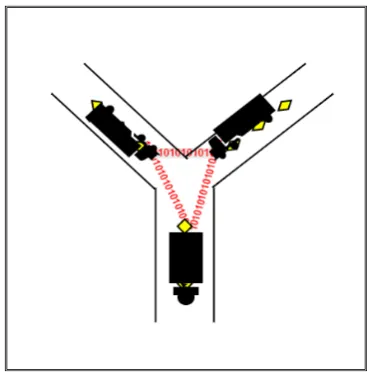
Figure 2 represents multiple vehicles communicating with each other in a Y Junction. It should also be taken
into consideration a lack of RSU in this scenario which might affect the accuracy for computing traffic flow but
can be very useful for alerting drivers and curb potential accidents. While humans can’t pick up on fast
modulations in light, LEDs can. Hence the headlights and taillights act as transmitters and receivers of data
packets [14]. The information of presence of other vehicles is sensed and the speed of the vehicle approaching is
estimated with the help of the encrypted LED. This data is updated in the database table after every certain
number of hops and thus transmitted further in the ad hoc network keeping a criterion either of distance not
being more than 70% or transmission delay being high, whichever one is smaller. This kind of communication
2.3 Infrastructure Based Communication
Figure 3: Traffic Control
A network can be formed by incorporating the first two communication techniques. The Li-Fi packets travel
short distances from one vehicle to the neighboring vehicle carrying information about their unique ID, speeding
information, number of hops and Virtual Path ID. Information is passed from one vehicle to another forming a
MANET infrastructure-less network. The local tables of every vehicle are updated through the On Board Unit
(OBU) provided for every car. Virtual Path ID and number of hops will alert users about probable accidents.
The RSU will be used inform the local user about congested routes. Since each vehicle will be given a unique
identity their speeding information can be tracked by the RSU which can be used for traffic control [9].
3.System Design
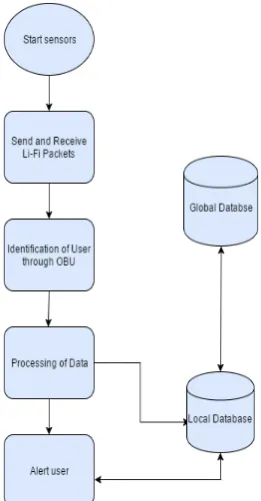
Infrastructure based communication system will consist of a local and global database. The working of this
system is explained further. The LED light installed in every vehicle will broadcast a "START" signal to all
sensors in the coverage area [12] .The on-board unit (OBU) is the device, installed in the motor vehicle of the
road user. The OBU will allow the system to collect details of the incoming Li-Fi packets for accurate
identification of the vehicle and processing of stored data [13].This data is processed .and added to the local
database. The local database has will perform two major roles. First it will alert the user about any threat in the
near future or provide updates about the traffic and speeding information. Secondly it will help in mapping a
global database which can be used for forming a MANET infrastructure-less network [2] used for traffic and
congestion control.
4.Infrastructure-less Vehicular Communication Network
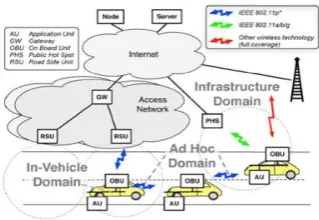
Figure 5: Ad-hoc network for V2V communication
Infrastructure-less communication forms a MANET network. A MANET is a collection of wireless mobile
nodes that dynamically make a network for exchange of information without any use of pre-existing fixed
network infrastructure or an administration that is centralized [2]. MANET nodes( i.e. vehicles) are equipped
with wireless receivers and transmitters using antennas, which are multidirectional (broadcast), highly
-directional (point-to-point), possibly a bit steerable, or some combination . At any given point in time depending
on the nodes’ positions and their receiver and transmitter coverage patterns, the co-channel interference levels
and the transmission power levels, wireless connectivity in the form of a multi-hop, random graph or an ad hoc
network that formulates between the nodes.
As an example, based on internal timetables and traffic conditions, the suitable and advisable speed limit for that
section of the road at the time is determined limit in the broadcasting dynamic velocity. As a result, the roadside
unit will sporadically broadcast the velocity limit message and will compare the vehicle data with any
geographic or directional limits to make a decision about sending a velocity limit warning to the vehicles in the
vicinity. If a vehicle exceeds the posted velocity limit, the vehicle receives a broadcast in the form of a auditory
or visual warning asking the driver to limit his speed [3].
Every vehicle that is part of a VANET has been equipped with an On Board Unit (OBU) and a couple of sensors
that collect and process information about vehicle’s position, road conditions, direction, speed, etc, and then
send it as a message to different vehicles or RSU via the wireless medium by using the broadcast
network congestion control, reliable message transfer IP mobility and data security .VANETs allow vehicles
that are equipped with OBUs to share information via Vehicle-to-Vehicle (v2v) communications and to perform
the communications between vehicles and Road Side Units (RSUs) via Vehicle to Infrastructure
communications (V2I). RSU is equipped with a network device for a Dedicated Short Range Communication
(DSRC) for Wireless Access Technology for Vehicular Environment (DSRC WAVE), which is developed by
the IEEE 1609 group, which utilizes IEEE 802.11p, a modified version of IEEE 802.11 (WiFi) standard. The
motivation behind the deployment of DSRC is to enable collision prevention application [16].
5. Reach Ability
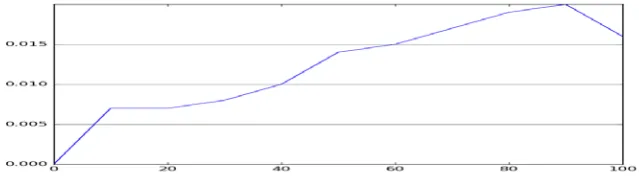
Figure 5: Average % of collisions vs. average inter-vehicle distance
Average percentage of packet collisions, the ratio of the number of collisions to the sum of the number of
receptions and the number of collisions averaged over all vehicles, remains between 24% and 30%. However,
these collisions affect reach ability drastically for inter-vehicle distance larger than 66 m. The reason for this is
that for shorter inter-vehicle distances, multiple paths are available to reach any vehicle. Hence, to decrease
reach ability, the collisions would need to occur on all possible free paths, whose probability is less. The larger
the inter-vehicle distance becomes, the number of available paths to reach vehicles becomes smaller and the
probability of several paths being affected by collisions increments. Hence, there is decreasing trend in reach
ability as the average inter-vehicle distance becomes greater. The large variations in reach ability are due to the
random movements of the vehicles that randomize the number of possible and available paths as the vehicle
cluster expands [4].
Figure 6: Depicts the average delay for vehicle-to-vehicle broadcasting ,
that require vehicle to vehicle broadcasting.
6. Conclusion
In this paper we discuss about Li-Fi technology and its application in vehicle to vehicle communication. The
types of different vehicular communication are presented. These communication systems can have varied
applications such as preventing accidents, traffic and congestion control and protecting drivers from blind spots.
The system design for infrastructure based vehicular communication system is proposed and network services
required for this system are established. We finally examine the affect of collisions on reach ability and infer
that the vehicle-to-vehicle broadcasting delay is within latency requirement by the vehicle safety applications.
References
[1] 1M.Sowmiya, 2G.Visali, A Study on LiFi Wireless Visible Light Communication, 1st ed. 2016.
[2] "Amazon Web Services (AWS) - Cloud Computing Services", Amazon Web Services, Inc., 2016.
[Online]. Available: https://aws.amazon.com/.
[3] H. Haas, L. Yin, Y. Wang and C. Chen, "What is LiFi?", Journal of Lightwave Technology, vol. 34, no.
6, pp. 1533-1544, 2016.
[4] Dr. Nirbhay Kumar Chaubey, Security Analysis of Vehicular Ad Hoc Networks (VANETs): A
Comprehensive Study, 1st ed. 2016.
[5] V. Kumar, S. Mishra and N. Chand, "Applications of VANETs: Present & Future", CN, vol. 05,
no. 01, pp. 12-15, 2013.
[6] "Área Computadores", Comp.ist.utl.pt, 2016. [Online]. Available: http://comp.ist.utl.pt/index.html/.
[7] S. Najafzadeh, N. Ithnin and S. Abd Razak, "Broadcasting in Connected and Fragmented Vehicular
AdHoc Networks", International Journal of Vehicular Technology, vol. 2014, pp. 1-15, 2014.
[8] "Mechatronika, Optika és Gépészeti Informatika tanszék - Bemutatkozás", Mogi.bme.hu, 2016.
[Online]. Available: http://www.mogi.bme.hu/.
[9] Cen B. Liu, "Enabling vehicular Visible Light Communication (V2LC) networks", Proceedings of the
Eighth International Workshop on Vehicular Ad Hoc Networks, VANET 2011, Las Vegas, NV, USA,
September 1, 2011, 2011.
[10] E. Eze, S. Zhang, E. Liu and J. Eze, "Advances in vehicular ad-hoc networks (VANETs): Challenges
and road-map for future development", International Journal of Automation and Computing, vol. 13,
[11] Geetam S. Tomar, "Position Based Routing for Wireless Mobile Ad Hoc Networks", IJSSST, Vol. 10,
No. 1.
[12] Qian Huang, "Integrating Li-Fi Wireless Communication and Energy Harvesting Wireless Sensor for
Next Generation Building", INTERNATIONAL HIGH PERFORMANCE BUILDINGS
CONFERENCE, 2014.
[13] "What is OBU (On-Board Unit) | IGI Global", Igi-global.com, 2016. [Online]. Available:
http://www.igi-global.com/dictionary/obu-on-board-unit/34930.
[14] Noof Al Abdulsalam, Raya Al Hajri, Zahra Al Abri, Zainab Al Lawati, and Mohammed M.
Bait-Suwailam, "Design and Implementation of a Vehicle to Vehicle Communication System Using Li-Fi
Technology", 2015.
[15] "What is a Virtual Path Identifier (VPI)? - Definition from Techopedia", Techopedia.com, 2016.
[Online]. Available: https://www.techopedia.com/definition/5407/virtual-path-identifier-vpi.
[16] "Li-Fi the future of Vehicular Ad hoc Networks", Scholarpublishing.org, 2016. [Online]. Available: