© 2015 IJSRST | Volume 1 | Issue 3 | Print ISSN: 2395-6011 | Online ISSN: 2395-602X Themed Section: Science
Microbiological Degradation of Starch Based Films: Preparation,
Properties and Evaluation of Biodegradation
Lessandra de Oliveira Couto *
1, Luciana de Oliveira Paiva
1, Marcel Cunha Lyra
1, Antonio Carlos
Augusto da Costa
1, Marcia Christina Amorim Moreira Leite
1*
1Programa de Pós-graduação em Química, Rio de Janeiro State University, Rio de Janeiro, RJ, BrazilABSTRACT
Discarded polymer materials are one of the causes of environmental pollution, leading to develop biodegradable materials, such as polymer composites. One commercial biodegradable polymer, called EcobrasTM, is claimed to be a good alternative in this respect, particularly because it is made with raw materials from renewable sources. Green coconut rush fiber is a lignocellulosic material, with low cost because it is a large scale waste. This article reports the preparation of new composites of EcobrasTM and green coconut rush fiber and the study of their biodegradation in simulated soil, revealing the microorganisms presence on the surface of the composites. The test consists in burying the samples in the soil for different periods, following the ASTM G 160-03 standard. After each interval, the samples were removed from the soil and analyzed by scanning electron microscopy (SEM), differential scanning calorimetry (DSC) and Fourier-transform infrared spectroscopy (FTIR). According to the results, EcobrasTM and its composites with green coconut rush fiber were considered biodegradable materials, and microorganisms presence on the material surface was observed. We expect these results will enable the development of biodegradable composites that will minimize the environmental impact generated by the inappropriate disposal of polymer materials.
Keywords: EcobrasTM, Green Coconut Fiber, Biodegradation, Polymer Composites, Polymer Morphology
I.
INTRODUCTION
Conventional synthetic polymers are used to produce a wide range of everyday products, such as clothing, plastic bags and bottles, among many others. However, these materials are very durable in the environment, causing them to accumulate both in landfills when properly disposed of and in open dumps and water bodies when improperly discarded. During the last decade, much attention has been focused on biodegradable polymers that can be produced from renewable resources, for example, developing polymer composites with insertion of natural fibers to produce materials with varying physical qualities that can be rapidly biodegraded by various types of microorganisms [1].
EcobrasTM is a biodegradable and compostable polymer, polyester Poly(butylene adipate-co-terephthalate) (Ecoflex) and starch based, obtained from renewable sources; produced by BASF in association with a Brazilian company CornProducts. EcobrasTM is economic viable for being highly compatible with
materials from renewable sources, which eases the use in composites and in polymer blends. EcobrasTM based products are widely used in tubes and plastic bags for reforestation, pens, injected packaging, films for food segments, plastic bags, among others [1-2].
Green coconut rush fiber is a lignocellulosic material, known for high strength and durability, because of its high lignin content compared to other natural fibers. The use of this fiber in Brazil is easy and has low cost because green coconut rush is large scale waste of coconut. Composites with a small amount of natural fiber can result in products with enhanced properties with a wide use in the polymers biodegradable industry. The advantages of this material include its renewable nature, biodegradability, enhanced mechanical proprieties and lower cost compared with synthetic fibers. [3-5].
and its composites in simulated soil, revealing the microorganism presence on the material.
II.
METHODS AND MATERIALS
A. Materials
The following materials and devices were used in the experiments:
Ecobras, acquired from Corn Products Brazil; green coconut rush fiber, supplied by the Coco Verde Project
in Rio de Janeiro; 4.0 kg of beach sand, collected in the
Barra da Tijuca Beach (Rio de Janeiro); 4.0 kg of horse manure, collected in a private stable in the district of Imbariê, Duque de Caxias, Rio de Janeiro State; 4.0 kg of fertile commercial soil with low clay content (Xaxim Furlan brand); cotton cloth with grammage of 445 g/m2 and dimensions of 1.00 m x 0.75 m; glass beakers (600 mL); and sieves (35 and 40 mesh). Takemura soil moisture and pH meter; Nova Ética 410 DR forced-air chambers for bacteriological culture with refrigeration; Icamo model 3 sterilization chamber; Retsch sieve, IPAS (Perkin Elmer Pyris 1), Differential Scanning Calorimeter; Perkin Elmer Spectrum One Fourier-transform infrared spectrophotometer; JEOL Scanning Electron Microscope (JEOL 6510 JSMLV –SEM); Denton Desk Vacuum Sputter Coater; PH press 2 bar (350 x 350 x 1); and Torque Rheometer equipped with and mixing chamber (Haake Polylab OS System).
B. Methods
1. Preparation of the Composites: The polyester
(Ecobras) was dried for 24 hours at 80 °C in a vacuum stove and the green coconut rush fiber was dried at 100°C drying chamber. The EcobrasTM and its composites with green coconut rush fiber were prepared at mixing chamber a temperature of 115°C, velocity of 60 rpm and processing time of 8 minutes. The test samples were prepared by compression molding at a temperature of 120°C for 10 minutes [6].
2. Biodegradation test: The biodegradation test in
simulated soil was performed according to the ASTM G 160-03 standard, with control of soil moisture (variation from 20% to 30%) and temperature (30°C ± 2°C). This test lasted for 17 weeks, to evaluate the two composites with 5% and 10% of coconut fiber (ECO5% and ECO10%) as well as the Ecobras free green coconut fiber. The simulated soil used in the biodegradation test was prepared by mixing equal parts of the fertile soil with low clay content, dried beach sand and dried horse manure, following the ASTM G-160-03 standard. The viability of the soil for the biodegradation test was verified by burying a piece of cotton cloth for five days in the soil and then evaluating its mechanical resistance
lost according to the NBR 11912/1991 standard [7]. The test was carried out and the cotton cloth lost 75% of its mechanical resistance in the prepared soil, establishing the soil’s suitability for the biodegradability test. After this, each sample was placed in a 500 mL beaker containing simulated soil to start the biodegradation test in a bacteriological chamber kept at a temperature of 30ºC (± 2ºC) and removed after periods of 2, 4, 7, 12 and 17 weeks. On being removed, the test samples were cleaned with a soft brush, dried in a desiccator and weighed to measure the mass loss. After each removal the samples were analyzed by Scanning Electron Microscopy (SEM), Differential Scanning Calorimetry (DSC) and Fourier-transform Infrared Spectroscopy (FTIR).
3. Mass loss: After biodegradability tests, any materials
attached to the surface of the specimens were removed they were thoroughly cleaned with a soft brush and then all movies are forwarded to a desiccator, to obtain to obtain a constant weight. To calculate the mass loss was taken into consideration the expression shown in Equation 1 that considers the relationship of the mass loss percentage of the dry sample. The weight loss percentage is calculated from the expression in Equation 1.
Mass Loss (%) = (M0 – M i / M0) X 100 (Equation 1)
4. Morphology Analysis - Scanning Electron Microscopy
(SEM): The samples of before and after burial test were
sputtered with gold and their surfaces were analyzed under a scanning electron microscope at an acceleration voltage of 10 kV. The composites and EcobrasTM free of natural fiber samples were analyzed at scanning electron microscope (JEOL JSM - 6510LV model) and metalized by sputtering (Gressington 108) with a thin layer of gold to allow observation with an accelerating voltage of 15 kV. To observe the microorganisms present in the samples via SEM, the samples were prepared using a post-fixation technique with osmium tetroxide (OsO4)
[8-9].
5. Differential Scanning Calorimetry (DSC): The
samples (mass of about 5 mg) were analyzed by DSC under a nitrogen atmosphere, at a flow of 20.0 mL/min and temperature range of 50 to 280ºC, at a heating rate of 20ºC/min [10].
6. Fourier-Transform Infrared Spectrometry (FTIR):
III.
RESULTS AND DISCUSSION
A. Biodegradation Evaluation of the polyester and its composites by Mass Loss
The results of the samples mass loss according to time buried in the simulated soil are shown in Figure 1. All the samples lost mass during the period of 17 weeks of the burial test.
The polyester (EcobrasTM) free of fiber has presented the greatest value of mass loss, around 55% and it was achieved very quickly, after 2 weeks of burial test and this mass loss remained constant until the end of the test. It is probably because of the 50% content of starch in EcobrasTM matrix [2]. The composites with green coconut rush fiber has lost maximum of 45% of mass and it was achieved after 7 weeks of burial and remained constant until the end of the test. These mass losses can be attributed to the biodegradation of both the polymer (EcobrasTM) and the natural fiber.
Figure 1: Results of the mass losses - biofilm EcobrasTM free from coconut fiber (black) and composite of film- grade EcobrasTM and coconut fiber ground in the proportions 95/5 (grey) and 90/10 (white)
These mass losses can be attributed to the degradation of EcobrasTM and the biodegradation of the natural fibers. The high content of starch in the EcobrasTM and its composites could have highly contributed to this initially higher degradation.
In a general way the presence of the fiber decrease the mass loss rate. This can be explained by the fact that the presence of the green coconut rush fiber makes more difficult the action of the microorganisms found in the simulated soil and also because of biodegradation rate of the fiber itself [10-11].
B. Thermal Analysis – Differential Scanning
Calorimetry (DSC)
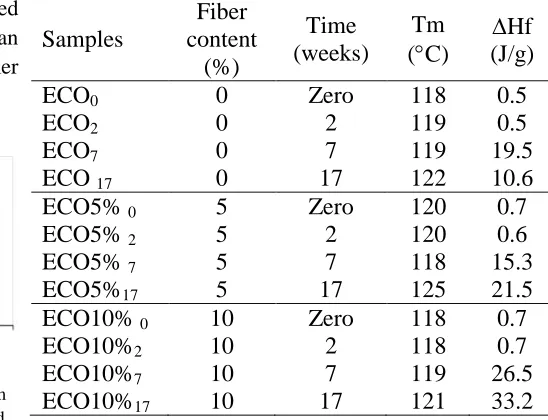
EcobrasTM is a semi-crystalline polymer and it is important to study the effect of the fiber in the final crystallinity of the prepared composites, and also the influence of biodegradation process in the crystalline phase of samples.
From the data obtained from DSC analysis it was possible to obtain the melting temperature (Tm) of the crystalline phase and the variation of enthalpy related to
melting (∆Hf) of the polyester EcobrasTM and its composites containing the different fiber concentrations (Table 1).
Table 1: Values of Tm, ∆Hf of the samples Ecobras free of fiber (ECO), Ecobras/coconut fiber 95/5 (ECO/5%), and Ecobras/coconut
fiber 90/10 (ECO10%F), during the biodegradation test
Samples
Fiber
content
(%)
Time
(weeks)
Tm
(
C)
Hf
(J/g)
ECO0
0
Zero
118
0.5
ECO2
0
2
119
0.5
ECO7
0
7
119
19.5
ECO
170
17
122
10.6
ECO5% 0
5
Zero
120
0.7
ECO5%
25
2
120
0.6
ECO5% 7
5
7
118
15.3
ECO5%17
5
17
125
21.5
ECO10%
010
Zero
118
0.7
ECO10%2
10
2
118
0.7
ECO10%7
10
7
119
26.5
ECO10%
1710
17
121
33.2
The crystallinity degree could not be calculated. The
ΔHf (enthalpy of fusion) obtained by DSC analysis was
used as a parameter based on the fact the higher the ΔHf
Other authors have already reported an increase in
crystallinity during biodegradation process in burial
test [15].
C. Morphology Analysis by Scanning Electron Microscopy (SEM)
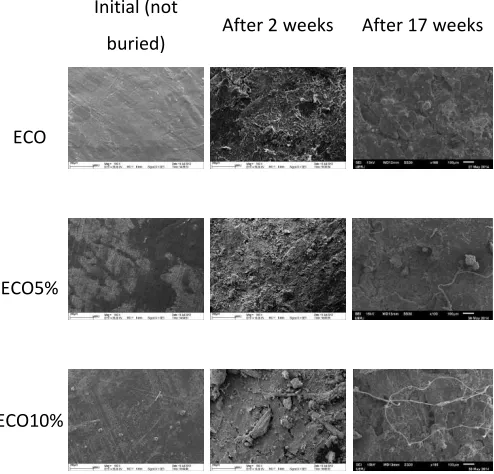
The images obtained by SEM (Figure 2) show the surface morphology of EcobrasTM free of fiber and of the prepared composites with 5% and 10% green coconut rush fibers content. It can be observed the matrix-fiber adherence in the composites and also the changes in morphology of it samples surface during the biodegradation test in simulated soil. Observing the images of the samples before burial (ECO, ECO5% and ECO10%) it can be seen that the insertions of the fiber in EcobrasTM matrix was effective. There are no signs of unbounded fibers.
Initial (not
buried) After 2 weeks After 17 weeks
ECO
ECO5%
ECO10%
Figure 2: SEM photomicrographs of the EcobrasTM/coconut fiber composite samples in the degradation test by burial in simulated soil,
according to number of weeks. ECO: EcobrasTM free green coconut rush fiber samples; ECO5%: EcobrasTM composite samples with 5%
coconut fiber; ECO10%: EcobrasTM composite samples with 10% coconut fiber
During the 17 weeks of burial a considerable change of the samples surface morphology can be noted namely the presence of holes and voids after the burial test. These surface modification has been caused by the microorganism attack to the samples and has originated the samples mass loss described before (section 3.1).
It can be also observed that the fibers turned to be less attached to the matrix after the burial because of the microorganism attack to the polyester during biodegradation process. These observations, related to different materials was reported by other authors [5,12].
After the 17 weeks test the samples were removed from the soil, treated as described in section 2.2.4 and analyzed by SEM in order to observe the biofilm at the surface samples. The Figure 3 shows the presence of microorganisms on the surface of EcobrasTM (ECO17)
and the 10% fiber composite (ECO10%17) after the 17
weeks of simulated soil burial test. It is possible to observe the presence of bacteria with cocos cell morphology (single and grouped) on the surface of EcobrasTM free of fiber (ECO 17) [13-14]. In Figure 3,
one can also observe the presence of microorganisms (cocos and bacilli) adhered to the composite with 10% of fiber surface (ECO10%17). These observations can
indicate the microorganisms participation in the degradation of the polymer, suggesting biodegradation process.
ECO17
ECO10%17
Figure 3: SEM micrographs of the EcobrasTM and ECO10% composites samples after 17 weeks of biodegradation burial test
D. Analysis by Fourier-Transform Infrared Spectrometry (FTIR)
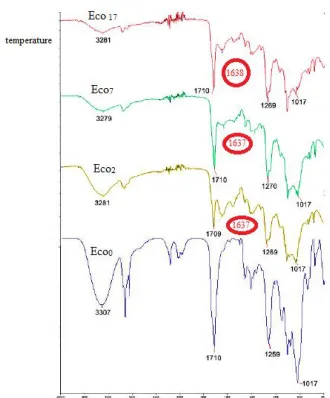
Figure 4: FTIR spectra of the polyester ECO before and during biodegradation test
Figure 5 show the ATR spectra of the prepared composite with 10% of fiber before burial test and at the various intervals (2,7 and 17weeks) of burial in the simulated soil in the biodegradation test (ECO10% 0,
ECO10% 2, ECO10%7 e ECO10% 17).
Figure 5: FTIR spectra of the composites ECO10% before and during biodegradation test
Observing Figures 4 and 5 it can be seen that before burial both EcobrasTM and its composite ECO10% presented axial deformations of carbonyl (C=O) at 1710 cm-1, and of C-O at 1160 cm-1, related to copolymer Poly(butyleneadipate-co-terephthalate (EcoflexTM) which is a polyester [8]. It can be observed also the bands at 3280 and 3307 cm-1, which can be related to the hydroxyl groups present in the starch and with the
absorption of water. As related before EcobrasTM made from EcoflexTM and starch.
Observing Figures 4 and 5 the FTIR spectra related to samples after all burial intervals, can be noticed that the samples suffered degradation during burial in the simulated soil, proved by the presence of bands at 3300 cm-1 and 1659 cm-1, related to moisture (absorption of water) and the formation of acidic functional groups derived from the hydrolysis reaction of the polyester. According to the literature, chemical degradation can occur at the same time as microbiological degradation [5,16].
IV.
CONCLUSION
The composites based on EcobrasTM and green coconut rush fiber were prepared and the presence of the fiber do not change the crystalline phase of the polymer matrix.
EcobrasTM and the prepared composites with green coconut rush fiber have lost mass during burial in simulated soil and these mass loss is related to microorganism attack, which was observed by SEM. Therefore EcobrasTM and the composite with green coconut rush fiber can be considered biodegradable materials according to the ASTM G160 – 03 standard. In addition, the microorganism presence was revealed on the surface of the material submitted to biodegradation test.
The biodegradation process can increase the crystallinity of both the EcobrasTM and the composites.
V.
REFERENCES
1. F. Kessler, L. Marconatto, R.S.B. Rodrigues, G.A. Lando, A. Schrank, M.H. Vainstein and D.E. Weibel. 2014. Journal of Photochemistry and Photobiology B: Biology. (Oct 2014), ISSN NO: 1011-1344 DOI:10.1016/j.jphotobiol.2013.11.002
2. M. Pellicano, W. Pachekoski, and J.A.M. Agnelli. 2009. Polímeros ciência e tecnologia. (May 2009), ISSN NO: 0104- 1428 DOI: 10.1590/S0104-14282013005000003
3. B.A.S. Machado, J.H.O. Reis, J.B. Silvac, L.S. Cruza, I.L. Nunes, F.V. Pereira, and J.I. Druzian. 2014. Química Nova. (Aug 2014), ISSN NO: 1678 – 7064 DOI: 10.5935/0100-4042.20140220
4. C.S. Miranda, R.P. Fiuza, R.F. Carvalho, and N.M. José. 2014. Química Nova. ( Nov 2014), ISSN NO: 1678 – 7064 DOI: doi:10.5935/0100-4042.20140303
5. A.S. Casarin, J.A.M. Agnelli, S.M. Malmonge, and F. Rosário. 2013. Polímeros ciência e tecnologia, (Jan 2013) ISSN NO: 0104-1428 DOI:10.1590/S0104-14282013005000003
6. C.R.G. Furtado, M.C.A.M. Leite, J.L. Leblanc, M.H. Ishizaki, and L.Y. Visconte. 2006. Polímeros ciência e tecnologia, 23, 115 (Apr 2006) ISSN NO: 1678-5169 DOI: 10.1590/S0104-14282006000300006
7. Standard Pratice for Evaluating Microbial Susceptibility of Nonmetallic Materials By Laboratory Soil Burial. ASTM G160 (2003) American Society For Testing And Materials: Philadelphia
8. C.F. Cheng, K.M. Wu, Y.T. Chen, and S.L. Hung. 2015. Journal of the Formosan Medical Association (Jan 2015) ISSN NO: 0929-6646 DOI: 10.1016/j.jfma.2013.07.010
9. F.J. Dias, J.P.M. Issa, J.N. Coutinho, V.P.S. Fazan, L.G. Sousa, M.M. Iyomasa, P.C. Papa, and I. Watanabe. 2015. Journal of the Neurological Sciences (Feb 2015) ISSN NO:0022-510X DOI: 10.1016/j.jns.2014.12.043
10. D. Raghavan. 1995. Polymer-Plastics Technology and Engineering (Jun 1995), ISSN NO: 0360-2559, DOI: 10.1080/03602559508017212
11. H. Cabral, M. Cisneros, J.M. Kenny, A. Vazquez, and C.R. Bernal. 2005. Journal of Composite Materials. (Jan 2005). ISSN NO: 1530-793X DOI:10.1177/0021998305046434
12. H.S. Yang, H.J. Kim, J.G. Son, H.J. Park, and T.S. Hwang. 2004. Composite Structures - Journal. (Feb 2004). ISSN NO: 0263-8223 DOI:10.1016/S0263-8223(03)00179-X
13. M. Bucková, A. Puskárová, M.C. Sclocchi, M. Bicchieri, P. Colaizzi, F. Pinzari, and D. Pangall. 2014. Polymer Degradation and Stability. (Jun 2014). ISSN NO: 0141-3910 DOI: 10.1016/j.polymdegradstab.2014.05.025
14. L. Husárova, S. Pekarová, P. Stloukal, P. Kucharzcyk, V. Verney, S. Commereuc, A. Ramone, and M. Koutny. 2014. International Journal of Biological Macromolecules. (Nov
2014).ISSN NO: 0141-8130 DOI:
10.1016/j.ijbiomac.2014.04.050
15. F. Masood, T. Yasin, and A. Hameed. 2014. International Biodeterioration & Biodegradation. (Feb 2014). ISSN NO: 0964-8305 DOI: 10.1016/j.ibiod.2013.09.023