IJSRST162631 | Received: 18 Nov 2016 | Accepted: 23 Nov 2016 | November-December-2016 [(2)6: 199-203]
© 2016 IJSRST | Volume 2 | Issue 6 | Print ISSN: 2395-6011 | Online ISSN: 2395-602X Themed Section: Science and Technology
199
Isolation, Biochemical Characterization, PCR, Serotyping and
Antibiogram of
Salmonella
from Chickens
Karthik C. D
1., Rathnamma D.
2, Chandrashekhara N.
3, Roopa Devi, Y. S.
41
Research Student, Department of Veterinary Microbiology, Bengaluru, KVAFSU, Bidar, Karnataka, India 2
Professor and Head, Department of Veterinary Microbiology, Bengaluru, KVAFSU, Bidar, Karnataka, India
3
Scientist, IAH & VB,Hebbal, Bengaluru, KVAFSU, Bidar, Karnataka, India
4
Assistant Professor, Department of Veterinary Pathology, Hassan, KVAFSU, Bidar. , Karnataka, India
ABSTRACT
Salmonellosis is an infectious disease of Birds, Animals and Humans caused by organisms of the two species of
Salmonella (Salmonella enterica, and S. bongori). Salmonellae produce Pullorum disease and Fowl Typhoid in poultry. In present study total of 260 tissue samples from 160 birds each Liver, Heart, Spleen and Gall Bladder, 40 eggs, 10 ovary samples, 25 faecal and feed samples from poultry farms in and around Bangalore were screened for
Salmonella serovars prevalence. The isolation was carried out following OIE protocol of pre enrichment with BPW and enrichment with RVSM and TTBG. Selective plating was carried using BGA, XLD, HE and MCA. The BGA was found to be more efficient in isolation of salmonella when enriched with TTBG rather with RVSM than on XLD and HE. Better isolation rate with less number of false positive results were obtained on BGA with TTBG enrichment. A total of 21 isolates were obtained at the end, after series of Isolation, biochemical characterization, Serotyping and PCR. A prevalence of 8.05 per cent was recorded. Twenty one isolates were subjected for PCR with genus specific invA, serogroup specific sefA and serotype specific fliC primers. All isolates amplified with amplicon size for invA and sefA each but none from fliC and further PCR proved to be the rapid and sensitive test for identification of Salmonella.
Keywords: Salmonella, Biochemical, Antibiogram, PCR and Isolation
I.
INTRODUCTION
Salmonella species are divided into over 50 serogroups according to the somatic or O-antigens, which are further divided into more than 2500 serovars based upon the flagellar or H-antigens (Fitzgerald et al., 2007). Poultry producers are faced with intensifying pressures from public health authorities, elected officials and consumers regarding food safety issues (Saif, 2003). Salmonellae are well recognized as potential pathogens, causing diseases in a wide range of mammalian and avian hosts (Baumler et al., 1998). Pullorum disease of chickens is a bacterial infection caused by Salmonella Pullorum. Fowl typhoid in chickens and turkeys is caused by S. Gallinarum and is more often observed in the later growing period and in mature stock. Disease is often characterised by rapid spread with high morbidity
and acute or subacute mortality. To date, more than 2,541 serovars of Salmonella have been described (National Salmonella Reference Laboratory, Galway, Ireland). Some serovars of Salmonella show host-specificity, such as Salmonella Gallinarum, which causes fowl typhoid (3). Other serovars, such as
Salmonella enterica serovar Typhimurium (S.
Typhimurium) and Salmonella enterica serovar Enteritidis (S. Enteritidis), are promiscuous and can cause infections in different species, including poultry and humans (Rodrigue et al., 1990). Salmonellae are the leading cause of morbidity and mortality in poultry and lead to significant economic losses (Baumler et al., 1997 and Prakash et al., 2005). At present, S. Typhimurium and S. Enteritidis are the most prevalent causes of
II.
METHODS AND MATERIAL
For isolation and identification OIE recommended procedure was followed. Pre-enrichment of samples carried out using Buffered Peptone Water (BPW) later enrichment with Tetrathionate brilliant green and Rappaport-Vassilidias soyabean meal broth (RVSM). One ml pre enriched broth were inoculated into 10 ml of both enrichment media, subsequent plating was done on Brilliant Green Agar (BGA), Xylose lysine deoxycholate agar (XLD), Hektoen Enteric (HE) and MacConkey Agar (MCA) plates.
DNA isolation: DNA templates were prepared from
isolates by boiling and snap chilling method. In this method, about 1000 µl of the 24 h inoculums from the selective enrichment was centrifuged at 6000 rpm for 5 min and resuspended in 50 µl of molecular grade water. The suspension was then kept in a boiling water bath for 10 min and immediately transferred onto ice, later it was centrifuged at 13000 rpm for 5min. for PCR technique, and five µl of supernatant was used as template (Anumolu et al., 2012).
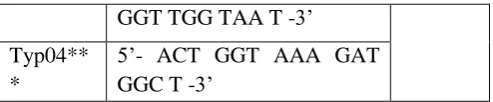
PCR: The primers for detection of Salmonella were synthesized at Bioserves Pvt. Ltd., Hyderabad. The nucleotide sequences of the primers used in this study were given in Table 1.
TABLE 1: PRIMERS USED FOR THE DETECTION
OF SALMONELLA SP. *, S. ENTERITIDIS, S.
GALLINARUM AND S. PULLORUM **AND
IDENTIFICATION OF S. TYPHIMURIUM***.
Name of the primer
Nucleotide Sequence 5’─ 3’
Amplico n size (bp) ST-139 * 5’-GTG AAA TTA TCG
CCA CGT TCG GGC AA -3’
284
ST-141 * 5’-TCA TCG CAC CGT CAA AGG AAC C -3’ A058 ** 5’- GAT ACT GCT GAA
CGT AGA AGG-3’ 488
A01 ** 5’- GCG TAA ATC AGC ATC TGC AGT AGC -3’
Fli15 *** 5’- CGG TGT TGC CCA 620
GGT TGG TAA T -3’
Typ04** *
5’- ACT GGT AAA GAT GGC T -3’
Isolates were subjected for three sets of primers viz.,
genus specific invA, serogroup D1 specific sefA and serotype specific fliC. The PCR protocol, annealing temperatures and cycling conditions initially standardized by Siddique et al., 2009 for invA and Oliveira et al., 2002 for sefA and fliC were applied. sefA and fliC cycling conditions were prolonged to 1 min each as the conditions described by Oliveira et al., 2002 did not give satisfactory results. The reaction mixture consisted of 5µl of the template, 2.5 µl of 10x assay buffer for Taqpolymerase containing 1.5 mM MgCl2, 1 µl of 25 µM each dNTP mix, 1 µl each of forward and reverse primer (4 pmol) and 0.9 U/ µl of Taq DNA polymerase made up to 25 µl using molecular grade water. Routinely, master mix was prepared and 20 µl each was distributed to the PCR tubes, to which 5 µl of the template was added. Amplification was carried out with initial denaturation at 94oC for 5 min, followed by 35 cycles each of denaturation at 94oC for 1 min, annealing at 45.1oC for 30 sec and extension at 72oC for 38 sec with a final extension period of 72oC at 7 min.
The amplification products were analyzed by agarose gel electrophoresis using 1.5% agarose gel containing 0.5 µg/ml ethidium bromide at constant voltage 5 V/cm in 1x TAE. The PCR targeting genus specific invA gene that codes invasive protein of Salmonella, serogroup specific sefA that encodes fimbrial protein and serotype specific fliC gene that encodes flagellar protein of S.
Typhimurium (Oliveria et al., 2002).
Amplification for invA gene primers was carried out using following conditions, Initial denaturation at 94°C for 5 min followed by 30 cycles of denaturation at 94°C for 1 min, annealing at 68°C for 1 min, extension at 72°C for 1 min followed by a final extension at 72°C for 5 min. Conditions for sefA were Initial denaturation at 94°C for 5 min followed by 35 cycles of denaturation at 94°C for 1 min, annealing at 55°C for 1 min, extension at 72°C for 1 min followed by a final extension at 72°C for 7 min.
ethidium bromide with 100 bp ladder as molecular weight marker. Bands were visualized under UV transilluminator and photographed by gel documentation system.
III. RESULTS AND DISCUSSION
A total of 44 isolates suggestive of Salmonella were obtained based on morphology and Grams staining. Colonies were pinkish, smooth, with regular margin, raised from surface on BGA (Fig. 1) and HE greenish colonies with and without black centre formed whereas on XLD pinkish to red with and without black centre on them (Fig. 3). Colonies were colourless pale on MCA indicating non-fermenters of lactose. Such colonies were made pure culture and were further subjected for biochemical characterization.
Figure 1: BGA with salmonella colonies
Figure 2: XLD (red) with H2S production on XLD
giving black centered colonies.
Figure 3: Colonies of Salmonella on HE (green)
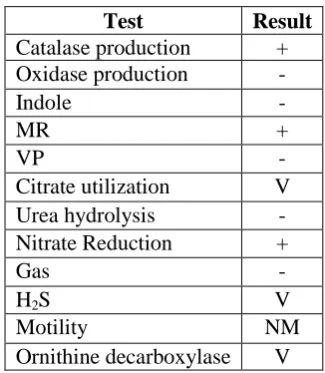
Biochemically isolates were negative for Indole, VP, Urea hydrolysis and Oxidase and positive for Catalase, MR, lysine decarboxylation, and reduced nitrate. The biochemical profile was in accordance with traditionally accepted results (Mdegela et al., 2000), however there was variation associated with citrate utilization and hydrogen sulphide production on TSI. Twenty one isolates out of these 44 were positive for Salmonella
with the biochemical pattern Table 2.
Table 2 : Biochemical Results of Isolates
Test Result
Catalase production +
Oxidase production -
Indole -
MR +
VP -
Citrate utilization V
Urea hydrolysis -
Nitrate Reduction +
Gas -
H2S V
Motility NM
Ornithine decarboxylase V
NM:Non-Motile, V:Variable
Salmonella specific PCR with primers for invA is rapid, sensitive, and specific for detection of Salmonella in many clinical samples (Lampel et al.,
2000). The present
study supports the ability of these specific primer sets to confirm the isolates as Salmonella. In the present study we used S139 and S141 primers for specific detection of Salmonella at genus level. A total of twenty one Salmonella isolates were found in chicken samples (8.07%), by conventional culturing and confirmed by PCR. All strains were subjected to Salmonella-specific gene (invA) and were confirmed as Salmonella positive by predicted product a 284 bp DNA fragment (Fig. 6). The results obtained in the present study were in corroboration with Nagappa et al., (2007).of isolates were amplifies with fliC S. typhimurium specific primers.
Figure 4: Urease test- 1 and 2 Negative and number 3
tube positive
Figure 5: Citrate utilization; 1, 9 & 10- negative, rest all
tubes positive showing blue colour
Figure 6: PCR amplification of 284 bp invAgene of
Salmonella genus isolated from poultry.
Figure 7: PCR amplification of 488 bp sefAgene of
Salmonella serogroup D1 isolated from poultry.
In the course of the study, not even a single isolate was found to be resistant to Neomycin, Ciprofloxacin and Gentamicin. Relatively 15 (71.42%) isolates were sensitive for Chloramphenicol. 12 (57.14%) isolates were less sensitive against each Cefotaxime, Ceftriaxone-Salbactum and Cefoxitin. Eleven isolates (52.38%) were moderately resistant to Ampicillin-Sulbactam and Enrofloxacin. A low percentage of isolates 9 (42.85%), 7 (33.33%) were resistant to Cefadroxil, Erythromycin and Streptomycin each respectively. Isolates were resistant (100%) to Amoxycillin-sulbactam, Ampicillin and Penicillin.
Twelve out of 21 isolates (57.14%) of S. Gallinarum were resistant to more than one antibiotic used substantiating Anjaappa et al. (1995). Study concluded that the appearance of substantial multiple drug resistance in Salmonella isolates suggesting the need for more sensible use of antibiotics in treatment and prophylaxis. Antibiotic selection should be based upon in-vitro testing.
IV. CONCLUSION
Culture techniques are universally recognized as gold standard methods for the detection of bacterial pathogens such as Salmonella in clinical samples, however these techniques take longer time and are less sensitive compared to PCR based methods. Salmonella specific PCR methods with primers for invA gene at genus level and sefA and fliC gene at serotype level are rapid, sensitive and specific for the detection of Salmonella in clinical samples. The widespread and indiscriminate use of antibiotics in the treatment of poultry diseases or in the prophylaxis has lead to an increase in the number of resistant Salmonella strains isolated from poultry. Hence antimicrobial sensitivity test must be performed before using antibiotics in the prophylaxis of the disease.
V.
REFERENCES
[1]. Anjanappa, M., Verma J. C. and Harbola, P. C. 1995. In vitro antibacterial sensitivity of
[2]. Anumolu, V. K., and Lakkineni, V. R. 2012. Screening of poultry samples for Salmonella Typhimurium by PCR assay. Vet. World.,
5(3):169-172
[3]. Baumler A.J., Gilde A.J., Tsolis R.M., van der Velden A.W., Ahmer B.M. & Heffron F. (1997). Contribution of horizontal gene transfer and deletion events to development of distinctive patterns of fimbrial operons during evolution of
Salmonella serotypes. J. Bacteriol., 179 (2): 317-322.
[4]. Baumler A.J., Tsolis R.M., Ficht T.A. & Adams L.G. (1998). Evolution of host adaptation in
Salmonella enterica. Infect. Immun., 66 (10): 4579-4587.
[5]. Fitzgerald, C., Collins, M., Van Duyne, S., Mikoleit, M., Brown, T., Fields, P., 2007. Multiplex, bead-based suspension array for molecular determination of common Salmonella serogroups. J. Clin. Microbiol., 45: 3323-3334. [6]. Lampel, K. A., Orlandi, P. A. and Kornegay, L.
2000. Improved template preparation for PCR-based assay for detection of food-borne bacterial pathogens. Appl. Environ. Microbiol., 66: 4539- 4542.
[7]. Le, minor, L. and Coynault, C. 1973. Annales de Microbiologie, 124b: 295.
[8]. MDEGELA, R. H., YONGOLO, M. G. S., MINGA, U. M. and ANDOLSEN, J. E., 2000. Molecular epidemiology of Salmonella gallinarum in chickens in Tanzania. Avian Pathology 29: 457–63.
[9]. Nagappa, K., Shantanu, T., Brajmadhuri, M. K. S. and Singh, S. P., 2007. Isolation of Salmonella
Typhimurium from poultry eggs and meat of Tarai region of Uttaranchal. Indian Journal of Biotechnology., 6: 407-409.
[10]. Oliveira, S.D., Santosa, L.R., Schucha, D.M.T., Silvaa, A.B., Sallea, C.T.P and Canala, C.W., 2002. Detection and identification of salmonellas from poultry-related samples by PCR. Veterinary Microbiology., 87: 25–35
[11]. Prakash B., Krishnappa G., Muniyappa L. & Santhosh K.B. (2005). Epidemiological characterization of avian Salmonella enterica
serovar infections in India. Int. J. Poult. Sci., 4 (6): 388-395.
[12]. Rodrigue D.C., Tauxe R.V. & Rowe B. (1990). International increase in Salmonella enteritidis: a new pandemic? Epidemiol. Infect., 105 (1): 21-27. [13]. Townsend S.M., Kramer N.E., Edwards R., Baker
S., Hamlin N., Simmonds M., Stevens K., Maloy S., Parkhill J., Dougan G. & Baumler A.J. (2001).
Salmonella enterica serovar Typhi possesses a unique repertoire of fimbrial gene sequences.
Infet. Immun., 69 (5): 2894-2901.
[14]. SAIF, Y. M. 2003. In: Diseases of poultry. Edn.