IJSRR, 7(4) Oct. – Dec., 2018 Page 1758
Research article
Available online www.ijsrr.org
ISSN: 2279–0543
International Journal of Scientific Research and Reviews
Vehicular Ad- Hoc Networks (VANETs) Assisted by Cognitive Radio
Technology: Current Prominence, Challenges, and Explore Trends- A
Survey
Jeya Rani D*
Department of Computer Applications KG College of Arts and Science.Coimbatore.
ABSTRACT
VANET and cognitive radio network (CRN) are both new budding technologies in wireless
networking. The application of CR concept in wireless communication systems for intelligent vehicles
has been cause to be as a promising idea towards solving the problem of sparse spectrum. This paper
discusses CR technologies for VANETs expected at opportunistic spectrum access (OSA) for
improved vehicular communication efficiency. This survey explored novel approaches and current
research challenges coupled with the use of CR technologies in VANETs. Our study is different from
previous works in that it presents latest advances, open issues, and future research directions on how
to efficiently design and organize CR enabled vehicular networks emphasizing on architecture,
CR-VANETs and WAVE Standards, MAC schemes for CR-CR-VANETs, spectrum sensing, minimized
intrusion impact through coordination between PUs and SUs, spectrum management, efficient
message routing, security and privacy, with CR enabled vehicular networks test-beds and simulation
platforms. Furthermore, the paper also identified several challenges facing the design and
development of CR-VANTs and the required approaches to gear them.
KEYWORDS:
Cognitive Radio-VANETs, WAVE, Cognitive Radio, Spectrum Sensing, ControlChannel, V2I, V2V, service channel.
*Corresponding author
Jeya Rani D
Assistant Professor
Department of Computer Applications
IJSRR, 7(4) Oct. – Dec., 2018 Page 1759
I. INTRODUCTION
The budding CR technology has been identified as the solution to the issues of spectrum
scarceness and the under utilization of the available spectrum. The primary idea behind this emerging
technology is to allow the Secondary (unlicensed) Users (SUs) to allocate the available spectral
resource of the Primary (licensed) Users (USs) without causing destructive interference to the rightful
licensed users1. In other words, CR devices intelligently detect spectrum gap (also known as spectrum
availability) and allocate the spectrum bandwidth to suitable SUs for effective utilization without
causing intervention to the licensed users 1,2. CR devices are capable of adapting to their internal states
by sensing their surrounding locality and making changes in certain operating parameters,
accordingly. The concept of CR was first planned by Mitola and Maguire 3. The authors proposed a
Radio Knowledge Representation Language (RKRL) with CR to intelligently operate the protocol
stack so as to adapt and efficiently satisfy the user requirements. This changes radio stations from
simple blind executors of pre-defined protocols into smart radio domain nodes that dynamically
deliver services with the awareness of CR technology.
Nowadays, the ever-increasing number of vehicles on the motorways has brought focus on
improving road safety and in- vehicle activity. Vehicular networks also referred to as VANETs have
been foreseen as an important application with giant societal impact 4,5 which includes road safety,
traffic efficiency and infotainment services. Efficient, dependable, and timely exchange of current and
upcoming traffic information among moving vehicles can reduce road accidents, minimize hours spent
on the motorways due to traffic jams, and reduce fuel utilization. Other applications of VANETs
contain location-based, and road side information services such as information about gas stations, road
side restaurants, parking, road side lodges, etc. The IEEE 1609.4 6 protocol stack which was projected
by a delegated IEEE Working Group (WG) is meant to supply mechanism for multi-channel
operations in wireless access for vehicular environments (WAVE), where all the seven channels (i.e.,
one control channel (CCH) and, six service channels (SCH)) are cyclically synchronized at intervals
for efficient message transmission. The United States’ central Communication Commission (US FCC)
made the pioneering step to support vehicular networks by allocating 75 MHz spectrum in the 5.9
GHz spectrum band for the WAVE system. In other words, all vehicular users will have to vie for the
channel access and use it to exchange both safety and non-safety related information in the 5.9 GHz
spectrum band. However, in order to realize the full potentials of VANETs, vehicles should be able to
communicate with one another using vehicle to vehicle (V2V), vehicle to roadside communications
(V2I), and vehicle to other pedestrians’ handheld devices (V2X) relations by leveraging on the wide
IJSRR, 7(4) Oct. – Dec., 2018 Page 1760
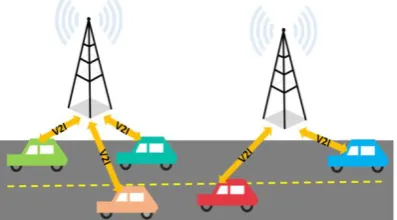
satellite networks, depending on the availability, and position of vehicles. Fig. 1 illustrates a V2V
communication circumstances with CR enabled vehicles which enables opportunistic spectrum usage
while moving with the recent advances in cognitive radio (CR) technology 7,8 introduction of CR
enabled VANETs will enable opportunistic spectrum sensing, and hopping from one frequency to
another in the entire spectrum range based on their requirements, and operating environment.
Fig. 1: V2V Communication Scenario with CR Enabled Vehicles.
It is essential to point out that in designing CR enabled vehicular networks, attention must be
paid to the strange characteristics of vehicular communication networks such as high speed of
vehicles, high density in urban areas, and extremely dynamic topology of vehicular networks due to
high mobility of the vehicles, which may direct to challenges of choosing suitable network,
communication channel or data rate.
The principal contributions of this study area in four folds and are listed as follows: (i) the
summary of the recent advances in CR technology and VANETs are discussed; (ii) the challenges and
techniques already accepted for designing CR enabled vehicular networks are also investigated; (iii)
the open issues and current research directions for future development and deployment of CR
enabled vehicular networks are presented; and (iv) the performance parameters for different CR
enabled vehicular network applications are surveyed and accessible.
The remuneration and potentials of CR technology in vehicular networks cannot be over
emphasized. In several cases, motor highways especially in rural areas are open spaces with
completely high chances of finding a radio spectrum hole that can be accessed opportunistically by
CR equipped vehicles. This is unlike sub-urban and urban areas where there are very slight chances of
finding radio spectrum holes as a result of high population which in turn leads to high usage of TV
white space. Hence, the combination of these two emerging technologies can resolve the problem of
scarce, limited, insufficient spectrum bandwidth, and under utilization of available spectral resource
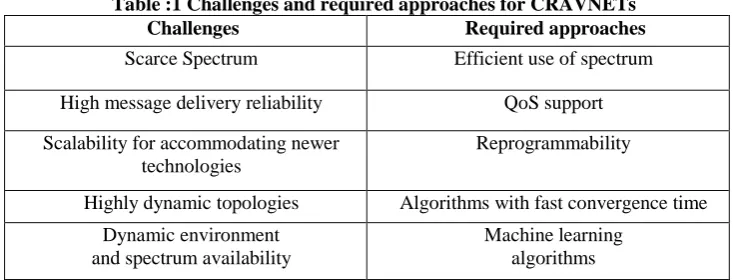
IJSRR, 7(4) Oct. – Dec., 2018 Page 1761 Table :1 Challenges and required approaches for CRAVNETs
Challenges Required approaches
Scarce Spectrum Efficient use of spectrum
High message delivery reliability QoS support
Scalability for accommodating newer technologies
Reprogrammability
Highly dynamic topologies Algorithms with fast convergence time Dynamic environment
and spectrum availability
Machine learning algorithms
II. CHALLENGES AND APPROACHES FOR Cognitive Radio ENABLED
VEHICULAR NETWORKS
The improvement and deployment of vehicular networks faces lacking radio spectrum
bandwidth allocations issues as a result of the random number of mobile users in the application. In
tune with the ever-increasing demand of this random number of vehicle, there will soon be a rapid rise
in development of new safety related and non-safety related applications and services for vehicular
environments. Some of the examples of these applications include collision avoidance, safety and
traffic monitoring, multimedia streaming, and applications for data collection for smart cities, V2V,
V2I, V2X, and infrastructure-to-infrastructure (I2I) communication. With the anticipated explosion of
the above applications in near future, the design and implementation of CRN technology in vehicular
networks has been assumed to further enhance efficient spectrum bandwidth distribution model in
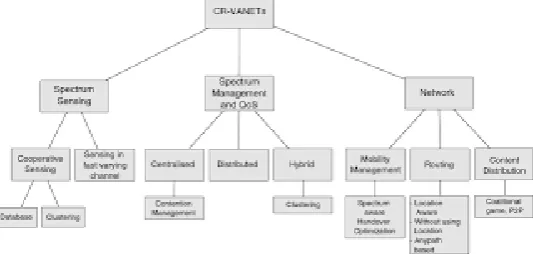
VANET to hold the applications. Taxonomy of recent advances on CR supported Vehicular NETwork
(CRAVNET) 1 is represented in Fig. 2 and further more explored in strength in this section.
A. WAVE Standards and CR assisted Vehicular Networks:
Vehicular network is a particular type of mobile ad-hoc networks (MANETs), where intelligent
vehicles in VANETs usually represent high mobility nodes with a highly dynamic network topology.
On the other hand, CR technology is a model newly devised to address the challenges of radio
spectrum insufficiency in communication networks. WAVE Physical Layer is based on the IEEE
802.11, on the other hand, because of the operating environment of vehicular networks; an amendment
of the standard is made which is known as IEEE 802.11p 2, 6. Although mobile stations in vehicular
networks travel in a random approach in line with the roads patterns, spectrum bandwidths are heavily
occupied and utilized in urban areas, which are usually high density environments whereas sub-urban
(or rural) areas are usually less density environments with many spectrum bandwidths unoccupied and
under utilized most of the time. Hence, incorporating CR technology into VANET will help in solving
IJSRR, 7(4) Oct. – Dec., 2018 Page 1762
through opportunistic spectrum access of the idle and underutilized spectrums. Table 1 prove
challenges and required approaches for CRAVNETs
Fig. 2: Taxonomy of recent advances on CR assisted vehicular networks.
In order to solve the challenges of high spectral congestions in CRAVNETs, the authors in 9
proposed a CR system that can temporarily and spatially add extra radio channels to vehicular
networks in the face of high vehicular density especially during the do too quickly hours when roads
are usually heavily jam-packed. The proposed CR framework accords the highest priority to critical
safety messages while ensuring that non- safety VANET applications (with non-safety messages) are
also successfully transmitted with less delay and increased overall network performance. Likewise
Tsukamoto et al 10 proposed a distributed channel coordination scheme for V2V message to exploits
the range of different communication frequencies and increase the data transmission rate of both intra
and inter-vehicle communications.
In Fawaz et al 11, a novel system is introduced to enlarge the spectrum bandwidth allocation to
CCH of wireless access in vehicular environment (WAVE) 12 protocols efficiently through the use of
cognitive network principles. Finally, the processing unit then deduce data conflict locations and
generates radio spectrum bandwidth schedules that will be dispatched to the passing smart vehicles.
In 13, the authors opine that radio spectrum shortage has now turned the most critical challenge facing
VANETs. Improved wireless architectures and its applications on vehicular networks, and the
consumption of CR technology to seek out better radio spectrum reuse through ad hoc, peer-to-peer
(P2P), and multi-hop communication results are addressed in Gerla and Kleinrock 13.
B. MAC Protocols for CR assisted Vehicular Networks:
Wireless MAC protocols provide channel admission mechanisms in CR assisted vehicular
networks. The main unique characteristic with value to the radio environmental conditions in which
the Cognitive Radio Network operates is the time/frequency/space-dependent availability of the
spectral resources, a trend commonly referred as spectrum heterogeneity. The design and effective
implementation of multi-channel MAC protocols with the ability of supporting concurrent message
IJSRR, 7(4) Oct. – Dec., 2018 Page 1763
sufficient in CR assisted vehicular networks due to the fast-fading feature connected with vehicular
network environment. On the other hand, wireless MAC protocols designed based on OSA for the
selection of available channels at every individual transmission may not guarantee reasonable and
efficient share of presented spectrum bandwidth between the challenging CR assisted SUs. In result
solutions to these challenges, Chung et al. 14 projected a cognitive MAC method for vehicular
networks. The cognitive MAC method uses both short-term and long-term radio spectrum access to
guarantee fair spectrum share (i.e., fair allocation of the additional spectrum amongst the challenging
CR assisted SUs). In addition, the proposed channel access scheme exploits multi-user diversity so as
to achieve high network throughput.
In a similar study, Shah et al. 15 adopted the CR concept and the enhanced distributed
coordination access (EDCA) to propose a MAC protocol for WAVE in order to develop the overall
utilization of the available channel (s) and satisfy the high transmission consistency demand
associated with vehicular safety messages. However, the dynamic MAC protocol was planned for
common VANET. Hence, in order to guarantee a significant boost in channel access reliability,
minimized transmission delay, and overall network throughput while concurrently agreeable the QoS
requirement, a dynamic channel access (i.e., MAC) scheme precise to CR assisted vehicular
networks must be planned and implemented.
C. Security, Privacy, and Liability for CR-VANETs :
Security and privacy issues are extremely essential for effective design, implementation, and
successful operation of CR enabled VANETs due to potential threats to traffic flow, properties, and
human lives by any cruel attempt, for instance, fake (or fraudulent) message transmission leading to
traffic disruption and fatal accidents. Some of the security and privacy challenges connected to
security, privacy, anonymity, and responsibility in CR assisted vehicular networks have been explored
in 12, 16. Vehicular networks supply wireless access for random vehicles to communicate and exchange
both security and non-safety related information on the road, whereas CRNs enable efficient sharing
of available spectrum bandwidth between these random vehicles. Hence, guaranteeing security,
privacy, secrecy, and liability in CR assisted vehicular networks remains one of the keys headed for
making CR enabled vehicular networks a reality. The distributed sensor technology assist to guarantee
high reliability and optimality of the proposed protocol, and prioritizes efficient QoS, robustness
against denial of service (DoS) security attacks, and the prevention of data aging. In general, wireless
access in vehicular network similar to other wireless networks is highly exposed to both DoS and
distributed DoS security attacks, such as radio jamming attack.
IJSRR, 7(4) Oct. – Dec., 2018 Page 1764
networks is jamming attacks, which can obstruct with legitimate wireless access communications to
adversely affect and degrade the overall QoS of the vehicular network. In a related study, Hamieh et
al.18 conducted a study on how to identify radio interference attacks in vehicular networks. According
to Hamieh et al.18, a jammer sends out transmissions only when valid radio movement is signalled
from its radio hardware to detect a given class of jamming attack. The security model proposed in 18
was used to effectively identify the presence of jamming attack.
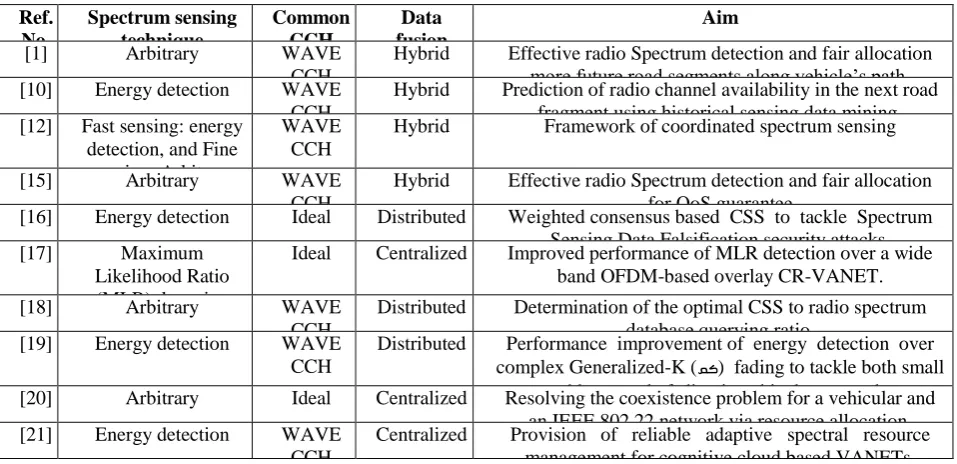
Table : 2. Cooperative spectrum sensing (CSS) techniques
Ref. No. Spectrum sensing technique Common CCH Data fusion Aim
[1] Arbitrary WAVE
CCH
Hybrid Effective radio Spectrum detection and fair allocation more future road segments along vehicle’s path.
[10] Energy detection WAVE
CCH
Hybrid Prediction of radio channel availability in the next road fragment using historical sensing data mining. [12] Fast sensing: energy
detection, and Fine sensing: Arbitrary
WAVE CCH
Hybrid Framework of coordinated spectrum sensing
[15] Arbitrary WAVE
CCH
Hybrid Effective radio Spectrum detection and fair allocation for QoS guarantee
[16] Energy detection Ideal Distributed Weighted consensus based CSS to tackle Spectrum Sensing Data Falsification security attacks.
[17] Maximum
Likelihood Ratio (MLR) detection
Ideal Centralized Improved performance of MLR detection over a wide band OFDM-based overlay CR-VANET.
[18] Arbitrary WAVE
CCH
Distributed Determination of the optimal CSS to radio spectrum database querying ratio.
[19] Energy detection WAVE
CCH
Distributed Performance improvement of energy detection over complex Generalized-K (ܩܭ) fading to tackle both small
and large scale fading in vehicular networks. [20] Arbitrary Ideal Centralized Resolving the coexistence problem for a vehicular and
an IEEE 802.22 network via resource allocation.
[21] Energy detection WAVE
CCH
Centralized Provision of reliable adaptive spectral resource management for cognitive cloud based VANETs.
D. Routing in C R-VANETs
Even though VANET is considered as a special kind of mobile ad hoc network (MANET), but
due to the peculiar network characteristics of CR enabled vehicular networks such as frequent network
disconnections, and varying network topology, existing conventional routing protocols designed for
MANETs are not applicable for CR-VANETs. Most of the vehicular network routing algorithms are
categorized into three, namely, opportunistic forwarding algorithms, geographic forwarding
algorithms, and trajectory-based forwarding algorithms. Opportunistic forwarding algorithms adopts
carrying-and- forwarding approach to receive and retain a message whenever given the opportunity
until the mobile node meets the next hop node through which the message can be routed to its
destination. This kind of algorithm is especially useful in wireless communication scenarios with
regular network disconnections and can be combined with other routing mechanisms that use
trajectory-based or geographic forwarding algorithms. On the other hand, geographic forwarding
algorithm routes messages towards their destination node based on its geographical location. Although
IJSRR, 7(4) Oct. – Dec., 2018 Page 1765
dead-ends. Trajectory-based forwarding algorithms can be the most appropriate message routing
algorithm for CR enabled vehicular networks since they regard as the road infrastructure as an overlay
absorbed graph, using the roads as graph edges, and the road intersections as graph nodes to enable
packets forwarding to move in pre- defined trajectories 8, 12.
Kim et al. 19 studied some of the restrictive factors of the existing routing protocols, where the
sensed channel information, and geographical location are used to carry out a cognitive routing of the
transmitted packets. The authors’ use of the sensed channel information, and geographical location
effected in overall network throughput improvement. The protocol they proposed uses unlicensed
spectrum band to manage in a multi-hop communication, and wireless ad hoc mode, which is different
from the traditional CR strategies. Through the application of diverse allocations of spectrum
bandwidth in CR assisted vehicular network, both safety and infotainment messages are routed across
the entire network so as to reach intended receivers. Barve and Kulkarni 20 addressed the challenges of
packets routing in CRNs. The study determined on the problem of message forwarding in CRNs,
which absorb identifying and maintaining the optimal path from the sender to receiver using the
presented common channel. Further mechanism on routing solutions to suitable the deployment of CR
assisted vehicular networks must be followed to solve the challenges of message forwarding in
CR-VANETs.
III. CONCLUSION
This paper presents a survey of new advances and search several research challenges
connected with the use of CR technology for vehicular networks. Although the design and
consumption of CR technology in VANETs is still in its initial stage, CR enabled vehicular networks
have great potentials in intelligent transportation systems (ITSs) in the next to future because of the
enormous consumer market for vehicular communications. However, the existing research solutions
designed for general-purpose CRNs are not straightly applicable to CR enabled vehicular networks
because of the unique features of VANETs which must be put into consideration when manipulative
the radio spectrum management functions for CR enabled vehicular networks. This paper has
recognized several challenges and requirements for efficient design and exploitation of CR enabled
vehicular networks. Furthermore, recent advances, open problems, and future research development
on effective application of CR technology into VANETs were examined.
REFERENCES
1. J. Eze, S. Zhang, E. Liu, E. E. Chinedum and H. Q. Yu. "Cognitive Radio Aided Internet of
Vehicles (IoVs) for Improved Spectrum Resource Allocation," 2015 IEEE International
IJSRR, 7(4) Oct. – Dec., 2018 Page 1766
Communications; Dependable, Autonomic and Secure Computing; Pervasive Intelligence and
Computing, Liverpool; 2015; 2346-2352.
2. J. Huang, X. Zeng, X. Tan, X. Jian and Y. He, "Spectrum allocation for cognitive radio
networks with non-deterministic bandwidth of spectrum hole"; in China Communications;
2017; 14(3): 87-96.
3. J. Mitola and G. Q. Maguire. “Cognitive radio: making software radios more personal”. in
IEEE Personal Communications; 1999;6(4): 13-18.
4. Eze, E.C. Sijing Zhang, Enjie Liu, "Vehicular ad hoc networks (VANETs): Current state,
challenges, potentials and way forward," 20th International Conference on Automation and
Computing (ICAC) 2014; 12-13 Sept 2014;176-181.
5. Rawat, D.B., Popescu, D.C., Gongjun Yan, Olariu S, "Enhancing VANET Performance
by Joint Adaptation of Window Size"; in IEEE Transactions on Parallel and Distributed
Systems, Transmission Power and Contention; Sept. 2011;22(9):1528-1535.
6. IEEE Std 1609 family, “IEEE Trial-Use Standard for Wireless Access in Vehicular
Environments (WAVE),” Nov. 2006.
7. Marfia G., Roccetti M., Amoroso A., Gerla M., Pau G., Lim J. H., “Cognitive Cars:
Constructing a Cognitive Playground for VANET Research Testbeds,” in 4th International
Conference on Cognitive Radio and Advanced Spectrum Management (CogART 2011),
Spain, Oct. 2011.
8. Kamal Deep Singh, Priyanka Rawat and Jean-Marie Bonnin, "Cognitive radio for vehicular ad
hoc networks (CR-VANETs): approaches and challenges," EURASIP Journal on Wireless
Communications and Networking, 2014;49:1-22.
9. N. J. Kirsch and B. M. O'Connor, "Improving the performance of vehicular networks in high
traffic density conditions with cognitive radios"; 2011 IEEE Intelligent Vehicles Symposium
(IV); 2011; 552-556.
10.Tsukamoto K., Matsuoka S., Altintas O., Tsuru M., & Oie Y., “Distributed channel
coordination in cognitive wireless vehicle-to-vehicle communications”; Conference on the
institute of electronics, information and communication engineers (IEICE), Tokyo; 2009; 59–
64.
11.K. Fawaz, A. Ghandour, M. Olleik and H. Artail, "Improving reliability of safety applications
in vehicle ad hoc networks through the implementation of a cognitive network," 2010 17th
International Conference on Telecommunications; Doha; 2010; 798-805.
12.Elias C, Eze Si-Jing Zhang, En-Jie Liu Joy C, Eze, "Advances in Vehicular Ad-hoc Networks
IJSRR, 7(4) Oct. – Dec., 2018 Page 1767
of Automation and Computing; 2016; 13(1): 1-18.
13.M. Gerla and L. Kleinrock, Vehicular networks and the future of the mobile internet,
Computer Networks, 2011; 55(2):457-469.
14.Seung-eun Chung, Joon Yoo and Chong-kwon Kim, "A cognitive MAC for VANET based on
the WAVE systems"; 11th International Conference on Advanced Communication
Technology; Phoenix Park; 2009; 41-46.
15.Shah N., Habibi D., & Ahmad I., "Multichannel cognitive medium access control protocol for
VANET"; Conference in vehicular technology; New York; NY 2012; 222–233.
16. Z. Wei, F. R. Yu, H. Tang, C. Liang and Q. Yan, "Securing cognitive radio vehicular Ad hoc
networks with trusted lightweight cloud computing"; 2016 IEEE Conference on
Communications and Network Security (CNS; Philadelphia; 2016; 450-456.
17.R. Muraleedharan and L. A. Osadciw, "Cognitive security protocol for sensor based VANET
using swarm intelligence," 2009 Conference Record of the Forty-Third Asilomar Conference
on Signals, Systems and Computers, CA, 2009; 288-290.
18.A. Hamieh, J. Ben-Othman and L. Mokdad, "Detection of Radio Interference Attacks in
VANET," GLOBECOM 2009 - 2009 IEEE Global Telecommunications Conference,
Honolulu, HI, 2009; 1-5.
19.W. Kim, S. Y. Oh, M. Gerla and K. C. Lee, "CoRoute: A new cognitive anypath vehicular
routing protocol," 7th International Wireless Communications and Mobile Computing
Conference, 2011; 766-771.
20.Barve, S. S., and Kulkarni, P., “A performance based routing classification in cognitive
radio networks,” International Journal of Computer Applications, 2012; 44: 11–21.
21.A. Nithya., "An Analysis of Manet and Vanet Routing Protocols", ISSN [ONLINE]: