Abstract—The index of the maintenance time is very important in the maintenance design , a efficient maintenance time measurement methodology plays an important role in the early stage of the maintenance design, though there are many methods to measure the maintenance time ,they ignore the relationship between line production and the maintenance work. This paper proposes a corrective MOD method considering several man-machine factors, on the basis of the decomposition of maintenance task, the original MOD value of maintenance therbligs which described in virtual simulation environment can be got. With the influence factor of ergonomics and DELMIA analysis tools, the influence coefficients of several factors are discussed to correct MOD value. Finally, a case verifies the practicability and effectiveness of the method.
Index Terms—Maintainability, human factor, virtual reality, motion-time.
I. INTRODUCTION
Maintainability prediction is defined to estimate and calculate maintainability parameters of new products under a given working condition based on historical experience and the data of similar products. Maintenance time is a critical quantitative parameter in describing maintainability design. Long maintenance time will lead to huge loss, and influence the combat mission success rate and resource consumption,however the traditional way to measure maintenance time by the actual work has drawbacks 1). Measuring time by the actual maintenance work relies on physical prototype which is lagged, nevertheless Changing the design is very difficult and consumes lots of human and material resources also time. 2). The data used in the cumulative model is obtained by the statistical experiment of skilled worker. The development of the virtual reality provides an effective way to solve the problem. Virtual maintenance (VM)” is a computer and virtual reality-based application technology that simulates the maintenance process of the environment, and includes digital prototypes and virtual humans. Since the 1990s, many studies proposed a number of solutions using VR. Caudell and Mizell proved the effectiveness of using a VR system to provide instructions for wiring harness assembly [1]. Real-time immersive virtual environments (VEs), such as the CAVE have been used to assess the maintainability of virtual prototyp e[2]. Compared with the object-oriented prototype
Manuscript received June 8, 2016; revised October 12, 2016.
Zhou Xinxin and Zhou Dong are with State Key Laboratory of Virtual Reality Technology and System Beijing, China (e-mail: [email protected]).
Guo Ziyue is with Reliability and System Engineering College, China (e-mail: [email protected]).
system called V-REALISM for maintenance training proposed by Li,J.R., et al. [3], a better solution has been presented by Abate, A.F., et al. [4], which combines VR techniques and haptic interaction to simulate process of product assembly maintenance in the aerospace industry. VM systems have been applied in maintenance process simulation [5], maintenance planning [6], and maintenance training Amos, H.C.N. et al. [7] have established a machine service support system that demonstrates advanced use of 3D graphical simulation tools in the resource domain, and expends the use of simulation modules from the system design and development phase into operation phase. Bourdot, P. et al. [8] presented an approach for integrating VR and computer-aided design (CAD), allowing intuitive and direct 3D edition on CAD objects within VEs. For the second, the difference between maintenance process and line production should be considered. The maintenance time is greatly influenced by the maintainability of the product. The method used in the line production is MTM (Method time Measurement) [9], which should be corrected in the maintenance time measurement. MTM is put forward by B.S.Q. Elzendoorn and Delphine Keller. A lot of literatures discussed MTM. In 1928, A. B. Segur raised the Motion-Time Mechanism in his Ph.D. thesis [10]. The line production is relatively easy and not influenced by many factors, however the maintenance work is very complex and the maintenance worker need high skills to complete it ,The MOD divides the motion more accurately ,which is more suitable to the maintenance work. .Given the observation above, this paper proposes a new way to measure maintenance time in the virtual environment.
II. FRAMEWORK OF THE PROPOSED METHODOLOG
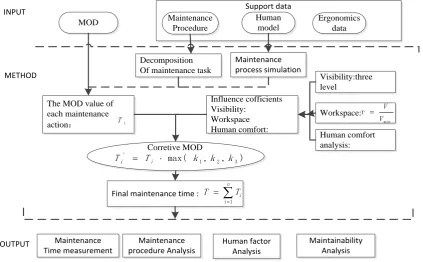
The Fig. 1 show the framework of this paper, which consist of four parts: support method, support data, maintenance measurement time and output. Support data provide the data for the research, which are maintenance procedure, human model and ergonomics data; Support method is the MOD method, provides the key way to measure each maintenance virtual simulation therbligs;The section of the method is how to calculate the maintenance time of each therbligs and determine the correction factor of the maintenance time. This will be discussed in detail; Output introduces the possible output of the proposed method.
III. TIME MEASUREMENT OF MAINTENANCE TASK
Using the MOD to measure the maintenance time regards human action as the core, so the decomposition of the maintenance task is the first step[11],then we can determine the value of the MOD for each therbligs, and the
A Maintenance Time Measurement Methodology under
the Combination of Ergonomics and Virtual Simulation
maintenance time need to be corrected considering the influence time of visibility, workspace and human posture.
MOD
The MOD value of each maintenance
action: Ti
Decomposition Of maintenance task
Maintenance process simulation
Influence cofficients Visibility:
Workspace Human comfort:
Visibility:three level
Workspace:
Human comfort analysis:
min r
V V
Corretive MOD
) , ,
max( 1 2 3
' T k k k
Ti i
Maintenance procedure Analysis
Human factor Analysis
Maintainability Analysis Maintenance
Time measurement
Final maintenance time :
n Ti
T
1 i
INPUT
METHOD
Maintenance Procedure
Human model
Ergonomics data Support data
OUTPUT
Fig. 1. Frame work of the proposed methodology. A. Decomposition of the Maintenance Task
Maintenance process should be decomposed before measuring maintenance time According to the traditional maintenance process decomposition, a maintenance process in general can be broken down into three levels: maintenance event, maintenance work and basic maintenance operation. In the process of the decomposition, the basic maintenance operation is the lowest level, the accuracy of the basic maintenance time results directly influence the final prediction result. However the prediction of the basic maintenance operation is mainly predicted according to the engineering experience and lack a Scientific and effective measurement method. Basic maintenance operation is directly related to the product meanwhile. For example, turning the screw, the complete process is different when operate different product. This makes maintenance time of the same basic maintenance operation different, So we need to study the basic maintenance measurement method. According to the hierarchical thinking, bottom-up building maintenance process simulation model, we determine the classification and time of maintenance therbligs, which has no relation to specific object. We finally decompose maintenance process into four layers: maintenance event layer, maintenance work layer, basic maintenance operation layer and maintenance therbligs layer.
For example, in the level of maintenance event ,replacing an unserviceable component can be divided into Fault location, Fault isolation, Remove component timing ,inspection, this is Maintenance work layer. Further removing the component can be divided into open the pressure machine covers , free the fixed bolted failure parts ,remove clamp failure, separate
Failure parts.. this is the basic maintenance operation layer, Further opening the pressure cover can also be divided into move(walk to operation location ),grasp(Stretch hand to grasp the target ),Disassembling operation(open action),let
go (release object and return to normal position),this is the level of maintenance therbligs layer.
According to maintenance work, this paper divides maintenance work into four parts considering characteristics of MOD method: mobile therbligs, posture-adjustive therbligs and operational therbligs. The detail description is shown Fig. 2.
B. Corrective MOD
The basic principle of the MOD is:
1) All operation actions of all people, contains basic movements can be divided into 21 basic action through lots of experiments.
2) Under the same condition , different people doing the same movement nearly take the same time.
3) The time of different movement is proportional to each other.
Mobile therbligs Posture-adjustive therbligs
Operational therbligs
Walk Side Striding Up and down
Stand Sit Squat Kneel Grovel
Lie l
Rotation Press Push Pull
Lift Knock
Fig. 2. Human action therbligs.
TABLEI:THE MODMETHOD CLASSIFICATION OF BASIC THERBLIGS
Classification Details Sign
action Wrist movement M2
Forearm movement M3
Upper arm movement M4
Straighten the arm
movement M5
Reflex motion Continuous repeatedly reflex action
M1/2、
M1、M2
End up
action
Grasping motion
Touch or contact G0
Grab without attention G1
Complicated capture G3
Putting motion
Simple placement P0
Complex placement, as
alignment P2
Placement aimed at
assemble P5
Other
action
Feet motion Cadence motion F3
Thigh motion Walk action W5
Independent motion (other
actions have to stop )
Visual inspection E2
correction R2
Judgment and reaction D3
Press down A4
Body movements at the same time
Spins C4
Stoop /curve body→
Stand up B17
Sit down→ Get up S30
Additive
factor gravimetric factor (Load) L1
The MOD choose the time of lifting a finger as the basic units, the time is 0.129s and is regard as a MOD[12]..However the time is not absolutely, and can be modified according to the practical situation. The MOD method divides human action into 21 categories including 11 basic therbilgs and 10 other auxiliary therbligs. 11 basic therbligs contains 5 mobile therbligs and 6 end therbligs. Specific definitions and symbols of each therbligs are shown in table 1.It is convenient to use MOD method to analyze actions. We can determine the the MOD value as long as we know which type of the action is. The MOD method will also encounter the consumption time which is not caused by movements but necessary, which is defined in the below Table II.
C. Workspace Factor Analysis 1) Visibility factor analysis
Visibility is one of the most important influence factors in maintenance work. In the maintenance work, lots of operation areas have poor visibility, which make the maintenance work difficult and influence the time greatly. Ergonomics show the degree of visibility can be divided into three levels
TABLEII:ADD SYMBOLS AND DEFINITIONS
Definition Sign Details Samples
Delayed BD one hand movements, Right hand M
another hand in the
stopped state, don't give
time
Left hand BD
Maintain H
Fixed state with hand
holding or grasping
objects, mainly refers to
the action of support and
fixed, don't give time
Left hand H
Right hand P2
Effective
time UT
Except movement of
serviceman, inherent
additional time caused by
machines or other
technical requirements
instead of action
produced, need to
measure time accurately.
Such as mechanical
working time, soldering,
riveting, testing, coating,
etc.
tin soldering
time UT or
Instrument
testing time
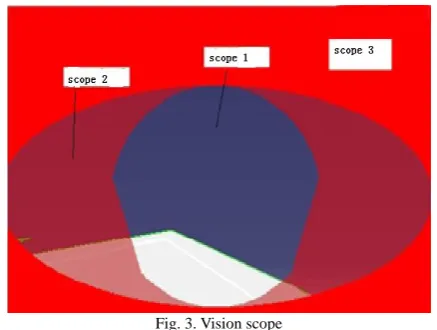
1 within the 15°scope cone, is the best vision field; 2 within the 30°scope cone, is the largest vision field; 3 outside the 30°scope cone, is the invisible field.
The virtual simulation software DELMIA support the visibility analysis tools, which can show us the detail information of scope cone, as shown in Fig. 3.
Assuming the distance between maintenance personnel’s eyes and maintenance operation object is h, the area of the best vision field, the largest vision field and the invisible field is S1, S2 and S3, then:
Fig. 3. Vision scope
TABLEIII: VISIBILITY INFLUENCE COEFFICIENT
Scope analysis area Visibility level Influence coefficient
15°scope cone Good 1
30°scope cone Normal 1.4679
Other scope cone Bad 2.4313
2 3
2
2 1
)
30
tan
(
4
)
30
tan
(
)
15
tan
(
)
15
tan
(
h
S
h
h
S
h
S
When the maintenance worker is in the best vision field,
the visibility won’t influence
coefficient.WhileS2/S1=tan30/tan1
4679 . 1 1547 . 2
k12 k13 5.9113 2.4313
When separately considering the impact of visibility, the value of MOD need to be modified to get actual time. So we can define 15°scope as the good level, 30°scope as the normal level, other scope as the bad level. And the coefficient is shown in the above Table III.
2) Workspace
Work space is defined the actual space for maintenance personnel, which is an important influence factor for maintenance. Operation of the maintenance worker in an environment where interference between human and machine parts is a major concern, sufficient operating room has to be reserved to avoid collisions during maintenance process [13]. What’s more, the space reserved for the maintenance motions may cause effect on operator’s comfort feelings and performance. Enough maintenance space for maintainers has to be reserved for the maintainers to ensure easy of operation, safety, comfort, and performance and so on. If the operator operate in the bad work space, he have to adjust his gesture to complete the work, which lead to maintenance time extending .certainly.
In ergonomics, scholars generally judge the degree of workspace by collision and interference [14]. And quantitative evaluation can be assessed by workspace ratio [15].
min
r
V
V
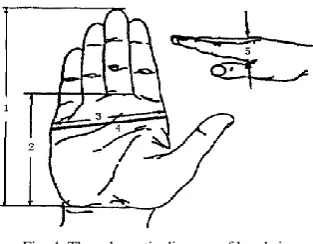
Maintenance operation is mainly divided into two kinds: bare-hand operation and with tool operation. Different kind has different way to calculate. The sizes of the maintainer’s hand are obtained through statistic data or related standards. Fig. 4 shows the schematic diagram of the sizes.
Fig. 4. The schematic diagram of hand sizes.
Bare-hand minimum workspace can be set as a cube model. Length (defined as l) is the sum of hand length (named as
l
h ) and palm length (named asl
p); width (defined as w) is equal to the hand width (named asw
h); height (defined as h) is three times as hand thickness (named ash
t ). So the bare-hand operation minimum workspace calculation expression is:t h p
h l • w h
l h w l
Vmin 3( )
Assuming maintenance personnel use standard tools to operate the failed units. The size data of the standard tools can be got through relative industry standard. The with tool operation minimum workspace expression is:
)
3
,
max(
)
,
max(
min t
t t h
t
t
w
w
h
h
l
V
where
l
t is the tool’s length;w
tis the tool’s width;h
ttis the thickness of the tool.By studying the ergonomics data, the influence of workspace to the maintenance time can be divided into three levels., good , normal ,bad. And the description are: Good: rm and tools of the maintenance personnel have enough operation in the natural condition, is convenient to complete maintenance operations; Normal: Maintenance personnel can make arm and tool seldom collide the surrounding equipment adjusting within a certain permitted scope, is convenient to complete maintenance operations; Bad: Arm and tool still cannot avoid colliding the surrounding equipment within a certain permitted scope, is difficult to finish the maintenance operation.
And the detail of the influence coefficient is: shown in the Table IV.
TABLEVI:VISIBILITY INFLUENCE COEFFICIENT Workspace level r influence coefficient
Good >1.8 1
Normal 1.5<r<1.8 1.1
bad <1.5 1.3
As a result, the workspace factor’s influence coefficient is: k21=1, k22=2.4539, k23=6.2231. And the specific data can be gained by virtual simulation software DELMIA. Through simulating therbligs which decomposed from maintenance task, maintenance personnel can receive detail human data and workspace data, as shown in Fig. 5.
Fig. 5. Workspace tool in DELMIA.
3) Human posture factor analysis
is in the received scope; brown state that the comfort level of this posture is poor, needs improve quickly; red explains maintenance personnel keeps a very bad working posture, posture needs to change right now in order to ensure maintenance safety.
TABLEV: DETAIL INFORMATION OF RULA
limb Result
range
Color relative to result
1 2 3 4 5 6
Upper
arm 1-6 green green yellow yellow red red
Forearm 1-3 green yellow red
Wrist 1-4 green yellow brown red
Wrist
twist 1-2 green red
Neck 1-6 green green yellow yellow red red
body 1-6 green green yellow yellow red red
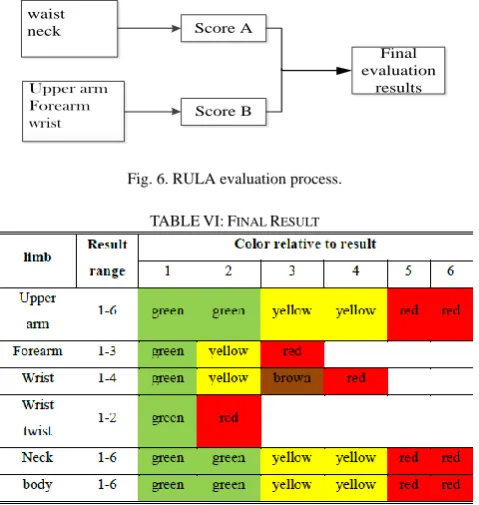
Then, RULA method divides these limb results into two groups, and analysis these result integrated and comprehensively, which is shown in the below figure 6.And The total score of the waist neck and upper arm is shown in the Table VI.
waist neck
Upper arm Forearm wrist
Score A
Score B
Final evaluation
results
Fig. 6. RULA evaluation process.
TABLEVI:FINAL RESULT
Lynn McAtamney and Dr. E Nigel Corlett (the authors of RULA) finally divided the comfort quantitative result into five parts and gave some suggestion. According to the ergonomics data and the influence to maintenance time, table 7 presents the influence coefficient of human posture factors which influence the maintenance time.
D. Determine MOD Value
As visibility, workspace and human posture don’t have directly interactive relationship when these three factors influencing on maintenance time measurement, this paper assumes that visibility, workspace and human posture are
three mutual independent factors in maintenance time measuring. Therefore, the MOD value can be calculated as following:
1) When finishing decomposing maintenance task into therbligs, maintenance personnel can simulate these therbligs in DELMIA;
2) For the ith maintenance therbligs, look up table 3, table 4 and table 10, finding out the influence coefficients of visibility, workspace and human posture through ergonomics tools in DELMIA; 3) According to the basic therbligs, look up Table I,
determine the basic MOD value, then converse it into consuming time, defined as
T
i.4) Visibility, workspace and human posture these three factors often occurred interactively. Bad visibility usually causes workspace and human posture problems while bad workspace situation may lead to uncomfortable human posture. Considering influence factors integrative, the final maintenance time measurement result can be corrected by the maximum coefficient.
5) Weighting basic time of the ith maintenance therbligs with three influence coefficients comprehensively, gain the correct i th consuming time, defined as
) , ,
max( 1 2 3
'
i T k k k
T i .
6) Add all maintenance time of each therbligs, the final maintenance time can be calculated as
ni i
T
T
1 '
IV. CASE STUDY
The APU motor starter of an air bus is installed at the Empennage of the plane. It is fixed by 8 hexagon bolt on the bracket. The weight of APU is about 20kg. Maintenance personnel has already contract virtual simulation maintenance environment in DELMIA.
A. Decomposition of the Maintenance Process
According to the related chapters content about APU motor starter in the maintenance manual of this air bus, its maintenance process can be decomposed as Fig. 7
B. Establishment of the Simulation Model
Single maintenance personnel can finish disassembling the APU motor starter with only hexagon wrench. According to the human data in GB-10000-1988, we build a Chinese maintenance personnel model in DELMIA.
Then we set up Human Task which is corresponded to the basic maintenance work and establish the maintenance therbligs, finally establish the simulation model of the whole maintenance process. As is shown in the below Fig. 8.
C. Maintenance Therbligs Time Measurement
TABLEVII: HUMAN POSTURE FACTOR LEVEL AND INFLUENCE COEFFICIENT
Activity result Final result Risk level suggestion Influence coefficient
0 1 No risk No need to improve 1
1 2~3 low Maybe need to improve 1.1
2 4~6 middle Need to improve 1.2
3 7~9 high Need to improve quickly 1.3
4 10~11 Polar high Need to improve right now 1.4
Disassemble the APU
Open the covering cap Take down the APU Put the APU on the table
Move to the cap Loose the lock Open the cap Loose the cable
plug
Loose the hexagon bolt
Take down the APU
Fig. 7. Decomposition figure of the maintenance process.
Fig. 8. Maintenance process simulation model.
Based on this method, the basic MOD value of each MTP can be filled in the property dialogue box. Then, we choose one human task under ProcessList in P.P.R environment.
After we get the basic MOD value, the next step is correcting MOD value by influence coefficients of visibility, workspace and human posture. Taking a screw MTP as an example, the maintenance therbligs is in the Fig. 8.
In the figure 8, maintenance tool is ratchet wrench, its length is 200mm, width is 30mm and thickness is 15mm. According to the content in “workspace factor analysis”, the minimum workspace is:
) ( 10 3944 . 1 28 3 83
200 6 3
min mm
V
And the workspace is:
) ( 10 6771 . 1 4 / ) 300 * 120 300 260 260
( 2 6 mm3
V
So the workspace ratio is:
5 . 1 203 . 1 3944 . 1
6771 . 1
min
V V r
And the workspace influence coefficient is k2=1.3.
Open the tool eye vision
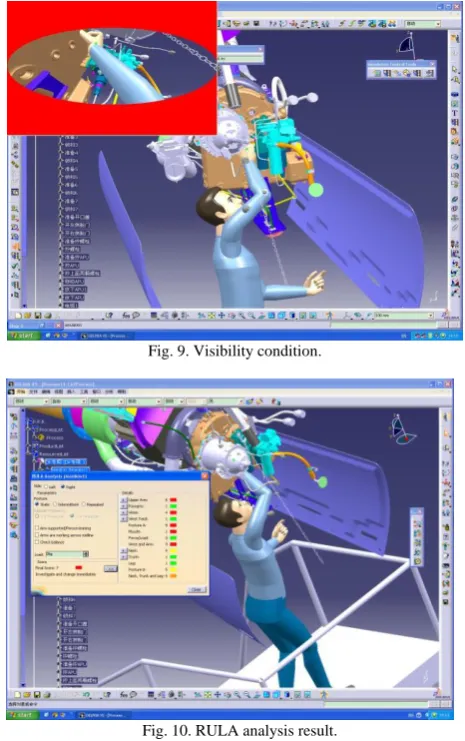
Fig. 9. Visibility condition.
Fig. 10. RULA analysis result.
According to the Fig. 9, we can find the scope is bad,so we can get the visibility k1=2.4313 according to table3. And we
open the human ergonomics tool and choose the RULA analysis tool; the result can be seen in Fig. 10.
As the basic MOD value of this maintenance therbligs is belongs to M2, so the basic MOD consumption time is 2
MOD. The corrective MOD value is:
MOD k
k k T
T i max( 1, 2, 3) 2 2.4313 4.8626 '
i Then
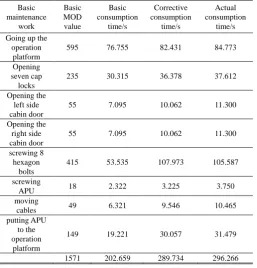
we can measure all maintenance therbligs MOD value in the same way.. We use Delmia, we can get the basic maintenance work measurement time and corrective time is presented in table 8.we can see that maintenance time measured directly by MOD method is 202.659s; while the maintenance time measured by corrected MOD method is 289.734s, which is closer to the actual maintenance time 296.266s than the previous one.
TABLEVIII:BASIC MAINTENANCE TIME MEASUREMENT RESULTS
Basic maintenance
work
Basic MOD value
Basic consumption
time/s
Corrective consumption
time/s
Actual consumption
time/s Going up the
operation platform
595 76.755 82.431 84.773
Opening seven cap
locks
235 30.315 36.378 37.612
Opening the left side cabin door
55 7.095 10.062 11.300
Opening the right side cabin door
55 7.095 10.062 11.300
screwing 8 hexagon
bolts
415 53.535 107.973 105.587
screwing
APU 18 2.322 3.225 3.750
moving
cables 49 6.321 9.546 10.465
putting APU to the operation
platform
149 19.221 30.057 31.479
1571 202.659 289.734 296.266
V. CONCLUSION AND FUTURE WORK
This paper proposed a methodology for measuring the maintenance time in virtual simulation environment. A maintenance action decomposition of maintenance tasks and corrective MOD with factors that influence the maintenance time are discussed. Finally a case study verifies the effectiveness of the proposed methodology.
Several areas need to be studied in the future work. This paper proposed the influence coefficients of corrective MOD is only decided by qualitative analysis. And we also need to concentrate on the difference between the virtual and real world. For example, the load of the object also influences the maintenance time, because people do the same work in the different load are different, and existing method doesn’t think of this, and the influence factor may exist interaction, which also need to be studied to predict the maintenance accurately.
REFERENCE
[1] P. C. Thomas and D. W. Mizell, “Augmented reality: An application of heads-up display technology to manual manufacturing processes,” in
Proc. the International Conference on Twenty-Fifth Hawaii, vol. 2, 1992.
[2] L. D. Cutler, B. Fröhlich, and P. Hanrahan, "Two-handed direct manipulation on the responsive workbench," in Proc. the Symposium on Interactive 3D Graphics, pp. 107-114, April 1997.
[3] W. Q. Hui and J. R. Li, “Interactive visualization of complex dynamic virtual environment for industrial assemblies,” Computers in Industry,
vol. 57, pp. 366-377, 2006.
[4] A. F. Abate, M. Guida, P. Leoncini, M. Nappi, and S. Ricciardi, “A haptic-based approach to virtual training for aerospace industry,”
Journal of Visual Languages and Computing, vol. 20 no. 1, pp. 318-25, 2009.
[5] A. G. D. Sa and G. Zachmann, “Virtual reality as a tool for verification of assembly and maintenance processes,” Computers and Graphics, vol. 23, no. 1, pp. 389-403.1999.
[6] F. J. A. M. V. Houten, “The virtual maintenance system: a computer-based support tool for robust design," Product Monitoring, Fault Diagnosis and Maintenance Planning, pp. 91-94, 2000. [7] H. C. N. Amos, J. Adolfsson, M. Sundberg, and L. J .D. Vin, “Virtual
manufacturing for press line monitoring and diagnostics,” Machine Tools and Manufacture, vol. 48, pp. 565-575, 2008.
[8] P. Bourdot, F. Picon, and M. Ammi, “VR-CAD integration: multimodal immersive interaction and advanced haptic paradigms for implicit edition of CAD models,” Computer-aided Design, vol. 42, no. 5, pp. 445-461, 2008.
[9] L. J. Forsman, M. Kadefors, and R. R. Ortengren, “MTM-based ergonomic workload analysis,” International Journal of Industrial Ergonomics, vol. 30-33, 2002.
[10] A. B. Segur, Motion Time Analysis, 1928.
[11] S. Lan, "Optimization of electric motor assembly operation with work study," in Proc. International Conference on the Logistics Systems and Intelligent Management, pp, 1101-1104, 2010.
[12] Z. Q. Ma, Q, Guangwei, S. Li , S. Yongcai, L. Peng, Y. C. Sun, "Research on the time quota of transmission gear based on MOD," in
Proc. the 2nd International Conference on Information Science and Engineering (ICISE), pp, 3091-3094, 2010.
[13] M. Ishii and M. Sato, "A 3D interface device with force feedback: a virtual work space for pick-and-place tasks," Virtual Reality Annual International Symposium, pp, 331-335, 1993.
[14] N. Duffy, D. Allan, and J. T. Herd, "Real-time collision avoidance system for multiple robots operating in shared work-space," Computers and Digital Techniques, vol. 136, no. 6, pp, 478-484,1989.
[15] Y. F. Huang and K. Gupta, “An adaptive configuration-space and work-space based criterion for view planning, intelligent robots and systems,” in Proc. theInternational Conference on Intelligent Robots and Systems, pp, 3366-3371, 2005.
[16] M. Hagberg, "Electromyography signs of shoulder muscular fatigue in two elevated arm position," Am J Phys Med, vol. 60, pp. 111-121, 1981.
Zhou Xinxin was born in Beijing, in 1992. He received his master in maintainability, systems engineering, virtual maintenance from State Key Laboratory of Virtual Reality Technology and System, Beijing China.
Zhou Dong is a professor. He is a member of State Key Laboratory of Virtual Reality and the Reliability and Environmental Engineering, National Defense Key laboratory. He is research are maintainability, systems engineering, virtual maintenance institution: reliability engineering and system.