IN
SILICO
ANALYSIS
OF
SINGLE
NUCLEOTIDE
POLYMORPHISMS (SNPS) IN HUMAN NLRP7 GENE
ASSOCIATION WITH RHMS
Nasreen Sultana1, K. Kasturi2
1. INTRODUCTION
Hydatidiform mole (HM) is a distorted human pregnancy characterized by aberrant embryonic development and hyper expansion of the trophoblast. It happens early in pregnancy when an embryo does not completely develop. It occurs 1 of every 600 pregnancies in western countries but has higher frequencies in Southern and Asian countries. Recurrent hydatidiform moles (RHMs) are defined by the existence of two abnormal pregnancies and it influences 1.5–9.3% of women with a prior HM. In [1, 2], the authors exhibited that NLRP7 is a major gene for RHMs. In [3-7], the authors studies the NLRP7 codes for a nucleotide oligomerization domain-like receptor pyrine containing protein and plays a role in inflammatory response, trophoblastic tissue differentiation and proliferation and is part of the oocyte cortical cytoskeleton. Mutations in NLRP7 are responsible for recurrent RHMs [8-11]. More than 50 mutations in the NLRP7 gene have been found to cause recurrent Hydatidiform mole.
The type of genetic mutation that causes a single amino acid substitution (AAS) in a protein sequence is called nsSNPs. An nsSNPs could potentially impudence the function of the protein. The harmful nsSNPs for the NLRP7 gene have not been predicted to date in silico. Therefore we designed a strategy for analyzing the entire NLRP7 coding region. Different algorithms such as SIFT [12], polyphen [13-14], PROVEAN [15], I-Mutant-2.0 [16-17], PANTHER [18], Phd-Snp [19], SNPs&GO [20], MutPred [21], NetsurfP [22], Hope [23] were utilized to predict high-risk nonsynonymous single nucleotide polymorphisms (nsSNPs) in coding regions that are likely to have an effect on the function and structure of the protein.
2. MATERIAL AND METHOD
The data on human NLRP7 gene was collected from Online Mendelian Inheritance in Man (OMIM) and National Center for Biological Information (NCBI) web site. The SNPs information (Protein accession number and SNP ID) of the NLRP7 gene was retrieved from the NCBI dbSNP and SWISSProt databases. Each SNP has a unique reference ID (rs id) which gives information about the SNP including amino acid change and their respective positions along with corresponding accession ID
2.1 Validation of tolerated and deleterious snps (SIFT)
Sift predicts the tolerated and deleterious SNPs and identifies the impact of amino acid substitution on protein function and phenotype alterations. The concept for this technique is based on the evolutionary conservation of the amino acids within protein families. Highly conserved positions tend to be intolerant to substitution, whereas those with a low degree of conservation tolerate most substitutions. Therefore, changes at well-conserved positions tend to be predicted as deleterious or damaging [12]. The threshold intolerance score for SNPs is 0.05 or less
1
Department of Biotechnology, Acharya Nagarjuna University, Guntur, A.P-522510 2
Department of Biotechnology, Acharya Nagarjuna University, Guntur, A.P-522510
Abstract-Single nucleotide polymorphisms (SNPs), present in the protein encoding regions of the genome can affect the structure and capacity of a protein. In this work, we have analyzed the mutations that can alter the function of the NLRP7 gene through computational strategies. NALP7 has recently been recognize as the adroit gene for familial repetitive Hydatidiform mole (FRHM), a attenuate autosomal (latent) recessive condition in which influences the people who have intermittent molar pregnancies of diploid bi-parental beginning. Here, we applied the distinctive computational tools like SIFT, polyphen, PROVEAN, I-Mutant-2.0, PANTHER, Phd-Snp, SNPs&GO, MutPred, NetsurfP. To understand the atomic arrangement in 3D space, the native and aberrant structures were modeled. Finally the structural analyses of native and mutant NLRP7 proteins were explored by utilizing Pymol and Hope project. Our Insilico analysis proposed that D657A variants of NLRP7 could directly or indirectly destabilize the amino acid interactions and hydrogen bond networks clarifies the functional deviations of protein to some extent. Screening of NLRP7, D657V variant might be valuable for disease molecular diagnosis and also to design the molecular inhibitors of NLRP7 pathways.
Keywords Single nucleotide polymorphisms, familial recurrent hydatidiform mole, computational tools.
2.2 Predicting the functional effect of amino acid substitutions PolyPhen-2:
PolyPhen-2 (Polymorphism Phenotyping v2) is a tool which predicts possible impact of an amino acid substitution on the structure and function of a human protein using straightforward physical and comparative considerations. It calculates position-specific independent counts (PSIC) scores for each of the two variants, and then computes the PSIC score difference between them. Higher the PSIC score difference, higher the functional impact a particular amino acid is likely to have. A PSIC score difference = 1.5 is considered to be damaging [13-14].
PROVEAN (Protein Variation Effect Analyzer) is a sequence based predictor that estimates the effect of protein sequence variation on protein function [15]. It is based on a clustering method where BLAST hits with more than 75% global sequence identity are clustered together and top 30 such clusters from a supporting sequence are averaged within and across clusters to generate the final PROVEAN score. A protein variant is predicted to be “deleterious” if the final score is below a certain threshold (default is -2.5), and is predicted to be “neutral” if the score is above the threshold.
2.3 Predicting the Stability Changes Caused by Single Amino Acid Polymorphisms Using Support Vector Machine (I-Mutant 2.0):
I-Mutant2.0 is a support vector machine (SMV) based tool for the automatic prediction of protein stability changes caused by single point mutations. it calculate the unfolding Gibbs free energy value of the mutated protein minus the unfolding Gibbs free energy value of the native protein (kcal mol ). Positive G values meant that the mutated protein has higher stability and negative values indicate lower stability [16-17].
2.4 Predicting Disease Associated Variations PANTHER:
PANTHER program is a protein family and subfamily database which predicts the frequency of occurrence of amino acid at a particular position in evolutionary related protein sequences. The threshold subPSEC score of -3 has been assigned below which the predictions are considered as deleterious [18].
PHD-SNP:
PhD-SNP is SVM based classifier, trained over the million amino acid polymorphism datasets
Using supervised training algorithm. It predicts whether the given amino acid substitution leads to disease associated or neutral along with the reliability index score [19].
SNP&GO:
The SNPs&GO algorithms predict the impact of protein variations using functional information encoded by Gene Ontology (GO) terms of the three main roots: Molecular function, Biological process, and Cellular component [20]. SNPs&GO is a support vector machine (SVM) based web server to predict disease related mutations from the protein sequence, scoring with accuracy of 82% and Matthews correlation coefficient equal to 0.63. SNPs&GO collects, in a unique framework, information derived from protein sequence, protein sequence profile and protein functions. The prediction results based on the discrimination among disease related and neutral variations of protein sequence. The probability score higher than 0.5 reveals the disease-related effect of mutation on the parent protein function.
MUTPRED:
MutPred is a web based tool, used to predict the molecular changes associated with amino acid variants [21]. It uses SIFT, PSI-BLAST, and Pfam profiles along with some structural disorder prediction algorithms, including TMHMM, MARCOIL, I-Mutant 2.0, B-factor prediction, and DisProt. Functional analysis includes the prediction of DNA-binding site, catalytic domains, calmodulin binding targets, and posttranslational modification sites [21].
Combining the scores of all four servers, the accuracy of prediction rises to a greater extent and finally we filtered the most disease-associated mutation.
2.5 Biophysical validation of nsSNPs
NetSurfP predicts the surface and, solvent accessibility of amino acids, using the amino acid FASTA sequence. The solvent accessibility has been predicted in two classes as either buried or exposed, based on the accessibility of the amino acid residues to the solvent, respectively.
The reliability of this prediction method is in the form of Z-score. The Z-score highlights the surface prediction reliability, but is not associated with the secondary structure [22].
2.6 3D structure prediction I-tasser:
accuracy of the model depends upon a confidence score (C-score) based on the quality of the threading alignments and structural assembly refinement simulations [24].
The C-score lies in the range of −5 to 2, with higher values depicting the high confidence for predicted model. The C-score has a correlation with the TM-score and RMSD. If the native structure is known, the TM-score and RMSD are used to measure the accuracy of predicted structure else, these are used to predict the quality of the modeling prediction by calculating the distance between two predicted models. The TM-score is a recently proposed scale to solve the local error problem of RMSD. A TM-score >0.5 high lights a model of correct topology and a TM-score < 0.17 indicates a random similarity. The 3D structure of NLRP7 was visualized by PyMOL.
2.7 Project HOPE:
Project Have yOur Protein Explained is an automatic mutant analysis server to study the insight structural features of native protein and the variant models. HOPE provides the 3D structural visualization of mutated proteins, and gives the results by using UniProt and DAS prediction servers. Input method of Project HOPE carries the protein sequence and selection of Mutant variants. HOPE server predicts the output in the form of structural variation between mutant and wild type residues [25].
3. RESULTS AND DISCUSSION
To determine the deleterious non-synonymous single nucleotide polymorphisms (nsSNPs), which might be involved in inducing disease associated phenomena, is now among the most important field of computational genomic research. The disease associated mutations can be identified with the help of genome sequencing and its analysis. The advanced method in computational biology has now enabled us to determine the deleterious nsSNPs in the target candidate genes. Computational methods were applied to study the protein structural and functional effect on point mutation at molecular level. In this investigation we implemented multiple computational methods to identify the most likely pathogenic mutations in NLRP7 gene. Our results also revealed that implementations of different algorithms often serve as powerful tools for prioritizing candidate functional nsSNPs. Here we used SIFT, PolyPhen, Provean, I-Mutant 2.0, PANTHER, PhD-SNP, SNP&GO and Mutpred tools to examine the most deleterious and disease associated nsSNPs from the SNP dataset. The combination of methods based on evolutionary information and protein structure and functional parameters were used in order to increase the prediction accuracy.
3.1 Screening of Deleterious nsSNPs
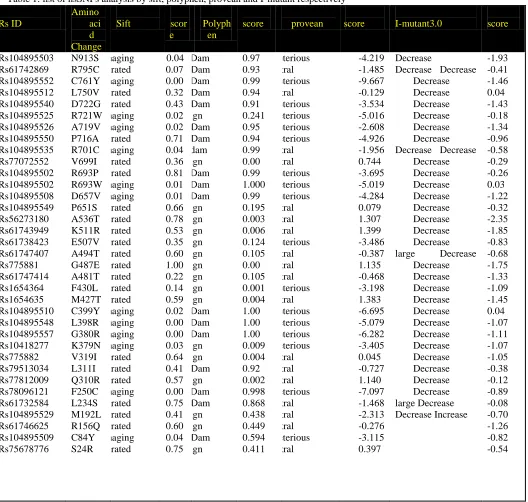
Table 1: list of nsSNPs analysis by sift, polyphen, provean and I-mutant respectively Rs ID Amino aci d Change
Sift scor
e
Polyph en
score provean score I-mutant3.0 score
Rs104895503 Rs61742869 Rs104895552 Rs104895512 Rs104895540 Rs104895525 Rs104895526 Rs104895550 Rs104895535 Rs77072552 Rs104895502 Rs104895502 Rs104895508 Rs104895549 Rs56273180 Rs61743949 Rs61738423 Rs61747407 Rs775881 Rs61747414 Rs1654364 Rs1654635 Rs104895510 Rs104895548 Rs104895557 Rs10418277 Rs775882 Rs79513034 Rs77812009 Rs78096121 Rs61732584 Rs104895529 Rs61746625 Rs104895509 Rs75678776 N913S R795C C761Y L750V D722G R721W A719V P716A R701C V699I R693P R693W D657V P651S A536T K511R E507V A494T G487E A481T F430L M427T C399Y L398R G380R K379N V319I L311I Q310R F250C L234S M192L R156Q C84Y S24R Damaging Tolerated Damaging Tolerated Tolerated Damaging Damaging Tolerated Damaging Tolerated Tolerated Damaging Damaging Tolerated Tolerated Tolerated Tolerated Tolerated Tolerated Tolerated Tolerated Tolerated Damaging Damaging Damaging Damaging Tolerated Tolerated Tolerated Damaging Tolerated Tolerated Tolerated Damaging Tolerated 0.04 0.07 0.00 0.32 0.43 0.02 0.02 0.71 0.04 0.36 0.81 0.01 0.01 0.66 0.78 0.53 0.35 0.60 1.00 0.22 0.14 0.59 0.02 0.00 0.00 0.03 0.64 0.41 0.57 0.00 0.75 0.41 0.60 0.04 0.75 Pro.Dam Pos.Dam Pro.Dam Pos.Dam Pos.Dam Benign Pos.Dam Pos.Dam Pro.dam Benign Pro.Dam Pro.Dam Pro.Dam Benign Benign Benign Benign Benign Benign Benign Benign Benign Pro.Dam Pro.Dam Pro.Dam Benign Benign Pos.Dam Benign Pro.Dam Pos.Dam Benign Benign Pos.Dam Benign 0.97 0.93 0.99 0.94 0.91 0.241 0.95 0.94 0.99 0.00 0.99 1.000 0.99 0.195 0.003 0.006 0.124 0.105 0.00 0.105 0.001 0.004 1.00 1.00 1.00 0.009 0.004 0.92 0.002 0.998 0.868 0.438 0.449 0.594 0.411 Deleterious Neutral Deleterious Neutral Deleterious Deleterious Deleterious Deleterious Neutral Neutral Deleterious Deleterious Deleterious Neutral Neutral Neutral Deleterious Neutral Neutral Neutral Deleterious Neutral Deleterious Deleterious Deleterious Deleterious Neutral Neutral Neutral Deleterious Neutral Neutral Neutral Deleterious Neutral -4.219 -1.485 -9.667 -0.129 -3.534 -5.016 -2.608 -4.926 -1.956 0.744 -3.695 -5.019 -4.284 0.079 1.307 1.399 -3.486 -0.387 1.135 -0.468 -3.198 1.383 -6.695 -5.079 -6.282 -3.405 0.045 -0.727 1.140 -7.097 -1.468 -2.313 -0.276 -3.115 0.397 Decrease
Decrease Decrease Decrease Decrease Decrease Decrease Decrease Decrease Decrease Decrease
Decrease Decrease Decrease Decrease Decrease Decrease Decrease Decrease large Decrease
Table 2: List of nsSNPs predicted as disease associated by Panther, PHD-SNP and SNP&GO server.
Rs ID Amino acid
change
Panther PHD-SNP SNP&GO
Rs104895503 Rs104895552 Rs104895526 Rs104895502 Rs104895508 Rs104895510 Rs104895548 Rs104895557 Rs78096121 Rs104895509
N913S C761Y A719V R693W D657V C399Y L398R G380R F250C C84Y
Deleterious Deleterious Tolerated Tolerated Tolerated Deleterious Deleterious Deleterious Deleterious Tolerated
Disease Disease Neutral Neutral Neutral Disease Disease Disease Disease Disease
Disease Disease Disease Disease Neutral Disease Disease Disease Disease Neutral
3.2 Prediction of Disease- Associated nsSNPs
PANTHER, PhD-SNP and SNPs&GO were performed to validate the results obtained from four tools. Out of 10 nsSNPs that predicted to be deleterious with SIFT, Polyphen, I-Mutant and PROVEAN; PANTHER predicted 6 nsSNP to be associated with disease (Table 2) PhD-SNP predicted 7 nsSNP and SNP&GO predicted 8 nsSNP,. Finally out of 35 nsSNP, we found 6 nsSNPs namely rs104895503 (N913S), rs104895552 (C761Y), rs104895510 (C399Y), rs104895557 (G380R) and rs78096121 (F250C) that are common in all (SIFT,Polyphen,I-Mutant,PROVEAN,PHD-SNP,SNP&GO,PANTHER) prediction.
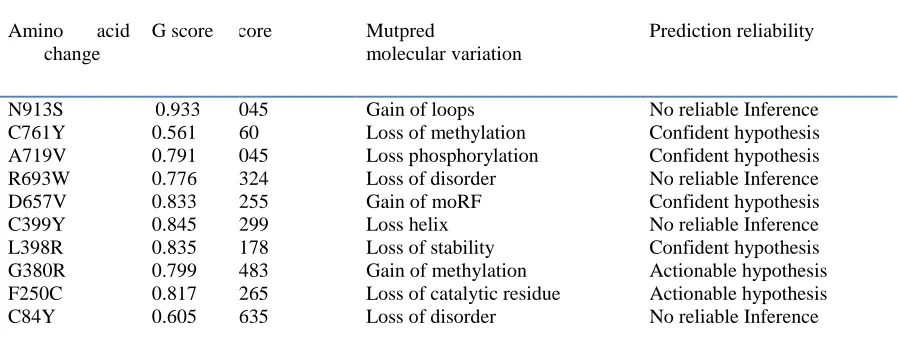
These 10 mutations were further analyzed by MutPred tool to predict the SNP disease association probability and probable change in the molecular mechanism in the mutant. We found “C761Y” to be highly deleterious with general probability (𝑔) scores of 0.791 and were predicted to induce the loss of methylation at K760 residue with (𝑝) score of 0.760, showing confident hypothesis. “A719V” was found to be highly deleterious with general probability (𝑔) scores of 0.835 and was predicted to induce the loss of Phosphorylation residue at T718 with (𝑝) score of 0.3045, showing confident hypothesis. “D657V” was found to be highly deleterious with general probability (𝑔) scores of 0.841 and was predicted to induce the gain of moRF binding with (𝑝) score of 0.0255, showing confident hypothesis. “L398R” was found to be highly deleterious with general probability (𝑔) scores of 0.950 and was predicted to induce the loss of stability with (𝑝) score of 0.1178, showing confident hypothesis. At the end of so many mutations considered, we screened C761Y, A719V, D657V and L398R as the most deleterious and disease associatedmutation in NLRP7 gene (Table 3). This prediction could beendorsed with the observed experimental data
Table 3: The G score, P score, molecular variations and prediction reliability calculated from MUTPRED server. Here the most disease associated mutations are displayed in bold.
Amino acid change
G score P score Mutpred
molecular variation
Prediction reliability
N913S C761Y A719V R693W D657V C399Y L398R G380R F250C C84Y
0.933 0.561 0.791 0.776 0.833 0.845 0.835 0.799 0.817 0.605
0.2045 0.760 0.3045 0.0324 0.0255 0.1299 0.1178 0.0483 0.0265 0.1635
Gain of loops Loss of methylation Loss phosphorylation Loss of disorder Gain of moRF Loss helix Loss of stability Gain of methylation Loss of catalytic residue Loss of disorder
Table 4: Surface accessibility of mutant variants in NLRP7
Amino acid chan ge
Class assignment
Relative surface accessibility
Absolute surface accessibility
Z-fit score for RSA prediction
N913S A719V D657V L398R
Buried Buried Exposed Buried
0.288 0.102 0.404 0.041
42.105 11.273 58.288 7.562
-1.783 -0.580 -2.065 0.295
3.3 Insilco biophysical validation of nsSNPs:
Based on the in silico analyses performed, 4 nsSNPs was selected for further analysis. The location and the type of a mutated residue affect the stability of the protein. In particular, as the solvent accessibility of a residue decreases, the stability of the protein due to mutation decreases.
NetSurfP Z-score allows the identification of the most reliable/unreliable predictions for both buried and exposed amino acids. A huge driftin the Z-score was observed for 1 nsSNPs as given in Table 4.
I-Tasser:
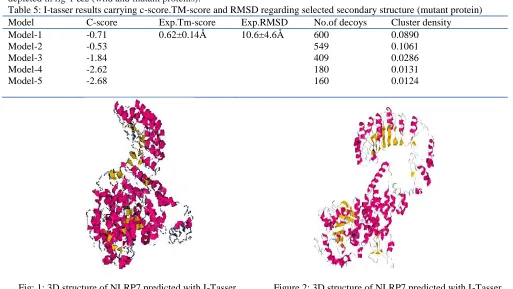
I-tasser tool created the 5 full- length models for NLRP7 protein. Among the 5 predicted models, model 2 carried the high-quality confidence in the form of C-score TM score and the RMSD. Mention the details in table-5. 3D structure of protein depicted in fig-1 &2 (wild and mutant proteins).
Table 5: I-tasser results carrying c-score.TM-score and RMSD regarding selected secondary structure (mutant protein)
Model C-score Exp.Tm-score Exp.RMSD No.of decoys Cluster density
Model-1 Model-2 Model-3 Model-4 Model-5
-0.71 -0.53 -1.84 -2.62 -2.68
0.62±0.14Å 10.6±4.6Å 600
549 409 180 160
0.0890 0.1061 0.0286 0.0131 0.0124
Fig: 1: 3D structure of NLRP7 predicted with I-Tasser Figure 2: 3D structure of NLRP7 predicted with I-Tasser (Wild) (Mutant)
The 3D analysis of wild type and mutant protein structures was performed by using project HOPE. Each amino acid in wild type and mutant structures carries specific properties like solvent accessibility, charge density, hydrophobicity, rigidity, molecular surfaces and electrostatic potential values. Native and mutant residues sometimes differ due to carrying such specific properties and can disrupt the structural and functional features of the original protein. Here we present the results upon each mutation and discuss the conformational variations and interactions with the neighboring amino acids. A/T mutation (rs104895508) resulted in a change of the aspartic acid to valine at position 657 (D657V). The mutant residue is smaller and less hydrophobic than the wild type (Fig. 2). The mutation will cause loss of hydrophobic interactions in the core of the protein. The mutation introduces a more hydrophobic residue at this position. This can result in loss of hydrogen bonds and/or disturb correct folding.
Mutated amino acid Wild amino acid
4. CONCLUSION
In modern genetic analysis, the characterization of disease-associated single nucleotide polymorphism is very encouraging. Bioinformatics has reduced the cost of genotyping and helped to increase genetic association studies. Hence we conducted a bioinformatics approach to analyze the disease associated nsSNPs of NLRP7. Out of 35 non-synonymous mutations, just one was predicted as deleterious by all software’s. Structural analysis study suggested that structure and function of NLRP7 can be disturbed by single gene mutation (D657V). Therefore, this SNP can be strongly considered as key candidates in causing disease related to NLRP7 malfunction; hence it will help in effective drug discovery and developing precision medicines.
5. REFERENCES
[1]. Ramesh Reddy, Ngoc MP Nguyen et. al., The genomic architecture of NLRP7 is Alu rich and predisposes to disease-associated large deletions, European Journal of Human Genetics, 24, 1445–1452, 2016.
[2]. Murdoch, S., et. al., Mutations in NALP7 cause recurrent hydatidiform moles and reproductive wastage in humans. Nat. Genet. 38, 300–302, 2006.
[3]. Khare S et. al., An NLRP7-containing inflammasome mediates recognition of microbial lipopeptides in human macrophages. Immunity, 36, 464–476, 2012.
[4]. Messaed C, Akoury E. et. al.,, A nucleotide oligomerization domain-like receptor protein, is required for normal cytokine secretion and co-localizes with Golgi and the microtubule-organizing center. JBiolChem, 286, 43313-43323. 2011.
[6]. Nguyen NM, Zhang L, Reddy R et al: Comprehensive genotype-phenotype correlations between NLRP7 mutations and the balance between embryonic tissue differentiation and trophoblastic proliferation. J Med Genet, 51, 623–634, 2014.
[7]. Akoury E et. al., NLRP7 and KHDC3L, the two maternal-effect proteins responsible for recurrent hydatidiform moles, co-localize to the oocyte cytoskeleton. Hum Reprod, 30, 159–169, 2015.
[8]. Estrada, H., et. al., The p.L750V mutation in the NLRP7 gene is frequent in Mexican patients with recurrent molar pregnancies and is not associated with recurrent pregnancy loss. Prenat. Diagn. 33, 205–208, 2013.
[9]. Qian, J., Cheng, et. al., The genetics of recurrent hydatidiform Moles in China: correlations between NLRP7 mutations, molar genotypes, and reproductive outcomes. Mol. Hum. Reprod. 17, 612–619, 2011.
[10]. Sebire, N.J., et. al., Histopathological features of biparental complete hydatidiform moles in women with NLRP7 mutations. Placenta 34, 50–56, 2013.
[11]. Slim, R., et. al., A strong founder effect for two NLRP7 mutations in the Indian population: an intriguing observation. Clin. Genet. 76, 292–295, 2009.
[12]. Ng, P.C., Henikoff, S., Predicting deleterious amino acid substitutions. Genome Res. 11, 863–874, 2001.
[13]. Ramensky, V., et. al., Human non-synonymous SNPs: server and survey. Nucleic Acids Res. 30, 3894–3900, 2002.
[14]. Adzhubei, I.A., et. al., A method and server for predicting damaging missense mutations. Nat Methods, 7(4): 248-249, 2010.
[15]. Choi, Y., et al., Predicting the functional effect of amino acid substitutions and indels. PLoS One 7 (10), 2012.
[16]. Capriotti, E., et. al., IMutant2.0: predicting stability changes upon mutation from the protein sequence or structure. Nucleic Acids Res., 33: 306-310, 2005.
[17]. Bava, K.A., et. al., ProTherm, version 4.0: thermodynamic database for proteins and mutants. Nucleic Acids Res., 32: D120-D121, 2004.
[18]. 0. Mi,H. et. al., PANTHER version 6: protein sequence and function evolution data with expanded representation of biological pathways. Nucleic Acids Res., 35, 247-252, 2007.
[19]. E. Capriotti, R. Calabrese, and R. Casadio, Predicting the insurgence of human genetic diseases associated to single point protein mutations with support vector machines and evolutionary information,” Bioinformatics,vol.22,no.22, 2729–2734, 2006.
[20]. Calabrese, R., et. al., Functional annotations improve the predictive score of human disease-related mutations in proteins. Hum. Mutat. 8, 1237–1244. doi: 10.1002/humu.21047, 2009.
[21]. B. Li, V. G. Krishnan, M. E. Mort et al., “Automated inference of molecular mechanisms of disease from amino acid substitutions” Bioinformatics,vol.25,no.21, 2744–2750, 2009.
[22]. Petersen, B., et al., A generic method for assignment of reliability scores applied to solvent accessibility predictions. BMC Struct. Biol. 9 (1), 51, 2009.
[23]. Y. Zhang, “I-TASSER server for protein 3D structure prediction,” BMC Bioinformatics,vol.9, article40, 2008.
[24]. Roy, A., Kucukural, A., Zhang, Y., I-TASSER: a unified platform for automated protein structure and function prediction. Nat. Protoc.5, 725–738, 2010.
[25]. Venselaar, H., et. al., Protein structure analysis of mutations causing inheritable diseases. An e-Science approach with life scientist friendly interfaces. BMC Bioinformatics 11, 548, 2010.