People’s awareness towards Organic food in the Motihari
district of Bihar
Anamika Kumari
Abstract
Organic Food is food grown organically without using chemical fertilisers or pesticides. Interest in Organic Food has increased worldwide in response to concerns about conventional agricultural practices and Human health. Consumer perceives organic products containing more nutrients including vitamins and minerals than conventionally produced food. The objective of this study was to present an update of the Consumer’s awareness of organic food and the availability of organic food in Motihari district of Bihar. The result indicates a Nutrition Health consciousness makes people aware about organic food. This research has indicated that the nutritional importance of organic food & farming.
Keywords:- Organic Food, Consumer, Organic farming, Health consciousness, Awareness.
Background
The term ‘Organic’ is rooted from Greek’ bios’ meaning life or way of living. Organic food products was first coined in the 1940s and refers to the food raised ,grown & stored or processed without the use of synthetically produced chemicals or fertilizers, herbicides, pesticides ,fungicides growth hormones and regulators of generic modification. Organic products are obtained by processes friendly to environment that promotes and enhances bio-diversity, biological cycle and soil biological activity. A wide range of consumers of organic food and non organic food were addressed and scrutinized to obtain their observations and vision towards organic food. All organic food consumers are not having the same method of approach towards organic food.
The advantages of organic food include:-
.Rich in nutrients:-According to the State of Science Review done in 2008, organic food has more nutritional superiority than its non organic counterparts.
. More safe & Hygenic:- No pesticides, chemical, or processed additives bogging down your system means a smaller risk of disease in yourself. It maintains a healthy life.
. Better in Taste:- Need of organic food
Of late as harmful effects of the increasing use of chemicals in farming are becoming obvious and apparent, environmentalists and health professionals are flagging many of these concerns .Ever since the environmentalists began increasing the awareness, consumer’s tastes and preferences have started shifting, which have led to the domestic as well as global rise in the demand for Organic products today. Many people are getting health consciousness and are shifting to a disciplined and healthy life style. People want to have chemical free food on their plate hence there is extreme need to Go Organic.
There is great need to promote organic and compost farming & its practices in the country to save the fertility of the agricultural lands. J. S. Sandhu, Agricultural Commissioner, and Government of India, after visiting East Champaran along with Senior State Agricultural department, said:-At present it is being practiced in 12 states and it is high time that it starts
on a massive scale in Bihar because the soil of Bihar, especially in North Bihar is the better condition than other state.
Organic farming
Organic farming is a system, which avoids or largely excludes the use of synthetic inputs (such as fertilizers ,pesticides ,hormones, feed additives etc.) and to the maximum extend feasible upon crop rotation, crop residues, animal manures, off-farm organic waste, mineral grade rock additives and biological system of nutrient mobilization and plant protection. Organic agricultural methods are internationally regulated and legally enforced by many Nations, based in large part of the standards set by the International Federation of Organic Agricultural Movement (IFOAM), an international umbrella organization for organic farming organizations established in 1972.
Objectives
1. To know the level of awareness towards organic food. 2. To examine the availability of Organic food in local market 3. To contribute the valuable suggestion for policy implications. Methodology
1. Survey Method and Research Design 2. Questionnaire development
3. Construct description 4. Sample Profile
Survey Method & Research Design:- A structured questionnaire having 40 questions were used for collecting the data. Convenience sampling and simple random sampling methods were used for collecting the data. The districts East Champaran (Motihari) was chosen for data collection by convenience sampling method. Both Urban & Rural people are considered as respondents. Questionnaire as printed paper were distributed among, and collected after answering. Total 100 respondents were chosen for survey.
Questionnaire Development:- On the basis of study about organic food, it is shown that consumer’s preference towards organic food is influenced by various factors such as- availability, culture, knowledge, personal intrinsic and extrinsic factors used in the current study, comprise of variables that measures the above stated factors. Previous section of questionnaire contains demographical information and health consciousness, healthy lifestyle, attitude towards organic food and later contains consumer awareness, sources of getting nutritional information etc.
Construct Description:- Some questions were dichotomous, while five point lickert scale was used for measuring variables. Response option was distributed on-quality, frequency, agreement and likelihood.
Sample Profile:- A total 90 completely answered questionnaire were found out of 100. Although 10 people returned ill filled questionnaire or without answering all questions. Limitations of the study
1. The research was not wide since it is confined to selected place of motihari district, so result can not be universally accepted.
Result of the study
Table:-1 The classification of respondents based on gender:-
Sr..No. Gender Respondents Percentage
1. Male 72 80%
2. Female 18 20%
Total 90 100%
The above table:-1 shows that 80% of respondents were belonging to male while remaining 20% was female. The number of male members was found more in survey.
Table:-2 The classification of respondent based on Age
Sr. no. Age Respondents Percentage
1 Less than 20 yrs. 10 11%
2 21-30 years 25 28%
3 31-40 years 40 44%
4 41-50 years 10 11%
5 50 years & above 05 06%
Total 90 100%
The above table:-2 It represents the age group respondents involved. 11% of respondents are less than 20 years, 28% of respondents are in between 21-30 years, 44% 0f respondents are in age between 31-40 years, 11% of respondents are in between 41-50 years, 6% of the respondents are above 50 years out of 90 respondents. The people between 31-40 years are more aware about organic food.
Male 80% Female
20%
Table;-3 The classification of respondents based on their qualification. Sr. no. Qualification Respondents Percentage
1 10th 06 07%
2 Intermediate 20 22%
3 Graduation 40 44%
4 PG 20 22%
5 Other 04 05%
Total 09 100%
The above table:-3 shows that 11% of respondents are having only secondary (10th) education, 22% of respondents are having higher secondary education, 44% of respondents are having graduation, 22% of respondents are having post graduation, rest 5% of respondents are having other qualification out of 90 respondents. The respondents are found conscious about organic products.
10
25
40
10
5 11%
28%
44%
11%
6% 2
2
3
5
0 10 20 30 40 50
Less than 20 years 21-30 years 31-40 years 41-50 years 50 years & above
The classification of Respondents
based on age
No.of Respondents age group Percentage
6
20
40
20
4 7%
22%
44%
22%
5% 2
2
3
5
0 10 20 30 40 50
10th Intermediate Graduation PG Other
The classification of Respondents based
on education
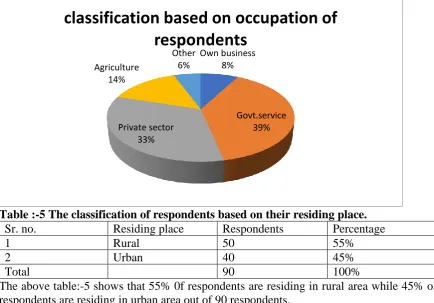
Table :-4 The classification based on occupation of respondents.
Sr. no. Occupation Respondents Percentage
1 Own business 07 08%
2 Govt. service 35 39%
3 Private sector 30 33%
4 Agriculture 13 14%
5 Other 05 06%
Total 90 100%
The above table:-4 shows that 8% of respondents are having own business,39% of respondents are in government service, 33% of respondents are in private sector, 14% of respondents are involved in agriculture, rest 6 % of respondents are involved in other occupation out of 90.
Table :-5 The classification of respondents based on their residing place. Sr. no. Residing place Respondents Percentage
1 Rural 50 55%
2 Urban 40 45%
Total 90 100%
The above table:-5 shows that 55% 0f respondents are residing in rural area while 45% of respondents are residing in urban area out of 90 respondents.
Own business 8%
Govt.service 39% Private sector
33% Agriculture
14%
Other 6%
Table:-6 Sources of food Safety & Nutritional updates about Organic Food.
Sr. no Sources of
information
Respondents Percentage
1 Internet news
sources
10 11%
2 Print media /news
paper
70 78%
3 Awareness
programme
00 0%
4 Friends 08 09%
5 TV/radio 02 02%
Total 90 100%
The table:-6 shows that 11 % of respondents are getting their food safety & nutritional updates from internet news sources, 78% of respondents are getting from print media, 9% of respondents are getting from friends, and rest 2% of respondents are getting from radio & TV out of 90 respondents. Most of the people are using print media foe their food safety & nutritional updates.
Rural 56% Urban
44%
Classification of respondent based on
their residing place
Internet news sources
11%
Print media/news
papaer 77% Awareness
programme 1%
Friends 9%
TV/Radio 2%
Table:-7 Respondents familiar with organic food and /organic agriculture.
Sr. no. Familiar with
organic food
Respondents Percentage
1 Yes 66 73%
2 No 24 27%
Total 90 100%
The table:-7 shows that 73% of respondents are having familiar with organic food while 27% of respondents are having unfamiliar with organic food out of 90 respondents.
Table:-8 The classification of respondents based on the availability of organic food in local market.
Sr. no. Availability No. of respondents Percentage
1 Very frequently 00 0%
2 Frequently 12 13%
3 Occasionally 06 07%
4 Rarely 54 60%
5 Never 18 20%
Other 90 100%
The table:-8 shows that 13% of respondents are having frequently availability of organic food in their local market, 7% of respondents are having occasionally, 60% respondents are having rarely, 20% of respondents are having never availability of organic food in their local market out of 90 respondents.
Familiar 73% Unfamiliar
27%
Table :-9 Sources of Purchase of organic food by respondents.
Sr. no. Places Respondents Percentage
1 Local market 10 11%
2 Farm 10 11%
3 Online shop 00 00%
4 Never buy 70 78%
Other 90 100%
The above table:-9 shows that 11% of respondents are buying organic food from their local market,11% of respondents are getting from farm, none of respondent are buying online, rest 78% of the respondents are never buying online food. Thus it is found that most of the respondents don’t buy organic food.
Table:-10 Classification based on respondents agree organic food rich in nutrients than conventional food.
Sr. no Agree No. of respondents Percentage
1 Yes 70 78%
2 No 20 22%
Total 90 100%
Very frequently
9% Frequently
12% Occasionally
6% Rarely
55% Never
18%
Classification of respondents based on
avaialbility of Organic Food in local
market
Local market 47% Farm
47% Online shop
0%
Never buy 6%
The above table 10 shows that 78% of respondents are agreeing organic food is rich in nutrients than conventional food, while rest 22% of are not agreeing out of 90 respondents.
Table:-11 Opinion of respondents towards cost of organic food products. Sr. no Opinion No.of respondents Percentage
1 Expensive 60 67%
2 Inexpensive 02 02%
3 Can’t say 28 31%
Total 90 100%
The above table 11 describes that the 67% of the respondents are saying expensive to organic food, 2% are saying inexpensive, rest 31% of respondents are having no opinion out of 90 respondents
Agree 78% Disagree
22%
Classification based on respondents
agree organic food rich in nutrients than
conventional food
Expensive-67% 67%
Inexpensive-02% 2%
Can't say-31% 31%
Table:-12 Respondent’s satisfaction to organic food.
Sr. no. Ranking No. of respondents Percentage
1
Strongly-Strongly-dissatisfactory
04 5%
2 Dis-
satisfactory
04 5%
3 Neutral 40 44%
4 Strongly satisfactory 12 13%
5 Satisfactory 30 33%
Total 90 100%
The above table 12 shows that 33% of respondents are having satisfactory ranking of organic food, 13% are having extremely satisfactory, 44% are having no opinion, 5% are having dis-satisfactory, rest 5% are having extremely dis-satisfactory ranking of organic food out of 90 respondents
Conclusion
Most of the respondents are familiar with organic food. This study finds that awareness to organic food are influenced by more relevant factors such as, gender, education and residing place as well as income, occupation and age. Therefore, effort of successfully expand awareness about organic food should consider nonconventional socioeconomic characteristic of consumer when segmenting markets.
The main problem faces by the consumers of Organic food is irregular availability of organic food products. Sometimes the consumers would purchase non organic products along with organic products. The varieties of organic products which are available in the local market are limited. The specific organic food product shops are unavailable in the study area. The consumers are convinced about high price of organic food. Although consumers agreed that organic food have good nutritional value. The study brought out the fact that the people were well aware of images & availability, but not loyal entirely to organic food products.
Consumer’s willingness to buy organic food products is influenced by limited and erratic supply, high price of the products and limited access and information.
0 0 0 0 0
4 4
40
12
30
5% 5%
44%
13%
33%
0 10 20 30 40 50
Strongly dissstisfactory
Satisfactory
Dis satisfactory Neutral Strongly
Satisfactory
Satisfactory
Respondent's satisfaction to organic
food
Suggestions
1. To impart knowledge of organic products is necessary among consumers; it may be done by any nutrition intervention programme or workshop.
2. Allocations of separate shares of organic food in departmental stores. 3. Easy & abundant availability of organic food in local market.
References
1. Committee on Nutrition, and Council on Environmental Health (2012). Organic foods: Health and environmental advantages and disadvantages. Pediatrics, 130(5): 2012-2579. DOI:10.1542/peds.2012-2579. Accessed June 11, 2015.
2. Whitney E, Rolfes SR (2013). Consumer concerns about foods and water. Understanding Nutrition, 13th ed., pp. 623-651. Belmont, CA: Wadsworth
• Dodd JL (2012). Behavioral-environmental: The individual in the community. In LK Mahan et al., eds., Krause's Food and the Nutrition Care Process, 13th ed., pp. 229-250. St Louis: Saunders.
• Environmental Working Group (2015). EWG's 2015 shopper's guide to pesticides in produce. Environmental Working Group. http://www.ewg.org/foodnews/summary.php. Accessed June 11, 2015.
• U.S. Department of Agriculture (2008). National Organic Program: Background and history.
Available online:
http://www.ams.usda.gov/AMSv1.0/getfile?dDocName=STELDEV3004443&acct=nopge ninfo.
orZeku tk¡p esa bZ&yfuZax dks fo”ks’k egRo fn;k x;k gSA bZ&yfuZax dk egRo orZeku esa mPp “kS{kf.kd Lrj dkQh rhoz xfr ls foLr`r gks jgk gSA bZ&yfuZax ds {ks= esa c<+rs lalk/kuksa ls vc lh[kuk&fl[kkuk dkQh vklku gks x;k gSA Ldwy] dkWyst] n¶rj gks ;k ?kj bu lk/kuksa ls Nk=@O;fDr vf/kxe ;k vius dkS”ky esa lq/kkj ykus dk iz;kl dj jgs gSaA Nk=ksa ds fy, bZ&yfuZax dk iz;ksx f”k{k.k izfØ;k esa ojnku fl) gks jgh gSA bZ& yfuZasx vf/kxe iz.kkfy;ksa dk ,d uo fufeZr iz;ksx gSA bZ&f”k{kk iz.kkfy;ksa ds rgr lkekftd f”k{kk vkSj lkekftd lkW¶Vos;j tSls &Cykx] fodh] okaMdkLV ,oa vkHkklh ds bLrseky ij vf/kd tksj fn;k tk jgk gSA bZ&yfuZax ds ek/;e ls Nk=ksa esa f”k{kk ds izfr :fp ns[kh tk jgh gSA rFkk mPp Lrj ds Nk=&Nk=kvksa dks f”k{kk esa lgk;rk izkIr gks jgh gSA ftlls Nk=ksa esa vf/kxe gsrq bZ&yfuZax tkx:drk esa o`f) gks jgh gSA
orZeku ;qx lapkj Økafr dk ;qx gS 21oha “krkCnh lapkj Økafr ds uke ls tkuh tkrh gSA
lapkj Økafr us lEiw.kZ fo'o dks ,d oSf'od xkWo esa ifjofrZr dj fn;k gSA lapkj Økafrus orZeku ekuo dh ewyHkwr vko';drkvksa esa ,d vko';drk vkSj lfEefyr dj nh gS]tks bZ ls lEcfU/kr gS ;k bysDVªkWfud ek/;e ls lEcfU/kr gS] byDVªkWfud ek/;eksa dkthou ds izR;sd {ks= esa viuk egRoiw.kZ ;ksxnku gSAVksuh Cys;j] ¼;wukbVsM fdaxMe ds iwoZ iz/kkue=h½ ftudh iqLrd ^^ok;MZ nqfu;ka dsLokeh** ds izkDdFku esa ladsr fn;s gS ftuesa dgk x;k gS fd ^nqfu;ka vFkZO;oLFkk ds :iesa ekSfyd :i ls cnyus dh izfØ;k ds nkSj ls xqtj jgk gS vkS|ksfxd mRiknu ds fy,d`f’k mRiknu ds fy,AKku vk/kkfjr vFkZO;oLFkk dk mn~Hko fMftVy vFkZO;OkLFkk gS vkSj ;g vxyg lnh esalrr~ izfrLi/kkZ dk L=ksr gSA vuqHkoh rduhdh fodkl vkSj bZ&yfuZax dk fodkl Hkfo’;dh :ijs[kk rS;kj dj jgh gSaA bZ&yfuZax ;k bysDVªkWfud vf/kxe in dk laca/k blizdkj ds vf/kxe ls gS ftlds laiknu esa dEI;wVj lsokvksa dh vfuok;Z :i lsvko”;drk iM+rh gSA bZ&yfuZax “kCnkoyh dk iz;ksx dEI;wVj foKku dh baVjusV rFkkosc rduhdh ij vk/kkfjr vkWu ykbu yfuZax rd gh lhfer j[kk tkuk pkfg,A dEI;wVjvk/kkfjr vf/kxe ;k dEI;wVj lgk; vuqns”ku dh rqyuk esa bZ&yfuZax dh vo/kkj.kk dqNvf/kd O;kid ekuh tkuh pkfg,A
bZ&yfuZax dh vo/kkj.kk dqN vU; le:i inkofy;ksa tSls vkWu ykbu yfuZax rFkk vkWuykbu ,twds”ku ls dqN vf/kd O;kid ekuh pkfg, D;ksafd bu nksuksa dk laca/k iwjh rjgls dsoy ek= osc vk/kkfjr yfuZax ;k vf/kxe ls gS tcfd bZ&yfuZax esa bl dk;Z lsdqN vkxs c<+dj vuqorhZ dk;kZsa rFkk v/;kid vkSj fo|kfFkZ;ksa ds chp vko”;d laizs’k.k,oa var%fØ;k j[kus ij /;ku fn;k tkrk gSA
bZ&yfuZax ;k vf/kxe dks n`”; vf/kxe] nwjorhZ f”k{kk ;k nwjorhZ vf/kxe dk i;kZ; ughaekuk tkuk pkfg,A ;g lgh gS fd vkt ds fnu n`”; JO; rFkk cgqek/; rduhdh rFkk
nwjorhZ f”k{kk laca/kh dk;ZØe dEI;wVj }kjk lqyHk baVjusV rFkk osc lsokvksa ij cgqr dqN
fuHkZj gS ijarq blls bUgsa bZ&yfuZax dk i;kZ; u ekudj bZ&yfuZax esa lgk;difjfLFkfr;ksa ;k bZ&yfuZax iz.kkyh dh miiz.kkfy;ksa ds :i esa ekU;rk nh tkuh pkfg,A
;g Hkh iwjh rjg Li’V djuk pkfg, fd bZ&yfuZax inkoyh dk iz;ksx lHkh izdkj ls,slh yfuaZx ;k vf/kxe ds fy, fd;k tkuk pkfg, ftls osc vk/kkfjr ;k baVjusVvk/kkfjr laizs’k.k tSls bZ&esy vkWfM;ks ,oa ohfM;ks dkaÝsaflax] esy fyLV] ykbo pSV~lrFkk VsyhQksu lsokvksa }kjk laikfnr fd;k tkrk gSA bl n`f’V ls fdlh Hkh izdkj dhbaVjusV rFkk osc rduhdh foghu yfuZax ;k vf/kxe dks bZ&yfuZax ds :i eas ugha ns[kktkuk pkfg,A
1993 ds vkjEHk esa fofy;e Mh xzsft;kMh us dbZ lkW¶Vos;j izksxzkeksa ds lkFk bysDVªkWfud
esy] nks oSDl uksV~l lEesyuksa vkSj xksQj@yhDl dk ,dlkFk bLrseky dj ,dvkWuykbu dEI;wVj&forfjr O;k[;ku] V~;wVksfj;y vkSj ewY;kadu ifj;kstuk dk o.kZufd;k ftldh lgk;rk ls Nk=ksa vkSj izf”k{kd us fjlpZ ,tqds”ku] lfoZl ,.M Vhfpax¼vuqlU/kku]f”k{kk]lsok ,o v/;kiu&vkjbZ,lVh½ esa ,d opqZvy baLVªD”kuy Dykl:e,uok;juesaV bu lkbal¼vkHkklh funZs”kkRed foKku d{kk okrkoj.k½ dk fuekZ.k fd;kA1997 esa MCY;w Mh xzsft;kMh vkSj vU; us ^^fcfYMx ,saflØksul ,.M flØksul Vhfpax&yfuZax ,uok;juesaV~l % ,DlIyksfjax , dkslZ@DykWl:e eSustesaV flLVelkWY;w”ku uked ,d ys[k izdkf”kr fd;kA
,l ;w ,u okbZ esa v/;kiu&f”k{kk ds {ks= esa izkS|ksfxdh&vk/kkfjr ikB~;Øe fodkl ,oaizca/ku dh ,d lEiw.kZ j.kuhfr fodflr djus ,oa mRiknksa dk ewY;kadu djus dh ,dizfØ;k dk o.kZu fd;kA bu mRiknksa dks ,slk cuk;k tkuk Fkk fd mUgsa bLrseky djus esavklkuh gks] vklkuh ls mudk j[kj[kko fd;k tk lds] ;s oguh; gks] bUgsa nksgjk;k tkldsa] ekik tk ldsa vkSj lkeF;kZuqlkj rqjar [kjknk tk ldsA vkt CykWx ls ysdjlg;ksxkRed lkW¶Vos;j] bZiksVZQksfy;ks],oa vkHkklh d{kkvksa rd bZ&f”k{kk eas dbZizkS|ksfxfd;ksa dk bLrseky fd;k tk ldrk gS vkSj fd;k tkrk gSA vf/kdka”k bZ&f”k{kkifjfLFkfr;ksa esa buesa ls dbZ rduhdksa dks ,dlkFk bLrseky fd;k tkrk gSAbZ&yfuZax “kCn lh,llh,y iz.kkfy;ksa dk ,d uofufeZe iz;ksx gS ftldh mRifÙk osc dsmn~Hko ds dky esa gqbZA vxj bZ&yfuZax ds utfj;s ls ns[kk tk, rks ikjaifjd bZ&f”k{kkiz.kkfy;ka vuqns”kkRed iz.kkfy;ksa ij vk/kkfjr] ftUgsa baVjusV izkS|ksfxfd;ksa dk bLrsekydjus okys Nk=ksa dks forfjr fd;k tkrk FkkA bu dkeksa dk ewY;kadu f”k{kd djrs FksA
blds foijhr]ubZ bZ&f”k{kkiz.kkfy;ksa ds lkekftd lkW¶Vos;j tSls CykWx] fodh]ikWMdkLV ,ao vkHkklh fo”o tSls lsdaM ykbQ¼nwljk thou½ ds bLrseky ij vkSj vf/kd tksj fn;k tkrk gSA bl ?kVuk dk ykWx Vsy yfuZax ds :i esa Hkh lUnfHkZr fd;k tkrkgSA
lh,llh,y ij vuk/kkfjr bZ&f”k{kk iz.kkfy;ksa ds foijhr] bZ&yfuZax ds ckjs esa ;g/kkj.k gS fd Kku¼vFkZ ,oa le> ds :i esa½ dk fuekZ.k lkekftd vk/kkj ij gqvk gSAf”k{kk&dk;Z lkexzh ds ckjs esa ckrphr vkSj leL;kvksa ,oa dk;ksZa ds ckjs esa vk/kkjHkwrckrphr ds ek/;e ls gksrk gSA lkekftd f”k{kk ds vf/koDÙkkvksa dk nkok gS fd ^^dqNHkh lh[kus ds lcls csgrjhu rjhsdksa esa ls ,d rjhdk bls vU; yksxksa dks lh[kkuk gSA**^U;w tlhZ bafLVV~;wV vkWQ VsDuksykWth* esa 1970 vkSj 1980 ds n”kd esa ^ewjsZ VqjksQ* vkSj^jksDlsus fgYV~t* }kjk fodflr ikB~;Øe] dukMk ds ^;wfuoflZVh vkWQ XosYQ* dsikB~;Øe] ^fczfV”k vksiu ;wfuoflZVh* ds ikB~;Øe vkSj ^;wfuoflZVh vkWQ fczfV”kdksyafc;k*¼tgkW osc lhVh lcls igys fodflr gqvk Fkh] tks vc CySdcksMZ esa ifjofrZrgS½ ds vkWuykbu nwjLFk ikB~;Øe tSlh dbZ vkjafHkd vkWuykbu ikB~;Øeksa us lnSo Nk=ksa
ds chp vkWuykbu ppkZ dk cgqr T;knk bLrseky fd;k gSA blds vykok “kq: ls gh ]^gSjkfle*¼1995½ tSls fpfdRldksa us bl bZ&yfuZax ls igys bZ&f”k{kk “kCn dh mRifÙk ls
Hkh cgqr igys] Kku dk fuekZ.k ds fy, f”k{kk usVodksZa ds bLrseky ij dkQh cy fn;kgSA
fefulksVk jkt; ds egkfo|ky;ksa ,oa fo”ofo|ky;ksa vkSj lkpse Ldwy fMfLVªDV tSlsfofHkUu f”k{kk iznkrkvksa ds lewy ds fy, ,d vkWuykbu f”k{kk eap ,oa d{kk ds :i esavkHkklh d{kkvksa¼vkWuykbu izLrqfr;ka ftudk vkWuykbu forj.k gksrk gS½ ds mi;ksx easdkQh o`f) gqbZ gSA
vkHkklh d{kk ds okrkoj.k cukus ds vykok ;s lkekftd usVodZ bZ&yfuZax dk ,degRoiw.kZ Hkkx cu x, gSa ijh{k.k dh rS;kjh ,oa Hkk’kk f”k{kk tSlh fofo/k fo’k;ksa dsbnZ&fxnZ vkWuykbu f”k{kk leqnk;ksa dk izksRlkfgr djuds ds fy, lkekftd usVodksaZ dkbLrseky fd;k tkrk gSA ^eksckby vflLVsM ySaXost yfuZax* ,d ,slh laKk gS ftldkiz;ksx Hkk’kk f”k{kk esa lgk;rk djus okys gLrpkfyr dEI;wVjksa ;k lsy Qksuksa ds mi;ksxksadk o.kZu djus ds fy, fd;k tkrk gSA
:f<+oknh vuqekuksa ds vuqlkj fo”oO;kih bZ&f”k{kk m|ksx dk ewY; vM+rhl¼38½ fcfy;u;wjks ls vf/kd gksus dk vuqeku gS] gkykafd vke cktkj ds Hkhrj ;wjksih; la?k esabZ&f”k{kk mRiknksa esa ls dsoy yxHkx 20 izfr”kr mRiknksa dk gh mRiknu gksrk gSAbaVjusV vkSj eYVhehfM;k izkS|ksfxfd;ksa ds fodkl] bZ&f”k{kk m|ksx ds ikap eq[; {ks=ksa ds:i eas igpkus tkus okys ijke”kZ] lkexzh] izkS|ksfxdh lsok vkSj leFkZu ds lkFk bZ&f”k{kkds cqfu;knh lgk;d gSA
iBuh;lkefxz;ksa ls f”k{kk xzg.k djuk vkSj lkSais x, dkeksa dh rS;kjh djuk “kkfey FkkA budkeksa dk ewY;kadu f”k{kd djrs FksA blds foijhr] ubZ&f”k{kk iz.kkfy;ksa ds rgrlkekftd f”k{kk vkSj lkekftd lkW¶Vos;j tSls&CykWx] fcØh ikWMdkLV ,oa vkHkklh fo”otSls&lsdaM ykbZQ ¼nwljk thou½] ds bLrseky ij vkSj vf/kd tksj fn;k tkrk gSA bl?kVuk dks ykWx Vsy yfuZax ds :i esa Hkh lanfHkZr fd;k tkr gSA bZ&f”k{kk iz.kkfy;ksa dsfoijhr ;g /kkj.kk gS fd Kku¼ vFkZ ,oa le> ds :i esa½ dk fuekZ.k lkekftd rkSj ijgqvk gS A f”k{kk&dk;Z lkexzh ds ckjs esa ckrphr vkSj leL;kvksa ,oa dk;ksZa ds ckjs esalek/kku vk/kkjHkwr ckrphr ds ek/;e ls gksrk gSA lkekftd f”k{kk ds vf/koDrkvksa dknkok gS fd dqN Hkh lh[kus ds lcls csgrjhu rjhdksa esa ls ,d rjhdk bls vU; yksxksadk fl[kkuk gSA
U;w tlhZ bafLVV~;wV vkWQ VsDuksykWth eas 1970 vkSj 1980 ds n”kd esa ^^ewjs VqjksQ vkSjjksDlsu fgYV~t**}kjk fodflr fd;k ikB~;Øe] dukMk ds ;wfuoflZVh vkWQ XosYQ dsikB~;Øe] fczfV”k ;wfuoflZVh ds ikB~;Øe vkSj ;wfuoflZVh vkWQ fczfV”k dksyafc;k ¼tgkWosc flVh lcls igys fodflr gqbZ tks vc CySdcksMZ bad ls lEcfU/kr gS@;k vUrHkqZDrgSA½ ds vkWuykbu nwjLFk ikB~;Øe tSlh dbZ vkjafHkd vkWuykbu ikB~;Øeksa us lnSoNk=ksa ds chp vkWuykbu ppkZ dk cgqr vf/kd iz;ksx fd;k gSA blds vykok] “kq: ls ghgSjkfleؼ1995½ tSls fpfdRldksa us bZ&yfuZax o bZ&f”k{kk ls igys Kku ds fuekZ.k dsfy, f”k{kk usVodksZa ds iz;ksx ij vf/kd cy fn;kA
blds iz;ksx ls fefulksVk jkT; ds fo”ofo|ky;ksa ,oa lkpse Ldwy fMfLVªDV tSlsfofHkUu f”k{kk iznkrkvksa ds lewg ds fy, ,d vkWuykbu f”k{kk eap ,oa d{kk ds :i esavkHkklh d{kkvksa ¼vkWuykbu izLrqfr;ka ftudk ykbo fooj.k gksrk gS½ ds mi;ksx esa dkQho`f) gqbZA
bZ&yfuZax vkHkklh d{kk ds okrkoj.k cuus ds lkFk&lkFk lkekftd usVodZ dk ,degRoiw.kZ Hkkx cu x;k gSA ijh{k.k dh rS;kjh ,oa Hkk’kk f”k{kk tSls fofo/k fo’k;ksa dsbnZ&fxnZ vkWuykbu f”k{kk leqnk;ksa dks izksRlkfgr djus ds fy, lkekftd usVodksZa dkiz;ksx fd;k tkrk gSA eksckby vflLVsM ySaXost yfuZax ¼eky@mall½ ,d ,slh laKk gSftldk iz;ksx Hkk’kk f”k{kk esa lgk;rk djus okys gLrpkfyr dEI;wVjksa ;k lsy Qksuksa dkmi;ksx dk o.kZu djus ds fy, fd;k tkrk gSA
orZeku le; esa f”k{kk ds {ks= esa ifjorZu ,oa ykus ds fy, mPp dksfV dh fodflrlEizs’k.k rFkk vf/klwpuk rduhdh dk mi;ksx fd;k tkus yxk gS] ftlesa dEI;wVj ,d“kfDr”kkyh midj.k ds :i esa lkeus vk;k gSA vkt Hkkjr D;k fo”o ds yxHkx lHkhns”kksa esa f”k{kk ds {ks= esas dEI;wVj ij baVjusV lsok dk mi;ksx fd;k tk jgk gSA blh dsifj.kkeLo:i uohu izR;;ksa dk fodkl Hkh gqvk gS] tSls & dEI;wVj baVjusV] baVªkusV],DlVªkusV] usVofdZax iz.kkyh] osclkbV] bZ&Ldwy iz.kkyh] bZ&yfuZax iz.kkyh] vkHkklhd{kk vkfnA vkt f”k{kk esa bu lHkh izR;;ksa dk mi;ksx cM+h rhozrk ls gksus yxk gSA
uhps ftu izR;;ksa dk fooj.k fn;k x;k gS] og bl izdkj gS& ¼1½ bZ&vf/kxe
¼2½ bZ&Ldwy
¼3½ vkHkklh d{kk&d{k
Vke dsyh rFkk flldks ds vuqlkj& **bZ&vf/kxe }kjk vfHklwpuk lEizs’k.k dh lgk;rk ls f”k{kk rFkk izf”k{k.k fn;k tkrk gSA izf”k{k.k dh fØ;k,¡] Nk= ds vf/kxe ,oa izf”k{k.k izfØ;kvksa dk mYys[k ugha fd;k tkrk gSA Nk= dh vko”;drkvksa ds vuq:i Kku rFkk dkS”ky mÙke <ax ls iznku fd;k tkrk gSA**
“E-learning is about information, communication, education andtraining, regardless of how trainers categorize, training andeducation, the learner only wants the skills and knowledge to do abetter job or to answer the next question from a customer.”
-Tom Kelly, cisco
& ** tc vuqns”ku dk lapkj vkaf”kd ;k iw.kZ :i esa fo|qr ;a=ksa
ds ek/;eksa dh lgk;rk ls rFkk osclkbV o baVjusV vFkok cgqek/;eksa lh0Mh0 jkse]Mh0oh0Mh0 ls fd;k tkrk gS] rc mls bZ&vf/kxe dgrs gSaA**
“Instruction that is delivered electronically, in part or wholly viaa web browsers, through the internet or an intranet, or throughmultimedia platforms such CD-ROM or DVD.”
-Brandon Hall
&
“E-learning covers a wide set of applications and processes such aweb-based learning, computer- based learning, virtual classroomsand digital collaboration. It includes the delivery of content viathe internet, audio and videotape, satellite broadcast, interactiveTV and CD-ROM.”
bZ&vf/kxe dh f”k{kk ds {ks= esa uohu izR;; gS vkSj f”k{kk dk ,d u;k vk;ke Hkh gSAbZ&vf/kxe dh izeq[k fo”ks’krk,¡ gSa&
¼1½ bl izdkj vf/kxe esa Nk=ksa dks viuh xfr ls lh[kus dk volj fn;k tkrk gSA bls Lok/;k; Hkh dgrs gSaA
¼2½ ;g vf/kxe Lo%funZsf”kr gksrk gSA Nk= viuh vko”;drkvksa ds vuqlkj ikB~;oLrqdk p;u djrk gSA vf/kxe ds fy, ek/;e dk p;u Hkh viuh vko”;drkuqlkj fd;ktkrk gSA
¼3½ bZ&vf/kxe eas cgqek/;eksa dk mi;ksx fd;k tkrk gSA fofo/k izdkjdh lapkj oizlkj.k dh izfof/k;ksa dks la;qDr :i esa iz;qDr fd;k tkrk gSA
¼4½ bZ&vf/kxe Nk=&dsfUnzr gksrk gSA
¼5½ bZ&vf/kxe esa HkkSxksfyd ck/kkvksa dk lek/kku gksrk gS rFkk eqDr f”k{kk dk izko/kkugksrk gSA ¼6½ bZ&vf/kxe esa vf/kd la[;k esa Nk=ksa dks lfEefyr fd;k tkrk gSA
¼7½ bl vf/kxe dk vk;kstu vkWu&ykbu fd;k tkrk gSA Nk= viuh vko”;drkuqlkjbldk mi;ksx dj ldrk gSA
¼8½ bl vf/kxe dks dEI;wVj }kjk izksUur fd;k tkrk gSA blesa baVjusV iz.kkyh dkmi;ksx fd;k tkrk gSA ¼9½ bZ&vf/kxe d{kk vf/kxe ls ferO;;h rFkk rhoz gksrk gSA
¼10½ bZ&vf/kxe ls dEI;wVj ,oa bUVjusV dkS”kyksa dk fodkl gksrk gSA ¼11½ blesa Nk=ksa dks vUr%izfØ;k dk volj vf/kd izkIr gksrk gSA
bZ&vf/kxe esa vusd izdkj dh izfof/k;ksa dks iz;qDr fd;k tkrk gS] blesa cgqek/;eksadk mi;ksx fd;k tkrk gSA bZ&vf/kxe ds izeq[k izdkj bl izdkj gSa&
¼1½ vkWuykbu vf/kxe&vkeus&lkeus dk volj ugha gksrk gSA ¼2½ fefJr vf/kxe
¼3½ flu~ØkWul~ vf/kxe ¼4½ vflu~ØkWul~ vf/kxe ¼5½ Lok/;k;
¼6½ osc&vk/kkfjr vf/kxe ¼7½ dEI;wVj vk/kkfjr vf/kxe ¼8½ n`”;&JO; Vsi }kjk vf/kxe
bZ&vf/kxe iz.kkyh ds vUrxZr Nk=ksa dks lh[kus gsrq iw.kZ Lora=rk iznku dh tkrh gSAbls eqDr vf/kxe Hkh dgrs gSaA cgqek/;e&vf/kxe Hkh dgrs gSaA
bZ&vf/kxe ls fuEufyf[kr mÌs”;ksa dh izkfIr dh tkrh gS& ¼1½ bZ&vf/kxe ls ikB~;oLrq dk lapkj rFkk laEizs’k.k djukA
¼2½ bZ&vf/kxe ls LFkkuh; leqnk; rFkk Hkwe.Myh; leqnk; dks f”k{kk dh lqfo/kk iznkudjukA ¼3½ bZ&vf/kxe ls eqDr :i ls lh[kus dk volj iznku djukA
¼4½ bZ&vf/kxe ls f”k{kk dk lHkh dks leku volj iznku djukA ¼5½ bZ&vf/kxe ls fefJr ek/;eksa dks izksRlkfgr djukA
¼6½ eqDr fo”ofo|ky;ksa esa bZ&yfuZax ls f”k{kk izfØ;k dh O;oLFkk djukA ¼7½ vkWuykbu f”k{kk dks bZ&vf/kxe ls izksRlkgu rFkk izksUur djukA ¼8½ vkWuykbu f”k{kk ls “kks/k v/;;uksa dh rhozrk ls o`f) djukA ¼9½ bZ&vf/kxe ls mPp f”k{kk dks ferO;;h cukukA
bZ&vf/kxe dk mi;ksx lEiw.kZ fo”o esa osc ;k lhMh jkse dh lgk;rk ls fd;k tkrkgSA ;g nwjorhZ vf/kxe ds leku gSA blds vUrxZr ek/;eksa dh lgk;rk ls lapkj rFkklEizs’k.k fd;k tkrk gSA blesa vxzkafdr ek/;eksa dk iz;ksx fd;k tkrk gS&
¼1½ eqfnzr ek/;e& blesa bZ0 ikB~;oLrq] ikB~;iqLrdksa rFkk bZ0 ftUl dk mi;ksx fd;ktkrk gSA ¼2½ n`”; ek/;e& blesa n`”;&Vsi] dsfcy] n`”; izokg] lSVsykbV izlkj.k] nwjn”kZu vkfn ek/;eksa dk iz;ksx djrs gSaA
¼3½ lEizs’k.k ek/;e& bl izdkj ds ek/;e dks nks oxksZa esa foHkDr fd;k tkrk gSA
¼aa½ vflu~ØkWul~ ¼Asynchronous½ ek/;e& blds vUrxZr bZ&esy] lquuk]okn&fookn vkfn dks lfEefyr fd;k tkrk gSA
¼b½ flu~ØkWul~¼Synchronous½ ek/;e& blds varxZr baVjusV] n`”; lEesyu rFkk VsyhdkuÝsaflax dk mi;ksx fd;k tkrk gSA
¼Technologies Used in E-learning½
bZ&vf/kxe dks fefJr vf/kxe Hkh dgrs gSaA blesa vusd izdkj ds ek/;eksa dk mi;ksx fd;k tkrk gSA blesa iz;qDr dh tkus okyh bl izdkj dh gS&
¼1½ osc vk/kkfjr f”k{k.k lkexzh ¼2½ cgqek/;e lhMh jkse ¼3½ osclkbV
¼4½ bZ&esy rFkk eksckby vf/kxe ¼5½ baVjusV ikB~;oLrq
¼6½ vf/kxe O;ofLFkr lkW¶Vos;j ¼7½ vuqdj.kh; Hkwfedk fuokZg ¼8½ dEI;wVj lgk; vkdyu ¼9½ vkHkklh d{kk f”k{k.k ¼10½ [ksy
lu~ 2006 rd la;qDr jkT; vesfjdk eas mPp f”k{kk laLFkkuksa esa vkWuykbu f”k{kk esa Hkkxysus okys Nk=ksa dh la[;k 3Û5 fefy;u FkhA Lyksu QkmaMs”ku dh fjiksVksZa ds vuqlkjlexz ukekadu esa vkSlru izfro’kZ yxHkx 2 izfr”kr dh rqyuk esa vesfjdh ek/;fedksÙkjiz.kkyh esa 2004 ls 2009 rd ikap o’kksZa esa iwjh rjg ls vkWuykbu f”k{kk ds fy, ukekaduds vkSlr esa izfr o’kZ yxHkx 12 ls 14 izfr”kr dh o`f) gqbZ gSA
^,yu ,oa lheSu* dk nkok gS fd 2008 esa ek/;fedksÙkj f”k{kk ds fy, HkrhZ gksus okysdqy Nk=ksa esa ls yxHkx ,d pkSFkkbZ Nk= lEiw.kZ :i ls vkWuykbu ikB~;Øeksa dk p;udj jgs Fks vkSj ,sfEc,UV bulkbV fjlpZ dh ,d fjiksVZ ls irk pyrk gS fd 2009 esala;qDr jkT; vesfjdk esa ek/;fedksÙkj Nk=ksa esa ls 44 izfr”kr Nk= vius dqN ;k lEiw.kZikB~;Øe dks vkWuykbu xzg.k dj jgs Fks vkSj vuqeku Fkk fd ;g vkadM+k 2014 rdc<+dj 81 izfr”kr gks tk,xkA bl izdkj ;g ns[kk tk ldrk gS fd bZ&f”k{kk de lsde la;qDr jkT; vesjfdk esa ek/;fedksÙkj f”k{kk dk ,d izeq[k :i cuus ds fy, cM+hrsth ls viuh lhek,a yka?k jgk gSA
dbZ mPp f”k{kk laLFkku] vFkkZr ljdkjh laLFkku] vc vkWuykbu d{kkvksa dh lqfo/kkiznku djrs gSaA blds foijhr] futh vkSj xSj&ljdkjh Ldwyksa esa ls dsoy yxHkx vk/ksLdwy gh ;g lqfo/kk iznku djrs gSaA vdknfed usrkvksa ds ,d losZ{k.k ds vk/kkj ij]^Lyksu dh fjiksVksaZ* ls irk pyrk gS fd vke rkSj ij ikjaifjd d{kkvksa dh rqyuk easvius vkWuykbu d{kkvksa ls Nk=ksa dks cgqe de larqf’V izkIr gksrh gSA gks ldrk gS fdfuth laLFkku bu vkWuykbu izLrqfr;ksa esa vkSj fnypLih ysus yxs D;ksafd bl rjg dhiz.kkyh ds laLFkkiu dh ykxr de gksrh gSA Nk=ksa ds lkFk vkWuykbu dke djus dsfy, vPNh rjg ls izf”kf{kr dfeZ;kas dks gh dke ij j[kuk pkfg,A bu deZpkfj;ksa dkslkexzh {ks= dks le>us dh t:jr gS vkSj bUgsa dEI;wVj ,oa baVjusV ds mi;ksx dsekeys esa Hkh cgqr T;knk lkexzh {ks= dks le>us dh t:jr gS vkSj bUgsa dEI;wVj ,oabaVjusV ds mi;ksx ds ekeys esa Hkh cgqr T;knk izf”kf{kr gksus dh t:jr gS AvkWuykbu f”k{kk rsth ls c<+ jgh gS vkSj izeq[k “kks/k fo”ofo|ky;ksa esa vkWuykbuMkWDVjy dk;ZØeksa dk fodkl fd;k tk pqdk gSA
vf/kd volj feyrk gSA va”kdkfyd Nk=ksa ds fy,bZ&vf/kxe ,d lgk;d iz.kkyh dk dk;Z djrh gS rFkk mudh igqWp esa Hkh gksrh gSAO;fDrxr osc ls okrkoj.k dk l`tu fd;k tkrk gS ftlesa okn&fookn rFkk Li’Vhdj.k dh Hkh lqfo/kk gksrh gSA blls ijEijkxr ck/kkvksa dks Hkh nwj fd;k tkrk gSA bZ&vf/kxedk mi;ksx nwjorhZ f”k{kk rFkk ijEijkxr f”k{kk esa fd;k tkrk gSA buesa Nk=ksa vkSjf”k{kdksa ds e/; lkekftd vUr%izfØ;k gksrh gSA Mkd lsokvksa rFkk v/;;u dsUnzksa ijiqLrdky;ksa dh Hkh lqfo/kk iznku dh tkrh gSA fyf[kr ek/;eksa dk Hkh mi;ksx fd;ktkrk gSA bu ek/;eksa ds fodkl ds ifj.kkeLo:i mPp f”k{kk dk vf/kxe lqxe ,oafeÙkO;;h cuk fn;k x;k gSA bZ&vf/kxe dk mPp f”k{kk rFkk fo”ofo|ky;h f”k{kk eas egRoiw.kZ ;ksxnku gSA
bZ&yfuZax }kjk f”k{kk izkIr djus ds izeq[k ek/;eksa dks pkVZ ds ek/;e ls izLrqr djus dk iz;kl d;k x;k gS] ftlesa f”k{k.k ds fuEu ek/;e gSa&
Û Class learning
Û Internet learning
Û Gaming
Û Tablet & Laptop Learning
Û Mobile e-learning
bZ&f”k{kk lsokvksa dk fodkl ml le; gqvk tc igyh ckj f”k{kkesa dEI;wVjksa dkbLrseky fd;k x;kA fefJr f”k{kk lsokvksa dh rjQ c<+us dh ,d izo`fÙk gksrh gS tgkadEI;wVj&vk/kkfjr xfrfof/k;ksa dks O;kogkfjd ;k d{kk&vk/kkfjr ifjfLFkfr;ksa ds lkFk,dhd`r fd;k tkrk gSA
csV~l ,oa iwy ¼2003½ vkSj vksbZlhMh ¼2005½ dk lq>ko gS fd fofHkUu izdkj ;k fofHkUu:i ds bZ&f”k{kk dksbZ bZ&f”k{kk ugha] vFkkZr~ v/;kiu ,oa f”k{kk ds fy, dEI;wVj vkSjbaVjusV dk dksbZ mi;ksx ugha] vr% v/;kiu ls d{kk lgk;rk tSls& ,d ikB~;Øe ;kf”k{kk izca/ku iz.kkyh ds ek/;e ls Nk=ksa ds fy, d{kk O;k[;ku ds fy, ikojIokabVLykbM dks miyC/k djkuk] ySiVkWi miyC/k djkuk ,oa Nk=ksa dks d{kk esa ySiVkWi dhvuqefr iznku djukA tgkW Nk=ksa dks mUgsa vkeus&lkeus d{kk ds Hkkx ds :i esabLrseky djus dh t:jr iM+rh gSA vkSj ladj f”k{kk] tgka d{kk ds le; dks defd;k tkrk gS u fd bls [kRe fd;k tkrk gS vkSj lkFk esa lEiw.kZ :i ls vkWuykbuf”k{kk ds ek/;e ls vkWuykbu f”k{kk ds fy, vf/kd le; lefiZr fd;k tkrk gS] tksnwjLFk f”k{kk dk gh ,d :i gS] ,d lkrR;d ekuk tkrk tk ldrk gSA ;g oxhZdj.kdqN gn rd bZ&f”k{kk dh fLFkfr ij vk/kkfjr ^Lyksu deh”ku dh fjiksVZ ds oxhZdj.k ds
rjg gS tks izkS|ksfxdh ds mi;ksx dh c<rh rhozrk dks n”kkZus ds fy, osc cf/kZr] osciwjd vkSj osc vk/kkfjr f”k{kk dks lanfHkZr djrk gSA
foLr`r Ja`[kyk dk o.kZu djldrk gS ;g lgdehZ dh leh{kk okys “kks/k izdk”kuksa esa Hkh fcYdqy Li’V ugha gS fdfdl rjg dh bZ&f”k{kk ij ppkZ dh tk jgh gSA gkykafd] ^csV~l ,oa iwy* dk rdZ gS fd
tc vuqns”kd ;g dgrs gSa fd os bZ&f”k{kk dk bLrseky dj jgs gSa] rks ;g vDlj T;knk
d{kk lgk;rk ds :i esa IkzkS|ksfxdh ds mi;ksx dks gh lanfHkZr djrk gS] le; ds lkFklEiw.kZ vkWuykbu f”k{kk esa ,d Øfed o`f) Hkh gqbZ gSA
Reference
❖ Assessment and collection, development. The journal ofacademic liberarianship 30(6), 476-481.
❖ Clark and mayer(2004) use of electronic journals byDoctrol research scholars.Hitech news,26(10), 12-15
❖ Singh and pateria (2007) University libraries in digitalEnvironment vision 2020.ILABuletian, 43 (3), 5-12.
❖ Shukla and Mishra (2011) Use of e-resources byresearch scholers ofinstilate of technology banares hindu university ofindia,journal of art, science and commerce ,retrived from.
❖ http://www.researchers world. Com /2/ issue 2/paper_17.pdf ❖ encyclopedia.com
❖ www.elearningnc.gov
❖ Singh & sharma ,elearning new trends and innovation, deep&deep publication private ltd ,new delhi,2005
❖ Learning management system
Changing Landuse Pattern in Paschim Champaran District
(Bihar): A Geographic Analysis
PRABHU SAHNI
Abstract
West Champaran is an administrative district in the state of Bihar in India, located just 60 km (37 mi) west of Birgunj. It is a part of Tirhut Division (Tirhut). The district headquarters are located in Bettiah. The district is known for its fluid border with Nepal. One of the major locations in West Champaran is KumarBagh and Vrindavan belongs to KumarBagh where Mahatma Gandhi started Satyagrah Aandolan. Agriculture is the main source of income of the people in West Champaran. Some agro-based industries have flourished here and are being run successfully. Sugar mills are established at Majhaulia, Bagaha, Ramnagar, Narkatiaganj, Chanpatia and Lauria. The last two units are closed at present. Some rice mills are also being run successfully and the produce is being marketed to different places outside the district. Cottage industries based on local available natural and agricultural produce catering the local needs such as Gur (raw-sugar), basket, rope, mat weaving etc are also popular. The District is divided into few distinct tracts. The first consists of the hilly tract of Someswar and Dun range in the north at the foot hills of Himalayas. It is noticeable that the soil even at the foot of the hills has no rocky formation and wherever water can be impounded,a rich growth of crop is possible. The hilly streams, however, play havoc by bringing down huge quantities of sand & destroying cultivable lands. The hills contain large stretches of forests.The Terai region is followed by fertile plains occupying the rest of the district. This plain itself is divided into two well defined tracts by the little Gandak and have markedly distinct characteristics. The northern portion is composed of old alluvium & has a considerable area of low land. It is traversed by a number of streams flowing southwards. The southern portion of the tract is characterized by stretches of upland varied in places by large marshy depressions known as chaurs.The Gandak or Narayani and Sikrahana or little Gandak are the two important rivers of this district.
Keywords: West Champaran, Landuse, Geography, Champaran, Pattern
Introduction
Champaran was occupied at an early period by races of Aryan descent and formed part of the country in which the Videha Empire ruled. After the fall of Videhan Empire the district formed part of the Vrijjain oligarchical republic with its capital at Vaishali of which Lichhavis were the most powerful and prominent. Ajatshatru the emperor of Magadh, by tact and force annexed Lichhavis and occupied its capital, Vaishali. He extended his sovereignty over Paschim Champaran which continued under the Mauryan rule for the next hundred years. After the Mauryas, the Sungas and Kanvas ruled over the Magadh territories. The district thereafter formed part of the Kushan Empire and then came under Gupta empire. Along with Tirhut, Champaran was possibly annexed by Harsha during whose reign Huen- Tsang, the famous Chinese pilgrim visited India. During 750 to 1155 AD, the Palas
of Bengal were in the possession of Eastern India and Champaran formed the part of their territory. Towards the close of the 10th century Gangaya Deva of the Kalacheeri dynasty conquered Champaran .He was succeeded by Vikramaditya of the Chalukya dynasty.During 1213 and 1227,the first Muslim influence was experienced when Ghyasuddin Iwaz the Muslim governor of Bengal extended his influence over Tribhukti or Tirhut .It was however, not a complete conquest and he was only able to have Tirhut from Narsinghdeva, a Simraon king.In about 1320, Ghyasuddin Tughlaq annexed Tirhut to the Tughlaq Empire and placed it under Kameshwar Thakur, who established Sugaon or Thakur dynasty. This dynasty continued to rule the area till Nasrat Shah, son of Allauddin Shah attacked Tirhut in 1530, annexed the territory, and killed the Raja and thus put an end to the Thakur dynasty. Nasrat Shah appointed his son-in-law as viceroy of Tirhut and thence forward the country continued to be ruled by the Muslim rulers. After the fall of Mughal Empire the British rulers came to power in India.
LAND USE PATTERN OF WEST CHAMPARAN
Mainly three types of crops are produced in this district – Bhadai (autumn crop), Aghani (Kharif) and Rabbi (spring crop). Bhadai crops comprise mainly Maize and Sugarcane. The main crops of Aghani season are paddy, potato etc. Wheat, Barley, Arhar (Cajamus indicus) are main Rabbi Crops. Main crops of the low lying land in northern region of the district are paddy. Land use pattern figures are as follows:-
Total Area of the district West Champaran - 11,96,819 Acre Forest land - 2,26,790 Acre
HQ
West Champaran (also known as Bettiah district)
Area 5,228 sq. kms.
Population Total 23,33,666 Rural 20,98,298 Urban 2,35,368 SC Population Total 3,35,249 Rural 3,17,428 Urban 1,17,821
ST Population Total 31,104 Rural 30,733 Urban 371 Sub Divisions Bettiah, Bagaha, Narkatiyaganj.
Blocks Bettiah, Sikta, Mainatand, Chanpattia, Bairia, Lauria, Bagaha-1, Bagaha-2, Madhubani, Gaunaha, Narkatiaganj, Manjhaulia, Nautan, Jogapatti, Ramnagar, Thakraha, Bhitaha, Piprasi.
Agriculture Rich paddy fields, Sugar Cane, Cane reeds.
Industry Sugar Factories.
Rivers Gandak.
NATURAL DIVISIONSOF WEST CHAMPARAN
The District is divided into few distinct tracts. The first consists of the hilly tract of Someswar and Dun range in the north at the foot hills of Himalayas. It is noticeable that the soil even at the foot of the hills has no rocky formation and wherever water can be impounded,a rich growth of crop is possible. The hilly streams, however, play havoc by bringing down huge quantities of sand & destroying cultivable lands. The hills contain large stretches of forests. Next to the hilly area comes the Terai region which is largely populated by Tharus of the District.The Terai region is followed by fertile plains occupying the rest of the district. This plain itself is divided into two well defined tracts by the little Gandak and have markedly distinct characteristics. The northern portion is composed of old alluvium & has a considerable area of low land. It is traversed by a number of streams flowing southwards. The southern portion of the tract is characterized by stretches of upland varied in places by large marshy depressions known as chaurs. The Gandak or Narayani and Sikrahana or little Gandak are the two important rivers of this district.
CLIMATIC CONDITIONS OF WEST CHAMPARAN
FLORA &FAUNAOF WEST CHAMPARAN
The district has suffered large scale denudation of forests. Forests are confined to the northern tract & particularly the Sumeswar & the Dun ranges are covered with forests. Sal, Sisam, Tun & Khair are among the trees found in this region. In terai region clumbs of bamboo, sabai grass & narkat reed are found in abundance.The types of animals available in the forests of the district are tiger, leopard, panther wild pig, nilgai, monkeys(both red and black faced), bear, dear, sambhar, bison, wolves and wild goats.Three types of quails of the Amazonian species are seen in the district. They are the bustard quails, button quails & the little button quails. Brown fly-catchers, the grey shrike, olive green birds and various types of mynas are found here.The rehu, naini, katla, tengra, buail, sauri and barari are the big fish varieties found in the bigger rivers & lakes of the district. Snakes are quite common and crocodiles and alligators are sometimes found in the larger river.
IRRIGATION FACILITIESOF WEST CHAMPARAN
Tirhut, Tribeni and Done canals are the most prominent canals operating in this district. They get their water supply from the Gandak River at Balmikinager, the northern most part of the district bordering Nepal.
LIVE STOCKOF WEST CHAMPARAN
This district depends a lot on livestock for cultivation. The plough cattle are bred locally. There are many fine well-conditioned bullocks seen in the district particularly the cart bullock. Buffaloes are main source of milk. They are generally of small type but in fairly good condition.
MINES &MINERALSOF WEST CHAMPARAN
The Dun & Sumeswar hills in the extreme north which are the continuation of Shivalik range are formed of ill compacted sandstone. There are beds of Kankar (sandstone) in parts of the district & saltpetre is found almost everywhere.
RAINFALLIN WEST CHAMPARAN
Rainfall is heavier than most of the districts & is especially heavy in the terai region. The normal annual rainfall is about 56".
TRADE &COMMERCEOF WEST CHAMPARAN
The rich forests of the district have opened the doors of a flourishing trade in timber. The district borders Nepal on the north over a long stretch of land. There are some road routes also connecting the district with Nepal. Naturally, therefore, a good bulk of the Indo Nepal trade is carried on through the district. Nepalese rice, timber and spices are imported into India while textiles, petroleum products etc. are exported into Nepal through the district. The chief trade centres are Bagaha, Bettiah, and Chanpatia & Narkatiaganj.
PLACES OF TOURIST & HISTORIC INTEREST VALMIKINAGAR, WEST CHAMPARN
have passed some years. Lord Shiva temple, constructed by Bettiah Raj and ancient Shiv-Parvati temple is also situated here.
BANK OF TRIVENI (Confluence), WEST CHAMPARN
This is in the north-western part of the district under Bagaha-II Block and situated about five miles above the Valmikinagar dam. The confluence of river Gandak. Panchanand and Sonaha is an attractive place to see. This place is at the Indo-Nepal border. One bank of this confluence touches Triveni village of Nepal while another bank extends to Bhaisalotan village of India. The holy book “Srimad Bhagwat” describes that the thousand years battle between Gaj (Elephant) and Grah (Crocodile) was started at this place. Lord Vishnu appeared and protected the elephant. Every year a fair is held at this holy place on the eve of “Magh Sankranti” (Magh is the 11th month of the Hindu lunar calander and ‘Sankranti’ refers to the period of time when Sun enters into a new sign of zodiac. This occasion is also known as bathing festival in holy rivers. Thousand of devotees including old, women, and children take the holy dip in this confluence.
BAWANGARHI, WEST CHAMPARN
A name meaning 52 forts, given to the remains of some old fortifications near Darwabari in Bagaha-II block about 8 Kms. from Tribeni. The place is also called Tripan Bazar. The remains of the 52 forts and 53 bazars are at a short distance to the north of the village. To the north-west across the swamp are remains of massive embankments which may perhaps have been intended to serve as reservoirs. No trustworthy informatrion is available as the history of Bawangarhi though legends abound.
BHIKNATOHARI, WEST CHAMPARN
A beauty spot located in Gaunaha block on the northern part of the district, is the last railway station on Narkatiaganj Bhiknathori section. Located in the midst of beautiful scenery, it gives a clear view of the snow capped Himalayas and the Annapurna peak in the winter. King George V had visited this place for hunting. An attractive bunglow is still existent here.
SUMESWER, WEST CHAMPARN
A fort is situated on the summit of the Sumeswer hills, at a height of 2,884 feet above sea level, in Ramnagar block. The fort which stands on the edge of a sharp precipice, is now in ruins, but its remains are well defined and reservoirs cut out of the soild rocks, in which water was stored for the use of the inhabitants, can still be seen. From the ridge upon which Fort Sumeswer is situated a magnificent view of the snow and of the intervening valleys and low hills situated in Nepal can be seen. The ridge here forms the boundary between West Champaran and Nepal. The great Himalayan peaks of Dhoulagiri, Gosainthan and Gaurishanker are all clearly visible, and the view is said to be, for extent, one of the finest obtainable from any place on the frontier line India.
BRINDAVAN, WEST CHAMPARN
Situated at a distance of 10 Kms. from Bettiah, in Gaunaha Block, this village had the honour of being the venue of the annual conference of 'All India Gandhi Seva Sangh' in 1937. It was attended by Mahatama Gandhi, Dr.Rajendra Prasad and Shri J.B. Kripalani. From that time a basic school founded by Gandhiji, has been functioning there.
BHITIHARAWA ASHRAM, WEST CHAMPARN
NANDANGARH AND CHANKIGARH, WEST CHAMPARN
Nandangarh is situated in Lauria block while Chankigarh is situated in Narkatiaganj block. These are actually two big mounds which are the remains of palaces of Nanda Dynasty and Chanakya, the world famous economist, Nandangarh has also been conjectured as the ashes Stupa where the ashes of Buddha are said to have been enshrined.
ASHOKA PILLARS, WEST CHAMPARN
About one kilometer east of Nandangarh in Lauria block is the lion pillar of Ashoka, over 2300 years old and is in excellent condition. This pillar is 35 feet in height and its base diameter is 35 inches and upper diameter is 22 inches. Its massiveness and exquisite finish furnish striking proof of the skill and resources of the masons of Ashokan age. Two more such pillars with their capitals removed have been discovered in Rampurwa village, close to Gandhi's Bhitiharawa Ashram in Gaunaha block. One of their capitals, the bull is now in the National Museum at New Delhi and the other, the lion, is at Calcutta Museum.
SARAIYA MAN, WEST CHAMPARN
Situated at a distance of about 6 Kms. from Bettiah town, Saraiya man is a lake which is a beauty spot. The water of this lake is considered salubrious for digestion because of black berries (Jamun) planted on its banks which fall in the water. The lake attracts large varieties of birds.
CONCLUSION
REFERENCES
1. "Bihar's first IT City to come up at Nalanda: Nitish Kumar". IANS. news.biharprabha.com. Retrieved 24 February 2014.
2. "Bihar prepares to be India's 1st Multimedia Hub within 3 Years". IANS. news.biharprabha.com. Retrieved 24 February 2014.
3. Chitransh, Anugya (1 September 2012). "Bhojpuri is not the only language in Bihar". Hill Post. Retrieved 10 April 2015.
4. Cardona, George; Jain, Dhanesh, eds. (11 September 2003). The Indo-Aryan Languages. Routledge Language Family Series. Routledge. p. 500. ISBN 978-0-415-77294-5. ...the number of speakers of Bihari languages are difficult to indicate because of unreliable sources. In the urban region most educated speakers of the language name Hindi as their language because this is what they use in formal contexts and believe it to be the appropriate response because of lack of awareness. The uneducated and the urban population of the region return Hindi as the generic name for their language.
5. https://hindi.firstpost.com/culture/legislators-demand-magahi-and-bhojpuri-language-to-included-in-8th-schedule-of-constitution-sa-19510.html
6. Carolyn Brown Heinz, 2006, “Documenting the Image in Mithila Art,” Visual Anthropology Review, Vol. 22, Issue 2, pp. 5-33
7. Singh, Gajendra Narayan (2008) [2002]. Surile Logon Ki Sangat. New Delhi: Kanishka Publishers & Distributors. ISBN 9788184570724.
8. Singh, Gajendra Narayan (1999). Swargangh.
9. "Collections". Padma Shri Gajendra Narayan Singh. Archived from the original on 11 August 2014.
10. Jugnu, Haidar Ali. Sati Sulochana – Bhojpuri Birha By Haidar Ali- Jugnu. YouTube. hamaarbhojpuri. Retrieved 25 July 2014.
11. Ganga Maiyya Tohe Piyari Charaihbo – First Bhojpuri language film Archived 15 March 2007 at the Wayback Machine
12. Bhaiyaa – First Magadhi language film 13. Kanyadan – First Maithili language film
14. "National Awards 2016: Here is the complete List of Winners". The Indian Express. 29 March 2016.
15. "Ganga Maiyya Tohe Piyari Chadhaibo (1962)". IMDb. Retrieved 27 February 2015. 16. Tripathy, Ratnakar (2007) 'BHOJPURI CINEMA', South Asian Popular Culture, 5:2,
145–165
17. "For my female audiences, I'll wear a really flimsy dhoti". The Telegraph. Kolkota, India. 14 April 2006. Retrieved 15 October 2009.
18. "Move over Bollywood, Here's Bhojpuri". BBC News.
19. "Home". Bhojpuri Film Award. Archived from the original on 2 November 2009. Retrieved 15 October 2009.
20. "bhojpuricity.com". bhojpuricity.com. Retrieved 15 October 2009. 21. "Sitamarhi". Britannica. Retrieved 30 January 2015.
22. "History of Sitamarhi". Official site of Sitamarhi district. Archived from the original on 20 December 2014. Retrieved 30 January 2015.
23. Pathak Prabhu Nath,Society and Culture in Early Bihar, Commonwealth Publishers, 1988, p. 140
25. Ahmad, Qeyamuddin, ed. (1988). Patna Through the Ages: Glimpses of History, Society and Economy. New Delhi: Commonwealth Publishers.
26. Rajendra Abhinandan Granth, "Nagri Pracharini Sabha", Arrah, 3 March 1950, pp. 353 27. Kumar, Nagendra (1971). Journalism in Bihar: A Supplement to Bihar State Gazette.
Government of Bihar, Gazetteers Branch. p. 28. Retrieved 17 April 2015. 28. Bihar ki Sahityik Pragati, Bihar Hindi Sahitya Sammelan, Patna 1956, p. 73 29. Jayanti Smarak Granth, pp. 583–585
30. Yang, Anand A (1998). Bazaar India: Markets, Society, and the Colonial State in Gangetic Bihar. ISBN 978-0-520-21100-1. Retrieved 15 October 2009.
31. Statics Tourism in Bihar on Indian Government's website Archived 22 December 2010 at the Wayback Machine
A Study of Relationship of Professional Commitment and
Spiritual Intelligence of Teacher Educators
Ashu Arora
Dr. Jyoti Khajuria
Abstract
Through this paper, an attempt is made to find out the correlation of professional commitment and spiritual intelligence of teacher educators. For this study, descriptive survey method was used. The sample consisted of 200 teacher educators (102 male and 98 female) selected through random sampling method from various self-financing colleges of education of Haryana state. Professional Commitment scale for teacher educators developed by Vishal Sood and Spiritual Intelligence Self Report Inventory developed by D.B. King were used for data collection. For analysis of data, mean, standard deviation, product moment method of correlation and ‘t’ test were used. After analysing the data, teacher educators were found to have average level of professional commitment and spiritual intelligence. A positive significant correlation was found between professional commitment and spiritual intelligence of teacher educators. And no significant difference was found in professional commitment and spiritual intelligence of teacher educators in terms of gender, qualification (NET and NET&Ph.D) and length of teaching experience.
Introduction
Every profession needs some training and education, in the same way teaching profession requires training and education. In fact, it is teacher education programme which forms the basis of teaching profession by preparing teachers. The aim of teacher education programme is to develop great interest, healthy attitude, values and commitment essential for the dignity of teaching profession among student teachers. For the success of teacher education programme, among other factors, it is commitment of teacher educators which plays a major role. For the teacher educators, commitment can be described as care, dedication, sincerity, enthusiasm and serious efforts for making the teacher preparation interesting and drawing out the best possibilities from student teachers so that they become true nation builders. On the whole, it is teacher educators’ commitment that makes committed teachers for any nation. Among various factors which affect professional commitment of teacher educators, spiritual intelligence is one such factor. Danah Zohar and Ian Marshall (2000) stated that spiritual intelligence is the most fundamental intelligence and uniquely human. It is that what we use to develop our longing and capacity for meaning, vision and value, in problem solving and decision making. It is that intelligence with which we can place our actions and our lives in a wider, richer, meaning giving context, the intelligence with which we can assess that one course of action or life-path is more meaningful than other. Kalantarkousheh Sharghi, Soleimani, & Ramezani, (2014) revealed from their study that among the employees of universities in Tehran Province, Iran, a definite correlation existed between spiritual intelligence and organizational commitment. Between spiritual intelligence and job satisfaction of secondary school teachers a significant positive correlation was found (Kaur
2013). Bhoslay (2015) through his research study conducted on teacher trainees suggested that teachers should encourage the pupils so that they can think independently and face any problematic situation. Moreover trainee teacher should pursue their spiritual intelligence and should keep doing exercise, meditation and yoga for their healthy mind and concentration. Mufti et. al.(2016) found a highly significant positive relation between spiritual intelligence and professional quality of life among the teachers and administrative staff of University of Gujarat. It was also said that spiritual intelligence is most necessary, because it gives a basis of direction for others. Encouragement of spiritual intelligence can promote the professional’s overall wellbeing.
Justification of the study
‘WHY’ why this question arises in one’s mind and how one tries to find out the answer of this. This is due to spiritual intelligence, with the help of which, one raises question of one’s existence and also finds solutions of various problems. It also helps in looking at all the aspects as a whole. Due to this spiritual intelligence has become an important subject of research now days. Various research studies have been conducted regarding spiritual intelligence and job satisfaction, motivation, teacher effectiveness, leadership qualities and organizational commitment etc. Among all these factors organizational commitment is of paramount importance, and when this commitment is towards any profession then it becomes professional commitment. In teaching profession commitment of teachers is of crucial importance as they make future of any nation. But by whom the future of teachers is made? It is made by teacher education more specifically teacher educators and their professional commitment and teacher effectiveness. What are the factors which affect their professional commitment; it may be work environment, salary, job satisfaction, emotional intelligence and spiritual intelligence etc. In Indian context few studies have been found on spiritual intelligence and professional commitment of teacher educators. So, here is an attempt to find out the correlation between professional commitment and spiritual intelligence of teacher educators.
Statement of the problem
A STUDY OF RELATIONSHIP OF PROFESSIONAL COMMITMENT AND SPIRITUAL INTELLIGENCE OF TEACHER EDUCATORS
Operational definitions of the terms used Professional commitment
Professional commitment refers to dedication, promise or pledge of teacher educators to behave and act according to certain established and well-accepted rules and norms, concerning mainly with student-teachers, society, profession, quest to achieve excellence and basic human values. It is a pre-requisite for effective performance in teacher training situations along with various professional competencies required from teacher educators. (Vishal Sood, 2011). In the present study, professional commitment has been measured in terms of commitment to the learner, commitment to the society, Commitment to the profession, commitment to achieve excellence for professional actions and commitment to basic values.
Spiritual intelligence
the present study, spiritual intelligence is measured in terms of critical existential thinking, personal meaning production, transcendental awareness and conscious state expansion. Teacher Educators
Here, the teacher educators are those who are working as Lecturers in self-financing colleges of Education of Haryana and teach D.Ed. and B.Ed. students.
Objectives
1. To study professional commitment and spiritual intelligence of teacher educators. 2. To examine the relationship of professional commitment with spiritual intelligence of
teacher educators.
3. To compare male and female teacher educators with regard to their professional commitment and spiritual intelligence.
4. To find out the difference among NET and NET&Ph.D qualified teacher educators with regard to their professional commitment and spiritual intelligence.
5. To compare the professional commitment and spiritual intelligence of teacher educators in terms of their teaching experience of upto five years and above five years.
Hypotheses of the study
1. There exists a significant positive relationship between professional commitment and spiritual intelligence of teacher educators.
2. There exists significant difference between male and female teacher educators with regard to their professional commitment and spiritual intelligence.
3. There exists significant difference between NET and NET& Ph.D. qualified teacher educators with regard to their professional commitment and spiritual intelligence. 4. There exists significant difference among teacher educators having up to five years and
above five years of teaching experience with regard to their professional commitment and spiritual intelligence.
Delimitations of the study
The present study is confined to the following:-
1. The present study is delimited to 200 teacher educators working in self-financing colleges of education in Haryana state.
2. The study is restricted to NET qualified teacher educators.
3. The study is delimited to two variables viz. professional commitment and spiritual intelligence.
Plan and procedure (a) Research Method
Descriptive survey method is used for this research study. (b) Sample
For this study four districts of Haryana state were selected randomly, named Fatehabad, Sirsa, Kaithal and Kurukshetra. From each district, ten self-financing colleges were selected on random basis. And from each self-financing college of education five teacher educators were selected randomly. Thus a total no. of 200 teacher educators constituted the sample for the present study.
(c) Tools used
i) Professional Commitment Scale for Teacher Educators developed by Vishal Sood (2011)
(d) Statistics Employed
For analysing data mean, median, S.D., ‘t’ test and product moment method of correlation were used.
Analysis and interpretation of data
TABLE NO. 1: MEAN, STANDARD DEVIATION AND LEVEL OF PROFESSIONAL COMMITMENT AND SPIRITUAL INTELLIGENCE OF
TEACHER EDUCATORS
Sr.No. Variables No. Mean S.D. Level
1. Professional Commitment
200 268.03 18.70 Average
2. Spiritual Intelligence 200 61.59 13.64 Average
Interpretation
Table No. 1 shows the level of professional commitment and spiritual intelligence of 200 teacher educator. The mean value of variable professional commitment of teacher educators (N=200) is found to be 268.03. This value lies in the ‘average’ level score of professional commitment scale. The mean value of variable spiritual intelligence of teacher educators (N=200) is found to be 61.59. This value lies in the ‘average’ level score of ‘spiritual intelligence’ scale. Thus, the professional commitment and spiritual intelligence of teacher educators are found to be ‘average’.
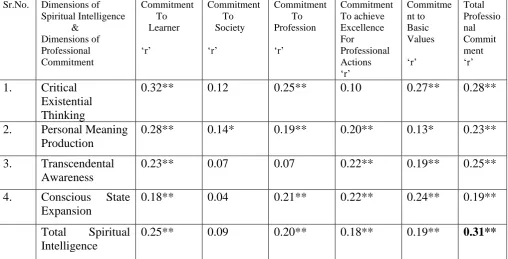
TABLE NO. 2: CORRELATION BETWEEN PROFESSIONAL COMMITMENT AND SPIRITUAL INTELLIGENCE OF TEACHER EDUCATORS
Variables No. Coefficient of
correlation ‘r’
Significance
Professional Commitment 200 0.31** Significant Spiritual Intelligence 200
** 0.01 level of significance Interpretation