244
International Journal of Pharmaceutical Sciences and Drug Research
2016; 8(5): 244-248
Research Article
CODEN (USA): IJPSPP
ISSN: 0975-248X
Effect of Lipids on Physicochemical Properties of Letrozole Loaded Solid
Lipid Nanoparticles
Archana Nerella
*, Basava Raju Dontamsetti, Aruna Devi Mantena
Shri Vishnu College of Pharmacy, Vishnupur, Bhimavaram, West Godavari-534202, Andhra Pradesh, India
ABSTRACT
The objective of the current investigation was to prepare solid lipid nanoparticles (SLNs) from different lipids and to study the effect of lipids on physicochemical characteristics of letrozole loaded SLN. In order to prepare small, stable, uniform and high Letrozole loaded SLNs, many factors such as lipid and stabilizer concentration and preparation parameters can be considered. Out of these, we have selected solid lipid as lipid matrix to investigate an effect on SLNs. SLNs were prepared using different lipids by modified hot sonication method. The effect of different lipids and stabilizers on physicochemical characteristics of Letrozole loaded SLNs were investigated. Letrozole loaded SLNs showed different physicochemical properties and release profiles according to used solid lipid. In case of particle size, SLN1 showed biggest particle size (532.5 ± 26.4nm) and highest encapsulation efficiency (81.37 ± 6.72%) and, SLN4 showed highest cumulative drug percentage (89.4 ± 1.8%, 24 h) release. These results suggest that lipids type affect physicochemical properties and release profile of SLN. The choice of lipid and stabilizer played important role on the physicochemical characteristics and in vitro release of Letrozole loaded SLNs.
Keywords: Letrozole, Solid lipid nanoparticles, in vitro release, stability.
INTRODUCTION
Solid lipid nanoparticles (SLNs) have recently attracted increasing attention as potential colloidal drug carriers for controlled drug delivery. SLNs combines the advantages of polymeric nanoparticles such as controlled drug release, cytotoxicity and avoiding drug leakage, and the advantages of emulsion and liposome such as low toxicity, good biocompatibility and higher bioavailability. [1-2] SLNs are composed of physiological
and compatible lipids as the solid core, which is coated by nontoxic amphiphilic surfactants as outer shell. [3]
*Corresponding author: Mrs. Archana Nerella,
Department of Pharmaceutics, Shri Vishnu College of Pharmacy, Vishnupur, Bhimavaram, West Godavari-534202, Andhra Pradesh, India;
E-mail: [email protected]
Received: 31 July, 2016; Accepted: 24 August, 2016
Studies have shown that the physiochemical characteristics and stability of drug-loaded SLNs depend on the properties of drug and ingredients. [4]
Suitable choice of lipids, surfactants, and their composition affect the particle size, entrapment efficiency, zeta potential, stability during storage, and release behavior. [5]
Int. J. Pharm. Sci. Drug Res. September-October, 2016, Vol 8, Issue 5 (244-248) types of delivery systems which increases the oral
bioavailability could lead to significant advantages in the clinical use of the drug. [6]
To prepare Letrozole loaded-SLNs, formulation factors such as solid lipid, stabilizer and physical mixer conditions were carefully monitored because they have an effect on physicochemical properties and release profile. [7] SLNs can be prepared from different types of
solid lipids such as triglycerides [8-10], fatty acids [11-12]
and waxes. [13-14] Therefore, in the present investigation
we assessed the difference of physicochemical properties and release profile of Letrozole loaded SLNs with different solid lipid matrix. Further characterized particle size, polydispersity index, zeta potential, solubility test and in vitro release study for all the developed SLNs.
MATERIALS AND METHODS Materials
LTZ was a kind gift from Natco Pharma Pvt. Ltd; Hyderabad, Behenic acid, myristic acid, palmitic acid and stearic acid were purchased purchased from Hi-Media (Mumbai, India). Centrisart filters (molecular weight cutoff 20,000) were purchased from Sartorius (Goettingen, Germany). The other chemicals were of analytical reagent grade.
Preparation of LTZ loaded solid lipid nanoparticles
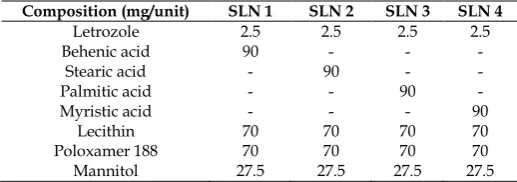
The SLNs were prepared using a modified hot sonication method. In this method initially lipid (Behenic acid/Stearic acid/Palmitic acid/Myristic acid), accurately weighed quantity was melted at 90°C in water bath (Waterbath WNB 22, memmert GmbH, Schwabach). Weighed quantity of Letrozole was dissolved in ethanol and then injected into the molten lipid under sonication. Lecithin and poloxamer 188 were dispensed into minimal amount of distilled water and added to the Letrozole lipid solution under sonication and resulting solution further sonicated for 10 min at 90°C in a water bath. Finally, the mixture was injected into 10% mannitol solution at 4°C. The final samples were freeze-dried until further use (Table 1).
HPLC methodology for Letrozole
HPLC determination of LTZ was performed using Shimadzu LC 20AT solvent delivery pump equipped with a 20μL loop and rheodyne sample injector UV-Visible detector at 230nm. Samples were chromatographed on a stainless steel C-18 reverse phase column (250 × 4.25 mm) packed with 5μm particle (phenomenex column). [6]
Characterization of LTZ loaded Solid Lipid Nanoparticles
Measurement of particle Size and zeta potential
The size and zeta potential of SLN were measured by photon correlation spectroscopy using a Zetasizer 3000 HSA (Malvern, UK). Zeta potential was carried out at room temperature and the electric field strength was around 23.4 V/cm. Samples were diluted appropriately with the aqueous phase of the formulation to get optimum kilo counts per second (Kcps) of 50-200 for
measurements, and the pH of diluted samples ranged from 7.0 ± 0.2.
Determination of drug content and entrapment efficiency
Drug content was estimated in the form of assay, 50μL of SLN formulation was diluted to 1 mL with ethanol. The final dilution was made with the mobile phase, and LTZ content was determined by HPLC. The prepared Letrozole SLNs (50 mg) were solubilized with 10 mL of ethanol, heated at 80°C for 30 min and then cooled down at -20°C for 30 min. This solution was centrifuged at 4,000 rpm for 3 min to precipitate the undissolved solid behenic/stearic/palmitic/ myristic acid, filtered through a 0.2µm filter and injected into the HPLC system.
Entrapment efficiency (E.E.) was calculated using following equation
Drug entrapment efficiency (%) = analyzed weight of drug in SLNs / theoretical weight of drug loaded in
system × 100
Fourier transform infra-red spectroscopy (FTIR) study
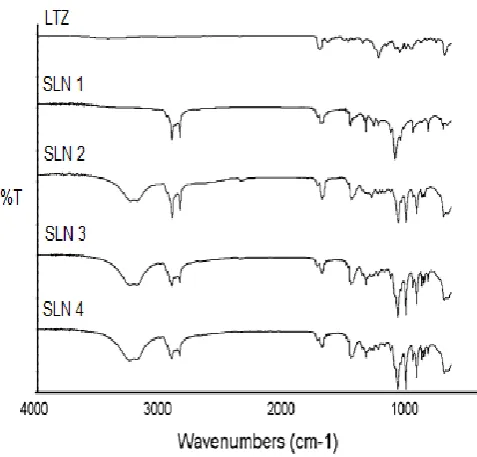
The Fourier transform infrared ((NICOLET 380 FT-IR, Thermo, USA) analysis was conducted to verify the possibility of chemical bonds between drug and polymer. Samples of pure LTZ, prepared formulations SLN1 to SLN4 were scanned in the IR range from 400 - 4000 cm-1 in order to assess the changes of solid state of
the samples.
Solubility studies of Letrozole Loaded SLNs
Accurately weighed Letrozole loaded SLNs were added to micro centrifuge tube containing 1 mL of distilled water. The samples were put on an end-to-end lab quake tube shaker /rotator (Thermo Scientific, Singapore) at 10 rpm at ambient temperature for 48 h in order to achieve equilibrium and were then stored at room temperature to investigate the change in solubility according to time. The samples were filtered with a 0.45µ membrane filter (Whatman Ltd., GE Healthcare Life Sciences, India) and the absorbance and amount of Letrozole solubilized was measured using HPLC. All solubility determinations were performed in triplicate.
In vitro release Study
Int. J. Pharm. Sci. Drug Res. September-October, 2016, Vol 8, Issue 5 (244-248) models: zero order, first order, Higuchi,
Korsemeyer-Peppas [15] semi empirical model. The release rate
constants (k) and correlation coefficients (R2) were
calculated by different mathematical models. The model giving a correlation coefficient close to unity was taken as the order of release. From the presented data, it was evident that drug release best fitted with Zero order release model.
Table 1: Composition of the investigated Letrozole loaded SLN formulations
Composition (mg/unit) SLN 1 SLN 2 SLN 3 SLN 4
Letrozole 2.5 2.5 2.5 2.5
Behenic acid 90 - - -
Stearic acid - 90 - -
Palmitic acid - - 90 -
Myristic acid - - - 90
Lecithin 70 70 70 70
Poloxamer 188 70 70 70 70
Mannitol 27.5 27.5 27.5 27.5
Table 2: Mean particle size, PDI, zeta potential and entrapment efficiency (EE%) of investigated LTZ-SLN formulations (mean ± SD, n = 3)
Formulation particle size Mean (nm)
Zeta potential
(mV)
PDI Entrapment efficiency (%)
SLN1 532.5 ± 26.4 15.8 ± 4.82 0.32 ± 0.02 81.37 ± 6.72
SLN2 378.2 ± 21.4 12.3 ± 5.12 0.28 ± 0.01 78.14 ± 5.84
SLN3 345.2 ± 18.4 11.6 ± 6.02 0.24 ± 0.02 75.15 ± 7.16
SLN4 308.3 ± 20.8 10.8 ± 5.82 0.19 ± 0.02 70.97 ± 8.92
Stability Studies
LTZ loaded SLN was stored at room temperature (25°C) and at refrigerator temperature (2-8°C) for 1 month and average particle size, zeta potential, PDI were determined. LTZ loaded SLNs were stored at room temperature for 30 days and entrapment efficiency is calculated.
RESULTS AND DISCUSSION
Particle size, polydispersity index and zeta potential of Letrozole loaded SLNs
Physicochemical properties of four different Letrozole loaded SLNs were compared according to solid lipid by measuring the particle size, polydispersity index and zeta potential. The results of particle size and polydispersity index revealed that increase with the increase of carbon chain length of fatty acid of lipid. Behenic acid (SLN1), stearic acid (SLN2), palmitic acid (SLN3) and myristic acid (SLN4) have 22, 18, 16, 14 carbon chain length of fatty acid, respectively. SLN 1 showed the biggest particle size of 532.5 ± 26.4nm, while SLN4 showed smallest particle size of 308.3 ± 20.8, in comparison to other SLN formulations. Formulations SLN2 and SLN3 exhibited 378.2 ± 21.4 and 345.2 ± 18.4nm, respectively. Polydispersity index and zeta potential of prepared SLNs were showed in Table 2.
Table 3: Release rate constants k, Correlation coefficients (R2), mean ± SD, (n=3) calculated after fitting the release profiles to mathematical
models to Letrozole loaded SLNs
Formulation Zero Order First order Higuchi Korsemeyer-Peppas n- Value
K0 R2 K0 R2 K0 R2 K0 R2
SLN1 0.898 ± 0.06 0.958 ± 0.07 0.041 ± 0.002 0.855 ± 0.04 2.503 ± 0.12 0.695 ± 0.09 0.161 ± 0.06 0.798 ± 0.05 0.917 SLN2 0.618 ± 0.04 0.892 ± 0.05 0.061 ± 0.002 0.635 ± 0.04 1.903 ± 0.14 0.715 ± 0.08 0.139 ± 0.07 0.485 ± 0.03 0.807 SLN3 0.591 ± 0.03 0.912 ± 0.06 0.076 ± 0.003 0.617 ± 0.05 2.023 ± 0.15 0.726 ± 0.08 0.128 ± 0.08 0.513 ± 0.04 0.824 SLN4 0.563 ± 0.06 0.852 ± 0.04 0.091 ± 0.002 0.785 ± 0.06 1.857 ± 0.14 0.759 ± 0.04 0.153 ± 0.06 0.482 ± 0.06 0.719
Table 4: Influence of storage condition and duration of storage on Mean particle size, zeta potential, PDI and Entrapment efficiency of optimized formulation (SLN1)
Storage condition Duration Mean particle size (nm) Zeta potential (mV) PDI Entrapment efficiency (%)
Room temperature Day 15 Initial 532.5 ± 26.4 546.5 ± 23.9 15.8 ± 4.82 13.1 ± 5.18 0.32 ± 0.02 0.33 ± 0.02 81.37 ± 6.72 80.57 ± 5.93
Day 30 548.3 ± 25.2 11.6 ± 5.31 0.33 ± 0.02 80.13 ± 6.22
Refrigerator temperature Day 15 Initial 532.5 ± 26.4 552.1 ± 18.9 15.8 ± 4.82 12.7 ± 3.64 0.32 ± 0.02 0.33 ± 0.03 81.37 ± 6.72 78.76 ± 5.91
Day 30 557.3 ± 19.6 11.9 ± 3.98 0.32 ± 0.03 79.13 ± 7.12
Zeta potential is a key factor to evaluate the stability of solid lipid dispersion. It was currently admitted that zeta potentials above 30mV were required for full electrostatic stabilization. However, many experiments demonstrated that not only electrostatic repulsion dominated the stability of nanoparticles; the use of steric stabilizer also favored the formation of stable nanoparticle dispersion. [16] In these studies, it seemed
that the value of zeta potential of LTZ loaded SLNs was not sufficient to keep the particles dispersing stably. However, the particle size did not change significantly within 45 days, which should contribute to the following point. Optimum surfactant mixture can easily compensate for missing electrostatic repulsion to stabilize the dispersion for long time. Poloxamer 188
provides a steric stability for maintaining the stability of SLN. The lipid did not affected the zeta potential of Letrozole loaded SLNs.
Entrapment efficiency of Letrozole loaded SLNs
Results of drug content and Entrapment efficiency of the prepared letrozole loaded SLNs were represented in Table 2. Drug content was achieved more than 85% in all the prepared formulations and Entrapment efficiency values were decreased with decreasing carbon chain length of the fatty acid, because the higher hydrophobicity of the longer chain fatty acids resulted in increased accommodation of lipophilic drugs. [17]
Int. J. Pharm. Sci. Drug Res. September-October, 2016, Vol 8, Issue 5 (244-248) characterized by the presence of many imperfections to
the β-modification forming a perfect crystal with no room for guest molecules. This phenomenon is even more pronounced when high purity lipids are used. The high purity lipid matrix of these particles solidifies upon cooling but does not recrystallize and remains in the amorphous state. A second type of SLN is formed when the lipid molecules are chemically very different, resulting in a structure with many imperfections to accommodate the drug and thus higher loading capacity. About 81% of entrapment efficiency is seen in SLN 1 formulation (Figure 1).
Characterization of SLNs using FT-IR
Samples of pure Letrozole and formulations SLN1 to SLN4 were characterized by the FTIR. The obtained spectra were illustrated in Figure 2. It showed that no significant differences on shape and position of the absorption peaks could be clearly observed for prepared SLN formulations. Most of the absorption peaks from pure LTZ & pure lipids overlapped with the absorption peaks from formulations. It can be concluded that no strong chemical interaction occurred between drug and lipids.
Fig. 1: Entrapment efficiency values of Letrozole loaded SLN formulations. Data are expressed as the mean ± S.D. (n = 3)
Fig. 2: FT-IR spectra of Pure API and Letrozole loaded SLN formulations
Fig. 3: Solubility studies of Letrozole loaded SLNs at initial, after 5 and 10 days after saturation
Fig. 4: In vitro dissolution profiles of Letrozole loaded SLNs in 0.1N HCl. Data are expressed as the mean ± S.D. (n = 3)
Solubility
Solubility kinetics according to elapsed day after saturation was represented in Figure 3. The Letrozole solubility of SLN1, SLN2, SLN3 and SLN4 was found to be 3.6 ± 0.3, 3.1 ± 0.2, 3.0 ± 0.5 and 2.8 ± 0.3 lg/mL, respectively. The Letrozole solubility was enhanced as the particle size of SLNs was decreased because the smaller particle has the higher surface area. [18]
According to the elapsed day after saturation, the solubility of Letrozole was decreased. This decrease was due to drug expulsion of drug from lipid matrix.
In vitro release study
Int. J. Pharm. Sci. Drug Res. September-October, 2016, Vol 8, Issue 5 (244-248) SLN1 compared to other SLNs. It was reported the
release of a drug from the SLN can be influenced by the nature of the lipid matrix, surfactant concentration and production parameters as well as lipid nature, solubility of the drug in lipid and partition coefficient.
[19] This clearly confirmed that higher solubility of drug
in lipid matrix is sufficient to prolong the drug release for longer period of time.
The release rate constant (k) calculated by different mathematical models and correlation coefficient (R2)
between observed release data and fitted profiles were summarized in Table 3. From the presented data, it was evident that drug release best fitted with zero order release model as evident from correlation coefficient values. Corresponding release constant (k) and release exponent (n) for the four formulations were calculated and it was observed that release rate constant gradually increased with the higher carbon chain length of lipid in zero order release model. All the formulations of Letrozole loaded SLNs followed nonFickian diffusion or anomalous mechanism of drug release (0.5 < n < 1).
Stability study
Formulation SLN1 was stored for stability in amber colored bottles at room and refrigerator temperature and is analyzed for particle size, zeta potential, entrapment efficiency and PDI on initial, 15 days and 1 month. The effect of duration of storage and storage condition on particle size, zeta potential and PDI of SLN are presented in Table 3. There is no significant difference in particle size, zeta potential, and PDI between SLN on the day of preparation but as the duration of storage increases up to one month the SLN formulation found to be stable. The good stability might derive from the slow transition of lipid in nano formulations, low particles size and the steric effect of Poloxamer 188. These results clearly suggest that an optimum Poloxamer 188 concentration was sufficient to cover the surface of nanoparticles effectively and prevent agglomeration during the homogenization process.
ACKNOWLEDGMENTS
The authors acknowledge M/s Natco Pharma Pvt. Ltd., India for providing Letrozole and also acknowledge Shri Vishnu College of Pharmacy, Bhimavaram for providing resources and continuous support.
REFERENCES
1. YiFan L, DaWei C, LiXiang R, XiuLi Zhao, Jing Qin. Solid lipid nanoparticles for enhancing vinpocetine's oral bioavailability. J Contr. Rel. 2006; 114:53-59.
2. Dingler A, Gohla S. Production of solid lipid nanoparticles (SLN): scaling up feasibilities. J Microencapsul. 2002; 19:11-16.
3. Mehnert W, Mader K. Solid lipid nanoparticles production, characterization and applica- tions. Adv Drug Deliv Rev. 2001; 47:165-196.
4. Lim SJ, Kim CK. Formulation parameters determining the physiochemical characteristics of solid lipid nanoparticles loaded with all-trans retinoic acid. Int J Pharm. 2002; 243:135-146.
5. Kim BD, Choi HK. Preparation and characterization of solid lipid nanoparticles (SLN) made of cacao butter and curdlan. Eur J Pharm Sci. 2005; 24:199-205.
6. Archana N, Basava Raju D, Aruna Devi M. Formulation, Optimization and In vitro Characterization of Letrozole Loaded Solid Lipid Nanoparticles. Int. J. Pharm. Sci. Drug Res. 2014; 6(3): 183-188.
7. Muller RH, Mader K, Gohla S. Solid lipid nanoparticles (SLN) for controlled drug delivery - a review of the state of the art. Eur J Pharm Biopharm. 2000; 50(1):161–177.
8. Joseph S, Bunjes H. Preparation of nanoemulsions an solid lipid nanoparticles by premix membrane emulsification. J Pharm Sci. 2012; 101(7):2479 - 2489.
9. Noack A, Hause G, Mader K. Physicochemical
characterization of curcuminoid-loaded solid lipid nanoparticles. Int J Pharm. 2012; 423(2):440 - 451.
10. Padois K, Cantieni C, Bertholle V, Bardel C, Pirot F, Falson F. Solid lipid nanoparticles suspension versus commercial solutions for dermal delivery of minoxidil. Int J Pharm. 2011; 416(1):300 - 304.
11. Carbone C, Tomasello B, Ruozi B, Renis M, Pulglisi G. Preparation and optimization of PIT solid lipid nanoparticles via statistical factorial design. Eur J Med Chem. 2012; 49:110 - 117.
12. Spada G, Gavini E, Cossu M, Rassu G, Giunchedi P. Solid lipid nanoparticles with and without hydroxypropyl-b-cyclodextrin: a comparative study of nanoparticles designed for colonic drug delivery. Nanotechnology. 2012; 23(9):095-101.
13. Kheradmandnia S, Vasheghani-Farahani E, Nosrati M, Atyabi F. Preparation and characterization of ketoprofen-loaded solid lipid nanoparticles made from beeswax and carnauba wax. Nanomedicine. 2010; 6(6):753 – 759.
14. Nesseem D. Formulation of sunscreens with enhancement sun protection factor response based on solid lipid nanoparticles. Int J Cosmet Sci. 2011; 33(1):70 – 79.
15. Korsemeyer RW, Gurny R, Docler E, Buri P, Peppas NA. Mechanisms of solute release from porous hydrophilic polymers. Int. J Pharm. 1983; 15(1): 25-35.
16. Cavalli R, Caputo O, Gasco MR. Preparation and characterization of solid lipid nanospheres containing paclitaxel. Eur. J. Pharm. Sci. 2000; 10:305-309.
17. Anderson M, Ormi A. The effect of different lipid components on the in vitro stability and release kinetics of liposome formulations. Drug Deliv. 2004; 11(1):33 – 39. 18. Sievens-Figueroa L, Bhakay A, Jerez-Rozo JI, Pandya N,
Romanach RJ, Michniak-Kohn B, Iqbal Z, Bilgili E, Dave RN. Preparation and characterization of hydroxypropyl methyl cellulose films containing stable BCS Class II drug nanoparticles for pharmaceutical applications. Int J Pharm. 2012; 423(2):496 – 508.
19. Jong-Suep Baek, Sang-Chul Shin, Cheong-Weon Cho. Effect of lipid on physicochemical properties of solid lipid nanoparticle of paclitaxel. J of Pharma Investigation. 2012; 42:279 – 283.