EFFECTIVENESS OF HULA HOOPING USING A CUSTOM
ON AGILITY, BALANCE, FLEXIBILITY AND CORE STRENGTH ON PROFESSIONAL TENNIS
SRM College of Physiotherapy, SRM Institution of Science and Technology,
A R T I C L E I N F O
INTRODUCTION
Hula hoops have a rich history dating back to ancient Greece. Hula hoop was first invented by Arthur K. Spud Melin and Richard Knerr in the year 1958. The children sized hul
are approximately 71 centimetres (28 inches) in diameter, and adult sized hula hoops are around 1.02 meters (40 inches).Traditionally people used willow, grapevines and stiff grasses to make hoops. Whereas today, they use of plastic tubing o make the hoops.[1] Hula Hooping is an wonderful form of exercise as it helps in working out the entire body, helps to burn calories in order to lose weight around your midsection and tone the muscles of your core for a slim and strong waist. The free continuous motion of th
hooping strengthens the core muscles. [2]
Hula Hooping workout activates 30 muscles around the core. There is solid proof implying that hula hooping can strengthen your low back stabilizing muscles and thereby reducing of back pain.[3]
International Journal of Current Advanced Research
ISSN: O: 2319-6475, ISSN: P: 2319-6505,
Available Online at www.journalijcar.org
Volume 7; Issue 4(C); April 2018; Page No.
DOI: http://dx.doi.org/10.24327/ijcar.2018
Copyright©2018 Suresh T.N and Boobesh V. This is an open access article distributed under the Creative Commons Attribution License, which permits unrestricted use, distribution, and reproduction in any medium, provided the original work is properly cited.
*Corresponding author: Suresh T.N
SRM College of Physiotherapy, SRM Institution of Science and Technology, Kattankulathur
Article History:
Received 11th January, 2018 Received in revised form 24th
February, 2018 Accepted 9th March, 2018 Published online 28th April, 2018
Key words:
Hula hooping, Tennis Players, Agility, Balance, Flexibility and Core Strength,
EFFECTIVENESS OF HULA HOOPING USING A CUSTOM-MADE POLYETHYLENE HOOP: EFFECTS
ON AGILITY, BALANCE, FLEXIBILITY AND CORE STRENGTH ON PROFESSIONAL TENNIS
PLAYERS
Suresh T.N* and Boobesh V
SRM College of Physiotherapy, SRM Institution of Science and Technology, Kattankulathur
A B S T R A C T
Background: Hula hooping is a fun recreational activity that has been used for exercise for centuries but there are very few studies on its effectiveness on athletic performance. Tennis is a sport that requires a number of athletic skills such as agility, balance, flexibility, and core strength. Objective: The purpose of this study was to determine the effectiveness of hula hoop training on agility, balance, flexibility and core strength in professional tennis players.
Methodology: 18 subjects,(18-25 years old), male, professional tennis players, study design: quasi experimental study; study design: pre-test and post
for at least 2 minutes is the criteria to include them into the study. Selected players were made to undergo pre-test, followed by which hula hooping protocol was
Post-test value was analysed by Paired ‘t’ test. The calculated ‘p’ value is 0.021 for agility test, 0.002 for balance test and 0.000 for flexibility and core strength test which are less than 0.05 at 5% level of significance. Discussion: All tested athletic skills showed a significant increase in performance. The training had its greatest affect on core strength and flexibility. Agility and balance also increased but surprisingly not to the extent of core strength and flexibility. Conclusion: Thus it is concluded that using a custom made polyethylene hula hoop was very effective in improving agility and balance but was most effective over improving flexibility and core strength in professional tennis players.
Hula hoops have a rich history dating back to ancient Greece. Hula hoop was first invented by Arthur K. Spud Melin and Richard Knerr in the year 1958. The children sized hula hoops are approximately 71 centimetres (28 inches) in diameter, and adult sized hula hoops are around 1.02 meters (40 inches).Traditionally people used willow, grapevines and stiff grasses to make hoops. Whereas today, they use of plastic Hula Hooping is an wonderful form of exercise as it helps in working out the entire body, helps to burn calories in order to lose weight around your midsection and tone the muscles of your core for a slim and strong waist. The free continuous motion of the hip on hula
Hula Hooping workout activates 30 muscles around the core. There is solid proof implying that hula hooping can strengthen your low back stabilizing muscles and thereby reducing of
Director of Hooping.org Mr. Ron Klint, says the heaviness of the hula hoop decides the percentage of aerobic workout one can feel while hula hooping. Lighter the hoops need more energy to rotate. To slim the waist one has to shed body fat by burning calories. Any kind of activity that increases your heart rate is effective.[4]
ACE (American council on exercise) researchers also looked on how much calorie can be burned on hooping compared to other popular workouts. Out of eight different workouts, hooping came in third for calories burned in a minute, with cardio kickboxing and boot camp before it. However, the difference was less than 1 calorie per minute, or 30 calories per half hour.[5]
Forcing the hula-hoop to rotate around the waist provides a perfect workout to core muscles. In order to keep the hula hoop rotating around your waist, one must shake the hip in a front (push) and back (pull). Start stand in the center of the hula hoop with the feet apart, put the dominant foot about 30 centimeters before the other foot, and slightly bend the knees. To keep the hoop rotating, simultaneously push the hula hoop front with your abdomen and pull the hula hoop behind with your lower back. Push the hoop to start the rotation on the waist. Instead of performing h
International Journal of Current Advanced Research
6505, Impact Factor: 6.614
www.journalijcar.org
; Page No. 11511-11516
//dx.doi.org/10.24327/ijcar.2018.11516.1996
This is an open access article distributed under the Creative Commons Attribution License, which permits unrestricted use, distribution, and reproduction in any medium, provided the original work is properly cited.
SRM College of Physiotherapy, SRM Institution of Science
MADE POLYETHYLENE HOOP: EFFECTS
ON AGILITY, BALANCE, FLEXIBILITY AND CORE STRENGTH ON PROFESSIONAL TENNIS
Kattankulathur
Hula hooping is a fun recreational activity that has been used for exercise for centuries but there are very few studies on its effectiveness on athletic performance. Tennis a number of athletic skills such as agility, balance, flexibility, and The purpose of this study was to determine the effectiveness of hula hoop training on agility, balance, flexibility and core strength in professional tennis
25 years old), male, professional tennis players, study test and post test. Ability to hula hoop for at least 2 minutes is the criteria to include them into the study. Selected players were test, followed by which hula hooping protocol was followed. Results: . The calculated ‘p’ value is 0.021 for agility test, 0.002 for balance test and 0.000 for flexibility and core strength test which are less All tested athletic skills showed a ormance. The training had its greatest affect on core strength and flexibility. Agility and balance also increased but surprisingly not to the extent of core Thus it is concluded that using a custom made ula hoop was very effective in improving agility and balance but was most effective over improving flexibility and core strength in professional tennis players.
Director of Hooping.org Mr. Ron Klint, says the heaviness of the hula hoop decides the percentage of aerobic workout one can feel while hula hooping. Lighter the hoops need more energy to rotate. To slim the waist one has to shed body fat by ies. Any kind of activity that increases your heart
ACE (American council on exercise) researchers also looked on how much calorie can be burned on hooping compared to other popular workouts. Out of eight different workouts, came in third for calories burned in a minute, with cardio kickboxing and boot camp before it. However, the difference was less than 1 calorie per minute, or 30 calories per
hoop to rotate around the waist provides a workout to core muscles. In order to keep the hula hoop rotating around your waist, one must shake the hip in a front (push) and back (pull). Start stand in the center of the hula hoop with the feet apart, put the dominant foot about 30 the other foot, and slightly bend the knees. To keep the hoop rotating, simultaneously push the hula hoop front with your abdomen and pull the hula hoop behind with your lower back. Push the hoop to start the rotation on the waist. Instead of performing hip thrusts, flex and extend the
Research Article
Professional Tennis Players
knees to keep the hula hoop spinning around the hip on the vertical plane. Perform twice or thrice- 30 seconds each repetition.[6]
Hula hoops take time get used to, but once got the motion the weighted hula hoop can be easier to use to the adult population. It is larger in size and heavier in mass than the usual children's hula hoops, the weighted hoops twirl at a slower rate, making it easy to balance on the waist and can spin for larger time duration.[7] The ACE helped for a study on how much calorie is used on hula hooping. The study’s finding was in 30 minutes 210 calories can be lost. [8]
Researchers say tennis is a sport where players respond to consecutive emergencies. Running towards the ball, reaching for the ball, ceasing the ball, changing flow of the ball, stepping forward to pick the ball and servicing. So, players must improve their agility, speed, flexibility, strength, endurance, power, body structure, anaerobic and aerobic fitness to enhance their tennis game.
Tennis requires extraordinary mobility. Greater the power quickly must be the response and the player must generate extremely powerful movements with smaller amount of effort. To get into position quickly the player must have explosive first steps to set up, and strike productive shots. Both top and bottom part of body are required to generate power. To maximize the power, player must transfer the lower body power to the upper body. This can be achieved only with the help of good core strength.[14]
Tennis requires agility, balance, flexibility and core strength for a good play on the court and hula hooping helps in improving the above requirements, so this study was done in order find the improvements of hula hooping in professional tennis players for period of 6weeks.
METHORDS
The professional Male Tennis players within the age group of 18 to 25 years were selected. The players can able to hula hoop minimum of two minutes. Based on this criteria 50 players were selected from M.M.Tennis academy, Ambattur Estate. Informed consent was taken before trail. Pre-training of how to hula hoop taught for 1 week. At the end of the pre-training the players were asked to maintain the hula hoop for at least of 2 minutes. Out of 50 male players 20 were able to hold and so were included into this study. Then pre-test was taken with regards to agility, balance, flexibility and core strength as outcomes. Later the players followed the hula hooping protocol in the following. After 6 weeks of hula hooping the post test for the same outcomes were taken.
Hula Hooping Protocol
S.no Weeks Duration(Min/Day)
Continuously
1. 1
st week
(7 DAYS) 6 minutes/day
2. 2
nd week
(14 DAYS) 8 minutes/day
3. 3
rd week
(21 DAYS) 10 minutes/day
4. 4
th week
(28 DAYS) 12 minutes/day
5. 5
th week
(35 DAYS) 14 minutes/day
6. 6
th week
(42 DAYS) 16 minutes/day
Outcome Measures
The outcome measures of the study are as follows:
Agility Test (T- Test)
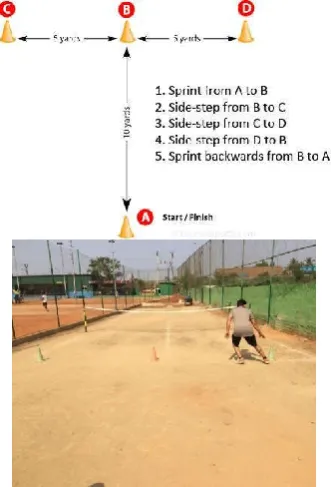
Four cones were arranged as shown in figure 3.The T-test began with the player standing at point A. A command “Start” was given and the player ran towards to point B and touched the base of the cone with the right hand. Then, while facing forward and not crossing the feet, the player ran 5 yards (4.6 m) towards the left and touched the base of the cone at point C with the left hand. The player then ran 10 yards (9.1 m) towards the right and touches the base of the cone at point D with the right hand. The player then ran 5 yards towards the left and touches the base of the cone at point B with the left hand, and next runs backward past point A, the stopwatch is stopped when he crosses the point A. The best time out of two trials is recorded. A trial is not taken into account when the player crosses his foot before the other instead of running sideways or does not touch any of the cones base or does not look straight for the entire test.
Fig 1 A player hula hooping
11513
Balance (Standing Stroke Blind Test)
The player stands comfortably on both feet with their hands on their hips. Then player pulls the dominant leg, puts the heel of the dominant foot over the medial aspect of the non-dominant knee cap and close both eyes then the command “Start” was given, and the stopwatch was started and the player lifts his heel on the dominant side to stand on the other foot alone. Then player holds this position for as much time he is able to. The test was stopped when the player’s non-dominant sole of the foot reaches the ground or the dominant foot slides away from the non-dominant knee cap. It was recorded with the stopwatch. The player rested for 3 minutes before the second trail. Best time out of the two was taken.
Flexibility (Sit and Reach Test)
The player warmed up for about 10 minutes and then removed his shoes. A scale was stuck to the upper surface of a box with the gum so that the front of the box is in straight line with 30cm marked on the scale and the zero end of the scale showing zero is pointed the player side. The player sat on the concrete ground with fully extended legs from the bottom with his feet over the box. The player reinforced one hand over other and gradually bent forward and reached the upper surface with the scale and touched the scale keeping up the stretch for two seconds. Readings were noted down, that is the distance reached by the player’s finger tips. The player performed the test thrice. The average of the three distances were calculated and this value to was taken to assess the player’s performance.
Core Strength (Partial Curl Up Test)
The player was made to lie in on his back over a concrete ground with the knee in right angle position. The arms aside resting over the floor, with the fingers on a 10.16 centimetre bar drawn with a chalk which was perpendicular to the fingers
(figure7.a). A parallel bar drawn with the chalk in a different colour was situated at a calculated distance using the player’s age which was 11.94 centimetres. Set a metronome (using mobile app) for 40 counts per minute and the player had to slowly perform it, controlled curl ups to pull the shoulder from the ground (figure7.b) simultaneously 20 curl ups per minute with the metronome was performed. Before starting the next curl-up the upper back must touch the ground. Bringing the chin to chest must be avoided by the player. The player performs as many repetitions to the extent he can without breaking in between.
Data Analysis
S – Significant NS – Not Significant P < 0.05 or [0.021 <0.05] In this table P value is less than 0.05 which is statistically significant and indicates reduction in the time taken to complete the agility test (T- test) by male tennis players.
Graph 1 (T-Test)
Comparison of pre test and post test of Agility using T-Test
Table 2 (Stroke blind test)
BALANCE Mean N Std. Deviation
Paired t
value P value
Pre test
Post test
38.8589
44.3444 18
18
11.66068
12.41803
-3.665 .002 S
S – Significant NS – Not Significant P < 0.05 or [0.002 <0.05]
Fig 3 A player performing stroke blind test
Fig 4 A player performing sit and reach test
Fig 5 A player performing curl up test
Table 1 (T-Test)
AGILITY Mean N Std.
Deviation
Paired t
value P value
PRE TEST POST TEST
11.3139 10.7478
18 18
1.32297
Professional Tennis Players
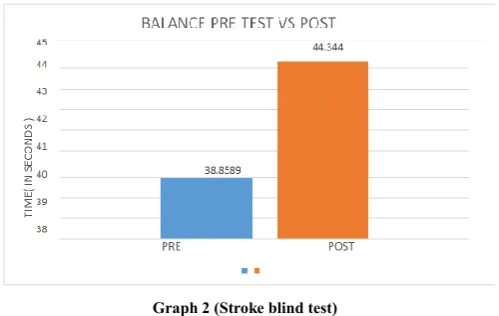
In this table P value is less than 0.05 which is statistically significant and indicates increase in the time taken to complete the balance test (Stroke blind test) by male tennis players.
Graph 2 (Stroke blind test)
Comparison of pre test and post test of Balance using Stroke blind test
Table 3 (Sit and Reach test)
Flexibility Mean N Std.
Deviation
Paired t
value P value
Pre test
Post test
34.2378
38.2811 18
18
8.87690
8.67608
-6.840 .000 S
S – Significant NS – Not Significant P < 0.05 or [0.000<0.05] In this table P value is less than 0.05 which is statistically highly significant and indicates increase in the length where the hand was able to touch to complete the flexibility test (Sit and reach test) by male tennis players.
Graph 3 (Sit and Reach test)
Comparison of pre test and post test of flexibility using Sit and Reach test
Table 4 (Partial curl up test)
Corestrength Mean N Std.
Deviation
Paired t
test P value
Pretest
Posttest
38.0556
45.8333 18
18
7.51839
8.98528
-6.915 .000 S
S – Significant NS – Not Significant P < 0.05 or [0.000< 0.05] In this table P value is less than 0.05 which is statistically highly significant and indicates increase in the repetitions to complete the Core strength test (Partial curl up test) by male tennis players.
Graph 4 (Partial Curl Up test)
Comparison of pre test and post test of Core strength using partial curl up test
RESULT
Statistical analysis was done using Paired ‘t’ test using IBM SPSS 20.0 Version was used to find out the improvement within the group.
According to Graph 1(T-Test), using Paired ‘t’ test 5% level of significance, the calculated ‘p’ value is 0.021 which is less than 0.05 showing that there is improvement in the agility after hula hooping for 6 weeks as per the protocol.
According to Graph 2(Stroke blind test), using Paired ‘t’ test 5% level of significance, the calculated ‘p’ value is 0.002 which is less than 0.05 showing that there is improvement in the balance after hula hooping for 6 weeks as per the protocol. According to Graph 3(Sit and reach test), using Paired ‘t’ test 5% level of significance, the calculated ‘p’ value is 0.000 which is less than 0.05showing that there is improvement in the flexibility after hula hooping for 6 weeks as per the protocol.
According to Graph 4(Partial Curl up test), using Paired ‘t’ test 5% level of significance, the calculated ‘p’ value is 0.000 which is less than 0.05 showing that there is improvement in the core strength after hula hooping for 6 weeks as per the protocol.
Post-test value was analysed by Paired ‘t’ test. The calculated ‘p’ value is 0.021 for agility test, 0.002 for balance test and 0.000 for flexibility and core strength test which are less than 0.05 at 5% level of significance. This test showed that here is significant difference between the pre-test and post-test after hula hooping for 6 weeks using a custom made poly ethylene hula hoop.
The mean values of flexibility test and core strength test shows us that hula hooping was very effective with regards to improving the flexibility and core strength of the professional tennis players.
DISCUSSION
11515
with agility, balance, flexibility and core strength as the outcome measures. Then followed by one week pre-training on how to hula hoop was taught and at the end of the week all the subjects were able to hula hoop for a minimum of 2 minutes. In the following week the hula hooping experiment was initiated. The subjects followed the protocol without any interruption for 6 weeks. Later post test for the same outcomes was taken.Agility test was done using T-test and the pre-test value was 11.31 seconds and post-test was 10.75 seconds, thereby showing that the time taken to complete the test was reduced by 0.56 seconds on an average. The p-value was 0.02 meaning it is also statistically significant. Balance test was done using Stroke blind test and the pre-test value obtained was 38.86 seconds and post test value was 44.34 seconds that is 5.48 seconds increased on an average. The p-value was 0.002 signifying it is statistically significant. Flexibility was assessed using Sit and Reach test, the pre-test value was 34.24 centimetres were as the post test value was 38.28 centimetres which is 4.04 centimetre increase on an average. The p-value was 0.00 implying it is statistically significant. Core strength was evaluated using Partial curl up test, the pre-test value was 38.06 repetitions as an average whereas the post test value increased by 7.77 repetitions making it 45.83 repetitions as an average. The p-value was 0.00 indicating it is statistically significant.
For the body to maintain this constant oscillatory pattern it requires great activity from the core musculature, if this is practiced daily it will result in core strengthening. This is because maintaining the swaying motion for longer periods the core continued to improve in strength. Other essential component to maintain the hula hoop motion is balance. Balance is required so that the hoop bounces off the body and continues to spin without falling to the ground. This requires good proprioception in core to maintain the necessary balance. So as an individual improves their performance, it can be reasoned their core proprioception is improving as a result improving balance.
Other surprising areas of improvement were found in agility and flexibility. Agility is the ability to stop a motion suddenly and alter the direction. It seems the constant rotatory motion of the hip from front to back and side to side have lead to the increase in agility. Flexibility is lengthening of the muscles to achieve complete range of bending. While performing hula hooping there is rhythmic to and fro motion forward and backward, shifting the body weight from one side to another while performing the hula hooping. This motion releases the muscle tension in the surrounding muscles of the sacrum and the spine there by resulting in rich blood flow to the area which ultimately helps in stretching of the muscles when performing daily.
This study reveals that the players were able to develop agility, balance, flexibility and core strength after a 6 week hula hooping exercise. But considering the rate of improvement on the outcome measures the flexibility and core strength seems to increase more than that of agility and balance. This leads us to the conclusion that hula hooping is an exercise that can increase agility, balance, flexibility and core strength in a short duration of time.
Dr John Porcari PhD(2010) and Cedric X. Bryant, Ph.D(2011) in their respective studies said that hooping delivers a
total-body workout that can improve flexibility and balance while strengthening the back, abdominal, arm and leg muscles.
In order splint into different directions as per the flow of the ball the tennis player needs to have good agility and in order to reach out for low shots the player needs good flexibility to get in contact with the ball. Players experienced a change in their reaction time to the ball after hula hooping for 4 weeks which they found it to be impressive. Irrespective of the different shots in different positions of the body the player needs to have good balance and flexibility or he will fall. Players who claimed of falling during the time of the game also found themselves not falling much irrespective of the risky font net lobe shots they took which were their greatest weakness once. They claimed their fall considerably reduced and have a better flexibility now as their able to reach out for risky shots without falling.
For a player to deliver a powerful shot or a power serve during a crucial moment of the game the player needs to have very good core strength as the power for the serve is generated from the core and delivered to the racket. The twisting motion of the trunk activates the core muscle to generate maximum power for a single swing. Players also claimed that their shots started getting more powerful after 4 weeks of hula hooping, they found their core getting stronger so do the power of their swing.
So in order to improve the players efficiency the tennis players can have hula hooping as one of their regular workouts as a short time spent with the hula hoop continuously for days can drastically improve the players efficiency with regards to his agility, balance, flexibility and core strength. A fit player is a better tennis player.
This study increases the evidence that hula hooping can increase flexibility and core strength more significantly and also with it there is increase in the agility and balance in tennis players who were my subjects of interest.
CONCLUSION
Thus it is concluded that using a custom made polyethylene hula hoop was very effective in improving agility and balance but was most effective over improving flexibility and core strength in professional tennis players.
Reference
1. “Background, History, Raw Materials, Design, And The
Manufacturing Process Of Hula Hoops”.
Madehow.Com. Retrieved 2011-05-23.
2. Panati, Charles (1989). The Extraordinary Origins Of Everyday Things. William Morrow Paperbacks / Harper-Collins. Isbn 0062277081.
3.
www.hoopnotica.com/blogs/stay-in-the-hoop/15471071-the-benefits-of-hula- hooping-aka-why-you-should-start-hooping-for-fitness-today
4. Http://Www.Hooping.Org/2003/05/Introduction-To-Hooping/
5. Hooping: A Revolutionary Fitness Program By Ariane Conrad, ChristabelZamor; Workman Publishing Company; Pap/Dvd Edition (June 4, 2009).
Professional Tennis Players
7. Davis, B. Et Al. (2000) Physical Education And The Study of Sport. Uk: Harcourt Publishers Ltd.
8. Mcardle, W. Et Al. (2000) Essentials of Exercise Physiology. 2nd Ed. Philadelphia: Lippincott Williams And Wilkins.
9. Essentials of strength training and conditioning / National Strength and Conditioning Association; G. Gregory Haff, N.Travis Triplett, editors. -- Fourth edition, ISBN: 978-1-4925-0162-61.
10. Effect of Hula Hooping as Compared to Walking on Adipose Tissue Distribution, Metabolic Parameters and Adipose Tissue Gene Expression
11. A Six Week Trial of Hula Hooping Using a Weighted Hoop: Effects on Skinfold, Girths, Weight, and Torso Muscle Endurance. McGill, Stuart M.; Cambridge, Edward D.J.; Andersen, Jordan T. Journal of Strength
& ConditioningResearch:May 2015 Volume29 Issue5
p1279–1284 (/nscajscr/toc/2015/05000) doi: 10.1519/JSC.0000000000000653.
12. A pilot study of women’s affective responses to common and uncommon forms of aerobic exercise Pages 239-257 | Received 21 Nov 2014, Accepted 14 Sep2015, Accepted author version posted online: 22 Sep 2015, Published online: 15 Oct 2015.
13. "History of Tennis". International Tennis Federation.
Retrieved 28 July 2008.
*******
How to cite this article:
Suresh T.N and Boobesh V (2018) 'Effectiveness of Hula Hooping Using A Custom-Made Polyethylene Hoop: Effects On Agility, Balance, Flexibility And Core Strength On Professional Tennis Players', International Journal of Current Advanced