Analyzing Cryptographical Properties of 1D and 2D Cellular Automaton
Sindhuja G1, Vinupriya P2, Jyothirbindhu V3, Mohaideen Pitchai K4 and Bhuvaneswari M5
1,2,3,4,5
Student, Department of Computer Science and Engineering, National Engineering College, K. R. Nagar, Kovilpatti, India.
Article Received: 24 January 2018 Article Accepted: 27 February 2018 Article Published: 08 April 2018
1.INTRODUCTION
Several important computer simulation methods rely on random numbers, including Monte Carlo techniques,
Brownian dynamics, and stochastic optimization methods such as simulated annealing. The quality of the results of
these methods critically depends on the quality of the random sequence as measured by suitable statistical tests.
Computational efficiency is also an important aspect when very long sequences of random numbers have to be
produced. Random numbers are also needed in another important application area: built-in self-test devices for
VLSI circuits [3].
In recent years, cellular automata (CA) have been found as an attractive modeling tool for various applications,
such as, pattern recognition, image processing, data compression, encryption and specially VLSI design and test.
However, for all such applications, a special class of CA, called as linear/additive CA, has been utilized. Since
linear CA, limit the search space, we may not reach to the best result while searching for the solution to a problem.
Nonlinear CA can be an alternative to linear/additive CA for achieving desired solutions in different applications.
Several researchers have attempted to apply the pseudorandomness of CA to cryptography. The cryptanalysis of
linear CA based cryptographic techniques show that nonlinearity is needed for Cryptographic applications.
However, nonlinear CA shows high correlation. Hence, for cryptography Cellular Automata rules need to be
nonlinear as well as satisfy additional properties.
In this paper, we analyze the CA by modeling its rule as a Boolean function relating output bits with input bits.
Parameters like nonlinearity, balancedness and algebraic degree are known to be important for the cryptographic
analysis of Boolean functions [5].
2.CONCEPT OF CELLULAR AUTOMATA
A cellular automaton consists of regular grid of cells in which each cell can have finite number of possible states.
The state of a cell at a given time step is updated in parallel and determined by the previous states of surrounding A B S T R A C T
neighborhood of cells with the help of a specified transition rule. The state of each cell is updated simultaneously at
discrete time steps based on the states in its neighborhood at the preceding time step.
There is one dimensional, two dimensional CA used to solve different type of problems. One dimensional CA (1D
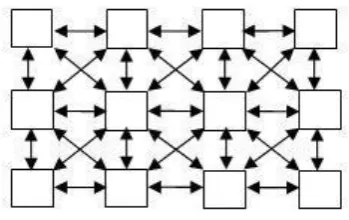
CA) consists of linear arrays of cells whereas in two dimensional CA (2D CA), cells are arranged in a rectangular or
hexagonal grid with connections among the neighboring cells, which is depicted in figure 1 and 2 respectively.
Fig 1: Structure of 1D CA
A CA can be represented with five tuple, 𝐶= {𝐿,𝑁,𝑄,𝛿,𝑞0}; where 𝐿 is the regular lattice of cells, 𝑄 is the finite set
of states, 𝑞0 is called the initial state and 𝑞0 𝑄,𝑁 is a finite set (of size 𝑛=|𝑁|) of neighborhood indices such that for
all 𝑟 𝐿, for all 𝑐 𝑁: 𝑟+𝑐 𝐿 and 𝛿: 𝑄𝑛→𝑄 is the transition function [6].
Fig 2: Structure of 2D CA
2.1.Neighborhood Structure
The neighborhood of a cell, called the core cell (or central cell), made up of the core cell and those surrounding cells
whose states determine the next state of the core cell. There are different neighborhood structures for cellular
automata. The two most commonly used neighborhoods are Von Neumann and Moore neighborhood, shown in
Figure 3.
(a) (b)
Von Neumann neighborhood has five cells, consisting of the cell and its four immediate non-diagonal neighbors
and has a radius of 1. The radius of a neighborhood is defined to be the maximum distance from the core cell,
horizontally or vertically, to cells in the neighborhood.
Moore neighborhood has nine cells, consisting of the cell and its eight surrounding neighbors and has a radius of 1.
Extended Moore neighborhood composed of the same cells as the Moore neighborhood, but the radius of
neighborhood is increased to 2 [7].
2.2.Boundary Conditions
Most popular boundary conditions are null boundary and periodic boundary conditions which are used when a
transition rule is applied to the boundary cells of CA. In null boundary conditions, the extreme cells are connected
to logic 0- state and in periodic boundary conditions the extreme cells are adjacent to each other.
2.3.One-dimensional generators
Wolfram first proposed CA as Pseudo Random Number Generators (PRNG). In particular, he extensively studied
the bit sequences generated by the 1−d, r = 1, rule 30. The rule number for one-dimensional, r = 1 rules represents in
decimal format the binary number encoding the rule table. Thus, f (1 1 1) = 0, f (1 1 0) = 0, f (1 0 1) = 0, f (1 0 0) =
1, f (0 1 1) = 1, f (0 1 0) = 1, f (0 0 1) = 1, f (0 0 0) = 0, is denoted rule 30. In the previous representation, the groups
of three bits between parentheses represent all the possible neighborhood states and the single bit after the equal
sign is the resulting output bit at the next time step. The rule number is obtained by multiplying each output bit by
the corresponding power of two and adding the results. Position 0 corresponds to the (0 0 0) neighborhood. There
exist 2^8= 256 possible rules with r = 1. In Boolean form, rule 30 can be written as:
si (t + 1) = si-1(t) XOR (si (t)OR si+1(t )), where si (t) of the state of cell i at time t. The formula gives the state of cell
i at time step t +1 as a Boolean function of the states of the neighboring cells at time t [1].
2.4.Two dimensional generators
In 2D Nine Neighborhood CA the next state of a particular cell is affected by the current state of itself and eight
cells in its nearest neighborhood. Such dependencies are accounted by various rules.
Let si,j (t) be the state of the cell at row i and column j, at time t. Its state at the next time step, si,j (t + 1) is then
computed as follows:
Si,j (t + 1) = X ⊕ (C · Si,j (t)) ⊕ (N · Si-1,j (t)) ⊕ (W · Si,j-1(t)) ⊕ (S · Si+1,j(t))
where ⊕ and · (dot) are the operations XOR and AND, respectively, and X, C (center), N (north), S (south), W
(west), and E (east) are binary variables. C, N, S, W and E denote whether the respective neighboring cell state is
taken into account (a value of 1) or not (a value of 0) [1].
3.PROPERTIES OF CRYPTOGRAPHICALLY ROBUST CELLULAR AUTOMATA RULES
This section describes the fundamental properties that should be possessed by cryptographic primitives. Here we
have explored the tests for cryptographic properties like d-monomial test, balancedness, nonlinearity etc.
3.1.Nonlinearity
Nonlinearity of a boolean function f of n variables is the minimum hamming distance from f to the set of affine
functions with n variables [2]. If An be the set of all n bit affine boolean function, then
)
,
(
min
)
(
f
d
f
h
nl
affine h
An affine function is a linear function or the complement of a linear function [8].
Example: f (x1, x2, x3) = x1
x2
1The Hamming distance between two functions is the number of places where their truth table representations
disagree [8].
Example: The hamming distance between 1011101 and 1001001 is 2.
If the pseudo random numbers are linear in nature, then we can easily predict the upcoming pseudo random
numbers. This will lead to the loss of cryptographic security. Hence, a good pseudo random number should be
nonlinear in nature. Thus, nonlinearity is one of the important cryptographic properties. Pseudo random numbers
with greater nonlinearity are considered as good pseudo random numbers.
3.2.Balancedness
A Boolean function of n variables is said to be
Balanced if for exactly 2n-1 assignments the function f will evaluate to 0 and for exactly 2n-1 assignments the
function f will evaluate to 1[8].
3.3.Algebraic Degree
The maximum number of literals in any conjunction of ANF of a Boolean function is called its degree. For example
f(x1, x2) = x1. x2
x2 has algebraic degree 2. Linear functions have algebraic degree 1 [8].3.4.d-Monomial test
It is a statistical test for pseudo randomness. If a Boolean function of n Boolean variables is a good pseudo random
sequence generator, then it will have
d
n
2
1
d-degree monomials. It is first introduced by [9]. It is a simple
cryptography community. d-monomial test has been used in [10] to test the pseudo randomness of the sequence
generated by the CA.
For example, consider the function of rule 60,
f(x1, x2, x3) = x1
x2, it has 2, 1-degree monomials and 0, 2 degree monomial. The ideal number of 1, 2 and 3 degreemonomials of 1D CA would be
1
3
2
1
= 1.5,
2
3
2
1
= 1.5,
3
3
2
1
= 0.5It turns out that it has 2, 1-degree monomials more and 1 2-degree monomial less, hence it is expected to be
non-pseudo random. On the other hand, the function of rule 120 f(x1, x2, x3) = x1
x2.x3 is expected to be a goodpseudo random generator.
The ideal number of 1, 2, 3, 4 and 5 degree monomials of 2D CA would be
1
5
2
1
= 2.5,
2
5
2
1
= 5,
3
5
2
1
= 5,
4
5
2
1
= 2.5,
5
5
2
1
= 0.5For example, consider the cell (2, 2), then the function of rule 15214748,
f(x1,2, x2,1, x2,2, x2,3, x3,2) = (x1,2 && x2,2)
(x1,2 && x2,3)
(x2,1 && x2,2)
(x2,1 && x2,3)
(x2,2 && x3,2)
(x1,2 && x2,1 && x2,2)
(x1,2 && x2,1 && x2,3)
(x1,2 && x2,2 && x2,3)
(x1,2 && x2,3 && x3,2)
(x2,1 && x2,3 && x3,2)
(x1,2 && x2,1 && x2,2 && x3,2)
(x1,2 && x2,1 && x2,2 && x2,3)
x2,2
x2,3is expected to be a good pseudorandom generator.
4.RESULT
The main objective of the work is to find out the rule that satisfy the cryptographic properties. Our tool is deriving
the linearity, balancedness, algebraic degree and d-monomial test. In order to identify the best rules, it is necessary
to feed the inputs like range of inputs, type of cellular automata.
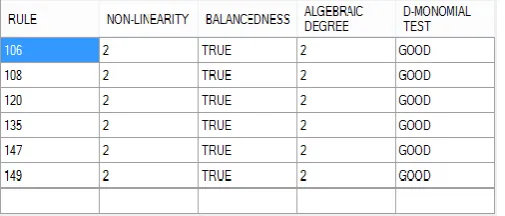
The following figure 4 shows that the properties of 1D CA rules. If the type CA is one dimensional, there is
possibility of 256 rules. Based on this analysis, we could identify the best possible rule that will generate longest
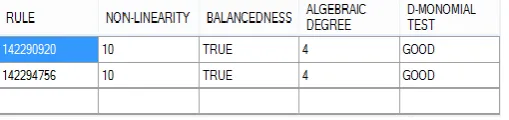
period Pseudo Random Numbers. The figure 5 portrays the cryptographical properties analysis of 2D CA rules.
Fig 5: 2D CA rules between rule 142290000 and rule 142300000 which are satisfying the above four
cryptographical properties
5.CONCLUSION
We have described about the cryptographical properties of pseudo random numbers such as nonlinearity,
balancedness, algebraic degree and d-monomial test. This will produce good pseudo random numbers, which can
be used for secure communication.
REFERENCE
[1] Muthukumaran. N and Ravi. R, 'Hardware Implementation of Architecture Techniques for Fast Efficient
loss less Image Compression System', Wireless Personal Communications, Volume. 90, No. 3, pp.
1291-1315, October 2016, SPRINGER.
[2] Muthukumaran. N and Ravi. R, 'The Performance Analysis of Fast Efficient Lossless Satellite Image
Compression and Decompression for Wavelet Based Algorithm', Wireless Personal Communications,
Volume. 81, No. 2, pp. 839-859, March 2015, SPRINGER.
[3] Muthukumaran. N and Ravi. R, 'VLSI Implementations of Compressive Image Acquisition using Block
Based Compression Algorithm', The International Arab Journal of Information Technology, vol. 12, no. 4,
pp. 333-339, July 2015.
[4] Marco Tomassini, Mathieu Perrenoud ,”Cryptography with cellular automata”, Institute of Computer
Science, University of Lausanne, 1015 Lausanne, Switzerland Received 7 December 2000; received in
revised form 29 March 2001; accepted 4 July 2001.
[5] Marco Tomassini a;_, Moshe Sipper b, Mosé Zolla a, Mathieu Perrenoud a a, “Generating high-quality
random numbers in parallel by cellular automata” Institute of Computer Science, University of Lausanne,
1015 Lausanne, Switzerland Logic Systems Laboratory, Swiss Federal Institute of Technology,
IN-Ecublens, CH-1015 Lausanne, Switzerland Accepted 17 March 1999
[6] Muthukumaran. N and Ravi. R, 'Simulation Based VLSI Implementation of Fast Efficient Lossless Image
Compression System using Simplified Adjusted Binary Code & Golumb Rice Code', World Academy of
[7] Ruban Kingston. M,Muthukumaran. and N, Ravi. R, 'A Novel Scheme of CMOS VCO Design with reduce
number of Transistors using 180nm CAD Tool', International Journal of Applied Engineering Research,
Volume. 10, No. 14, pp. 11934-11938, 2015.
[8] Muthukumaran. N and Ravi. R, 'Design and analysis of VLSI based FELICS Algorithm for lossless Image
Compression', International Journal of Advanced Research in Technology, Vol. 2, No. 3, pp. 115-119,
March 2012.
[9] Manoj Kumar. B and Muthukumaran. N, 'Design of Low power high Speed CASCADED Double Tail
Comparator', International Journal of Advanced Research in Biology Engineering Science and
Technology, Vol. 2, No. 4, pp.18-22, June 2016.
[10] N. Muthukumaran, 'Analyzing Throughput of MANET with Reduced Packet Loss', Wireless Personal
Communications, Vol. 97, No. 1, pp. 565-578, November 2017, SPRINGER.
[11] Meier, W., Staffelbach, O., “ Analysis of pseudo random sequences generated by Cellular Automata”. In:
Davies, D.W. (ed.) EUROCRYPT 1991. LNCS, vol. 547, pp. 186–199. Springer, Heidelberg (1991)
[12] Martin, B., Sole, P., Lacharme, P.:,” Pseudo-random sequences, boolean functions and cellular automata”.
“Boolean Functions: Cryptography and Applications” (2007)
[13] P.Venkateswari, E.Jebitha Steffy, Dr. N. Muthukumaran, 'License Plate cognizance by Ocular Character
Perception', International Research Journal of Engineering and Technology, Vol. 5, No. 2, pp. 536-542,
February 2018.
[14] N. Muthukumaran, Mrs R.Sonya, Dr.Rajashekhara and Chitra V, 'Computation of Optimum ATC Using
Generator Participation Factor in Deregulated System', International Journal of Advanced Research Trends
in Engineering and Technology, Vol. 4, No. 1, pp. 8-11, January 2017.
[15] Keziah. J, Muthukumaran. N, 'Design of K Band Transmitting Antenna for Harbor Surveillance Radar
Application', International Journal on Applications in Electrical and Electronics Engineering, Vol. 2, No. 5,
pp. 16-20, May 2016.
[16] Akhil. M.S and Muthukumaran. N, 'Design of Optimizing Adders for Low Power Digital Signal
Processing', International Journal of Engineering Research and Applications, Vol. 5, pp. 59-65, March
2014.
[17] Muthukumaran. N and Ravi. R, 'Quad Tree Decomposition based Analysis of Compressed Image Data
Communication for Lossy and Lossless using WSN', World Academy of Science, Engineering and
Technology, Volume. 8, No. 9, pp. 1543-1549, 2014.
[18] Nayak, D. R., Sahu, S. K., Mohammed, J. 2,” A Cellular Automata Based Optimal Edge Detection
Technique using Twenty-Five Neighborhood Model”. IJCA. vol. 84. No. 10. pp. 27-33, 2013.
[19] Carole J. Etherington Lieutenant ,”An analysis of cryptographically significant Boolean functions with
high correlation immunity by reconfigurable computer”, United States Navy B.S., University of Kentucky,
2004
[20] Filiol, ´E.:, “A New Statistical Testing for Symmetric Ciphers and Hash Functions”. In: Deng, R.H., Qing,