Data Cluster Formation Using FAST Algorithm
1
Priyanka Patil, 2 Babita Bhagat
1,2
Computer Engineering
Pillai’s HOC College of Engineering, Rasayani. Mumbai,India
Abstract - Process of selecting relevant features from available dataset is known as features selection. Feature selection is use to remove or reduce redundant and irrelevant features. Various feature selection algorithms such as CFS (correlation feature selection), FCBF (Fast Correlation Based Filter) and CMIM (Conditional Mutual Information Maximization) are used to remove redundant and irrelevant features. To determine efficiency and effectiveness is the aim of feature selection algorithm. Time factor is denoted by efficiency and quality factor is denoted by effectiveness of subset of features. Problem of feature selection algorithm is accuracy is not guaranteed, computational complexity is large, ineffective at removing redundant features. To overcome these problems Fast Clustering based feature selection algorithm (FAST) is used. Removal of irrelevant features, construction of MST (Minimum Spanning Tree) from relative one and partition of MST and selecting representative features using kruskal’s method are the three steps used by FAST algorithm.
Keywords - Feature Clustering, Feature Subset Selection, Minimum Spanning Tree.
1.
Introduction
Now-a-days whole world is computerized and therefore every information is stored in the form of softcopy or datasets. Searching particular information from very huge database is a big task, hence mining is necessary which easily search data from huge dataset. Process of selecting relevant features from available dataset is known as features selection. Feature selection is use to remove or reduce redundant and irrelevant features and for searching required information from datasets. Various feature selection algorithms such as CFS (correlation feature selection), FCBF (Fast Correlation Based Filter) and CMIM (Conditional Mutual Information Maximization) are used to remove redundant and irrelevant features. To determine efficiency and effectiveness is the aim of feature selection algorithm. Time factor is denoted by efficiency and quality factor is denoted by effectiveness of subset of features. Problem of feature selection algorithm is that accuracy is not guaranteed, computational complexity is
large, ineffective at removing redundant features. To overcome these problems Fast Clustering based feature selection algorithm (FAST) is used. Removal of irrelevant features, construction of MST (Minimum Spanning Tree) from relative one and partition of MST and selecting representative features using kruskal’s method are the three steps used by FAST algorithm. Identification and removal of unwanted or unnecessary feature is the aim of feature subset selection method because (i) unrelated features do not provide required correctness (ii) unwanted or unnecessary features do not support or provide additional information to main data, which is required. [1]
using clustering-based strategy. Efficiency and effectiveness of FAST is determined by using minimum-spanning method.
In this paper, introducing results of this work. In next section II, presenting the literature survey over the various methods presented for clustering. In section III, existing system is depicted. In section IV, presenting the proposed system. In section V result is depicted. Finally conclusion is predicted in section VI.
2.
Literature Survey
Data mining starts with raw data, which is processed and output is obtained in the form of simulation data, images or signals. These data are preprocessed using techniques such as sampling, multi resolution, de-noising, feature extraction and normalization. After data are preprocessed patterns are determined by using pattern recognition software. Obtained patterns are defined as an ordering and it also contains some underlying structure. The result which is obtained is also proceeded back into images or numbers which are familiar to experts who can examine the information and determine the result.
Feature subset method has been recent research topic which is started since 1970’s and huge amount of search work has been published. From the research work which is present till now it has been observed that most feature subset algorithms can recognize irrelevant features based on dissimilar assessment functions. Depending upon feature interaction, unnecessary features and immaterial features. Various features subset algorithm can be grouped into three categories: (a) the one that can handle only immaterial features, (b) the one that can handle both unrelated and unnecessary features and (c) the one that can handle both unrelated and unnecessary features along with feature interface. Depending upon the behavioral pattern of various feature subset algorithm they are ranked based on their importance to the target concept.
Various companies and organizations store their confidential data in data-warehouse or data-marts and retrieve required data from it in order to display and retrieve information or to take particular action depending upon results. Therefore identification and removal of unwanted or unnecessary feature is the aim of feature subset selection method because(a) unrelated features do not provide required correctness (b) unwanted or unnecessary features do not support or provide additional information to main data, which is required.
Traditionally, research on feature subset selection has focused on searching for required or relevant features. One of the best examples is Relief, which works on the basis of
distance-based criteria function by assigning weights on each feature depending upon ability to discriminate instances under different target [9]. But Relief is not effective for removing redundant features because two predictive but correlated features are highly weighted. Hence Relief-F is introduced which extends Relief, and this method deals with noisy, incomplete datasets along with multi-class problems, but still cannot identify redundant features.
3. Existing System
In existing system, supervised neural network learning mutual information is used which is independent of robust estimation. Use of mutual information in this method is determined by input dimensionality which requires approximation due to prohibitive demands on computation and samples. For this, an algorithm is introduced which is based on “greedy” selection of features and consider both mutual information depending upon the output class and already selected features. During preprocessing stage approximate features are determined from raw data which has a crucial impact on complexity of learning phase and also on performance. One major drawback is that they are variant under a transformation of variables.
Fig 1: Existing System
generate clusters which are known as dendrogram. Clusters are extracted from tree by dividing tree into various heights beginning with maximum height of tree. This method has comparable accuracy as compared to wrapper and CSF method.
In consistency based search method feature selection acts as an effective technique in reducing dimensionality. In this method classification is done by determining optimal subset of relevant features which increases accuracy of classification. Existing algorithms make use of various methods to determine goodness of feature subsets.
4. Proposed System
In this section, a new model has been proposed which easily extracts data from large amount of database. This system proposes a new solution to problem of removing redundant and irrelevant data which other methods fails to do. In proposed system, feature selection algorithm works in two steps. In first step, various features that are present in data are divided and then grouped into clusters by using graph theoretic clustering methods. In second step, features that are equivalent to target classes are selected fromvarious clusters to forma subset of features. Features which are present in different clusters are not related to each other. In FAST, a clustering-based strategy is used with the help of which useful and independent features are determined. Feature selection technique with the help of filter method is more effective as compared to traditional feature selection methods. Graph- theoretic clustering method which is used in FAST is very simple which constructs a neighborhood graph of features, then depending upon the value of F-correlation unwanted edges are removed which results in group of information which is known as clusters.
Proposed FAST algorithm sensibly consists of three steps
1) Removing immaterial features
2) MST is constructed from relative ones
3) MST is portioned and then selecting representative features.
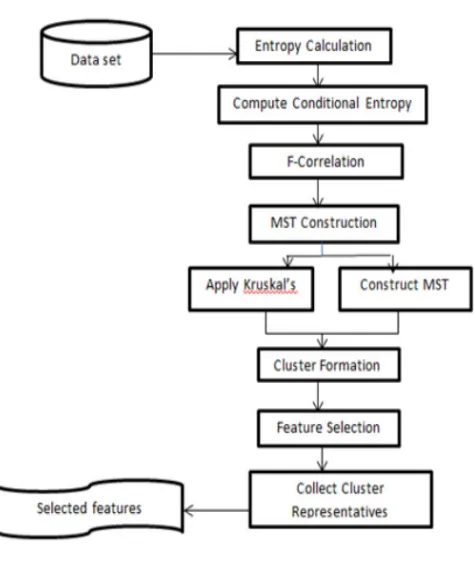
The above steps help to remove irrelevant and redundant features. Mutual information determines the distribution of feature value and target classes. Symmetric uncertainty is derived from mutual information and this is done by normalizing it to the entropies of required values. It also determines goodness of each feature therefore, symmetric uncertainty is chosen as a measure of correlation between two features or a feature and target information.
Fig 2: Proposed System
The project implementation is divided into following steps:
Step 1: Removal of Irrelevant features
Removal of irrelevant features helps to improve result, remove irrelevant and unnecessary data, reduce dimensionality and increase learning accuracy. Machine learning applications use many feature selection methods. If we consider a Dataset 'D' with m features C= {C1, C2, …. Cn } and class C, features are available with target relevant feature. The generality of the selected features is limited and computational complexity is large. Filter and wrapper methods are combine to form hybrid method, therefore reduces search space that will be considered by the subsequent wrapper.
Step 2: T-Relevance, F-correlation calculation
The reason behind this is as follows
1. Target concept provides weak correlation to irrelevant features.
2. Representative feature can be identified from group of cluster, which is formed by redundant features.
Step 3: MST construction:
Minimum-spanning tree (MST) clustering method is used to ensure the efficiency and effectiveness of FAST. Comparison between FAST and several representatives feature selection algorithm is carried out by using various experiments. Minimum spanning tree is constructed with weights, which connects all vertices such that the sum of weights of edges is minimum, using well-known Kruskal’s algorithm.
Step 4: Relevant feature calculation:
After partition of tree and removal of unnecessary and irrelevant results in two disconnected trees. Removal of unnecessary edges, a forest is obtained. Each tree acts as a cluster. Finally, feature subset is generated, and then calculates the accurate or relevant feature.
5. Results
FAST algorithm is used to form clusters of data. So we can consider data from any field like medical, banking, etc. is selected. Required data is in .CSV file format means comma separated value format in which each value is separated by comma which helps to import data easily into database application. Medical related data files are uploaded in database application. Data is then process to remove irrelevant and redundant data and to form clusters of required feature subset.
Fig 3: Data Uploading
Data which is in .CSV file is now needed to convert into table and should be extracted and displayed. This format helps to form clusters of feature subsets. After data is loaded in the form of table and extracted it is now classified into various subsets depending upon the value which is present in the last column of table.
Fig 4: Data classified
After data is divided into various subsets, next step is to remove redundant and irrelevant data and for this it is necessary to calculate entropy, conditional entropy and T-relevance and then T-T-relevance value is compared to threshold value. Only those features whose T-relevance value is greater than threshold value is considered and other features are eliminated as shown in figure
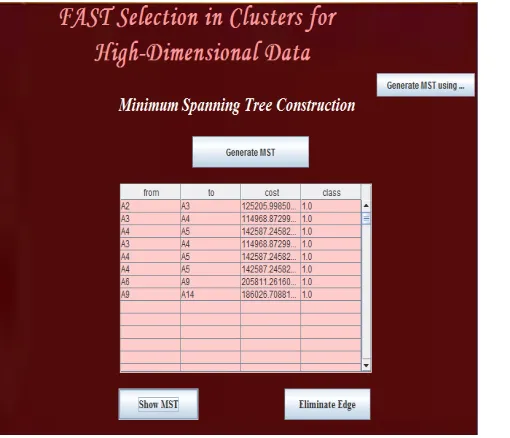
Next step after elimination of redundant and irrelevant data is the construction of minimum spanning tree. In order to construct minimum spanning tree first it is necessary to calculate F-correlation and after that unrequired edges are eliminated. From minimum spanning tree, F-correlation is calculated and unrequired edges are eliminated them MST is divided into various clusters.
Fig 6: Minimum Spanning Tree
Fig 7: Cluster Formation
6. Conclusion and Future Scope
The existing feature selection algorithms cannot eliminate both unrelated and unwanted features. Hence, it becomes difficult to select relevant features from entire set of features and thereby reduces efficiency and effectiveness
of relevant features. So, in order to overcome the difficulties of irrelevant and unwanted feature removal, a new algorithm called “FAST Algorithm” has been implemented. It works in two steps. In first step, graph-theoretic clustering methods are used to partition features into clusters. In second step, subset of features is formed by combining representative’s features from target class. This has improved the performance of search algorithm on large scale. In future we can study and explain different types of correlation measures and properties of feature space.
In future one can apply different algorithms and methodologies for clustering to compare with current methodology to get better result in clustering and study and explain different types of correlation measures and properties of feature space.
References
[1] Qinbao Song, Jingjie Ni and Guangtao Wang , On A Fast Clustering-Based Feature Subset Selection Algorithm for High Dimensional Data ,In proceedings of the Fifth IEEE international Conference on Data Mining,2013
[2] Fayyad U. and Irani K., Multi-interval discretization of continuous-valued attributes for classification learning, In Proceedings of the Thirteenth International Joint Conference on Artificial Intelligence, pp 1022-1027, 1993.
[3] Mitchell T.M., Generalization as Search, Artificial Intelligence, 18(2), pp203-226, 1982.
[4] Das S., Filters, wrappers and a boosting-based hybrid for feature Selection, In Proceedings of the Eighteenth International Conference on Machine Learning, pp 74- 81, 2001.
[5] Dash M. and Liu H., Feature Selection for Classification, Intelligent Data Analysis, 1(3), pp 131-156, 1997.
[6] Hall M.A., Correlation-Based Feature Subset Selection for Machine Learning, Ph.D. dissertation Waikato, New Zealand: Univ. Waikato, 1999.
[7] Yu L. and Liu H., Feature selection for high-dimensional data: a fast correlation-based filter solution, in Proceedings of 20th International Conference on Machine Leaning, 20(2), pp 856-863, 2003.
[8] Fleuret F., Fast binary feature selection with conditional mutual Information, Journal of Machine Learning Research, 5, pp 1531-1555, 2004.
[9] Kira K. and Rendell L.A., The feature selection problem: Traditional methods and a new algorithm, In Proceedings of Nineth National Conference on Artificial Intelligence, pp 129-134, 1992.
Priyanka Patil received B.E degree in Computer Engineering from the Mumbai University in 2009.She had received Best Paper Award Certificate in International Conference On Advances in Science and Technology in 2015. She currently works as a lecturer in Vishwatmak Om Gurudev College of Engineering, Atgaon, Mumbai.