Self Regulated Learning strategies as Predictors of Reading Comprehension among Students of English as a Foreign Language
AbdulRahman Awad Al Asmari (Assistant Professor, Director, English Language Center, Taif University, KSA)
Nasrah Mahmoud Ismail (Assistant Professor, English Language Center, Taif University, KSA)
178 Theoretical foundation
Self regulated learning (SRL) Knowledge nowadays tends to become obsolete very quickly due to rapid technological changes, market changes, and continuous innovations in how work is organized to keep pace with our turbulent society (Onstenk, 1998). Consequently, schools emphasize that students should be equipped for self-regulated learning, which has been defined as a learning process in which
self-generated thoughts, feelings, and actions are systematically oriented towards attainment of the student’s own goals (Zimmerman & Schunk, 2008). Self-regulation is a broad construct that includes a monitoring and an action component that encompass a complex array of interacting cognitive and emotional processes aimed at goal attainment (Eisenberg, Champion, & Ma, 2004; Mischel & Ayduk, 2004). Self-regulation can refer to the degree to which individuals become metacognitively, motivationally, and behaviorally active participants in their own learning processes Self Regulated Learning strategies as Predictors of Reading Comprehension among Students of English as a Foreign Language
Abstract
Author (s)
AbdulRahman Awad Al Asmari
Assistant Professor, Director, English Language Center, Taif University, KSA
Email: [email protected]
Nasrah Mahmoud Ismail
Assistant Professor, English Language Center, Taif University, KSA
E-mail: [email protected]
This cross-sectional study investigates the self regulated learning strategies used as predictors of reading comprehension. Participants of the study were 248 EFL university students: 112 males and 136 females enrolled in the Faculty of Arts, Foreign Languages Department. The primary aims of the study were: (1) to examine whether there were positive relationships between the use of self regulated learning strategies and reading comprehension; (2) whether there were significant differences between males and females in use of self regulated learning strategies and reading comprehension; (3) and finally to gauge predictors of reading comprehension themselves through self regulated learning strategies towards learning English language. Students were asked to answer questions based on a 5-point Likert-scale self regulated learning Questionnaire and they were asked to read three different passages and answer the questions that followed each passage. The results of MANOVA also revealed that there were differences between males and females in the use of self regulated learning strategies in favour of females. However, there were differences between males and females in the reading comprehension test to the advantage of males. The results of MANOVA analysis revealed that there were differences between students across their different academic levels in self regulated learning strategies. There were also differences between students across different academic levels, in the reading comprehension test. The results of multiple regression reported that some of the self-regulated learning strategies were predictors of reading comprehension.
179 (Zimmerman, 1986). Self-regulated learning is
a construct that has developed during the last 30 years in order to meet these demands (Winne, 2005). Self-regulated learners manipulate the skills to learn effectively both in school and later in life. As such, self-regulated learning has been highly praised as the key competence to initiate and maintain lifelong learning (see e.g., Kauffman, 2004).
Self-regulation, while related to academic achievement and cognitive skills, is clearly not synonymous with cognitive competency alone. It brings into the arena success in schooling, and later on, professional development and complex cognitive and socioemotional processes that extend beyond language and mathematical competency (Evans & Rosenbaum, 2008). According to Schunk (2001), self-regulated learning is defined as, ‘‘learning that results from students’ self-generated thoughts and behaviours that are systematically oriented toward the attainment of their learning goals” (p. 125). To become self-regulated learners, Boekaerts (1999) argued that students should learn to regulate the use of information-processing modes, the learning process, and the self. By recognising the importance of regulating the self, the focus of research into self-regulated learning is shifting from studying principally cognitive processes to studying cognition in interaction with motivation (Rozendaal, Minnaert, & Boekaerts, 2001). Self-regulated learning (SRL) is deemed as a multi-dimensional construct that has traditionally been difficult to operationalise (Boekaerts, 1996; Boekaerts & Corno, 2005).
In general, SRL involves activating and sustaining cognitions, behaviours, and emotions in a systematic way to attain learning goals (Pintrich, 2000). Accordingly, self-regulated learners are assumed to manage their behaviours and anxieties to facilitate learning, actively avoiding behaviours and cognitions detrimental to academic success (Byrnes, Miller, & Reynolds, 1999; Stallworth-Clark, Cochran, Nolen, Tuggle, & Scott, 2000). Also, it was found that self-regulated students understand the strategies and environments necessary for learning to occur, and feel capable of performing to their personal
standards (Chemers, Hu, & Garcia, 2001; Pintrich & De Groot, 1990; Zimmerman & Schunk, 2008). When challenged, self-regulated learners manage to understand when and how to utilize strategies that increase persistence and performance, and they purposefully use meta-cognitive strategies that incorporate self-monitoring and evaluative components that allow for self-observation and self-reaction (Schunk & Zimmerman, 1994). Further, self-regulated students are supposed to monitor the efficacy of their learning strategies and replace inefficient strategies with different ones (Kolić-Vehovec, Rončević & Bajšanski, 2008). Kolić-Vehovec et al. conclude that groups with high mastery orientation had more adaptive motivational profile and more adequate reading strategy use than groups with high work-avoidance orientation. In a recent study, highly self-regulated group had a tendency to study more material and for a longer time than less self-regulated individuals (Abar & Loken, 2010).
From a relevant perspective, deficiencies in self-regulation skills, beginning in early childhood was found to contribute to the
income-achievement gap. Evans and
Rosenbaum (2008) contend that success in school depends upon more than cognitive skill attainment, including the maturation of self-regulation skills. To become self-regulated learners, the students must regulate not only their behaviour but also their underlying motives; i.e. their performance related cognition, beliefs, intentions, and emotions. This implies that students who develop effective self-regulated learning are mentally active in their own learning process and exert a significant degree of control over goal attainment instead of being a passive recipient of information (Schunk, 1994), which is assumed to lead to high performance.
180 self-judgment, and self-reaction (Bandura,
1986; Schunk, 1989). Goal setting is essential to self-regulation. Self-regulated learning processes involve goal-directed cognitive activities that students instigate, modify, and sustain (Zimmerman, 1986). Self-regulated performance differs from Self-regulated learning in that Self-regulated learning is based on both will and skill, while Self-regulated performance is based just on wills (McCombs & Marzano, 1990). Key line of research in this area has identified three major components for
self-regulated learning: Cognitive,
metacognitive, and resource management learning strategies.
Reading comprehension
Reading means different things to different people. For some it is perceived as recognizing written words, while for others, especially students, it can be an opportunity to learn pronunciation and practice speaking. However, reading always has a purpose. It is something that we do every day; it is an integral part of our daily lives, taken very much for granted and generally assumed to be something that everyone can do. The rationale for reading depends very much on the purpose for reading (Berardo, 2006). Good reading ability is the key to success in school and this is one reason why researchers are trying to find significant educational and psychological variables that can explain variations in reading ability and
academic achievement. Reading
comprehension, the construction of meaning from text, is generally considered one of the most central cognitive skills young students acquire during their school career (Mason, 2004). Reading comprehension lays the foundation for the acquisition of knowledge in different subject matters taught at elementary and secondary schools and constitutes an important prerequisite for lifelong learning in adulthood (Alvermann & Earle, 2003). The mastery of basic reading skills, such as word recognition and decoding, is integral to many higher-order processes involved in reading comprehension skills (e.g., Artelt, Schiefele, & Schneider, 2001; Cromley & Azevedo, 2007). First language (L1) studies have shown that good readers use strategies that assist them in building a global model of text content, such as
identifying the most important information in the text that focuses their attention more on larger chunks of text, such as paragraphs which eventually help them regulate the reading process (Bimmel, 1999).
Research in the field of strategies has proposed that poor readers are not strategic due to the assumption that they use fewer and less complex strategies and use them in a maladaptive way (Botsas & Padeliadu, 2001). On the contrary, good readers possess a well developed repertoire of strategies that along, with their adaptive way of use, helps them to successfully comprehend texts (Botsas & Padeliadu, 2003). According to O`Malley and Chamot (1995, p.182-183), instructors exercise the reading comprehension strategies to encourage students to use inference in order to make logical guesses from context, elaborate prior knowledge, transfer cognates from the first language and use deduction, which lead to the application of grammar rules. Luke (2000) casts reading as a set of practices dependent on four reader resources which are code breaking, participating in text, using the text for one’s own purposes, and analysing or critiquing the text. Luke’s view of reading reflects the dialogic metaphor of readers as both listeners and responders. The reading process has been described as dynamic in that the reader’s variables such as background knowledge, aptitude, and memory constraints interact with text variables; e.g. text structure, length, lexical and linguistic complexity, as readers attempt to construct a mental representation or comprehend a text (Leeser, 2007)
The relationship between self-regulated learning and reading comprehension strategies
181 meaning of a text the students need to monitor
their comprehension (Pressley & Ghatala, 1990). As such, self-regulated learning is important for reading ability and achievement (Folkesson & Swalander, 2007).
The concept of self-regulated learning has been brought up as a synthesis between research on how learning functions – focusing on the learner’s cognitive and motivational processes (e.g., Boekaerts, 1999; Pintrich, 1999), and research on how instruction functions— focusing on the interaction between learner and instructor in a social environment (e.g., Zimmerman, 1989; Schunk, 2001). Despite the lack of a simple definition of SRL, Artelt, Baumert, Julius-McElvany, and Peschar (2003) argue that some measurable characteristics of students are associated with a tendency to regulate learning, as well as with greater performance. These three main aspects of RL are: (a) academic self-concept, (b) motivation, and (c) learning strategies. Hence, this is a biased view of self-regulated learning. So to speak, it is centred on some positive characteristics that put students in a better position to regulate their learning (Artelt et al., 2003).
Subsequently, insights into the possible effects of self regulated learning strategies on reading comprehension are a little absent, especially in the Saudi Arabian context. In an effort to contribute to the line of research on how self-regulated learning strategies may affect the interplay of motivation and cognition, this study explores the influence of students’ administration of self-regulated learning strategies on students’ reading comprehension.
Self regulated learning and achievement The effectiveness of self-regulated learning for academic achievement is a key area of research that cannot be ignored (e.g., Zimmerman, 1990; Zimmerman & Bandura, 1994; Winne, 1995; Zimmerman & Martinez-Pons, 1988; VanZile-Tamsen & Livingston, 1999; Chung, 2000; Paris & Paris, 2001; Dignath, Buettner, & Langfeld, 2008; Matuga, 2009), as well as on learning motivation (Pintrich, 1999). Based on a study by Zimmerman and Martinez-Pons (1986) that bears on the issue of the relationship between learning strategies and
reading achievement, it was found that high
achievement students reported using
significantly more strategies than the low-achieving students. Zimmerman and Pons concluded that self- regulated learning scores were shown to be valid predictors of achievement, and confirmed that self- regulated learning strategies used have a meaningful relationship with learning outcomes in reading and math. Muis & Franco (2009) reported that the types of learning strategies that students self-reportedly used in their educational psychology course predicted their final grades. Specifically, metacognitive self-regulation, elaboration, critical thinking, and rehearsal strategies positively predicted achievement. The results of Zimmerman and Martinez-Pons (1988) also indicated that students who have trouble self-regulating, their academic studying achieve poorly in school.
Reading comprehension and gender differences
Several studies show that gender is a significant factor when attempting to explain reading comprehension. However the results of these studies have until been somewhat inconsistent (Hay, Ashman, & Van Kraayenoord, 1998; Yongqi, 2002). Other studies (e.g., Skaalvik & Rankin, 1990; Wagemaker, 1996: Pae, 2004; O'Reilly & McNamara, 2007) have found that girls achieve higher reading comprehension scores, whereas some studies have failed to show gender differences (e.g. Rowe, 1991). Gender differences revealed that girls read better on narrative and expository texts, had a more positive reading attitude, and more positive verbal self-concept (Swalander & Taube, 2007). On the other hand, other findings suggest that males and females perform differently on different items of reading comprehension Yazdanpanah (2007). For example, Yazdanpanah reported that females scored higher on identifying main idea, guessing meaning from context, and text coherence questions. Conversely, males outperformed females in reading for specific
information, identifying referential
182 meaning from context, and text coherence in
favour of the females (Yazdanpanah, 2007). Self-regulated learning strategies and gender differences
A student characteristic that has received scant attention in L2 strategy research is differential strategy use by males and females. In their interview of gender differences in language learning strategy use, Oxford and her associates found only four studies in which this question was addressed (Oxford, Nyikos, and
Ehrman, 1988). Three were strategy
identification studies, and all showed differences in strategy use favouring women. The other study provided strategy training and mixed results, favouring men for some skills tested and women for others (O`Malley & Chamot, 1995, p.164). Recently, Reeves & Stich (2010) observed that there are no differences between males and females in SLR strategies (i.e. gender was not observed). There was no significant difference in the SRL strategy use of male and female
.
Statement of the problem
The theoretical foundation of the current study has established that self regulated learning strategies may be a potential determinant as predictors of reading comprehension. Yet little is known about the relationships between the variables of the study related to EFL students at the university level and how far self regulated learning is a practical predictor of reading comprehension. Students with high SRL skills do better than those who lack these skills (Azevedo, 2005; Pressley & Ghatala, 1990; Pressley & Harris, 2006; White & Frederiksen, 2005). Unfortunately, previous studies have also shown that the majority of students are poor regulators of their learning (e.g. Paris & Paris, 2001). These findings have triggered the urge to investigate how SRL skills can be taught and prompted in learning environments. While research has shed some light on the issue, it is unclear as to which specific SRL processes best position students to capitalise on.
Several researchers have investigated issues related to self regulated learning strategies (e.g., Onstenk, 1998; Zimmerman & Schunk, 1989; Boekaerts, 1999; Pintrich, 2000;
Stallworth-Clark, Cochran, Nolen, Tuggle, & Scott, 2000; Rozendaal, Minnaert, & Boekaerts, 2001; Boekaerts, 1996; Boekaerts & Corno, 2005; Zimmerman & Schunk, 2008),
and others have examined reading
comprehension in different contexts in which English is taught as a second language/foreign language; e.g. Fecteau, (1999); Nassaji (2003); Taguchi, Gorsuch & Sasamoto (2006). However, a few studies have examined the relationship between self regulated learning and its effect on reading comprehension, especially in the Arab context. Having been EFL teachers for many years, the reserahcers have observed that some students in the English Dept. are poor readers and have unidentified goals toward learning, in general, and toward reading comprehension in particular. Accordingly, this study investigates the effects of self regulated learning strategies on reading comprehension among Saudi EFL learners at the university level in an attempt to canvass related issues through answering the following set of questions:
1. Are there any relationships between self regulated learning strategies and reading comprehension?
2. Are there any differences in reading comprehension and SRL between males and females?
3. Can we predict reading
comprehension through self regulated learning strategies?
4.
Are there any differences among the students in self regulated learning strategies and reading comprehension according to their levels?Method
Study Sample The participants of this multi-level study
included 248 (112 males and 136 females) undergraduates across the 2nd, 4th, 6th, and 8th levels majoring in English at a Saudi
Arabian University. Amongst those
183 academic level (31 males & 23 females). The
participants ranged in age between 18 and 29 years with a mean of 21.383 (SD = 1.515). It was thus assumed that the participants of this study would provide a homogeneous sample in terms of their cultural environment and instructional input.
Study Instruments
Self regulated learning Questionnaire A questionnaire that assessed students` self regulated learning was administered in this study to suit the Saudi context based on Pintrich, Smith, Garcia & Mckeachie (1993) and other similar studies that urged for the adaptive use of this questionnaire in different contexts. The questionnaire designed was based on a 5-point Likert-scale that ranged from 1 indicating that the statement is very true of me through 5 indicating that the statement is not at all true of me. The Questionnaire included three dimensions: (1) cognitive strategies, (2) metacognitive strategies, and (3) different learning resources. The development of the questionnaire used in this study was guided by two points: (1) the need for a context-sensitive instrument; i.e. one which would tap self regulated language learning strategies most relevant to the learning of English in Saudi Arabia; and (2) the value of several stages of outside review of the questionnaire items and instructions.
Factor analyses: Self regulated learning strategies
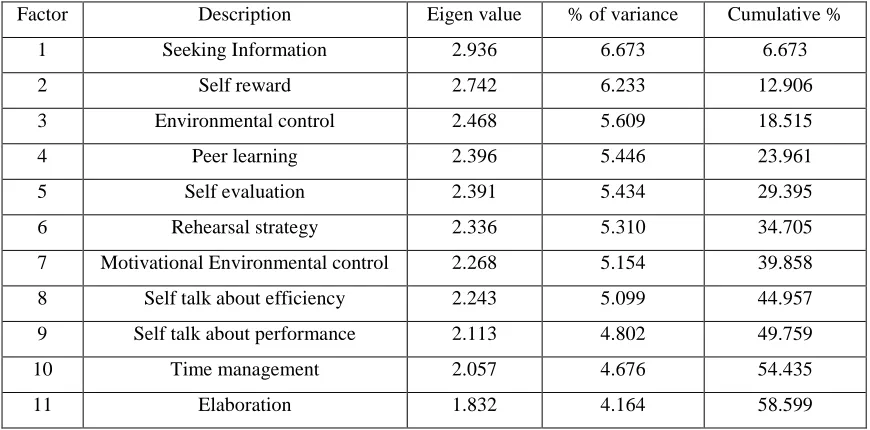
Based on the principal-component analysis, eleven-factor solution was obtained for the scores in the ‘‘Self regulated learning strategies’’ data. The eleven extracted factors accounted below.
Table-1 Factor analyses: Self regulated learning strategies
The eleven extracted factors accounted for 58.599% of the total variance. Equamax with Kaiser Normalization was then used. Table 1 presents a summary of the results of the factor analysis of the ‘‘self regulated learning strategies’’ data. The factor loadings of each item in this section on the eleven rotated
factors and means, and standard deviations of the items that loaded are provided in Appendix A.
The first factor obtained high loadings from items such as ‘‘If the information that is presented in any academic course is not satisfactory, I look up extra information in the library,’’ so, it seems to represent a dimension reflecting students` seeking information that helps the students to understand well their courses. The second factor obtained high loadings from items such as ‘‘when I succeed in doing any task, I reward myself,’’. Therefore, this factor seems to represent a dimension reflecting students` self reward for themselves when doing something good. For factor three the high loadings obtained from items such as" I make sure that the place where I study is convenient". Therefore it seems to represent a dimension reflecting students` environmental control. The forth factor got the high loadings from items such as" I work together with my friends to achieve a better understanding for what we are studying", hence it reflects the importance of peer learning for the students` achievement. For factor five the high loadings obtained from items such as " I summarize reading course in form of questions and answers and during revision I try answer questions first", therefore it seems to represent a dimension reflecting students` self evaluation. For factor six the high loadings gained from items such as "When the lecturer mentions a new concept, I repeat it many times not to forget it ` so, it seems obviously to represent a dimension reflecting students` rehearsal strategy for remembering new information.
184 items such as" I encourage myself by thinking
about achieving high scores to impress the others" Thus, this factor obviously reflects a dimension representing the students’ importance of self talk about performance. The tenth factor loaded highly on items such as" Before studying I set specific times breaks". It is obvious that this factor represents a dimension that reflects the students` managing of their time. Finally, the item that loaded highly on the eleventh factor is "I make clarified summaries to help me understand the difficult topics". It is obviously this factor represents a dimension that reflects students` elaboration.
Item validity and internal consistency for Self regulated learning Questionnaire The corrected item-total correlations ranged from 0.260 to 0.571 (p < 0.01), suggesting adequate item validity. Correlation for item subscales ranged as follows: Subscale 1, from 0.714 to 0.863 (p < 0.01), Subscale 2 from 0.431 to 0.798 (p < 0.01), Subscale 3 from 0.258 to 0.633 (p < 0.01), Subscale 4 from 0.430 to 0.787 (p < 0.01), Subscale 5 from 0.305 to 0.676 (p < 0.01), Subscale 6 from 0.265 to 0.714 (p < 0.01), Subscale 7 from 0.208 to 0.603 (p < 0.01), Subscale 8 from 0.252 to 0.702 (p < 0.01), Subscale 9 from 0.242 to 0.738 (p < 0.01), Subscale 10 from 0.353 to 0.765 (p < 0.01), and Subscale 11 from 0.216 to 0.671 (p < 0.01). All of these figures suggest adequate item validity.
The internal consistency was high for the total scale (α =0.90). The mean Total Score was 151.201 (S.D. = 22.045). The means for Subscale 1(M= 11.774, S.D. = 4.212, α = 0.81) and for Subscale 2 (M= 13.915, S.D. = 2.359, α =0.79), for Subscale 3 (M= 15.669, S.D. = 3.373, α =0.72) and for Subscale 4 (M= 10.854, S.D = 2.874, α =0.74), for Subscale 5 (M= 14.020, S.D = 3.489, α =0.73), for Subscale 6 (M= 14.528, S.D = 3.185, α =0.65), for Subscale 7 (M= 14.290, S.D = 3.542, α =0.66), for Subscale 8 (M= 19.141. S.D = 3.843, α =0.74), for Subscale 9 (M= 15.645, S.D = 3.013, α =0.71), for Subscale 10 (M= 10.604, S.D = 2.700, α =0.64), and for
Subscale 11 (M= 10.758, S.D = 2.359, α =0.54).
Table 2: Dimension-total correlations between dimensions and total score for SRL questionnaire subscales
There are positive correlations among SRL dimensions and total score for 11 subscales ranging from (0.503– 0.665) indicating that subscales of the SRL Questionnaire display high internal consistency in measuring students' SRL strategies. See Table
2
2 in Appendix BReading comprehension Test
Three reading comprehension passages with 21 multiple choice questions constituted the instructional materials for the intervention. They were selected from IGCSE English as Second Language (Lucantoni, 1996). These passages included three to four paragraphs in length and ranged from easy to moderate in difficulty. The students were instructed to answer the questions that followed each passage. The internal consistency reliability split half for reading comprehension Test is 0.7 for 80-person university sample. Reading total score validity with GPA is 0.367.
Results
Overview of results
The present study results are overviewed according to factors influencing SRL strategies (See Appendix A). Following that, descriptive data for Saudi students` Self Regulated
Learning Strategies and Reading
Comprehension Test according to their gender and their academic levels were analysed and presented (See Table 3 in Appendix B). Means and standard deviations are displayed for the composite of the two variables: Self Regulated Learning strategies and for Reading Comprehension Test total score. The results are thematically presented as follows: Level and gender-based differences, correlations
between SRL strategies and reading
185 Level and gender- based differences in SRL
strategies
Data analysis provides descriptive statistics for Saudi students` self regulated learning strategies across their academic levels. Means and standard deviations for the composite of the four academic levels (2, 4, 6, 8) were (M=262.5088, SD = 38.8712), (M=267.1833, SD =33.7988), (M=258.5921, SD =36.8565), and (M=247.9444, SD=42.8589), for the total
was (M=259.2551, SD =38.3906),
respectively. For reading comprehension test according to their academic levels, means and standard deviations for the composite of the four levels (2, 4, 6, 8) were (M=9.6140, SD =
3.9223), (M=9.0333, SD =3.0251),
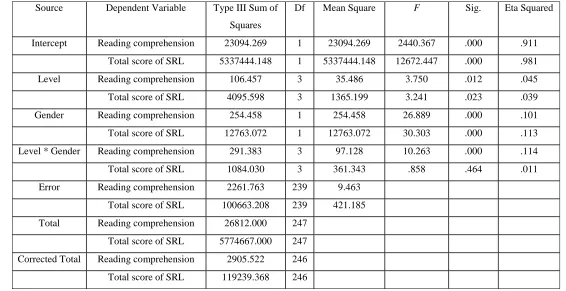
(M=10.8289, SD =3.3522), and (M=9.5741, SD=3.1955), for the total was (M=9.8381, SD =3.4367) respectively as shown in Appendix B. In Table 4 specifically, MANOVA test is used to reveal gender and level differences in Self Regulated Learning Strategies subscales and Reading Comprehension Test
Distinguishing the students at different academic levels, results reveal that there are differences between students` academic levels in the use of self regulated learning strategies,
F( 3, 244)= 3.241, p < 0.05). With an estimated η2= 0. .039. In addition, there are differences among students in reading comprehension according to their academic levels F (3, 244) = 3.750, p < 0.05). With an estimated η2= 0. .045. To determine the differences between the students` levels in reading comprehension, Scheffe Test was run indicating there are differences between level 4 (M= 9.033, SD=3.025) and level 6 (M=10.829, SD =3.352) in favour of level 6. To determine the differences between the student levels in SRL strategies, Scheffe Test was run indicating there are differences between level 4 (M=
157.416, SD=20.427) and level 8
(M=143.833, SD =23.364) in favour of level 4.
To examine gender differences in the aspects of self regulated learning strategies F ( 3, 244)= 30.303, p < 0.01) and reading comprehension test, F( 3, 244)= 26.88, p < 0.01) was run using. Results show that there are differences in self regulated learning strategies in favour of females in which males scored M=143.261, SD=20.888 and females
scored M=157.889, SD=20.757. However, there are differences between males and females in the favour of males in the reading comprehension test in which males scored M=10.828, SD=3.233 and females scored M=9.029, SD=3.397.
Further computational processes were used to explore potential relationships between SRL strategies and reading comprehension. Based on Pearson correlation, there are relationships between self regulated learning strategies sub-dimensions and reading comprehension. Entered multiple regression analysis was then performed to predict reading comprehension from self regulated learning strategies. See Table 5 in Appendix B.
Model Summary
Data analysis reports that the statistically significant predictors of the reading comprehension were SRL strategies sub- dimensions. The results also show that SRL strategies explain 12.8 per cent of the variance in reading comprehension, (F (11,233) = 3.106, p< 0.001) as shown in Error! Reference source not found. below. This result is consistent with many results of Zimmerman and Martinez -Pons (1986) that SRL scores were shown to be valid predictors of achievement.
Multiple regression tests were employed as the main analysis method. Entered multiple regression analysis was carried out with the data to see which aspects of SRL were
significant in predicting reading
comprehension. Table 6 below indicates that the contribution of some of self regulated learning strategies (rehearsal strategy, Self talk about efficiency and Elaboration) is significant on the students` reading comprehension.
Discussion
186 reading comprehension, SRL and reading
comprehension across academic levels, and SRL strategies as predictors of reading comprehension in EFL learning.
Gender differences between SRL and reading comprehension
To examine gender differences in the aspects of self regulated learning strategies F( 3, 244)= 30.303, p < 0.01) and reading comprehension test, F( 3, 244)= 26.88, p < 0.01) was run using. Results show that there are differences in self regulated learning strategies in favour of females in which males scored M=143.261, SD=20.888 and females scored M=157.889, SD=20.757. However, there are differences between males and females in favour of males in the reading comprehension test in which males scored M=10.828, SD=3.233 and females scored M=9.029, SD=3.397.
The findings of the current study confirm that there are differences in the use of SRL strategies between males and females. Females outscore males in the use of SRL strategies in all subscales. This finding is consistent with the results of several previous studies that detected differences in strategy use to the advantage of the female learners (Law, Chan &
Sachs, 2008). However, reading
comprehension test results reported that there are differences between males and females in the favour of males. While this finding is partially consistent with the finding of Yazdanpanah, (2007), it suggests that males outperform females in reading on different items of reading comprehension, such as specific information, identifying referential information, and matching titles with paragraph. On the other hand, other previous studies found that girls achieved higher reading comprehension scores (e.g., Skaalvik & Rankin, 1990; Wagemaker, 1996; Swalander & Taube, 2007). One possible explanation for the superiority of the male students in this study is that males and females may not have been equally matched in language ability. Although they were at the same instruction level, the male students seem to have been more proficient readers than their female counterparts. Language ability is an important
factor that affects comprehension (Martino and Hoffman, 2002; Norris and Hoffman, 2002; Ridgway, 1997). It seems that they have enough linguistic knowledge to comprehend the reading passages without great difficulty. This possibility raises the question of the quality of instruction in the girls’ department. It is suggested here that female departments need to reassess their classroom teaching and practices and to focus on reading activities to promote a higher level of reading skills. The implication drawn here is that students in general, and female students in particular, should be encouraged to read more informative texts, as these types of texts are very important for academic and professional activities.
SRL strategies and reading comprehension across academic levels
The findings of the current research show that there are differences between students in the use of SRL strategies according to their academic levels, F( 3, 244)= 3.241, p < 0.05). There are also differences among students in reading comprehension according to their academic levels F (3, 244) = 3.493, p < 0.05). These differences were detected between level 4 (M= 9.033, SD=3.025) and level 6 (M=10.828, SD =3.352) in favour of level 6. This might be explained in terms of the students’ experience and the development of their use of SRL strategies in reading comprehension as they progress in their academic levels. Though at different age levels, this result is contradicts the results of Law et al. (2008) which reported that grade 5 children displayed more self-regulated strategies than grade 6 children.
EFL learners` SRL strategies as predictors of reading comprehension
187 achievement is mediated by the use of SRL
strategies such as organizing, goal-setting, planning, self-evaluating, information seeking, record keeping, self-reflecting, self-monitoring, and reviewing (e.g. Boekaerts & Corno, 2005; Winne, 2005; Zimmerman & Martinez-Pons, 1990). On the other hand, this may not be consistent with other study findings in which SRL strategies were generally deemed as inaccurate predictors of academic achievements. (Rotgans, & Henk, 2009; Wang, 2011) It is assumed that readers must use self-regulated strategies to fully employ their ability to interpret or make something of texts. Therefore, developing such self-regulated skill holds benefits for many educational tasks, not the least of which is increased test scores (Mason, et al., 2006; Pintrich & DeGroot, 1990). As such, this finding of measuring the use of SRL strategies may tentatively be adapted to
predict the EFL learners’ reading
comprehension. This expected to assist the EFL instructors’ endeavour to diagnose their learners’ deficiencies in reading, and perhaps attempt to direct their students to use better SRL strategies. Thus, the importance of self-regulated learning strategies to academic achievement has been fairly well established (Kuo, 2010).
Conclusion
Findings of the present study were mainly consistent with most of the other previous studies conducted in other contexts. The findings could be used as evidence of the importance of SRL strategies in the EFL learning process. Based on that, further efforts need to be exerted to identify and help students, especially those with poor reading comprehension. This can be done by appropriate the use of SRL strategies as a way of analysing their needs and diagnosing their problematic issues in reading comprehension.
Another relevant key finding is that SRL strategies can be a demanding need for poor readers in the light of the significant relationship between SRL strategies and
reading comprehension which were
synthesized in this study. The results of the
present study clearly indicate that some of the SRL strategies are significant predictors of reading comprehension, such as rehearsal strategy, self talk about efficiency and elaboration. This study also explored gender differences in reading comprehension. The male students performed better than their female counterparts in their comprehension of reading passages. These results suggest that language educators should take into consideration the differences between the two
genders and promote equal learning
opportunities in order to adjust the apparent differences between female and male students. Although the results were based on a large number of students at Taif university (N= 248), they need to be treated with caution. A first limitation pertains to the generalisability of the findings in this study to Saudi students at a college level. A second limitation is about using more than one predictor of reading comprehension was used in order to give more insight into gender differences and to strengthen the results by gathering evidence from more than one setting. Further directions for research in this area can include investigating efficient ways of developing SRL strategies in correlation with reading comprehension. As modelling can be an effective approach to learning, teachers themselves need to be trained on appropriate use of SRL strategies in their classroom which can be a potential direction for further research as well.
References
Abar, B. Loken, E. (2010) "Self-regulated learning and self-directed study in a pre-college sample" Learning and Individual Differences, Vol.20,pp.25–29.
Artelt, C., Schiefele, U., & Schneider, W. (2001) "Predictors of reading literacy" European Journal of Psychology of Education, Vol.16, pp. 363–383.
Artelt, C., Baumert, J., Julius-McElvany, N., & Peschar, J. (2003). Learners for life. Student approaches to learning. Results from PISA. Paris: OECD.
188 Educational Psychologist, Vol. 40, pp.193–
197.
Bandura, A. (1986) Social foundations of thought and action: A social cognitive theory. Englewood Cliffs, NJ: Prentice-Hall. Berardo, S.A. (2006). The use of authentic materials in the teaching of reading. The Reading Matrix, Vol.6, No.2,pp.60-69. Bimmel, P. E. (1999). Training en transfer van leesstrategie¨en: Training in de moedertaal en
transfer naar een vreemde taal—een
effectstudie bij leerlingen uit het voortgezet onderwijs [Training and transfer of reading strategies: Training in the mother tongue and transfer to a foreign language—A training study with students in secondary education].
’s-Hertogenbosch, The Netherlands:
Malmberg.
Boekaerts, M. (1996) "Self-regulated learning and the junction of cognition and motivation" European Psychologist, Vol.1,pp.100−112. Boekaerts, M. (1999) "Self-regulated learning: Where we are today" International Journal of Educational research, Vol.31, No.6, pp. 445– 457.
Boekaerts, M., & Corno, L. (2005) "Self-regulation in the classroom: A perspective on assessment and intervention" Applied Psychology: An International Review, Vol.54, pp.199−231.
Botsas, G., & Padeliadu, S. (2001) Comprehension metacognitive strategies in reading. In: M. Vamvoukas, & A. Hatjidaki (Eds.), Vol. 1. Learning and instruction of Greek language as mother and second language (pp. 128–141). Rethymno, University of Crete (in Greek).
Botsas, G., & Padeliadu, S. (2003) Reading comprehension metacognitive monitoring and fix-up strategy use of reading disabled students and good readers. In E. Mela-Athanasopoulou (Ed.), 15th International Symposium selected papers on Theoretical and Applied Linguistics (pp. 490–509). Thessaloniki: School of English—Aristotle University of Thessaloniki (in Greek).
Byrnes, J. P., Miller, D. C., & Reynolds, M. (1999) "Learning to make good decisions: A self-regulation perspective" Child Development, Vol. 70, pp. 1121−1140. Chemers, M. M., Hu, L., & Garcia, B. F. (2001) "Academic self-efficacy and first-year college student performance and adjustment"
Journal of Educational Psychology, Vol.93,pp. 55−64.
Chung, M. (2000) "The development of self-regulated learning" Asia Pacific Education Review, Vol.1, No.1, pp. 55–66.
Corno, L., & Mandinach, E. B. (1983) "The role of cognitive engagement in classroom learning and motivation" Educational Psychologist, Vol.18, pp. 88-108.
Cromley, J. G., & Azevedo, R. (2007) "Testing and refining the direct and inferential mediation model of reading comprehension" Journal of Educational Psychology, Vol.99, pp.311–325.
Dignath, C. Buettner, G. & Langfeld, H. (2008) "How can primary school students learn self-regulated learning strategies most effectively? A meta-analysis on self-regulation training programmes" Educational Research Review Vol. 3, pp.101–129.
Eisenberg, N., Champion, C., & Ma, Y. (2004) "Emotion-related regulation: An emerging construct" Merrill-Palmer Quarterly Vol.50, pp.236–259.
Evans, G.W. & Rosenbaum, J. (2008) Self-regulation and the income-achievement gap. Early Childhood Research Quarterly, Vol.23, pp.504–514.
Fecteau, M. (1999) "First- and second- language reading comprehension of literary texts" The Modern Language Journal, Vol.83, pp.475-493.
Folkesson, A.-M. & Swalander, L. (2007) "Self-regulated learning through writing on
computers: Consequences for reading
comprehension" Computers in Human Behavior Vol.23, pp.2488–2508.
Guthrie, J. T., Schafer, W., Wang, Y. Y., & Afflerbach, P. (1995) "Relationships of instruction to amount of reading: an exploration of social, cognitive, and instructional connections" Reading Research Quarterly, Vol.30, pp.8–25.
189 orientation patterns" Learning and Individual
Differences, Vol.18, pp.108–113.
Kuo, Y. (2010). Self-Regulated Learning: From Theory to Practice.
Law, Yin-Kum., Chan, C. K., & Sachs, J. (2008) "Beliefs about learning, self-regulated strategies and text comprehension among Chinese children" British Journal of Educational Psychology, Vol.78, No.1, pp. 51-73.
Lucantoni, P. (1996). English as a second language. Cambridge University Press. Martino, N. L., & Hoffman, P. R. (2002) "An investigation of reading and languageabilities of college freshmen" Journal of Research in Reading, Vol.25, No.3,pp.310-318.
Mason, L. H., Snyder, K. H., Sukhram, D. P., & Kedem, Y. (2006) "TWA +PLANS strategies for expository reading and writing: Effects for nine fourth-grade students" Exceptional Children, Vol.73, pp. 69-89. Mischel, W., & Ayduk, O. (2004). Willpower in a cognitive-affective processing system. In R. E. Baumeister & K. D. Vohs (Eds.), Handbook of self-regulation (pp. 99–129). New York: Guilford Press.
Nassaji, H. (2003) "Higher- level and lower-level text processing skills in advanced ESL reading comprehension" The Modern language Journal, Vol.87, pp. 261-276.
Norris, J. A., & Hoffman, P. R. (2002)
"Phonemic Awareness: A complex
developmental process" Topics in Language Disorders, Vol.22, No.1,pp.1-34.
O`Malley, J. M., Chamot, A.U., & Walker, C. (1987) "Some applications of cognitive theory to second language acquisition" Studies in Second language Acquisition Vol.9, pp. 287-306.
O`Reill, T., & McNamara, D. S. (2007) "The impact of science knowledge reading skill and reading strategy knowledge on more traditional "high stakes" measures of high school students` science achievement" American Educational Research Journal, Vol. 44, No.1, 161-196.
Pae, T. (2004) "Gender effect on reading comprehension with Korean EFL Learners System", 32 (3), 265-281.
Paris, S. G., & Paris, A. H. (2001) "Classroom applications of research on self-regulated learning" Educational Psychologist, Vol.36, No.2, pp. 89–101.
Pintrich, P. R., & De Groot, E. V. (1990) "Motivational and self-regulated learning
components of classroom academic
performance" Journal of Educational Psychology, Vol.82, pp.33−40.
Pintrich, P. R., Smith, D. Garcia, T. & Mckeachie, W. (1993) "Reliability and Predictive Validty of the Motivated Strategies for Learning Questionnaire (MSLQ)" Educational and Psychological Measurement, Vol.53, No.3,pp.801-813.
Pintrich, P. R., Anderman, E. M., & Klobucar, C. (1994) "Intraindividual differences in motivation and cognition in students with and without learning disabilities" Journal of Learning Disabilities, Vol.27, No.6, 360–370.
Pintrich, P. R. (1999) "The role of motivation in promoting and sustaining self-regulated learning" International Journal of Educational Research, Vol.31, No.6,pp.459–470.
Pintrich, P. R. (2000) The role of goal orientation in self-regulated learning. In M. Boekaerts P. R. Pintrich & M. Zeidner (Eds.), Handbook of self-regulation (pp. 451−502). San Diego, CA: Academic.
Pintrich, P. R. (2000b) "Multiple goals, multiple pathways. The role of goal orientation in learning and achievement" Journal of Educational Psychology, Vol.92, No.3,pp. 544–555.
Pintrich, P.; Wolters, C. & Baxter, G. (2000C). Assessing Metacognition and self-regulated learning. In G. Schraw & J. Impara (Eds.): Issues in the measurement of metacognition, (pp. 43-97). Lincoln, University of Nebraska press. Pressley, M., & Ghatala, E. S. (1990) "Self-regulated learning: Monitoring learning from text" Educational Psychologist, Vol.25, No.1, pp. 19–33. Pressley, M., & Harris, K. R. (2006). Cognitive strategies instruction: From basic research to classroom instruction. In P. Alexander & P. Winne (Eds.), Handbook of educational psychology (2nd ed., pp. 264– 286). Mahwah, NJ: Erlbaum.
Ridgway, T. (1997) "Threshold of the
background knowledge effect in
190 regulated learning" Educational Studies,
Vol.35, No.3, pp. 239-253.
Rowe, K. J. (1991) "The influence of reading activity at home on students’ attitudes towards reading, classroom attentiveness and reading achievement: an application of Structural Equation Modeling" British Journal of Educational Psychology, Vol.61, pp.19–35. Schunk, D. H. (1989) "Self-efficacy and achievement behaviors" Educational Psychology Review, Vol.1, pp.173–208. Schunk, D. H., & Zimmerman, B. J. (1994). Self regulation of learning and performance: Issues and educational applications. Hillsdale, NJ: Lawrence Erlbaum.
Schunk, D. H. (2001). Social cognitive theory and self-regulated learning. In B. J. Zimmerman & D. H. Schunk (Eds.). Self-regulated learning and academic achievement: Theoretical perspectives (Vol. 2, pp. 125–152). Mahwah, NJ: Lawrence Erlbaum.
Skaalvik, E. M., & Rankin, R. J. (1990) "Math, verbal, and general academic self- concept: the internal/external frame of reference model and gender differences in self-concept structure" Journal of Educational Psychology, Vol.82, pp.546–554.
Stallworth-Clark, R., Cochran, J., Nolen, M. T., Tuggle, D. L., & Scott, J. S. (2000) "Test
anxiety and performance on reading
competency tests" Research and Teaching in Developmental Education, Vol.17, pp.39−47. Swalander, L. & Taube, K. (2007) "Influences of family based prerequisites, reading attitude, and self-regulation on reading ability" Contemporary Educational Psychology Vol.32, pp. 206–230.
Wagemaker, H. (1996). Are girls better readers? Gender differences in reading literacy in 32 countries. Amsterdam: The International Association for the Evaluation of Educational Achievement.
Taguchi,E., Gorsuch, G.J. & Sasamoto, E. (2006) "Developing second and foreign language reading fluency and its effect on comprehension: a missing link" The Reading Matrix, Vol.6, No.2, pp.1-18.
Wang, T. H. (2011) "Developing Web-based assessment strategies for facilitating junior high school students to perform self regulated learning in an e-learning environment" Computers & Education, Vol.57, No.2,pp. 1801-1812.
Winne, P. H. (1995) "Inherent details in self-regulated learning" Educational Psychologist, Vol.30, No.4, pp.173–187.
Winne, P. H. (2005). A perspective on state-of-the-art research on self-regulated learning. Instructional Science, Vol.33, No.5/6,pp.559– 565.
Yazdanpanah, K. (2007). "The effect of
background knowledge and reading
comprehension test items on male and female performance" The Reading Matrix, Vol.7, No.2, pp. 64-80.
Zimmerman, B. J. (1986) "Development of self-regulated learning: Which are the key sub processes" Contemporary Educational
Psychology, Vol.16, pp. 307–313.
Zimmerman, B. J. (1989) "A social cognitive view of self-regulated academic learning" Journal of Educational Psychology, Vol.81, No.3, pp. 329–339.
Zimmerman, B. J., & Schunk, D. H. (2008). Motivation: An essential dimension of self regulated learning. In D. H. Schunk & B. J. Zimmerman (Eds.), Motivation and self regulated learning: Theory, research, and applications (pp. 1−30). New York: Laurence Erlbaum.
Zimmerman, B. J., & Bandura, A. (1994) "Impact of self-regulatory influences on writing course attainment" American Educational Research Journal, Vol.31, No.4, pp. 845–862.
Zimmerman, B. J., & Martinez-Pons, M. (1986) "Development of a structured interview for assessing student use of self-regulated learning strategies" American Educational Research Journal, Vol. 23, No.4, pp. 614-628. Zimmerman, B. J., & Martinez-Pons, M. (1988) "Construct validation of a strategy model if students self-regulated learning" Journal of Educational Psychology, Vol.80, No.3, pp.284–290.
Zimmerman, B. J. (2000) Attaining self-regulation. A social cognitive perspective. In M. Boekaerts, P. R. Pintrich, & M. Zeidner (Eds.), Handbook of self-regulation (pp. 13– 39). San Diego, CA: Academic Press.
Appendix A
Factor analyses: Self regulated learning strategies
No. Items Mean SD Loading
60 I look for any information in the library or in the internet to help me to understand the ambiguous academic topics.
3.2200 1.1532 .619
Facto
r
1
61 If the information that presented in any academic course is not satisfied, so I look
up extra information in the library.
2.9000 1.3746 .790
62 I fix specific times for the library and I try to read more in order to develop my
academic and professional efficiencies.
2.7600 1.4222 .754
63 I ask the teacher about useful references to help me understand the courses. 3.0600 1.2785 .682
Facto
r
2
23 When I read any subject and finish it, I reward myself by taking a break or doing
any enjoyable activity.
3.5150 1.2680 .782
24 When I succeed in doing any task, I reward myself. 3.5600 1.1589 .847
25 I reward myself when I continue in reading a specific subject and understanding it
well even if I feel bored.
3.2000 1.2278 .662
26 I make a deal with myself: if I do the required task in a good way and in a
suitable time, I will do some enjoyable things.
3.6100 1.1725 .621
Facto
r
3
47 I study in a quiet place free of distracters in order to concentrate. 4.2400 .9784 .559
48 I have a favorite place to study. 3.9700 1.1942 .753
49 I make sure that the place of studying is convenient. 3.9600 1.0314 .827
50 I arrange the place where I study to help me to achieve better. 3.6500 1.2020 .671
Self Regulated Learning strategies...
193 of the topic.
57 I work together with friends to achieve better understanding for what we are studying.
3.9500 .9758 .735
58 I prefer conversation and discussion with my friends related to the reading course. 3.3500 1.1152 .694
Facto
r
5
74 To prepare for the final examinations, I predict exam questions and attempt to
answer them.
3.1500 1.4062 .643
75 When I am studying, I stop every now and then to predict questions and to try to
think about their answers in my mind.
4.2400 1.0333 .492
76 I summarize reading course in form of questions and answers and during revision
I try answer questions first.
3.7100 1.1100 .759
77 When I am reading, I form some questions and I try to answer them at the end of
my studying session to make sure that I understood the passage.
3.5550 1.1849 .659
Facto
r
6
1 I repeat the new information many times to memorize it. 3.3550 1.2192 .703
2 When the lecturer mentions a new concept, I repeat it many times to not forget it. 3.3450 1.2545 .724
3 When I read any topic, I repeat it twice in a loud voice. 3.8150 1.1651 .437
4 When I prepare for the examination in the reading course, I try to repeat the
information of the course more times.
3.9400 1.0304 .485
Facto
r
7
27 I change the way I sit during my studying when I have no desire to complete what
I am doing.
3.9550 .9367 .550
28 When I get bored with studying, I change the place of studying. 3.9000 1.0075 .720
29 When I feel bored with studying, I stand or walk in the place during the studying. 4.1250 1.0072 .702
International Journal of Asian Social Science, 2(2), pp.178-201
194
Facto
r
8
31 When I feel bored, I convince myself to continue to understand the subjects and
develop my academic efficiencies.
3.6800 1.1198 .606
32 When I feel that I do not want to study, I remind myself by the importance of
doing more effort to gain new information that I did not know before.
3.7150 1.1621 .754
33 When I have no desire to study, I try to convince myself that is necessary to
complete what I am doing to achieve understanding and perfection.
3.4500 1.2227 .562
34 I try to convince myself that I have good abilities. 4.2400 .9784 .373
35 When I do not understand any academic topics, I do not give up quickly and talk
myself to try again and again.
3.9700 1.1942 .343
Facto
r
9
37 I encourage myself by thinking about achieving high scores to impress the others. 3.9600 1.0314 .776
38 When I lose the desire to complete the required tasks, I remind myself with the
consequences related to my score in the subject.
3.6500 1.2020 .740
39 When I encounter difficulties to complete the required task, I try to convince
myself to complete because of its importance.
3.2850 1.1920 .392
40 40. When my attention is distracted and gets busy away from studying, myself
argues me to return to study to achieve success.
3.6250 1.1667 .362
Facto
r
1
0
71 I do the required tasks in time and I do not put them off. 3.7450 1.1386 .484
72 Before studying I set specific times breaks. 3.9350 1.1346 .673
73 I organize my time and distribute it according to the nature of the different
subjects.
3.3850 1.1591 .596
Self Regulated Learning strategies...
195 6 I try to relate between the information in the reading course and similar
information in other courses.
3.9350 1.1591 .361
7 When I study any unclear reading topic, I do some modifications and additions to
make it easy to understand.
3.6650 1.0670 .532
Appendix B
Table-1 Factor analyses: Self regulated learning strategies
Factor Description Eigen value % of variance Cumulative %
1 Seeking Information 2.936 6.673 6.673
2 Self reward 2.742 6.233 12.906
3 Environmental control 2.468 5.609 18.515
4 Peer learning 2.396 5.446 23.961
5 Self evaluation 2.391 5.434 29.395
6 Rehearsal strategy 2.336 5.310 34.705
7 Motivational Environmental control 2.268 5.154 39.858
8 Self talk about efficiency 2.243 5.099 44.957
9 Self talk about performance 2.113 4.802 49.759
10 Time management 2.057 4.676 54.435
11 Elaboration 1.832 4.164 58.599
Table 2: Dimension-total correlations between dimensions and total score for SRL questionnaire subscales Sub factors Factor1 Factor2 Factor 3 Factor 4 Factor 5
International Journal of Asian Social Science, 2(2), pp.178-201
196
Correlations 0.634 0.587 0.484 0. 610 0.667 0.665 0.579 0.625
Sub factors Factor
9 Factor10 Factor11
Correlations 0.495 0.660 0.519
Table 3: Descriptive data for Saudi students` Self Regulated Learning Strategies and Reading Comprehension Test according to their gender and their academic levels
N Level Gender Mean SD
Total of reading comprehension 22 2.00 Male 12.5000 3.7257
35 Female 7.8000 2.8263
57 Total 9.6140 3.9223
29 4.00 Male 11.0345 2.4854
31 Female 7.1613 2.1771
60 Total 9.0333 3.0251
29 6.00 Male 10.7586 3.4086
47 Female 10.8723 3.3532
76 Total 10.8289 3.3522
Self Regulated Learning strategies...
197
23 female 9.6522 3.6756
54 Total 9.5741 3.1955
111 Total male 10.8288 3.2330
136 female 9.0294 3.3970
247 Total 9.8381 3.4367
Total of SRL strategies 22 2.00 male 141.7727 22.1057
35 female 158.1143 20.4490
57 Total 151.8070 22.3953
29 4.00 male 151.9310 20.0552
31 female 162.5484 19.7211
60 Total 157.4167 20.4270
29 6.00 male 144.7241 17.5171
47 female 155.5957 21.6791
76 Total 151.4474 20.7624
31 8.00 male 134.8387 21.1268
23 female 155.9565 20.9469
54 Total 143.8333 23.3640
111 Total male 143.2613 20.8883
136 female 157.8897 20.7570
247 Total 151.3158 22.0162
International Journal of Asian Social Science, 2(2), pp.178-201
198
Source Dependent Variable Type III Sum of
Squares
Df Mean Square F Sig. Eta Squared
Intercept Reading comprehension 23094.269 1 23094.269 2440.367 .000 .911
Total score of SRL 5337444.148 1 5337444.148 12672.447 .000 .981
Level Reading comprehension 106.457 3 35.486 3.750 .012 .045
Total score of SRL 4095.598 3 1365.199 3.241 .023 .039
Gender Reading comprehension 254.458 1 254.458 26.889 .000 .101
Total score of SRL 12763.072 1 12763.072 30.303 .000 .113
Level * Gender Reading comprehension 291.383 3 97.128 10.263 .000 .114
Total score of SRL 1084.030 3 361.343 .858 .464 .011
Error Reading comprehension 2261.763 239 9.463
Total score of SRL 100663.208 239 421.185
Total Reading comprehension 26812.000 247
Total score of SRL 5774667.000 247
Corrected Total Reading comprehension 2905.522 246
Total score of SRL 119239.368 246
Self Regulated Learning strategies...
199
R.C SRF1 SRF2 SRF3 SRF4 SRF5 SRF6 SRF7 SRF8 SRF9 SRF10 SRF11
Reading
comprehension
1.000
SRL F1 -.021 1.000
SRL F2 -.033 .370** 1.000 .
SRL F3 .156* .183** .146* 1.000
SRL F4 .108 .254** .268** .284 1.000
SRL F5 -.053 .377** .323** .237 .398** 1.000
SRL F6 .222** .396** .231** .313 .384** .410** 1.000
SRL F7 .021 .322** .289** .178 .310** .318** .299** 1.000
SRL F8 .149* .246** .314** .226 .320** .301** .323** .426** 1.000
SRL F9 .067 .126* .206** .291 .208** .258** .322** .237** .452** 1.000
SRL F10 .009 .501** .386** .282 .328** .466** .371** .313** .324** .116 1.000 .
SRL F11 .180** .271** .217** .255 .314** .327** .416** .253** .306** .267** .285** 1.000
Note: SRL refer to Self regulated Learning strategies, R.C refer to Reading comprehension
International Journal of Asian Social Science, 2(2), pp.178-201
200
Model R R2 Adjusted R2 Std. Error
1 0.358 0.128 0.087 11.552
Table -7 Multiple Regression Analysis (SRL strategies sub-dimensions and reading comprehension)
SRL sub-scales Unstandardized Coefficients
Standardized
Coefficients
t Sig.
B Std. Error Beta
(Constant) 65.78 5.558 11.836 .000
Seeking Information -.247 712 -.087 -1.140 .255
Self reward . 181- .220 -.058 -.823 .411
Environmental
control
.372 .245 .103 15.70 .130
Peer learning .250 .303 .049 .679 .498
Self evaluation -.620 .263 -.179 -2.356 .019
Rehearsal Strategy .910 .291 .241 3.122 .002
Motivational
Environmental
Control
-.175 .244 -.051 -.716 .475
Self Regulated Learning strategies...
201 Efficiency
Self talk about
Performance
-.264 .291 -.066 -.909 .364
Time Management -.171 .355 -.038 -.482 .630