IJEDR1703066
International Journal of Engineering Development and Research (
www.ijedr.org
)
443
Energy Consumption for Cluster Based Wireless
Routing Protocols in Sensor Networks
1
J.Daniel Mano,
2Dr.S.Sathappan
1Ph.D Research Scholar, 2Associate Professor 1Department of Computer Science
1Erode Arts and Science College, Erode, Tamil Nadu, India
________________________________________________________________________________________________________
Abstract—Wireless Sensor Networks [WSNs] are a collection of hundred or thousand sensor nodes linked to Wireless Radio link [3].Nowadays such networks are used in many application areas such as Monitoring, Medical Applications etc. The cluster based routing protocol is improved to the Network lifetime and reduce the energy consumption of the WSNs. In this paper, an attempt was made to develop an enhanced algorithm named E-LEACH protocol for WSN. The performance of proposed algorithm is compared with existing cluster based protocol LEACH using simulators namely Network Simulator version 2 and MATLAB. The Experimental results of the proposed research work give improved performance in terms of PDR, Delay, Throughput and Energy Consumption.
Key words- Cluster, LEACH-E, Transceiver
________________________________________________________________________________________________________
I. INTRODUCTION
A. Wireless Sensor Networks
Wireless Sensor Networks can be defined as nodes, which can sense the environment and communicate the information gathered from the monitored field through the Wireless Links. Components of Sensor Nodes are microprocessor, micro sensor, memory, battery, transceiver, power and processing unit. Wireless sensor network differs from a conventional sensor wireless network in that it does not have a fixed infrastructure. [3]
B. Cluster Based Routing protocol
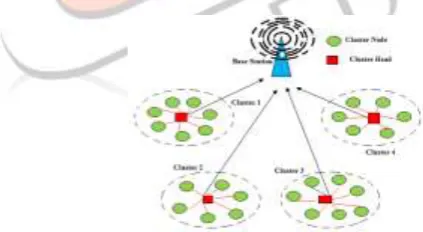
Wireless Sensor Networks are collection of sensor nodes into a cluster. Every cluster contains a Leader called Cluster Head (CH). A CH may be selected by the group of cluster. A cluster head collects the information from the nodes within cluster and send this information to the base station or destination. Clustering can be used as an energy-efficient communication protocol. The aim of clustering is to minimize the total transmission power aggregated over the nodes in the selected path, and to balance the load between the nodes for extend the network lifetime. Cluster-based routing algorithms are growing to be an essential part of routing technology in wireless sensor networks on account of a form of advantages, such as larger scalability, less load, a smaller amount energy consumption and extra robustness [1].
The cluster based routing protocols [2] are classified into three kinds: Viz., Grid cluster, Chain cluster, and Block Cluster based routing protocols. The standard grid cluster based routing protocols are GAF, SLGC, TTDD, PANEL, HGMR etc. The standard chain cluster based routing protocols are CCS, TSC, PEGASIS. The popular block cluster based routing protocols are TEEN, LEACH, LEACH-VF, HEED, CCM, EECS, UCS, HCTE, BCDCP, MWBCA etc.
Fig 1: Cluster Based Routing Protocols for Wireless Sensor Networks Tree
II. RELATED WORK
Sabri et al., [4] presented a survey on Hierarchical cluster based routing protocols for wireless sensor networks. The author reviewed the hierarchical based routing scheme using homogeneous, heterogeneous and multi-hop categories. The authors analysed performance of the reduced energy consuming and improve network lifetime. Finally, the authors concluded that the routing protocols are covered both strengths and limitations of protocols.
IJEDR1703066
International Journal of Engineering Development and Research (
www.ijedr.org
)
444
Kochher et al., [6] focused a review of enhanced cluster based routing Protocol for mobile nodes in wireless sensor network. The authors proposed an Enhanced LEACH protocol module including additional parameters which consider the mobile node and balancing the energy Consumption of nodes. Finally, the authors concluded that the proposed protocol gives a better performance such as a high packet delivery ratio, throughput, Energy Consumption, Routing Over head and Low Level of Delay.Diwakar et al., [7] presented an article on Energy Efficient level based clustering routing protocol for wireless sensor networks. The authors proposed an energy efficient protocol for residual energy of each node and distance from the normal node to base station node. The authors developed a model which is tested in MATLAB Simulation. Finally, the authors analysed the result that the energy consumed for each round in EELBCRP-2 is much lower than in LEACH. They also revealed that the performance of the proposed protocol is better than the Existing protocol for LEACH.
Kaur et al., [8] highlight the deployment of an optimized LEACH-C protocol for Wireless Sensor Network. The authors analysed the Energy Efficient Routing Protocols such as LEACH and OLEACH-C. The nodes that have Maximum remaining energy will be selected as Cluster Head. The authors proposed PBO Algorithm which is used for clustering in the Wireless Sensor Network for homogenous network environment. Finally the result shows that proposed OLEACH-C protocol had good performance than the LEACH protocol.
Lotf, J.J et al., [9] discussed several clustering protocols in the survey, in addition to that the author analysed the advantages and limitations of each algorithm. The author selected seven popular clustering algorithms for WSNs, such as LEACH, TL-LEACH, EECS, TEEN, APTEEN, and etc. Additionally, the survey compared these clustering protocols in terms of energy consumption and network lifetime.
Xu et al., [10] made a survey on six clustering routing protocols. The author analysed these clustering routing algorithms based on performance parameters such as energy conservation, network lifetime, data aggregation, robustness, scalability and security.
III. PROPOSEDWORK
Communication plays a vital role for better decision-making. In order to convey the effective communication a better packets with request and its replay is mandatory to complete one path. Similarly, various path are identifies and finally selecting the better path. In this solution control packet ROUTE REQUEST [RREQ] and ROUTE REPLY [RREP] are routed in a broadcast way. When the source wishes to transmit, it checks its routing table for any route to the desired destination. If this is not the case, it starts Detection Phase by broadcasting control packet [RREQ]. In this modification, the proposed work is to eliminate the local repair phase to minimize modified protocol M-AODV tasks.
LEACH Protocol:
Low-Energy Adaptive Clustering Hierarchy (LEACH) is one of the new cluster routing approaches for Wireless Sensor Networks. The fundamental idea of LEACH has been an inspiration for many subsequent cluster routing protocols. The main objective of LEACH is to select sensor nodes as CHs by rotation, so the high energy dissipation in communicating with the BS is spread to all sensor nodes in the network. The operation of LEACH is broken up into lots of rounds, where each round is separated into two phases, the set-up phase and the steady-state phase. In the set-up phase the clusters are organized, while in the steady-state phase data is delivered to the BS. During the set-up phase, each node decides whether or not to become a CH for the current round. This decision is made by the node choosing at random. LEACH uses a TDMA/code-division multiple access (CDMA) MAC to reduce inter-cluster and intra-cluster collisions. After a certain time, which is determined a priori, the network goes back into the set-up phase again and enters another round of CH selection.
Figure 3.1 Basic architecture of LEACH.
RESIDUAL BATTERY ENERGY
Routing Protocols designs are classified into two types Dynamic and Static Routing. Dynamic Routing alters the paths in each Transmission to the current nodes. In static routing, message transfer from one node to another via fixed path. The dynamic routing protocol is balance the load on each and every node. In the case of large amount of data compared to other points, then the sink will remain stationary until another relocating path event occurs.
IJEDR1703066
International Journal of Engineering Development and Research (
www.ijedr.org
)
445
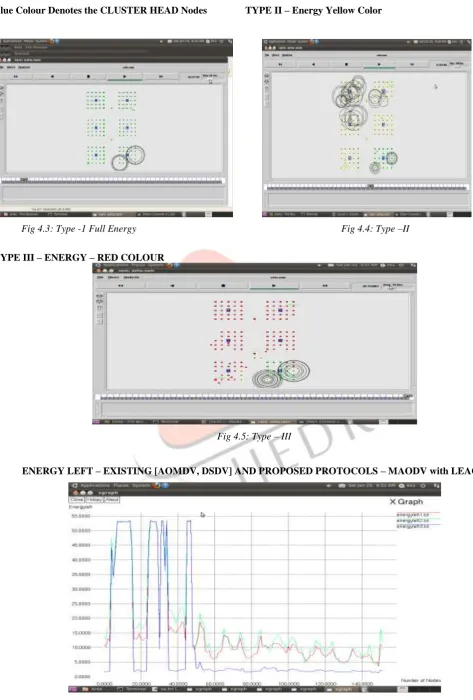
The Transmission Range adjusting will depend on the residual battery energy of a sensor node. They are classified into three types I, II and III. Sensor node adapt a large Transmission Range to shorten the routing path, while a sensor node with only a Low Residual Energy can tune the Transmission Range to be small to conserve its Residual Energy.TABLE 3.1: Transmission Range and Energy Colour Type
Type- I Transmission Range 100% Green
Type- II Transmission Range 50% Yellow
Type- III Transmission Range 15% Red
IV.NETWORKLIFETIME
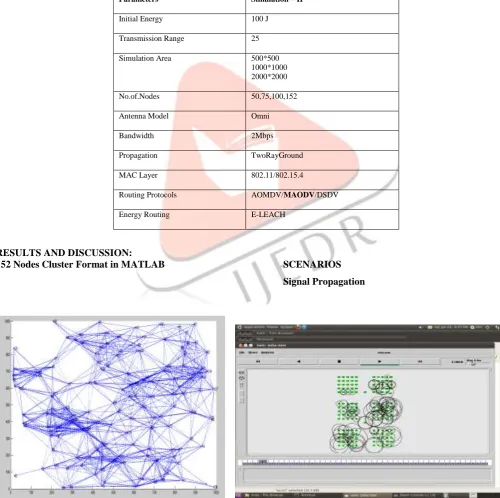
The Simulation Scenarios are Compared the routing network lifetime algorithm by varying the number of sensor nodes, initial energy, the size of the simulation areas and the Transmission Ranges. Simulation Scenarios Investigate the network lifetime under the network simulator 2.34 Environment settings of the TABLE 4.1.
TABLE 4.1: Parameters Setting
Parameters Simulation – II
Initial Energy 100 J
Transmission Range 25
Simulation Area 500*500
1000*1000 2000*2000
No.of.Nodes 50,75,100,152
Antenna Model Omni
Bandwidth 2Mbps
Propagation TwoRayGround
MAC Layer 802.11/802.15.4
Routing Protocols AOMDV/MAODV/DSDV
Energy Routing E-LEACH
RESULTS AND DISCUSSION:
152 Nodes Cluster Format in MATLAB SCENARIOS
Signal Propagation
IJEDR1703066
International Journal of Engineering Development and Research (
www.ijedr.org
)
446
TYPE – I – Full ENERGYBlue Colour Denotes the CLUSTER HEAD Nodes TYPE II – Energy Yellow Color
Fig 4.3: Type -1 Full Energy Fig 4.4: Type –II
TYPE III – ENERGY – RED COLOUR
Fig 4.5: Type – III
ENERGY LEFT – EXISTING [AOMDV, DSDV] AND PROPOSED PROTOCOLS – MAODV with LEACH
IJEDR1703066
International Journal of Engineering Development and Research (
www.ijedr.org
)
447
V. PERFORMANCE METRICSRouting Protocols are evaluated by the metrics such as Delay, PDR, Throughput and Energy Consumption DELAY
The Packet Transmission from source to Destination reception. Delay=Time Packet Received - Time at Packet Sent.
PDR (Packet Delivery Ratio)
The Total Number of Packets successfully received at the Destination PDR = Total Number of Packets Received/ Total Number of Packets Sent. Throughput
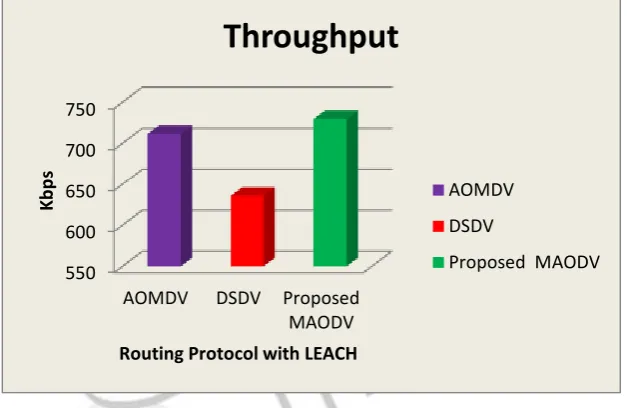
The Time taken to delivery Packets at its Destination to the Total Number of Packets Sent. Throughput [Kbps] = Total PKT Received /1000)*512)/1024.
Energy
Number of Packets Transmitted and the number of Packets Receiving at the Simulation Time. Energy = Total Energy Consumed/ (100*10000.000000))*100.000000)
ROUTING PROTOCOL AND PARAMETERS VALUES
TABLE 5.1: Parameters Values
Parameters LEACH with AOMDV LEACH with DSDV LEACH with Proposed MAODV
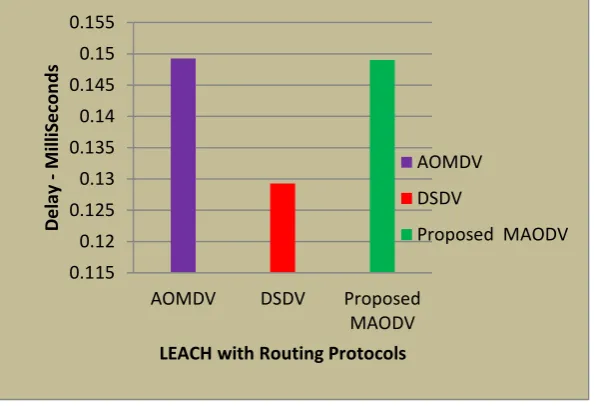
Delay (Ms) 0.14926 0.12929 0.14901
PDR 99.0206 68.6416 99.0791
Throughput 711.24 635.66 729.45
DELAY
The following Figure 5.1 shows that MAODV with LEACH has a low level of Delay and compare with the Existing Routing Protocols.
Fig 5.1: Delay – Existing and Proposed protocols
0.115 0.12 0.125 0.13 0.135 0.14 0.145 0.15 0.155
AOMDV DSDV Proposed MAODV D e lay -M ill iS e co n d s
LEACH with Routing Protocols
AOMDV DSDV
IJEDR1703066
International Journal of Engineering Development and Research (
www.ijedr.org
)
448
PACKET DELIVERY RATIOThe following Figure 5.2 shows that MAODV with LEACH has highest level of Packet Delivery Ratio than the Existing Routing Protocols.
Fig 5.2: PDR – Existing and Proposed protocols
THROUGHPUT
From the Figure 5.3, we observed that MAODV with LEACH has high level of packet transfer when compared to Existing Routing Protocols.
Fig 5.3: Throughput – Existing and Proposed protocols
VI. CONCLUSION
This paper has analysed the Energy Efficient clustering routing protocols for Wireless Sensor Networks. The Enhanced LEACH with proposed MAODV protocol technique has extended the network lifetime and Energy consumption at each node. The Network Simulator 2.34 and MATLAB simulator has been used in our experiment. The result shows that the proposed protocol gives better and high level of Packet Delivery Ratio, Low level of Energy Consumption and Delay.
References
[1] X.Linu and J.Shi “Clustering Routing Algorithms in Wireless Sensor Network An overview”, KSII Transcation on Internet and Information system, Vol.6,No.7, Pp- 1735-1755,2012
[2] Santar pal singh, S.C.Sharma “ Survey on Clustering Based Routing Protocols in Wireless Sensor networks”, in proc. Of International conference on advanced computer technologies and Applications(ICACTA), Pp.687-695.
[3] J.Daniel Mano, Dr.S.Sathappan,“ Comparison of Wireless Routing Protocols in Sensor Network Using NS2 Tool, IJARBEST, ISSN-2395-695X, Vol.2, Special Issue 19, October 2016.
[4] Alia Sabri and Khalil Al- Shqeerat, Hierarchical cluster based routing protocols for wireless sensor networks- A Survey, International Journal of Computer Science Issue, Vol.11, No.2, January 2014. www.ijcsi.org.
0 20 40 60 80 100
%
Protocols
PDR
LEACH with AOMDV
LEACH with DSDV
LEACH with Proposed MAODV
550 600 650 700 750
AOMDV DSDV Proposed MAODV
K
b
p
s
Routing Protocol with LEACH
Throughput
AOMDV DSDV
IJEDR1703066
International Journal of Engineering Development and Research (
www.ijedr.org
)
449
[5] Tyagi, EHE-LEACH: Enhanced Heterogeneous LEACH protocol for Life time Enhanced of Wireless SNs, IEEE,Pp: 1485-1490, DOI-10.1109/ICACCI.2013.6637399.
[6] Vimmi Kochher and Rajesh Kumar Tyagi, A Review of enhanced cluster based Routing Protocol for Mobile Nodes in Wireless Sensor Networks, Advanced in electronic and Electric Engneering, Vol.4, No.6(2014), pp. 629-636.
[7] Meenakshi diwakar and Sushil Kumar, An Energy Efficient level based clustering routing protocol for wireless sensor networks, IJASSN, Vol.2, No.2, April 2012.
[8] Er.sarbjeet kaur and Er.Ravi Gupta, Deploying an optimized LEACH-C protocol for wireless sensor network, Vol.5, issue 7, July 2015
[9] Lotf and Hosseinzadeh M, Hierarchical routing in Wireless Sensor Networks: A survey, ICCET, 16-18 April 2010, pp. 650-654.
[10] Xu,D, Comparison study of hierarchical Routing protocols in Wireless Sensor networks, procedia Environ.Sci 2011, 10,pp.595- 600.