Evaluation on Performance of Bituminus Concrete Mixes
with Replacement of Fly Ash as Filler and Sisal Fibre as
Stablizing Additive
#1
Bhaskara.M.T, Pg Student
#2
Matam Jagadeesh, Assistant Professor
#3
P.Lakshmaiah Chowdary, Professor
Bheema Institute Of Technology & Science, Adoni
ABSTRACT:
Hot Bituminous mixes are commonly used in India, Pavements are always prone to distress such as cracking, pot holes, pavement deformation and surface wears. Modification of Bituminous mix is one of the approaches to improve the pavement performances. The best improvement technique observed so far are Bituminous mixes with stabilizing with additives like Crumb rubber, Natural Fibre and Fly ash or Coal ash etc. Used as a filler replacement to increase the performance and economical point of view. In the present study has been made to study the effect of use of naturally available Fibre called Sisal Fibre is used as a stabilizer and coal ash (fly ash) used as a filler replacement in Bituminous concrete mixes. Performance tests such as Marshal Stability, Indirect tensile strength, tensile strength ratio, Fatigue Tests are conducted. Results of Laboratory performance represent that modified BC mix is better than conventional BC mix.
1.INTRODUCTION
Normally bituminous mixes having the primary constituents such as coarse aggregates,fine aggregates and fillers.actually in some of building locations various size portion of aggregates are not available.acquisition of these aggregates from long distances leads to increament in expense.in India 70% of electric production is generally coal based power plant.About 112 tons of flyash as produced by 120 coal based power plants(2010-11.data)disposing of these materials is a challenging task,and also it affects the utilization of land and health haxards to habitants.Overcome these problems, many studies
was carried out.One of the research outcome is to replacing the some degree of filler by these materials in bituminous concrete mixes, and also added the fibres to improve the mechanical properties of the mix.Easily and locally available sisal fibre is used normally, it enhance the performance of asphalt mixes.It is taken from a plant and scientific name called as Agave sisalana.
Ali et al conducted experiment on using
flyash as a filler in bituminous concrete
mixes.Resistance to stripping and resilient modulus properties of the mix is increased by utilization of fly ash as a mineral filler.Amirkhanian and Mr Churchill made a experiment on coal ash is used in the place of fine aggregates and it shows moderate detrimental affect in tensile strength.simillarly Colonna made study on practicality of blend with using bottom ash in hot bituminous mixes and other layer in pavement.Study says upto 15% addition of bottom ash shows better results in mixes.Mr.Kar conducted experiment on Sisal fibre impact in Stone Matrix Asphalt as well as in BC mixes.Optimum binder content is obtained as 5 percent and 5.2 percent for BC and SMA mixes respectively.optimalfibre content is 0.3%.From the literature we observe that no investigation on flyash together with fibre in Bituminous concrete mixes.This is the basic inspiration on this research work.
terms of (tensile strength ratio),Indirect tensile strength,Retained stability and fatigue tests are carried out.
1.1.EVALUATION OF MIX DESIGN
Water Bound Macadam is initially used for construction of rural street.but draw back in this is fast expulsion of fine particles as residue due to rapid increase in automobiles.At the beginning stage oil substances is used to reduces these problem.The primary formal mix structure technique was Hubbar field strategy which was initially created on sand black top mix.ButHubber field Strategy couldn’t taken care on large aggregates.
Some of disadvantages observed in Hubber field Strategy bituminous mixes.Another scientist Francis Hveem (Head of the highway department California) prepared the HveemStabilometer,He didn’t relate any knowledge on making decision about the mix from its shading and use different mix parametres are used to find out optimal bitumen content.He used concept of surface area calculation for asses the binder content required in mix.(it is similar in concrete mix).In 1946 and 1954 additional tests such as moisture susceptibility & sand equivalent tests were conducted respectively.Another invention on this field is Marshall stability
equipment,before 2nd world war Bruce Marshall
builtup the Marshall equipment and it is received in 1930’s by US army corps of engineers.additional adjustment and practices done on this equipments is made in 1940- 50.
1.2.CLASSIFICATION OF BITUMINOUS
MIXTURES:
A Bituminous blend is made by mixing of aggregates,binders and added substances.Bituminous blends utilized in asphalt applications are ordered either by their strategies for creation or by their qualities.By the strategy for creation bituminous
blends can be arranged into Hot mix
asphalt(HMA),Penitration macadam and Cold mix asphalt.Hot mix asphalt is created in hot mix blending plant by blending appropriately graded aggregates mix with a measured quantity of bitumen
with a raised temperature.Normally required
Figure1. Dense graded HMA
Figure.2. Open graded HMA
Polymer as an added substance,Bituminous asphalts have encountered quickened decay because of traffic development and climatic conditions. Bitumenous surface layer deforms when the load is applied. Be that as it may, bitumen, being a viscoelastic material, most of the deformation recovers when the load is expelled.But small amount of strain is not recoverable.Accumalation of huge number small strains leads to rutting of asphalt pavements.Some of the tests are conducted to asses the properties of mixes i.e.,Marshallstability,Creep test (Dynamic and Static),Immersion wheel tracking tests etc…
1.3.TYPES OF HMA PAVEMENTS:
There are varius typesof HMA asphalts.for example, bituminous surface treatments (BSTs) are considered by most projects to be a maintenance purpose . HMA blend types vary from one another,mainly in most large aggregate size, gradation of aggregates and bitumen content/type. The three most regular sorts of HMA asphalt are: • Dense-graded HMA
• Open-graded HMA • Gap graded mixes
Dense-graded HMA:
Generally Dense graded bituminous mixes
are commonly used for bituminous surface
courses.Dense graded bituminous mixes are normally impermeable mixes.It is normally identified as
nominal maximum aggregate size.This mix is classified as fine graded and course graded mixes.
Figure.3. Dense-graded HMA Open-graded HMA:
course contaminants are washed from surface layer specifically into the shoulder channels without permeating it in to the underneath layers which prompts stopping up of storm water drains.
Gap graded mixes:
Regular gap graded blends contain aggregates held on a 19mm or 32mm sieve, and particles passing the No.4 (4.75mm) strainer. Gap graded blends are utilized to get uniform surfaces for uncovered aggregate concrete and can likewise build strengh and lessen creep and shrinkage. aggregates is gap graded when intermediate sizes are basically missing from the gradation. Use about 25% by volume with rounded aggregate and 35% with crushed aggregates. Air entrainment as a rule is required to enhance the usefulness of low-slump, gap graded blends.
1.4. INFLUENCE OF AGGREGATE ON HMA:
Aggregates are classified based on the surface,shape and angularity.These properties is
depends completely on geometry.molecular
measurement proportions and various edges shows angularity property of aggregates.and it also portrays aggregates shape rounded to angular.Surface texture
is the another property of the
aggregates.surfaceunpleasentness of the molecules of the aggregates depicts in this property.angulariy not affected defining this property.(Rousan,2004) shows these three properties independent each other.one properties does not affect other two properties.a schematic diagram represents shape of the aggregates.
Figure .4.Influence of aggregate on HMA
1.5.Requirementof Bituminous mixes:- Stability
Is defined as deformation resistance under traffic load of paving bituminous mixes deformation mainly observed two types,
a) shoving – over speeding up of vehicles, on the pavement surface rigid distortion in the transverse direction. b) grooving – Traffic channelization
leads to longitudinal ridging of pavement surface.Pavement strength mainly depends on the aggregates and
binder cohesion property.Adequate
bitumen must be required to coat each
particles surface quickly.Suppose
bitumen content is very much high also leads to decrease the stability.
o Durability:
It is defined as the property of mix which the mix is resistance againastabarassive and weathering actions.Volatiles in the bitumen mix is lost by weathering action,due to wheel load
weathering affected areas shows tensile
strain.Durability is very important in paving mix,lesser durable mix leads to creation of potholes due to stripping.Increasing the binder content suficiently should make the mix solid and impervious.
o Flexibility
It is defined as the bending strength of the bituminous mixes to bear the traffic load and to avoid crack formation on surafce.Two major cracks appear on the sufaces are alligator cracks and hair line cracks.Shrinkage and brittleness of bitumen cauases these types of cracks.Aging of bitumen is
main factor for shrinkage due to volume
reduction.Bending of surface is repeatedly due to traffic load leads btrittleness of mix.Increasing the sufficient quantiy of binder is measure of these problems.
o Skid resistance:
of the pavement surface in higher speed traffic movement.Open graded friction course is better for skid resistance.
o Workability:
It is the property of mix with easy to prepare,laid and compact it and made it required shape.Shape of aggregates,texture of aggregates and gradation,binder content influence on this property of mix.Rounded aggregates shows better workability compare to angular and elongated aggregates.
Propertiesof mix
Some of the desirable properties of the paving mix is discussed below:
Stability of the mix carry traffic demand.
Binder used in the mix is easily coat with aggregates and bond each other
Sufficient voids in the mix to proper
drainage and small amount of compaction due to traffic.
Easy to laid,compaction etc..
Environmental friendly and cost effective
mix.
II. Experimental Programme
2.1. Methodology
Bitumenous pavement performance mainly depends on the shape properties of the aggregates. Dilation and frictional properties of aggregates mainly depends on texture and angularity of aggregates. Adhesive bond between aggregates and bitumen is influenced by texture of aggregates, shape and particle size. Flat and prolonged particles will break down during mixing and compaction.To avoid the pavement failure aggregate shape factor is major consideration in mix design.It is highly influence on the performance.Cubical,round,angular and elongated
aggregates normally available.But flaky and
elongated particles are normally avoided in the mix due to easy breakdown under traffic.Voids in the mix also depends on the shape of aggregates present in it.
2.2.Characteristics of Material used in Bituminous Mix:
There are different sorts of mineral aggregates which can be utilized in bituminous blends. The aggregates used to prepare bituminous
blends can be gotten from various regular sources, for example, glacial deposits or mines. These are named as natural aggrgates and can be utilized with or without further processing. Industrial by products, for example, steel slag, GGBS,fly ash etc.. are used in bituminous blends to increase the performances. Reclaimed bituminous asphalt is likewise an imperative wellspring of aggregates for bituminous blends. Thus aggregates play a very important role in bituminous mix.
2.3.Mixture constituent:
A bituminous blend is produced using aggregates, reviewed from greatest part to littler portion (typically under 25mm IS sieve to the mineral filler, littler than 0.075mm IS sieve), which are mixed with bitumen binder to frame a reliable blend. This blend is then laid and compacted to accomplish a flexible body which is consistently impenetrable and hard. The investigation of blend configuration is to accomplish the appropriate extent of aggregates, bitumen and different added substances whenever included.
Aggregates:
Aggregates have critical impact in
bituminous blend.Load bearing and strength
parametres of the mix is mainly depends on the maximum size of aggregates in the mix.Quality of aggregates and physical properties of aggregates is very much influence on the mix.Mainly 3 types of aggregatres are used in paving mixes are described below.
Coarse aggregates:
Coarse aggregates are defined as aggregate
particles retained on 4.75mm standard
sieve.aggregates should called good quality when
satisfy the physical trademarks such as
hardness,toughness,angular in shape,free from dust perticles etc.. these requirements are very important in achieving adequate compressive strength and interlocking property.
Fine aggregates
properties requirement mention above para. Voids present between coarse aggregates are filled by fine aggregates.
Mineral Filler
Aggregates fractions passing 75 micron IS sieve is called filler.Voids available between coarse and fine fraction are filled by mineral filler. Filler is very important in preparing the dense mix.
Bitumen
Bitumen/Binder place very important role in preparing the paving mixes.It is viscoelastic in nature.Bitumen eliminates the small portion of voids present in between aggregates and filler.
Additives
Main role of adding additives in the mix is to increase the performance of the mix.Nowadays various types of additives(natural and chemical)
additives are
available.e.g.coconutfibre,sisalfibre,polymerfibre etc…these types of fibres enhance the execution characteristics of paving mix.
In the present examination sisal Fiber is utilized as balancing out added substances insights concerning sisal Fiber is expressed underneath.
Sisal is a hard fiber removed from the leaves of sisal plants which are perinnialsucculents that develop best in hot and dry areas.sisal is a natural well disposed fiber.
Generally sisal has been the main material
for agricultural twine on account of its
strength,durability,ability to stretch and protection from decay in saltwater.
Sisal fibre.
2.3. Materials used in study
For preparation of Bituminous paving mixes materials considerd as follws.
Aggregates
Fly ash (mineral filler)
VG-30 (bitumen binder)
SisalFibre (additives)
Aggregate
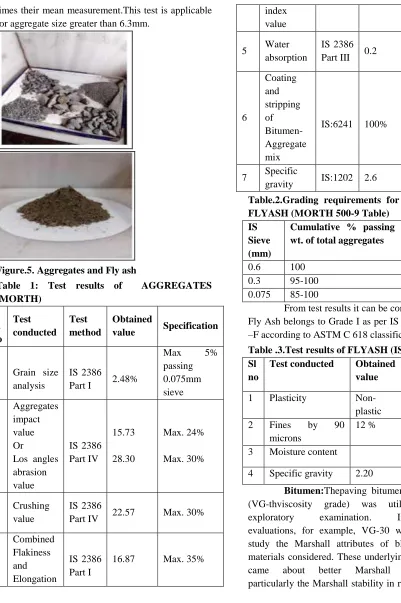
Aggregates are stored in crusher in different sizes separately. For this study various sizes of aggregates are taken from nearby Quarry,sizes varying from 19.00mm to 0.075mm and the same shown in figure.here 2% by total weight of filler replaced by fly ash is used as mineral filler.Flyash mineral filler is procured from Raichur thermal power plant.The requirement of properties of fine and coarse aggregates are shown in Table.4.1.
Evaluation of Aggregates:Different shapes of aggregates are available in size range such as cubical,rounded,flaky and elongated. Flaky and elongated particles shows less strength and durability
compared to cubical shapes of aggregates.
Henceforth excessively flaky and a lot of elongatedparticlesavoided as much aspossible.Visual observation is the better technique to identifying the shape of aggregates.
times their mean measurement.This test is applicable for aggregate size greater than 6.3mm.
Figure.5. Aggregates and Fly ash
Table 1: Test results of AGGREGATES (MORTH)
Sl. No
Test conducted
Test method
Obtained
value Specification
1 Grain size
analysis
IS 2386
Part I 2.48%
Max 5%
passing 0.075mm sieve
2
Aggregates impact value Or
Los angles abrasion value
IS 2386 Part IV
15.73
28.30
Max. 24%
Max. 30%
3 Crushing
value
IS 2386
Part IV 22.57 Max. 30%
4
Combined Flakiness and Elongation
IS 2386 Part I
16.87 Max. 35%
index value
5 Water
absorption
IS 2386
Part III 0.2 Max. 2%
6
Coating and stripping of Bitumen-Aggregate mix
IS:6241 100%
Minimum retained coating 95%
7 Specific
gravity IS:1202 2.6 2.5-3.2
Table.2.Grading requirements for mineral filler FLYASH (MORTH 500-9 Table)
IS Sieve (mm)
Cumulative % passing by wt. of total aggregates
Obtained value
0.6 100 100
0.3 95-100 98
0.075 85-100 88
From test results it can be concluded that the Fly Ash belongs to Grade I as per IS 3812 and Class –F according to ASTM C 618 classification.
Table .3.Test results of FLYASH (IS 3812-1981) Sl
no
Test conducted Obtained value
Specification
1 Plasticity
Non-plastic
Non-plastic
2 Fines by 90
microns
12 % Max. 20%
3 Moisture content -
4 Specific gravity 2.20 1.9 -2.96
Bitumen:Thepaving bitumen grade VG-30
(VG-thviscosity grade) was utilized in this
exploratory examination. Initially,bitumen
evaluations, for example, VG-30 were utilized to study the Marshall attributes of blends with the materials considered. These underlying preliminaries
came about better Marshall characteristics,
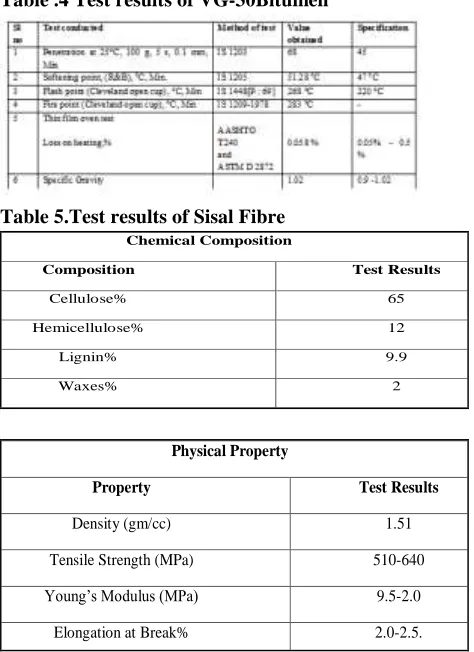
made up of fly ash and Fiber with VG-30 bitumen as binder. The physical qualities of VG-30 bitumen tried according to IS guidelines are given in table.
Table .4 Test results of VG-30Bitumen
Table 5.Test results of Sisal Fibre
Chemical Composition
Composition Test Results
Cellulose% 65
Hemicellulose% 12
Lignin% 9.9
Waxes% 2
Physical Property
Property Test Results
Density (gm/cc) 1.51
Tensile Strength (MPa) 510-640
Young’s Modulus (MPa) 9.5-2.0
Elongation at Break% 2.0-2.5.
Experimental Design:
The adopted gradation for Bituminous Concrete Grade-2is specified in MORTH. and is given in Table-Throughout the experimental study the aggregate gradation used are shown in Table 4.6, and the following tests were performed. The aggregate gradation curve is indicated in figure.
Table 6.Aggregate Gradation BC-2
0 50 100
0.01 1 100
%
f
in
e
s
Sieve size mm
Upper limit
Lower limit
Obtained gradation
Figure.6 BC-2 Gradation
Proportion of Materials
20mm down
12mm down
6.3mm down dust Total
0.120 0.280 0.240 0.360 1.000
Gradation is applied as stated above and performance characteristics are done as follows.
(i) Marshall stability test. (ii) Indirect tensile strength test. (iii)Tensile strength ratio. (iv)Retained stability test.
(v) Fatigue Test.
Design mix
The Bituminous Concrete blends were set up as per the Marshall method indicated in ASTM D6927-2015. All elements of blend, for example, coarse aggregates, fine aggregates, filler, Fiber and VG-30 bitumen were blended in a predefined methodology. Before setting up the specimens, Fibers were covered with SS-1 emulsion and put away in a sight-seeing oven at 1100C as Coated Fiber are put
bitumen that may stick to Fiber, Then the Fibers were cut into indicated lengths of about 10mm - 15mm changing the rates of 0.1 to 0.3% of the aggregate blend as given in figure. The aggregates and bitumen
were heated independently to the blending
temperature of 1550C to 1600C. The temperature of
the aggregates was kept up 1000C higher than that of
the binder. Required amounts of bitumen VG-30 and covered emulsion Fiber pieces were added to the pre-heated aggregates and altogether blended as appeared in Figure.
Figure.7.Coating of emulsion on Fibre and Oven dry Fibre
Figure.8.Cutting of coated Fibre, Addition and mixing of Fibre
Figure.9.Preparation of Marshall specimens
In the preparation of mix manual mixing is done until consistency is achieved.Time taken for mixing is about 2-5 minutes.at the temperature range between 150-160 degree celcius.Prepared mix is put into pre-heated Marshall mould and compaction is
done by Automatic compactor with 75 blows on each side.
Indirect tensile test
Static indirect tensile test of bituminous blends was performed in understanding to ASTM D 6931 (2007) to assess the resistance to thermal cracking for a Marshall cylindrical shaped saample that is stacked in vertical polar plane as appeared in figure 4.6. This tests were completed on Bituminoous Concrete example which were set up at their optimum binder content, optimum Fiber content as determined from Marshall propeties investigation. The impact of temperature on the Indirect Tensile Strength (ITS) of blends with and without Fiber was likewise considered. The load at which tensile split were create in the saample were noted down from the dial gauge of the proving ring and was determined.
Figure 10. Loading and failure pattern of indirect tensile strength test
Where St= Indirect Tensile strength, kPa
P = Maximum Load, kN
T = Specimen height before testing, mm
D = Specimen Diameter, mm
III.ANALYSIS OF RESULTS AND
DISCUSSION
investigation are given beneath. Second area manages computation and correlation of optimum binder content, optimum Fiber quantity of Bituminous concrete blends with and without flyash cinder utilized as a filler. Third segment manages performance tests conducted on bituminous mixes
such as Static Indirect tensile test,moisture
susceptibility and retained stability tests.
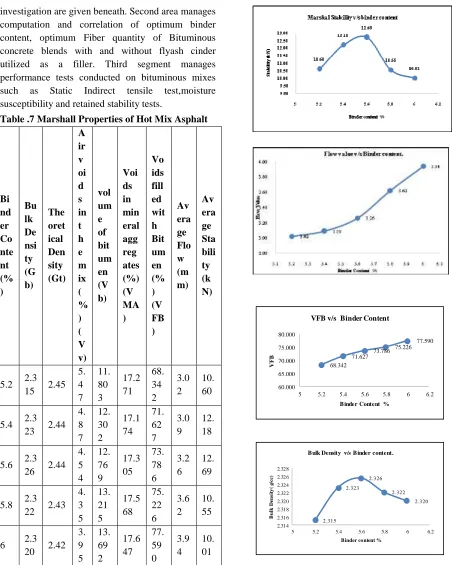
Table .7 Marshall Properties of Hot Mix Asphalt
Bi nd er Co nte nt (% ) Bu lk De nsi ty (G b) The oret ical Den sity (Gt) A ir v oi d s in t h e m ix ( % ) ( V v) vol um e of bit um en (V b) Voi ds in min eral agg reg ates (%) (V MA ) Vo ids fill ed wit h Bit um en (% ) (V FB ) Av era ge Flo w (m m) Av era ge Sta bili ty (k N)
5.2 2.3
15 2.45
5. 4 7 11. 80 3 17.2 71 68. 34 2 3.0 2 10. 60
5.4 2.3
23 2.44
4. 8 7 12. 30 2 17.1 74 71. 62 7 3.0 9 12. 18
5.6 2.3
26 2.44
4. 5 4 12. 76 9 17.3 05 73. 78 6 3.2 6 12. 69
5.8 2.3
22 2.43
4. 3 5 13. 21 5 17.5 68 75. 22 6 3.6 2 10. 55
6 2.3
20 2.42
3. 9 5 13. 69 2 17.6 47 77. 59 0 3.9 4 10. 01 68.342 71.627 73.786 75.226 77.590 60.000 65.000 70.000 75.000 80.000
5 5.2 5.4 5.6 5.8 6 6.2
V
F
B
Binder Content %
VFB v/s Binder Content
2.315 2.323 2.326 2.322 2.320 2.314 2.316 2.318 2.320 2.322 2.324 2.326 2.328
5 5.2 5.4 5.6 5.8 6 6.2
B u lk D en si ty ( g/ cc )
Binder content %
3.60 3.80 4.00 4.20 4.40 4.60 4.80 5.00 5.20 5.40 5.60
5 5.2 5.4 5.6 5.8 6 6.2
%
o
f
air
v
oid
s
Binder content %
% of air Voids v/s Binder Content
Figure 11.Marshall properties of bituminous concrete mixes.
From the graphs OBC is
Name OBC
Marshall Stability v/s Bitumen Content 5.60%
Density v/s Bitumen Content 5.60%
Percent Voids v/s Bitumen Content 5.93%
OBC 5.71%
9.00 11.00 13.00 15.00 17.00 19.00
5 5.2 5.4 5.6 5.8 6 6.2
M
A
R
S
H
A
L
S
T
A
B
IL
IT
Y
(
kN
)
BINDER CONTENT (% )
Marshall stability v/s Bitumen Content (%)
2.00 2.50 3.00 3.50 4.00 4.50
5 5.2 5.4 5.6 5.8 6 6.2
F
LO
W
(m
m
)
B INDER CONTENT (% )
Flow Value v/s Bitumen C ontent
0.00 1.00 2.00 3.00 4.00 5.00 6.00 7.00
5 5.2 5.4 5.6 5.8 6 6.2
AI
R
VOI
DS
(%
)
BINDER CONTENT (%)
Air voids in the mix
30.000 40.000 50.000 60.000 70.000 80.000 90.000 100.000
5 5.2 5.4 5.6 5.8 6 6.2
VF
B
(
%
)
BINDER CONTENT (%)
Voids filled with bitumen%
2.320 2.340 2.360 2.380 2.400 2.420 2.440
5 5.2 5.4 5.6 5.8 6 6.2
B
UL
K
DE
NS
IT
Y
(g/cc
)
BINDER CONTENT (%)
Bulk density (gm/cc)
Figure.12.Marshall properties of bituminous concrete mixes(0.1% sisal fibre).
From the graphs
Name OBC
Marshall Stability v/s Bitumen Content 5.80%
Density v/s Bitumen Content 5.75%
OBC 5.68%
IV . Conclusions
Stability is very important criteria in any of
the bituminous mix, here a modified bituminous mix(adding 0.2% sisal Fibre and 2% fly ash with replacement of mineral filler) shows better stability compare to conventional bituminous mixes.
Indirect tensile strength shows better in
modified bituminous mix. Shows better cohesion.
Tensile strength ratio is increasing gradually
in modified mixes it shows better coating of emulsion and high resistance to moisture damage.
Repeated load application leads to fatigue
cracking. Fatigue life is more in modified mixes compare to conventional bituminous mixes.
Binder content for conventional method is
5.71% and modified mix is 5.6% it shows the 1.96% reduction in binder content for modified mix.
Overall, Modified bituminous mix shows
better performance in structural layer (rainfall area,coastal regions) compared to conventional mixes.
References
[1]. A
li, N., Chan, J. S., Simms, S., Bushman, R., & Bergan, A. T.; “Mechanistic evaluation of fly ash asphalt concrete mixtures”. Journal of Materials in Civil Engineering, (1996), 8(1), 19-25.
[2]. B
oyes, A. J.; “Reducing moisture damage in asphalt mixes using recycled waste additives” Diss. California Polytechnic State University, San Luis Obispo, (2011).
[3]. C
hakroborty, P., & Das, A. “Principles of Transportation Engineering”, Prentice Hall of India, New Delhi, (2010), pp 294-299.
[4]. C
olonna, P.; Berloco, N., Ranieri, V., & Shuler, S. T.
(2012), “Application of bottom ash for pavement binder course.”,Procedia-Social and Behavioral Sciences 53 (2012): 961-971.
[5]. G
unalaan, V.; “Performance On Coal Bottom Ash In Hot Mix Asphalt” International Journal of Research in Engineering and Technology, (Aug 2013) eISSN: 2319-1163 | pISSN: 2321-7308.
[6]. H
adiwardoyo, S. P.; “Evaluation of the addition of short coconut Fibres on the characteristics of asphalt mixtures.” Civil and Environmental Research 3.4 (2013): 63-73.
[7]. S
takston, A.D., and Bahia, H. (2003). The Effect of Fine Aggregate Angularity, Asphalt Content and Performance Graded Asphalts on Hot Mix Asphalt Performance, University of
[8]. W
isconsin – Madison, Department of Civil and Environmental Engineering, Submitted to Wisconsin
Department of Transportation, Division of
Transportation Infrastructure Development, Research Coordination Section, WisDOT Highway Research Study 0092-45-98.
[9]. Z
aniewski, J.P., and Srinivasan, G. (2004). Evaluation of Indirect Tensile Strength to Identify Asphalt Concrete Rutting Potential, Asphalt Technology Program, Department of Civil and Environmental Engineering, West Virginia University, Performed in
Cooperation with the U.S. Department of
Transportation - Federal Highway Administration
[10]. Ministry Of Road Transport & Highways