PROCONVUSANT ACTIVITY OF HYPERICUM PERFORATUM L. EXTRACT POWDER AND ITS INTERACTION WITH PHENYTOIN AND CLONAZEPAM
IN WISTAR RATS
Radhika MS1, Patil PA2*, Patil MI2, Mayur SS3
1Dept. of Pharmacology, S.D.M College of Medical Sciences and Hospital, Dharwad,
India
2Department of Pharmacology, J.N. Medical College, Belgaum, India
3Dept. of Community Medicine, S.D.M College of Medical Sciences and Hospital,
Dharwad, India
Summary
Hypericum perforatum L. (HP) is an herbal antidepressant, which acts by inhibiting non-selectively, the reuptake of neurotransmitters like norepinephrine (NE), GABA, dopamine (DA), serotonin (5HT) and glutamate. Though its antidepressant and anxiolytic activities are well documented, there is a paucity of information about its effect on convulsions. The present study therefore aims at exploring the influence of HP on convulsions and its interactions with commonly used anticonvulsants viz…phenytoin and clonazepam in Wistar rats. HP, phenytoin and clonazepam in their therapeutic equivalent doses were evaluated on convulsions induced by maximum electroshock seizure (MES), pentylenetetrazol (PTZ) and isoniazid (INH).For the interaction studies, HP was coadministration with phenytoin in MES studies and with clonazepam in PTZ and INH studies. HLE, number of seizures, duration of seizure and time for onset and recovery from seizures were monitored. HP failed to protect the rats in MES studies and worsened the seizures induced by PTZ as well as INH. It also reversed the protective effects of phenytoin in MES and of clonazepam in PTZ and INH seizure models. The findings of the present study suggest that HP possesses proconvulsant activity and might compromise the efficacy of anticonvulsant therapy, if the findings of the present study could be extrapolated to humans.
Key words: Hypericum perforatum; Interaction; Isoniazid; Pentylenetetrazole; Maximum electroshock seizure.
*Corresponding author:
Patil P. A., Professor,
Pharmacologyonline 3: 240-246 (2009) Radhika et al.
PROCONVUSANT ACTIVITY OF HYPERICUM PERFORATUM L. EXTRACT POWDER AND ITS INTERACTION WITH PHENYTOIN AND CLONAZEPAM IN
WISTAR RATS
Radhika MS1, Patil PA2*, Patil MI2, Mayur SS3
1Dept. of Pharmacology, S.D.M College of Medical Sciences and Hospital, Dharwad, India 2Department of Pharmacology, J.N. Medical College, Belgaum, India
3Dept. of Community Medicine, S.D.M College of Medical Sciences and Hospital, Dharwad,
India
Summary
Hypericum perforatum L. (HP) is an herbal antidepressant, which acts by inhibiting non-selectively, the reuptake of neurotransmitters like norepinephrine (NE), gamma amino butyric acid (GABA), dopamine (DA), serotonin (5HT) and glutamate. Though its antidepressant and anxiolytic activities are well documented, there is a paucity of information about its effect on convulsions. The present study therefore aims at exploring the influence of HP on convulsions and its interactions with commonly used anticonvulsants viz…phenytoin and clonazepam in Wistar rats. HP, phenytoin and clonazepam in their therapeutic equivalent doses were evaluated on convulsions induced by maximum electroshock seizure (MES), pentylenetetrazol (PTZ) and isoniazid (INH).For the interaction studies, HP was coadministration with phenytoin in MES studies and with clonazepam in PTZ as well as INH studies. HLE, number of seizures, duration of seizure and time for onset as well as recovery from seizures were monitored. HP failed to protect the rats in MES studies and worsened the seizures induced by PTZ as well as INH. It also reversed the protective effects of phenytoin in MES and of clonazepam in PTZ and INH seizure models. The findings of the present study suggest that HP possesses proconvulsant activity and might compromise the efficacy of anticonvulsant therapy, if the findings of the present study could be extrapolated to humans.
Key words: Hypericum perforatum; Interaction; Isoniazid; Maximum electroshock seizure; Pentylenetetrazol.
*Corresponding author: Patil P. A., Professor, Dept of Pharmacology and
Pharmacologyonline 3: 240-246 (2009) Radhika et al.
Introduction
Hypericum perforatum L. also called as St John’s Wort is an herbal preparation, best known for its antidepressant properties.1 It also possesses nootropic, antioxidant, analgesic and
anti-inflammatory properties.1,2 It has been reported to act by inhibiting non-selectively, the reuptake
of neurotransmitters like NE, GABA, DA, 5HT and glutamate. 2, 3 As it increases NE and
GABA levels in the brain, it could be expected to possess anticonvulsant and anxiolytic activity.
Though its anxiolytic property is well documented, the reports on its anticonvulsant activity are scanty and accordingly it has been reported to attenuate effects of phenytoin, carbamazepine, phenobarbitone and precipitate convulsions.4 As, it has also been reported that
HP increases excitatory neurotransmitter glutamate5, 6, it could be expected to possess
proconvulsant activity. In view of these controversial findings, it was decided to explore the activity of HP on convulsions induced by MES, PTZ and INH in Wistar rats.
As HP is a known enzyme inducer 7, 8 and is also an over the counter (OTC) drug, it
could be expected to interact with concurrently administered drugs; in fact, such interactions of
HP with some antiepileptics viz… phenobarbitone, phenytoin and carbamazepine have been reported4 but there is paucity of such information with clonazepam. Therefore, the present study
was also planned to explore the interactions of HP with phenytoin and clonazepam in the above said models of epilepsy.
Materials and methods
Animals: Healthy, male, adult, Wistar rats weighing 150± 30g (procured from Central Animal House of the Institute) were maintained on standard pellet diet (Amrut Brand, Sangli) with water ad libitum and acclimatized to the departmental laboratory for a week in 12 h light and dark cycle. The animals were starved over night with free access to water prior to the day of experimental procedures. The study was approved by Institutional Animal Ethical Committee constituted as per CPCSEA guidelines.
Drugs and chemicals: Powder of HP extract (Indian Herbs Research and Supply Co. Ltd, Saharanpur. UP.), Phenytoin (Kare labs Pvt Ltd. Verna.Goa), Isoniazid and Pentylenetetrazole (Rajesh Chemicals, Mumbai) were obtained as generous gift samples from respective sources. Clonazepam (Clonotril) was purchased from the local market.
Experimental design: HP (powder) extract and clonazepam was suspended in 2% gum acasia while phenytoin was dissolved in saline. The animals were divided into groups (n=6) to receive either test drugs (HP, phenytoin/ clonazepam) or vehicle (gum acasia/ saline). Single therapeutic equivalent doses of all the drugs were administered orally as calculated with the help of conversion table.9 For all experiments, HP was administered 2.5 hrs before while
Pharmacologyonline 3: 240-246 (2009) Radhika et al.
1. Maximum Electricshock Seizures (MES):MES were induced as described by Toman et al. (1946) 10 with an alternating current of 150 mA delivered through the ear clip electrode
for 0.2 sec with the help of convulsiometer. Absence of HLE was taken as protection against seizures. Only the animals which showed HLE during screening procedure on the earlier day were included in the study.
2. Pentylenetetrazole (PTZ) induced seizures: In the present study the chemical convulsant, PTZ was used in the dose of 50 mg/kg i.p. to induce convulsions as described earlier by Louis et al. (1982). 11 Control animals within 30 min developed a sequence of
excitement, myoclonic jerks and clonic seizures. The anticonvulsant activity was assessed by decrease in the number, duration as well as recovery time and increased time for onset of seizures.
3. Isoniazid (INH) induced seizures: In the present study INH was used in the dose of 200mg/kg i.p. to induce convulsions as described by Vogel G.H. (2002). 12 Typical clonic
convulsions were seen within 5-6 min of administration in control animals. The test drugs were assessed for altering the number of seizures, duration of seizure and time for onset as well as recovery or number of deaths from seizures.
For interaction studies HP was co-administered with phenytoin and clonazepam in separate groups (n=6, in each) and the animals were subjected for MES, PTZ and INH induced seizures in the same way as in the previous experiments.
Statistical analysis: The data was analyzed by Fisher’s exact test in MES and by ANOVA followed by Dunnet’s post-hoc test in case of PTZ and INH induced seizures. p≤0.05 was considered significant.
Results
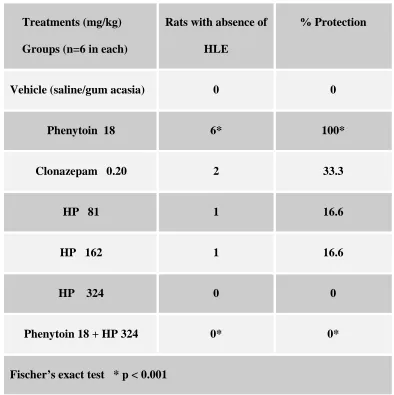
MES studies: HP in its therapeutic equivalent dose of 81 mg or in incremental doses of 162 and 324 mg did not offer significant protection against seizures. While phenytoin in its therapeutic equivalent dose offered significant (100% p<0.001) protection but clonazepam failed to significantly (33.33% p=0.5) protect animals against MES induced seizures. (Table 1) In interaction studies, HP 324 mg when coadministered with therapeutic equivalent dose of phenytoin, reduced significantly (p<0.001) the protective effect of phenytoin (Table 1).
Pharmacologyonline 3: 240-246 (2009) Radhika et al.
INH studies: HP 81 mg significantly increased only the number of seizures (p<0.001) while, HP 162 mg significantly increased the number (p<0.001) and duration (p<0.001) of the seizures. However, HP 324mg significantly decreased the seizure onset time (p<0.01), increased the number (p<0.001) as well as duration of seizures (p<0.01).HP in 324 mg dose produced 50% mortality.Clonazepam significantly (p<0.001) protected all the rats from INH seizures while phenytoin worsened the INH seizures.
In the interaction studies, HP 324 mg significantly (p<0.01) reduced the protective effect of clonazepam. (Table 2)
Discussion
HP in any of the doses tested could not offer significant protection against MES induced seizures and worsened the seizures induced by PTZ as well as INH. There is paucity of information regarding similar studies of HP. In the interaction studies, HP decreased anticonvulsant activity of phenytoin in MES and of clonazepam in PTZ as well as INH seizures and precipitated seizures in treated groups. HP treatment has been reported to precipitate convulsions in epileptic patients on phenytoin therapy and this has been attributed to the induction of hepatic microsomal enzymes by the former. 7, 8
The main objective of the present study was to explore the interaction between HP and the commonly used antiepileptics. The limitation of the study is its inability to characterize the nature of the interaction since plasma levels of the drugs have not been monitored. However, interaction at the absorption site can be ruled out as there was 30 min gap between the administrations of the two drugs but it is difficult to rule out the possibility of the increased metabolism of phenytoin and clonazepam by microsomal enzymes induced by HP 7, 8
contributing for the interaction, as it is not known whether a single dose of HP could induce the microsomal enzymes. The findings of the present study and the earlier reports of HP on the central synaptic neurotransmitter levels tempt to suggest pharmacodynamic rather than pharmacokinetic effects contributing for the interaction.
Extrapolating the present findings to the clinical situation considering the fact that HP is an OTC drug and hence is accessible to anyone including epileptic patients on phenytoin or clonazepam; it could precipitate convulsions as a result of its interaction. Thus, it is reasonable to propose that the use of HP should be avoided in epileptic patients.
Pharmacologyonline 3: 240-246 (2009) Radhika et al.
Table 1: Effect of various treatments and their combinations on MES.
Treatments (mg/kg) Groups (n=6 in each)
Rats with absence of HLE
% Protection
Vehicle (saline/gum acasia) 0 0
Phenytoin 18 6* 100*
Clonazepam 0.20 2 33.3
HP 81 1 16.6
HP 162 1 16.6
HP 324 0 0
Phenytoin 18 + HP 324 0* 0*
Pharmacologyonline 3: 240-246 (2009) Radhika et al.
Table 2: Effect of various treatments in PTZ and INH seizures.
Groups ( n=6 in each)
PTZ seizures INH seizures
Treatment (mg/kg)
Onset time (min)
Number Duration (sec)
Recovery time (min)
Onset time (min)
Number Duration (sec)
Control (saline/gum
acasia)
3.00±0.52 1.17±0.17 60.67±4.30 65.83±3.75 4.33±0.56 1.67±0.21 169.7±25.93
Phenytoin 18 2.58±0.14 2.62±0.31** 74.50±4.30* 62.50 ±2.14 2.97 ±0.22** 2.67±0.21*** 230.0±5.47
HP 81 2.53±0.19 2.83±0.17*** 76.33±2.03* 68.33±2.47 3.77±0.20 2.83±0.17*** 220.8±17.81
HP 162 1.83±0.12** 1.67± 0.21*** 81.67± 1.67* 70.33±3.13 3.60±0.17 2.83±0.17*** 273.2±12.68***
HP 324 1.65± 0.11 ** 2.83± 0.17*** 84.67±1.33* 75.33±2.40 2.98±0.19** 3.17±0.17*** 276.0±12.12**
Clonazepam 0.20
0.00±0.00*** 0.00±0.00*** 0.00±0.00*** 0.00±0.00*** 0.00±0.00*** 0.00±0.00*** 0.00±0.00***
Clonazepam 0.20 + HP 324
3.05±0.23 2.33±0.21 68.33±1.20 71.50±2.28 3.90±0.29 3.00±0.00 255.3±8.89**
Pharmacologyonline 3: 240-246 (2009) Radhika et al.
Acknowledgement
The authors are grateful to the Principal, J. N. Medical College, Belgaum for providing facilities. Thanks to Mr. Mallapur (Biostastician), Mr. A. V. Karvekar and Mr. M. D. Kankanwadi for their skilful assistance. Authors acknowledge Indian Herbs Research and Supply Co. Ltd, Saharanpur. UP, Kare labs Pvt. Ltd. Verna. Goa and Rajesh Chemicals, Mumbai for supplying the drug samples.
References
1. Linde K, Ramirez G, Mulrow CD, Pauls A, Weidenhammer W, Melchart D. St John’s wort for depression – an overview and meta analysis of randomized clinical trials. BMJ 1996; 313: 253-58.
2. Kumar V, Singh PN, Bhattacharya SK. Neurochemical studies on Indian Hypericum perforatum L. Ind J exp Biol 2001 ; 39 : 334-38.
3. Calapai S, Crupi A, Firenzuoli F, et al. Effects of hypericum perforatum on levels of 5-hydroxytryptamine, noradrenaline and dopamine in the cortex, diencephalon and brainstem of the rat. J Pharm Pharmacol 1999; 51: 723-28.
4. Barnes J, Anderson LA, Phillipson DJ. St John’s wort (Hypericum perforatum L); a review of its chemistry, pharmacology and clinical properties. J Pharm Pharmacol 2001; 53 : 583-600
5. Langosch JM, Zhou XY, HeinenM, et al. St John’s wort (Hypericum perforatum) modulates evoked potentials in guinea pig hippocampal slices via AMPA and GABA receptors. European Neuropsychopharm 2002; 12(3): 209-16.
6. Wonnemann M, Singer A, Muller WE. Inhibition of synaptosomal uptake of 3 H-L-glutamate and 3H-GABA by hyperforin, a major constituent of St. John’s wort : The role of amiloride sensitive sodium conductive pathways. Neuropsychopharmacology 2000; 23(3): 188-97.
7. Tannergren C, Engman H, Knutson L, et al. St John’s wort decreases the bioavailability of R-and S-verapamil through induction of the first pass metabolism. Clin pharmacol ther 2004; 75: 298-309.
8. Mueller SC, Vehleke B, Woehling H, et al. Effect of St John’s Wort dose and preparations on the pharmacokinetics of digoxin. Clin Pharmacol ther 2004; 75: 546-557.
9. Paget GE and Barnes JM. Toxicity tests. In: Laurence, D. R. and Bacharach, A. L. Evaluation of drug activities: Pharmacometrics. Academic press. London and New York, 1964: 135-166.
10. Toman JEP, Swinyard EA, Goodman LS. Properties of maximal seizures and their alteration by anticonvulsant drugs and other agents. J.Neumophysiol 1946; 9: 231-39. 11.Louis WJ, Papanicolaou J, Summers RJ, and Vajda FJ. Role of central β- adrenoreceptors in