PROMOTION OF PRESERVATION AND CONSERVATION IN GREEK LIBRARIES WITH SPECIAL REFERENCE
TO THE EDUCATION OF GREEK LIBRARIANS
MARIA SKEPASTIANOU
Thesis submitted in fulfilment of the requirements for the degree of
Doctor of Philosophy in Library and Information Sciences University of London
School of Library, Archive and Information Studies
ProQuest Number: 10046016
All rights reserved
INFORMATION TO ALL USERS
The quality of this reproduction is dependent upon the quality of the copy submitted.
In the unlikely event that the author did not send a complete manuscript and there are missing pages, these will be noted. Also, if material had to be removed,
a note will indicate the deletion.
uest.
ProQuest 10046016
Published by ProQuest LLC(2016). Copyright of the Dissertation is held by the Author.
All rights reserved.
This work is protected against unauthorized copying under Title 17, United States Code. Microform Edition © ProQuest LLC.
ProQuest LLC
789 East Eisenhower Parkway P.O. Box 1346
To George, Veta,
A C K N O W L E D G E M E N T S
My greatest debt is to my supervisor Mr J.H.St.J, Mcllwaine for his support, guidance and advice leading to the completion of the thesis. I would like to extend my gratitude to Dr I.C. Mcllwaine for her valuable suggestions.
I would also like to thank all my colleagues who provided me promptly with information necessary for my research, the Public Benefit Foundation "Alexandros S. Onassis" for financial assistance during the last two years of my research and Mr Aref Makooi for his support when most needed.
A B S T R A C T
This research concerns the promotion of preservation and conservation in Greek Libraries and the education of Greek librarians on preservation issues. Firstly the problems of the current situation are investigated. Based on a question naire survey, the factors which affect Greek library materials have been identified. To further substantiate the results of the questionnaire, a book collection survey was conducted. The study reveals the inadequate housing and environmental conditions of the library collections of the libraries sur veyed which results from a lack of awareness concerning pre ventive preservation measures, lack of preservation programmes and limited conservation education, limited resources for conservation activities, the weak organisational structure and funding of Greek libraries in general. It concludes that unless the existing situation is reversed, collections will continue to deteriorate resulting in the loss of valuable components of the Greek cultural heritage.
d) promotion of communication and cooperation at local, national and international level and e) addressing national issues such as use of acid-free paper, translation and use of standards and guidelines, research projects, promotion of the creation of conservation and microfilming centres.
C O N T E N T S
Acknowledgements 1
Abstract 2
Contents 4
List of Tables 9
List of Graphic Presentations (Figures) 10
List of Appendices 12
List of Charts 13
List of Maps 13
PART A
Introduction 15
1. GREECE 27
1.1 Education 27
1.2 Environment 29
1.3 Economy 32
1.4 Paper Production 33
1.5 Book Production 37
1.6 Libraries 39
1.7 Library Education in Greece 59
1.8 Greek Librarians' Association 68
References 71
2. NATURE, STRUCTURE AND REASONS FOR THE
DETERIORATION OF PRINTED MATERIAL. THEIR
PRESERVATION AND CONSERVATION. 73
2.1 Introduction 73
2.2 Nature and Structure of Printed Material 74
2.3 Reasons for Deterioration 82
2.3.1 Internal Reasons 82
2.3.2 External Reasons 88
2.4 Preservation and Conservation 94
Reference 98
3. PRESERVATION AND CONSERVATION EDUCATION IN
GREECE 100
3.1 Preservation Education 101
3.1.1 Technological Educational Institutions
Library School Departments. 101
3.1.2 University of the Ionian. Archive and
Library Studies Dept. 103
3.1.3 Libraries and Preservation Education 105
3.2 Conservation Education 105
3.2.1 Technological Educational Institution. School of Graphic and Art Studies.
Department of Conservation of Antiquities
and Works of Art 106
3.2.5 Hellenic Organisation of Small and Medium
Sized Industries and Handicrafts 113 3.2.6 Private School of Conservation 114
References 116
4. IDENTIFICATION OF FACTORS AFFECTING THE
GREEK LIBRARY MATERIALS. 117
4.1 Introduction 117
4.1.1 Type of Library Materials and Libraries 124 4.1.1.1 Type and Size of Printed Collections 125 4.1.2 Factors Affecting Greek Library Materials 127 4.1.2.1 Printed Material According to Publication
Date 127
4.1.2.1.1 Publication Dates and Types of Libraries 127 4.1.2.2.1 Buildings Housing Greek Libraries 130 4.1.2.2.2 Construction Date of Surveyed Libraries 131 4.1.2.2.3 Purpose Built Constructions 132 4.1.2.2.4 Purpose Built Building According to
Construction Date 134
4.1.2.2.5 Problems of Purpose Built Constructions 136 4.1.2.2.6 Problems of Non Purpose Built Constructions 136
4.1.2.3 Location of Libraries 137
4.1.2.3.1 Specific Area Location of the Libraries 138
4.1.2.4 Staff in Greek Libraries 139
4.1.2.4.1 Qualified and Unqualified staff 141
4.1.2.5 Hazards 143
4.1.2.5.1 Personal Evaluation of Potential Hazard
to the Collections 143
4.1.2.5.2 Other Hazards Indicated by the Respondents 145
4.1.2.6 Bio-deterioration Factors 145
4.1.2.7 Disasters in Greece 146
References 147
5. BOOK COLLECTION SURVEY. 148
5.1 Introduction 148
5.2 5.2.1
Aristotelian University of Thessaloniki. Main Library
Publication Dates and Size of Collections
151 152
5.2.2 Places of Publication 153
5.2.3 Paper Condition 154
5.2.4 Paper Condition and Places of Publication 155
5.2.5 Mould and Pest Stains 156
5.2.6 Covering Material and Cover Condition 157
5.2.7 Other Comments 159
5.3 Public (dimotiki) Library of Thessaloniki 161 5.3.1 Results of the Survey. Closed Stacks 162 5.3.1.1 Publication Dates and Size of Collections 162
5.3.1.2 Places of Publication 163
5.3.1.3 Paper Condition 164
5.3.1.4 Paper Condition and Places of Publication 165
5.3.1.5 Mould and Pest Stains 166
5.3.1.6 Covering Material and Cover Condition 167
5.3.1.7 Other Comments 169
5.3.2.1 Publication Dates, Places of Publication
and Paper condition 170
5.3.2.2 Covering Material and Cover Condition 171
5.3.2.3 Other Comments 173
5.3.2.4 Total Results on the Paper Condition of the
Public Library Survey 173
References 175
6. PRESERVATION AND CONSERVATION SITUATION IN
GREEK LIBRARIES 176
6.1 Activities on Preservation and Conservation 176 6.2 Reasons Hindering Preservation and
Conservation Activities 177
6.3 Current Preservation Activities 183
6.4 Conservation Situation 185
6.5 Conservation & Microfilming Dept, at the
Greek National Library 188
References 190
Part A. Summary and Conclusion 191
PART B
7. PRESERVATION POLICY PROGRAMMES. THE PROBLEMS OF IMPLEMENTING THEM IN GREEK
LIBRARIES 206
7.1 Preservation Policy Programmes 208
7.1.1 Evaluation of Preservation and Conservation
Needs 208
7.1.2 Preventive Measures 210
7.1.2.1 Disaster and Security Plans 212
7.1.2.2 Staff and User Education 213
7.1.3 Collection Management and Development 214
7.1.4 Cooperation 215
7.1.5 Conservation Treatments and Procedures 216 7.1.5.1 Preservation of the Artefact. Conservation
Treatments 218
7.1.5.2 Preservation of Intellectual Content.
Substitution 222
7.2 Preservation Manager: Duties and Required
Qualifications 225
7.3 Preservation Policy Programmes in Greek
Libraries: the Problems 227
References 237
8. NATIONAL PRESERVATION COMMITTEE 239
8.1 Establishment, Aims, Priorities and
Structure 240
8.1.1 Promotion and Increase of Awareness 246
8.1.2 Education 253
8.1.3 Promotion of Implementation of
8.1.4 Information and Consultancy Services 262
8.1.5 Communication/Cooperation 266
8.1.6 National Issues 268
8.1.7 Economics and Location of the National
Preservation Committee 273
References 277
9. PRESERVATION POLICY PROGRAMMES FOR GREEK LIBRARIES. THEIR IMPLEMENTATION AND
INTEGRATION 278
9.1 Preservation Policy Programmes for Greek
Libraries 278
9.1.1 Evaluation of Preservation and
Conservation Needs 278
9.1.2 Preventive Measures 282
9.1.3 Disaster and Security Plans 287
9.1.4 Staff and User Education 291
9.1.5 Collection Development and Management 292 9.1.6 Communication and Cooperation 293 9.1.7 Conservation Treatment in Greek Libraries 294 9.1.7.1 Conservation Service Options 294 9.1.7.2 Substitution Service Options 295 9.1.7.3 Considerations for Conservation and
Substitution Services 296
9.2 Implementation and Integration of the Preservation Policy Programmes in Greek
Libraries 301
9.2.1 Options for Planning the Preservation
Programmes 302
9.3 Preservation Managers in Greek Libraries 308 9.4 Preservation's Position in the Libraries'
Organisation 310
9.5 Integration of Preservation Progrsunmes 312
References 315
10. CONSERVATION AND MICROFILMING CENTRES
IN GREECE 317
10.1 Establishment of the Conservation and
Microfilming Centres 318
10.2 Financial Support 319
10.3 Cooperation and Coordination of
Conservation and Microfilming Centres 320 10.4 Considerations for Conservation and
Microfilming Centres 320
10.5 Mass Conservation Treatment in Greece 325 10.5.1 Mass Conservation Assessment Group 326
11. PRESERVATION EDUCATION IN GREECE:A PROPOSAL 328 11.1 Preservation Education at the TEI Library
School Departments 328
11.2 Preservation Education at the Archive and Library Dept, of the University of the
Ionian 335
11.3 Post-graduate Course in Preservation
Management 338
References 343
Part B. Summary 344
Recommendations 357
Appendices 364
LIST OF TABLES
Table Page
1.1 Illiteracy in Greece 28
1.3 Structure of Gross Domestic Product 32
1.4.1 Total Papers and Boards 33
1.4.2 Total Graphic Papers and Boards 33 1.4.3 Mechanical Woodpulp for Paper and Board
Manufacturing 33
1.4.4 Woodpulp for Paper and Board Manufacturing 33 1.4.5 Uncoated Printing, Writing Paper, Board 34 1.4.6 Coated Printing, Writing paper. Board 34 1.4.7 Other Print & Writing Paper 34 1.4.8 pH of Imported Printing Paper 36
1.5.1 Book Production 1987-1991 37
1.5.2 Importation and Exportation of Books
and Pamphlets; 1980, 1985,1990 38
1.6. Greek Libraries 39
1.6.1 Size of Collections at the Greek National
Library 42
1.6.1.1 Acquisitions by the Greek National
Library: 1986-89 43
1.6.1.2 Additions to the Greek National
Library: 1987-89 43
1.6.1.3 Greek National Library: Staff and
their Educational Level 45
1.6.1.4 Greek National Library: Staff Distribution
According to Specialty 46
1.6.2 Greek Universities 49
1.6.2.1 Greek Colleges of University Level Standing 50 1.6.2.2 Greek University Libraries: Size of
the Collections 51
2.1 pH Scale 85
3.1 Cultural Foundation of the National Bank:
Paper and Fine Art Conservation Graduates 110 3.1.1 Cultural Foundation of the National Bank:
Binding Graduates 110
4.1 Number and Type of Libraries Surveyed 121 4.1.1 Type of Libraries and No. of Responses 122 4.2 Type of Library and Type of Material 124 4.3 Total Number of Staff According to Type
of Library 140
4.3.1 Greek Libraries: Qualified &
LIST OF GRAPHIC PRESENTATIONS (Figures)
Figure Page
1.1 Greece. Average Seasonal Temperature 1987-1990 29 1.2 Greece. Average Seasonal R. Humidity 1987-1990 30 1.3 University of the Ionian. Archive & Library
Studies Dept. % Distribution of Core Subjects 66 1.4 University of the Ionian. Archive & Library
Studies Dept. % Distribution of Subjects 67 4.1 Greek Libraries. Printed Collections. Books 125 4.2 Greek Libraries. MSS Collections 126 4.3 Greek Libraries. Publication Dates of
Holdings (books) 128
4.4 Greek Libraries. Date of Establishment 129 4.5 Greek Libraries. Publication Dates of Holdings
by Type of Libraries 130
4.6 Greek Libraries. Construction Dates 132 4.7 Greek Libraries. Purpose Built Buildings 133 4.8 Greek Libraries. Purpose Built Buildings
According to Type of Libraries 134
4.9 Greek Libraries. Purpose Built Buildings
According to Construction Date 135
4.10 Greek Libraries. General Area Location 137 4.11 Greek Libraries. Total No. of Staff 139 4.12 Greek Libraries. Qualified and
Unqualified Staff (1) 141
4.13 Greek Libraries. Qualified and
Unqualified Staff (2) 142
4.14 Greek Libraries. Hazards' Evaluation 144 5.1 Aristotelian University of Thessaloniki.
Book Survey. Publication Dates &
Size of Collection 152
5.2 Aristotelian University of Thessaloniki.
Book Survey. Major Places of Publication 153 5.3 Aristotelian University of Thessaloniki.
Book Survey. Paper Condition 154
5.4 Aristotelian University of Thessaloniki. Book Survey. Paper Condition &
Places of Publication 155
5.5 Aristotelian University of Thessaloniki.
Book Survey. Mould Stains 156
5.6 Aristotelian University of Thessaloniki.
Book Survey. Pest Stains 157
5.7 Aristotelian University of Thessaloniki. Book Survey. Covering Material &
Publication Dates 158
5.8 Aristotelian University of Thessaloniki.
Book Survey. Cover Condition 158
5.9 Aristotelian University of Thessaloniki.
Book Survey. Other Comments and Paper Condition 160 5.10 Public Library of Thessaloniki. Book Survey.
Closed Stacks. Publication Dates by Size
of Collection 162
5.11 Public Library of Thessaloniki. Book Survey.
5.12 Public Library of Thessaloniki. Book Survey.
Closed Stacks. Paper Condition by Publication Date 164 5.13 Public Library of Thessaloniki. Book Survey.
Closed Stacks. Paper Condition by Places
of Publication 165
5.14 Public Library of Thessaloniki. Book Survey.
Closed Stacks. Mould Stains 166
5.15 Public Library of Thessaloniki. Book Survey.
closed Stacks. Pest Stains 167
5.16 Public Library of Thessaloniki. Book Survey. Closed Stacks. Covering Material by Publication
Date 168
5.17 Public Library of Thessaloniki. Book Survey.
Closed Stacks. Cover Condition 168
5.18 Public Library of Thessaloniki. Book Survey.
Closed Stacks. Other Comments by Paper Condition 169 5.19 Public Library of Thessaloniki. Book Survey.
Open Stacks. Publication Dates 170
5.20 Public Library of Thessaloniki. Book Survey.
Open Stacks. Paper Condition by Publication Date 171 5.21 Public Library of Thessaloniki. Book Survey.
Open Stacks. Covering Material 172
5.22 Public Library of Thessaloniki. Book Survey.
Opens Stacks. Cover Condition 172
5.23 Public Library of Thessaloniki. Book Survey. Open and Closed Stacks. Paper Condition by
Publication Date 174
6.1 Greek Libraries. Preservation and Conservation
Activities 176
6.2 Greek Libraries. Reasons Hindering PAC Activities 178 6.3 Greek Libraries. Staff by Users 180 6.4 Greek Libraries. Staff by Size of Collections 180 App. N.l Greek Library Buildings. Future Plans
App. N.2 Greek Library Buildings. Future Plans by Type of Libraries
App. N.3 Greek Library Buildings. Future Plans: Indications
LIST OF APPENDICES
Appendix Page
A Seasonal Temperature and Relative Humidity
1987-1990 365
B Publishers' Questionnaire 370
C Technological Educational Institution.
Library School Curriculum 371
Cl University of the Ionian. Archive and Library
Studies Dept. Curriculum. Stream: Librarianship 372 C2 KATEE Library School Curriculum 1977-1981 375 D Recommended Bibliography for the Education of
Preservation at the Archive and Library
Studies Dept, of the University of the Ionian. 376
E Questionnaire No. 1 378
El Questionnaire No. 2 380
F Type and Size of A/V Collections in the
Surveyed Libraries 383
G Approximate Size of Collection According
to Date-groups and Types of Libraries 385 H Area Location with One Responding Library 387 I University and Public Library Collection
Condition Survey Form 388
II Explanatory Notes for Codes Used in the
Survey Form 389
12 Aristotelian University of Thessaloniki.
Main Library. Publication Dates. 390 13 Aristotelian University of Thessaloniki.
Main Library. Places of Publication 391 14 Aristotelian University of Thessaloniki.
Main Library. Paper Condition 392
15 Aristotelian University of Thessaloniki.
Main Library. Mould Stains 393
16 Aristotelian University of Thessaloniki.
Main Library. Pest Stains 394
17 Public Library of Thessaloniki (dimotiki).
Closed Stacks. Publication Dates. 395 18 Public Library of Thessaloniki (dimotiki).
Closed Stacks. Places of Publication 395 19 Public Library of Thessaloniki (dimotiki).
Closed Stacks. Paper Condition 396
110 Public Library of Thessaloniki (dimotiki).
Closed Stacks. Mould Stains 397
III Public Library of Thessaloniki (dimotiki).
Closed Stacks. Pest Stains 398
J Model of Preservation Options 399
K Public Library of Thessaloniki (dimotiki).
Organisation Chart 400
L Regions of Greece 401
M Basic Selected List of Titles for Translation 402 N Future Plans for Library Buildings 406 0 Specimen Layouts for Conservation and Microfilming
Facilities. Conservation Facilities. 409 01 Specimen Layouts for Conservation and Microfilming
P Specific Duties and Required Qualifications for
Conservators and Conservation Technicians 415 Pi Job Description of Microfilming Unit Staff 418 Q Technical Information and Paramétrés of Selected
and Tested Mass Deacidification Methods 421 Q1 Comparative Table of Mass Deacidification
Processes 423
Q2 Comparative Table of Mass Deacidification
Strengthening Processes 424
LIST OF CHARTS
Chart Page
1.1 Greek National Library (GNL). Organisation
Chart 41
8.1 National Preservation Committee: Structure 245 App. K Public Library of Thessaloniki (dimotiki)
Organisation Chart 400
LIST OF MAPS
Map Page
4.1 Specific Area Location of the Libraries 138 App. H Area Location with One Responding Library 387
I N T R O D U C T I O N
Greece is a country which is known best for its ancient history and classical authors as for example Plato, Euripides, Sophocles. The great empire created under Alexander the Great, has through the centuries, been reduced to a small country on the Balkan Peninsula. People are reminded every four years of the origins of the Olympic geunes and of course there are the remains of that era especially the Parthenon in Athens, Phaestos in Crete, Delphi, Dion and Vergina in Macedonia which are now main tourist attractions. Their preservation and conservation have made it possible for them to stand where they were first erected and still be a "live" part of the Greek cultural heritage.
The state having recognised the historic and cultural value of both ancient remains and buildings which represent various periods from an architectural point of view has established bodies within ministries (Ministry of Cultural Affairs and Ministry of Environment, Planning and Public Works) the main concern of which is to keep them in the best possible condition. There are seven Advisory Committees around the country for the Preservation and Conservation of Classical and Historic buildings which either undertake the restoration of the buildings themselves or supervise works being undertaken by the owners of buildings which have been classified as
"preservable".
and certainly not only these archaeological remains and architectural structures. Historical, social and political events and achievements in various fields have been recorded on paper and these too are part of the cultural heritage of the country and its people. Unlike the ancient remains these records which are equally or even more vulnerable have not been preserved as they ought to. They are kept in libraries and archives throughout the country in conditions which are far from the desirable or unacceptable. It is common knowledge amongst Greeks that rare manuscripts and books disappear from libraries and are found being sold in auctions. As most of the older and occasionally very rare material is not recorded it can not be proved that they came from a specific institution. Occasionally the buyer is the institu tion or establishment itself from where the item(s) disap peared. In many cases however, the bidder is an individual and possibly a foreign one and this of course means that the item is taken out of the country. The above example could well be attributed to loose security measures, an issue related to the preservation of library material.
of Greek libraries' operations was slowly strengthened. The preservation knowledge acquired during my library studies abroad and the image of the state of materials in the libraries visited led to the topic of this thesis.
The original thought that preservation and conservation were totally absent from the Greek libraries had to be established by facts and the reasons for their absence explained. To achieve that, my principal objective was to identify the main factors that have led to the deterioration of materials held in Greek libraries not only in terms of physical causes but also in terms of existing organisational, administrative and educational conditions; to discover whether any preservation and/or conservation activities were being employed, and to ascertain the librarians' own perceptions of their conserva tion needs and activities.
Although no research had been done in relation to the reasons of deterioration in Greek libraries the factors which affected material worldwide were undoubtedly affecting material in Greek library collections.
imported paper used by Greek publishers; the nature of library buildings and the condition of stock which was examined through sample condition surveys.
These findings enabling the establishment of the existence of the problem, other aspects had to be examined, the outcome of which would provide material for the illustration of the pres ent preservation and conservation situation in Greek libraries. These aspects included; the librarians' awareness of the materials' deterioration; whether any actions were taken to reverse the situation; the reasons through which librarians justified the non-existence of preservation and conservation activities, the nature of the existing education for conservators and that of preservation education for librarians. To complete the intended illustration of the Greek libraries' situation in relation to preservation and conservation it seemed necessary that the professional struc ture and attitudes were presented and analysed.
Having collected data on the existing situation and attitudes, this is then analysed as the basis for making proposals for a wide range of actions that might be taken to improve the situation.
A total number of four surveys were conducted and as the medium for retrieving the required information the distribu tion of questionnaires to selected libraries was chosen.
location of the libraries in relation to atmospheric pollu tion, increased relative humidity levels, etc. the age of the building housing the collections in relation to security offered by the building itself and "internal" environment, etc. the original purpose of the building housing the collections and the problems faced, etc.); factors which were seen by Greek librarians as harmful to Greek library material and an indication of the existence of any activities in relation to their preservation and conservation (chapter four). This same questionnaire aimed at establishing information as to the number of staff employed in each library, the approximate annual number of users and approxi mate size of specific date groups relating to the publication dates of the material housed in the various types of libraries surveyed. This kind of data was required so as to explain and establish the differences among the various types of libraries in Greece from what is considered to be the norm in other countries.
The second questionnaire was directed to those libraries which had indicated that they were conducting preservation and conservation activities in order to further examine these (chapter six). This questionnaire aimed at extracting data related to preservation policy aspects, (as for example the existence of a disaster plan, the existence of users' guides for proper handling of the material, the existence and description of facilities, etc.).
During the process of analysing the data received, information related to the pH level of the paper produced and used in Greek publications seemed necessary. This third survey was addressed to the publishers and paper manufacturers both in Greece and abroad (chapter one).
My employment at the Library School of the Technological Educational Institution of Thessaloniki made possible the fourth survey which was concerned with the examination of the state of collections in two libraries in the northern part of Greece (chapter five).
The thesis comprises two parts. In part A (chapters one to six) the findings of the surveys conducted are presented and analysed along with other relevant information which would enable the reader to establish an idea not only of the preservation and conservation situation in Greek libraries but of the surrounding professional structure and attitudes as well.
present situation in terms of personnel, administration and funding are described followed by a brief general account of the publics' relation to libraries.
The library education currently offered by the two Library Schools of the Technological Educational Institutions (TEI) is described followed by a portrayal of the newly established Archive and Library Studies Dept, at the University of the Ionian. The last section of this chapter illustrates the state of the Greek Librarians' Association.
The nature and structure of printed materials, the reasons for their deterioration and a brief introduction to their preservation and conservation are the content of the second chapter.
Prior to the presentation of the results of the main survey which was concerned with the factors affecting the Greek library materials, the nature of the existing preservation education for librarians and that of the education of conservators are presented in the third chapter.
Library Studies Dept, at the University of the Ionian.
The fact that conservation itself is considered part of preservation and the fact that the state of the Greek conservators education had to be assessed for the needs of the thesis made it essential that the nature of their education be presented as part of this chapter. "Conservation Educa tion" therefore, describes the variety of establishments and institutions offering this specific type of education.
The findings of the survey conducted in the selected libraries in relation to the factors affecting Greek library collections is the content of the fourth chapter.
Besides the information required as to the internal and external reasons of decay, data referring to the main types of material housed in Greek libraries emerged.
employed in the surveyed libraries.
The sample book collection surveys conducted in the central library of the Aristotelian University of Thessaloniki and the Public library in the same area are analysed and presented in chapter five, whereas the librarians' own perceptions of their conservation needs and activities are presented and discussed in chapter six.
Part A ends with an inclusive summary of all chapters followed by the conclusions derived from the findings which support the initial hypothesis in connection with the absence of preserva tion and conservation activities in Greek libraries and the reasons which have resulted in this absence.
Bearing in mind the facts which have led to the situation described in Part A as well as the present and future possibilities for altering the preservation and conservation state in Greek libraries some possible solutions to the present problems have been proposed. These solutions are presented in Part B of the thesis.
Chapter seven presents and describes desirable preservation policy programmes, their content, and the reasons why the application of each one of them is required for prolonging the useful life of library materials. The problems of implement ing such programmes in Greek libraries are identified and discussed.
undertake the task of altering the situation is proposed, a National Preservation Committee which would aim at promoting and increasing the awareness of librarians and that of the general public, the promotion of various aspects of education as for example educational material, the inclusion of preservation education in library schools curricula and the establishment of an additional conservation department. It would play an active role in the implementation of pres ervation policies in Greek libraries, provide information and consultancy services, and encourage communication and cooperation and promotion of other various issues of national interest.
Chapter nine suggests some possible ways for the preservation policy programmes to be applied by Greek libraries. Chapter seven having described the content (what) and the reasons^hy) the preservation policy programmes should be applied, in this chapter the means (how) and options for their application are offered which would conform with the libraries' situation. Besides the suggestions offered for the programmes themselves, ways to implement and integrate them within the various
library types are proposed.
Chapter eleven is concerned with a proposal for preservation education in Greece. It proposes introductions and changes in the present curriculum of the TEI Library schools and the Archive and Library Studies Dept, of the University of the Ionian. The establishment of a course intended for preserva tion managers is also proposed as part of the latter.
An overall summary of the chapters comprising Part B is followed by a synopsis of the recommendations proposed for future action which could be potentially useful in developing policy.
with the fear of attempting to patronise Greek practices.
CHAPTER ONE
G R E E C E
The modern Greek state, the "Hellenic Republic" is located on one of the three major European peninsulas that reaches southward into the Mediterranean Sea, with a total area of 131,944 sq.km. (50,944 sq. miles) and population 10,264,156 [^] almost one third of which is concentrated in the Athens region, the capital of the country.
Greece secured its independence from Turkey in 1830. After freedom from German occupation in the 2nd World War, there was a civil conflict. From April 1967 until July 1974 the country was ruled by a military junta. Greece was declared a republic in June 1973 and this was confirmed by a referendum in December 1974. A new republican constitution was introduced in June 1975. It has been a member of Unesco and the EC since
1946 and 1981 respectively.
1.1 EDUCATION
Greece offers a free educational system which is compulsory for the first level of education-primary (duration six years) and the first part of the second level of education (duration three years) and optional for the remainder.
> compulsory The three educational levels are:
1. Primary starting at the age of five. --2. Secondary level of education
2 a. gymnasion duration three years --2 b. lykio duration three years
3. Third level of education
— Technological Educational Institutions (TEI)
— Universities (Anotata Ekpedeftika Idrymata) (AEI)
In spite of the free educational system offered in Greece, statistics reveal that the illiterate population for 1981 and 1990 was as follows:
Table 1.1 [^] Illiteracy in Greece
Age Total No. % Male % Female % 1981 Total
Population
15+ 701,056 9.5 3.9 14.7
1990 Estimates 15+ 548,400 6 . 8 2.4 10.9
1.2 ENVIRONMENT 1.2.1 CLIMATE
The Greek climate is described as Mediterranean, that is a climate which is characterised by dry summers, wet and some times stormy winters.
Temperature and Relative Humidity The levels of temperature and relative humidity in Greece, are typical of its climate (Figures 1.1 and 1.2), with increased levels of temperature and low levels of relative humidity in the summer and low levels of temperature and high levels of relative humidity in the winter seasons. Seasonal levels of temperature and relative humidity appear at Appendix A.
Greece
Average Seasonal Temperature 1987-1990
1987
Year
1988 e n 1989
S o u r c e : N a t i o n a l S t a t i s t i c a l S e r v i c e o f G r e e c e S t a t i s t i c a l Y e a r t j o o k o f G r e e c e , v o l s . 3 4 - 3 7 . A t h e n s N S S G , 1 9 8 9 - 1 9 9 2
u
-Winter C" Spring 0 * Summer C* Autumn C~
1987 9.5 12.6 25.6 18.1
1988 9 14.9 26.7 16.6
1989 8.5 16 24.7 16.8
1990 8.9 16.2 16.8 18.4
1990
Figure 1.1
Greece
Average Seasonal R. Humidity 1987-1990
1987 1988 1989 1990
Winter %
55.2 75 66.7 70.4
Spring %
69.2 66.4 63.2 61
Summer %
70 51.9 55.6 52.8 1987 Year
1988 □ 1989
S o u r c e : N a t i o n a l S t a t i s t i c a l S e r v i c e o f G r e e c e S t a t i s t i c a l Y e a r b o o k o f G r e e c e , v o l s 3 4 - 3 7 A t h e n s : N S S G , 1 9 8 9 - 1 9 9 2 .
Autumn %
75.2 65.1 66.7 68.9
1990
Figure 1.2
1.2.2 ENVIRONMENTAL POLLUTION
The problem of air-pollution in Greece appeared almost immedi ately after the 2nd World War. The main reasons are the high rate of industrialisation, the intense urbanisation and the high rate of economic growth. The principal sources of air pollution in Greece are considered to be vehicles, industry, power stations and central heating boilers. Nowadays, the main pollution problems are in the major cities - Athens, Kozani, Thessaloniki, Kavala, Patras, Volos, Iraklio: but other cities also have pollution problems.
Although seven cities have been mentioned as "main pollution problems" data is usually only available for the Athens area and not until recently for the Thessaloniki area.
Athens area Monitoring the air pollution was started in 1973 by measuring SOg and smoke.
In 1984 an automatic monitoring system was installed, which consisted of six stations and which measured continuously SOg, CO, NOg and O3. From the analysis of the data received from these stations it was estimated that the smoke levels were tending to decline; the levels of photochemical pollution (NO2 and O3) had increased; the levels at periphery stations were increasing as well.
For the Athens area the primary pollutants (smoke, SOg and CO) are at a maximum during the winter months (November - April), while the secondary pollutants (NOg and O3) are at a maximum during the summer months (May - October).[S]
Thessaloniki area A report discussing the air pollution in
the Thessaloniki area was published in 1988 and it concluded that primary pollutants (smoke, SOg, CO) are at a maximum during the winter months. There were no statistics for NOg and O3. [^] Population concentration in big cities, leading to the increase of the pollution sources as they have been described previously will result in higher levels of pollu tion.
^ European Environmental Yearbook, 2nd ed. (London: DocTer International U.K., 1991) 411-413.
1.3 ECONOMY
The Greek economy is a mixed one, with large agricultural and manufacturing sectors, each contributing 16% of gross domestic product. After a reduction in the importance of the agricul tural sector in the 1960s, its relative share has been main tained in the 1970s and first half of the 1980s.
Manufacturing developed rapidly in the 1980s, with clothing, textiles, petroleum products and iron and steel major exports. Shipping and tourism are important earners of foreign exchange.
Table 1.3
Structure of Gross Domestic Product % of total[^]
1960 1970 1980 1984
Agriculture 22 16 16 16
Manufacturing 15 17 17 16
Construction 6 7 8 6
Transport & Communication
6 6 7 7
Other 51 54 52 55
1.4 PAPER PRODUCTION
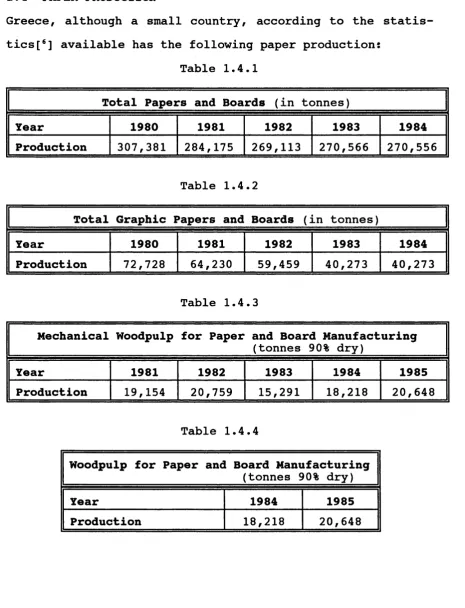
Greece, although a small country, according to the statis tics [®] available has the following paper production:
Table 1.4.1
Total Papers and Boards (in tonnes)
Year 1980 1981 1982 1983 1984
Production 307,381 284,175 269,113 270,566 270,556
Table 1.4.2
Total Graphic Papers and Boards (in tonnes)
Year 1980 1981 1982 1983 1984
Production 72,728 64,230 59,459 40,273 40,273
Table 1.4.3
Mechanical Woodpulp for Paper and Board Manufacturing (tonnes 90% dry)
Year 1981 1982 1983 1984 1985
Production 19,154 20,759 15,291 18,218 20,648
Table 1.4.4
Woodpulp for Paper and Board Manufacturing (tonnes 90% dry)
Year 1984 1985
Production 18,218 20,648
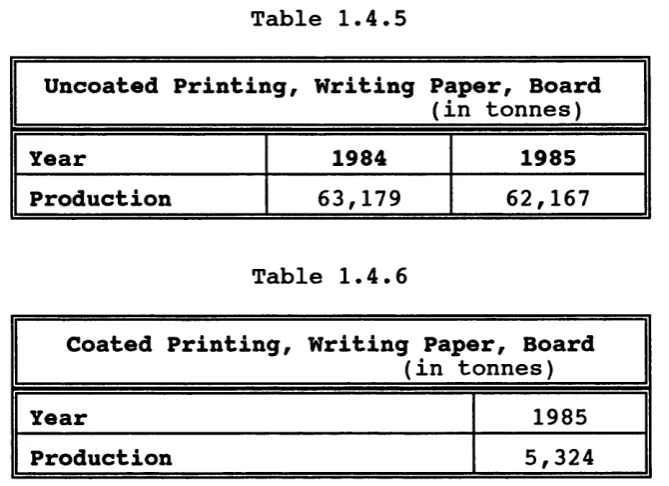
Table 1.4.5
Uncoated Printing, Writing Paper, Board
____________________ (in tonnes)
Year
Production 63,179
1984
62,167
1985
Table 1.4.6
Coated Printing, Writing Paper, Board
(in tonnes)
Year 1985
Production 5,324
The Statistical Yearbook published by Unesco [^] provides the following;
Table 1.4.7
Other Printing & Writing Paper [®]
Production Imports Exports Consumption Cons.per
1,000 inh.
1970 30,000 5,700 — — — 35,700 4,061
1975 35,000 34,300 300 69,000 7,628
1980 80,000 42,500 28,300 94,200 9,770
1985 70,000 46,300 3,200 113,100 11,385
1990 62,000 86,500 2,700 145,800 14,512
As one can see the imports since 1975 either equal the produc tion or are more than half of it. This can be explained by two reasons; either the production is not sufficient for the market's needs, or the quality is not the one required.
According to the results of a questionnaire[’] (see Appendix B) distributed to the 83 most productive Greek publishers, it was revealed that only two Greek paper-making companies were actually supplying them with printing paper while they complemented their needs by importing paper from other countries such as Austria, Spain, Portugal, former Yugoslavia, Sweden, Norway, Finland, Italy, Germany, Brazil, Argentina and Israel, either independently or through other paper importers. There were indications by some of the publishers that they preferred not to use paper produced in Greece due to its poor quality and unreliable and problematic delivery.
The main importer indicated by the publishers is the "News print Organisation" the activities of which include imports of printing paper besides newsprint. The Organisation has been active in imports since 1957 and it supplies around 70% of the country's needs in printing paper.
1.4.1 pH l e v e l
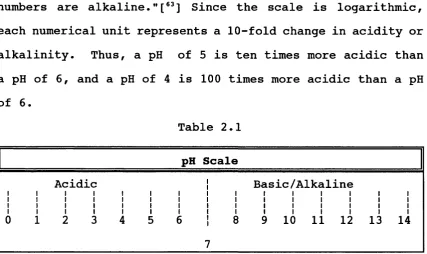
The level of acid in paper, one of the reasons which leads to its deterioration, (see page 84) is referred to as pH.
pH Level of Greek Paper-making Companies The two Greek paper- making companies, identified by the Greek publishers, were contacted so as to identify the pH level of the paper manufactured. One of them responded and indicated that the level of pH was 6-6.5.
pH Level of Imported Printing Paver The names and addresses
of a number of the paper companies which export printing paper to Greece were obtained and contact with them showed that the pH level of the paper they exported to Greece varied from 4.5 to 9. More explicitly:
Table 1.4.8
pH of Imported Printing Paper Name of country pH level
Brazil 4.5 + 0.5
Belgium 7
Portugal 9
Sweden 6
Due to the fact that Finland's production is totally alka line [^°] paper-making companies of that country were not con tacted.
1.5 BOOK PRODUCTION
The lack of a Greek National Bibliography until recently makes the identification of the approximate size of book production in Greece rather difficult. The appearance of the Greek National Bibliography in 1990 covering the books deposited under the legal deposit law in the Greek National Library in 1989 may be the beginning of a solution to other problems in the librarianship profession. It is agreed however, that it can not be a reliable source as to the approximate number of the country's book production due to the very loose nature of the legal deposit law.
The Statistical Yearbooks published by Unesco provide information as to the book production in Greece only for the year of 1990 and this totals 3,255.[“ ]
Another source is the annual cumulation of "ICHNEFTIS", a monthly guide to the books appearing in the Greek market. This guide is regarded as the most reliable source of informa tion as to the book production in Greece and it is usually referred to by the Greek National Library, the Ministry of Education and that of Cultural Affairs. The book production
for the 1987-1991 period was as follows: Table 1.5.1
Book Production 1987-1992
Year 1987 1988 1989 1990 1991 1992
No. of Books 2,348 2,400 2,640 2,870 3,130 3,465
11
It should be noted that in the number of books presented in the above tables the following categories are not included: reprints, official and private publications, books distributed to the University students and generally books that are not found in bookshops. This could explain the difference between the information provided by Unesco and that of "ICHNEFTIS". As shown in the following table the needs of the country are complemented by imports.
Table 1.5.2
Importation and Exportation of Books and Pamphlets: 1980, 1985 and 1990["]
Exports Imports Balance
1980 3.7 8. 1 - 4.4
1985 3.0 5.7 - 2.7
1990 5.0 31.3 -26.3
1.6 LIBRARIES
There is a number of sources which provide information as to the number of libraries in Greece the total numbers varying from source to source.
The Greek Ministry of C u l t u r e p r o v i d e s statistics which indicate that the total number of libraries in Greece is 600. Another source of s t a t i s t i c s p r o v i d e s the following:
Table 1. 6 Greek Libraries
Year Type Ad.
Units
Serv. Points
No. of Volumes
(0 0 0 )
Annual Additions
1989 National 1 1 2,500 11,830
1986 Public 615 615 8,296 213,784
1989 Non-special- ised [17]
758 758 7,492 216,221
1984 Special [1®] 1 00 884 2,363 52,489
The non-existence of any directory indicating the exact number of libraries presently functioning in Greece presents a prob lem to the researcher in any attempt to extract information required for any research.
National Statistical Service of Greece, Cultural Statistics (Athens: NSSG, 1986) 20-21.
15 Statistical Yearbook 1992 (Paris: Unesco, 1992) 7-27.
Data relating to Public libraries include the National and Special libraries.
Non-specialised libraries of a learned character which are neither libraries of institutions of higher education nor national libraries, though they may fulfil the functions of a national library for a specific geographic area.
Irrespective of the numbers each source reveals, Greek libraries may be distinguished into: National, Academic, Public, Special/Research and Monastic.
It is worth noting here that the one type of libraries Greece lacks is the School libraries.[^]
1.6.1 GREEK NATIONAL LIBRARY
The Greek National Library belongs to the Public sector and is under the control of the Greek Ministry of Education and Religion. Established in 1829, it was part of the National Museum at the Orphanage in Egina. In 1832 it was separated from the museum and functioned as a public library. It was transferred to Athens from Egina in 1834. In 1842 the Athens University library was established. The same year, this library was united with the public library and with a Royal decree in 1866 both libraries were united into one, the Greek National Library. The building which houses the library was built in 1903.
The main Law describing the library's administrative structure and organisation dates back to 1943. Although there have been some changes since then, the above mentioned law is still valid in its most basic elements with all the consequent results of an unmodified law in a progressing environment. In 1985 there was an unsuccessful attempt to modernise and update the 1943 law. The following chart illustrates the organisational structure of the GNL.
Chart 1.1
GREEK NATIONAL LIBRARY ORGANISATION CHART [ ]
MINISTRY OF EDUCATION AND RELIGION
1 1 1
1 1_______ ___1
I I
1 GNL Director |--- 1 Advisory | 1 Committee |
1 1 1 1 1 1
Acqui Cat. I I Reading MSS I ISerials Conser- 1 , Admn.1 sition Class. Room Office Office vation, |
1
1 Indexing Micro- 1
1
1 11 filming |
1
1 11 Finan.
ISSN National 11
ISBN Bibliogr. 11
Office Office 11
1 1 Administr. 1 1 Technical Binding ! Services 1 1 Bindery
The Greek National Library since 1943 has been the deposit library -under the legal deposit law 880/1943- for Greek or foreign language publications, published in Greece. Unfor tunately this law has been very loosely applied and it is only since 1988 when the ISBN and ISSN centres were established in the GNL that the results of the legal deposit system can be cross-checked with that of the above mentioned centres and used to identify part of the Greek book production. Until
then the GNL could identify new publications only through the publishers' lists. According to results appearing in the "Feasibility Study for the Automation of the Greek National Library" [21] in 1988 the coverage of the Greek publications reached 48% due to introduction of the ISBN. It is thought that the Greek publications deposited under the legal deposit law represents around 75% of the whole book production in the country. Literary works i.e.novels, deposited in the GNL reach 99% which is thought to be some 30% of the total book production.
Size of collections There is no exact figure as to the size
of the collections housed in the GNL. At the time of the above mentioned study the library's stock was estimated approximately as follows:
Table 1.6.1
Size of Collections at the Greek National Library
Type of No. of Annual
collection Titles Additions
Monographs 1,000,000 10,000[^^] Periodicals
21,000--Newspapers
3,500--Reprints 100
MSS 4,000
Documents 200,000 Microfilms 5,000
— > 900
2^ ELIDOC, Feasibilitv Study for the Automation of the Greek National Librarv. Phase A (Athens: ELIDOC, 1990) (in Greek, confidential report)
Acquisitions According to the same study acquisitions for the years 1986-1989 were as follows:
Table 1.6.1.1
Acquisitions by the Greek National Library 1986-89 Year Leg.Dep. Purch. Gifts Not regist.
[” ]
Total
1986 5,036 252 2,952 — — — — 8,240
1987 3,943 282 1,524 96 5,845
1988 4,222 1,106 1,492 600 7,420
1989[2*] 3,700 363 1,854 294 6 , 2 1 1
Since for certain reasons not all acquisitions are catalogued and some are left in warehouses the only way to identify the real number of additions is through the cataloguing statis tics, which show that:
Table 1.6.1.2
Additions to the Greek National Library 1987-89
Year Leg. Dep. Purchases MSS Gifts Total
1987 3,943 282 n.a. n.a. 4,225
1988 4,222 947 115 10 0 5,384
1989 [” ] 3,300 250 13 250 3,813
Comparing this table with the one provided by the Statistical Yearbook of Unesco one can see that there is a considerable
Refers to books which have no accession number and it is not known when they were acquired or who donated them.
Approximate figures. The study was conducted a few months before the end of 1989.
difference in the annual addition section provided by Unesco and the one indicated by the Feasibility study report. A possible explanation could be that the GNL provided to Unesco the total number of acquisitions rather than real additions.
In addition, there is a difference between the numbers pro vided by "ICHNEFTIS” (Table 1.5.1) at least for the year 1989 and the ones provided by the GNL as they are illustrated in Table 1.6.1.1.
For the previous years this could be justified by the fact that there were no statistics available within the GNL, but it can not be explained for the year 1989 since statistics were available.
Staff The Greek National Library has a staff of 94 persons
Table 1.6.1.3
Greek National Library: Staff and Their Educational Level
Section Post grad
studies BA grad TEI grad Secondary level educ Tech Assist Total Acquisi tions
— 3 2 6 — — 11
Cat/Clas Indexing
2 8 6 5 — — 19
MSS 2 3 — — — — 2 5
Reading room
1 2 5 12 2 21
Serials & newspa pers
— — 2 2 2 1 7
Microf ilming
— — — 2 1 — — 3
Conserva tion
— — 1 2 4 — — 7
Secretary — — 1 1 1 — — 3
Finance Dept.
1 2 1 1 — — 4
Assist ants
— — — — — 14 14
Total 6 23 21 32 18 94
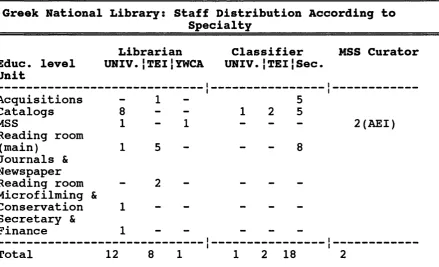
The two main categories of personnel are those of librarian
and classifier. The following table illustrates the GNL's
Table 1.6.1.4
Greek National Library: Staff Distribution According to Specialty
Educ. level Unit
Librarian Classifier MSS Curator UNIV.jTEl|YWCA UNIV.|TEIjSec.
Acquisitions
Catalogs 8
MSS 1
Reading room
(main) 1
Journals & Newspaper Reading room Microfilming & Conservation 1 Secretary &
Finance 1
2(AEI)
Total 12 8 1 2 18
The low number of employees and their employment status can be explained by the fact that the law governing the GNL (dated 1943) is such that new positions can not be created. The 29 non-permanent staff are employed under the "indefinite time employment" scheme which may last for ever or for only a few years.
Products The current Greek National Bibliography appeared in 1990, the first list of Greek Subject Headings in 1991 and the Greek Names Authority File in 1992. These products however, have not been circulated among the Greek libraries mainly due to the small number of copies produced, the inability so far to decide how these copies will be distributed and their price. It is worth noting here that the publication of the GNB has been suspended for administrative and financial reasons.
The problems the Greek National Library faces are adminis
trative, financial and those relating to personnel, space and equipment.
Administrative Although the law governing the GNL allows free
movement in relation to finance and administration the practice throughout the years has been that every minor detail was reported to the Ministry. The Advisory Committee, comprising members[^*] who do not necessarily have the desir able qualifications, interferes with the operation and function of the Library especially in issues such as organisation and automation.
Financial Although the budget of the GNL has been increased
over the years it remains small and sometimes it is not totally used.
Personnel Although there has been an increase to the budget, the library is considered understaffed due to the present governing law which does not allow further recruitment.
Space The building is old and does not provide adequate
accommodation for the preservation, circulation and use of the material. The lack of space also creates problems both to
staff and users.
Equipment The equipment of the GNL is inadequate not only as
far as automation is concerned but even to more trivial matters such as the lack of facilities for telephoning overseas.
1.6.2 ACADEMIC LIBRARIES
There are eleven Universities (multi-faculty) and five Univer sity level schools. Both types of institutions of the Anotata Ekpedeftika Idrimata (AEI) are of relatively recent origin.
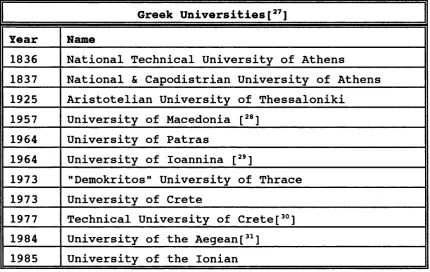
Table 1.6.2 Greek Universities Year Name
1836 National Technical University of Athens
1837 National & Capodistrian University of Athens 1925 Aristotelian University of Thessaloniki
1957 University of Macedonia [=*] 1964 University of Patras
1964 University of loannina
1973 "Demokritos" University of Thrace 1973 University of Crete
1977 Technical University of Crete [^°] 1984 University of the Aegean
1985 University of the Ionian
As shown in the table above the oldest Universities were founded in Athens and Thessaloniki. During the past 20 years, enthusiasm on the part of politicians to create more
The World of Learning 1993, 43rd ed. (London: Europa, 1992) 649-653.
Founded as Graduate Industrial School of Thessaloniki. Name change in 1991.
Founded as a branch of the Aristotelian University of Thessaloniki. Established as an independent University in
1970.
universities and other institutions of higher learning has led to the foundation of the above mentioned Universities.
It should be noted, however, that not all the departments of these Universities function due to financial and staffing problems. [ ^^ ]
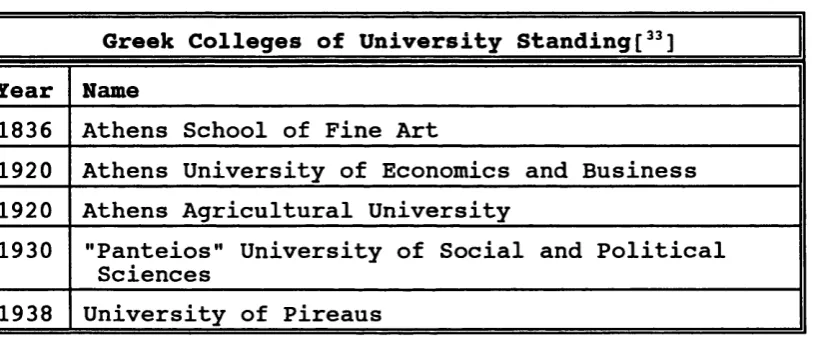
University Level Collèges
The following table illustrates the year the University level colleges were established.
Table 1.6.2.1
Greek Colleges of University Standing Year Name
1836 Athens School of Fine Art
1920 Athens University of Economics and Business 1920 Athens Agricultural University
1930 "Panteios" University of Social and Political Sciences
1938 University of Pireaus
With the exception of the National & Capodistrian University of Athens which technically shares the facilities of the National Library but in reality does not have a central library, all libraries have central or faculty and depart mental libraries. The number of departmental libraries varies
since they might exist in name but not in reality.
R.J. Hartley and I. Trohopoulos, "Information Technol ogy in Greek Libraries: Problems and Prospects," Program 24
(4) Oct. 1990: 333-342.
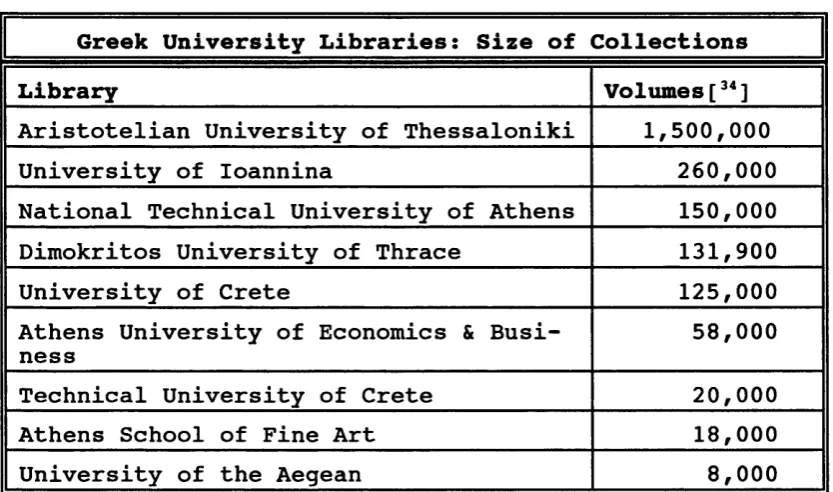
The following table illustrates the size of collections in nine of the sixteen universities, since data for all of them is not available.
Table 1.6.2.2
Greek University Libraries: Size of Collections
Library Volumes [3*]
Aristotelian University of Thessaloniki 1,500,000
University of loannina 260,000
National Technical University of Athens 150,000 Dimokritos University of Thrace 131,900
University of Crete 125,000
Athens University of Economics & Busi ness
58,000 Technical University of Crete 2 0 , 0 0 0
Athens School of Fine Art 18,000
University of the Aegean 8 , 0 0 0
Also at the tertiary level of education are the Technological Educational Institutions which resemble the former British Polytechnics and were established in 1977. There are 11 TEI covering almost the whole geographical area of the country. These are in: Athens, Halkida, Heraklion (Crete), Kavala, Kozani, Larisa, Mesologi, Patras, Piraeus, Serres and Thessaloniki. These institutions provide as their name indi cates mainly technological education. No source of informa tion is available as to the number of libraries in these institutions and the size of their collections.
The personnel of these libraries is recruited on the basis of
joint approval by the Ministry of Education and the Ministry of Finance.
Each Academic and Technological Educational Institution establishment is a self governing body.
1.6.3 PUBLIC LIBRARIES
The modern public library movement dates from just after the Second World War. The Greek Public libraries encompass three basic types according to their legal status, administrative responsibility and target group. These are; dimosies,
dimotikes and pedikes.
There are 40 dimosies including the Greek National Library which has already been described. They are each based upon
a nomos, which is an administrative unit similar to the
each of the 52 nomoi which make up the whole country.
The dimotikes libraries are governed by library committees
consisting of the mayor and community leaders of the munici pality or the respective local authority. There is no legal obligation on the municipalities to provide these libraries with the obvious result that there is a variation as to the number of these libraries presently functioning. Funding for this type of library varies widely according to the availabil ity of funds and the support of the mayor, local politicians and private donations. Personnel for these libraries are hired and paid by each respective dimos.
This funding variation is obviously reflected in the services provided by the dimotikes libraries. "The municipal (dimotiki) library of Thessaloniki, the second city of Greece with a population of more than one million, is probably the best developed municipal library. Currently the staff oper ates a central library and 14 branch libraries, [some of which are devoted solely to children], from within a directorate which also has responsibility for an art gallery and an orchestra."[35] This library is the exception rather than the norm which is described by Dewe[^®].
R.J. Hartley and I. Trohopoulos, "Information Technol ogy in Greek Libraries: Problems and Prospects," Program 24
(4) Oct. 1990: 335.
Later legislation did not provide for the qualification of library personnel in Public (both dimosies and dimotikes) libraries. As an effect the directors appointed were univer sity graduates usually from the faculty of law or economics, and there were no stipulated educational requirements for other library employees. Although this situation has changed since 1991 and there are specific library educational require ments as to the qualifications of both directors and librar ians, the vast majority of positions have been filled through the years with unqualified personnel, who under the latest law will have to reach the age of 65 to be replaced.
Apart from this change, in 1991 the Minister of the Interior announced that 800 librarians would be employed in the Public libraries.[^] Although this has not been realised yet, this move on the part of the government shows that they do recognise the need for a sufficient number of staff in the libraries.
The pedikes or children's libraries in rural areas were orig
inally funded by the Ministry of Agriculture mainly due to the interest expressed by a former minister of agriculture1 The original intention for these libraries was to move the control over to the Ministry of Education. However, due to certain reasons on behalf of the Greek Ministry this has not yet been realised and since 1989 they have been totally funded by a French philhellene [^®]. These libraries are managed by the
37 Makedonia 20 May 1991. (Thessaloniki, Greece)
Centre of the Child and the Adolescent Book which is under the authority of the General Secretary of New Generation.
Although there is a more or less finite number for the dimosies libraries, there is confusion as to the number of the dimotikes. The information provided by the Greek Ministry of Culture (see page 39) and that provided by Unesco (Public and Non Specialised) differs considerably (see page 39, Table 1.6). The only justification for the large number of these libraries reported can be the number of "communities" existing, where each one is supposed to have a library; but this is far from the reality. According to another source the dimotikes libraries could be 400. [*°]
1.6.4 SPECIAL/RESEARCH LIBRARIES
This type of library has emerged in the past fifteen years mainly due to the information needs of scientists. Some belong to public organisations and some to private cor porations. Again the estimated number of Special libraries, the vast majority of which is concentrated in the Athens area, varies considerably amongst the sources available. The number of Special libraries provided by the directory of Special Libraries in the Athens region is 1 4 8 . Comparing this to
"Community" is any geographical area with less than 10,000 registered inhabitants.
R.J. Hartley and I. Trohopoulos, "Information Technol ogy in Greek Libraries: Problems and Prospects," Program 24
(4) Oct. 1990: 333-342.
the number of Special libraries given by Unesco as shown at Table 1.6 one can see that there is a big difference in the information provided by these two sources. It should be noted here that each of the above mentioned libraries (148) repre sents one respective administrative unit.
1.6.5 MONASTIC LIBRARIES
Another type of libraries exists in the monasteries. Monastic libraries in Greece are difficult to identify due to the fact that such information is not available and consequently this hampers any attempt at identifying whether there are libraries in all of them and what the content of their collections is. Where these libraries exist, they are almost exclusively for and used by monks and with great difficulty by a handful of researchers [^^]. The most famous monastic libraries are those located at Mount Athos. The "Holy Mountain" as is known to Greeks is located on the easternmost prong of the Halkidiki Peninsula in the Aegean Sea. Today Mount Athos is an autonomous state under the Greek Republic. For spiritual matters, Athos is responsible to the Patriarch of the Eastern Orthodox Church in Constantinople, Turkey. In matters of governance, a representative council from the monasteries rules. A governor, small police force, and a few administra tors maintain the law and order according to Athos'
tional charter on behalf of the Republic.["] In reality however, the Republic has no authority whatsoever over Athos. Admission to the area (women have been forbidden since 885 A.D.) presupposes a permit from the Ministry of Macedonia and Thrace in Thessaloniki (for foreigners), and visits are limited to three nights. Guests are not permitted to spend more than one night in a single place. "Access to the
libraries is granted only with permission of the Patri arch" an extremely rare case. Although Shafer implies that the status is changing in Mount Athos as far as the accessibility to the material of libraries is concerned in fact the situation has radically changed since 1988 [*S] and access is now almost impossible for outsiders.
In contrast to the situation described in relation to the libraries of Mt. Athos, a small number of important monastic libraries provide a more liberal accessibility to their collections. One such example is the St. John monastery, at the island of Patmos. (see pages 112-113)
Greeks and Libraries Greeks as a whole are not familiar with
and therefore regular users of libraries.
This civil governor, appointed by the government is responsible for public order outside the monasteries.
S.L. Shafer, "A Librarian's Journey to Mount Athos," Ohio Media Spectrum 39 (4) 1987: 16.