The Impact Of Website Design Features On
Behavioral Intentions
Chun-Chin Chiu, Hao-Erl Yang
Abstract: The design of a website interface plays an important role in online purchasing, and customers are more likely to visit and buy from better-designed websites. However, previous studies have not provided consistent information about the features a website should provide. Based on Hausman and Siekpe’s (2009) comprehensive model, this study aims to empirically verify whether the model can be applied in e-service markets to predict and explain website users’ behavioral intentions (trade intentions and revisit intentions). Based on the data from a survey of 303 Internet users, the results indicate that computer factors and human factors, the key website design features, are significantly related to website users' experiences: perceived usefulness, perceived entertainment value, and perceived informativeness, in turn, significantly affect the intermediary outcomes of attitude toward the site and, ultimately, influence users' behavioral intentions.
Index Terms: Website Design Features, Uses and Gratifications Theory, TAM, Irritation, Flow Theory, Behavioral Intentions. ——————————◆——————————
1
I
NTRODUCTIONRecently, firms have made efforts to apply Internet technologies to improve the design of their websites to ensure quality in customers’ interaction experience (Al-Qeisi, Dennis, Alamanos, & Jayawardhena, 2014). In online shopping environments, a website interface serves as the "online storefront" for customers to interact with the online retailer, and to experience and evaluate the quality of service manifested by the website design (Zhang & von Dran, 2002). Previous studies have found that the website design interface plays an important role in online purchasing during customers’ initial experiences with an online retailer, as the website design elements and the interaction experience influence customers' initial beliefs and subsequent behavioral intentions (Wells, Valacich, & Hess, 2011; Al-Qeist et al., 2014) and customers are more likely to visit and buy from better-designed websites (Mithas, Ramasubbu, Krishnan, & Fornell, 2007). However, previous studies have not provided consistent information about the features a website should provide. For example, Hausman and Siekpe(2009)used computer factors and human factors, which can be referred to as utilitarian and hedonic characteristics, as the web interface features; Seckler, Heinz, Forde, Tuch, and Opwis (2015) suggested that the website characteristics include five dimensions: graphic design (visual design), structure design( usability), content design(security signs), social-cue design(customer service), and personal and social proof (users’social proof); Hasan (2016)proposed a three-dimensional model(visual design, navigation design, and information design). Hausman and Siekpe (2009) argued that effective website design should include both high task- relevant computer factors (e.g., technical aspects) and low- task human factors (e.g., visual appearance such as color and graphics) to create a more effective online shopping experience.
In Internet banking context, most businesses and customers use online banking transactions, not only because of the high efficiency and low cost of the channel but also because of the great potential for development (Lu, 2001). Some studies have pointed out that many consumers finish buying goods at the site, but Internet trading platforms do not complete the payment transaction so customers feel disappointed. This cannot produce a satisfactory consumer experience and may even make consumers think that companies ignore customers' needs (Nielsen, 2000;Rosen & Purinton, 2004). Many types of research have attached attention in the direction of the human-machine interface; through experience and ease of use, research has measured the quality of website operation conditions (Preece et al., 1994). This study focuses on factors that have a direct impact on online transactions. Hausman and Siekpe (2009) critically examined both machine and human elements of web design, first categorizing design elements, then linking these elements to managerial outcomes. They developed a comprehensive model including elements from several areas such as technology acceptance model (TAM), extrinsic motivation theory, uses and gratifications theory (U&G), and the concept of flow and attitude for explaining customer trade intentions and revisit intentions. In addition, they included the perceived irritation construct, which is scarcely investigated in the study of the effects of website design factors in online shopping contexts, in their comprehensive model (Hasan, 2016). Therefore, based on Hausman and Siekpe’s (2009) model, this study aimed to verify whether the model can be applied in e-service markets to predict how website design factors (computer factors and human factors) influence shoppers' positive and negative perceptions and attitudes and, in turn, to predict and explain their behavioral intentions (trade intentions and revisit intentions).
2
R
ESEARCHM
ODEL ANDH
YPOTHESESD
EVELOPMENT2.1 Technology Acceptance Model
The technology acceptance model (TAM) proposed by Davis (1989) suggests that perceived usefulness and perceived ease of use determine an individual's attitude towards usage and intention to use a new technology or service, and perceived usefulness is also considered to be affected directly by perceived ease of use. TAM has been widely extended and used to explore the adoption and continued use of new technology or services, such as the use of service websites in _________________________
Chun-Chin Chiu. PH. D Candidate of The Graduate Institute of Design Science, Tatung University, Taiwan. E-mail: [email protected]
72 online service contexts. The findings of previous studies
revealed that both computer factors and human factors of website design were positively related to perceived usefulness. For example, Heijden (2003) suggested a link between perceived visual attractiveness (human factors), perceived usefulness, and perceived enjoyment; Calisir and Calisir (2004) found that perceived ease of use, system capability, and user guidance (computer factors) are determinants of perceived usefulness; and Hausman and Siekpe (2009) reported that both computer factors and human factors of website design features have a positive and significant impact on perceived usefulness. Therefore, we propose the following hypothesis:
H1: a) Computer factors and b) human factors have a positive effect on perceived usefulness.
2.2 Uses and Gratifications Theory
Uses and gratifications theory (U&G) is considered a useful approach for understanding users' motivations and how they actively seek out specific media/information technology to fulfill specific needs(Luo, Chea, & Chen, 2011). The primary U&G theory is based on the psychological needs of consumers, in which the assumption is that users themselves can take the initiative to select the media path and generate a psychological assessment (Lee, Xiong & Hu, 2012). U&G studies have noted that other features of the site provide interactive entertainment business value, so it is possible to provide users with escape, kill-time, and aesthetic or emotional release (Ducoffe, 1996). Recent research on the adoption of web-based information services (WISs) indicated that both hedonic and utilitarian needs drive an individual's information technology adoption decision. Previous studies have suggested that people use the Internet for retrieving information and seeking entertainment. These studies have reported the following motivations for using the Internet: convenience, information seeking, entertainment, and social interaction. WISs are growing rapidly, which empowers users by enabling them to personalize services and gratify their entertainment and information needs (Ferguson & Perse, 2000; Papacharissi & Rubin, 2000; Luo et al., 2011). In addition, Hausman and Siekpe (2009) found that computer factors and human factors have a positive and significant impact on informativeness and computer factors have a positive and significant impact on perceived entertainment. Therefore, we propose the following hypotheses:
H2: Informativeness is positively influenced by a) computer factors and b) human factors.
H3: Perceived entertainment is positively influenced by human factors.
In traditional shopping contexts, perceived irritation among consumers has been widely recognized and investigated in the literature, as it has shown negative effects on various aspects of consumer purchasing behavior. However, investigations into perceived irritation in online shopping environments are limited in the literature (Hasan, 2016). Thus, the antecedents and consequences of perceived irritation in online shopping deserve further investigation and understanding. In the measure related to site usage, the factors encompass both human and computer factors. Computer factors include the page design, up-to-date
information, and assurance of privacy, all of which affect consumers’ evaluation (Schneiderman & Designing, 1997). Negative incentives cause users to feel distressed and unhappy or confused when using the site; in severe cases, they give up or complain (Ducoffe, 1996; Chen & Wells, 1999). Human factors include a global search feature, humor, language options, and feedback features, which provide easy-to-use navigation. Many previous studies have noted that poor quality of a site causes a decline in the value of advertising and consumer motivation, generating severely negative comments. Therefore, in online shopping contexts, poorly designed websites may impede consumers’ ability to effectively navigate the websites and assess certain types of products (Wells et al., 2011). Thus, an attractively designed website is expected to have a negative effect on perceived irritation. Hausman and Siekpe (2009) hypothesized that computer factors and human factors of website design features are positively related to perceived irritation. However, their results showed that computer factors have a negative and significant effect on perceived irritation and this, in turn, has a negative and significant effect on attitude toward the site. Hasan (2016) found that two website design characteristics have negative effects on perceived irritation. Therefore, we propose the following hypothesis:
H4: Perceived irritation is negatively influenced by a) computer factors and b) human factors.
2.3 Attitude toward the Sites
H5: Attitude toward the website is positively influenced by a) perceived usefulness, b) perceived informativeness, c) perceived entertainment, but negatively affected by d) perceived irritation.
2.4 The Concept of Flow
Flow was first described by Csikszentmihaiyi (1975) as the process of optimal experience in a situation where individuals act with a sense of total control, concentration, deep involvement, and enjoyment (Bilgihan, Nusair, Okumus, & Cobanoglu, 2015). Flow theory was first applied to online environments by Hoffman and Novak (1996), who argued that online flow can be experienced when one is completely immersed in an online activity. The flow construct is important for understanding the nature of the consumer experience and is recognized as a useful variable for explaining online consumer behavior. Also, flow consists of a process state that requires a set of antecedents to occur and results in a set of consequences (Obada, 2013). Prior research has demonstrated that website interactivity has an impact on online consumers' cognitive, affective, and behavioral responses: online flow, the website users' complete immersion in an online activity, which in turn leads to more browsing, shopping, and, ultimately, repeat purchase (Smith & Sivakumar, 2004; Van Noort, Voorveld, & Van Reijmersdal, 2012). Hoffman and Novak (1996) suggested that flow mediates the effects of interactivity while navigating across websites; online flow mediates the relationship between website interactivity and responses of concern to marketers, such as consumers' generated product and website impressions, attitudes, and behavioral responses. In an online travel community study, Wu and Chang (2005) argued that online flow mediates interactivity effects on behavioral responses. Empirical support for the effects of perceived usefulness, entertainment, informativeness, and irritation on online flow is provided by Hausman and Siekpe (2009) in two e-commerce website studies. The suggestion is that greater interaction with a visually appealing, entertaining, informative, or perceived-as-useful website may lead consumers to experience a state of flow. Therefore, we propose the following hypothesis:
H6: Perceived flow is positively influenced by a) perceived usefulness, b) perceived informativeness, c) perceived entertainment, but negatively affected by d) perceived irritation.
2.5 Behavioral Intentions
Attitude is a key determinant of behavior or behavioral intention in the online purchase context (Wells et al., 2011). Several studies have demonstrated that attitude toward the site positively influenced behavioral intentions. For example, by applying extended TAM, Chen, Gillenson, and Sherrell(2002) found that attitude toward the site mediated the effect of perceived usefulness on behavioral intention to use the site and attitude toward the site positively influenced behavioral intentions. Based on U&G theory applied to the interactivity context, Ko, Cho, and Roberts (2005) found a
positive relationship between user website attitude and purchase intentions. Hausman and Siekpe (2009) reported a positive relationship between user website attitude and purchase intentions and revisit intentions. Recently, Wagner et al. (2016) found that the attitude toward IETV shopping has a positive and significant influence on intention to inform and intention to purchase. Therefore, we propose the following hypothesis:
H7: a) Intention to trade from the website and b) Intention to revisit the website are positively influenced by the attitude toward the website.
In online service contexts, flow variables are related to attractive outcomes, such as positive attitudes toward websites (Huang, 2003), future intentions to revisit, and repurchase transaction intentions (Smith & Sivakumar, 2004; Siekpe, 2005; Wu & Chang, 2005). Meanwhile, Wu and Chang (2005) showed that online flow mediates interactivity effects on behavioral responses. Hausman and Siekpe (2009) found that perceived flow has a positive and significant effect on purchase intention and revisit intention. Therefore, we propose the following hypothesis:
H8. a) Intention to trade from the website and b) intention to revisit the website are positively influenced by the perceived level of flow.
3
M
ETHODSThis study was intended to examine how online service website features affect consumer trade intentions and revisit intentions through consumers’ online surfing experiences and attitude toward the site. Before formally starting this study, we performed preliminary research on related literature. Results were used as the basis for the implementation of this study. We then asked subjects to participate in the survey and answer the questions in the questionnaire about their perceptions of the characteristics of the website they used and their behavioral intentions.
3.1 Subjects and Data Collection
The target population of this study was service website users from Taiwan. First, we conducted a pilot study by using the data from 30 website users. Based on their responses and suggestions, minor modifications were made to the questionnaire. We then conducted a self-administered survey. A total of 346 questionnaires was returned, and after discarding 43 that were unusable, 303 valid questionnaires were used for further analysis.
3.2 Research Model
74 Figure 1 . Research Model
4 Data Analysis and Results
To empirically test the proposed research hypotheses, the data from a sample of 303 respondents were analyzed by using the statistical packages of SPSS 21.0 and AMOS 21.0. The analysis methods included descriptive statistics, confirmatory factor analysis, reliability and validity analysis, and structural equation modeling. The results are described in detail below.
4.1 Descriptive Statistics
The 303 respondents included 158 males (52.1%) and 145 females (47.9%), with 52.5% between the ages of 21 and 30,
33.3% between the ages of 31 and 40, 10.6% between the ages of 41 and 50, and 2.3% older than 50. Most respondents worked in the service industry (54.8%); 11.2% were in business, 6.6% were public servants, 5.3% worked in the communications industry, 5% were self-employed, 4% were students, 8.9% worked in other industries, and 0.3% worked in agricultural industries. Most respondents (39.3%) used the Internet for 4-9 hours per week, 36.6% used it for more than 10 hours a week, and 24.1% used it for less than 3 hours a week.
4.2 Measurement Model Analysis
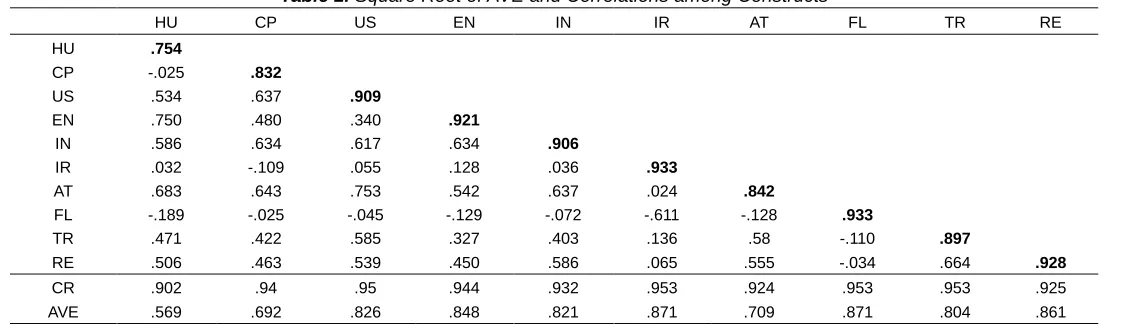
Table1. Square Root of AVE and Correlations among Constructs
HU CP US EN IN IR AT FL TR RE
HU .754
CP -.025 .832
US .534 .637 .909
EN .750 .480 .340 .921
IN .586 .634 .617 .634 .906
IR .032 -.109 .055 .128 .036 .933
AT .683 .643 .753 .542 .637 .024 .842
FL -.189 -.025 -.045 -.129 -.072 -.611 -.128 .933
TR .471 .422 .585 .327 .403 .136 .58 -.110 .897
RE .506 .463 .539 .450 .586 .065 .555 -.034 .664 .928
CR .902 .94 .95 .944 .932 .953 .924 .953 .953 .925
AVE .569 .692 .826 .848 .821 .871 .709 .871 .804 .861
Note: Numbers on the diagonal are the square root of relevant AVEs. Other are the correlations of all constructs.
Abbreviation: HU= Human Factors, CP=Computer Factors, US= Usefulness, EN= Entertainment, IN= Informativeness, IR= Irritation, AT= Attitude, FL=Flow, TR= Trade intentions , RE= Revisit Intentions.
CR= Composite Reliability, AVE= Average Variance Extracted.
All study constructs were assessed by the measurement scales adapted from those used by Hausman and Siekpe(2009). To validate the constructs, we performed
IFI = 0.929, TLI = 0.922, and CFI = 0.928, all were greater than 0.9; RMSEA = 0.07(<0.08). The results revealed that all measurement items loaded properly on their intended constructs and all factor loadings were significant (p<0.01) and greater than the acceptable threshold of 0.6. Two indicators of convergent validity were calculated basing on factor loadings: composite reliability (CR) and average variance extracted (AVE). As shown in Table 1, the composite reliability (CR), ranging from 0.902 (Human factors) to 0.953 (perceived flow), greater than the threshold of 0.7 and the average variance extracted (AVE) for each construct was between 0.569 (Human factors) and 0.871 (perceived flow), higher than 0.5 , indicating all CR and AVE values of constructs were sufficient in this study. In addition, the correlation coefficients of different constructs were lower than any of their square root of AVEs, indicating that the discriminant validity was adequate in this study (Table 1)
4.3STRUCTURAL MODEL ANALYSIS
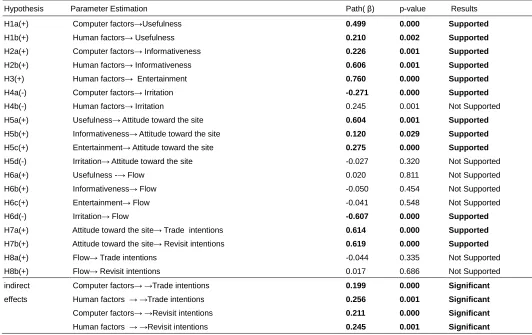
Structural equation modeling (SEM) was performed to test the structural model and hypotheses. The fit indexes of structural model were: χ2/df =2.137 which was less than 3; IFI = 0.929, TLI = 0.922, and CFI = 0.928, all were greater than 0.9; RMSEA = 0.06(<0.08), all within the accepted thresholds suggested in the literature, indicating that the hypothesized model fit the data well. The results of testing the proposed hypotheses were shown in Table 2. Computer factors (β=0.499, p<0.001) and human factors (β=0.210, p=0.002) were found to have positive and significant influences on perceived usefulness, indicating that H1a and H1b were
supported. Computer factors (β=0.226, p=0.001) and human factors (β=0.606, p=0.001) had positive and significant influences on perceived informativeness, indicating that H2a and H2b were supported. Human factors (β=0.760 , p<0.001) had a positive and significant influence on perceived entertainment, indicating that H3 was supported. Computer factors (β=-0.271, p<0.001) had a negative and significant influence on perceived irritation, indicating that H4a was supported. However, the standardized coefficient of the path linking human factors(β=0.245, p=0.001 ) to perceived irritation was positive and significant, indicating that H4b was not supported. The effects of two website design factors on perceived usefulness and perceived informativeness were different. Computer factors had a more influential impact on usefulness and human factors had a more influential impact on informativeness. Perceived usefulness (β=0.604, p=0.005), perceived entertainment (β=0.275, p=0.001), and perceived informativeness (β=0.120, p=0.029) had a positive and significant influence on attitude toward the site, respectively, but the effect of perceived irritation(β= -0.027 , p=0.320 on attitude toward the site was not significant, indicating that Hypotheses 5a-5c were supported, but not H5d. On the other hand, the impacts of perceived usefulness (β=0.020, p=0.811 ), perceived informativeness(β= -0.050, p=0.454), and perceived entertainment(β= -0.041, p=0.548) on perceived flow were non-significant, thus H6a-6c were not supported. However, perceived irritation(β=-0.607, p<0.001 ) had a negatively significant impact on attitude toward the site, thus H6d was supported.
Table 2. Hypotheses Testing Results
Hypothesis Parameter Estimation Path( β) p-value Results
H1a(+) Computer factors→Usefulness 0.499 0.000 Supported
H1b(+) Human factors→ Usefulness 0.210 0.002 Supported
H2a(+) Computer factors→ Informativeness 0.226 0.001 Supported
H2b(+) Human factors→ Informativeness 0.606 0.001 Supported
H3(+) Human factors→ Entertainment 0.760 0.000 Supported
H4a(-) Computer factors→ Irritation -0.271 0.000 Supported
H4b(-) Human factors→ Irritation 0.245 0.001 Not Supported
H5a(+) Usefulness→ Attitude toward the site 0.604 0.001 Supported
H5b(+) Informativeness→ Attitude toward the site 0.120 0.029 Supported
H5c(+) Entertainment→ Attitude toward the site 0.275 0.000 Supported
H5d(-) Irritation→ Attitude toward the site -0.027 0.320 Not Supported
H6a(+) Usefulness -→ Flow 0.020 0.811 Not Supported
H6b(+) Informativeness→ Flow -0.050 0.454 Not Supported
H6c(+) Entertainment→ Flow -0.041 0.548 Not Supported
H6d(-) Irritation→ Flow -0.607 0.000 Supported
H7a(+) Attitude toward the site→ Trade intentions 0.614 0.000 Supported H7b(+) Attitude toward the site→ Revisit intentions 0.619 0.000 Supported
H8a(+) Flow→ Trade intentions -0.044 0.335 Not Supported
H8b(+) Flow→ Revisit intentions 0.017 0.686 Not Supported
indirect Computer factors→ →Trade intentions 0.199 0.000 Significant
effects Human factors → →Trade intentions 0.256 0.001 Significant
Computer factors→ →Revisit intentions 0.211 0.000 Significant
76 Finally, the impacts of attitude toward the site on both trade intentions (β=0.614, p<0.000) and revisit intentions (β=0.619, p<0.001) were significant, indicating that H7a and H7b were supported. However, the impact of perceived level of flow on both revisit intentions (β=0.017, p=0.686 ) and trade intentions (β=-0.044 , p=0.335 )were non-significant. Thus, H8a and H8b were not supported. When we examined the standardized indirect effects of computer factors and human factors on trade and revisit intentions, as shown in Table 2, we found that both computer factors (0.199(p<0.001), 0.211(p<0.001))and human factors (0.256 (p=0.001), 0.245 (p=0.001) have positively significant indirect effects on trade intentions and revisit intentions with human factors having a more influential impact on trade and revisit intentions, respectively.
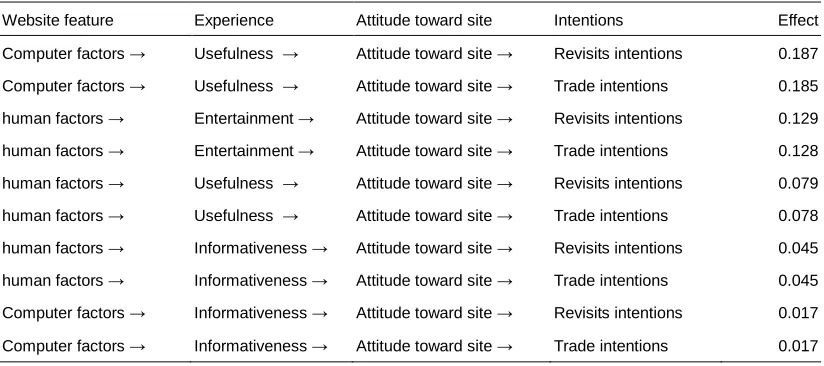
Table 3. The Important Influential Paths toward Behavioral Intentions
Website feature Experience Attitude toward site Intentions Effect Computer factors → Usefulness → Attitude toward site → Revisits intentions 0.187 Computer factors → Usefulness → Attitude toward site → Trade intentions 0.185 human factors → Entertainment → Attitude toward site → Revisits intentions 0.129 human factors → Entertainment → Attitude toward site → Trade intentions 0.128 human factors → Usefulness → Attitude toward site → Revisits intentions 0.079 human factors → Usefulness → Attitude toward site → Trade intentions 0.078 human factors → Informativeness → Attitude toward site → Revisits intentions 0.045 human factors → Informativeness → Attitude toward site → Trade intentions 0.045 Computer factors → Informativeness → Attitude toward site → Revisits intentions 0.017 Computer factors → Informativeness → Attitude toward site → Trade intentions 0.017
5.
D
ISCUSSION ANDS
UGGESTIONSThis study employed a comprehensive website design structural model to examine how computer factors and human factors of website design features influence website users' behavioral intentions. First, we checked the effects of both computer factors and human factors on website users' experiences: perceived usefulness, perceived entertainment value, perceived informativeness, and perceived irritation. We found that both computer factors and human factors are important predicators of usefulness and informativeness, with computer factors (β=0.499) having a more influential effect on usefulness than human factors(0.210) and, in contrast, human factors(0.606) having a more influential effect on informativeness than computer factors (0.226). Human factors had positive and significant impacts on entertainment and irritation, and computer factors had a negative impact on irritation. Their strong impact on these three experience variables suggests their importance in website design. Second, we examined how website users' experiences influenced their attitude toward the site and its flow. As shown in Table 2, the impacts of perceived usefulness (0.604), perceived entertainment value (0.275), and perceived informativeness (0.125) on attitude toward the site were significant, whereas the impact of perceived irritation (-0.027) was not. On the contrary, the impacts of perceived usefulness (0.020), perceived entertainment value (-0.041), and perceived informativeness (-0.050) on flow were not significant, but the impact of perceived irritation (-0.607) on flow, as expected, was negative and significant. Third, we found that the effects of attitude toward the site on trade intentions (0.614) and revisit intentions(0.619) were very strong. However, the effects of flow on trade intentions (-0.040) and revisit intentions (0.017))were not significant. Finally, when we checked how human factors and computer factors influence customers' behavioral intentions, we found that the most important path, with a total indirect effect value of 0.187, as shown in Table 3,
was:
Computer factors→ Usefulness→ Attitude toward site→ Revisits intentions
REFERENCES
[1] Al-Qeisi, K., Dennis, C., Alamanos, E., & Jayawardhena, C. (2014). Website design quality an usage behavior: Unified Theory of Acceptance and Use of Technology, Journal of Business Research, 67, 2282-2290.
[2] Azeem, A. & Haq, Z.u.(2012). Perception towards Internet Advertising: A Study With Reference to Three Different Demographic Groups, Global Business and Management Research: An International Journal, 4(1), 28-45.
[3] Bilgihan, A., Nusair, K., Okumus, F.I. , & Cobanoglu, C. (2015). Applying flow theory to booking experiences: An integrated model in an online service context, Information & Management , 52, 668–678.
[4] Calisir, F. & Calisir, F. (2004). The Relation of Interface Usability Characteristics, Perceived Usefulness, and Perceived Ease of Use to End-User Satisfaction with Enterprise Resource Planning (ERP) Systems. Computers in Human Behavior, 20(4), 505-515.
[5] Chen, Q., Clifford, S. J., & Wells, W.D(2002). Attitude Toward The Site II: New Information. Journal of Advertising Research , 42(2), 33-45.
[6] Chen, L., Gillenson, M. L., & Sherrell, D. L. (2002). Enticing Online Consumers: A Technology Acceptance Perspective, Information & Management, 39(8), 705-719.
[7] Chen, Q. & Wells, W.D.(1999). Attitude Toward The Site. Journal of advertising research , 39(5), 27-37.
[8] Csikszentmihalyi, M. (1975). Beyond Boredom & Anxiety, Jossey-Bass, 1975.
[9] Davis, F. D. (1989). Perceived usefulness, perceived ease of use, and user acceptance of information technology. MIS Quarterly, 13(3), 319-340.
[10] Ducoffe, R. H. (1996). Advertising Value and Advertising on The Web. Journal of advertising research , 36(5), 21– 35.
[11] Ferguson, D.A., & Perse, E.M. (2000). The world wide web as a functional alternative to television, Journal of Broadcasting & Electronic Media, 44 (2) , 155–174.
[12] Gao, Y., & Wu, X. (2010). A cognitive model of trust in e-commerce: evidence from a field study in china, Journal of Applied Business Research, 26(1), 37-44.
[13] Hasan, B. (2016). Perceived irritation in online shopping: The impact of website design characteristics. Computer in Human Behavior, 54, 224-230.
[14] Hausman, A. V. & Siekpe, J. S. (2009). The effect of web interface features on consumer online purchase intentions. Journal of Business Research , 62, 5–13.
[15] Heijden, Hvd.(2003). Factors influencing the usage of websites: the case of a generic portal in the Netherlands, Information & Management . 40(6), 541–549.
[16] Hoffman, D.L., & Novak, T.P. (1996). Marketing and hypermedia computer-mediated environments: conceptual foundations. Journal of Marketing,60(3), 50-68.
[17] Huang, M. H. (2003). Designing website attributes to induce experiential encounters, Computers in Human Behavior, 19 (4),425–442.
[18] Ko, H.J., Cho, C.H., & Roberts, M.S. (2005). Internet uses and gratifications—a structural equation model of interactive advertising source. Journal of Advertising , 34 (2), 57–70.
[19] Lee, W., Xiong, L., & Hu, C.(2012). The effect of Facebook users’ arousal and valence on intention to go to the festival: Applying an extension of the technology acceptance model. International Journal of Hospitality Management, 31(3), 819-827.
[20] Lu, C. M. (2001). The development and impact of Internet Banking. Central Bank of the Republic of China(Taiwan) of Quarterly, 23(1).
[21] Luo, M. M., Chea, S., & Chen, J. S.,(2011) Web-based information service adoption: A comparison of the motivational model and the uses and gratifications theory, Decision Support System, 51, 21-30.
[22] Mithas, S., Ramasubbu, N., Krishnan, M. S., & Fornell, C. (2007). Designing web sites for customer loyalty across business domains: a multilevel analysis. Journal of Management Information Systems, 23(3), 97-127
[23] Nielsen, J.(2000). Designing Web Usability: The Practice of Simplicity. New Riders Publishing.
[24] Obada, D. R.(2013). Flow Theory and Online Marketing Outcomes: a Critical Literature Review, International Economic Conference of Sibiu 2013 Post Crisis Economy: Challenges and Opportunities, IECS, Procedia Economics and Finance, 6,550–561.
[25] Papacharissi, Z., & Rubin, A.M.(2000). Predictors of internet use. Journal of Broadcasting & Electronic Media, 44 (2) , 175–196.
[26] Preece, J.(1994). Human-computer Interaction. USA: Addison Wesley.
[27] Rosen, E. E., & Purinton, E. (2004). Website Design: Viewing the Web as a Cognitive Landscape. Journal of Business Research , 57, 787-794.
[28] Schneiderman, B., & Designing. (1997). Information-abundant Websites. International Journal Human-Computer Studies , 47(1), 5-29.
78 [30] Siekpe, J. S. (2005). An examination of the
multidimensionality of flow construct in a computer-mediated environment. Journal of Electronic Commerce Research , 6 (1), 31–43.
[31] Smith, D. N., & Sivakumar, K., (2004). Flow and Internet shopping behavior: a conceptual model and research propositions. Journal of Business Research, 57 (10), 1199–1208.
[32] Van Noort, G., Voorveld, H., & Van Reijmersdal , E. (2012). Interactivity in brand web sites: Cognitive, affective, and behavioral responses explained by consumers' online flow experience. Journal of Interactive Marketing. 26, 223– 234.
[33] Wagner, G., Schramm-Klein, H., & Steinmann, S. (2016). Consumers' attitudes and intentions toward Internet-enabled TV shopping. Journal of Retailing and Consumer Services.
http://dx.doi.org/10.1016/j.jretconser.2016.01.010.
[34] Wells, J. D., Valacich, J. S., & Hess, T. J. (2011). What signal are you sending? How website quality influences perceptions of product quality and purchase intentions. MIS Quarterly, 35(2), 373-396.
[35] Wu, Jyh-Jeng & Chang, Yong-Sheng (2005). Towards Understanding Members' Interactivity, Trust, and Flow in Online Travel Community . Industrial Management & Data Systems, 105(7), 937–954.