www.orientjchem.org
An International Open Free Access, Peer Reviewed Research Journal
2017, Vol. 33, No. (3): Pg.1438-1446
Fabrication of Anchored Complexes as Electrodes for Sensing
Heavy Metal Ions by Electrochemical Method
JEMINI JOSE
1, RIYA DATTA
1and SREEJA P B
1*1Department of Chemistry, Christ University, Hosur Road, Bangalore 560029, India. *Corresponding author E-mail: [email protected]
http://dx.doi.org/10.13005/ojc/330346
(Received: May 09, 2017; Accepted: May 31, 2017)
ABSTRACT
Anchored coordination complexes as electrochemical sensors play a significant role in the modern era. It is evident that this becomes a fact on account of their practical convenience. Furthermore, they have unlimited scope in ecological, therapeutic, experimental and biomedical applications. It has been observed that 165 such papers have reported on anchored complexes for electrochemical sensing during the past two years. While human vitality is rigorously threatened by heavy metal ions today, numerous trials are restrained for screening these in nature. This retrace highlights the electro analytical methods and the masterpiece contribution of anchored coordination complexes as electrochemical sensors for the identification of heavy metals such as indium, uranium, lead, beryllium, and mercury in 2015 and 2016.
Keywords: Molecularly imprinted polymers, ion-imprinted polymers, DNAzyme functionalized nanoparticle.
INTRODUCTION
Chemical sensors have a vital role in promoting the speedy development of electrochemical sensors in smart chemistry. They deliver ever lasting information about their environment. Ultimately, a chemical sensor affords an exact kind of reaction which imparted to the scope of the particular class of chemical compounds. All chemical sensors form a transducer. It helps the mutual conversion of the response into a sensible sign on the exactroutes, and a chemically selective film. In addition, it separates the reaction of the analyte from its expeditious
situation. In the beginning of the present century, research on electrochemical sensor fabrication has made radical changes in the integrable arena of science. Referred to miscellaneous sensors, electrochemical sensors have dominant position owing to their significant sensibility, tentative easiness, minimum expenditure and its relevances in various disciplines. Because of the non-biodegradability and proliferation of heavy metal ions in tissues, they are observed as the fundamental basis to fade the biosphere and affect the physical well-being of human kind1–3. Diverse systems such
methods6 have been exaggerated for the exposition
of the ions. The presence of substantial metal particles causes the alteration of the capacitance, current flow, electrochemical impedance, and electroluminescent methods which are capable of utilized for their investigation7,8. The approaches
like potentiometry, capacitance, electrochemical impedance, amperometry and electroluminescence are derived from these ascertaining signals. By modified functionalization and construction, these materials can be brought together in the exterior part of an electrode for the assembly of appropriate electrodes. It also assists the susceptible and selective detection of heavy metal ions. The setting up of various materials has widened the electrochemical achievements. For concrete illustration, polymers or biomaterials are regularly come together on inorganic nanomaterials to manufacture the highly responsive electrochemical sensors for heavy metal ions9–18.Because of the
potential for the small analytical period, less engine capacity, valuable sensitivity and simple adaptability for in-situ extent19,electrochemical detection methods
using anchored complexes have attracted enormous attention in the detection of heavy metal ions. This review summons up the formulation and sensing means such as the molecularly imprinted polymers, ion-imprinted polymers, exploitation incentive responses of a deoxyribozyme (DNAzyme), fluorescence and complexes with conducting nation binders for heavy metal ions in 2015 and 2016are briefly explained.
Detection Of Metal Ions Detection Of Indium
Indium is the fragile and flexible constituent engrossing in the design of high purity materials, semiconductor enterprises and atomic studies20–22.
Moreover, indium salts presume a decisive part in insoluble batteries. It can be blended with the footprints of minerals like sphalerite and is usually acquired as a result of zinc mining. Physiologically, composites of indium harm various living functions of human body. S. Kagaya et al., 2009, incorporated inductively coupled plasma spectroscopy to produce excited atoms for determination of the element after co-precipitation with indium sulphate23 as vindication. E.Kazemi
et al., 2011, found the satisfactory results of indium in a water sample and standard alloys with liquid-liquid micro extraction fibre optic linear array detection
spectroscopy24. The another attempt to enhance the
sensitivity using slotted quartz tube atom-trap-flame atomic absorption spectrometry was suggested by Arslan, 201125. Yang et al., 2010, achieved the
measurements of isotope ratios of indium, and Karadas et al., 2011, detected the presence of indium in sea water using multi-collector inductively coupled plasma mass spectrometry26,27 Optical strategies28,29
and electrochemical method30 are employed for the
determination of indium. Nevertheless, numerous issues are encountered in handling these techniques. The specimen of indium is isolated from tin, silicon, tellurium and sulphate particles by flame atomic absorption spectroscopy at the time of atomization stage31. Volatilization shrinkage in the atomization
procedure brought on high temperature equally bring about the lower outcome than the original strength32.Stripping voltammetric and polarographic
strategies have weak distinction toward constituents of resembling zenith position of indium33.Besides,the
essence of indium in experiments is subtle; hence, establishing an exact explanatory strategy to mark out indium is entirely critical. Zhang et al., 2015, proposed highly selective molecularly imprinted electrochemical sensor for the detection of In3+ by
using Indium Alizarin red S compound acting as a support molecule comprehended through the vacant spaces in the molecularly imprinted polymer34 and is
illustrated in scheme 1
Scheme 1: Molecular imprinting detection of In3+ions based on metal-ligand
chelate-oriented recognition Ref 34
in the composite. The procedure was profoundly sensitive for quantitative investigation of In3+ in the
fixations going from 1X10⁻⁸ mol/L to 2.5X10⁻⁷ mol/L
with recognition boundary of 4.7 X 10⁻⁹ mol/L which
was lower than commonly used methods. The proposed sensor has been effectively utilized as a part of identifying In3+ in positive specimens34.
Detection Of Uranyl Ion
The spoliation of uranium is usually of distinct sorts of soils and stones. Additionally, it can be procured from excavation and fabrication. Its corrupt nature increases the responsibility of distinguishing such tainting in water. Estimation of uranium fixation is having an incredible significance in atomic production because of the use of the metal as fuel in fission reactions. Different strategies have been utilized to decide Uranyl particles fixation. The spectrometric procedure is employed to evaluate uranyl in ocean water35,36 and adsorption
of uranium by polarographic technique37. The
constitutional effects of the UO2 complex with bulky groups were inspected through nuclear magnetic resonance spectrometry38.The drawbacks of these
promulgated systems35–38contrive a requisite to
build up a quick, delicate and authentic strategy for uranium resolution in different fragments. Zamani
et al.,2012manufactured a potentiometric sensor of pristine gadolinium for lanthanide sequence deduction39and aterminalofneodymium (III) was
built by Menon et al.,201140.A variety of ligands
has been utilized to set up the uranyl sensors such as 1-(4-carboxyphenyl)-1H-1,2,3-triazole-4-carboxylic acid41and crown ether42.Shokrollahiet
al.,2009,43arranged and concentrated on the
anodes criterion for uranyl sensors rely on bis (2-hydroxy acetophenone) ethylene diimine. Bader
et al., 2012 created uranyl layer terminals based on amino ( tri-methyl) phosphate44and the formed
film cathodes observed to be specific in the vicinity of uranyl particle over a vast number of impeding cations. Metilda et al., 200445arranged particle
engraved polymer materials for uranyl particle by framing binary 5,7-dichloroquinoline-8-ol (DCQ) or 4-vinylpyridine.Molecularly imprinted polymers have been tailored and thoroughly described for the detection of uranyl ion. M.A.Abu-Dalo et al., 2016, displayed another uranyl electrochemical sensor by adopting acrylic acid as a monomer; ethylene glycol dimethacrylateas a cross coupling agent and benzoyl peroxide as an initiator. The boosted polymer was promoted by magnetic material; Uranyl–carboxy
benzotriazole complex. The comfortable situation for the format particle rebinding can be produced by keeping up the complex genome–attempt through the cross–linking and discharging velocity. A few uranyl cathodes were developed by handling distinctive masses of polyvinyl chloride frame work. Cathode tape measures including inclines, working focuses, pH,and obstructions were assessed. The
terminals show an extensive variety of fixation from 3X10⁻⁶ to 6X10⁻²M and sensibility of 1X10⁻⁶ M.
The impact of Cr3+,La3+,Ba2+,Ca2+,Cu2+,Na+ and K+
particles impedances on the cathode reaction were assessed. The coupling limit and stability dissolution variables were dictated by contemplating the coupling isotherm. The combinations of uranyl particle in the fabricated settlements controlled by the expansion technique and the outcomes were agreeable with deviation lower than 7%.At last, the sensor was tried to decide the uranyl particles focuses in water test by standard expansion technique46.
Detection Of Be2+
Beryllium is a deceptive cancer-causing poison because of its trouble in biodegradation47.It
can be recognized by means of atomic absorption and emission spectrometry48and fluoro spectrometry49. In
any case, techniques either lack affectability and selectivity or need costly mechanical assembly and entangled investigation. Moreover, the sensing may be upset by the intervening blends in tests. Therefore, it is imperative to formulate adequate and precise location technique for ultra-proof beryllium in water and other provisions. Electro chemilumine scence sensors have great responsive quality50. Molecularly imprinted polymer sensors
through electrochemilumin escent estimation could encourage the receptivity and exclusive exposition with a quite clear specimen a pre-treatment strategy51,52.The intricate particle is bestowed as the
layout atom to copolymerize with the monomer and frame sensor. Jianping Li et al.,201553has picked the
compound of Be2+with 4-(2-Pyridylazo)-resorcinol
The depressions framed could further perform as the blunt for the exchange for test atoms to deliver echo alert indication. The certainty
simple operation, and the capacity for examining the component speciation. The outline and usage of the silver–based coordination compounds have conquered the expanding consideration in the last decades69–71 owing to their intriguing atomic
structures, as well as their characteristic properties. The geometrical adaptability of silver (1) brings about the elaborate coordination models and exhibits a chance to investigate the features like an assembly of metal and ligands containing many donor atoms, the ratio of metal and ligand and counter particles in coordination combinations72,73. Yangjuan Wanget
al.,2016,was integrated, an organized pattern of the donor ligand of nitrogen, carboxylic acid and metal salts of silver (1)74.The differential pulse anode
stripping voltammetric method is employed to find out the minute levels of lead and selectivity of the complex in exact figuration with high accuracy. The stripping current is gained with the amount of lead and the location cut off is 8.0X10⁻¹⁰ mol.L-1.In
spite of slight aggregation time, themelanine/silver nitrate/terephthalic acid terminal is bounded by a lesser threshold of evaluation and extensive direct range of the maximum cathodes assessed other than the bismuth film adjusted electrode75. Plaxco
and collaborators have employed deoxyribonucleic acid/gold bio standardized keys to accomplish sign intensification for the lead in nano molar level76.Yang
et al.,201077additionally facilitated the discovery
of lead availing functionalized gold nanoparticles with DNA zyme as a method for enhancement, empowering as far as possible to be 0.028nM.Zeng and group have bestowed a carboxylic acid family functionalized multiwall carbon nanotubes /AuNPs-adjusted anode and exploiting Pb2+ generated G-rich
DNA conformation, with maximum restriction of 4 . 3 X 1 0- 6n M7 8. N eve r t h e l e s s , t h e r e p o r t e d
electrochemical lead diagnosing techniques require complex and multistep conventions. Introducing nanoporous gold cathode as a strong support for the immobilization of probe DNA and implementing an appropriately constructed, catalytically existing gold nanoparticle framework to accomplish signal improvement were researched. Cheng Zhang
et al.,201679depicted a boosted technique reinforcing
nanoporous Au (NPG) and gold nanoparticles (AuNPs) to distinguish Pb2+particles in water. The
procedure is given in Scheme 3
Schematic presentation of the apta sensor preparation and the proposed mechanism for the Pb2+ detection.
depended on the strength of the symbol, which was corresponding to the convergences of the composites in the specimen arrangement, and the Be2+ fixation could then be resolved implicitly.
The outcomes demonstrated that in the span of 7X10-11mol/L to 8.0X10⁻⁹mol/L, the electrochemilumin
escent strength hada. direct association with the Be2+fixations, with the point of confinement of
2.35X10⁻¹¹ mol/L. The strategy is profoundly ideal and
delicate, with minimal effort and great steadiness to spot Be2+ in water. It is anticipated to give another
system to manufacture molecularly imprinted polymer sensors for the identification of other metal particles.
Detection Of Lead
Among the hazardous substances, lead is known to prompt an expansive scope of physiological, biochemical, and behavioural dysfunctions in creatures, which incorporate troubling the frameworks of the heart, blood, nerve, kidneys and liver54.The massive impairment of these metal
particles to the earth, physique and sustainment, have created a basic need for creating productive detecting frameworks that are susceptible and concrete, as well as exact cost effective, and sensible1,55.Over previous
decades, various spectroscopic techniques56–62 and
different synthetically adapted electrodes63–68have
come up with the evaluation of Pb2+.The estimation
P 1 ( p r o b e 1 ) : 5 1 – S H
– ( C H 2 ) 6 T T T C A T C T C T T C T C C -GAGCCGGTCGAAATAGTGAGT- 31,
P2(Probe2): 51 –SH
–(CH2)6-ACT-CACTATArGGAAGAGATG-31P1 is the Pb2+specific
DNA, and P2 is the substrate oligonucleotide, hexaammine ruthenium (III) chloride (RuHex) and MCH is 6-mercaptohexanol Ref 79.
For the hybridization of gold nanoparticles named oligonucleotide and framing of the two–fold helix structures of DNA, the thiol altered Pb2+
catalytically active DNA molecule was arranged onto the surface of the organized nanoporous gold terminal. They used chronocoulometry to evaluate DNA coating thickness using measuring redox charge of ruthenium hexammine at surfaces, and it was adopted to figure out immobilized DNA. The
state of the subsequent chronocoulogram can be comprehended by allowing for the fixation slopes in the arrangement adjoining the anode surface and could distinguish Pb2+by exploiting intensification
impacts of the nanoporous gold cathode. For expanding the response location of assessment and DNA-Au NPs composites for realizing the adsorption of vast quantities of hexaammine ruthenium atoms in the scope of 0.05-100 nM, with a snapping point of recognition as low as 0.012 nM. Selectivity estimations uncovered that the sensor was particular for Pb2+ even with impedance on
significant amounts of other metal particles. In the investigation with the conventional Pb2+sensor,
aptasensor depends on the measure of surface limited DNA switch, which is sovereign with the unique structures like G-quadruplex78,hairpin76,or
stem loop80.Moreover,the intensification framework
of apta sensor maintains a strategic distance from the tedious synthetic methodology, phenomenal selectivity and reproducibility.
Detection Of Mercury
As a result of the diverse types of pollution through mercury81,there has been a
developing enthusiasm for extraordinarily elegant and precise materials for detecting mercuric particles in the course of recent years. Different sensor materials ,for example, natural fluorescent and colour responsible functional group compounds82–84, organic conjugated macromolecule
substances85,86,metal nanoparticles87–89, biopolymers
of nucleotides and aminoacids90–93 DNAzymes91and
fractions of nanometer materials94,95have been
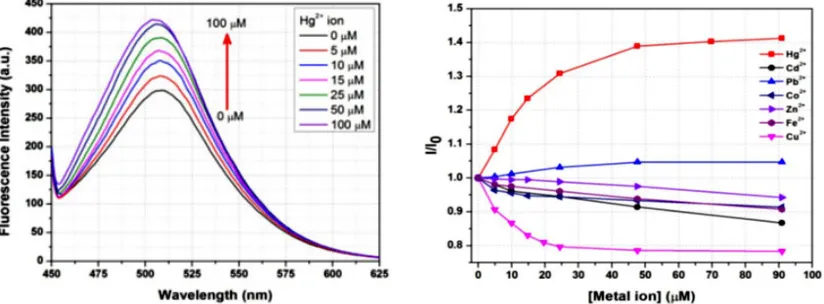
Fig. 1: demonstrates change in the fluorescence power of the complex upon accumulation of Hg2+ particle (HgCl
accounted for identification of Hg2+.On the
other hand, the majority of these cases have restrictions in choice, susceptibility and feasibility. Cheng et al.,201496resolved the mercury species
colorimetrically by utilizing gold nanoparticles activated with diethyldithiocarbamate in the Cu2+
particle. Xiao et al.,201597,latelyestimated a very
specific discovery of methyl–mercury cation in fish tests using Ag0/Hg0 amalgamation. In a while, optical
detecting of the metal particle was accounted for by Zhe and colleagues98,in the light of semiconductor
quantum dots. The writers outlined the thought to make water solvent quantum dots is to trade the local natural ligands topped on the quantum dots surface with other dissolvable ligands utilizing peripheral charge and nonpolar cooperations. On the other hand, there are still shortcomings, for example, obstruction from another metal particle99,100 or permanent
response82.Shortly,fluorescencesupported detecting
materials for harmful metal particles seems to be prominent amongst the most encouraging procedures because of its high aptitude and great affectability101.The nearness of ultra-low grouping
of the analyte is adequate for the eye in recognising elevation of fluorescence. The profit of this course of action is that it imposes just a couple microgram of the sensor material and it doesn’t pay out many analytes and no reference material 102.Besides,
a couple of phosphorescence sensors were additionally created for detecting Hg2+103–105.Nilam
Sing et al.,2016106reported the detecting property
of complex C48H96.8N12 O22.4Co2Cl2 towards the metal particles like Hg2+,Cd2+, Pb2+, Co2+, Zn2+, Fe2+ and
Cu2+. Isolate a liquots were set up holding a balanced
tincture of complex and expanding quantities of a metal particle and fluorescence of the subsequent blend was determined.
Fluorescence emission spectra of complex 1 in aqueous solution upon addition of increasing amount of Hg2+(=425 nm). The concentration of
Hg2+in the medium is indicated in the legend; the
arrow shows the growth of fluorescence intensity with the increase of the concentration of the Hg2+ ion
Ref 106.
Fig 1shows that at every expansion of Hg2+ particle, fluorescence power promotes to a
vast degree. AtHg2+concentration of 100 µM the
fluorescence power increments by ~half. Strangely, aside from Hg2+, no other metal particles can bring a
notable improvement of fluorescence. This outcome obviously shows a specific detecting of Hg2+ by Co II
complex. Subsequently, the present compound was observed to be an accurate sensor for Hg2+ in liquid
beginning at a focus as low as ~0.25 µM. Despite the fact that as far as possible, this case is not very cheap, in any event, the bright point of the compound is that it demonstrates turn on ensign in the proximity of Hg2+ divergent to the majority of the reports on Hg2+
detecting. Additionally, the ejection wavelength range is utterlyan evident area which opens plausibility for observing through eyes.
CONCLUSION
This review discussed anchored complexes which help to detect the aforesaid compounds like indium, uranium, beryllium, lead and mercury being an electrochemical sensor. What is more, it has also described regarding the research in this recent two years mentioning the fabrication, sensitivity and the benefits compared to other analytical methods. Everybody isata race to make out the pure water. This motivates researchers to identify heavy metal ions in water. However, it is miserable that they have reached only at the micro and nano level. Most of the work above mentioned are in the water like medium or aqueous medium and this review may help the researcher to extend the work to the aqueous medium and thereby living organism. Therefore, it is forecasted that if they are able to investigate the parts per million levels of the above ions, it will be a considerable asset to the mankind.
REFERENCES
1. Kemper, T.; Sommer, S. Environ. Sci. Technol.
2002, 36 (12), 2742.
2. Tu, C.; Shao, Y.; Gan, N.; Xu, Q.; Guo, Z. Inorg. Chem. 2004, 43 (15), 4761.
3. Tuzen, M.; Melek, E.; Soylak, M. J. Hazard. Mater. 2006, 136 (3), 597.
4. Aragay, G.; Merkoi, A. Electrochim. Acta 2012,
5. Ugo, P.; Zampieri, S.; Moretto, L. M.; Paolucci, D. Anal. Chim. Acta 2001, 434 (2), 291. 6. Kim, H. N.; Ren, W. X.; Kim, J. S.; Yoon, J.
Chem. Soc. Rev. 2012, 41 (8), 3210. 7. Combellas, C.; Kanoufi, F.; Pinson, J.;
Podvorica, F. I. J. Am. Chem. Soc. 2008, 130
(27), 8576.
8. Fan, L.; Chen, J.; Zhu, S.; Wang, M.; Xu, G.
Electrochem. commun. 2009, 11 (9), 1823. 9. Chey, C. O.; Ibupoto, Z. H.; Khun, K.; Nur, O.;
Willander, M. Sensors (Basel). 2012, 12 (11), 15063.
10. Gong, T. Z. J.; Song, D.; Zhang, L.; Hu, X. Anal. Chem. 2010, 82 (2), 567.
11. He, X.; Su, Z.; Xie, Q.; Chen, C.; Fu, Y.; Chen, L.; Liu, Y.; Ma, M.; Deng, L.; Qin, D.; Luo, Y.; Yao, S. Microchim. Acta 2011, 173 (1–2), 95.
12. Kong, R.-M.; Zhang, X.-B.; Zhang, L.-L.; Jin, X.-Y.; Huan, S.-Y.; Shen, G.-L.; Yu, R.-Q.
Chem. Commun. (Camb). 2009, No. 37, 5633.
13. Liu, M.; Zhao, G.; Tang, Y.; Yu, Z.; Lei, Y.; Li, M.; Zhang, Y.; Li, D. Environ. Sci. Technol. 2010,
44 (11), 4241.
14. Pan, D.; Wang, Y.; Chen, Z.; Lou, T.; Qin, W.
Anal. Chem. 2009, 81 (12), 5088.
15. Sanchez, A.; Morante-Zarcero, S.; Perez-Quintanilla, D.; Sierra, I.; Del Hierro, I.
Electrochim. Acta 2010, 55 (23), 6983. 16) Wang, L.; Xu, M.; Han, L.; Zhou, M.; Zhu, C.;
Dong, S. Anal. Chem. 2012, 84, 7301"7307. 17. Sudibya, H. G.; He, Q.; Zhang, H.; Chen, P.
ACS Nano 2011, 5 (3), 1990.
18. Tang, S.; Tong, P.; Li, H.; Tang, J.; Zhang, L.
Biosens. Bioelectron. 2013, 42 (1), 608. 19. Wong, E. L. S.; Chow, E.; Justin Gooding, J.
Electrochem. commun. 2007, 9 (4), 845. 20. Ferreira, E. D. M. M.; Morelli, T.; Moreira, I. M.
N. S.; De Carvalho, M. S. J. Braz. Chem. Soc.
2004, 15 (4), 563.
21. Acar, O.; Kiliç, Z.; Türker, A. R. Anal. Chim. Acta 1999, 382 (3), 329.
22. Ferreira, S. L. C.; Andrade, M. G. M.; Lobo, I. P.; Costa, A. C. S. Anal. Lett. 1991, 24 (9), 1675.
23. Kagaya, S.; Mizuno, T.; Tohda, K. Talanta
2009, 79 (2), 512.
24. Kazemi, E.; Shokoufi, N.; Shemirani, F. J. Anal. Chem. 2011, 66 (10), 924.
25. Arslan, Y.; Kendüzler, E.; Ataman, O. Y. Talanta
2011, 85 (4), 1786.
26. Yang, L.; Sturgeon, R. E.; Mester, Z.; Meija, J. Anal. Chem. 2010, 82 (21), 8978.
27. Karadaº, C.; Kara, D.; Fisher, A. Anal. Chim. Acta 2011, 689 (2), 184.
28. Gnihotri, N. K. A.; Atnani, S. R.; Ingh, V. K. S.; Ingh, H. B. S. 2003, 19 (September), 2. 29. Huseyinli, A. A.; Alieva, R.; Haciyeva, S.;
Güray, T. J. Hazard. Mater. 2009, 163 (2–3), 1001.
30. Bobrowski, A.; Putek, M.; Zarebski, J.
Electroanalysis 2012, 24 (5), 1071.
31. Acta, C.; Chemistry, A.; Motu-umcmachi, C.; Prefecture, O. 1975.
32. Volynsky, a. Spectrochim. Acta Part B At. Spectrosc. 2000, 55 (2), 103.
33. Chumbimuni-Torres, K. Y.; Calvo-Marzal, P.; Wang, J. Electroanalysis 2009, 21 (17–18), 1939.
34. Zhang, L.; Li, J.; Zeng, Y.; Meng, L.; Fu, C. 2015, 1758.
35. Konstantinou, M.; Pashalidis, I. Mediterr. Mar. Sci. 2004, 5 (1), 55.
36. Smith, N. A.; Cerefice, G. S.; Czerwinski, K. R. J. Radioanal. Nucl. Chem. 2013, 295 (2), 1553.
37. Inam, R.; Çaykara, T.; Kantolu, O. /. Nucl. Instruments Methods Phys. Res. Sect. B Beam Interact. with Mater. Atoms 2003, 208
(1–4), 400.
38. Amato, M. E.; Ballistreri, F. P.; Pappalardo, A.; Tomaselli, G. A.; Toscano, R. M. Molecules
2010, 15 (3), 1442.
39. Ecjhao, C.; Zamani, H. A. L. I.; Behmadi, H. 2012, 9 (1), 308.
40. Menon, S. K.; Modi, N. R.; Patel, B.; Patel, M. B. Talanta 2011, 83 (5), 1329.
41. Knope, K. E.; Cahill, C. L. CrystEngComm
2011, 13, 153.
42. Kakhki, R. M. Z.; Rounaghi, G. Mater. Sci. Eng. C 2011, 31 (8), 1637.
43. Shokrollahi, a; Ghaedi, M.; Montazerozohori, M.; Khanjari, N.; Najibzadeh, M. 2009, 812. 44. Badr, I. H. A.; Zidan, W. I.; Akl, Z. F.
Electroanalysis2012, 24 (12), 2309.
45. Metilda, P.; Mary Gladis, J.; Prasada Rao, T.
Anal. Chim. Acta2004, 512 (1), 63.
Actuators B. Chem.2016, 227, 336.
47. Larivière, D.; Tremblay, M.; Durand-Jézéquel, M.; Tolmachev, S. Anal. Bioanal. Chem.2012,
403 (2), 409.
48. Beiraghi, A.; Babaee, S. Anal. Chim. Acta
2008, 607 (2), 183.
49. Ji, X.; Shi, W.; Zhang, S.; Wei, M.; Evans, D. G.; Duan, X. Anal. Chim. Acta 2012, 728, 77. 50. Laser, D.; Bard, A. J. J. Electrochem. Soc.1975,
No. 5, 632.
51. Li, S.; Tao, H.; Li, J. Electroanalysis 2012, 24
(7), 1664.
52. Li, J.; Li, S.; Wei, X.; Tao, H.; Pan, H. 2012. 53. Li, J.; Ma, F.; Wei, X.; Fu, C.; Pan, H. Elsevier
B.V. 2015.
54. Matoviæ, V.; Buha, A.; Dukiæ-Æosiæ, D.; Bulat, Z. Food Chem. Toxicol. 2015, 78, 130. 55. Darwish, I. A.; Blake, D. A. Anal. Chem. 2002,
74 (1), 52.
56. Leopold, K.; Foulkes, M.; Worsfold, P. J. TrAC - Trends Anal. Chem. 2009, 28 (4), 426. 57. Pourreza, N.; Parham, H.; Kiasat, A. R.;
Ghanemi, K.; Abdollahi, N. 2009, 78, 1293. 58. Bagheri, H.; Afkhami, A.; Saber-Tehrani, M.;
Khoshsafar, H. Talanta 2012, 97, 87.
59. Taylor, P.; Afkhami, A.; Madrakian, T.; Siampour, H. No. May 2013, 37.
60. Afkhami, A.; Saber-Tehrani, M.; Bagheri, H. J. Hazard. Mater. 2010, 181 (1–3), 836. 61. Li, Y.; Jiang, Y.; Yan, X. P.; Ni, Z. M. Environ.
Sci. Technol. 2002, 36 (22), 4886.
62. Mas, J. L.; Villa, M.; Hurtado, S.; García-Tenorio, R. J. Hazard. Mater. 2012, 205–206, 198.
63. Morante-Zarcero, S.; Pérez-Quintanilla, D.; Sierra, I. J. Solid State Electrochem. 2015,
19 (7), 2117.
64. Arantes, T. M.; Sardinha, A.; Baldan, M. R.; Cristovan, F. H.; Ferreira, N. G. Talanta 2014,
128, 132.
65. Kim, H. J.; Son, D. W.; Park, J. M.; Hwang, D. Y.; Mo, C. Y.; Park, S. W.; Kim, G.; Eun, J. B.
Food Sci. Biotechnol. 2010, 19 (5), 1211. 66. Lu, Y. Y.; Chen, M. N.; Gao, Y. L.; Yang, J. M.;
Ma, X. Y.; Liu, J. Y. Fenxi Huaxue/ Chinese J. Anal. Chem. 2015, 43 (9), 1395.
67. Jasmin, J. P.; Cannizzo, C.; Dumas, E.; Chaussé, A. Electrochim. Acta 2014, 133, 467.
68. Wang, Y.; Wu, Y.; Xie, J.; Hu, X. Sensors
Actuators, B Chem. 2013, 177, 1161. 69. Wang, C. C.; Wang, P.; Guo, G. L. Transit. Met.
Chem. 2012, 37 (4), 345.
70. Chen, C. L.; Kang, B. S.; Su, C. Y. Aust. J. Chem. 2006, 59 (1), 3.
71. Wang, C. C.; Wang, P.; Guo, G. S. Transit. Met. Chem. 2010, 35 (6), 721.
72. Tong, M. L.; Wu, Y. M.; Ru, J.; Chen, X. M.; Chang, H. C.; Kitagawa, S. Inorg. Chem. 2002,
41 (19), 4846.
73. Ni, J.; Wei, K. J.; Liu, Y.; Huang, X. C.; Li, D.
Cryst. Growth Des. 2010, 10 (9), 3964. 74. Manuscript, A. 2016.
75. Kachoosangi, R. T.; Banks, C. E.; Ji, X.; Compton, R. G. Anal. Sci. 2007, 23 (3), 283. 76. Baker, B. R.; Lai, R. Y.; Wood, M. S.; Doctor, E.
H.; Heeger, A. J.; Plaxco, K. W. J. Am. Chem. Soc. 2006, 128 (10), 3138.
77. Yang, X.; Xu, J.; Tang, X.; Liu, H.; Tian, D.
Chem. Commun. (Camb). 2010, 46 (18), 3107.
78. Zhu, Y.; Zeng, G. M.; Zhang, Y.; Tang, L.; Chen, J.; Cheng, M.; Zhang, L. H.; He, L.; Guo, Y.; He, X. X.; Lai, M. Y.; He, Y. B. Analyst 2014,
139 (19), 5014.
79. Zhang, C.; Lai, C.; Zeng, G.; Huang, D.; Tang, L. Biosens. Bioelectron .2016, 81, 61. 80. Ke, C.; Huang, C.; Fan, C. 2003.
81. Harris, H. H.; Pickering, I. J.; George, G. N.
Science (80-. ). 2003, 301 (5637), 1203. 82. Yang, Y. K.; Yook, K. J.; Tae, J. J. Am. Chem.
Soc. 2005, 127 (48), 16760.
83. Nolan, E. M.; Lippard, S. J. J. Am. Chem. Soc.
2007, 129 (18), 5910.
84. Ando, S.; Koide, K. 1980, No. Ii, 1.
85. Kim, I. B.; Bunz, U. H. F. J. Am. Chem. Soc.
2006, 128 (9), 2818.
86. Dave, N.; Chan, M. Y.; Huang, P. J. J.; Smith, B. D.; Liu, J. J. Am. Chem. Soc. 2010, 132 (36), 12668.
87. Lee, J. S.; Han, M. S.; Mirkin, C. A. Angew. Chemie - Int. Ed. 2007, 46 (22), 4093. 88. Xue, X.; Wang, F.; Liu, X. 2008, 3244. 89. Li, D.; Wieckowska, A.; Willner, I. Angew.
Chemie - Int. Ed. 2008, 47 (21), 3927. 90. Ono, A.; Togashi, H. Angew. Chemie - Int. Ed.
2004, 43 (33), 4300.
91. Liu, J.; Lu, Y. Angew. Chemie - Int. Ed. 2007,
46 (40), 7587.
D.; Perrin, D. M. Angew. Chemie - Int. Ed .2008, 47 (23), 4346.
93. Chen, P.; He, C. J. Am. Chem. Soc. 2004, 126
(3), 728.
94. Brainina, K. Z.; Stozhko, N. Y.; Shalygina, Z. V. J. Anal. Chem. 2002, 57 (10), 945. 95. Palomares, E.; Vilar, R.; Durrant, J. R. Chem.
Commun. (Camb). 2004, No. December 2003, 362.
96. Chen, L.; Li, J.; Chen, L. ACS Appl. Mater. Interfaces 2014, 6 (18), 15897.
97. Deng, L.; Li, Y.; Yan, X.; Xiao, J.; Ma, C.; Zheng, J.; Liu, S.; Yang, R. Anal. Chem. 2015, 87 (4), 2452.
98. Lou, Y.; Zhao, Y.; Chen, J.; Zhu, J.-J. J. Mater. Chem. C2014, 2 (4), 595.
99. Šandor, M.; Geistmann, F.; Schuster, M. Anal. Chim. Acta 1999, 388 (1–2), 19.
100. Hallale, O.; Bourne, S. A.; Koch, K. R. 2005, 1416.
101. Li, M. J.; Ko, C. C.; Duan, G. P.; Zhu, N.; Yam, V. W. W. Organometallics2007, 26 (25), 6091. 102. Lakowicz, J. R. Kluwer Acad. Publ. 2002, 3. 103. Zhao, Q.; Cao, T.; Li, F.; Li, X.; Jing, H.; Yi, T.
Society 2007, No. Iii, 2077.
104. Ru, J. X.; Guan, L. P.; Tang, X. L.; Dou, W.; Yao, X.; Chen, W. M.; Liu, Y. M.; Zhang, G. L.; Liu, W. S.; Meng, Y.; Wang, C. M. Inorg. Chem.
2014, 53 (21), 11498.
105. Ru, J.; Chen, X.; Guan, L.; Tang, X.; Wang, C.; Meng, Y.; Zhang, G.; Liu, W. Anal. Chem.
2015, 87 (6), 3255.