~ 321 ~ WWJMRD 2018; 4(2): 321-325
www.wwjmrd.com International Journal Peer Reviewed Journal Refereed Journal Indexed Journal UGC Approved Journal Impact Factor MJIF: 4.25 e-ISSN: 2454-6615
Sabreen Kh. Pibars Water Relations & Field Irrigation Department, Agric. Division, National Research Centre, Cairo, Egypt
H. A. Mansour Water Relations & Field Irrigation Department, Agric. Division, National Research Centre, Cairo, Egypt
M. S. Gaballah
Water Relations & Field Irrigation Department, Agric. Division, National Research Centre, Cairo, Egypt
Correspondence: H. A. Mansour Water Relations & Field Irrigation Department, Agric. Division, National Research Centre, Cairo, Egypt
Effect of Water Regime and Compost Tea on Growth
Characters of Sugar Beet under Different Irrigation
System
Sabreen Kh. Pibars, H. A. Mansour, M. S. Gaballah
Abstract
Field experiments were conducted during two successive growing seasons in a factorial design at the National Research Center farm, Nubaria area, Behura Governorate. Experiments investigated the effect of water deficit 100, 75; 50% of ETc (IR1, IR2; IR3), compost tea (30,40, 60 and 80 L/fed: CT1,
CT2, CT3 and CT4) on growth yield and quality of sugar beet plants grown under conditions of drip and sprinkler irrigation systems. Data also showed that application of compost tea enhancing both yield of root and sugar. Application of compost tea increased root yield by 10.35, 12.77 and 17.19 % and sugar yield by 27.58, 34.29 and 22.40%, respectively compared to that without fertilizer addition. The drip irrigation system was significantly more efficient than sprinkler irrigation system.
Keywords: Sprinkler, Drip, Irrigation, Deficit irrigation, Compost tea, Sugar beet
Introduction
Sugar beet (Beta vulgaris L.) is one of the most important crops and comes second after sugar cane as sugar crop in Egypt (Abd El-Motagally and Attia, 2002). Sugar production plays an important enormous role in the Egyptian economy. Increases in soil salinity in the Nile valley lands mainly from logging caused from excess irrigation have reduced arable land resources for sugar cane production (El_Abyad, et al 1988). Beside the high water required and the climatic condition unsuitable for growing sugar cane. To increase cultivation of sugar crops to face the increasing demand of a growing population, sugar beet more suitable for extension areas in the new reclaimed soils in Northern parts of Egypt. Using suitable irrigation strategies with sugar beet can mean a healthy crop with higher yield and quality potential. Applied irrigation just before the available soil water is depleted to 60% and replenishing available soil water near field capacity in appropriate root zone will greatly assist in producing high quality and high yielding sugar beet crop (Efetha, 2012). Drought is one of the major factors causing profit losses sugar beet crop. However, sugar beet could be efficiently grown under a wide range of irrigation level, where it is ready adapted to limit irrigation because plants utilize deep stored soil, water and recover quickly following water stress (Monereal, et al 2006). Under deficit irrigation in arid and semi – arid regions, using the treatments (20 kg of P2O5 fed and 100% of ETc and skipped two irrigations at the floral initiation stage.) and (20 kg of P2O5 fed and 100% of ETc and skipped two irrigations at podding stage.) could save 11.4 and 4.7 % of irrigation and in the same time achieve a comparable yield for faba bean (Tayel and Sabreen, 2011).
Compost tea is an infusion of compost in water for a period of time, the compost is removed and the remaining solution is the compost tea, which is then applied to plant to provide benefits not only microorganism but also supply essential plant nutrients to the plant and soil (Bess, 2000). Therefore, the objective of this work is to study the effect of Compost tea and water regime on growth and yield of sugar beet under different irrigation system.
Materials and Methods
Field experiments were carried out in sandy soil during two successive growing seasons at the Experimental farm of the National Research Centre, El-Bostan, Nobaria El-Behara
Governorate, Egypt to study the effect of irrigation system, irrigation regimes, Compost tea and drip and sprinkler
irrigation systems on plant characters and yield.
Table 1: Some soil physical properties of the experiment at site.
Sample depth, cm
Particle Size Distribution, %
θw (w/w) O.M.
(%) pH (1:2.5)
EC (dSm
-1)
Texture class Coarse
Sand
Fine Sand
Clay and Silt
CaCo3
(%) F.C W.P S.P
0-20 57.76 50.70 2.45 7.02 10.1 4.7 21.0 0.65 8.7 0.35 Sandy 20-40 56.99 39.56 3.75 2.34 13.5 5.6 19.0 0.40 8.8 0.32 Sandy 40-60 36.78 59.40 3.84 4.68 12.5 4.6 22.0 0.25 9.3 0.44 Sandy
Where: F. C: Field capacity, B.D: Bulk density, W.P: Welting point, A.W: Available water
Experiment Layout:
The design of the experiment was split, split plot in four replicated. Seeds of sugar beet were sown on 15 Nov., in both winter seasons. The compost tea treatments were injected into the irrigation system by injection pump.
Treatments:
Irrigation system: two irrigation system (drip and
sprinkler irrigation systems).
Irrigation water: three rates of irrigation water 100, 75; 50% of ETc (2483, 1862 and1241 m3/fed.)
Compost tea: application of compost tea in the rates of (30, 40, 60 and 80 L/fed: CT1, CT2 CT3, and CT4)
Irrigation Requirement
Standard methods for estimating water requirements and irrigation scheduling were as following:
A-Estimating of potential evapotranspiration using the following equation (Hargreave and Samnai, 1982)
ETP = 0.0075 × TF × SS × KS × ETR --- (1) Where:
ETP = Potential evapotranspiration, (mm/day) TF = Mean daily temperature, 0(F) SS = Sunshine coefficient, TF (100 x n / N) 0.5
N = Mean daily duration of max. possible sunshine hours hours n = Actual mean daily duration of sunshine, hours KS = Solar radiation coefficient, KS = 0.097 - 0.00042 ×RH RH = Mean daily relative humidity, (%) ETR = Extra-terrestrial radiation, mm/day
Irrigation interval was estimated from the following equation
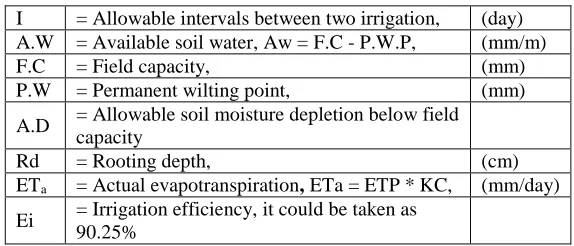
I = (A.W × A.D × Rd / ETa) ×Ei --- (2) Where:
I = Allowable intervals between two irrigation, (day) A.W = Available soil water, Aw = F.C - P.W.P, (mm/m)
F.C = Field capacity, (mm)
P.W = Permanent wilting point, (mm)
A.D = Allowable soil moisture depletion below field capacity
Rd = Rooting depth, (cm)
ETa = Actual evapotranspiration, ETa = ETP * KC, (mm/day)
Ei = Irrigation efficiency, it could be taken as 90.25%
Water requirements were calculated according to the following equation:
W.R = ETa× I (1+ L.R) × 4.2 ---(3) where:
W.R = Water requirement, (m3/fed) L.R
Statistical analysis:
All data collected were statistically analyzed as a split-split plot design with three replications using analysis of variance to evaluate main and interaction effects as described by Snedecor and Chocran, (1980). Means among treatments were compared using Least Significant
Difference (LSD) at P 0.05 probability.
Results and Discussion
The main effect of irrigation system, compost tea and water regime on growth parameters:
~ 323 ~
explained on the basis that CP is an essential major nutrient, especially for legumes, Egyptian soil is poor in the available fertilizer. The results of the present study showed that the organic media can improve plant growth. This can be due to increased media moisture storage and enhanced nutrient absorption (Samei et. al., 2005, Sabreen and Mansour, 2015, Mansour et al., 2015a, and Mansour et al., 2015b). (Kamari Shahmaleki et. Al., 2010) found that treatment with 20 and 50 mg/l humic acid in lettuce increased characteristics significantly. ( Sabreen et.al.,
2015) Mentioned that use of compost tea as plant nutrition materials in organic production systems gave the highest sunflower yield was obtained with drip irrigation system and 50l/fed. Compost tea.
Regardless of irrigation method and CP treatments, the data of Fig (2) demonstrated the effect of water regime on the characters under study. Based upon the obtained values of the studied characters, water regime could put in the following ascending order: IR1 < IR2 < IR3. The differences in investigating characters among water regime were significant at the 5% level. Abo Shady, et al (2010) revealed that increasing the drought period resulted in a significant increase in root length, root/top ratio, gross sugar % and white sugar % and decreased root and top yield, root diameter, while white and gross sugar yield, soluble non-sugar content as well as sugar purity were not affected. Abayomi and Wright (2002). Found that water deficit early in the growing season had a larger effect on leaf growth, Leaf extension rate, area of individual leaf and leaf area index. Mid or late-season soil, water deficit showed relatively smaller of leaf growth. Moreover, water deficit decreased sugar yield and sugar concentration. The soil moisture technical for this crop is 70% of field capacity, i.e. irrigation should be performed when about two thirds of available in the soil layer to 0.60 m in spent (Dragovic, et al 2000 and Mahmoodi, et al 2008). Pijec, et al (2011) pointed out that values of crop response in the growing period indicated that sugar beet is moderately sensitive to soil water stress in the climatic condition. All the values of the studied characters in the DIS × CP×WR surpassed those of the SIS × CP×WR, the depressive effects of the interaction on the obtained values of the characters could arranged in the following descending order DIS × CP1 × IR1< DIS × CP2× IR 2 < DIS × CP3 × IR 3 < DIS × CP4 × IR3and SIS × CP1× IR1< SIS × CP2× IR2 < SIS × CP3× IR3< SIS × CP4× IR3. The difference between any two interactions was significant at the 5% level. In this respect, several investigators shown that the addition of a specific amount of compost tea substances to plant can enhance vegetative growth parameters (Verlinden et al., 2009)
Irrigation system x Water regime
Root characters and yield of roots or sugar beet responded negatively to the lesser quantity of water used in irrigation, where showed approximately reduction in root yield but the reduction in sugar yield of the DIS exceeded those SIS resulted from the lower quantity of irrigation water. Ober, et al (2005) concluded that the selection and breeding drought tolerance of varieties was the proper target to avoid drought damages.
Water regime x compost tea
Examination of Data showed that characters of sugar beet
plants increased parallel to the increase in combined irrigation with compost tea. Data also showed that application of compost tea enhancing both yield of root and sugar.. El-Kammah (1995) reported the high response of growth and yield of sugar beet to water regime and fertilization. El-Hawary, et al (2013) observed the improving effect of nitrogen fertilizer on growth of sugar beet crop under different rates of irrigation.
SIS: Sprinkler Irrigation system; DIS: Drip irrigation system
SIS: Sprinkler Irrigation system; DIS: Drip irrigation system
Fig 2: The effect of irrigation system, water deficit and compost treatments on diameter of root (cm) of sugar beet plants.
SIS: Sprinkler Irrigation system; DIS: Drip irrigation system
Fig 3: The effect of irrigation system, water deficit and compost treatments on root yield (mg/fed) of sugar beet plants.
SIS: Sprinkler Irrigation system; DIS: Drip irrigation system
Fig 4: The effect of irrigation system, water deficit and compost treatments on sugar yield (mg/fed) of sugar beet plants.
Conclusions
From the above mentioned presentation, it can be concluded that:
1. The use of organic materials such as compost tea for plant nutrition in organic production systems should be considered. Desired biochemical or physiological processes and crop quality factors could be obtained by the right choice of organic fertilizers or application rates.
2. The highest and the lowest sugar beet yield (1450 and 980 kg fed-1.) was obtained with treatment DIS x CP4 x IR3 and SIS x CP1 x IR1, respectively.
3. The main effect of compost tea on the studied traits could be written the following ascending order CP1<CP2< CP3 <CP4.
4. The main effects of irrigation method on growth parameters. The obtained data indicated that the drip irrigation exceeded the sprinkler irrigation in all the studied growth and growth characters.
References
1. Abayomi, Y.A. and Wright, D. (2002). Sugar leaf growth and yield response to soil, water deficit. Afric. Crop Sci. J., 10(1): 51-66.
~ 325 ~
3. Abo Shady,Kh. A.; Hillal, S.M.; El-Shrief, E.El.and Ibrahim, M. (2010). Yield and quality of sugar beet as affected by irrigation intervals, cultivars and potassium fertilization in North Delta. J. Agric. Res. Khafr El-Shiek Univ., 36(4):361.
4. Bess, V.H. Understanding compost tea. Bio-Cycle, 2000. 41(10): 71-72.
5. Dragovic, (2002). Irrigation. Edt. Res. Inistitute of field and vegetable crops. Novi Sad, Serbia.
6. El_Abyad, M.S; Hendorf, H. and Rizk, M.A. (1988) Impact of salinity stress in soil-borne fungi of sugar beet. Plant and Soil., 110:27-32.
7. El-Hawary, M.A.; Soliman, E.M.;A bd El-Aziz, I.M.; El-Shrief, M. and Shadia Mohamed, A. (2013). Effect of irrigation water quantity, source and rate of nitrogen on growth and yield quality of sugar beet.Res.J. Agric.& Biol. Sci., 9(1): 58-59.
8. El-Kammah, M.A.(1995).Quantity of sugar beet biomass as affected interrelationships of water irrigation regime and fertilization. J. Agric. Sci. Mansoura Univ., 20(12):5249-5263.
9. Hargreave, G. H. and Z. A. Samani, (1982) Estimating potential evapotranspiration J. of Irrig. And Drainage, ASCE, 108(3).
10. Kamari Shahmaleki, S., Peyvast, Q., Olfati, J. (2010) Journal of Horticultural Sciences., 24(2):149-153. 11. Mahmoodi, R.; Maralian, H. and Aghabarata, A.
(2008). Effect of limiting irrigation on root yield and quality of sugar beet. Afric. J. of Biotech.7(24): 4475-4478.
12. Mansour, H. A., E.F. Abdallah, M.S. Gaballah and Cs. Gyuricza (2015a). Impact of bubbler discharge and irrigation water quantity on 1- hydraulic performance evaluation and maize biomass yield. Int. J. of GEOMATE, Vol. 9, No. 2 (Sl. No. 18), pp. 1538-1544 13. Mansour, H. A., M. Abdel-Hady and Ebtisam I. El-dardiry, V. F, Bralts (2015b). Performance of automatic control different localized irrigation systems and lateral lengths for: 1- emitters clogging and maize (zea mays l.) Growth and yield. Int. J. of GEOMATE, Vol. 9, No. 2 (Sl. No.18), pp.pp. 1545-1552.
14. Monereal, A.J.; Jemenez, E.T.; Remeseal, R.; Morelli-Velaradi, E. and Garcia-Maurino, S. (2006). Proline content of sugar beet storage roots: response to water deficit and nitrogen fertilization at field condition. Environ. & Exper. Bot., 60 Issue 2: 257-267.
15. Ober, E.S.; Bloa, M.L.; Clark, C.J.; Royal, A.; Jaggard, K.W. and Bidgeon, J.D. (2005). Evaluation of physiological traits as indirect selection criteria for drought tolerance in sugar beet. Field Crop Res., 91(2/3): 231-249.
16. Sabreen Kh. Pibars and H. A. Mansour (2015) Evaluate the Response of Sunflower Productivity toModern Chemigation systems in New Reclaimed Lands. International Journal of ChemTech Research.Vol.8, No.12 pp 160-169
17. Sabreen Kh. Pibars, Ebtisam I. Eldardiry, Soha E. Khalil, and M. Abd El-Hady.(2015). Effect Of Compost Tea On Growth Character Of Sunflower (Helianthus Annuus L.) Under Surface And Subsurface Drip Irrigation. International Journal of ChemTech Research, Vol.8, No.6, pp 490-495,2015.
18. Sabreen Kh. Pibars, Ebtisam I. Eldardiry, Soha E. Khalil,and M. Abd El-Hady.(2015) Effect Of Compost Tea On Growth Character Of Sunflower (Helianthus Annuus L.) Under Surface And Subsurface Drip Irrigation. International Journal of ChemTech Research. Vol.8, No.6, pp 490-495.
19. Samei, L., Khaligi, A., Kafi, M., Samavat, S.( 2005). Journal of Horticultural Science and Technology., 6(2): 79-88.
20. Snedcor, G.W. and W.G. Cochran, 1980. Statistical Mothods 7 th Ed. The Iowa State Univ. Press, Iowa, USA.
21. Tayel, M.Y. and Sabreen, Kh. Pibars.(2011). Effect of Irrigation Regimes, Phosphorous Level and Two Vicia Faba Varities on : II-Yield, Water and Phosphorous Use Efficiency. Journal of Applied Sciences Research, 7(11): 1518-1526.
22. Pejic, B., B. Ćupina and M. Dimitrijevic (2011) Response of sugar beet to soil water deficit. Romanian agricultural research 28(28):151-155